Arivusudar NagarajanArivusudar Nagarajan
Senior Manager (Operation & Special products marketing)Senior Manager (Operation & Special products marketing)
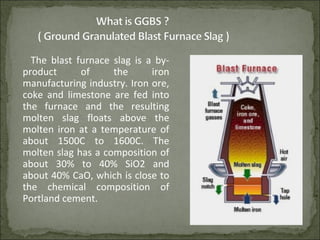
The blast furnace slag is a by-
product of the iron
manufacturing industry. Iron ore,
coke and limestone are fed into
the furnace and the resulting
molten slag floats above the
molten iron at a temperature of
about 1500C to 1600C. The
molten slag has a composition of
about 30% to 40% SiO2 and
about 40% CaO, which is close to
the chemical composition of
Portland cement.
Use of high grade of cement should not be taken for granted to
yield high grade (Strength) concrete, Increase in cement Grade
does not increase the quality of concrete
Concrete may possess high strength but may deteriorate
sooner than expected, concrete made should satisfactorily in
both strength and durability
Beyond a certain period all grades shows same strength, only
advantage of use of higher grade cement is faster rate of gain in
strength during initial period
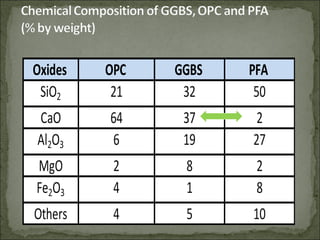
Oxides OPC GGBS PFA
SiO2 21 32 50
CaO 64 37 2
Al2O3 6 19 27
MgO 2 8 2
Fe2O3 4 1 8
Others 4 5 10
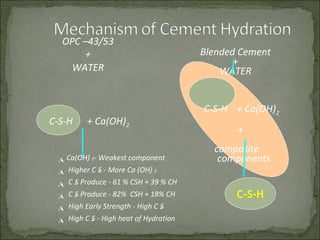
C-S-H
OPC –43/53
+
WATER
C-S-H + Ca(OH)2

Ca(OH) 2- Weakest component

Higher C 3S - More Ca (OH) 2

C 3S Produce - 61 % CSH + 39 % CH

C 2S Produce - 82% CSH + 18% CH

High Early Strength - High C 3S

High C 3S - High heat of Hydration
Blended Cement
+
WATER
C-S-H + Ca(OH)2
+
composite
components

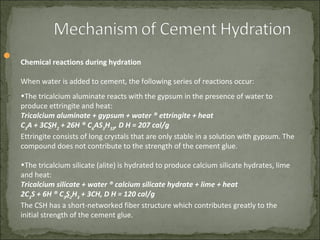
Chemical reactions during hydration
When water is added to cement, the following series of reactions occur:
•The tricalcium aluminate reacts with the gypsum in the presence of water to
produce ettringite and heat:
Tricalcium aluminate + gypsum + water ® ettringite + heat
C3
A + 3CSH2
+ 26H ® C6
AS3
H32
, D H = 207 cal/g
Ettringite consists of long crystals that are only stable in a solution with gypsum. The
compound does not contribute to the strength of the cement glue.
•The tricalcium silicate (alite) is hydrated to produce calcium silicate hydrates, lime
and heat:
Tricalcium silicate + water ® calcium silicate hydrate + lime + heat
2C3
S + 6H ® C3
S2
H3
+ 3CH, D H = 120 cal/g
The CSH has a short-networked fiber structure which contributes greatly to the
initial strength of the cement glue.
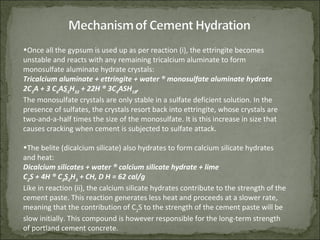
•Once all the gypsum is used up as per reaction (i), the ettringite becomes
unstable and reacts with any remaining tricalcium aluminate to form
monosulfate aluminate hydrate crystals:
Tricalcium aluminate + ettringite + water ® monosulfate aluminate hydrate
2C3
A + 3 C6
AS3
H32
+ 22H ® 3C4
ASH18
,
The monosulfate crystals are only stable in a sulfate deficient solution. In the
presence of sulfates, the crystals resort back into ettringite, whose crystals are
two-and-a-half times the size of the monosulfate. It is this increase in size that
causes cracking when cement is subjected to sulfate attack.
•The belite (dicalcium silicate) also hydrates to form calcium silicate hydrates
and heat:
Dicalcium silicates + water ® calcium silicate hydrate + lime
C2
S + 4H ® C3
S2
H3
+ CH, D H = 62 cal/g
Like in reaction (ii), the calcium silicate hydrates contribute to the strength of the
cement paste. This reaction generates less heat and proceeds at a slower rate,
meaning that the contribution of C2
S to the strength of the cement paste will be
slow initially. This compound is however responsible for the long-term strength
of portland cement concrete.
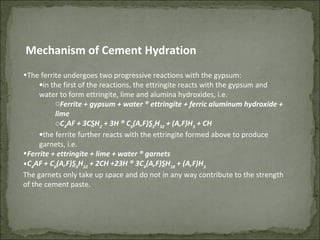
•The ferrite undergoes two progressive reactions with the gypsum:
•in the first of the reactions, the ettringite reacts with the gypsum and
water to form ettringite, lime and alumina hydroxides, i.e.
oFerrite + gypsum + water ® ettringite + ferric aluminum hydroxide +
lime
oC4
AF + 3CSH2
+ 3H ® C6
(A,F)S3
H32
+ (A,F)H3
+ CH
•the ferrite further reacts with the ettringite formed above to produce
garnets, i.e.
•Ferrite + ettringite + lime + water ® garnets
•C4
AF + C6
(A,F)S3
H32
+ 2CH +23H ® 3C4
(A,F)SH18
+ (A,F)H3
The garnets only take up space and do not in any way contribute to the strength
of the cement paste.
Mechanism of Cement Hydration
Heat of Hydration
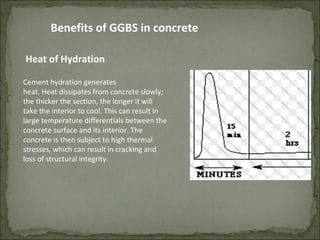
Cement hydration generates
heat. Heat dissipates from concrete slowly;
the thicker the section, the longer it will
take the interior to cool. This can result in
large temperature differentials between the
concrete surface and its interior. The
concrete is then subject to high thermal
stresses, which can result in cracking and
loss of structural integrity.
Benefits of GGBS in concrete
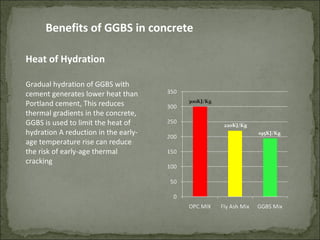
Heat of Hydration
220KJ/Kg
195KJ/Kg
Gradual hydration of GGBS with
cement generates lower heat than
Portland cement, This reduces
thermal gradients in the concrete,
GGBS is used to limit the heat of
hydration A reduction in the early-
age temperature rise can reduce
the risk of early-age thermal
cracking
Benefits of GGBS in concrete
Water demand
Lower W/C Ratio  High Compressive Strength
Reduced water Cement Ratio will contribute to compressive Strength gain
GGBS is a glassy material and its smoother surface requires less water to
adequately cover the particles. Though powder volume increase due to low
specific gravity as the percentage of GGBS in the mix increases, any reduction
in water may become smaller due to the higher powder volume.
Rheological behavior between GGBS and Portland cement enable a small
reduction water demand of 3–5% (i.e., 5 to 10 litres of water per Cubic meter
of concrete).
Setting Time
Increased setting time may be advantageous in extending the time for which
the concrete remains workable and, may reduce the risk of cold joints. This
delay is mainly due to the slower initial rate of reaction of GGBS, compared to
that of OPC. The effect is magnified at higher percentages
Appearance
GGBS cement also produces a smoother, more defect free
surface, due to the fineness of the GGBS particles
 GGBS is effective in preventing efflorescence when used at
replacement levels of 50% to 60%
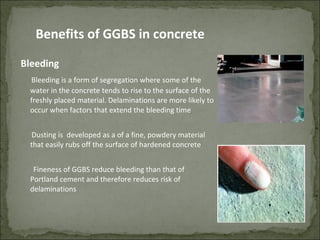
Bleeding
Bleeding is a form of segregation where some of the
water in the concrete tends to rise to the surface of the
freshly placed material. Delaminations are more likely to
occur when factors that extend the bleeding time
Dusting is developed as a of a fine, powdery material
that easily rubs off the surface of hardened concrete
Fineness of GGBS reduce bleeding than that of
Portland cement and therefore reduces risk of
delaminations
Benefits of GGBS in concrete
Workability
GGBS particles are less water absorptive than Portland
cement particles and thus GGBS concrete is more workable
than Portland cement concrete. For equivalent workability,
a reduction in water content of up to 10% is possible
Sulphate Resistance
Sulphates react with C3A and Ca(OH)2 present in OPC
concrete, causing the concrete to expand and crack. GGBS
is a sulphate-resisting, Specifying GGBS at 50%–70%
content gives optimum protection against sulphate attack.
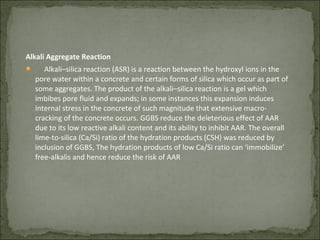
Alkali Aggregate Reaction
 Alkali–silica reaction (ASR) is a reaction between the hydroxyl ions in the
pore water within a concrete and certain forms of silica which occur as part of
some aggregates. The product of the alkali–silica reaction is a gel which
imbibes pore fluid and expands; in some instances this expansion induces
internal stress in the concrete of such magnitude that extensive macro-
cracking of the concrete occurs. GGBS reduce the deleterious effect of AAR
due to its low reactive alkali content and its ability to inhibit AAR. The overall
lime-to-silica (Ca/Si) ratio of the hydration products (CSH) was reduced by
inclusion of GGBS, The hydration products of low Ca/Si ratio can ‘immobilize’
free-alkalis and hence reduce the risk of AAR
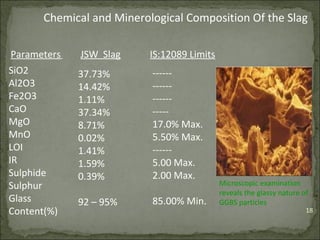
Chemical and Minerological Composition Of the Slag
Parameters
SiO2
Al2O3
Fe2O3
CaO
MgO
MnO
LOI
IR
Sulphide
Sulphur
Glass
Content(%)
JSW Slag
37.73%
14.42%
1.11%
37.34%
8.71%
0.02%
1.41%
1.59%
0.39%
92 – 95%
IS:12089 Limits
------
------
------
-----
17.0% Max.
5.50% Max.
------
5.00 Max.
2.00 Max.
85.00% Min.
Microscopic examination
reveals the glassy nature of
GGBS particles
18
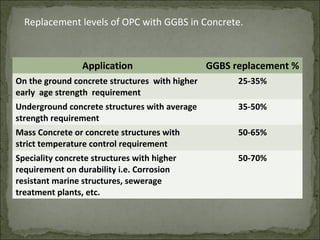
Application GGBS replacement %
On the ground concrete structures with higher
early age strength requirement
25-35%
Underground concrete structures with average
strength requirement
35-50%
Mass Concrete or concrete structures with
strict temperature control requirement
50-65%
Speciality concrete structures with higher
requirement on durability i.e. Corrosion
resistant marine structures, sewerage
treatment plants, etc.
50-70%
Replacement levels of OPC with GGBS in Concrete.
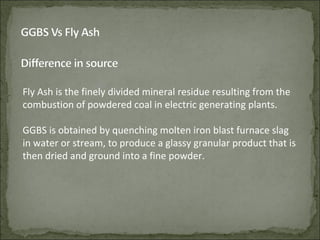
Fly Ash is the finely divided mineral residue resulting from the
combustion of powdered coal in electric generating plants.
GGBS is obtained by quenching molten iron blast furnace slag
in water or stream, to produce a glassy granular product that is
then dried and ground into a fine powder.
Slag is the co-product of a controlled process, iron production,
which results in a very uniform composition from source to
source.
Fly ash is a byproduct of electric power generation that varies
from source to source.
Fly Ash usually contains very high SiO2 and Al2O3, but very
low in CaO (<2%).
GGBS has very similar chemical compositions to Ordinary
Portland Cement (OPC) such as 30-42% of CaO, 35-38% of
SiO2, 10-18% of Al2O3, 10-18% of MgO etc.
Depending upon the reactivity of fly- ash, only a limited
amount, and not the entire calcium hydroxide is consumed
due to pozzolanic reactions. All the Ca(OH)2 in concrete
cannot be consumed simply by addition of 20-30 percent fly
ash . Stoichiometry indicates that equal weights of lime
(Ca(OH)2)and active silica combine in pozzolanic reactions.
The amount of Ca(OH)2 liberated in hydration is about 25
percent by weight of cement. For example, if there is 400 kg
of OPC in the mix,100 kg of Ca(OH) 2 will be liberated, which
will require 100 kg of active silica for chemical reaction
Indian Fly Ashes contain about 55 percent SiO2, out of which
only 20 to 25 percent are in glassy form. Hence, addition of
100 kg of fly ash (that is,25 percent of OPC), will consume
only about 14 percent of Ca(OH)2; and 86 percent will
remain unconsumed.
This calculation is in line with the fact that all of Ca(OH)2 in
concrete was shown to be consumed only when 50 percent
of Slag or 30 percent of silica fume was used, which is mostly
active silica.
Fly Ash is not a hydraulic material, hydration will not take
place on its own, and it will only harden with the use of
activators (e.g. OPC).
GGBS, in contrast, is a hydraulic material, which means that
it will set and harden due to a chemical reaction with water.
After hardening, it will retain some strength development
and remain stable even under water. Concrete containing
GGBS cement has a higher ultimate strength than concrete
that uses 100% Portland cement.
The permitted replacement ratio of Fly Ash in OPC is 15-35%
(IS 1489 Part-1), but it’s usually no more than 30% in
concrete.
On the other hand, the permitted replacement ratio of
GGBS in OPC or concrete is 25-70%(IS 455).
7 9028
CompressiveStrength-MPa
GGBS MIX
OPC MIX
AGE - (DAYS)
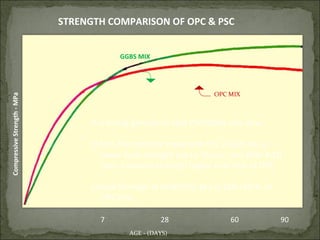
It is wrong perception that PSC/GGBS sets slow.
In fact, the concrete made with PSC /GGBS has a
lower early strength (up to 7days) , and after 8-10
days it possess strength higher than that of OPC.
Lateral Strength of GGBS/PSC Mix is 126-140 % of
OPC Mix
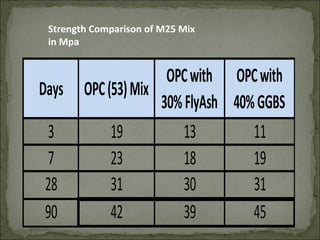
STRENGTH COMPARISON OF OPC & PSC
60
Days OPC(53)Mix
OPCwith
30%FlyAsh
OPCwith
40%GGBS
3 19 13 11
7 23 18 19
28 31 30 31
90 42 39 45
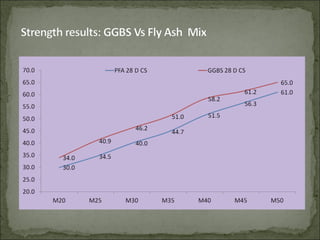
Strength Comparison of M25 Mix
in Mpa



OPC=6300/MT: PFA=1100/MT: GGBS= 2850/MT
GRADE M15
Item Qty Amount Item Qty Amount Item Qty Amount
Cement 220 1386 Cement 180 1134 Cement 120 756
Fly ash 80 88 GGBS 130 371
1386 1222 1127
GRADE M20
Item Qty Amount Item Qty Amount Item Qty Amount
Cement 300 1890 Cement 220 1386 Cement 150 945
Fly ash 90 99 GGBS 150 428
1890 1485 1373
GRADE M25
Item Qty Amount Item Qty Amount Item Qty Amount
Cement 320 2016 Cement 265 1669.5 Cement 176 1109
Fly ash 100 110 GGBS 160 456
2016 1780 1565
OPC + GGBS MIX
cementecious cost cementecious cost
OPC + FLY ASH MIX
cementecious cost
PURE OPC MIX
OPC + GGBS MIX
cementecious cost cementecious cost cementecious cost
PURE OPC MIX OPC + FLY ASH MIX OPC + GGBS MIX
PURE OPC MIX OPC + FLY ASH MIX
cementecious cost cementecious cost cementecious cost
OPC=6300/MT: PFA=1100/MT: GGBS= 2850/MT
GRADE M30
Item Qty Amount Item Qty Amount Item Qty Amount
Cement 350 2205 Cement 295 1858.5 Cement 210 1323
Fly ash 90 99 GGBS 157 447
2205 1957.5 1770
GRADE M35
Item Qty Amount Item Qty Amount Item Qty Amount
Cement 380 2394 Cement 360 2268 Cement 245 1544
Fly ash 60 66 GGBS 180 513
2394 2334 2057
GRADE M40
Item Qty Amount Item Qty Amount Item Qty Amount
Cement 400 2520 Cement 380 2394 Cement 260 1638
Fly ash 80 88 GGBS 200 570
2520 2482 2208
PURE OPC MIX OPC + FLY ASH MIX OPC + GGBS MIX
cementecious cost cementecious cost cementecious cost
PURE OPC MIX OPC + FLY ASH MIX OPC + GGBS MIX
cementecious cost cementecious cost cementecious cost
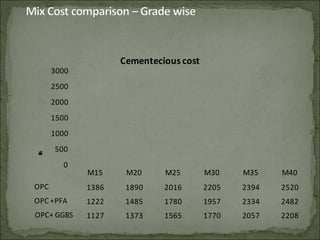
M15 M20 M25 M30 M35 M40
OPC 1386 1890 2016 2205 2394 2520
OPC +PFA 1222 1485 1780 1957 2334 2482
OPC+ GGBS 1127 1373 1565 1770 2057 2208
0
500
1000
1500
2000
2500
3000
Cubicmetercost
Cementecious cost
M15 1386 1222 1127 300 164
M20 1890 1485 1373 578 190
M25 2016 1780 1565 509 190
M30 2205 1957 1770 491 271
M35 2394 2334 2057 392 357
M40 2520 2482 2208 368 366
GRADE
Savingsw.r.t
OPC Mix
Savingsw.r.t
OPC+PFA
OPC+GGBSOPC+PFAOPC
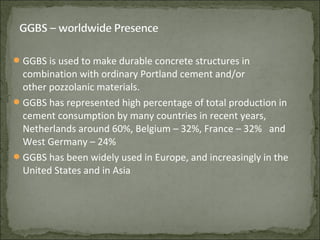
GGBS is used to make durable concrete structures in
combination with ordinary Portland cement and/or
other pozzolanic materials.
GGBS has represented high percentage of total production in
cement consumption by many countries in recent years,
Netherlands around 60%, Belgium – 32%, France – 32% and
West Germany – 24%
GGBS has been widely used in Europe, and increasingly in the
United States and in Asia
THANK YOU
Email :
n.arivusudar@yahoo.com

Ggbs readymix

  • 1.
    Arivusudar NagarajanArivusudar Nagarajan SeniorManager (Operation & Special products marketing)Senior Manager (Operation & Special products marketing)
  • 2.
    The blast furnaceslag is a by- product of the iron manufacturing industry. Iron ore, coke and limestone are fed into the furnace and the resulting molten slag floats above the molten iron at a temperature of about 1500C to 1600C. The molten slag has a composition of about 30% to 40% SiO2 and about 40% CaO, which is close to the chemical composition of Portland cement.
  • 3.
    Use of highgrade of cement should not be taken for granted to yield high grade (Strength) concrete, Increase in cement Grade does not increase the quality of concrete Concrete may possess high strength but may deteriorate sooner than expected, concrete made should satisfactorily in both strength and durability Beyond a certain period all grades shows same strength, only advantage of use of higher grade cement is faster rate of gain in strength during initial period
  • 4.
    Oxides OPC GGBSPFA SiO2 21 32 50 CaO 64 37 2 Al2O3 6 19 27 MgO 2 8 2 Fe2O3 4 1 8 Others 4 5 10
  • 5.
    C-S-H OPC –43/53 + WATER C-S-H +Ca(OH)2  Ca(OH) 2- Weakest component  Higher C 3S - More Ca (OH) 2  C 3S Produce - 61 % CSH + 39 % CH  C 2S Produce - 82% CSH + 18% CH  High Early Strength - High C 3S  High C 3S - High heat of Hydration Blended Cement + WATER C-S-H + Ca(OH)2 + composite components
  • 6.
     Chemical reactions duringhydration When water is added to cement, the following series of reactions occur: •The tricalcium aluminate reacts with the gypsum in the presence of water to produce ettringite and heat: Tricalcium aluminate + gypsum + water ® ettringite + heat C3 A + 3CSH2 + 26H ® C6 AS3 H32 , D H = 207 cal/g Ettringite consists of long crystals that are only stable in a solution with gypsum. The compound does not contribute to the strength of the cement glue. •The tricalcium silicate (alite) is hydrated to produce calcium silicate hydrates, lime and heat: Tricalcium silicate + water ® calcium silicate hydrate + lime + heat 2C3 S + 6H ® C3 S2 H3 + 3CH, D H = 120 cal/g The CSH has a short-networked fiber structure which contributes greatly to the initial strength of the cement glue.
  • 7.
    •Once all thegypsum is used up as per reaction (i), the ettringite becomes unstable and reacts with any remaining tricalcium aluminate to form monosulfate aluminate hydrate crystals: Tricalcium aluminate + ettringite + water ® monosulfate aluminate hydrate 2C3 A + 3 C6 AS3 H32 + 22H ® 3C4 ASH18 , The monosulfate crystals are only stable in a sulfate deficient solution. In the presence of sulfates, the crystals resort back into ettringite, whose crystals are two-and-a-half times the size of the monosulfate. It is this increase in size that causes cracking when cement is subjected to sulfate attack. •The belite (dicalcium silicate) also hydrates to form calcium silicate hydrates and heat: Dicalcium silicates + water ® calcium silicate hydrate + lime C2 S + 4H ® C3 S2 H3 + CH, D H = 62 cal/g Like in reaction (ii), the calcium silicate hydrates contribute to the strength of the cement paste. This reaction generates less heat and proceeds at a slower rate, meaning that the contribution of C2 S to the strength of the cement paste will be slow initially. This compound is however responsible for the long-term strength of portland cement concrete.

  • 8.
    •The ferrite undergoestwo progressive reactions with the gypsum: •in the first of the reactions, the ettringite reacts with the gypsum and water to form ettringite, lime and alumina hydroxides, i.e. oFerrite + gypsum + water ® ettringite + ferric aluminum hydroxide + lime oC4 AF + 3CSH2 + 3H ® C6 (A,F)S3 H32 + (A,F)H3 + CH •the ferrite further reacts with the ettringite formed above to produce garnets, i.e. •Ferrite + ettringite + lime + water ® garnets •C4 AF + C6 (A,F)S3 H32 + 2CH +23H ® 3C4 (A,F)SH18 + (A,F)H3 The garnets only take up space and do not in any way contribute to the strength of the cement paste. Mechanism of Cement Hydration
  • 9.
    Heat of Hydration Cementhydration generates heat. Heat dissipates from concrete slowly; the thicker the section, the longer it will take the interior to cool. This can result in large temperature differentials between the concrete surface and its interior. The concrete is then subject to high thermal stresses, which can result in cracking and loss of structural integrity. Benefits of GGBS in concrete
  • 10.
    Heat of Hydration 220KJ/Kg 195KJ/Kg Gradualhydration of GGBS with cement generates lower heat than Portland cement, This reduces thermal gradients in the concrete, GGBS is used to limit the heat of hydration A reduction in the early- age temperature rise can reduce the risk of early-age thermal cracking Benefits of GGBS in concrete
  • 11.
    Water demand Lower W/CRatio  High Compressive Strength Reduced water Cement Ratio will contribute to compressive Strength gain GGBS is a glassy material and its smoother surface requires less water to adequately cover the particles. Though powder volume increase due to low specific gravity as the percentage of GGBS in the mix increases, any reduction in water may become smaller due to the higher powder volume. Rheological behavior between GGBS and Portland cement enable a small reduction water demand of 3–5% (i.e., 5 to 10 litres of water per Cubic meter of concrete).
  • 12.
    Setting Time Increased settingtime may be advantageous in extending the time for which the concrete remains workable and, may reduce the risk of cold joints. This delay is mainly due to the slower initial rate of reaction of GGBS, compared to that of OPC. The effect is magnified at higher percentages
  • 13.
    Appearance GGBS cement alsoproduces a smoother, more defect free surface, due to the fineness of the GGBS particles  GGBS is effective in preventing efflorescence when used at replacement levels of 50% to 60%
  • 14.
    Bleeding Bleeding is aform of segregation where some of the water in the concrete tends to rise to the surface of the freshly placed material. Delaminations are more likely to occur when factors that extend the bleeding time Dusting is developed as a of a fine, powdery material that easily rubs off the surface of hardened concrete Fineness of GGBS reduce bleeding than that of Portland cement and therefore reduces risk of delaminations Benefits of GGBS in concrete
  • 15.
    Workability GGBS particles areless water absorptive than Portland cement particles and thus GGBS concrete is more workable than Portland cement concrete. For equivalent workability, a reduction in water content of up to 10% is possible
  • 16.
    Sulphate Resistance Sulphates reactwith C3A and Ca(OH)2 present in OPC concrete, causing the concrete to expand and crack. GGBS is a sulphate-resisting, Specifying GGBS at 50%–70% content gives optimum protection against sulphate attack.
  • 17.
    Alkali Aggregate Reaction Alkali–silica reaction (ASR) is a reaction between the hydroxyl ions in the pore water within a concrete and certain forms of silica which occur as part of some aggregates. The product of the alkali–silica reaction is a gel which imbibes pore fluid and expands; in some instances this expansion induces internal stress in the concrete of such magnitude that extensive macro- cracking of the concrete occurs. GGBS reduce the deleterious effect of AAR due to its low reactive alkali content and its ability to inhibit AAR. The overall lime-to-silica (Ca/Si) ratio of the hydration products (CSH) was reduced by inclusion of GGBS, The hydration products of low Ca/Si ratio can ‘immobilize’ free-alkalis and hence reduce the risk of AAR
  • 18.
    Chemical and MinerologicalComposition Of the Slag Parameters SiO2 Al2O3 Fe2O3 CaO MgO MnO LOI IR Sulphide Sulphur Glass Content(%) JSW Slag 37.73% 14.42% 1.11% 37.34% 8.71% 0.02% 1.41% 1.59% 0.39% 92 – 95% IS:12089 Limits ------ ------ ------ ----- 17.0% Max. 5.50% Max. ------ 5.00 Max. 2.00 Max. 85.00% Min. Microscopic examination reveals the glassy nature of GGBS particles 18
  • 19.
    Application GGBS replacement% On the ground concrete structures with higher early age strength requirement 25-35% Underground concrete structures with average strength requirement 35-50% Mass Concrete or concrete structures with strict temperature control requirement 50-65% Speciality concrete structures with higher requirement on durability i.e. Corrosion resistant marine structures, sewerage treatment plants, etc. 50-70% Replacement levels of OPC with GGBS in Concrete.
  • 20.
    Fly Ash isthe finely divided mineral residue resulting from the combustion of powdered coal in electric generating plants. GGBS is obtained by quenching molten iron blast furnace slag in water or stream, to produce a glassy granular product that is then dried and ground into a fine powder.
  • 21.
    Slag is theco-product of a controlled process, iron production, which results in a very uniform composition from source to source. Fly ash is a byproduct of electric power generation that varies from source to source.
  • 22.
    Fly Ash usuallycontains very high SiO2 and Al2O3, but very low in CaO (<2%). GGBS has very similar chemical compositions to Ordinary Portland Cement (OPC) such as 30-42% of CaO, 35-38% of SiO2, 10-18% of Al2O3, 10-18% of MgO etc.
  • 23.
    Depending upon thereactivity of fly- ash, only a limited amount, and not the entire calcium hydroxide is consumed due to pozzolanic reactions. All the Ca(OH)2 in concrete cannot be consumed simply by addition of 20-30 percent fly ash . Stoichiometry indicates that equal weights of lime (Ca(OH)2)and active silica combine in pozzolanic reactions. The amount of Ca(OH)2 liberated in hydration is about 25 percent by weight of cement. For example, if there is 400 kg of OPC in the mix,100 kg of Ca(OH) 2 will be liberated, which will require 100 kg of active silica for chemical reaction
  • 24.
    Indian Fly Ashescontain about 55 percent SiO2, out of which only 20 to 25 percent are in glassy form. Hence, addition of 100 kg of fly ash (that is,25 percent of OPC), will consume only about 14 percent of Ca(OH)2; and 86 percent will remain unconsumed. This calculation is in line with the fact that all of Ca(OH)2 in concrete was shown to be consumed only when 50 percent of Slag or 30 percent of silica fume was used, which is mostly active silica.
  • 25.
    Fly Ash isnot a hydraulic material, hydration will not take place on its own, and it will only harden with the use of activators (e.g. OPC). GGBS, in contrast, is a hydraulic material, which means that it will set and harden due to a chemical reaction with water. After hardening, it will retain some strength development and remain stable even under water. Concrete containing GGBS cement has a higher ultimate strength than concrete that uses 100% Portland cement.
  • 26.
    The permitted replacementratio of Fly Ash in OPC is 15-35% (IS 1489 Part-1), but it’s usually no more than 30% in concrete. On the other hand, the permitted replacement ratio of GGBS in OPC or concrete is 25-70%(IS 455).
  • 27.
    7 9028 CompressiveStrength-MPa GGBS MIX OPCMIX AGE - (DAYS) It is wrong perception that PSC/GGBS sets slow. In fact, the concrete made with PSC /GGBS has a lower early strength (up to 7days) , and after 8-10 days it possess strength higher than that of OPC. Lateral Strength of GGBS/PSC Mix is 126-140 % of OPC Mix STRENGTH COMPARISON OF OPC & PSC 60
  • 29.
    Days OPC(53)Mix OPCwith 30%FlyAsh OPCwith 40%GGBS 3 1913 11 7 23 18 19 28 31 30 31 90 42 39 45 Strength Comparison of M25 Mix in Mpa
  • 30.
  • 31.
  • 32.
  • 33.
    OPC=6300/MT: PFA=1100/MT: GGBS=2850/MT GRADE M15 Item Qty Amount Item Qty Amount Item Qty Amount Cement 220 1386 Cement 180 1134 Cement 120 756 Fly ash 80 88 GGBS 130 371 1386 1222 1127 GRADE M20 Item Qty Amount Item Qty Amount Item Qty Amount Cement 300 1890 Cement 220 1386 Cement 150 945 Fly ash 90 99 GGBS 150 428 1890 1485 1373 GRADE M25 Item Qty Amount Item Qty Amount Item Qty Amount Cement 320 2016 Cement 265 1669.5 Cement 176 1109 Fly ash 100 110 GGBS 160 456 2016 1780 1565 OPC + GGBS MIX cementecious cost cementecious cost OPC + FLY ASH MIX cementecious cost PURE OPC MIX OPC + GGBS MIX cementecious cost cementecious cost cementecious cost PURE OPC MIX OPC + FLY ASH MIX OPC + GGBS MIX PURE OPC MIX OPC + FLY ASH MIX cementecious cost cementecious cost cementecious cost
  • 34.
    OPC=6300/MT: PFA=1100/MT: GGBS=2850/MT GRADE M30 Item Qty Amount Item Qty Amount Item Qty Amount Cement 350 2205 Cement 295 1858.5 Cement 210 1323 Fly ash 90 99 GGBS 157 447 2205 1957.5 1770 GRADE M35 Item Qty Amount Item Qty Amount Item Qty Amount Cement 380 2394 Cement 360 2268 Cement 245 1544 Fly ash 60 66 GGBS 180 513 2394 2334 2057 GRADE M40 Item Qty Amount Item Qty Amount Item Qty Amount Cement 400 2520 Cement 380 2394 Cement 260 1638 Fly ash 80 88 GGBS 200 570 2520 2482 2208 PURE OPC MIX OPC + FLY ASH MIX OPC + GGBS MIX PURE OPC MIX OPC + FLY ASH MIX OPC + GGBS MIX cementecious cost cementecious cost cementecious cost cementecious cost cementecious cost cementecious cost PURE OPC MIX OPC + FLY ASH MIX OPC + GGBS MIX cementecious cost cementecious cost cementecious cost
  • 35.
    M15 M20 M25M30 M35 M40 OPC 1386 1890 2016 2205 2394 2520 OPC +PFA 1222 1485 1780 1957 2334 2482 OPC+ GGBS 1127 1373 1565 1770 2057 2208 0 500 1000 1500 2000 2500 3000 Cubicmetercost Cementecious cost
  • 36.
    M15 1386 12221127 300 164 M20 1890 1485 1373 578 190 M25 2016 1780 1565 509 190 M30 2205 1957 1770 491 271 M35 2394 2334 2057 392 357 M40 2520 2482 2208 368 366 GRADE Savingsw.r.t OPC Mix Savingsw.r.t OPC+PFA OPC+GGBSOPC+PFAOPC
  • 37.
    GGBS is usedto make durable concrete structures in combination with ordinary Portland cement and/or other pozzolanic materials. GGBS has represented high percentage of total production in cement consumption by many countries in recent years, Netherlands around 60%, Belgium – 32%, France – 32% and West Germany – 24% GGBS has been widely used in Europe, and increasingly in the United States and in Asia
  • 38.