THE INDIAN POWER
SECTOR
Marching Towards a New Paradigm
DIVYA LIZ GEORGE
DHARA B SHAH
GEORGE JACOB
MARY MONISHA
SHANKAR R
AGENDA
 Indian Power Sector – A Glance
 Major Players
 Porters Five Force Analysis
 Generation
 Transmission & Distribution
 Growth Drivers
 Challenges & Quick Fixes
THE POWER SECTOR – AT A GLANCE
4th largest
producer &
consumer of
electricity
Expected
CAGR – 7.5%
over 2015-16
to 2020
Robust
growth in
renewables
Favourable
policy
environment
5th largest
installed
capacity
[2,72,687 MW]
Installed Capacity
70%
15%
2% 13%
Thermal Hydro Nuclear RES
COAL 87%
GAS 12%
OIL 1%
831
862
937
998
1072
FY 11 FY 12 FY 13 FY 14 FY 15 E
Demand for Power Growth Rate [In bn units]
1,142
1,223
1,319
1,425
1,541
FY 16 P FY 17 P FY 18 P FY 19 P FY 20 P
Projected Demand Growth for Power for next 5 Years [bn units]
45%
22%
7%
26%
FY 2015
Industrial Agricultural Commercial Domestic
Sector wise Demand Growth
41%
20%
8%
31%
FY 2020E
Industrial Agricultural Commercial Domestic
MAJOR PLAYERS
CENTRAL
PRIVATE
PORTERS FIVE FORCES ANALYSIS
Competitive Rivalry
Threat of New
Entrants
Substitutes Bargaining Power
Of Suppliers
Bargaining Power
Of Customers
HIGH
MEDIUM
LOW
G E N E R A T I
Power Demand-Supply
0.0%
1.0%
2.0%
3.0%
4.0%
5.0%
6.0%
7.0%
8.0%
9.0%
10.0%
0
200
400
600
800
1000
1200
FY 11 FY 12 FY 13 FY 14 FY 15
Demand
Supply
Deficit
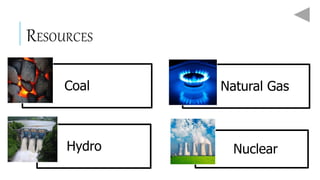
RESOURCES
Coal Natural Gas
Hydro Nuclear
t r a n s m i s s i o n
d i s t r i b u t&
T & D IN INDIA
T & D
Distribution
Networks
State
Grids
Regional
Grids
 3 Tier Structure
 Increase in the transmission lines
 AT & C Losses – 26-27%
• Technical Losses
• Commercial Losses
• Pilferage & Theft
 Privatization of Distribution
 Distribution reform schemes – APDRP , RGGVY
-
1,000,000
2,000,000
3,000,000
4,000,000
5,000,000
6,000,000
7,000,000
8,000,000
9,000,000
10,000,000
2002-03 2003-04 2004-05 2005-06 2006-07 2007-08 2008-09 2009-10 2010-11 2011-12 2012-13
Power : Transmission Lines
GROWTH DRIVERS
Growing Demand
Increase in industrial
Activity
Increasing penetration,
per-capita consumption
Growing middle class
and consumer base
Policy Support
Electricity Act 2003
Fuel supply agreement
with Coal India Ltd
Development of UMPP’s
National Tariff Policy
2006
Increasing
Investments
Rising FDI flows
Growing M&A
Investments in
equipment manufacture
and power generation
CHALLENGES IN POWER SECTOR
 Stretched financials and developers
 Lack of long term PPA
 Delay in clearances
 Expansions through acquisitions
 Limited gas availability
 Constraints on financial flexibility of the
players
QUICK FIXES
 Land Acquisitions
 Obtaining Forest & Environment clearances
 Extent of fuel supply
 Ordering BTC equipment
 PPA
BUDGET IN ACTION
 Clean energy cess on coal doubled
 Budget allocation to T&D up by 26%
 Setting up of NIIF, corpus of Rs 200B
 Setting up of 5 UMPP’S
 INR 5B towards proposed ultra mega solar power projects
SOURCE : CRISIL RESEARCH
THANK YOU

Indian power

Editor's Notes

  • #4 Fourth largest producer and fourth largest consumer globally - With a production of 1,052 TWh, India is the fourth largest producer and fourth largest consumer of electricity in the world. It has fifth largest installed capacity in the world 2. Large-scale government initiated expansion plans -The government targets capacity addition of 88.5 GW under the 12th Five-Year Plan (2012–17) and around 100 GW under the 13th Five-Year Plan (2017–22) By February 2014, 33.1 GW of capacity additions were made. Investments of around USD223.9 billion are planned for the power sector during the 12th Plan Five-Year Plan 3. Robust growth in renewables Renewable energy capacity additions to 41 GW are planned till 2017 to meet the growing energy demand. The installed capacity reached 32.2 GW as on March 2014 Wind energy is estimated to contribute 15 GW, followed by solar power at 10 GW 4. Favourable policy environment- 100 per cent FDI is allowed under the automatic route in the power segment and renewable energy .Cutting of excise duties by 2 per cent on capital goods import in interim budget of 2014-15 .In the Budget 2014-15, the tax holiday has been extended till March 2017
  • #6 Base load power demand grew at a CAGR of 5.2 per cent over the past 5 years. Demand growth was healthy in 201112 and 201213 at 8.8 per cent and 6.5 per cent respectively on the back of robust growth in economic activity and improved power availability supported by capacity additions of around 20 GW each in these years. However, demand growth witnessed a sharp slowdown in 201314 to 0.4 per cent on account of weak demand from industrial and commercial consumers due to subdued economic growth. Moreover, poor financial health of discoms as reflected in accumulated losses (Rs. 2.5 trillion as on March 2013)x led to curtailment of power offtake. In 201415, demand growth revived to 7 per cent led by a pickup in economic activity coupled with steady rise in power availability led by healthy capacity additions and a sharp increase in coal production. Moreover, implementation of the financial restructuring plan in 7 states in 201314 and 201415 led to improvement in power offtake in these states. Over 201015, the share of residential segment in overall power demand increased to 28 per cent in 201415 from 24 per cent in 200910, while that of the industrial segment declined to 44 per cent from 47 per cent during the same period. At a regional level, demand growth was led by the Northern and Eastern regions registering over 5.5 per cent demand expansion.
  • #7 Power demand is expected to grow at 7.5 per cent over 201516 to 201920 in line with a gradual improvement in economic outlook. Overall GDP (as per old series) is expected to increase at 6.5 per cent CAGR over the forecast period. Demand growth will be driven by the residential and industrial segments, which are expected to grow at 10 per cent and 6.7 per cent CAGR respectively (as compared to 8 per cent and 4.8 per cent respectively over the past 5 years). While growth in the residential segment will be led by high latent demand, that in the industrial segment will be driven by gradual pickup in manufacturing activity. In our analysis, we have also factored the scheduled outages (15 billion units in 201415) and shift from diesel based power (1.6 billion units in 201415) to grid power with improved availability. While overall growth in power demand is expected to be higher than 5.2 per cent growth witnessed over the past five years (201011 to 201415), it will be capped by the inability of state discoms to offtake higher power on account of their poor financial health. For rapid growth in power demand, significant pickup in the manufacturing sector and adequate tariff hikes and reduction in AT&C losses will be critica
  • #8 Overall power demand growth is expected to be driven by the residential segment, which is estimated to grow at a CAGR of about 10 per cent over 20152020 as compared to 8 per cent CAGR over the last 5 years. This is primarily on account of high latent demand, which is expected to be met through higher power availability coupled with improved access to electricity. Power offtake by the residential segment would also be supported by rising disposable income and urbanization. As compared to the residential segment, demand from the industrial segment is expected to be moderate at about 6.7 per cent CAGR over the next 5 years. Nevertheless, demand growth would be higher than the 4.7 per cent growth witnessed over the previous 5 years. This is on account of a gradual pickup in manufacturing and mining activities led by government thrust on increasing domestic manufacturing and increase in captive coal mining. Moreover, demand is also expected to improve on account of shift to grid power from diesel based generation. We expect demand from the commercial segment to improve led by rising urbanization which in turn will lead to a growth in commercial spaces such as hospitals, educational institutions, malls and offices. Demand growth in the agricultural segment, however, is expected to remain steady at about 5 per cent CAGR. Despite moderate growth in the industrial segment, it will continue to account for a majority share in total power consumption. We expect the share of the industrial segment at 41 per cent in 201920 from 44 per cent in 201415. On the other hand, the share of residential segment is expected to rise to 32 per cent from 28 per cent over the same
  • #10 Competitive Rivalry Rivalry is not intense due to oligopoly structure •In India, the projected demand is already above the supply levels •Competitive rivalry is expected to increase due to government encouraging private players to enter the sector Threat of New Entrants Capital intensive nature of the industry makes it difficult for new entrants •Regulatory approvals, land remain a major problem Substitute Products Does not have any substitutes Bargaining Power of Suppliers Bargaining power of suppliers is high as presence of bigger players block the new entrants Bargaining Power of Customers Medium, as for retail consumers, government sometimes interferes to regulate prices. However, prices are not regulated for industrial customers
  • #12 Base load demand grew at a CAGR of 5.2 per cent in the past 5 years (200910 to 201314) while supply increased at a faster pace of 6.8 per cent CAGR on the back of strong capacity additions. As a result, deficit declined to 4.2 per cent in 201314. Deficit declined sharply, particularly in 201314, on account of muted demand growth of 0.4 per cent, the lowest witnessed over the past 3 decades. This was due to a decline in industrial and commercial demand owing to weak economic growth during the year. In 201415 demand rebounded and grew at 6.5 per cent (yoy) led by a low base and gradual pickup in industrial activity. Despite this, deficit declined by 60 bps to 3.6 per cent as power supply grew by 7.6 per cent (yoy) on the back of sharp growth in coal based generation. Base deficit in the southern region declined to 4.8 per cent in 201415 from 15.5 per cent in 201213. This was primarily on account of integration of the southern region with the national grid on commissioning of the Raichur Sholapur transmission line with a transfer capacity of about 3,000 MW. Moreover, commissioning of key power projects such as NTPC's Vallur TPP (1000 MW), TNEB's North Chennai extension project (1200 MW) led to healthy growth in power supply resulting in lower deficit in this region. On the other hand, base deficit in the Western region (13.7 per cent in 200910), which declined to 3.3 per cent in 201213, dropped further to 0.8 per cent in 201415 due to healthy capacity additions and significant reduction in Aggregate Technical and Commercial (AT&C) losses, mainly in Maharashtra and Gujarat. Similarly, deficit in the northern region declined to 6.3 per cent in 201415 from 11.6 per cent in 200910 led by healthy capacity additions in states including Punjab and Haryana.
  • #15 A reliable T&D system is important for the proper and efficient transfer of power from generating stations to load centres. A T&D system comprises transmission lines, substations, switching stations, transformers and distribution lines. In order to ensure reliable supply of power and optimal utilisation of generating capacity, a T&D system is organised in a grid, which interconnects various generating stations and load centres. This ensures uninterrupted power supply to a load centre, even if there is a failure at the local generating station or a maintenance shutdown. In addition, power can be transmitted through an alternate route if a particular section of the transmission line is unavailable. In India, the T&D system is a threetier structure comprising distribution networks, state grids and regional grids. The distribution networks and state grids are primarily owned and operated by the respective State Transmission utilities or state governments (through state electricity departments). Most interstate and interregional transmission links are owned and operated by PGCIL which facilitates the transfer of power from a surplus region to one with deficit.
  • #16 The transmission segment plays a key role in transmitting power continuously to various distribution entities across the country. Further, the transmission sector needs concomitant capacity additions in line with the generation capacity additions to enable seamless flow of power. The government's focus on providing electricity to rural areas has led to the power T&D system being extended to remote villages. The total length of transmission lines in the country has increased from 6.5 million circuit kilometres (ckm) in 20022003to around 9.0 million ckm in 201213.