How to teach grammar from examples
In an inductive
approach,
without having
met the rule,
the learner
studies
examples and
from these
examples
derives an
understanding
of the rule
Natural Route
to learn
Learning
through
experience
The Direct
Method and the
Natural Approach
TPR
Basic Assumption
language is best
processed
inductively
without
translation
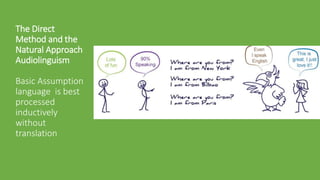
The Direct
Method and the
Natural Approach
Audiolinguism
Basic Assumption
language is best
processed
inductively
without
translation
Noam Chomsky
Claimed that language, rather than being a habit structure, was instead
ruled-governed creativity.
Discovery
Learning
Involves cycles
of trial and
error, with
guidance and
feedback
provided by the
teacher
Pros and Cons of Inductive Teaching
• Rules are more memorable, meaningful and
serviceable.
• The mental effort involved ensures a greater
degree of cognitive depth which, again
ensures greater memorability.
• Students are more actively involved in the
learning process.
Pros and Cons of Inductive Teaching
• It is an approach which favours pattern-
recognition and problem-solving abilities which
suggests that it is particularly Suitable for learners
who like this kind of challenge.
• If the problem-solving is done collaboratively,
and in the target language, learners get the
opportunity for extra language practice.
• Working things out for themselves prepares
students for greater self-reliance and is therefore
conducive to learner autonomy.
Pros and Cons of Inductive Teaching
• The time and energy spent in working out rules
may mislead students into believe that rules are
the objectiye of language learning, rather than a
means.
• The time taken to work out a rule may be at the
expensc of time spent in putting the rule to some
sort of productive practice..
• Students may hypotheslse the wrong rule, in its
application.
Pros and Cons of Inductive Teaching
• It can place heavy demands on teachers in
planning a lesson.
• The time taken to work out a rule may be at the
expensc of time spent in putting the rule to some
sort of productive practice..
• An inductive approach frustrates students who,
by dint of their personal learning style or their
past learning experience (or both), would prefer
simply to be told the rule.
Resources
How to teach Grammar
Scott Thornbury
Longman
©Pearson Education Limited 1999

Inductive teaching

  • 1.
    How to teachgrammar from examples
  • 2.
    In an inductive approach, withouthaving met the rule, the learner studies examples and from these examples derives an understanding of the rule
  • 3.
  • 4.
    The Direct Method andthe Natural Approach TPR Basic Assumption language is best processed inductively without translation
  • 5.
    The Direct Method andthe Natural Approach Audiolinguism Basic Assumption language is best processed inductively without translation
  • 6.
    Noam Chomsky Claimed thatlanguage, rather than being a habit structure, was instead ruled-governed creativity.
  • 7.
    Discovery Learning Involves cycles of trialand error, with guidance and feedback provided by the teacher
  • 8.
    Pros and Consof Inductive Teaching • Rules are more memorable, meaningful and serviceable. • The mental effort involved ensures a greater degree of cognitive depth which, again ensures greater memorability. • Students are more actively involved in the learning process.
  • 9.
    Pros and Consof Inductive Teaching • It is an approach which favours pattern- recognition and problem-solving abilities which suggests that it is particularly Suitable for learners who like this kind of challenge. • If the problem-solving is done collaboratively, and in the target language, learners get the opportunity for extra language practice. • Working things out for themselves prepares students for greater self-reliance and is therefore conducive to learner autonomy.
  • 10.
    Pros and Consof Inductive Teaching • The time and energy spent in working out rules may mislead students into believe that rules are the objectiye of language learning, rather than a means. • The time taken to work out a rule may be at the expensc of time spent in putting the rule to some sort of productive practice.. • Students may hypotheslse the wrong rule, in its application.
  • 11.
    Pros and Consof Inductive Teaching • It can place heavy demands on teachers in planning a lesson. • The time taken to work out a rule may be at the expensc of time spent in putting the rule to some sort of productive practice.. • An inductive approach frustrates students who, by dint of their personal learning style or their past learning experience (or both), would prefer simply to be told the rule.
  • 12.
    Resources How to teachGrammar Scott Thornbury Longman ©Pearson Education Limited 1999