School Counseling,
 Plans of Study, and
 Individual Learning
              Plans
                                 [C121 ]


                    Gary L. Spear
     School Counseling Consultant
WI Department of Public Instruction
   Highest failure rates in K-12 education:
                      Grade 9
   Highly correlated to dropping out of high
    school
   Some factors:
    ◦   Failure   to   connect to goals after high school
    ◦   Failure   to   enroll in exploratory or CTE courses
    ◦   Failure   to   connect with an adult in school
    ◦   Failure   to   transition to new environment
                                               [SREB & ECS]

Reduce Failure
   Comprehensive School Counseling program

   Student and Parent Educational/Career
    Planning Conferences

   Individual Learning Plans

Redesign for Success
   A comprehensive school counseling program is an
    integral component of the school’s academic
    mission. Comprehensive school counseling
    programs, driven by student data and based on
    standards in academic, career and personal/social
    development, promote and enhance the learning
    process for all students.
        • ensures equity and access to a rigorous
    education                  for all students
        • identifies the knowledge and skills all students
    will                acquire as a result of the preK-12
    comprehensive              school counseling program
        • is delivered to all students in a systematic
    fashion
        • is based on data-driven decision making
        • is provided by a state-credentialed school
                 counselor

Comprehensive School
Counseling
   As students understand themselves,
    explore the world around them and
    establish goals for their futures, they
    begin to see why an education is
    important. They no longer attend school
    simply to receive a diploma or avoid
    truancy. Instead, students understand the
    connection between success in school
    today and success in their lives and
    careers tomorrow.

Comprehensive School
Counseling
   Conferencing is a process that involves
    activities planned and directed by school
    counselors that assists students in planning,
    monitoring, and managing their own
    learning, as well as, their personal and career
    development. Through these activities,
    students are encouraged and given
    opportunities to set and evaluate their
    educational and career goals and develop
    their Individual Learning Plan that will help
    them achieve their educational, career and
    life goals.


Educational/Career Conferences
•   Students take responsibility for their future
•   Students and parents gain insight into
    student’s growth and development
•   Parents feel more informed and involved
•   Students and parents are motivated to be
    involved earlier in post-secondary planning
•   Student apprehension about school and
    future goals is reduced
•   A connection is developed between school,
    parents, and students to ensure academic
    success
                   [see session C143 - Conferences]


Conference Benefits
   Students will investigate the inter-
    relationship of educational achievement,
    life goals, career planning, training and
    placement; evaluate the present job
    market and analyze predictions of future
    trends at local, regional, state, national
    and global levels; and propose career
    options based on their Individual Learning
    Plan.


Individual Learning Plan
   Learning Record versus Learning Plan

    ◦ Traditional Four Year Plan
      A format that serves as a learning record and
       looks toward the past

    ◦ Individual Learning Plan
      A format that identifies what is to be achieved and
       looks toward the future


Individual Learning Plan
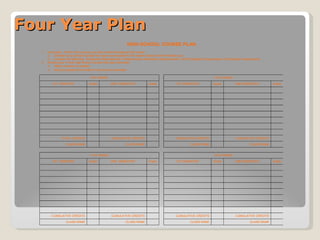
Four Year Plan
                                                              HIGH SCHOOL COURSE PLAN
  1.   Use pencil. Write in the courses you plan to take throughout high school.
       a. Consider your school’s sample four-year course plans for the career major(s) which interests you.
       b. Consider the following: Graduation Requirements / Postsecondary Admissions Requirements / NCAA Eligibility Requirements / Scholarship Requirements
  2.   Review your 4-Year High School Course Plan each semester.
       a. Make revisions as needed.
       c. Add your grades and credits for the previous semester.

                                     9TH GRADE                                                                             10TH GRADE

          1ST SEMSTER              Grade           2ND SEMESTER              Grade               1ST SEMESTER              Grade          2ND SEMESTER           Grade


                TOTAL CREDITS                      CUMULATIVE CREDITS                           CUMULATIVE CREDITS                        CUMULATIVE CREDITS

                   CLASS RANK                                CLASS RANK                                   CLASS RANK                                CLASS RANK


                                    11TH GRADE                                                                             12TH GRADE
          1ST SEMSTER              Grade           2ND SEMESTER              Grade               1ST SEMESTER              Grade          2ND SEMESTER           Grade


         CUMULATIVE CREDITS                        CUMULATIVE CREDITS                           CUMULATIVE CREDITS                        CUMULATIVE CREDITS
                   CLASS RANK                                CLASS RANK                                   CLASS RANK                                CLASS RANK
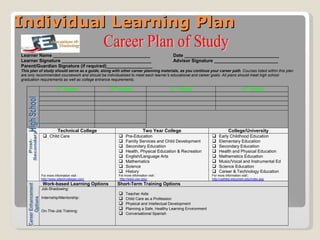
Individual Learning Plan
Learner Name ______________________________________                                   Date _____________________________________
Learner Signature ___________________________________                                 Advisor Signature _________________________
Parent/Guardian Signature (if required)__________________
This plan of study should serve as a guide, along with other career planning materials, as you continue your career path. Courses listed within this plan
are only recommended coursework and should be individualized to meet each learner’s educational and career goals. All plans should meet high school
graduation requirements as well as college entrance requirements.

                     9th Grade                   10th Grade                          11th Grade                                12th Grade


                  Technical College                                     Two Year College                              College/University
             Child Care                                  Pre-Education                                      Early Childhood Education
                                                          Family Services and Child Development              Elementary Education
                                                          Secondary Education                                Secondary Education
                                                          Health, Physical Education & Recreation            Health and Physical Education
                                                          English/Language Arts                              Mathematics Education
                                                          Mathematics                                        Music/Vocal and Instrumental Ed
                                                          Science                                            Science Education
                                                          History                                            Career & Technology Education
           For more information visit :               For more information visit::                         For more information visit::
           http://www.witechcolleges.com/             http://www.uwc.edu/                                  http://uwhelp.wisconsin.edu/index.asp
            Work-based Learning Options               Short-Term Training Options
           Job-Shadowing:
                                                          Teacher Aide
           Internship/Mentorship:                         Child Care as a Profession
                                                          Physical and Intellectual Development
           On-The-Job Training:
                                                          Planning a Safe, Healthy Learning Environment
                                                          Conversational Spanish
    ILP’s meet benchmarks within the Model
    Academic Standards for school counseling

   ILP’s take into account what happens to
    students outside the walls of the school
    building

    ILP’s can provide a process and product for
    students to use that opens them up to unique
    educational and career opportunities


Individual Learning Plan
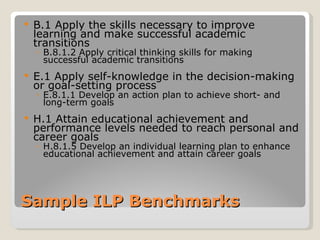
   B.1 Apply the skills necessary to improve
    learning and make successful academic
    transitions
    ◦ B.8.1.2 Apply critical thinking skills for making
      successful academic transitions
   E.1 Apply self-knowledge in the decision-making
    or goal-setting process
    ◦ E.8.1.1 Develop an action plan to achieve short- and
      long-term goals
   H.1 Attain educational achievement and
    performance levels needed to reach personal and
    career goals
    ◦ H.8.1.5 Develop an individual learning plan to enhance
      educational achievement and attain career goals


Sample ILP Benchmarks
   Curricular Domains       [required]
    ◦ Academic
    ◦ Career
    ◦ Personal/Social

   Plan of Study            [required]

   Portfolio / ePortfolio   [optional
    elements]


ILP Components
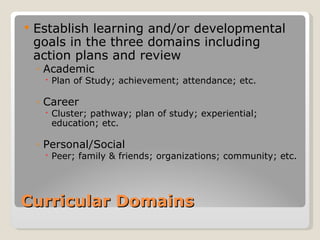
   Establish learning and/or developmental
    goals in the three domains including
    action plans and review
    ◦ Academic
      Plan of Study; achievement; attendance; etc.

    ◦ Career
      Cluster; pathway; plan of study; experiential;
       education; etc.

    ◦ Personal/Social
      Peer; family & friends; organizations; community; etc.


Curricular Domains
Domain Goals
                                            Individual Learning Plan
                                                   2008-2009
                                 Academic            Career       Personal/Social


     Student _____________________                                          Grade ______________

                       Goals                       Action Plan                      Review
     Academic

              Education

              Plan of Study[college]


     Career

              Experiential

              Plan of Study[career]


     Personal/Social

              Family & friends

              Civic/community


     Student signature _______________________________                              Date ____________

     Parent signature _______________________________                               Date ____________

     Counselor/advisor _______________________________                              Date ____________
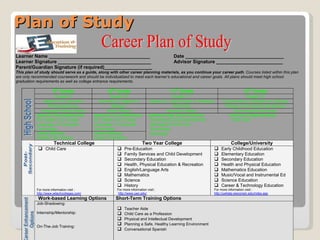
Plan of Study
Learner Name ______________________________________                                           Date _____________________________________
Learner Signature ___________________________________                                         Advisor Signature _________________________
Parent/Guardian Signature (if required)__________________
This plan of study should serve as a guide, along with other career planning materials, as you continue your career path. Courses listed within this plan
are only recommended coursework and should be individualized to meet each learner’s educational and career goals. All plans should meet high school
graduation requirements as well as college entrance requirements.

                     9th Grade                     10th Grade                               11th Grade                                       12th Grade
                     English 9                    English 10                                  English 11                                   English 12
               Algebra I or Geometry          Geometry or Algebra II            Algebra II, Trigonometry or Statistics        Trigonometry or Statistics or Calculus
                 Physical Science                  Biology I                                  Chemistry                        Physics or Environmental Science
              Geography/State History            World History                            American History                          Economics/Government
           Required Courses/Electives       Required Courses/Electives         Additional High School Electives                   Technical College Electives
           PE, Health, Art, Foreign         PE, Health, Art, Foreign             Parenting & Child Development                      Child Care
           Language, or Computer            Language, or Computer                Marriage & Family Life
           Technology                       Technology                           Psychology
           Career Electives                 Career Electives                     Sociology
           Healthy Life Choices             Career Orientation
                      Technical College                                    Two Year College                                         College/University
             Child Care                                      Pre-Education                                                Early Childhood Education
                                                              Family Services and Child Development                        Elementary Education
                                                              Secondary Education                                          Secondary Education
                                                              Health, Physical Education & Recreation                      Health and Physical Education
                                                              English/Language Arts                                        Mathematics Education
                                                              Mathematics                                                  Music/Vocal and Instrumental Ed
                                                              Science                                                      Science Education
                                                              History                                                      Career & Technology Education
           For more information visit :                  For more information visit::                                    For more information visit::
           http://www.witechcolleges.com/                http://www.uwc.edu/                                             http://uwhelp.wisconsin.edu/index.asp
            Work-based Learning Options                 Short-Term Training Options
           Job-Shadowing:
                                                              Teacher Aide
           Internship/Mentorship:                             Child Care as a Profession
                                                              Physical and Intellectual Development
           On-The-Job Training:
                                                              Planning a Safe, Healthy Learning Environment
                                                              Conversational Spanish
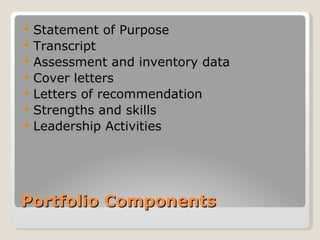
   Statement of Purpose
   Transcript
   Assessment and inventory data
   Cover letters
   Letters of recommendation
   Strengths and skills
   Leadership Activities


Portfolio Components
   Work experience
   Work-based learning
   Service learning/community-volunteer
    service
   Extra/co-curricular activities
   Awards and honors
   Language skills
   21st Century Skills


Portfolio Components
   Participation data
   Student feedback
   Parent/guardian feedback
   School improvement data goals
   Standards and benchmarks
   Scheduling data
   Postsecondary data


Evaluation and Impact

Individual learning plans like SoP's

  • 1.
    School Counseling, Plansof Study, and Individual Learning Plans [C121 ] Gary L. Spear School Counseling Consultant WI Department of Public Instruction
  • 2.
    Highest failure rates in K-12 education: Grade 9  Highly correlated to dropping out of high school  Some factors: ◦ Failure to connect to goals after high school ◦ Failure to enroll in exploratory or CTE courses ◦ Failure to connect with an adult in school ◦ Failure to transition to new environment [SREB & ECS] Reduce Failure
  • 3.
    Comprehensive School Counseling program  Student and Parent Educational/Career Planning Conferences  Individual Learning Plans Redesign for Success
  • 4.
    A comprehensive school counseling program is an integral component of the school’s academic mission. Comprehensive school counseling programs, driven by student data and based on standards in academic, career and personal/social development, promote and enhance the learning process for all students. • ensures equity and access to a rigorous education for all students • identifies the knowledge and skills all students will acquire as a result of the preK-12 comprehensive school counseling program • is delivered to all students in a systematic fashion • is based on data-driven decision making • is provided by a state-credentialed school counselor Comprehensive School Counseling
  • 5.
    As students understand themselves, explore the world around them and establish goals for their futures, they begin to see why an education is important. They no longer attend school simply to receive a diploma or avoid truancy. Instead, students understand the connection between success in school today and success in their lives and careers tomorrow. Comprehensive School Counseling
  • 6.
    Conferencing is a process that involves activities planned and directed by school counselors that assists students in planning, monitoring, and managing their own learning, as well as, their personal and career development. Through these activities, students are encouraged and given opportunities to set and evaluate their educational and career goals and develop their Individual Learning Plan that will help them achieve their educational, career and life goals. Educational/Career Conferences
  • 7.
    Students take responsibility for their future • Students and parents gain insight into student’s growth and development • Parents feel more informed and involved • Students and parents are motivated to be involved earlier in post-secondary planning • Student apprehension about school and future goals is reduced • A connection is developed between school, parents, and students to ensure academic success [see session C143 - Conferences] Conference Benefits
  • 8.
    Students will investigate the inter- relationship of educational achievement, life goals, career planning, training and placement; evaluate the present job market and analyze predictions of future trends at local, regional, state, national and global levels; and propose career options based on their Individual Learning Plan. Individual Learning Plan
  • 9.
    Learning Record versus Learning Plan ◦ Traditional Four Year Plan  A format that serves as a learning record and looks toward the past ◦ Individual Learning Plan  A format that identifies what is to be achieved and looks toward the future Individual Learning Plan
  • 10.
    Four Year Plan HIGH SCHOOL COURSE PLAN 1. Use pencil. Write in the courses you plan to take throughout high school. a. Consider your school’s sample four-year course plans for the career major(s) which interests you. b. Consider the following: Graduation Requirements / Postsecondary Admissions Requirements / NCAA Eligibility Requirements / Scholarship Requirements 2. Review your 4-Year High School Course Plan each semester. a. Make revisions as needed. c. Add your grades and credits for the previous semester. 9TH GRADE 10TH GRADE 1ST SEMSTER Grade 2ND SEMESTER Grade 1ST SEMESTER Grade 2ND SEMESTER Grade TOTAL CREDITS CUMULATIVE CREDITS CUMULATIVE CREDITS CUMULATIVE CREDITS CLASS RANK CLASS RANK CLASS RANK CLASS RANK 11TH GRADE 12TH GRADE 1ST SEMSTER Grade 2ND SEMESTER Grade 1ST SEMESTER Grade 2ND SEMESTER Grade CUMULATIVE CREDITS CUMULATIVE CREDITS CUMULATIVE CREDITS CUMULATIVE CREDITS CLASS RANK CLASS RANK CLASS RANK CLASS RANK
  • 11.
    Individual Learning Plan LearnerName ______________________________________ Date _____________________________________ Learner Signature ___________________________________ Advisor Signature _________________________ Parent/Guardian Signature (if required)__________________ This plan of study should serve as a guide, along with other career planning materials, as you continue your career path. Courses listed within this plan are only recommended coursework and should be individualized to meet each learner’s educational and career goals. All plans should meet high school graduation requirements as well as college entrance requirements. 9th Grade 10th Grade 11th Grade 12th Grade Technical College Two Year College College/University  Child Care  Pre-Education  Early Childhood Education  Family Services and Child Development  Elementary Education  Secondary Education  Secondary Education  Health, Physical Education & Recreation  Health and Physical Education  English/Language Arts  Mathematics Education  Mathematics  Music/Vocal and Instrumental Ed  Science  Science Education  History  Career & Technology Education For more information visit : For more information visit:: For more information visit:: http://www.witechcolleges.com/ http://www.uwc.edu/ http://uwhelp.wisconsin.edu/index.asp Work-based Learning Options Short-Term Training Options Job-Shadowing:  Teacher Aide Internship/Mentorship:  Child Care as a Profession  Physical and Intellectual Development On-The-Job Training:  Planning a Safe, Healthy Learning Environment  Conversational Spanish
  • 12.
    ILP’s meet benchmarks within the Model Academic Standards for school counseling  ILP’s take into account what happens to students outside the walls of the school building  ILP’s can provide a process and product for students to use that opens them up to unique educational and career opportunities Individual Learning Plan
  • 13.
    B.1 Apply the skills necessary to improve learning and make successful academic transitions ◦ B.8.1.2 Apply critical thinking skills for making successful academic transitions  E.1 Apply self-knowledge in the decision-making or goal-setting process ◦ E.8.1.1 Develop an action plan to achieve short- and long-term goals  H.1 Attain educational achievement and performance levels needed to reach personal and career goals ◦ H.8.1.5 Develop an individual learning plan to enhance educational achievement and attain career goals Sample ILP Benchmarks
  • 14.
    Curricular Domains [required] ◦ Academic ◦ Career ◦ Personal/Social  Plan of Study [required]  Portfolio / ePortfolio [optional elements] ILP Components
  • 15.
    Establish learning and/or developmental goals in the three domains including action plans and review ◦ Academic  Plan of Study; achievement; attendance; etc. ◦ Career  Cluster; pathway; plan of study; experiential; education; etc. ◦ Personal/Social  Peer; family & friends; organizations; community; etc. Curricular Domains
  • 16.
    Domain Goals Individual Learning Plan 2008-2009 Academic Career Personal/Social Student _____________________ Grade ______________ Goals Action Plan Review Academic Education Plan of Study[college] Career Experiential Plan of Study[career] Personal/Social Family & friends Civic/community Student signature _______________________________ Date ____________ Parent signature _______________________________ Date ____________ Counselor/advisor _______________________________ Date ____________
  • 17.
    Plan of Study LearnerName ______________________________________ Date _____________________________________ Learner Signature ___________________________________ Advisor Signature _________________________ Parent/Guardian Signature (if required)__________________ This plan of study should serve as a guide, along with other career planning materials, as you continue your career path. Courses listed within this plan are only recommended coursework and should be individualized to meet each learner’s educational and career goals. All plans should meet high school graduation requirements as well as college entrance requirements. 9th Grade 10th Grade 11th Grade 12th Grade English 9 English 10 English 11 English 12 Algebra I or Geometry Geometry or Algebra II Algebra II, Trigonometry or Statistics Trigonometry or Statistics or Calculus Physical Science Biology I Chemistry Physics or Environmental Science Geography/State History World History American History Economics/Government Required Courses/Electives Required Courses/Electives Additional High School Electives Technical College Electives PE, Health, Art, Foreign PE, Health, Art, Foreign Parenting & Child Development Child Care Language, or Computer Language, or Computer Marriage & Family Life Technology Technology Psychology Career Electives Career Electives Sociology Healthy Life Choices Career Orientation Technical College Two Year College College/University  Child Care  Pre-Education  Early Childhood Education  Family Services and Child Development  Elementary Education  Secondary Education  Secondary Education  Health, Physical Education & Recreation  Health and Physical Education  English/Language Arts  Mathematics Education  Mathematics  Music/Vocal and Instrumental Ed  Science  Science Education  History  Career & Technology Education For more information visit : For more information visit:: For more information visit:: http://www.witechcolleges.com/ http://www.uwc.edu/ http://uwhelp.wisconsin.edu/index.asp Work-based Learning Options Short-Term Training Options Job-Shadowing:  Teacher Aide Internship/Mentorship:  Child Care as a Profession  Physical and Intellectual Development On-The-Job Training:  Planning a Safe, Healthy Learning Environment  Conversational Spanish
  • 18.
    Statement of Purpose  Transcript  Assessment and inventory data  Cover letters  Letters of recommendation  Strengths and skills  Leadership Activities Portfolio Components
  • 19.
    Work experience  Work-based learning  Service learning/community-volunteer service  Extra/co-curricular activities  Awards and honors  Language skills  21st Century Skills Portfolio Components
  • 20.
    Participation data  Student feedback  Parent/guardian feedback  School improvement data goals  Standards and benchmarks  Scheduling data  Postsecondary data Evaluation and Impact