The 8th Annual

 AP Report to the Nation
             ®


 February 8, 2012


Knowledge | Skills | Behaviors | Awareness
About the Data
Because a central source of demographic data for nonpublic schools is not available
for all states, this report represents public school students only. References to the
total number of high school graduates represent projections supplied in Knocking at
the College Door (Western Interstate Commission for Higher Education, 2008). 	
Additionally, this report looks at students’ entire experience with AP — tracking exams
taken by seniors throughout their high school career — as opposed to just reporting
exam results from a particular calendar year.
Additional data are available exclusively online at apreport.collegeboard.org.
Table of Contents

      	 2	   AP®: A Collaborative Community
      	 4	 in a Classroom: Whitney M. Young Magnet School, Chicago Public Schools
           AP
      	 6	 AP in a District: Colton Joint Unified School District, Colton, California
      	 8	 AP in a University: University of Wisconsin–Madison


        10		 Working Toward          the Nation’s Goals, Together
      1
      	 2	 Increasing Rigor
      	16	Promoting Equity
       	24	 Supporting STEM


      2
      	 6	   Strategies for Progress

      28	    Celebrating Equity and Excellence

      32	 Appendix and Endnotes
The AP     ®


                                           “
   Experience in:
                                               The AP courses that I completed helped me
   A Classroom
                                               build the confidence and acquire the knowledge

                                                                                     ”
   A District
   A University                                that is necessary to dive into college.
                                               Zachary Stuart, Former AP Student and Stanford
                                               University Freshman


 AP : A Collaborative
                     ®


2 The 8th Annual AP Report to the Nation
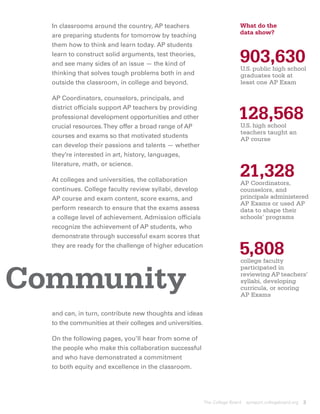
In classrooms around the country, AP teachers                            What do the
  are preparing students for tomorrow by teaching                          data show?
  them how to think and learn today. AP students
  learn to construct solid arguments, test theories,
  and see many sides of an issue — the kind of
                                                                           903,630
                                                                           U.S. public high school
  thinking that solves tough problems both in and                           graduates took at
  outside the classroom, in college and beyond.                             least one AP Exam

  AP Coordinators, counselors, principals, and


                                                                          128,568
  district officials support AP teachers by providing
  professional development opportunities and other
  crucial resources. They offer a broad range of AP                        U
                                                                            .S. high school
                                                                           teachers taught an
  courses and exams so that motivated students
                                                                           AP course
  can develop their passions and talents — whether
  they’re interested in art, history, languages,


                                                                           21,328
  literature, math, or science.

  At colleges and universities, the collaboration
                                                                           AP Coordinators,
                                                                           
  continues. College faculty review syllabi, develop                       counselors, and
  AP course and exam content, score exams, and                             principals administered
                                                                           AP Exams or used AP
  perform research to ensure that the exams assess                         data to shape their
  a college level of achievement. Admission officials                      schools’ programs
  recognize the achievement of AP students, who
  demonstrate through successful exam scores that
  they are ready for the challenge of higher education
                                                                           5,808
                                                                           
                                                                           college faculty


Community
                                                                           participated in
                                                                           reviewing AP teachers’
                                                                           syllabi, developing
                                                                           curricula, or scoring
                                                                           AP Exams

  and can, in turn, contribute new thoughts and ideas
  to the communities at their colleges and universities.

  On the following pages, you’ll hear from some of
  the people who make this collaboration successful
  and who have demonstrated a commitment
  to both equity and excellence in the classroom.


                                                           The College Board   apreport.collegeboard.org   3
The AP
   Experience in:
   A Classroom
   A District
                                           “   To me, it’s about creating an environment where
                                               students feel safe and relaxed and are able to

                                                                                         ”
   A University
                                               be themselves and interact with each other.
                                               Matthew Moran, AP Calculus Teacher


                                               AP Calculus
                                               Whitney M. Young Magnet School
                                               Chicago Public Schools
                                               Chicago, Illinois


4 The 8th Annual AP Report to the Nation
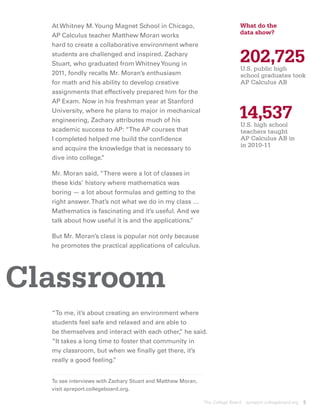
At Whitney M. Young Magnet School in Chicago,                              What do the
  AP Calculus teacher Matthew Moran works                                    data show?
  hard to create a collaborative environment where
  students are challenged and inspired. Zachary
  Stuart, who graduated from Whitney Young in
                                                                             202,725
                                                                             U.S. public high
  2011, fondly recalls Mr. Moran’s enthusiasm                                 school graduates took
  for math and his ability to develop creative                                AP Calculus AB
  assignments that effectively prepared him for the
  AP Exam. Now in his freshman year at Stanford
  University, where he plans to major in mechanical
  engineering, Zachary attributes much of his
                                                                            14,537
                                                                            U.S. high school
  academic success to AP: “The AP courses that                               teachers taught
  I completed helped me build the confidence                                 AP Calculus AB in
                                                                             in 2010-11
  and acquire the knowledge that is necessary to
  dive into college.
                   ”

  Mr. Moran said, “There were a lot of classes in
  these kids’ history where mathematics was
  boring — a lot about formulas and getting to the
  right answer. That’s not what we do in my class …
  Mathematics is fascinating and it’s useful. And we
  talk about how useful it is and the applications.
                                                  ”

  But Mr. Moran’s class is popular not only because
  he promotes the practical applications of calculus.


Classroom
  “To me, it’s about creating an environment where
  students feel safe and relaxed and are able to
  be themselves and interact with each other, he said.
                                             ”
  “It takes a long time to foster that community in
  my classroom, but when we finally get there, it’s
  really a good feeling.”


  To see interviews with Zachary Stuart and Matthew Moran,
  visit apreport.collegeboard.org.

                                                             The College Board   apreport.collegeboard.org   5
The AP
   Experience in:
   A Classroom
   A District
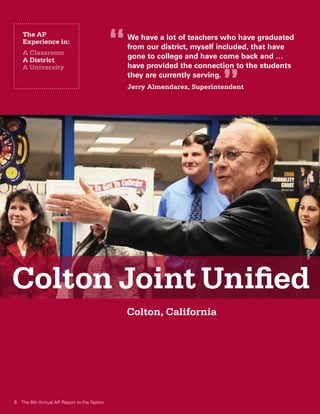
                                           “   We have a lot of teachers who have graduated
                                               from our district, myself included, that have
                                               gone to college and have come back and …
                                               have provided the connection to the students

                                                                         ”
   A University
                                               they are currently serving.
                                               Jerry Almendarez, Superintendent


Colton Joint Unified
                                               Colton, California


6 The 8th Annual AP Report to the Nation
Colton Joint Unified School District was selected                             What do the
   by the College Board as an AP District of the Year                            data show?
   last year ­ honored for increasing access to AP
             —
   course work while simultaneously increasing the
   percentage of students earning scores of 3 or
                                                                                 540,619
                                                                                  U.S. public high school
   higher on AP Exams.                                                             graduates scored
                                                                                   a 3 or higher
   Jerry Almendarez, superintendent for Colton Joint


                                                                                12,926
   Unified School District, attributes Colton’s success
   to its teachers, who serve as role models, offering
   students real-life examples of how to prepare for                            U.S. public high
                                                                                 schools were
   college, earn their degrees, and fulfill their dreams
                                                                                 represented by
   for the future. “We have a lot of teachers who have                           AP Exam-takers in
   graduated from our district, myself included, that                            the class of 2011
   have gone to college and have come back and …
   have provided the connection to the students they
   are currently serving, said Almendarez. “There are
                         ”
   a lot of caring people here who care not only for
   improving [the] students’ academic performance
   but also for the human being.  ”

   This special connection has paid off. Ignacio
   Cabrera, principal of Bloomington High School in
   Colton, proudly reported that “one of the programs
   that has excelled is our math program. We’ve


School District
   had a three-year run of over 98 percent of our
   students succeeding — and the thing that is really
   unusual … is that 100 percent succeeded just
   this past year.
                 ”


   To see interviews with educators from Colton and another
   AP District of the Year — New Jersey’s West New York School
   District — visit apreport.collegeboard.org.

                                                                 The College Board   apreport.collegeboard.org   7
The AP
   Experience in:
   A Classroom
                                           “   [AP courses on a student’s transcript] tell us
                                               that they’re challenging themselves … preparing
                                               for the rigor that they will encounter at the
   A District
                                               University of Wisconsin–Madison. These students

                                                                                     ”
   A University
                                               are going to be the most successful.
                                               Bobbie Jean St. Arnauld, Freshman Admissions Manager


                                           University of
                                               Madison, Wisconsin


8 The 8th Annual AP Report to the Nation
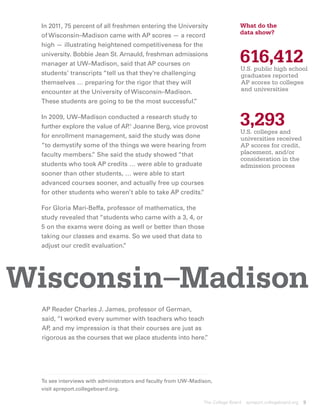
In 2011, 75 percent of all freshmen entering the University                   What do the
 of Wisconsin–Madison came with AP scores — a record                           data show?
 high — illustrating heightened competitiveness for the
 university. Bobbie Jean St. Arnauld, freshman admissions
 manager at UW–Madison, said that AP courses on
                                                                               616,412
                                                                               U.S. public high school
                                                                               
 students’ transcripts “tell us that they’re challenging                       graduates reported
 themselves … preparing for the rigor that they will                           AP scores to colleges
 encounter at the University of Wisconsin–Madison.                             and universities
 These students are going to be the most successful.   ”

 In 2009, UW–Madison conducted a research study to
 further explore the value of AP 1 Joanne Berg, vice provost
                                .                                              3,293
                                                                               U.S. colleges and
 for enrollment management, said the study was done                             universities received
 “to demystify some of the things we were hearing from                          AP scores for credit,
 faculty members. She said the study showed “that
                   ”                                                            placement, and/or
                                                                                consideration in the
 students who took AP credits … were able to graduate                           admission process
 sooner than other students, … were able to start
 advanced courses sooner, and actually free up courses
 for other students who weren’t able to take AP credits. ”

 For Gloria Mari-Beffa, professor of mathematics, the
 study revealed that “students who came with a 3, 4, or
 5 on the exams were doing as well or better than those
 taking our classes and exams. So we used that data to
 adjust our credit evaluation.
                             ”


Wisconsin–Madison
  AP Reader Charles J. James, professor of German,
  said, “I worked every summer with teachers who teach
  AP and my impression is that their courses are just as
     ,
  rigorous as the courses that we place students into here.
                                                          ”


 To see interviews with administrators and faculty from UW–Madison,
 visit apreport.collegeboard.org.

                                                               The College Board   apreport.collegeboard.org   9
Working Toward the
Nation’s Goals, Together
                In 2008, the College Board set an ambitious national goal: to increase
                the percentage of 25- to 34-year-olds who hold an associate degree or
                higher to 55 percent by 2025.2 The resulting College Completion Agenda
                is part of a growing national conversation about reestablishing the
                United States’ position as a global leader in education and ensuring its
                future prosperity.3 Three goals are critical to this effort:
                	 •	 Increasing rigor;
                	 •	 Promoting equitable access to college-level academic experiences; and
                	 •	upporting science, technology, engineering, and math
                     S
                     (STEM) education.

                		 As you’ll see on page 17, one obstacle to achieving all three goals —
                in particular, promoting equity — is a troubling opportunity gap among
                some of the nation’s most promising students.

                		 Success is rarely the result of just one element, and AP isn’t a
                comprehensive solution. But AP — and the dedication and hard work of
                the students and educators who comprise its collaborative community —
                is one key ingredient in a larger recipe to support all three of these goals.


10 The 8th Annual AP Report to the Nation
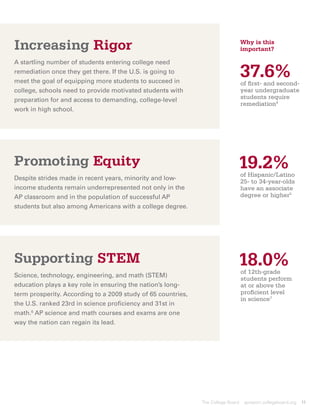
Increasing Rigor                                                                  Why is this
                                                                                  important?

A startling number of students entering college need
remediation once they get there. If the U.S. is going to
meet the goal of equipping more students to succeed in
                                                                                  37.6%
                                                                                  
                                                                                  of first- and second-
college, schools need to provide motivated students with                          year undergraduate
preparation for and access to demanding, college-level                            students require
                                                                                  remediation4
work in high school.


Promoting Equity                                                              19.2%
                                                                                  o
                                                                                   f Hispanic/Latino
Despite strides made in recent years, minority and low-
                                                                                  25- to 34-year-olds
income students remain underrepresented not only in the                           have an associate
AP classroom and in the population of successful AP                               degree or higher5
students but also among Americans with a college degree.


Supporting STEM                                                               18.0%
                                                                               of 12th-grade
Science, technology, engineering, and math (STEM)
                                                                                 students perform
education plays a key role in ensuring the nation’s long-                        at or above the
term prosperity. According to a 2009 study of 65 countries,                      proficient level
                                                                                 in science7
the U.S. ranked 23rd in science proficiency and 31st in
math.6 AP science and math courses and exams are one
way the nation can regain its lead.


                                                              The College Board    apreport.collegeboard.org   11
Increasing Rigor
                 AP teachers encourage their students to do more, to think more deeply,
                 and to always ask “Why?” — habits and skills crucial for college success.
                 AP may not be right for every student, and it’s not the only answer to
                 increasing rigor in the nation’s classrooms, but it’s a key tool to foster
                 a college-going and college-ready culture.

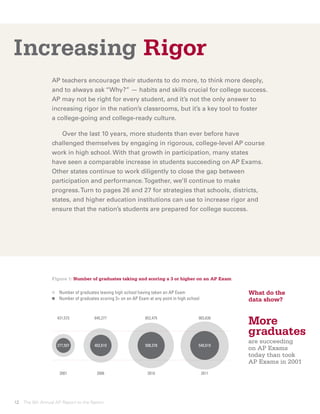
                 	 Over the last 10 years, more students than ever before have
                 challenged themselves by engaging in rigorous, college-level AP course
                 work in high school. With that growth in participation, many states
                 have seen a comparable increase in students succeeding on AP Exams.
                 Other states continue to work diligently to close the gap between
                 participation and performance. Together, we’ll continue to make
                 progress. Turn to pages 26 and 27 for strategies that schools, districts,
                 states, and higher education institutions can use to increase rigor and
                 ensure that the nation’s students are prepared for college success.


                 Figure 1: Number of graduates taking and scoring a 3 or higher on an AP Exam

                  	 Number of graduates leaving high school having taken an AP Exam                   What do the
                  	 Number of graduates scoring 3+ on an AP Exam at any point in high school          data show?

                   431,573            645,277                   852,475                    903,630
                                                                                                      More
                                                                                                      graduates
                                                                                                      are succeeding
                   277,507            402,610                   508,378                    540,619
                                                                                                      on AP Exams
                                                                                                      today than took
                                                                                                      AP Exams in 2001
                    2001               2006                      2010                          2011


12 The 8th Annual AP Report to the Nation
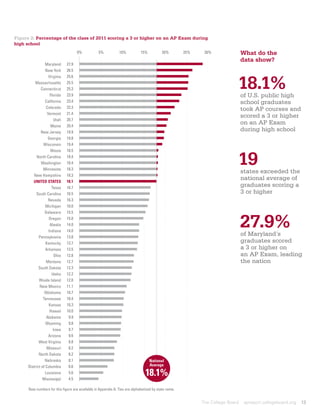
Figure 2: Percentage of the class of 2011 scoring a 3 or higher on an AP Exam during
high school
                                       0%         5%           10%           15%          20%         25%    30%                What do the
                                                                                                                                data show?
                  Maryland      27.9
                  New York      26.5


                                                                                                                            18.1%
                    Virginia    25.6
          Massachusetts         25.5
              Connecticut       25.3
                     Florida    23.9                                                                                            of U.S. public high
                 California     23.4                                                                                             school graduates
                  Colorado      22.3                                                                                             took AP courses and
                   Vermont      21.4
                                                                                                                                 scored a 3 or higher
                        Utah    20.7
                     Maine      20.4
                                                                                                                                 on an AP Exam
               New Jersey       19.9
                                                                                                                                 during high school
                    Georgia     19.8
                Wisconsin       19.4


                                                                                                                            19
                     Illinois   18.5


           North Carolina       18.4
               Washington       18.4
                Minnesota       18.3
                                                                                                                                states exceeded the
         New Hampshire          18.3
         UNITED STATES          18.1
                                                                                                                                national average of
                      Texas     16.7
                                                                                                                                graduates scoring a
           South Carolina       16.5                                                                                            3 or higher
                    Nevada      16.3
                  Michigan      16.0
                 Delaware       15.5
                    Oregon
                     Alaska
                    Indiana
                                15.0
                                14.0
                                14.0
                                                                                                                                27.9%
                                                                                                                                
                                                                                                                                of Maryland’s
             Pennsylvania       13.8
                  Kentucky      13.7                                                                                            graduates scored
                  Arkansas      13.5                                                                                            a 3 or higher on
                        Ohio    12.8                                                                                            an AP Exam, leading
                  Montana       12.7                                                                                            the nation
             South Dakota       12.3
                      Idaho     12.2
             Rhode Island       12.0
              New Mexico        11.1
                 Oklahoma       10.7
                Tennessee       10.4
                    Kansas      10.3
                     Hawaii     10.0
                   Alabama       9.9
                  Wyoming        9.8
                       Iowa      9.7
                    Arizona      9.6
             West Virginia       8.8
                   Missouri      8.2
             North Dakota        8.2
                 Nebraska        8.1                                               National
      District of Columbia       6.6                                               Average
                  Louisiana
                Mississippi
                                 5.6
                                 4.5
                                                                                18.1%
      Raw numbers for this figure are available in Appendix A. Ties are alphabetized by state name.


                                                                                                            The College Board    apreport.collegeboard.org   13
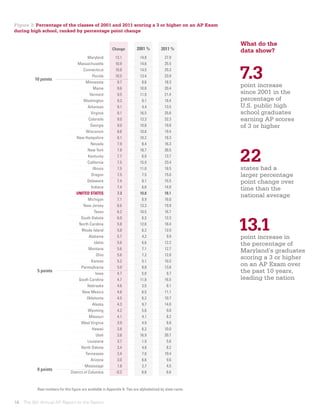
Figure 3: Percentage of the classes of 2001 and 2011 scoring a 3 or higher on an AP Exam
during high school, ranked by percentage point change

                                                                                                          What do the
                                                         Change          2001 %         2011 %            data show?
                                           Maryland        13.1            14.8            27.9
                                   Massachusetts           10.9            14.6            25.5


         10 points
                                       Connecticut
                                              Florida
                                         Minnesota
                                                           10.8
                                                           10.5
                                                            9.7
                                                                           14.5
                                                                           13.4
                                                                            8.6
                                                                                           25.3
                                                                                           23.9
                                                                                           18.3
                                                                                                          7.3
                                                                                                          point increase
                                              Maine         9.6            10.8            20.4
                                            Vermont         9.5            11.9            21.4           since 2001 in the
                                        Washington          9.3             9.1            18.4           percentage of
                                           Arkansas         9.1             4.4            13.5           U.S. public high
                                             Virginia       9.1            16.5            25.6           school graduates
                                           Colorado         9.0            13.3            22.3           earning AP scores
                                             Georgia        9.0            10.8            19.8           of 3 or higher
                                         Wisconsin          8.6            10.8            19.4
                                  New Hampshire             8.1            10.2            18.3
                                             Nevada         7.9             8.4            16.3


                                                                                                          22
                                           New York         7.8            18.7            26.5
                                           Kentucky         7.7             6.0            13.7
                                           California       7.5            15.9            23.4
                                              Illinois      7.5            11.0            18.5            states had a
                                             Oregon         7.5             7.5            15.0             larger percentage
                                          Delaware          7.4             8.1            15.5             point change over
                                             Indiana        7.4             6.6            14.0             time than the
                                  UNITED STATES             7.3            10.8            18.1
                                                                                                            national average
                                           Michigan         7.1             8.9            16.0
                                        New Jersey          6.6            13.3            19.9
                                               Texas        6.2            10.5            16.7


                                                                                                          13.1
                                      South Dakota          6.0             6.3            12.3


                                     North Carolina         5.8            12.6            18.4
                                      Rhode Island          5.8             6.2            12.0
                                            Alabama         5.7             4.2             9.9           point increase in
                                               Idaho        5.6             6.6            12.2           the percentage of
                                           Montana          5.6             7.1            12.7
                                                                                                          Maryland’s graduates
                                                 Ohio       5.6             7.2            12.8
                                                                                                          scoring a 3 or higher
                                             Kansas         5.2             5.1            10.3
                                      Pennsylvania          5.0             8.8            13.8
                                                                                                          on an AP Exam over
          5 points
                                                Iowa        4.7             5.0             9.7           the past 10 years,
                                    South Carolina          4.7            11.8            16.5           leading the nation
                                          Nebraska          4.6             3.5             8.1
                                       New Mexico           4.6             6.5            11.1
                                          Oklahoma          4.5             6.2            10.7
                                              Alaska        4.3             9.7            14.0
                                           Wyoming          4.2             5.6             9.8
                                            Missouri        4.1             4.1             8.2
                                      West Virginia         3.9             4.9             8.8
                                              Hawaii        3.8             6.2            10.0
                                                 Utah       3.8            16.9            20.7
                                           Louisiana        3.7             1.9             5.6
                                      North Dakota          3.4             4.8             8.2
                                         Tennessee          3.4             7.0            10.4
                                             Arizona        3.0             6.6             9.6
                                         Mississippi        1.8             2.7             4.5
          0 points
                               District of Columbia        -0.2             6.8             6.6


          Raw numbers for this figure are available in Appendix A. Ties are alphabetized by state name.


14 The 8th Annual AP Report to the Nation
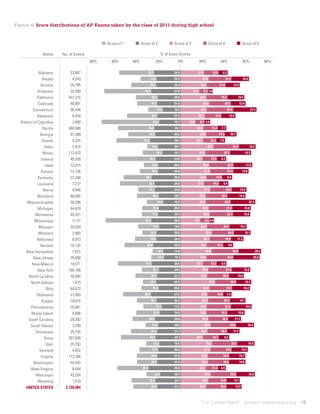
Figure 4: Score distributions of AP Exams taken by the class of 2011 during high school


                                                 Score of 1         Score of 2                  Score of 3                    Score of 4                                 Score of 5

                 States     No. of Exams                                                 % of Exam Scores
                                           80%     60%        40%                   20%           0%                20%                      40%                         60%                      80%

               Alabama          23,687                                     32.3                 24.5                21.6             13.5         8.2
                 Alaska          4,243                                       14.8               22.2                   25.8                            21.2                 16.0
                Arizona         35,795                                      23.2                22.4                  24.1                  17.4               12.9
              Arkansas          33,390                                43.6                      27.0         17.0          8.5 3.9
             California        451,215                                        20.4              20.9                 23.6                       19.7                  15.4
              Colorado          48,801                                       18.7               21.5                   26.4                           20.0            13.4
          Connecticut           36,446                                               13.6       16.4                  24.1                              24.4                        21.4
             Delaware            6,454                                        28.1              21.4                22.3                 15.5            12.6
  District of Columbia           2,900                                         53.2             19.7     13.8        8.3 5.0
                 Florida       260,486                                     33.8                 24.1            20.9               13.4          7.7
                Georgia         97,380                                      25.3                23.2                 23.5                   17.3             10.7
                 Hawaii          5,225                               31.2                       28.1            20.7              12.3       7.8
                  Idaho          7,919                                        10.2              20.7                         30.3                              23.6                 15.2
                 Illinois      112,432                                              18.3        16.7                22.8                           22.9                      19.3
                Indiana         48,559                                      35.1                23.0            20.1               13.5         8.3
                   Iowa         12,915                                        13.6              20.5                   26.3                             22.6                  17.0
                Kansas          12,126                                        16.8              20.8                       27.3                         21.4             13.8
              Kentucky          31,248                                 26.1                     26.6                 23.9                 14.6          8.9
              Louisiana          7,277                                     32.1                 24.0            21.5                 14.0         8.4

                 Maine           9,946                                     15.7                 23.6                       27.3                        20.0            13.4
              Maryland          90,895                                        20.2              20.1                23.2                         20.1                 16.4

      Massachusetts             58,286                                               15.3       16.0                 23.3                          23.0                            22.4

              Michigan          64,470                                         15.5             20.0                   25.9                            21.9                  16.8

            Minnesota           45,521                                        15.1              20.7                       26.8                         21.7                 15.6

            Mississippi          7,177                                42.4                      26.8          18.1          8.6 4.0

               Missouri         20,939                                         19.4             19.8                 24.4                         20.7                 15.7

              Montana            3,985                                       13.3               22.2                        28.9                         20.5                15.1

             Nebraska            6,973                                      19.8                22.4                       26.7                       19.9           11.3

                Nevada          18,134                                 26.6                     25.2                  24.1                15.2           9.0

     New Hampshire               7,027                                               10.1       15.8                        28.6                               25.0                        20.5

           New Jersey           76,030                                               12.2       15.1                 23.8                               24.9                           24.0

          New Mexico            10,571                                31.5                      26.5            20.7               12.7          8.6

              New York         190,186                                         15.7             20.1                   25.6                            21.8                  16.8

       North Carolina           78,680                                        20.1              21.7                  24.6                        20.0               13.6

         North Dakota            1,673                                      12.4                22.5                              31.9                       19.5             13.7

                    Ohio        64,672                                         16.2             20.0                   26.6                             21.1                 16.2

             Oklahoma           21,083                                26.0                      27.2                  24.8                 14.6         7.4

                Oregon          18,874                                       18.1               22.2                  25.3                         20.4                14.1

         Pennsylvania           70,881                                              17.2        17.2                 24.0                             22.5                    19.0

         Rhode Island            4,606                                            21.8          19.2                 23.8                       19.3                  15.8

       South Carolina           28,392                                     20.8                 23.6                   25.5                      18.4           11.7

         South Dakota            3,709                                        11.9              20.5                       27.6                           23.6                  16.4

            Tennessee           25,755                                        24.1              21.7                  24.7                      18.3           11.2

                  Texas        301,508                                      32.1                23.1            20.5                 14.7          9.5

                    Utah        25,753                                         12.3             19.6                        29.0                              23.1                 15.9

               Vermont           4,852                                        17.5              20.6                       27.4                        19.8             14.7

                Virginia       113,188                                       18.9               21.5                  25.0                        19.9                14.7

           Washington           54,342                                       18.7               21.6                  25.3                        19.6                14.8

         West Virginia           8,444                              29.0                        29.5                23.2            11.4        6.9

            Wisconsin           43,224                                            12.9          18.7                       27.7                              23.8                  16.9

              Wyoming            1,810                                      22.3                23.1                   25.6                  16.8               12.1

     UNITED STATES           2,720,084                                        22.5              21.3                 23.5                    18.8               13.9


                                                                                                                      The College Board                                      apreport.collegeboard.org   15
Promoting Equity
                    The numbers of traditionally underserved students participating and
                    succeeding in AP are increasing, in large part because of the kinds of
                    efforts made by the students and educators you heard from on pages 4–9.

                    	 However, underserved minority8 and low-income students remain
                    underrepresented in AP classrooms, and we continue to face challenges
                    in transforming the educational experiences of underserved students
                    in this country. Schools that serve significant populations of minority
                    and low-income students need support, including more professional
                    development opportunities for teachers, and a focus on differentiated
                    instruction and access to rigorous course work for students. Simply
                    expanding access to AP is not enough to promote equity; schools
                    must expand access within a framework that supports teachers to help
                    these students succeed. On pages 26 and 27, you’ll find strategies for
                    supporting teachers and giving underserved students the confidence,
                    encouragement, and preparation they need — both to take the AP
                    challenge and to succeed at it.


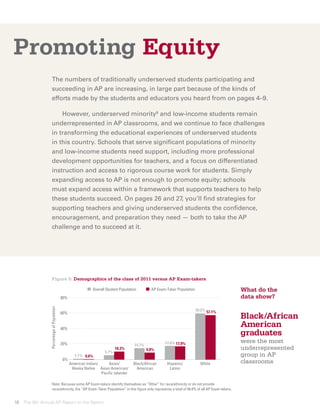
                    Figure 5: Demographics of the class of 2011 versus AP Exam-takers

                                                             Overall Student Population        AP Exam-Taker Population                     What do the
                                           80%                                                                                              data show?
                Percentage of Population


                                                                                                                          59.2% 57.1%
                                           60%
                                                                                                                                            Black/African
                                           40%
                                                                                                                                            American
                                                                                                                                            graduates
                                           20%                                                        17.6% 17.0%                           were the most
                                                                                     14.7%
                                                                           10.3%             9.0%                                           underrepresented
                                                                    5.7%
                                                   1.1% 0.6%                                                                                group in AP
                                           0%
                                                 American Indian/     Asian/         Black/African     Hispanic/            White           classrooms
                                                  Alaska Native Asian American/        American         Latino
                                                                  Pacific Islander

                    Note: Because some AP Exam-takers identify themselves as “Other” for race/ethnicity or do not provide
                    race/ethnicity, the “AP Exam-Taker Population” in this figure only represents a total of 94.0% of all AP Exam-takers.


16 The 8th Annual AP Report to the Nation
Fulfilling AP Potential
Ensuring that students realize their full potential is a critical
component to achieving the nation’s education goals. The College
Board is committed to working with educators to help provide all
students with potential for success in AP — regardless of location,
ethnicity, or socioeconomic status — an opportunity to maximize
their college years by having successful AP experiences.

	 While many schools and districts have worked to increase
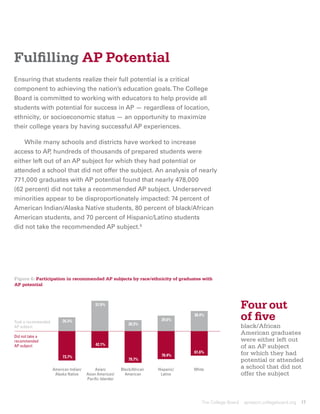
access to AP hundreds of thousands of prepared students were
              ,
either left out of an AP subject for which they had potential or
attended a school that did not offer the subject. An analysis of nearly
771,000 graduates with AP potential found that nearly 478,000
(62 percent) did not take a recommended AP subject. Underserved
minorities appear to be disproportionately impacted: 74 percent of
American Indian/Alaska Native students, 80 percent of black/African
American students, and 70 percent of Hispanic/Latino students
did not take the recommended AP subject.9


Figure 6: Participation in recommended AP subjects by race/ethnicity of graduates with
AP potential


                                            57.9%
                                                                                                             Four out
Took a recommended        26.3%
                                                              20.3%
                                                                            29.6%
                                                                                      38.4%
                                                                                                             of five
AP subject                                                                                                   black/African
                                                                                                             American graduates
Did not take a
recommended                                                                                                  were either left out
                                            42.1%
AP subject                                                                                                   of an AP subject
                                                                                      61.6%                  for which they had
                          73.7%                                             70.4%
                                                              79.7%                                          potential or attended
                     American Indian/        Asian/       Black/African   Hispanic/   White
                                                                                                             a school that did not
                      Alaska Native     Asian American/     American       Latino                            offer the subject
                                        Pacific Islander


                                                                                         The College Board    apreport.collegeboard.org   17
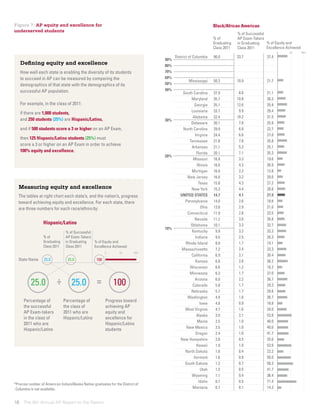
Figure 7: AP equity and excellence for                                                                        Black/African American
underserved students
                                                                                                                           % of Successful
                                                                                                              % of         AP Exam-Takers
                                                                                                              Graduating   in Graduating   % of Equity and
                                                                                                              Class 2011   Class 2011      Excellence Achieved
                                                                                                                                                  0    50        100+
                                                                                       District of Columbia   90.0         33.7            37.4
                                                                                 90%
   Defining equity and excellence                                                 80%
   How well each state is enabling the diversity of its students                 70%
   to succeed in AP can be measured by comparing the                             60%
                                                                                               Mississippi    50.3         10.9            21.7
   demographics of that state with the demographics of its                       50%
   successful AP population.                                                     40%
                                                                                           South Carolina     37.9          8.0            21.1
                                                                                               Maryland       35.7         10.8            30.3
   For example, in the class of 2011:                                                            Georgia      35.1         12.6            35.9
                                                                                               Louisiana      33.7          9.9            29.4
   if there are 1,000 students,
                                                                                                Alabama       32.4         10.2            31.5
   and 250 students (25%) are Hispanic/Latino,                                   30%
                                                                                               Delaware       30.1          7.8            25.9
   and if 500 students score a 3 or higher on an AP Exam,                                  North Carolina     29.9          6.8            22.7
                                                                                                  Virginia    24.4          6.6            27.0
   then 125 Hispanic/Latino students (25%) must
                                                                                              Tennessee       21.8          7.8            35.8
   score a 3 or higher on an AP Exam in order to achieve
                                                                                                Arkansas      21.1          5.3            25.1
   100% equity and excellence.                                                                     Florida    20.1          7.1            35.3
                                                                                 20%
                                                                                                Missouri      16.8          3.3            19.6
                                                                                                   Illinois   16.0          4.3            26.9
                                                                                                Michigan      16.0          2.2            13.8
                                                                                             New Jersey       16.0          3.2            20.0
                                                                                                    Texas     15.8          4.3            27.2
  Measuring equity and excellence                                                              New York       15.3          4.4            28.8
  The tables at right chart each state’s, and the nation’s, progress                      UNITED STATES       14.7          4.1            27.9
  toward achieving equity and excellence. For each state, there                             Pennsylvania      14.0          2.6            18.6
  are three numbers for each race/ethnicity:                                                          Ohio    13.8          2.9            21.0
                                                                                             Connecticut      11.9          2.8            23.5
                                                                                                 Nevada       11.2          3.0            26.8
                  Hispanic/Latino                                                              Oklahoma       10.1          3.3            32.7
                                                                                 10%
                                % of Successful                                                 Kentucky       9.9          3.2            32.3
                  % of          AP Exam-Takers                                                    Indiana      9.5          2.5            26.3
                  Graduating    in Graduating   % of Equity and                             Rhode Island       8.9          1.7            19.1
                  Class 2011    Class 2011      Excellence Achieved
                                                                                           Massachusetts       7.2          2.4            33.3
                                                         0        50      100+
                                                                                               California      6.9          2.1            30.4
  State Name      25.0           25.0              100                                            Kansas       6.8          2.6            38.2
                                                                                              Wisconsin        6.6          1.2            18.2
                                                                                              Minnesota        6.3          1.7            27.0

          25.0            ÷        25.0            =          100                                 Arizona
                                                                                                Colorado
                                                                                                               6.0
                                                                                                               5.8
                                                                                                                            2.2
                                                                                                                            1.7
                                                                                                                                           36.7
                                                                                                                                           29.3
                                                                                               Nebraska        5.7          1.7            29.8
                                                                                             Washington        4.9          1.8            36.7
      Percentage of            Percentage of             Progress toward
                                                                                                     Iowa      4.8          0.9            18.8
      the successful           the class of              achieving AP
                                                                                            West Virginia      4.7          1.6            34.0
      AP Exam-takers           2011 who are              equity and
                                                                                                   Alaska      3.9          2.1            53.8
      in the class of          Hispanic/Latino           excellence for
                                                                                                   Maine       2.5          1.0            40.0
      2011 who are                                       Hispanic/Latino
                                                                                             New Mexico        2.5          1.0            40.0
      Hispanic/Latino                                    students
                                                                                                  Oregon       2.4          1.0            41.7
                                                                                          New Hampshire        2.0          0.5            25.0
                                                                                                   Hawaii      1.9          1.0            52.6
                                                                                            North Dakota       1.8          0.4            22.2
                                                                                                 Vermont       1.6          0.8            50.0
                                                                                            South Dakota       1.2          0.7            58.3
                                                                                                      Utah     1.2          0.5            41.7
                                                                                                Wyoming        1.1          0.4            36.4
                                                                                                    Idaho      0.7          0.5            71.4
*Precise number of American Indian/Alaska Native graduates for the District of
 Columbia is not available.                                                                     Montana        0.7          0.1            14.3


18 The 8th Annual AP Report to the Nation
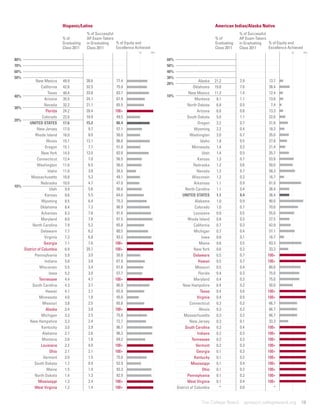
Hispanic/Latino                                                                         American Indian/Alaska Native
                                             % of Successful                                                                         % of Successful
                                % of         AP Exam-Takers                                                             % of         AP Exam-Takers
                                Graduating   in Graduating   % of Equity and                                            Graduating   in Graduating   % of Equity and
                                Class 2011   Class 2011      Excellence Achieved                                        Class 2011   Class 2011      Excellence Achieved
                                                                    0    50        100+                                                                     0    50        100+

80%                                                                                       60%
70%                                                                                       50%
60%                                                                                       40%
50%                                                                                       30%
              New Mexico        49.9         38.6            77.4                                            Alaska     21.2         2.9             13.7
                                                                                          20%
                 California     42.8         32.5            75.9                                        Oklahoma       19.8         7.6             38.4
                      Texas     40.4         33.8            83.7                                     New Mexico        11.3         1.4             12.4
40%                                                                                       10%
                    Arizona     35.5         24.1            67.9                                         Montana        8.1         1.1             13.6
                    Nevada      32.2         21.1            65.5                                    North Dakota        6.8         0.5              7.4
30%
                     Florida    24.2         28.4           100+                                            Arizona      6.0         0.8             13.3
                  Colorado      22.0         10.9            49.5                                    South Dakota        5.0         1.1             22.0
20%
         UNITED STATES          17.6         15.2            86.4                                           Oregon       2.2         0.7             31.8
               New Jersey       17.0          9.7            57.1                                         Wyoming        2.2         0.4             18.2
             Rhode Island       16.0          8.0            50.0                                      Washington        2.0         0.7             35.0
                     Illinois   15.1         13.1            86.8                                             Idaho      1.8         0.5             27.8
                    Oregon      15.1          7.7            51.0                                       Minnesota        1.4         0.3             21.4
                  New York      14.5         12.0            82.8                                               Utah     1.4         0.5             35.7
              Connecticut       12.4          7.0            56.5                                           Kansas       1.3         0.7             53.8
               Washington       11.6          6.5            56.0                                        Nebraska        1.2         0.6             50.0
                      Idaho     11.0          3.8            34.5                                           Nevada       1.2         0.7             58.3
          Massachusetts         10.8          5.3            49.1                                       Wisconsin        1.2         0.2             16.7
                 Nebraska       10.0          4.7            47.0                                         Arkansas       1.1         0.9             81.8
10%
                        Utah     9.9          5.6            56.6                                   North Carolina       1.1         0.4             36.4
                    Kansas       8.6          5.5            64.0                                UNITED STATES           1.1         0.4             36.4
                  Wyoming        8.5          6.4            75.3                                          Alabama       1.0         0.9             90.0
                 Oklahoma        8.4          7.3            86.9                                         Colorado       1.0         0.7             70.0
                  Arkansas       8.3          7.6            91.6                                         Louisiana      0.9         0.5             55.6
                  Maryland       8.0          7.8            97.5                                    Rhode Island        0.8         0.3             37.5
           North Carolina        7.9          5.2            65.8                                         California     0.7         0.3             42.9
                 Delaware        7.7          6.2            80.5                                         Michigan       0.7         0.4             57.1
                    Virginia     7.3          6.8            93.2                                              Iowa      0.6         0.1             16.7
                    Georgia      7.1          7.6           100+                                             Maine       0.6         0.5             83.3
      District of Columbia       6.9         20.7           100+                                          New York       0.6         0.2             33.3
             Pennsylvania        5.9          3.0            50.8                                        Delaware        0.5         0.7            100+
                    Indiana      5.6          3.8            67.9                                            Hawaii      0.5         0.7            100+
                Wisconsin        5.5          3.4            61.8                                          Missouri      0.5         0.4             80.0
                       Iowa      5.2          3.0            57.7                                            Florida     0.4         0.3             75.0
                Tennessee        4.4          4.7           100+                                          Maryland       0.4         0.3             75.0
           South Carolina        4.3          3.7            86.0                                New Hampshire           0.4         0.2             50.0
                     Hawaii      4.1          2.7            65.9                                             Texas      0.4         0.6            100+
                Minnesota        4.0          1.8            45.0                                           Virginia     0.4         0.5            100+
                   Missouri      3.8          2.5            65.8                                     Connecticut        0.3         0.2             66.7
                     Alaska      3.4          3.8           100+                                             Illinois    0.3         0.2             66.7
                  Michigan       3.3          2.5            75.8                                 Massachusetts          0.3         0.2             66.7
         New Hampshire           3.3          2.4            72.7                                      New Jersey        0.3         0.1             33.3
                  Kentucky       3.0          2.9            96.7                                  South Carolina        0.3         0.4            100+
                   Alabama       2.7          2.6            96.3                                           Indiana      0.2         0.3            100+
                  Montana        2.6          1.8            69.2                                       Tennessee        0.2         0.3            100+
                  Louisiana      2.2          4.0           100+                                           Vermont       0.2         0.3            100+
                        Ohio     2.1          2.1           100+                                            Georgia      0.1         0.3            100+
                   Vermont       2.0          1.5            75.0                                         Kentucky       0.1         0.2            100+
             South Dakota        1.7          0.9            52.9                                       Mississippi      0.1         0.4            100+
                     Maine       1.5          1.4            93.3                                               Ohio     0.1         0.2            100+
             North Dakota        1.4          1.3            92.9                                    Pennsylvania        0.1         0.2            100+
                Mississippi      1.3          2.4           100+                                     West Virginia       0.1         0.4            100+
             West Virginia       1.2          1.4           100+                              District of Columbia         *         0.0                *


                                                                                                               The College Board       apreport.collegeboard.org      19
A Closer Look at AP Students


Low Income
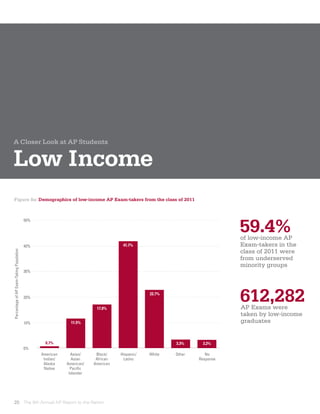
 Figure 8a: Demographics of low-income AP Exam-takers from the class of 2011


                                                                                                                         59.4%
                                          50%


                                          40%                                      41.7%
                                                                                                                         
                                                                                                                         of low-income AP
                                                                                                                         Exam-takers in the
                                                                                                                         class of 2011 were
Percentage of AP Exam-Taking Population


                                                                                                                         from underserved
                                                                                                                         minority groups
                                          30%


                                          20%

                                                                        17.0%
                                                                                              22.7%
                                                                                                                         612,282
                                                                                                                         
                                                                                                                         AP Exams were
                                                                                                                         taken by low-income
                                          10%                11.5%                                                       graduates


                                                  0.7%                                                3.3%     3.2%
                                          0%
                                                American     Asian/     Black/    Hispanic/   White   Other      No
                                                 Indian/      Asian     African    Latino                     Response
                                                 Alaska    American/   American
                                                 Native      Pacific
                                                            Islander


  20 The 8th Annual AP Report to the Nation
A Closer Look at AP Students


Black/African American
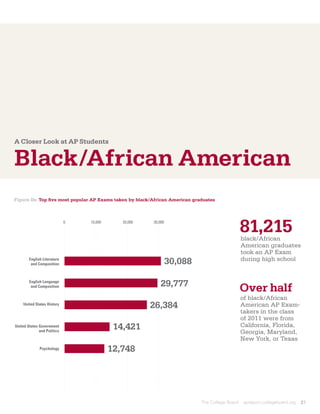
Figure 8b: Top five most popular AP Exams taken by black/African American graduates


                             0   10,000      20,000      30,000

                                                                                                 81,215
                                                                                                 
                                                                                                 black/African
                                                                                                 American graduates
                                                                                                 took an AP Exam
                                                                                                 during high school
        English Literature
         and Composition                                          30,088

        English Language
                                                             29,777
         and Composition
                                                                                                 Over half
                                                                                                 of black/African
    United States History
                                                        26,384                                    American AP Exam-
                                                                                                  takers in the class
                                                                                                  of 2011 were from
United States Government
              and Politics
                                           14,421                                                 California, Florida,
                                                                                                  Georgia, Maryland,
                                                                                                  New York, or Texas
              Psychology                  12,748


                                                                             The College Board    apreport.collegeboard.org   21
A Closer Look at AP Students


Hispanic/Latino
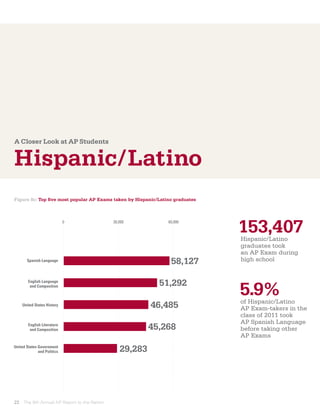
Figure 8c: Top five most popular AP Exams taken by Hispanic/Latino graduates


                             0              30,000              60,000

                                                                               153,407
                                                                               
                                                                               Hispanic/Latino
                                                                               graduates took
                                                                                an AP Exam during
       Spanish Language                                          58,127         high school


                                                            51,292
                                                                               5.9%
        English Language
         and Composition


    United States History                                46,485                
                                                                               of Hispanic/Latino
                                                                               AP Exam-takers in the
                                                                               class of 2011 took
                                                                               AP Spanish Language
        English Literature
         and Composition                                45,268                 before taking other
                                                                               AP Exams
United States Government
              and Politics                     29,283


22 The 8th Annual AP Report to the Nation
A Closer Look at AP Students


American Indian/
Alaska Native
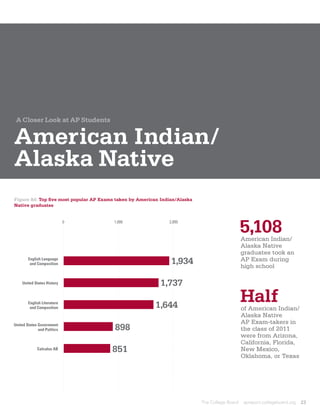
Figure 8d: Top five most popular AP Exams taken by American Indian/Alaska
Native graduates


                             0           1,000                 2,000

                                                                                                5,108
                                                                                                
                                                                                                American Indian/
                                                                                                Alaska Native
                                                                                                graduates took an
        English Language
         and Composition                                        1,934                           AP Exam during
                                                                                                high school

    United States History                                  1,737
        English Literature
         and Composition                                 1,644
                                                                                                Half
                                                                                                
                                                                                                of American Indian/
                                                                                                Alaska Native
                                                                                                AP Exam-takers in
United States Government
              and Politics               898                                                    the class of 2011
                                                                                                were from Arizona,
                                                                                                California, Florida,
             Calculus AB                851                                                     New Mexico,
                                                                                                Oklahoma, or Texas


                                                                            The College Board   apreport.collegeboard.org   23
Supporting STEM
                 We need to support student engagement and success in STEM subjects
                 today to ensure an innovative and healthy society tomorrow. AP STEM
                 courses and exams — and the kinds of critical thinking, experimentation,
                 and problem-solving they cultivate — support national efforts to increase
                 student achievement in these critical subjects.

                 	 Participation and success in AP STEM subjects have increased over
                 the last 10 years, but our work isn’t done. To ensure that more students
                 succeed in these subjects, we need to continue to work with schools,
                 districts, states, and higher education institutions to provide more
                 opportunities to prepare students for the challenges of these subjects
                 in middle school and the early high school years. Turn to pages 26 and
                 27 for strategies to support STEM.


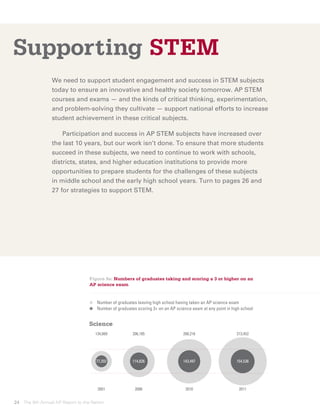
                                  Figure 9a: Numbers of graduates taking and scoring a 3 or higher on an
                                  AP science exam


                                   	 Number of graduates leaving high school having taken an AP science exam
                                   	 Number of graduates scoring 3+ on an AP science exam at any point in high school


                                  Science
                                     134,669           206,185                   288,216                    313,452


                                     77,202            114,826                   143,497                    154,536


                                      2001              2006                      2010                       2011


24 The 8th Annual AP Report to the Nation
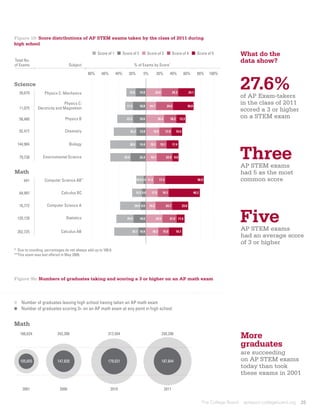
Figure 10: Score distributions of AP STEM exams taken by the class of 2011 during
high school

                                                    Score of 1         Score of 2                Score of 3                Score of 4                 Score of 5               What do the
Total No.                                                                                                                                                                      data show?
of Exams                           Subject                                        % of Exams by Score*

                                             80%      60%        40%       20%              0%            20%           40%            60%            80%     100%

Science
   26,679          Physics C: Mechanics                                    13.8          14.9            23.0              24.3              24.1
                                                                                                                                                                               27.6%
                                                                                                                                                                               
                                                                                                                                                                               of AP Exam-takers
                              Physics C:
                                                                          11.5           18.8     14.7               24.9                    30.0
                                                                                                                                                                               in the class of 2011
   11,075     Electricity and Magnetism                                                                                                                                        scored a 3 or higher
   58,460                      Physics B                                  23.5           18.6              26.4         18.2      13.3
                                                                                                                                                                               on a STEM exam

   92,477                      Chemistry                                       33.2      13.9         19.5          17.9       15.5


  144,984                          Biology


                                                                                                                                                                               Three
                                                                               38.0      14.4      15.1      15.1          17.4


   79,738        Environmental Science                                  29.9             22.4      15.7             22.9 9.0

                                                                                                                                                                               AP STEM exams
Math                                                                                                                                                                            had 5 as the most
      641         Computer Science AB**                                               10.9 3.4 11.4          17.3                                      56.9                     common score

   64,997                    Calculus BC                                              14.2 6.0     17.5          16.1                               46.2


   16,772           Computer Science A                                            29.6 8.0        14.2              24.7              23.6


  120,128                       Statistics                                25.0           18.0             24.5          21.0 11.6
                                                                                                                                                                               Five
                                                                                                                                                                               
                                                                                                                                                                               AP STEM exams
  202,725                    Calculus AB                                         35.1 10.9          18.3         15.9          19.7
                                                                                                                                                                               had an average score
                                                                                                                                                                               of 3 or higher
* Due to rounding, percentages do not always add up to 100.0.
**This exam was last offered in May 2009.                          29.9                  22.4      15.7             22.9 9.0


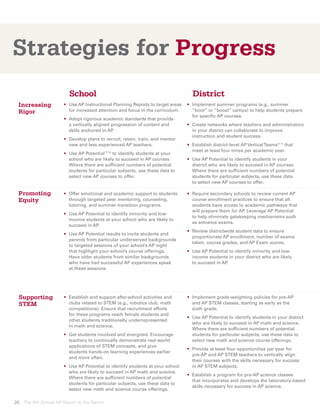
Figure 9b: Numbers of graduates taking and scoring a 3 or higher on an AP math exam


 	 Number of graduates leaving high school having taken an AP math exam
 	 Number of graduates scoring 3+ on an AP math exam at any point in high school


Math
   166,624                242,288                         312,504                                                330,296
                                                                                                                                                                               More
                                                                                                                                                                               graduates
                                                                                                                                                                               are succeeding
   105,655                147,820                         179,031                                                187,844                                                       on AP STEM exams
                                                                                                                                                                               today than took
                                                                                                                                                                               these exams in 2001

     2001                   2006                            2010                                                  2011


                                                                                                                                                           The College Board    apreport.collegeboard.org   25
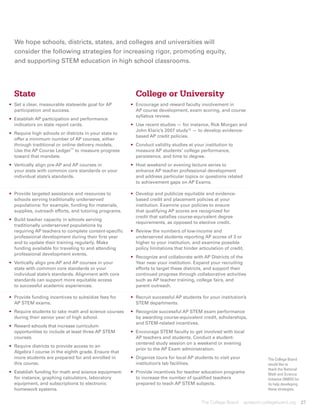
Strategies for Progress
                         School                                                    District
 Increasing           •	 se AP Instructional Planning Reports to target areas
                        U                                                        •	
                                                                                   Implement summer programs (e.g., summer
 Rigor                  for increased attention and focus in the curriculum.       “boot” or “boost” camps) to help students prepare
                                                                                   for specific AP courses.
                      •	
                        Adopt rigorous academic standards that provide
                        a vertically aligned progression of content and          •	
                                                                                   Create networks where teachers and administrators
                        skills anchored in AP .                                    in your district can collaborate to improve
                                                                                   instruction and student success.
                      •	
                        Develop plans to recruit, retain, train, and mentor
                        new and less experienced AP teachers.                    •	Establish district-level AP Vertical Teams® 11 that
                                                                                    meet at least four times per academic year.
                      •	Use AP Potential™10 to identify students at your
                         school who are likely to succeed in AP courses.           Use AP Potential to identify students in your
                                                                                 •	
                         Where there are sufficient numbers of potential           district who are likely to succeed in AP courses.
                         students for particular subjects, use these data to       Where there are sufficient numbers of potential
                         select new AP courses to offer.                           students for particular subjects, use these data
                                                                                   to select new AP courses to offer.

 Promoting            •	
                        Offer emotional and academic support to students         •	
                                                                                   Require secondary schools to review current AP
 Equity                 through targeted peer mentoring, counseling,               course enrollment practices to ensure that all
                        tutoring, and summer transition programs.                  students have access to academic pathways that
                                                                                   will prepare them for AP Leverage AP Potential
                                                                                                           .
                      •	
                        Use AP Potential to identify minority and low-
                                                                                   to help eliminate gatekeeping mechanisms such
                        income students at your school who are likely to
                                                                                   as entrance exams.
                        succeed in AP.
                                                                                 •	
                                                                                   Review districtwide student data to ensure
                      •	
                        Use AP Potential results to invite students and
                                                                                   proportionate AP enrollment, number of exams
                        parents from particular underserved backgrounds
                                                                                   taken, course grades, and AP Exam scores.
                        to targeted sessions of your school’s AP night
                        that highlight your school’s course offerings.           •	
                                                                                   Use AP Potential to identify minority and low-
                        Have older students from similar backgrounds               income students in your district who are likely
                        who have had successful AP experiences speak               to succeed in AP.
                        at these sessions.


  Supporting          •	
                        Establish and support after-school activities and        •	
                                                                                   Implement grade-weighting policies for pre-AP
  STEM                  clubs related to STEM (e.g., robotics club, math           and AP STEM classes, starting as early as the
                        competitions). Ensure that recruitment efforts             sixth grade.
                        for these programs reach female students and
                                                                                 •	
                                                                                   Use AP Potential to identify students in your district
                        other students traditionally underrepresented
                                                                                   who are likely to succeed in AP math and science.
                        in math and science.
                                                                                   Where there are sufficient numbers of potential
                      •	
                        Get students involved and energized. Encourage             students for particular subjects, use these data to
                        teachers to continually demonstrate real-world             select new math and science course offerings.
                        applications of STEM concepts, and give
                                                                                 •	
                                                                                   Provide at least four opportunities per year for
                        students hands-on learning experiences earlier
                                                                                   pre-AP and AP STEM teachers to vertically align
                        and more often.
                                                                                   their courses with the skills necessary for success
                      •	
                        Use AP Potential to identify students at your school       in AP STEM subjects.
                        who are likely to succeed in AP math and science.
                                                                                 •	
                                                                                   Establish a program for pre-AP science classes
                        Where there are sufficient numbers of potential
                                                                                   that incorporates and develops the laboratory-based
                        students for particular subjects, use these data to
                                                                                   skills necessary for success in AP science.
                        select new math and science course offerings.

26 The 8th Annual AP Report to the Nation
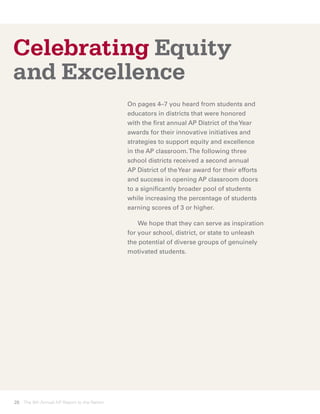
We hope schools, districts, states, and colleges and universities will
  consider the following strategies for increasing rigor, promoting equity,
  and supporting STEM education in high school classrooms.


  State                                                  College or University
•	
  Set a clear, measurable statewide goal for AP        •	
                                                         Encourage and reward faculty involvement in
  participation and success.                             AP course development, exam scoring, and course
                                                         syllabus review.
•	
  Establish AP participation and performance
  indicators on state report cards.                    •	
                                                         Use recent studies — for instance, Rick Morgan and
                                                         John Klaric’s 2007 study13 — to develop evidence-
•	
  Require high schools or districts in your state to
                                                         based AP credit policies.
  offer a minimum number of AP courses, either
  through traditional or online delivery models.       •	
                                                         Conduct validity studies at your institution to
                             12
  Use the AP Course Ledger to measure progress           measure AP students’ college performance,
  toward that mandate.                                   persistence, and time to degree.
  Vertically align pre-AP and AP courses in
•	                                                    •	
                                                         Host weekend or evening lecture series to
  your state with common core standards or your          enhance AP teacher professional development
  individual state’s standards.                          and address particular topics or questions related
                                                         to achievement gaps on AP Exams.

•	
  Provide targeted assistance and resources to         •	
                                                         Develop and publicize equitable and evidence-
  schools serving traditionally underserved              based credit and placement policies at your
  populations: for example, funding for materials,       institution. Examine your policies to ensure
  supplies, outreach efforts, and tutoring programs.     that qualifying AP scores are recognized for
                                                         credit that satisfies course-equivalent degree
•	
  Build teacher capacity in schools serving
                                                         requirements, as opposed to elective credit.
  traditionally underserved populations by
  requiring AP teachers to complete content-specific   •	
                                                         Review the numbers of low-income and
  professional development during their first year       underserved students reporting AP scores of 3 or
  and to update their training regularly. Make           higher to your institution, and examine possible
  funding available for traveling to and attending       policy limitations that hinder articulation of credit.
  professional development events.
                                                       •	
                                                         Recognize and collaborate with AP Districts of the
•	
  Vertically align pre-AP and AP courses in your         Year near your institution. Expand your recruiting
  state with common core standards or your               efforts to target these districts, and support their
  individual state’s standards. Alignment with core      continued progress through collaborative activities
  standards can support more equitable access            such as AP teacher training, college fairs, and
  to successful academic experiences.                    parent outreach.

•	
  Provide funding incentives to subsidize fees for     •	
                                                         Recruit successful AP students for your institution’s
  AP STEM exams.                                         STEM departments.
•	
  Require students to take math and science courses    •	
                                                         Recognize successful AP STEM exam performance
  during their senior year of high school.               by awarding course-equivalent credit, scholarships,
                                                         and STEM-related incentives.
•	eward schools that increase curriculum
  R
  opportunities to include at least three AP STEM      •	
                                                         Encourage STEM faculty to get involved with local
  courses.                                               AP teachers and students. Conduct a student-
                                                         centered study session on a weekend or evening
•	
  Require districts to provide access to an
                                                         prior to the AP Exam administration.
  Algebra I course in the eighth grade. Ensure that
  more students are prepared for and enrolled in       •	
                                                         Organize tours for local AP students to visit your              The College Board
  this course.                                           institution’s lab facilities.                                   would like to
                                                                                                                         thank the National
•	stablish funding for math and science equipment:
  E                                                    •	
                                                         Provide incentives for teacher education programs               Math and Science
  for instance, graphing calculators, laboratory         to increase the number of qualified teachers                    Initiative (NMSI) for
  equipment, and subscriptions to electronic             prepared to teach AP STEM subjects.                             its help developing
  homework systems.                                                                                                      these strategies.


                                                                                         The College Board    apreport.collegeboard.org          27
Celebrating Equity
and Excellence
                                            On pages 4–7 you heard from students and
                                            educators in districts that were honored
                                            with the first annual AP District of the Year
                                            awards for their innovative initiatives and
                                            strategies to support equity and excellence
                                            in the AP classroom. The following three
                                            school districts received a second annual
                                            AP District of the Year award for their efforts
                                            and success in opening AP classroom doors
                                            to a significantly broader pool of students
                                            while increasing the percentage of students
                                            earning scores of 3 or higher.

                                            	 We hope that they can serve as inspiration
                                            for your school, district, or state to unleash
                                            the potential of diverse groups of genuinely
                                            motivated students.


28 The 8th Annual AP Report to the Nation
“ ur teachers have worked tirelessly to increase rigor in their classes,
                                     O
                                     and to coach and support students who had never experienced an
                                     AP course before. Our students have really stepped up, too. I’m sure
                                     there have been times when they felt like giving up, or times when
                                     they thought the work was too difficult. Nonetheless, they persevered
                                     and are now reaping the benefits from all that hard work.
                                     	 “We intentionally sought out capable students (including those
                                     from underrepresented populations) for this initiative. We knew there
                                     were many with great potential, but who had not yet been stretched
                                     academically to meet the demands of the challenging AP course work.
                                     By actively recruiting these students, working with their parents, and
                                     providing them with the support they needed to be successful, our
                                     students have soared! While we know this journey is still in its early
                                     stages, we are extremely proud of our teachers and students.   ”
                                     —Sherrie B. Nickell, Superintendent


Celebrating Equity and Excellence

Polk County Public Schools, Florida


                                                           The College Board   apreport.collegeboard.org   29
“ tudent achievement continues to increase, as measured by Val Verde
                                             S
                                             Unified School District’s rising test scores and college admission
                                             rates. In addition, several local schools have been recognized across
                                             the state and nation for raising academic achievement standards
                                             among all students. This is made possible by a talented and dedicated
                                             staff working with exceptional students who have strong support
                                             from parents and the community.     ”
                                             —Alan Jensen, Superintendent


Celebrating Equity and Excellence

Val Verde Unified School District, California


30 The 8th Annual AP Report to the Nation
“ eing named the small district winner by the College Board is a
                                     B
                                     great distinction for Copiague. This ranking has been achieved due
                                     to the commitment of our students and the dedication of our high
                                     school administrators and Advanced Placement teachers. We’ve
                                     always known that we had the student and staff talent to succeed at
                                     the Advanced Placement level, and this recognition clearly supports
                                     that. As a district, we continually strive for ways to raise the bar
                                     academically and to offer our students opportunities to excel. This
                                     honor puts Copiague on par with high-achieving districts throughout
                                     the country and allows our students the chance to compete on a
                                     global level.”
                                     —Charles A. Leunig, Superintendent


Celebrating Equity and Excellence

Copiague Public Schools, New York


                                                          The College Board   apreport.collegeboard.org   31
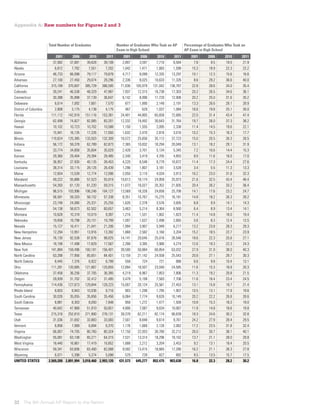
Appendix A: Raw numbers for Figures 2 and 3


                       Total Number of Graduates                 Number of Graduates Who Took an AP       Percentage of Graduates Who Took an
                                                                 Exam in High School                      AP Exam in High School
                            2001      2006      2010      2011       2001      2006      2010      2011       2001     2006      2010      2011
Alabama                   37,082    37,681    39,628    39,108      2,897     3,597     7,710     8,584         7.8      9.5      19.5     21.9
Alaska                     6,812     7,782     7,551     7,202      1,042     1,471     1,683     1,599       15.3      18.9      22.3      22.2
Arizona                   46,733    66,098    79,117    79,878      4,717     8,099    12,335    13,297        10.1     12.3      15.6      16.6
Arkansas                  27,100    27,450    29,074    28,296      2,336     8,025    10,633    11,326         8.6     29.2      36.6      40.0
California               315,189 370,697 385,728 386,595           71,836   105,979   131,042   136,787       22.8      28.6      34.0      35.4
Colorado                  39,241    46,538    48,329    47,987      7,937    12,315    16,738    17,303        20.2     26.5      34.6      36.1
Connecticut               30,388    35,998    37,139    36,647      6,142     8,996    11,720    12,906        20.2     25.0      31.6      35.2
Delaware                   6,614     7,092     7,661     7,570        877     1,890     2,149     2,191        13.3     26.6      28.1      28.9
District of Columbia       2,808     3,175     4,138     4,175        467       629     1,037     1,084        16.6     19.8      25.1      26.0
Florida                  111,112 142,918 151,116 153,381           24,401    44,805    65,658    72,685        22.0     31.4      43.4      47.4
Georgia                   62,499    74,827    82,085    83,201     12,332    19,492    30,643    31,764        19.7     26.0      37.3      38.2
Hawaii                    10,102    10,723    10,702    10,588      1,150     1,555     2,095     2,338       11.4      14.5      19.6      22.1
Idaho                     15,941    16,135    17,226    17,050      1,632     2,470     2,816     3,016       10.2      15.3      16.3      17.7
Illinois                 110,624 125,385 133,503 132,309           16,572    25,656    35,112    37,723        15.0     20.5      26.3      28.5
Indiana                   56,172    59,378    62,789    62,873      7,365    10,832    18,294    20,049        13.1     18.2      29.1      31.9
Iowa                      33,774    34,858    35,604    35,029      2,428     3,701     5,134     5,345         7.2     10.6      14.4      15.3
Kansas                    29,360    29,404    29,394    28,485      2,340     3,419     4,705     4,853         8.0     11.6      16.0      17.0
Kentucky                  36,957    37,930    40,135    39,453      4,220     6,548     9,779    10,872        11.4     17.3      24.4      27.6
Louisiana                 38,314    33,115    28,126    26,439      1,296     1,807     3,181     3,528         3.4      5.5      11.3      13.3
Maine                     12,654    13,539    12,774    12,096      2,050     3,110     4,034     3,913       16.2      23.0      31.6      32.3
Maryland                  49,222    55,886    57,523    55,919     10,613    18,174    24,959    25,973        21.6     32.5      43.4      46.4
Massachusetts             54,393    61,120    61,220    59,315     11,072    16,027    20,352    21,605        20.4     26.2      33.2      36.4
Michigan                  96,515 103,996 106,246 104,127           13,569    18,326    24,658    25,708        14.1     17.6      23.2      24.7
Minnesota                 56,581    59,320    58,152    57,338      8,351    10,767    15,275    16,181        14.8     18.2      26.3      28.2
Mississippi               23,748    24,080    25,331    25,255      1,626     2,378     3,576     3,605         6.8      9.9      14.1      14.3
Missouri                  54,138    58,673    62,502    60,657      3,463     5,214     8,364     8,560         6.4      8.9      13.4      14.1
Montana                   10,628    10,318    10,019     9,387      1,216     1,531     1,802     1,823       11.4      14.8      18.0      19.4
Nebraska                  19,658    19,798    20,151    19,799      1,097     1,637     2,498     2,665         5.6      8.3      12.4      13.5
Nevada                    15,127    16,411    21,041    21,206      1,994     3,907     5,949     6,217       13.2      23.8      28.3      29.3
New Hampshire             12,294    13,951    13,916    13,392      1,868     2,582     3,160     3,204        15.2     18.5      22.7      23.9
New Jersey                76,130    92,538    97,676    98,025     14,141    20,645    25,016    26,546        18.6     22.3      25.6      27.1
New Mexico                18,199    17,498    17,829    17,567      2,288     3,385     3,980     4,274        12.6     19.3      22.3      24.3
New York                 141,884 159,496 160,181 156,401           39,590    50,884    60,854    63,032        27.9     31.9      38.0      40.3
North Carolina            63,288    77,956    85,651    84,401     13,159    21,142    24,558    25,543        20.8     27.1      28.7      30.3
North Dakota               8,445     7,376     6,922     6,799        558       724       721       888         6.6      9.8      10.4      13.1
Ohio                     111,281 120,685 121,867 120,855           12,894    18,507    23,040    24,585        11.6     15.3      18.9      20.3
Oklahoma                  37,458    36,256    37,705    36,385      4,219     6,967     7,853     7,806        11.3     19.2      20.8      21.5
Oregon                    29,939    31,702    32,412    31,495      3,479     5,199     7,583     7,706        11.6     16.4      23.4      24.5
Pennsylvania             114,436 127,673 129,844 128,223           15,007    20,124    25,561    27,453        13.1     15.8      19.7      21.4
Rhode Island               8,603     9,943    10,036     9,716        903     1,298     1,795     1,907        10.5     13.1      17.9      19.6
South Carolina            30,026    35,055    35,856    35,456      6,064     7,774     9,626    10,149        20.2     22.2      26.8      28.6
South Dakota               8,881     8,303     8,050     7,948        958     1,272     1,477     1,509        10.8     15.3      18.3      19.0
Tennessee                 40,642    47,968    51,910    50,851      4,806     7,087     9,634    10,067        11.8     14.8      18.6      19.8
Texas                    215,316 252,810 271,900 276,131           39,378    62,211    82,174    90,639        18.3     24.6      30.2      32.8
Utah                      31,036    31,692    33,883    33,083      7,507     8,848     9,614     9,761        24.2     27.9      28.4      29.5
Vermont                    6,856     7,089     6,694     6,370      1,176     1,669     2,126     2,062        17.2     23.5      31.8      32.4
Virginia                  66,067    74,705    80,760    80,324     17,150    22,933    30,780    32,212        26.0     30.7      38.1      40.1
Washington                55,081    63,108    65,271    64,315      7,531    13,314    18,296    19,162        13.7     21.1      28.0      29.8
West Virginia             18,440    16,861    17,419    16,852      1,688     2,212     3,204     3,453         9.2     13.1      18.4      20.5
Wisconsin                 59,341    63,606    63,400    62,068      9,592    13,415    16,665    17,280        16.2     21.1      26.3      27.8
Wyoming                    6,071     5,398     5,274     5,098        579       728       827       892         9.5     13.5      15.7      17.5
UNITED STATES          2,569,200 2,891,994 3,018,460 2,993,120    431,573   645,277   852,475   903,630        16.8     22.3      28.2      30.2


32 The 8th Annual AP Report to the Nation
Endnotes


                       Number of Graduates Who Scored 3+ on     Percentage of Graduates Who Scored 3+               1. The Advanced Placement Program and
                                                                                                                       
                       an AP Exam in High School                on an AP Exam in High School                           UW–Madison New Freshmen (Academic
                           2001     2006       2010      2011      2001      2006      2010      2011                  Planning and Analysis, Office of the Provost,
Alabama                   1,552     2,129     3,573     3,872        4.2       5.7       9.0       9.9                 University of Wisconsin–Madison, August 2009),
                                                                                                                       http://apa.wisc.edu/Admissions/APAnalysis.pdf.
Alaska                      664       941     1,080     1,006        9.7     12.1      14.3      14.0
Arizona                   3,102     4,929     6,963     7,675        6.6       7.5       8.8       9.6              2. Coming to Our Senses: Education and the
                                                                                                                       
Arkansas                  1,187     2,652     3,623     3,827        4.4       9.7     12.5      13.5                  American Future (New York: The College Board,
California               49,991    71,007    85,845    90,409      15.9      19.2      22.3      23.4                  2008), http://advocacy.collegeboard.org/sites/
                                                                                                                       default/files/coming-to-our-senses-college-
Colorado                  5,217     7,753    10,330    10,692      13.3       16.7     21.4       22.3
                                                                                                                       board-2008.pdf.
Connecticut               4,397     6,593     8,420     9,270       14.5      18.3      22.7      25.3
Delaware                    536     1,017     1,180     1,172        8.1      14.3     15.4       15.5              3. For more information, visit the College
                                                                                                                       
District of Columbia        190       226       285       276        6.8       7.1       6.9       6.6                 Board’s College Completion Agenda at
Florida                  14,896    24,791    33,636    36,678       13.4      17.3     22.3       23.9                 completionagenda.collegeboard.org.
Georgia                   6,754    10,786    15,668    16,476       10.8      14.4      19.1      19.8              4. The College Completion Agenda 2011 Progress
                                                                                                                       
Hawaii                      629       776     1,001     1,060        6.2       7.2       9.4      10.0                 Report (New York: The College Board, 2011).
Idaho                     1,059     1,508     1,893     2,079        6.6       9.3      11.0      12.2              5. Ibid.
                                                                                                                       
Illinois                 12,150    18,123    23,024    24,449       11.0      14.5      17.2      18.5
                                                                                                                    6. Organisation for Economic Co-operation and
                                                                                                                       
Indiana                   3,696     5,351     7,764     8,773        6.6       9.0      12.4      14.0
                                                                                                                       Development, PISA 2009 Results: What Students
Iowa                      1,686     2,471     3,145     3,392        5.0       7.1       8.8       9.7
                                                                                                                       Know and Can Do, accessed 11/17/11, www.
Kansas                    1,493     2,197     2,805     2,943        5.1       7.5       9.5      10.3                 oecd.org/edu/pisa/2009.
Kentucky                  2,208     3,331     4,903     5,393        6.0       8.8      12.2      13.7
                                                                                                                    7. Ibid.
Louisiana                   726       839     1,306     1,474        1.9       2.5       4.6       5.6
Maine                     1,371     1,921     2,430     2,462       10.8      14.2      19.0      20.4              8. Underserved minorities are defined throughout
                                                                                                                       
Maryland                  7,309    12,082    15,167    15,610       14.8      21.6      26.4      27.9                 this report as American Indian/Alaska Native,
Massachusetts             7,956    11,537    14,122    15,129       14.6      18.9      23.1      25.5                 black/African American, and Hispanic/Latino.
Michigan                  8,620    12,083    15,914    16,628        8.9      11.6      15.0      16.0              9. “AP potential” is defined here as a 70 percent
                                                                                                                       
Minnesota                 4,844     7,120     9,795    10,493        8.6      12.0      16.8      18.3                 or greater likelihood of scoring a 3 or higher
Mississippi                 630       798     1,115     1,133        2.7       3.3       4.4       4.5                 on an AP Exam. These data are based on
Missouri                  2,208     3,396     4,682     4,959        4.1       5.8       7.5       8.2                 2,005,862 public school PSAT/NMSQT® takers
                                                                                                                       in the class of 2011. Students were classified
Montana                     757     1,011     1,174     1,196        7.1       9.8      11.7      12.7
                                                                                                                       as taking a recommended AP subject if they
Nebraska                    684     1,018     1,497     1,605        3.5       5.1       7.4       8.1
                                                                                                                       completed an AP Exam in a subject for which
Nevada                    1,270     2,298     3,148     3,451        8.4      14.0      15.0      16.3                 they had potential to succeed.
New Hampshire             1,251     1,808     2,311     2,453       10.2      13.0      16.6      18.3
New Jersey               10,146    14,740    18,214    19,486       13.3      15.9      18.6      19.9             10.  P Potential is a free, Web-based tool that
                                                                                                                       A
                                                                                                                       uses PSAT/NMSQT results to find students
New Mexico                1,178     1,623     1,820     1,954        6.5       9.3      10.2      11.1
                                                                                                                       who are likely to succeed in AP. For more
New York                 26,463    33,430    39,462    41,427       18.7      21.0      24.6      26.5
                                                                                                                       information, visit appotential.collegeboard.org.
North Carolina            7,946    12,291    14,995    15,496       12.6      15.8      17.5      18.4
North Dakota                402       517       474       555        4.8       7.0       6.8       8.2             11.  n AP Vertical Team is a group of middle
                                                                                                                       A
                                                                                                                       and high school educators (usually teachers
Ohio                      8,059    11,552    14,323    15,453        7.2       9.6      11.8      12.8
                                                                                                                       of grades six through 12) in a particular subject
Oklahoma                  2,316     3,339     3,895     3,892        6.2       9.2      10.3      10.7
                                                                                                                       area who work cooperatively to develop
Oregon                    2,259     3,227     4,579     4,719        7.5      10.2      14.1      15.0                 and implement vertically aligned curricula
Pennsylvania             10,093    13,561    16,488    17,708        8.8      10.6      12.7      13.8                 to facilitate student preparedness for AP
Rhode Island                530       844     1,095     1,168        6.2       8.5      10.9      12.0                 courses in that subject area and for college.
South Carolina            3,554     4,532     5,409     5,855       11.8      12.9      15.1      16.5
                                                                                                                   12.  or more information,
                                                                                                                       F
South Dakota                557       762       882       974        6.3       9.2      11.0      12.3                 visit www.collegeboard.org/apcourseledger.
Tennessee                 2,838     4,074     5,017     5,274        7.0       8.5       9.7      10.4
                                                                                                                   13.  ick Morgan and John Klaric, AP Students in
                                                                                                                       R
Texas                    22,546    34,709    42,226    46,013       10.5      13.7      15.5      16.7
                                                                                                                       College: An Analysis of Five-Year Academic
Utah                      5,231     6,113     6,503     6,853       16.9      19.3      19.2      20.7
                                                                                                                       Careers (New York: The College Board, 2007).
Vermont                     817     1,118     1,460     1,361       11.9      15.8      21.8      21.4
Virginia                 10,900    14,751    19,162    20,542       16.5      19.7      23.7      25.6
Washington                5,002     8,154    11,182    11,812        9.1      12.9      17.1      18.4
West Virginia               896     1,065     1,328     1,483        4.9       6.3       7.6       8.8
Wisconsin                 6,401     9,348    11,615    12,058       10.8      14.7      18.3      19.4
Wyoming                     340       368       450       501        5.6       6.8       8.5       9.8
UNITED STATES           277,507   402,610   508,378   540,619       10.8      13.9      16.8      18.1


                                                                                                         The College Board     apreport.collegeboard.org              33
About the College Board
The College Board is a mission-driven
not-for-profit organization that connects
students to college success and opportunity.
Founded in 1900, the College Board was
created to expand access to higher education.
Today, the membership association is
made up of more than 5,900 of the world’s
leading educational institutions and is
dedicated to promoting excellence and
equity in education. Each year, the College
Board helps more than seven million
students prepare for a successful transition
to college through programs and services
in college readiness and college success —
including the SAT® and the Advanced
Placement Program®. The organization
also serves the education community
through research and advocacy on behalf
of students, educators and schools.

For further information,
visit www.collegeboard.org.

For more copies of this report
The 8th Annual AP Report to the Nation
may be downloaded as a PDF from
apreport.collegeboard.org.

Printed copies may be ordered free of
charge at www.collegeboard.org/freepubs.


© 2012 The College Board. College Board, Advanced
Placement Program, AP, AP Vertical Teams, SAT and the
acorn logo are registered trademarks of the College Board.
AP Potential is a trademark owned by the College Board.
PSAT/NMSQT is a registered trademark of the College
Board and National Merit Scholarship Corporation.            120084774 12b-5036

2012 AP Report to the Nation

  • 1.
    The 8th Annual AP Report to the Nation ® February 8, 2012 Knowledge | Skills | Behaviors | Awareness
  • 2.
    About the Data Becausea central source of demographic data for nonpublic schools is not available for all states, this report represents public school students only. References to the total number of high school graduates represent projections supplied in Knocking at the College Door (Western Interstate Commission for Higher Education, 2008). Additionally, this report looks at students’ entire experience with AP — tracking exams taken by seniors throughout their high school career — as opposed to just reporting exam results from a particular calendar year. Additional data are available exclusively online at apreport.collegeboard.org.
  • 3.
    Table of Contents 2 AP®: A Collaborative Community 4 in a Classroom: Whitney M. Young Magnet School, Chicago Public Schools AP 6 AP in a District: Colton Joint Unified School District, Colton, California 8 AP in a University: University of Wisconsin–Madison 10 Working Toward the Nation’s Goals, Together 1 2 Increasing Rigor 16 Promoting Equity 24 Supporting STEM 2 6 Strategies for Progress 28 Celebrating Equity and Excellence 32 Appendix and Endnotes
  • 4.
    The AP ® “ Experience in: The AP courses that I completed helped me A Classroom build the confidence and acquire the knowledge ” A District A University that is necessary to dive into college. Zachary Stuart, Former AP Student and Stanford University Freshman AP : A Collaborative ® 2 The 8th Annual AP Report to the Nation
  • 5.
    In classrooms aroundthe country, AP teachers What do the are preparing students for tomorrow by teaching data show? them how to think and learn today. AP students learn to construct solid arguments, test theories, and see many sides of an issue — the kind of 903,630 U.S. public high school thinking that solves tough problems both in and graduates took at outside the classroom, in college and beyond. least one AP Exam AP Coordinators, counselors, principals, and 128,568 district officials support AP teachers by providing professional development opportunities and other crucial resources. They offer a broad range of AP U .S. high school teachers taught an courses and exams so that motivated students AP course can develop their passions and talents — whether they’re interested in art, history, languages, 21,328 literature, math, or science. At colleges and universities, the collaboration AP Coordinators, continues. College faculty review syllabi, develop counselors, and AP course and exam content, score exams, and principals administered AP Exams or used AP perform research to ensure that the exams assess data to shape their a college level of achievement. Admission officials schools’ programs recognize the achievement of AP students, who demonstrate through successful exam scores that they are ready for the challenge of higher education 5,808 college faculty Community participated in reviewing AP teachers’ syllabi, developing curricula, or scoring AP Exams and can, in turn, contribute new thoughts and ideas to the communities at their colleges and universities. On the following pages, you’ll hear from some of the people who make this collaboration successful and who have demonstrated a commitment to both equity and excellence in the classroom. The College Board apreport.collegeboard.org 3
  • 6.
    The AP Experience in: A Classroom A District “ To me, it’s about creating an environment where students feel safe and relaxed and are able to ” A University be themselves and interact with each other. Matthew Moran, AP Calculus Teacher AP Calculus Whitney M. Young Magnet School Chicago Public Schools Chicago, Illinois 4 The 8th Annual AP Report to the Nation
  • 7.
    At Whitney M.Young Magnet School in Chicago, What do the AP Calculus teacher Matthew Moran works data show? hard to create a collaborative environment where students are challenged and inspired. Zachary Stuart, who graduated from Whitney Young in 202,725 U.S. public high 2011, fondly recalls Mr. Moran’s enthusiasm school graduates took for math and his ability to develop creative AP Calculus AB assignments that effectively prepared him for the AP Exam. Now in his freshman year at Stanford University, where he plans to major in mechanical engineering, Zachary attributes much of his 14,537 U.S. high school academic success to AP: “The AP courses that teachers taught I completed helped me build the confidence AP Calculus AB in in 2010-11 and acquire the knowledge that is necessary to dive into college. ” Mr. Moran said, “There were a lot of classes in these kids’ history where mathematics was boring — a lot about formulas and getting to the right answer. That’s not what we do in my class … Mathematics is fascinating and it’s useful. And we talk about how useful it is and the applications. ” But Mr. Moran’s class is popular not only because he promotes the practical applications of calculus. Classroom “To me, it’s about creating an environment where students feel safe and relaxed and are able to be themselves and interact with each other, he said. ” “It takes a long time to foster that community in my classroom, but when we finally get there, it’s really a good feeling.” To see interviews with Zachary Stuart and Matthew Moran, visit apreport.collegeboard.org. The College Board apreport.collegeboard.org 5
  • 8.
    The AP Experience in: A Classroom A District “ We have a lot of teachers who have graduated from our district, myself included, that have gone to college and have come back and … have provided the connection to the students ” A University they are currently serving. Jerry Almendarez, Superintendent Colton Joint Unified Colton, California 6 The 8th Annual AP Report to the Nation
  • 9.
    Colton Joint UnifiedSchool District was selected What do the by the College Board as an AP District of the Year data show? last year ­ honored for increasing access to AP — course work while simultaneously increasing the percentage of students earning scores of 3 or 540,619 U.S. public high school higher on AP Exams. graduates scored a 3 or higher Jerry Almendarez, superintendent for Colton Joint 12,926 Unified School District, attributes Colton’s success to its teachers, who serve as role models, offering students real-life examples of how to prepare for U.S. public high schools were college, earn their degrees, and fulfill their dreams represented by for the future. “We have a lot of teachers who have AP Exam-takers in graduated from our district, myself included, that the class of 2011 have gone to college and have come back and … have provided the connection to the students they are currently serving, said Almendarez. “There are ” a lot of caring people here who care not only for improving [the] students’ academic performance but also for the human being. ” This special connection has paid off. Ignacio Cabrera, principal of Bloomington High School in Colton, proudly reported that “one of the programs that has excelled is our math program. We’ve School District had a three-year run of over 98 percent of our students succeeding — and the thing that is really unusual … is that 100 percent succeeded just this past year. ” To see interviews with educators from Colton and another AP District of the Year — New Jersey’s West New York School District — visit apreport.collegeboard.org. The College Board apreport.collegeboard.org 7
  • 10.
    The AP Experience in: A Classroom “ [AP courses on a student’s transcript] tell us that they’re challenging themselves … preparing for the rigor that they will encounter at the A District University of Wisconsin–Madison. These students ” A University are going to be the most successful. Bobbie Jean St. Arnauld, Freshman Admissions Manager University of Madison, Wisconsin 8 The 8th Annual AP Report to the Nation
  • 11.
    In 2011, 75percent of all freshmen entering the University What do the of Wisconsin–Madison came with AP scores — a record data show? high — illustrating heightened competitiveness for the university. Bobbie Jean St. Arnauld, freshman admissions manager at UW–Madison, said that AP courses on 616,412 U.S. public high school students’ transcripts “tell us that they’re challenging graduates reported themselves … preparing for the rigor that they will AP scores to colleges encounter at the University of Wisconsin–Madison. and universities These students are going to be the most successful. ” In 2009, UW–Madison conducted a research study to further explore the value of AP 1 Joanne Berg, vice provost . 3,293 U.S. colleges and for enrollment management, said the study was done universities received “to demystify some of the things we were hearing from AP scores for credit, faculty members. She said the study showed “that ” placement, and/or consideration in the students who took AP credits … were able to graduate admission process sooner than other students, … were able to start advanced courses sooner, and actually free up courses for other students who weren’t able to take AP credits. ” For Gloria Mari-Beffa, professor of mathematics, the study revealed that “students who came with a 3, 4, or 5 on the exams were doing as well or better than those taking our classes and exams. So we used that data to adjust our credit evaluation. ” Wisconsin–Madison AP Reader Charles J. James, professor of German, said, “I worked every summer with teachers who teach AP and my impression is that their courses are just as , rigorous as the courses that we place students into here. ” To see interviews with administrators and faculty from UW–Madison, visit apreport.collegeboard.org. The College Board apreport.collegeboard.org 9
  • 12.
    Working Toward the Nation’sGoals, Together In 2008, the College Board set an ambitious national goal: to increase the percentage of 25- to 34-year-olds who hold an associate degree or higher to 55 percent by 2025.2 The resulting College Completion Agenda is part of a growing national conversation about reestablishing the United States’ position as a global leader in education and ensuring its future prosperity.3 Three goals are critical to this effort: • Increasing rigor; • Promoting equitable access to college-level academic experiences; and • upporting science, technology, engineering, and math S (STEM) education. As you’ll see on page 17, one obstacle to achieving all three goals — in particular, promoting equity — is a troubling opportunity gap among some of the nation’s most promising students. Success is rarely the result of just one element, and AP isn’t a comprehensive solution. But AP — and the dedication and hard work of the students and educators who comprise its collaborative community — is one key ingredient in a larger recipe to support all three of these goals. 10 The 8th Annual AP Report to the Nation
  • 13.
    Increasing Rigor Why is this important? A startling number of students entering college need remediation once they get there. If the U.S. is going to meet the goal of equipping more students to succeed in 37.6% of first- and second- college, schools need to provide motivated students with year undergraduate preparation for and access to demanding, college-level students require remediation4 work in high school. Promoting Equity 19.2% o f Hispanic/Latino Despite strides made in recent years, minority and low- 25- to 34-year-olds income students remain underrepresented not only in the have an associate AP classroom and in the population of successful AP degree or higher5 students but also among Americans with a college degree. Supporting STEM 18.0% of 12th-grade Science, technology, engineering, and math (STEM) students perform education plays a key role in ensuring the nation’s long- at or above the term prosperity. According to a 2009 study of 65 countries, proficient level in science7 the U.S. ranked 23rd in science proficiency and 31st in math.6 AP science and math courses and exams are one way the nation can regain its lead. The College Board apreport.collegeboard.org 11
  • 14.
    Increasing Rigor AP teachers encourage their students to do more, to think more deeply, and to always ask “Why?” — habits and skills crucial for college success. AP may not be right for every student, and it’s not the only answer to increasing rigor in the nation’s classrooms, but it’s a key tool to foster a college-going and college-ready culture. Over the last 10 years, more students than ever before have challenged themselves by engaging in rigorous, college-level AP course work in high school. With that growth in participation, many states have seen a comparable increase in students succeeding on AP Exams. Other states continue to work diligently to close the gap between participation and performance. Together, we’ll continue to make progress. Turn to pages 26 and 27 for strategies that schools, districts, states, and higher education institutions can use to increase rigor and ensure that the nation’s students are prepared for college success. Figure 1: Number of graduates taking and scoring a 3 or higher on an AP Exam Number of graduates leaving high school having taken an AP Exam What do the Number of graduates scoring 3+ on an AP Exam at any point in high school data show? 431,573 645,277 852,475 903,630 More graduates are succeeding 277,507 402,610 508,378 540,619 on AP Exams today than took AP Exams in 2001 2001 2006 2010 2011 12 The 8th Annual AP Report to the Nation
  • 15.
    Figure 2: Percentageof the class of 2011 scoring a 3 or higher on an AP Exam during high school 0% 5% 10% 15% 20% 25% 30% What do the data show? Maryland 27.9 New York 26.5 18.1% Virginia 25.6 Massachusetts 25.5 Connecticut 25.3 Florida 23.9 of U.S. public high California 23.4 school graduates Colorado 22.3 took AP courses and Vermont 21.4 scored a 3 or higher Utah 20.7 Maine 20.4 on an AP Exam New Jersey 19.9 during high school Georgia 19.8 Wisconsin 19.4 19 Illinois 18.5 North Carolina 18.4 Washington 18.4 Minnesota 18.3 states exceeded the New Hampshire 18.3 UNITED STATES 18.1 national average of Texas 16.7 graduates scoring a South Carolina 16.5 3 or higher Nevada 16.3 Michigan 16.0 Delaware 15.5 Oregon Alaska Indiana 15.0 14.0 14.0 27.9% of Maryland’s Pennsylvania 13.8 Kentucky 13.7 graduates scored Arkansas 13.5 a 3 or higher on Ohio 12.8 an AP Exam, leading Montana 12.7 the nation South Dakota 12.3 Idaho 12.2 Rhode Island 12.0 New Mexico 11.1 Oklahoma 10.7 Tennessee 10.4 Kansas 10.3 Hawaii 10.0 Alabama 9.9 Wyoming 9.8 Iowa 9.7 Arizona 9.6 West Virginia 8.8 Missouri 8.2 North Dakota 8.2 Nebraska 8.1 National District of Columbia 6.6 Average Louisiana Mississippi 5.6 4.5 18.1% Raw numbers for this figure are available in Appendix A. Ties are alphabetized by state name. The College Board apreport.collegeboard.org 13
  • 16.
    Figure 3: Percentageof the classes of 2001 and 2011 scoring a 3 or higher on an AP Exam during high school, ranked by percentage point change What do the Change 2001 % 2011 % data show? Maryland 13.1 14.8 27.9 Massachusetts 10.9 14.6 25.5 10 points Connecticut Florida Minnesota 10.8 10.5 9.7 14.5 13.4 8.6 25.3 23.9 18.3 7.3 point increase Maine 9.6 10.8 20.4 Vermont 9.5 11.9 21.4 since 2001 in the Washington 9.3 9.1 18.4 percentage of Arkansas 9.1 4.4 13.5 U.S. public high Virginia 9.1 16.5 25.6 school graduates Colorado 9.0 13.3 22.3 earning AP scores Georgia 9.0 10.8 19.8 of 3 or higher Wisconsin 8.6 10.8 19.4 New Hampshire 8.1 10.2 18.3 Nevada 7.9 8.4 16.3 22 New York 7.8 18.7 26.5 Kentucky 7.7 6.0 13.7 California 7.5 15.9 23.4 Illinois 7.5 11.0 18.5 states had a Oregon 7.5 7.5 15.0 larger percentage Delaware 7.4 8.1 15.5 point change over Indiana 7.4 6.6 14.0 time than the UNITED STATES 7.3 10.8 18.1 national average Michigan 7.1 8.9 16.0 New Jersey 6.6 13.3 19.9 Texas 6.2 10.5 16.7 13.1 South Dakota 6.0 6.3 12.3 North Carolina 5.8 12.6 18.4 Rhode Island 5.8 6.2 12.0 Alabama 5.7 4.2 9.9 point increase in Idaho 5.6 6.6 12.2 the percentage of Montana 5.6 7.1 12.7 Maryland’s graduates Ohio 5.6 7.2 12.8 scoring a 3 or higher Kansas 5.2 5.1 10.3 Pennsylvania 5.0 8.8 13.8 on an AP Exam over 5 points Iowa 4.7 5.0 9.7 the past 10 years, South Carolina 4.7 11.8 16.5 leading the nation Nebraska 4.6 3.5 8.1 New Mexico 4.6 6.5 11.1 Oklahoma 4.5 6.2 10.7 Alaska 4.3 9.7 14.0 Wyoming 4.2 5.6 9.8 Missouri 4.1 4.1 8.2 West Virginia 3.9 4.9 8.8 Hawaii 3.8 6.2 10.0 Utah 3.8 16.9 20.7 Louisiana 3.7 1.9 5.6 North Dakota 3.4 4.8 8.2 Tennessee 3.4 7.0 10.4 Arizona 3.0 6.6 9.6 Mississippi 1.8 2.7 4.5 0 points District of Columbia -0.2 6.8 6.6 Raw numbers for this figure are available in Appendix A. Ties are alphabetized by state name. 14 The 8th Annual AP Report to the Nation
  • 17.
    Figure 4: Scoredistributions of AP Exams taken by the class of 2011 during high school Score of 1 Score of 2 Score of 3 Score of 4 Score of 5 States No. of Exams % of Exam Scores 80% 60% 40% 20% 0% 20% 40% 60% 80% Alabama 23,687 32.3 24.5 21.6 13.5 8.2 Alaska 4,243 14.8 22.2 25.8 21.2 16.0 Arizona 35,795 23.2 22.4 24.1 17.4 12.9 Arkansas 33,390 43.6 27.0 17.0 8.5 3.9 California 451,215 20.4 20.9 23.6 19.7 15.4 Colorado 48,801 18.7 21.5 26.4 20.0 13.4 Connecticut 36,446 13.6 16.4 24.1 24.4 21.4 Delaware 6,454 28.1 21.4 22.3 15.5 12.6 District of Columbia 2,900 53.2 19.7 13.8 8.3 5.0 Florida 260,486 33.8 24.1 20.9 13.4 7.7 Georgia 97,380 25.3 23.2 23.5 17.3 10.7 Hawaii 5,225 31.2 28.1 20.7 12.3 7.8 Idaho 7,919 10.2 20.7 30.3 23.6 15.2 Illinois 112,432 18.3 16.7 22.8 22.9 19.3 Indiana 48,559 35.1 23.0 20.1 13.5 8.3 Iowa 12,915 13.6 20.5 26.3 22.6 17.0 Kansas 12,126 16.8 20.8 27.3 21.4 13.8 Kentucky 31,248 26.1 26.6 23.9 14.6 8.9 Louisiana 7,277 32.1 24.0 21.5 14.0 8.4 Maine 9,946 15.7 23.6 27.3 20.0 13.4 Maryland 90,895 20.2 20.1 23.2 20.1 16.4 Massachusetts 58,286 15.3 16.0 23.3 23.0 22.4 Michigan 64,470 15.5 20.0 25.9 21.9 16.8 Minnesota 45,521 15.1 20.7 26.8 21.7 15.6 Mississippi 7,177 42.4 26.8 18.1 8.6 4.0 Missouri 20,939 19.4 19.8 24.4 20.7 15.7 Montana 3,985 13.3 22.2 28.9 20.5 15.1 Nebraska 6,973 19.8 22.4 26.7 19.9 11.3 Nevada 18,134 26.6 25.2 24.1 15.2 9.0 New Hampshire 7,027 10.1 15.8 28.6 25.0 20.5 New Jersey 76,030 12.2 15.1 23.8 24.9 24.0 New Mexico 10,571 31.5 26.5 20.7 12.7 8.6 New York 190,186 15.7 20.1 25.6 21.8 16.8 North Carolina 78,680 20.1 21.7 24.6 20.0 13.6 North Dakota 1,673 12.4 22.5 31.9 19.5 13.7 Ohio 64,672 16.2 20.0 26.6 21.1 16.2 Oklahoma 21,083 26.0 27.2 24.8 14.6 7.4 Oregon 18,874 18.1 22.2 25.3 20.4 14.1 Pennsylvania 70,881 17.2 17.2 24.0 22.5 19.0 Rhode Island 4,606 21.8 19.2 23.8 19.3 15.8 South Carolina 28,392 20.8 23.6 25.5 18.4 11.7 South Dakota 3,709 11.9 20.5 27.6 23.6 16.4 Tennessee 25,755 24.1 21.7 24.7 18.3 11.2 Texas 301,508 32.1 23.1 20.5 14.7 9.5 Utah 25,753 12.3 19.6 29.0 23.1 15.9 Vermont 4,852 17.5 20.6 27.4 19.8 14.7 Virginia 113,188 18.9 21.5 25.0 19.9 14.7 Washington 54,342 18.7 21.6 25.3 19.6 14.8 West Virginia 8,444 29.0 29.5 23.2 11.4 6.9 Wisconsin 43,224 12.9 18.7 27.7 23.8 16.9 Wyoming 1,810 22.3 23.1 25.6 16.8 12.1 UNITED STATES 2,720,084 22.5 21.3 23.5 18.8 13.9 The College Board apreport.collegeboard.org 15
  • 18.
    Promoting Equity The numbers of traditionally underserved students participating and succeeding in AP are increasing, in large part because of the kinds of efforts made by the students and educators you heard from on pages 4–9. However, underserved minority8 and low-income students remain underrepresented in AP classrooms, and we continue to face challenges in transforming the educational experiences of underserved students in this country. Schools that serve significant populations of minority and low-income students need support, including more professional development opportunities for teachers, and a focus on differentiated instruction and access to rigorous course work for students. Simply expanding access to AP is not enough to promote equity; schools must expand access within a framework that supports teachers to help these students succeed. On pages 26 and 27, you’ll find strategies for supporting teachers and giving underserved students the confidence, encouragement, and preparation they need — both to take the AP challenge and to succeed at it. Figure 5: Demographics of the class of 2011 versus AP Exam-takers Overall Student Population AP Exam-Taker Population What do the 80% data show? Percentage of Population 59.2% 57.1% 60% Black/African 40% American graduates 20% 17.6% 17.0% were the most 14.7% 10.3% 9.0% underrepresented 5.7% 1.1% 0.6% group in AP 0% American Indian/ Asian/ Black/African Hispanic/ White classrooms Alaska Native Asian American/ American Latino Pacific Islander Note: Because some AP Exam-takers identify themselves as “Other” for race/ethnicity or do not provide race/ethnicity, the “AP Exam-Taker Population” in this figure only represents a total of 94.0% of all AP Exam-takers. 16 The 8th Annual AP Report to the Nation
  • 19.
    Fulfilling AP Potential Ensuringthat students realize their full potential is a critical component to achieving the nation’s education goals. The College Board is committed to working with educators to help provide all students with potential for success in AP — regardless of location, ethnicity, or socioeconomic status — an opportunity to maximize their college years by having successful AP experiences. While many schools and districts have worked to increase access to AP hundreds of thousands of prepared students were , either left out of an AP subject for which they had potential or attended a school that did not offer the subject. An analysis of nearly 771,000 graduates with AP potential found that nearly 478,000 (62 percent) did not take a recommended AP subject. Underserved minorities appear to be disproportionately impacted: 74 percent of American Indian/Alaska Native students, 80 percent of black/African American students, and 70 percent of Hispanic/Latino students did not take the recommended AP subject.9 Figure 6: Participation in recommended AP subjects by race/ethnicity of graduates with AP potential 57.9% Four out Took a recommended 26.3% 20.3% 29.6% 38.4% of five AP subject black/African American graduates Did not take a recommended were either left out 42.1% AP subject of an AP subject 61.6% for which they had 73.7% 70.4% 79.7% potential or attended American Indian/ Asian/ Black/African Hispanic/ White a school that did not Alaska Native Asian American/ American Latino offer the subject Pacific Islander The College Board apreport.collegeboard.org 17
  • 20.
    Figure 7: APequity and excellence for Black/African American underserved students % of Successful % of AP Exam-Takers Graduating in Graduating % of Equity and Class 2011 Class 2011 Excellence Achieved 0 50 100+ District of Columbia 90.0 33.7 37.4 90% Defining equity and excellence 80% How well each state is enabling the diversity of its students 70% to succeed in AP can be measured by comparing the 60% Mississippi 50.3 10.9 21.7 demographics of that state with the demographics of its 50% successful AP population. 40% South Carolina 37.9 8.0 21.1 Maryland 35.7 10.8 30.3 For example, in the class of 2011: Georgia 35.1 12.6 35.9 Louisiana 33.7 9.9 29.4 if there are 1,000 students, Alabama 32.4 10.2 31.5 and 250 students (25%) are Hispanic/Latino, 30% Delaware 30.1 7.8 25.9 and if 500 students score a 3 or higher on an AP Exam, North Carolina 29.9 6.8 22.7 Virginia 24.4 6.6 27.0 then 125 Hispanic/Latino students (25%) must Tennessee 21.8 7.8 35.8 score a 3 or higher on an AP Exam in order to achieve Arkansas 21.1 5.3 25.1 100% equity and excellence. Florida 20.1 7.1 35.3 20% Missouri 16.8 3.3 19.6 Illinois 16.0 4.3 26.9 Michigan 16.0 2.2 13.8 New Jersey 16.0 3.2 20.0 Texas 15.8 4.3 27.2 Measuring equity and excellence New York 15.3 4.4 28.8 The tables at right chart each state’s, and the nation’s, progress UNITED STATES 14.7 4.1 27.9 toward achieving equity and excellence. For each state, there Pennsylvania 14.0 2.6 18.6 are three numbers for each race/ethnicity: Ohio 13.8 2.9 21.0 Connecticut 11.9 2.8 23.5 Nevada 11.2 3.0 26.8 Hispanic/Latino Oklahoma 10.1 3.3 32.7 10% % of Successful Kentucky 9.9 3.2 32.3 % of AP Exam-Takers Indiana 9.5 2.5 26.3 Graduating in Graduating % of Equity and Rhode Island 8.9 1.7 19.1 Class 2011 Class 2011 Excellence Achieved Massachusetts 7.2 2.4 33.3 0 50 100+ California 6.9 2.1 30.4 State Name 25.0 25.0 100 Kansas 6.8 2.6 38.2 Wisconsin 6.6 1.2 18.2 Minnesota 6.3 1.7 27.0 25.0 ÷ 25.0 = 100 Arizona Colorado 6.0 5.8 2.2 1.7 36.7 29.3 Nebraska 5.7 1.7 29.8 Washington 4.9 1.8 36.7 Percentage of Percentage of Progress toward Iowa 4.8 0.9 18.8 the successful the class of achieving AP West Virginia 4.7 1.6 34.0 AP Exam-takers 2011 who are equity and Alaska 3.9 2.1 53.8 in the class of Hispanic/Latino excellence for Maine 2.5 1.0 40.0 2011 who are Hispanic/Latino New Mexico 2.5 1.0 40.0 Hispanic/Latino students Oregon 2.4 1.0 41.7 New Hampshire 2.0 0.5 25.0 Hawaii 1.9 1.0 52.6 North Dakota 1.8 0.4 22.2 Vermont 1.6 0.8 50.0 South Dakota 1.2 0.7 58.3 Utah 1.2 0.5 41.7 Wyoming 1.1 0.4 36.4 Idaho 0.7 0.5 71.4 *Precise number of American Indian/Alaska Native graduates for the District of Columbia is not available. Montana 0.7 0.1 14.3 18 The 8th Annual AP Report to the Nation
  • 21.
    Hispanic/Latino American Indian/Alaska Native % of Successful % of Successful % of AP Exam-Takers % of AP Exam-Takers Graduating in Graduating % of Equity and Graduating in Graduating % of Equity and Class 2011 Class 2011 Excellence Achieved Class 2011 Class 2011 Excellence Achieved 0 50 100+ 0 50 100+ 80% 60% 70% 50% 60% 40% 50% 30% New Mexico 49.9 38.6 77.4 Alaska 21.2 2.9 13.7 20% California 42.8 32.5 75.9 Oklahoma 19.8 7.6 38.4 Texas 40.4 33.8 83.7 New Mexico 11.3 1.4 12.4 40% 10% Arizona 35.5 24.1 67.9 Montana 8.1 1.1 13.6 Nevada 32.2 21.1 65.5 North Dakota 6.8 0.5 7.4 30% Florida 24.2 28.4 100+ Arizona 6.0 0.8 13.3 Colorado 22.0 10.9 49.5 South Dakota 5.0 1.1 22.0 20% UNITED STATES 17.6 15.2 86.4 Oregon 2.2 0.7 31.8 New Jersey 17.0 9.7 57.1 Wyoming 2.2 0.4 18.2 Rhode Island 16.0 8.0 50.0 Washington 2.0 0.7 35.0 Illinois 15.1 13.1 86.8 Idaho 1.8 0.5 27.8 Oregon 15.1 7.7 51.0 Minnesota 1.4 0.3 21.4 New York 14.5 12.0 82.8 Utah 1.4 0.5 35.7 Connecticut 12.4 7.0 56.5 Kansas 1.3 0.7 53.8 Washington 11.6 6.5 56.0 Nebraska 1.2 0.6 50.0 Idaho 11.0 3.8 34.5 Nevada 1.2 0.7 58.3 Massachusetts 10.8 5.3 49.1 Wisconsin 1.2 0.2 16.7 Nebraska 10.0 4.7 47.0 Arkansas 1.1 0.9 81.8 10% Utah 9.9 5.6 56.6 North Carolina 1.1 0.4 36.4 Kansas 8.6 5.5 64.0 UNITED STATES 1.1 0.4 36.4 Wyoming 8.5 6.4 75.3 Alabama 1.0 0.9 90.0 Oklahoma 8.4 7.3 86.9 Colorado 1.0 0.7 70.0 Arkansas 8.3 7.6 91.6 Louisiana 0.9 0.5 55.6 Maryland 8.0 7.8 97.5 Rhode Island 0.8 0.3 37.5 North Carolina 7.9 5.2 65.8 California 0.7 0.3 42.9 Delaware 7.7 6.2 80.5 Michigan 0.7 0.4 57.1 Virginia 7.3 6.8 93.2 Iowa 0.6 0.1 16.7 Georgia 7.1 7.6 100+ Maine 0.6 0.5 83.3 District of Columbia 6.9 20.7 100+ New York 0.6 0.2 33.3 Pennsylvania 5.9 3.0 50.8 Delaware 0.5 0.7 100+ Indiana 5.6 3.8 67.9 Hawaii 0.5 0.7 100+ Wisconsin 5.5 3.4 61.8 Missouri 0.5 0.4 80.0 Iowa 5.2 3.0 57.7 Florida 0.4 0.3 75.0 Tennessee 4.4 4.7 100+ Maryland 0.4 0.3 75.0 South Carolina 4.3 3.7 86.0 New Hampshire 0.4 0.2 50.0 Hawaii 4.1 2.7 65.9 Texas 0.4 0.6 100+ Minnesota 4.0 1.8 45.0 Virginia 0.4 0.5 100+ Missouri 3.8 2.5 65.8 Connecticut 0.3 0.2 66.7 Alaska 3.4 3.8 100+ Illinois 0.3 0.2 66.7 Michigan 3.3 2.5 75.8 Massachusetts 0.3 0.2 66.7 New Hampshire 3.3 2.4 72.7 New Jersey 0.3 0.1 33.3 Kentucky 3.0 2.9 96.7 South Carolina 0.3 0.4 100+ Alabama 2.7 2.6 96.3 Indiana 0.2 0.3 100+ Montana 2.6 1.8 69.2 Tennessee 0.2 0.3 100+ Louisiana 2.2 4.0 100+ Vermont 0.2 0.3 100+ Ohio 2.1 2.1 100+ Georgia 0.1 0.3 100+ Vermont 2.0 1.5 75.0 Kentucky 0.1 0.2 100+ South Dakota 1.7 0.9 52.9 Mississippi 0.1 0.4 100+ Maine 1.5 1.4 93.3 Ohio 0.1 0.2 100+ North Dakota 1.4 1.3 92.9 Pennsylvania 0.1 0.2 100+ Mississippi 1.3 2.4 100+ West Virginia 0.1 0.4 100+ West Virginia 1.2 1.4 100+ District of Columbia * 0.0 * The College Board apreport.collegeboard.org 19
  • 22.
    A Closer Lookat AP Students Low Income Figure 8a: Demographics of low-income AP Exam-takers from the class of 2011 59.4% 50% 40% 41.7% of low-income AP Exam-takers in the class of 2011 were Percentage of AP Exam-Taking Population from underserved minority groups 30% 20% 17.0% 22.7% 612,282 AP Exams were taken by low-income 10% 11.5% graduates 0.7% 3.3% 3.2% 0% American Asian/ Black/ Hispanic/ White Other No Indian/ Asian African Latino Response Alaska American/ American Native Pacific Islander 20 The 8th Annual AP Report to the Nation
  • 23.
    A Closer Lookat AP Students Black/African American Figure 8b: Top five most popular AP Exams taken by black/African American graduates 0 10,000 20,000 30,000 81,215 black/African American graduates took an AP Exam during high school English Literature and Composition 30,088 English Language 29,777 and Composition Over half of black/African United States History 26,384 American AP Exam- takers in the class of 2011 were from United States Government and Politics 14,421 California, Florida, Georgia, Maryland, New York, or Texas Psychology 12,748 The College Board apreport.collegeboard.org 21
  • 24.
    A Closer Lookat AP Students Hispanic/Latino Figure 8c: Top five most popular AP Exams taken by Hispanic/Latino graduates 0 30,000 60,000 153,407 Hispanic/Latino graduates took an AP Exam during Spanish Language 58,127 high school 51,292 5.9% English Language and Composition United States History 46,485 of Hispanic/Latino AP Exam-takers in the class of 2011 took AP Spanish Language English Literature and Composition 45,268 before taking other AP Exams United States Government and Politics 29,283 22 The 8th Annual AP Report to the Nation
  • 25.
    A Closer Lookat AP Students American Indian/ Alaska Native Figure 8d: Top five most popular AP Exams taken by American Indian/Alaska Native graduates 0 1,000 2,000 5,108 American Indian/ Alaska Native graduates took an English Language and Composition 1,934 AP Exam during high school United States History 1,737 English Literature and Composition 1,644 Half of American Indian/ Alaska Native AP Exam-takers in United States Government and Politics 898 the class of 2011 were from Arizona, California, Florida, Calculus AB 851 New Mexico, Oklahoma, or Texas The College Board apreport.collegeboard.org 23
  • 26.
    Supporting STEM We need to support student engagement and success in STEM subjects today to ensure an innovative and healthy society tomorrow. AP STEM courses and exams — and the kinds of critical thinking, experimentation, and problem-solving they cultivate — support national efforts to increase student achievement in these critical subjects. Participation and success in AP STEM subjects have increased over the last 10 years, but our work isn’t done. To ensure that more students succeed in these subjects, we need to continue to work with schools, districts, states, and higher education institutions to provide more opportunities to prepare students for the challenges of these subjects in middle school and the early high school years. Turn to pages 26 and 27 for strategies to support STEM. Figure 9a: Numbers of graduates taking and scoring a 3 or higher on an AP science exam Number of graduates leaving high school having taken an AP science exam Number of graduates scoring 3+ on an AP science exam at any point in high school Science 134,669 206,185 288,216 313,452 77,202 114,826 143,497 154,536 2001 2006 2010 2011 24 The 8th Annual AP Report to the Nation
  • 27.
    Figure 10: Scoredistributions of AP STEM exams taken by the class of 2011 during high school Score of 1 Score of 2 Score of 3 Score of 4 Score of 5 What do the Total No. data show? of Exams Subject % of Exams by Score* 80% 60% 40% 20% 0% 20% 40% 60% 80% 100% Science 26,679 Physics C: Mechanics 13.8 14.9 23.0 24.3 24.1 27.6% of AP Exam-takers Physics C: 11.5 18.8 14.7 24.9 30.0 in the class of 2011 11,075 Electricity and Magnetism scored a 3 or higher 58,460 Physics B 23.5 18.6 26.4 18.2 13.3 on a STEM exam 92,477 Chemistry 33.2 13.9 19.5 17.9 15.5 144,984 Biology Three 38.0 14.4 15.1 15.1 17.4 79,738 Environmental Science 29.9 22.4 15.7 22.9 9.0 AP STEM exams Math had 5 as the most 641 Computer Science AB** 10.9 3.4 11.4 17.3 56.9 common score 64,997 Calculus BC 14.2 6.0 17.5 16.1 46.2 16,772 Computer Science A 29.6 8.0 14.2 24.7 23.6 120,128 Statistics 25.0 18.0 24.5 21.0 11.6 Five AP STEM exams 202,725 Calculus AB 35.1 10.9 18.3 15.9 19.7 had an average score of 3 or higher * Due to rounding, percentages do not always add up to 100.0. **This exam was last offered in May 2009. 29.9 22.4 15.7 22.9 9.0 Figure 9b: Numbers of graduates taking and scoring a 3 or higher on an AP math exam Number of graduates leaving high school having taken an AP math exam Number of graduates scoring 3+ on an AP math exam at any point in high school Math 166,624 242,288 312,504 330,296 More graduates are succeeding 105,655 147,820 179,031 187,844 on AP STEM exams today than took these exams in 2001 2001 2006 2010 2011 The College Board apreport.collegeboard.org 25
  • 28.
    Strategies for Progress School District Increasing • se AP Instructional Planning Reports to target areas U • Implement summer programs (e.g., summer Rigor for increased attention and focus in the curriculum. “boot” or “boost” camps) to help students prepare for specific AP courses. • Adopt rigorous academic standards that provide a vertically aligned progression of content and • Create networks where teachers and administrators skills anchored in AP . in your district can collaborate to improve instruction and student success. • Develop plans to recruit, retain, train, and mentor new and less experienced AP teachers. • Establish district-level AP Vertical Teams® 11 that meet at least four times per academic year. • Use AP Potential™10 to identify students at your school who are likely to succeed in AP courses. Use AP Potential to identify students in your • Where there are sufficient numbers of potential district who are likely to succeed in AP courses. students for particular subjects, use these data to Where there are sufficient numbers of potential select new AP courses to offer. students for particular subjects, use these data to select new AP courses to offer. Promoting • Offer emotional and academic support to students • Require secondary schools to review current AP Equity through targeted peer mentoring, counseling, course enrollment practices to ensure that all tutoring, and summer transition programs. students have access to academic pathways that will prepare them for AP Leverage AP Potential . • Use AP Potential to identify minority and low- to help eliminate gatekeeping mechanisms such income students at your school who are likely to as entrance exams. succeed in AP. • Review districtwide student data to ensure • Use AP Potential results to invite students and proportionate AP enrollment, number of exams parents from particular underserved backgrounds taken, course grades, and AP Exam scores. to targeted sessions of your school’s AP night that highlight your school’s course offerings. • Use AP Potential to identify minority and low- Have older students from similar backgrounds income students in your district who are likely who have had successful AP experiences speak to succeed in AP. at these sessions. Supporting • Establish and support after-school activities and • Implement grade-weighting policies for pre-AP STEM clubs related to STEM (e.g., robotics club, math and AP STEM classes, starting as early as the competitions). Ensure that recruitment efforts sixth grade. for these programs reach female students and • Use AP Potential to identify students in your district other students traditionally underrepresented who are likely to succeed in AP math and science. in math and science. Where there are sufficient numbers of potential • Get students involved and energized. Encourage students for particular subjects, use these data to teachers to continually demonstrate real-world select new math and science course offerings. applications of STEM concepts, and give • Provide at least four opportunities per year for students hands-on learning experiences earlier pre-AP and AP STEM teachers to vertically align and more often. their courses with the skills necessary for success • Use AP Potential to identify students at your school in AP STEM subjects. who are likely to succeed in AP math and science. • Establish a program for pre-AP science classes Where there are sufficient numbers of potential that incorporates and develops the laboratory-based students for particular subjects, use these data to skills necessary for success in AP science. select new math and science course offerings. 26 The 8th Annual AP Report to the Nation
  • 29.
    We hope schools,districts, states, and colleges and universities will consider the following strategies for increasing rigor, promoting equity, and supporting STEM education in high school classrooms. State College or University • Set a clear, measurable statewide goal for AP • Encourage and reward faculty involvement in participation and success. AP course development, exam scoring, and course syllabus review. • Establish AP participation and performance indicators on state report cards. • Use recent studies — for instance, Rick Morgan and John Klaric’s 2007 study13 — to develop evidence- • Require high schools or districts in your state to based AP credit policies. offer a minimum number of AP courses, either through traditional or online delivery models. • Conduct validity studies at your institution to 12 Use the AP Course Ledger to measure progress measure AP students’ college performance, toward that mandate. persistence, and time to degree. Vertically align pre-AP and AP courses in • • Host weekend or evening lecture series to your state with common core standards or your enhance AP teacher professional development individual state’s standards. and address particular topics or questions related to achievement gaps on AP Exams. • Provide targeted assistance and resources to • Develop and publicize equitable and evidence- schools serving traditionally underserved based credit and placement policies at your populations: for example, funding for materials, institution. Examine your policies to ensure supplies, outreach efforts, and tutoring programs. that qualifying AP scores are recognized for credit that satisfies course-equivalent degree • Build teacher capacity in schools serving requirements, as opposed to elective credit. traditionally underserved populations by requiring AP teachers to complete content-specific • Review the numbers of low-income and professional development during their first year underserved students reporting AP scores of 3 or and to update their training regularly. Make higher to your institution, and examine possible funding available for traveling to and attending policy limitations that hinder articulation of credit. professional development events. • Recognize and collaborate with AP Districts of the • Vertically align pre-AP and AP courses in your Year near your institution. Expand your recruiting state with common core standards or your efforts to target these districts, and support their individual state’s standards. Alignment with core continued progress through collaborative activities standards can support more equitable access such as AP teacher training, college fairs, and to successful academic experiences. parent outreach. • Provide funding incentives to subsidize fees for • Recruit successful AP students for your institution’s AP STEM exams. STEM departments. • Require students to take math and science courses • Recognize successful AP STEM exam performance during their senior year of high school. by awarding course-equivalent credit, scholarships, and STEM-related incentives. • eward schools that increase curriculum R opportunities to include at least three AP STEM • Encourage STEM faculty to get involved with local courses. AP teachers and students. Conduct a student- centered study session on a weekend or evening • Require districts to provide access to an prior to the AP Exam administration. Algebra I course in the eighth grade. Ensure that more students are prepared for and enrolled in • Organize tours for local AP students to visit your The College Board this course. institution’s lab facilities. would like to thank the National • stablish funding for math and science equipment: E • Provide incentives for teacher education programs Math and Science for instance, graphing calculators, laboratory to increase the number of qualified teachers Initiative (NMSI) for equipment, and subscriptions to electronic prepared to teach AP STEM subjects. its help developing homework systems. these strategies. The College Board apreport.collegeboard.org 27
  • 30.
    Celebrating Equity and Excellence On pages 4–7 you heard from students and educators in districts that were honored with the first annual AP District of the Year awards for their innovative initiatives and strategies to support equity and excellence in the AP classroom. The following three school districts received a second annual AP District of the Year award for their efforts and success in opening AP classroom doors to a significantly broader pool of students while increasing the percentage of students earning scores of 3 or higher. We hope that they can serve as inspiration for your school, district, or state to unleash the potential of diverse groups of genuinely motivated students. 28 The 8th Annual AP Report to the Nation
  • 31.
    “ ur teachershave worked tirelessly to increase rigor in their classes, O and to coach and support students who had never experienced an AP course before. Our students have really stepped up, too. I’m sure there have been times when they felt like giving up, or times when they thought the work was too difficult. Nonetheless, they persevered and are now reaping the benefits from all that hard work. “We intentionally sought out capable students (including those from underrepresented populations) for this initiative. We knew there were many with great potential, but who had not yet been stretched academically to meet the demands of the challenging AP course work. By actively recruiting these students, working with their parents, and providing them with the support they needed to be successful, our students have soared! While we know this journey is still in its early stages, we are extremely proud of our teachers and students. ” —Sherrie B. Nickell, Superintendent Celebrating Equity and Excellence Polk County Public Schools, Florida The College Board apreport.collegeboard.org 29
  • 32.
    “ tudent achievementcontinues to increase, as measured by Val Verde S Unified School District’s rising test scores and college admission rates. In addition, several local schools have been recognized across the state and nation for raising academic achievement standards among all students. This is made possible by a talented and dedicated staff working with exceptional students who have strong support from parents and the community. ” —Alan Jensen, Superintendent Celebrating Equity and Excellence Val Verde Unified School District, California 30 The 8th Annual AP Report to the Nation
  • 33.
    “ eing namedthe small district winner by the College Board is a B great distinction for Copiague. This ranking has been achieved due to the commitment of our students and the dedication of our high school administrators and Advanced Placement teachers. We’ve always known that we had the student and staff talent to succeed at the Advanced Placement level, and this recognition clearly supports that. As a district, we continually strive for ways to raise the bar academically and to offer our students opportunities to excel. This honor puts Copiague on par with high-achieving districts throughout the country and allows our students the chance to compete on a global level.” —Charles A. Leunig, Superintendent Celebrating Equity and Excellence Copiague Public Schools, New York The College Board apreport.collegeboard.org 31
  • 34.
    Appendix A: Rawnumbers for Figures 2 and 3 Total Number of Graduates Number of Graduates Who Took an AP Percentage of Graduates Who Took an Exam in High School AP Exam in High School 2001 2006 2010 2011 2001 2006 2010 2011 2001 2006 2010 2011 Alabama 37,082 37,681 39,628 39,108 2,897 3,597 7,710 8,584 7.8 9.5 19.5 21.9 Alaska 6,812 7,782 7,551 7,202 1,042 1,471 1,683 1,599 15.3 18.9 22.3 22.2 Arizona 46,733 66,098 79,117 79,878 4,717 8,099 12,335 13,297 10.1 12.3 15.6 16.6 Arkansas 27,100 27,450 29,074 28,296 2,336 8,025 10,633 11,326 8.6 29.2 36.6 40.0 California 315,189 370,697 385,728 386,595 71,836 105,979 131,042 136,787 22.8 28.6 34.0 35.4 Colorado 39,241 46,538 48,329 47,987 7,937 12,315 16,738 17,303 20.2 26.5 34.6 36.1 Connecticut 30,388 35,998 37,139 36,647 6,142 8,996 11,720 12,906 20.2 25.0 31.6 35.2 Delaware 6,614 7,092 7,661 7,570 877 1,890 2,149 2,191 13.3 26.6 28.1 28.9 District of Columbia 2,808 3,175 4,138 4,175 467 629 1,037 1,084 16.6 19.8 25.1 26.0 Florida 111,112 142,918 151,116 153,381 24,401 44,805 65,658 72,685 22.0 31.4 43.4 47.4 Georgia 62,499 74,827 82,085 83,201 12,332 19,492 30,643 31,764 19.7 26.0 37.3 38.2 Hawaii 10,102 10,723 10,702 10,588 1,150 1,555 2,095 2,338 11.4 14.5 19.6 22.1 Idaho 15,941 16,135 17,226 17,050 1,632 2,470 2,816 3,016 10.2 15.3 16.3 17.7 Illinois 110,624 125,385 133,503 132,309 16,572 25,656 35,112 37,723 15.0 20.5 26.3 28.5 Indiana 56,172 59,378 62,789 62,873 7,365 10,832 18,294 20,049 13.1 18.2 29.1 31.9 Iowa 33,774 34,858 35,604 35,029 2,428 3,701 5,134 5,345 7.2 10.6 14.4 15.3 Kansas 29,360 29,404 29,394 28,485 2,340 3,419 4,705 4,853 8.0 11.6 16.0 17.0 Kentucky 36,957 37,930 40,135 39,453 4,220 6,548 9,779 10,872 11.4 17.3 24.4 27.6 Louisiana 38,314 33,115 28,126 26,439 1,296 1,807 3,181 3,528 3.4 5.5 11.3 13.3 Maine 12,654 13,539 12,774 12,096 2,050 3,110 4,034 3,913 16.2 23.0 31.6 32.3 Maryland 49,222 55,886 57,523 55,919 10,613 18,174 24,959 25,973 21.6 32.5 43.4 46.4 Massachusetts 54,393 61,120 61,220 59,315 11,072 16,027 20,352 21,605 20.4 26.2 33.2 36.4 Michigan 96,515 103,996 106,246 104,127 13,569 18,326 24,658 25,708 14.1 17.6 23.2 24.7 Minnesota 56,581 59,320 58,152 57,338 8,351 10,767 15,275 16,181 14.8 18.2 26.3 28.2 Mississippi 23,748 24,080 25,331 25,255 1,626 2,378 3,576 3,605 6.8 9.9 14.1 14.3 Missouri 54,138 58,673 62,502 60,657 3,463 5,214 8,364 8,560 6.4 8.9 13.4 14.1 Montana 10,628 10,318 10,019 9,387 1,216 1,531 1,802 1,823 11.4 14.8 18.0 19.4 Nebraska 19,658 19,798 20,151 19,799 1,097 1,637 2,498 2,665 5.6 8.3 12.4 13.5 Nevada 15,127 16,411 21,041 21,206 1,994 3,907 5,949 6,217 13.2 23.8 28.3 29.3 New Hampshire 12,294 13,951 13,916 13,392 1,868 2,582 3,160 3,204 15.2 18.5 22.7 23.9 New Jersey 76,130 92,538 97,676 98,025 14,141 20,645 25,016 26,546 18.6 22.3 25.6 27.1 New Mexico 18,199 17,498 17,829 17,567 2,288 3,385 3,980 4,274 12.6 19.3 22.3 24.3 New York 141,884 159,496 160,181 156,401 39,590 50,884 60,854 63,032 27.9 31.9 38.0 40.3 North Carolina 63,288 77,956 85,651 84,401 13,159 21,142 24,558 25,543 20.8 27.1 28.7 30.3 North Dakota 8,445 7,376 6,922 6,799 558 724 721 888 6.6 9.8 10.4 13.1 Ohio 111,281 120,685 121,867 120,855 12,894 18,507 23,040 24,585 11.6 15.3 18.9 20.3 Oklahoma 37,458 36,256 37,705 36,385 4,219 6,967 7,853 7,806 11.3 19.2 20.8 21.5 Oregon 29,939 31,702 32,412 31,495 3,479 5,199 7,583 7,706 11.6 16.4 23.4 24.5 Pennsylvania 114,436 127,673 129,844 128,223 15,007 20,124 25,561 27,453 13.1 15.8 19.7 21.4 Rhode Island 8,603 9,943 10,036 9,716 903 1,298 1,795 1,907 10.5 13.1 17.9 19.6 South Carolina 30,026 35,055 35,856 35,456 6,064 7,774 9,626 10,149 20.2 22.2 26.8 28.6 South Dakota 8,881 8,303 8,050 7,948 958 1,272 1,477 1,509 10.8 15.3 18.3 19.0 Tennessee 40,642 47,968 51,910 50,851 4,806 7,087 9,634 10,067 11.8 14.8 18.6 19.8 Texas 215,316 252,810 271,900 276,131 39,378 62,211 82,174 90,639 18.3 24.6 30.2 32.8 Utah 31,036 31,692 33,883 33,083 7,507 8,848 9,614 9,761 24.2 27.9 28.4 29.5 Vermont 6,856 7,089 6,694 6,370 1,176 1,669 2,126 2,062 17.2 23.5 31.8 32.4 Virginia 66,067 74,705 80,760 80,324 17,150 22,933 30,780 32,212 26.0 30.7 38.1 40.1 Washington 55,081 63,108 65,271 64,315 7,531 13,314 18,296 19,162 13.7 21.1 28.0 29.8 West Virginia 18,440 16,861 17,419 16,852 1,688 2,212 3,204 3,453 9.2 13.1 18.4 20.5 Wisconsin 59,341 63,606 63,400 62,068 9,592 13,415 16,665 17,280 16.2 21.1 26.3 27.8 Wyoming 6,071 5,398 5,274 5,098 579 728 827 892 9.5 13.5 15.7 17.5 UNITED STATES 2,569,200 2,891,994 3,018,460 2,993,120 431,573 645,277 852,475 903,630 16.8 22.3 28.2 30.2 32 The 8th Annual AP Report to the Nation
  • 35.
    Endnotes Number of Graduates Who Scored 3+ on Percentage of Graduates Who Scored 3+ 1. The Advanced Placement Program and an AP Exam in High School on an AP Exam in High School UW–Madison New Freshmen (Academic 2001 2006 2010 2011 2001 2006 2010 2011 Planning and Analysis, Office of the Provost, Alabama 1,552 2,129 3,573 3,872 4.2 5.7 9.0 9.9 University of Wisconsin–Madison, August 2009), http://apa.wisc.edu/Admissions/APAnalysis.pdf. Alaska 664 941 1,080 1,006 9.7 12.1 14.3 14.0 Arizona 3,102 4,929 6,963 7,675 6.6 7.5 8.8 9.6 2. Coming to Our Senses: Education and the Arkansas 1,187 2,652 3,623 3,827 4.4 9.7 12.5 13.5 American Future (New York: The College Board, California 49,991 71,007 85,845 90,409 15.9 19.2 22.3 23.4 2008), http://advocacy.collegeboard.org/sites/ default/files/coming-to-our-senses-college- Colorado 5,217 7,753 10,330 10,692 13.3 16.7 21.4 22.3 board-2008.pdf. Connecticut 4,397 6,593 8,420 9,270 14.5 18.3 22.7 25.3 Delaware 536 1,017 1,180 1,172 8.1 14.3 15.4 15.5 3. For more information, visit the College District of Columbia 190 226 285 276 6.8 7.1 6.9 6.6 Board’s College Completion Agenda at Florida 14,896 24,791 33,636 36,678 13.4 17.3 22.3 23.9 completionagenda.collegeboard.org. Georgia 6,754 10,786 15,668 16,476 10.8 14.4 19.1 19.8 4. The College Completion Agenda 2011 Progress Hawaii 629 776 1,001 1,060 6.2 7.2 9.4 10.0 Report (New York: The College Board, 2011). Idaho 1,059 1,508 1,893 2,079 6.6 9.3 11.0 12.2 5. Ibid. Illinois 12,150 18,123 23,024 24,449 11.0 14.5 17.2 18.5 6. Organisation for Economic Co-operation and Indiana 3,696 5,351 7,764 8,773 6.6 9.0 12.4 14.0 Development, PISA 2009 Results: What Students Iowa 1,686 2,471 3,145 3,392 5.0 7.1 8.8 9.7 Know and Can Do, accessed 11/17/11, www. Kansas 1,493 2,197 2,805 2,943 5.1 7.5 9.5 10.3 oecd.org/edu/pisa/2009. Kentucky 2,208 3,331 4,903 5,393 6.0 8.8 12.2 13.7 7. Ibid. Louisiana 726 839 1,306 1,474 1.9 2.5 4.6 5.6 Maine 1,371 1,921 2,430 2,462 10.8 14.2 19.0 20.4 8. Underserved minorities are defined throughout Maryland 7,309 12,082 15,167 15,610 14.8 21.6 26.4 27.9 this report as American Indian/Alaska Native, Massachusetts 7,956 11,537 14,122 15,129 14.6 18.9 23.1 25.5 black/African American, and Hispanic/Latino. Michigan 8,620 12,083 15,914 16,628 8.9 11.6 15.0 16.0 9. “AP potential” is defined here as a 70 percent Minnesota 4,844 7,120 9,795 10,493 8.6 12.0 16.8 18.3 or greater likelihood of scoring a 3 or higher Mississippi 630 798 1,115 1,133 2.7 3.3 4.4 4.5 on an AP Exam. These data are based on Missouri 2,208 3,396 4,682 4,959 4.1 5.8 7.5 8.2 2,005,862 public school PSAT/NMSQT® takers in the class of 2011. Students were classified Montana 757 1,011 1,174 1,196 7.1 9.8 11.7 12.7 as taking a recommended AP subject if they Nebraska 684 1,018 1,497 1,605 3.5 5.1 7.4 8.1 completed an AP Exam in a subject for which Nevada 1,270 2,298 3,148 3,451 8.4 14.0 15.0 16.3 they had potential to succeed. New Hampshire 1,251 1,808 2,311 2,453 10.2 13.0 16.6 18.3 New Jersey 10,146 14,740 18,214 19,486 13.3 15.9 18.6 19.9 10. P Potential is a free, Web-based tool that A uses PSAT/NMSQT results to find students New Mexico 1,178 1,623 1,820 1,954 6.5 9.3 10.2 11.1 who are likely to succeed in AP. For more New York 26,463 33,430 39,462 41,427 18.7 21.0 24.6 26.5 information, visit appotential.collegeboard.org. North Carolina 7,946 12,291 14,995 15,496 12.6 15.8 17.5 18.4 North Dakota 402 517 474 555 4.8 7.0 6.8 8.2 11. n AP Vertical Team is a group of middle A and high school educators (usually teachers Ohio 8,059 11,552 14,323 15,453 7.2 9.6 11.8 12.8 of grades six through 12) in a particular subject Oklahoma 2,316 3,339 3,895 3,892 6.2 9.2 10.3 10.7 area who work cooperatively to develop Oregon 2,259 3,227 4,579 4,719 7.5 10.2 14.1 15.0 and implement vertically aligned curricula Pennsylvania 10,093 13,561 16,488 17,708 8.8 10.6 12.7 13.8 to facilitate student preparedness for AP Rhode Island 530 844 1,095 1,168 6.2 8.5 10.9 12.0 courses in that subject area and for college. South Carolina 3,554 4,532 5,409 5,855 11.8 12.9 15.1 16.5 12. or more information, F South Dakota 557 762 882 974 6.3 9.2 11.0 12.3 visit www.collegeboard.org/apcourseledger. Tennessee 2,838 4,074 5,017 5,274 7.0 8.5 9.7 10.4 13. ick Morgan and John Klaric, AP Students in R Texas 22,546 34,709 42,226 46,013 10.5 13.7 15.5 16.7 College: An Analysis of Five-Year Academic Utah 5,231 6,113 6,503 6,853 16.9 19.3 19.2 20.7 Careers (New York: The College Board, 2007). Vermont 817 1,118 1,460 1,361 11.9 15.8 21.8 21.4 Virginia 10,900 14,751 19,162 20,542 16.5 19.7 23.7 25.6 Washington 5,002 8,154 11,182 11,812 9.1 12.9 17.1 18.4 West Virginia 896 1,065 1,328 1,483 4.9 6.3 7.6 8.8 Wisconsin 6,401 9,348 11,615 12,058 10.8 14.7 18.3 19.4 Wyoming 340 368 450 501 5.6 6.8 8.5 9.8 UNITED STATES 277,507 402,610 508,378 540,619 10.8 13.9 16.8 18.1 The College Board apreport.collegeboard.org 33
  • 36.
    About the CollegeBoard The College Board is a mission-driven not-for-profit organization that connects students to college success and opportunity. Founded in 1900, the College Board was created to expand access to higher education. Today, the membership association is made up of more than 5,900 of the world’s leading educational institutions and is dedicated to promoting excellence and equity in education. Each year, the College Board helps more than seven million students prepare for a successful transition to college through programs and services in college readiness and college success — including the SAT® and the Advanced Placement Program®. The organization also serves the education community through research and advocacy on behalf of students, educators and schools. For further information, visit www.collegeboard.org. For more copies of this report The 8th Annual AP Report to the Nation may be downloaded as a PDF from apreport.collegeboard.org. Printed copies may be ordered free of charge at www.collegeboard.org/freepubs. © 2012 The College Board. College Board, Advanced Placement Program, AP, AP Vertical Teams, SAT and the acorn logo are registered trademarks of the College Board. AP Potential is a trademark owned by the College Board. PSAT/NMSQT is a registered trademark of the College Board and National Merit Scholarship Corporation. 120084774 12b-5036