The “NEW” Wisconsin
Comprehensive School
   Counseling Model

  From Theory to Application
         June 2008
The Wisconsin Comprehensive
School Counseling Model

          Gary L. Spear
   School Counseling Consultant
        Student Services
  Prevention and Wellness Team
          Wisconsin DPI
Audio Difficulties
   Make sure the volume is turned up (volume button beneath the
    speaker’s picture)
   Make sure the volume on the computer is turned up (volume
    icon located on the right hand side of your computer task bar)
   Contact your IT department
   If audio and visual is lost during the program, go back to:
    http://media2.wi.gov/dpi/catalog, and click on the Student
    Services Prevention and Wellness Team link on the left, then
    when the SSPW Team page of archived programs appears,
    select the program link desired.
   If problems persist, contact Randy Thiel (608)-266-9677 or
    Laurie Salzman (608) 267-9117
Presentation material

A copy of the PowerPoint is available at:

http://dpi.wi.gov/sspw/scpowerpoint.html
The “OLD” WDGM
   Based upon Nine Competencies
   connecting family, school, and work
   solve problems
   understand diversity, inclusiveness, and fairness
   work in groups
   manage conflicts
   integrate growth and development
   direct change
   make decisions
   set and achieve goals
The “ NEW” WCSCM
   ASCA National Model
   National Consortium for State Guidance
    Leadership
   The Educational Trust: Transforming School
    Counseling Initiative
   National Career Development Guidelines
       National Occupational Information Coordinating
        Committee
   WDGM
Differences: WDGM to WCSCM
   Program Implementation
   Model Academic Standards
   Conferencing
   Individual Learning Plans
   Accountability / Evaluation
Program Implementation
   Building the Foundation
   Planning the Program
   Establishing Priorities
   Designing the Program
   Preparing for Implementation
   Evaluating the Program
Program Implementation
   Transition from a position to program
    approach
   Program of:
        BY ALL . . .FOR ALL
   A program that encourages and promotes
    academic, career, and personal/social
    development for ALL students
   A program with the goal of academic success
    for ALL students
WCSCM: . . .FOR ALL
   The fundamental goals of
    comprehensive school counseling are
    twofold:
       provide for student achievement and
        success;
       increase the options that students perceive
        for themselves
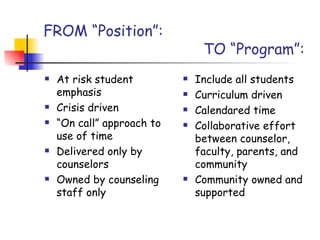
FROM “Position”:
                                 TO “Program”:
   At risk student            Include all students
    emphasis                   Curriculum driven
   Crisis driven              Calendared time
   “On call” approach to      Collaborative effort
    use of time                 between counselor,
   Delivered only by           faculty, parents, and
    counselors                  community
   Owned by counseling        Community owned and
    staff only                  supported
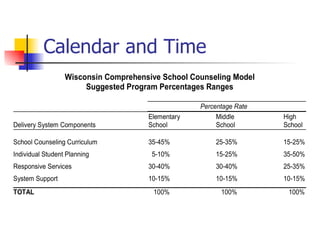
Calendar and Time
                  Wisconsin Comprehensive School Counseling Model
                       Suggested Program Percentages Ranges

                                                   Percentage Rate
                                      Elementary        Middle       High
Delivery System Components            School            School       School

School Counseling Curriculum          35-45%           25-35%        15-25%
Individual Student Planning            5-10%           15-25%        35-50%
Responsive Services                   30-40%           30-40%        25-35%
System Support                        10-15%           10-15%        10-15%
TOTAL                                  100%              100%         100%
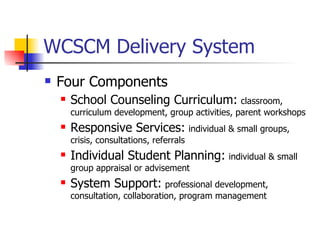
WCSCM Delivery System
   Four Components
       School Counseling Curriculum: classroom,
        curriculum development, group activities, parent workshops
       Responsive Services: individual & small groups,
        crisis, consultations, referrals
       Individual Student Planning: individual & small
        group appraisal or advisement
       System Support: professional development,
        consultation, collaboration, program management
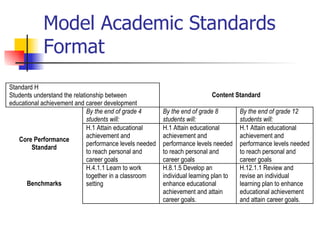
Model Academic Standards
            Format
Standard H
Students understand the relationship between                                 Content Standard
educational achievement and career development
                              By the end of grade 4       By the end of grade 8         By the end of grade 12
                              students will:              students will:                students will:
                              H.1 Attain educational      H.1 Attain educational        H.1 Attain educational
                              achievement and             achievement and               achievement and
   Core Performance
                              performance levels needed   performance levels needed     performance levels needed
        Standard
                              to reach personal and       to reach personal and         to reach personal and
                              career goals                career goals                  career goals
                              H.4.1.1 Learn to work       H.8.1.5 Develop an            H.12.1.1 Review and
                              together in a classroom     individual learning plan to   revise an individual
      Benchmarks              setting                     enhance educational           learning plan to enhance
                                                          achievement and attain        educational achievement
                                                          career goals.                 and attain career goals.
School Counseling Curriculum:
Student Standards
   Content Standards
   Core Performance Standards
   Grade Level Performance Standards [4, 8, 12]
        Content Standard = A

           Core Performance = 1

              Grade Level = 4.1.1


             Ex. = A.4.3.1, D.8.2.1, I.12.1.1
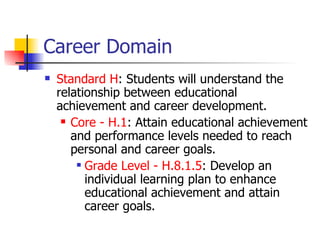
Career Domain
   Standard H: Students will understand the
    relationship between educational
    achievement and career development.
      Core - H.1: Attain educational achievement

       and performance levels needed to reach
       personal and career goals.
         Grade Level - H.8.1.5: Develop an

          individual learning plan to enhance
          educational achievement and attain
          career goals.
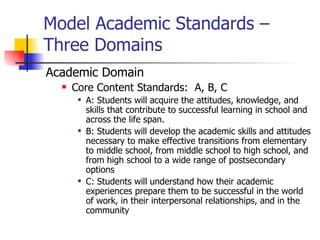
Model Academic Standards –
Three Domains
Academic Domain
     Core Content Standards: A, B, C
          A: Students will acquire the attitudes, knowledge, and
           skills that contribute to successful learning in school and
           across the life span.
          B: Students will develop the academic skills and attitudes
           necessary to make effective transitions from elementary
           to middle school, from middle school to high school, and
           from high school to a wide range of postsecondary
           options
          C: Students will understand how their academic
           experiences prepare them to be successful in the world
           of work, in their interpersonal relationships, and in the
           community
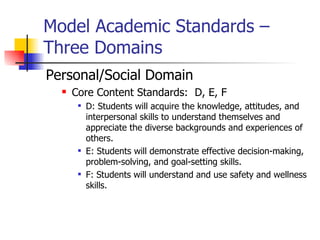
Model Academic Standards –
Three Domains
Personal/Social Domain
     Core Content Standards: D, E, F
          D: Students will acquire the knowledge, attitudes, and
           interpersonal skills to understand themselves and
           appreciate the diverse backgrounds and experiences of
           others.
          E: Students will demonstrate effective decision-making,
           problem-solving, and goal-setting skills.
          F: Students will understand and use safety and wellness
           skills.
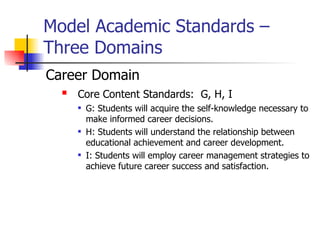
Model Academic Standards –
Three Domains
Career Domain
     Core Content Standards: G, H, I
         G: Students will acquire the self-knowledge necessary to
          make informed career decisions.
         H: Students will understand the relationship between
          educational achievement and career development.
         I: Students will employ career management strategies to
          achieve future career success and satisfaction.
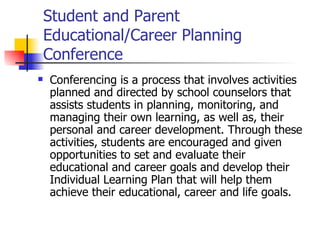
Student and Parent
    Educational/Career Planning
    Conference
   Conferencing is a process that involves activities
    planned and directed by school counselors that
    assists students in planning, monitoring, and
    managing their own learning, as well as, their
    personal and career development. Through these
    activities, students are encouraged and given
    opportunities to set and evaluate their
    educational and career goals and develop their
    Individual Learning Plan that will help them
    achieve their educational, career and life goals.
Student and Parent
Educational/Career Planning
Conference
The WCSCM has defined the mission of the Student and Parent
  Educational/Career Planning Conferences to:

      Require the school counselor(s) to provide curricular opportunities
       for all students in the areas of academic, personal/social and career
       development.

      Impact all students in the most effective manner concerning the
       importance of career decision making and planning for life after
       high school.

      Involve the school (student and counselor(s)), parents, and the
       community (business and industry) in the conferencing process and
       activities.
Student and Parent
Educational/Career Planning
Conference
Common elements of an effective
 conferencing process include:
     School Counseling Curriculum
     Individual Assessment Materials
     Student Individual Learning Plans
     Resources and Options
     Framework
Individual Learning Plan
   Students will investigate the inter-relationship
    of educational achievement, life goals, career
    planning, training and placement; evaluate
    the present job market and analyze
    predictions of future trends at local, regional,
    state, national and global levels; and propose
    career options based on their Individual
    Learning Plan.
Individual Learning Plan
   ILP’s meet benchmarks within the Model
    Academic Standards for school counseling

   ILP’s take into account what happens to
    students outside the walls of the school
    building

    ILP’s can provide a process and product for
    students to use that opens them up to unique
    educational and career opportunities
Impact of WCSCM
   As students understand themselves, explore
    the world around them and establish goals for
    their futures, they begin to see why an
    education is important. They no longer attend
    school simply to receive a diploma or avoid
    truancy. Instead, students understand the
    connection between success in school today
    and success in their careers tomorrow.
Accountability/Evaluation
       Program Audit
       Counselor Performance
       Program Evaluation
        Student Progress
       Advisory Committee

Wcscmoverview

  • 1.
    The “NEW” Wisconsin ComprehensiveSchool Counseling Model From Theory to Application June 2008
  • 2.
    The Wisconsin Comprehensive SchoolCounseling Model Gary L. Spear School Counseling Consultant Student Services Prevention and Wellness Team Wisconsin DPI
  • 3.
    Audio Difficulties  Make sure the volume is turned up (volume button beneath the speaker’s picture)  Make sure the volume on the computer is turned up (volume icon located on the right hand side of your computer task bar)  Contact your IT department  If audio and visual is lost during the program, go back to: http://media2.wi.gov/dpi/catalog, and click on the Student Services Prevention and Wellness Team link on the left, then when the SSPW Team page of archived programs appears, select the program link desired.  If problems persist, contact Randy Thiel (608)-266-9677 or Laurie Salzman (608) 267-9117
  • 4.
    Presentation material A copyof the PowerPoint is available at: http://dpi.wi.gov/sspw/scpowerpoint.html
  • 5.
    The “OLD” WDGM  Based upon Nine Competencies  connecting family, school, and work  solve problems  understand diversity, inclusiveness, and fairness  work in groups  manage conflicts  integrate growth and development  direct change  make decisions  set and achieve goals
  • 6.
    The “ NEW”WCSCM  ASCA National Model  National Consortium for State Guidance Leadership  The Educational Trust: Transforming School Counseling Initiative  National Career Development Guidelines  National Occupational Information Coordinating Committee  WDGM
  • 7.
    Differences: WDGM toWCSCM  Program Implementation  Model Academic Standards  Conferencing  Individual Learning Plans  Accountability / Evaluation
  • 8.
    Program Implementation  Building the Foundation  Planning the Program  Establishing Priorities  Designing the Program  Preparing for Implementation  Evaluating the Program
  • 9.
    Program Implementation  Transition from a position to program approach  Program of: BY ALL . . .FOR ALL  A program that encourages and promotes academic, career, and personal/social development for ALL students  A program with the goal of academic success for ALL students
  • 10.
    WCSCM: . ..FOR ALL  The fundamental goals of comprehensive school counseling are twofold:  provide for student achievement and success;  increase the options that students perceive for themselves
  • 11.
    FROM “Position”: TO “Program”:  At risk student  Include all students emphasis  Curriculum driven  Crisis driven  Calendared time  “On call” approach to  Collaborative effort use of time between counselor,  Delivered only by faculty, parents, and counselors community  Owned by counseling  Community owned and staff only supported
  • 12.
    Calendar and Time Wisconsin Comprehensive School Counseling Model Suggested Program Percentages Ranges Percentage Rate Elementary Middle High Delivery System Components School School School School Counseling Curriculum 35-45% 25-35% 15-25% Individual Student Planning 5-10% 15-25% 35-50% Responsive Services 30-40% 30-40% 25-35% System Support 10-15% 10-15% 10-15% TOTAL 100% 100% 100%
  • 13.
    WCSCM Delivery System  Four Components  School Counseling Curriculum: classroom, curriculum development, group activities, parent workshops  Responsive Services: individual & small groups, crisis, consultations, referrals  Individual Student Planning: individual & small group appraisal or advisement  System Support: professional development, consultation, collaboration, program management
  • 14.
    Model Academic Standards Format Standard H Students understand the relationship between Content Standard educational achievement and career development By the end of grade 4 By the end of grade 8 By the end of grade 12 students will: students will: students will: H.1 Attain educational H.1 Attain educational H.1 Attain educational achievement and achievement and achievement and Core Performance performance levels needed performance levels needed performance levels needed Standard to reach personal and to reach personal and to reach personal and career goals career goals career goals H.4.1.1 Learn to work H.8.1.5 Develop an H.12.1.1 Review and together in a classroom individual learning plan to revise an individual Benchmarks setting enhance educational learning plan to enhance achievement and attain educational achievement career goals. and attain career goals.
  • 15.
    School Counseling Curriculum: StudentStandards  Content Standards  Core Performance Standards  Grade Level Performance Standards [4, 8, 12]  Content Standard = A  Core Performance = 1  Grade Level = 4.1.1 Ex. = A.4.3.1, D.8.2.1, I.12.1.1
  • 16.
    Career Domain  Standard H: Students will understand the relationship between educational achievement and career development.  Core - H.1: Attain educational achievement and performance levels needed to reach personal and career goals.  Grade Level - H.8.1.5: Develop an individual learning plan to enhance educational achievement and attain career goals.
  • 17.
    Model Academic Standards– Three Domains Academic Domain  Core Content Standards: A, B, C  A: Students will acquire the attitudes, knowledge, and skills that contribute to successful learning in school and across the life span.  B: Students will develop the academic skills and attitudes necessary to make effective transitions from elementary to middle school, from middle school to high school, and from high school to a wide range of postsecondary options  C: Students will understand how their academic experiences prepare them to be successful in the world of work, in their interpersonal relationships, and in the community
  • 18.
    Model Academic Standards– Three Domains Personal/Social Domain  Core Content Standards: D, E, F  D: Students will acquire the knowledge, attitudes, and interpersonal skills to understand themselves and appreciate the diverse backgrounds and experiences of others.  E: Students will demonstrate effective decision-making, problem-solving, and goal-setting skills.  F: Students will understand and use safety and wellness skills.
  • 19.
    Model Academic Standards– Three Domains Career Domain  Core Content Standards: G, H, I  G: Students will acquire the self-knowledge necessary to make informed career decisions.  H: Students will understand the relationship between educational achievement and career development.  I: Students will employ career management strategies to achieve future career success and satisfaction.
  • 20.
    Student and Parent Educational/Career Planning Conference  Conferencing is a process that involves activities planned and directed by school counselors that assists students in planning, monitoring, and managing their own learning, as well as, their personal and career development. Through these activities, students are encouraged and given opportunities to set and evaluate their educational and career goals and develop their Individual Learning Plan that will help them achieve their educational, career and life goals.
  • 21.
    Student and Parent Educational/CareerPlanning Conference The WCSCM has defined the mission of the Student and Parent Educational/Career Planning Conferences to:  Require the school counselor(s) to provide curricular opportunities for all students in the areas of academic, personal/social and career development.  Impact all students in the most effective manner concerning the importance of career decision making and planning for life after high school.  Involve the school (student and counselor(s)), parents, and the community (business and industry) in the conferencing process and activities.
  • 22.
    Student and Parent Educational/CareerPlanning Conference Common elements of an effective conferencing process include:  School Counseling Curriculum  Individual Assessment Materials  Student Individual Learning Plans  Resources and Options  Framework
  • 23.
    Individual Learning Plan  Students will investigate the inter-relationship of educational achievement, life goals, career planning, training and placement; evaluate the present job market and analyze predictions of future trends at local, regional, state, national and global levels; and propose career options based on their Individual Learning Plan.
  • 24.
    Individual Learning Plan  ILP’s meet benchmarks within the Model Academic Standards for school counseling  ILP’s take into account what happens to students outside the walls of the school building  ILP’s can provide a process and product for students to use that opens them up to unique educational and career opportunities
  • 25.
    Impact of WCSCM  As students understand themselves, explore the world around them and establish goals for their futures, they begin to see why an education is important. They no longer attend school simply to receive a diploma or avoid truancy. Instead, students understand the connection between success in school today and success in their careers tomorrow.
  • 26.
    Accountability/Evaluation  Program Audit  Counselor Performance  Program Evaluation  Student Progress  Advisory Committee

Editor's Notes

  • #12 This shift requires that counseling move (click) From an emphasis on at risk youth (click) to serving all students K-12. (click) From crisis driven (click) to curriculum driven. (click) From an on call approach to use of time (click) to calendared time. (click) From being delivered by counselors only (click) to a collaborative effort between counselors, faculty, parents, and community. (click) Owned by counselors only (click) to becoming community owned and supported.