Indirect Retainers
INDIAN DENTAL ACADEMY
Leader in continuing Dental Education
www.indiandentalacademy.com
Contents
 Introduction
 Principle of levers
 Rotation of denture bases around various axes
 Definition
 Principle of Indirect Retainers
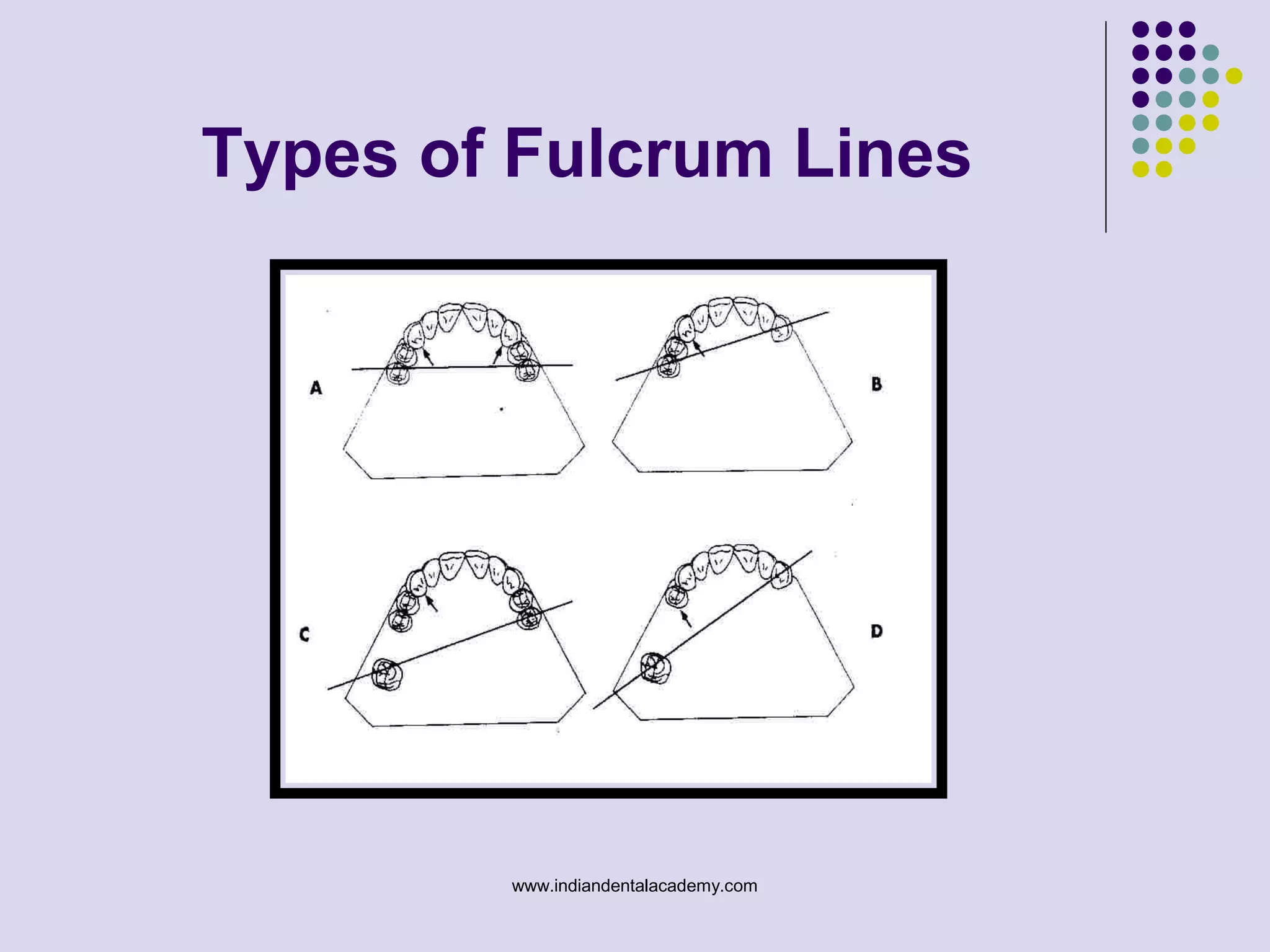
 Types of Fulcrum Lines
 Factors Influencing Indirect Retainers
 Auxillary Functions
 Forms of Indirect Retainers
 Summary
 References
www.indiandentalacademy.com
Introduction
William E. Avant said “Indirect retention is required on
all extension base partial dentures retained by
clasps. It is required also when tooth at one end of
the denture base is clasped for retention but the
tooth at the other end is not suitable for retention.
Extension base partial dentures are needed more
often than any other type of removable partial
denture. If these statements are true, then we need
to consider indirect retainers carefully.”
www.indiandentalacademy.com
Principle of Levers
FF
EERR
www.indiandentalacademy.com
Mechanical Advantage= Effort Arm
Resistance Arm
www.indiandentalacademy.com
Rotation Around a TransverseRotation Around a Transverse
AxisAxis
www.indiandentalacademy.com
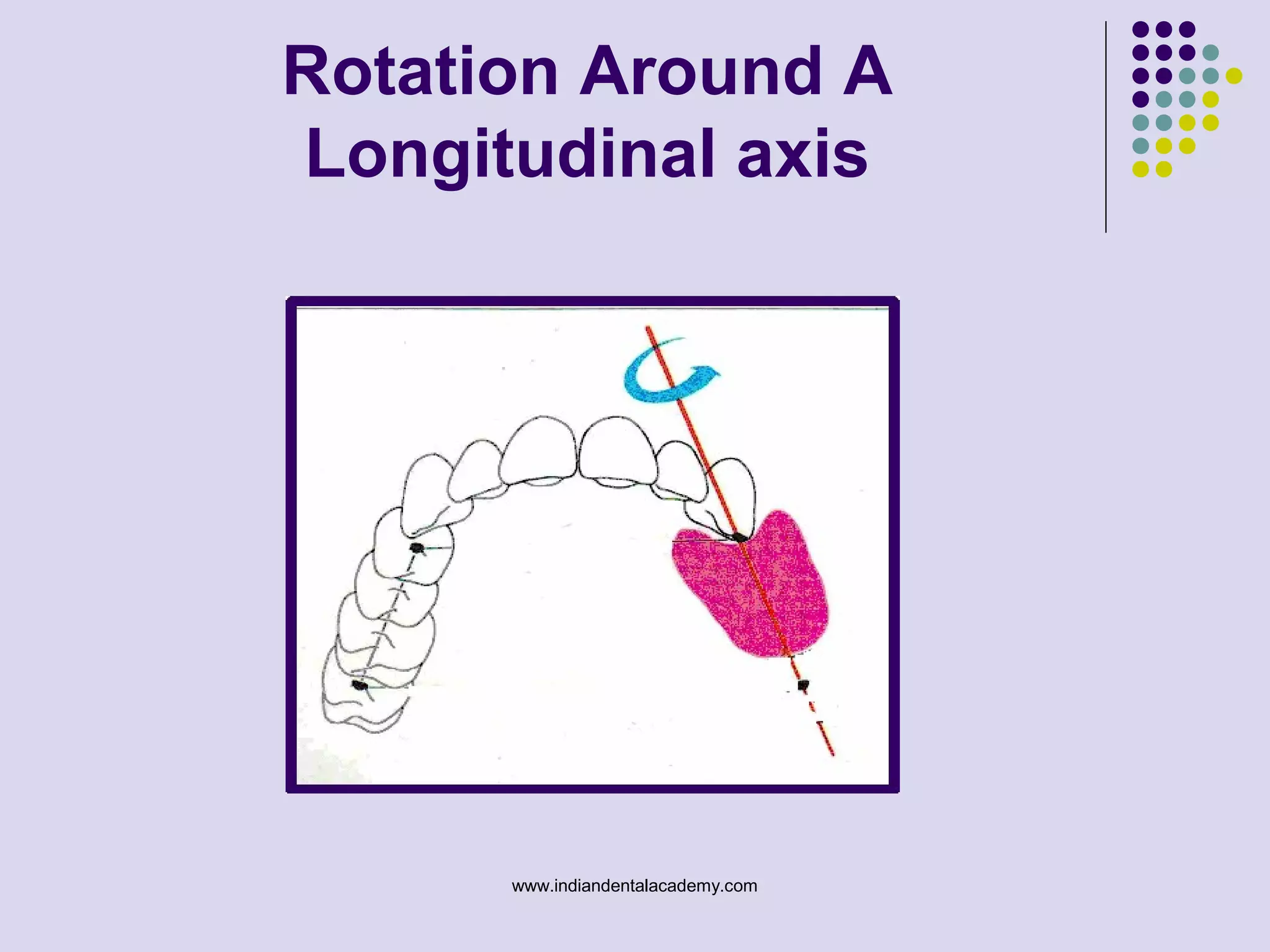
Rotation Around A
Longitudinal axis
www.indiandentalacademy.com
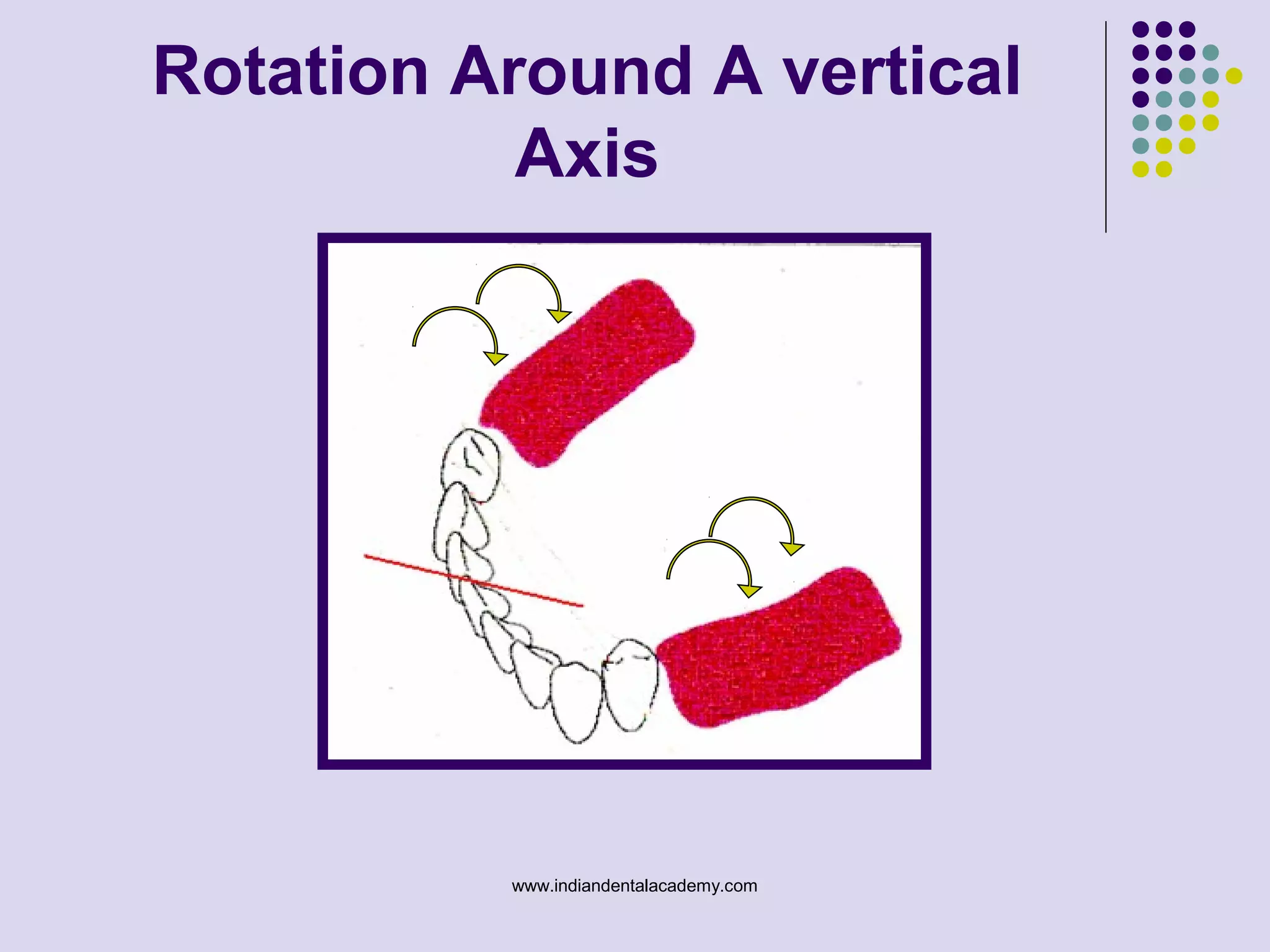
Rotation Around A vertical
Axis
www.indiandentalacademy.com
“The component of a removable partial denture
that assists the direct retainer(s) in preventing
displacement of the distal extension denture
base by functioning through lever action on
the opposite side of the fulcrum line when the
denture base moves away from the tissues in
pure rotation around the fulcrum line.”-GPT
Definition
www.indiandentalacademy.com
An indirect retainer does not control the movement of
the denture base in the tissueward direction
Amount of movement =amount of compressible
mucosa
Fulcrum line runs between the most posterior rests.
www.indiandentalacademy.com
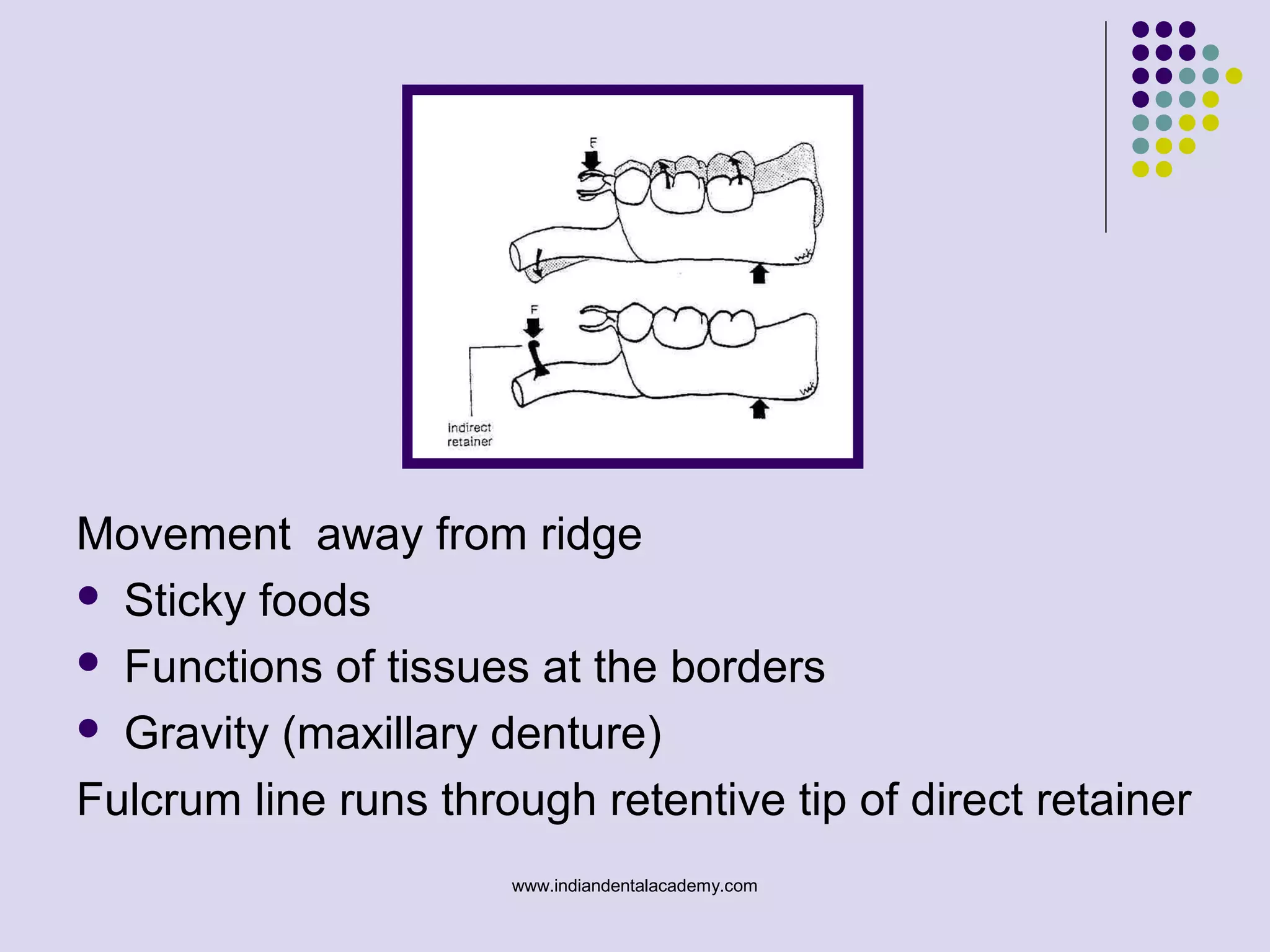
Movement away from ridge
 Sticky foods
 Functions of tissues at the borders
 Gravity (maxillary denture)
Fulcrum line runs through retentive tip of direct retainer
www.indiandentalacademy.com
Principle of Indirect Retainer
www.indiandentalacademy.com
Types of Fulcrum Lines
www.indiandentalacademy.com
Factors Influencing Effectiveness
of Indirect Retainers
• Principal
Occlusal rests
• Fulcrum line
1. Length of extension
base
2. Location of fulcrum
line
3. Position of indirect
retainer
• Rigidity of
Connectors
• Supporting tooth
www.indiandentalacademy.com
Auxiliary Functions
 Reduce leverage
 Stabilization
 Support
 Prevent lingual movement
 Need to reline
www.indiandentalacademy.com
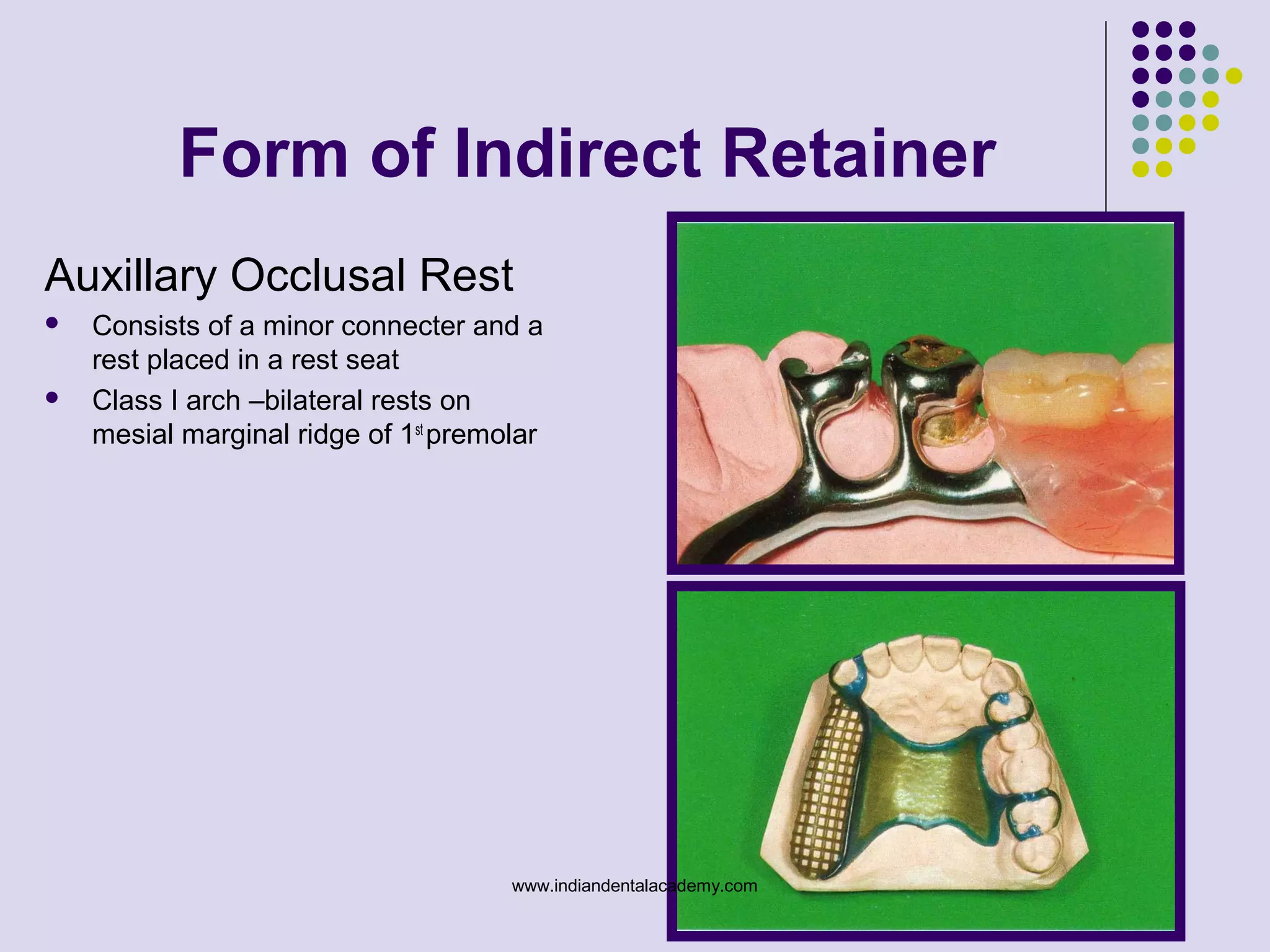
Form of Indirect Retainer
Auxillary Occlusal Rest
 Consists of a minor connecter and a
rest placed in a rest seat
 Class I arch –bilateral rests on
mesial marginal ridge of 1st
premolar
www.indiandentalacademy.com
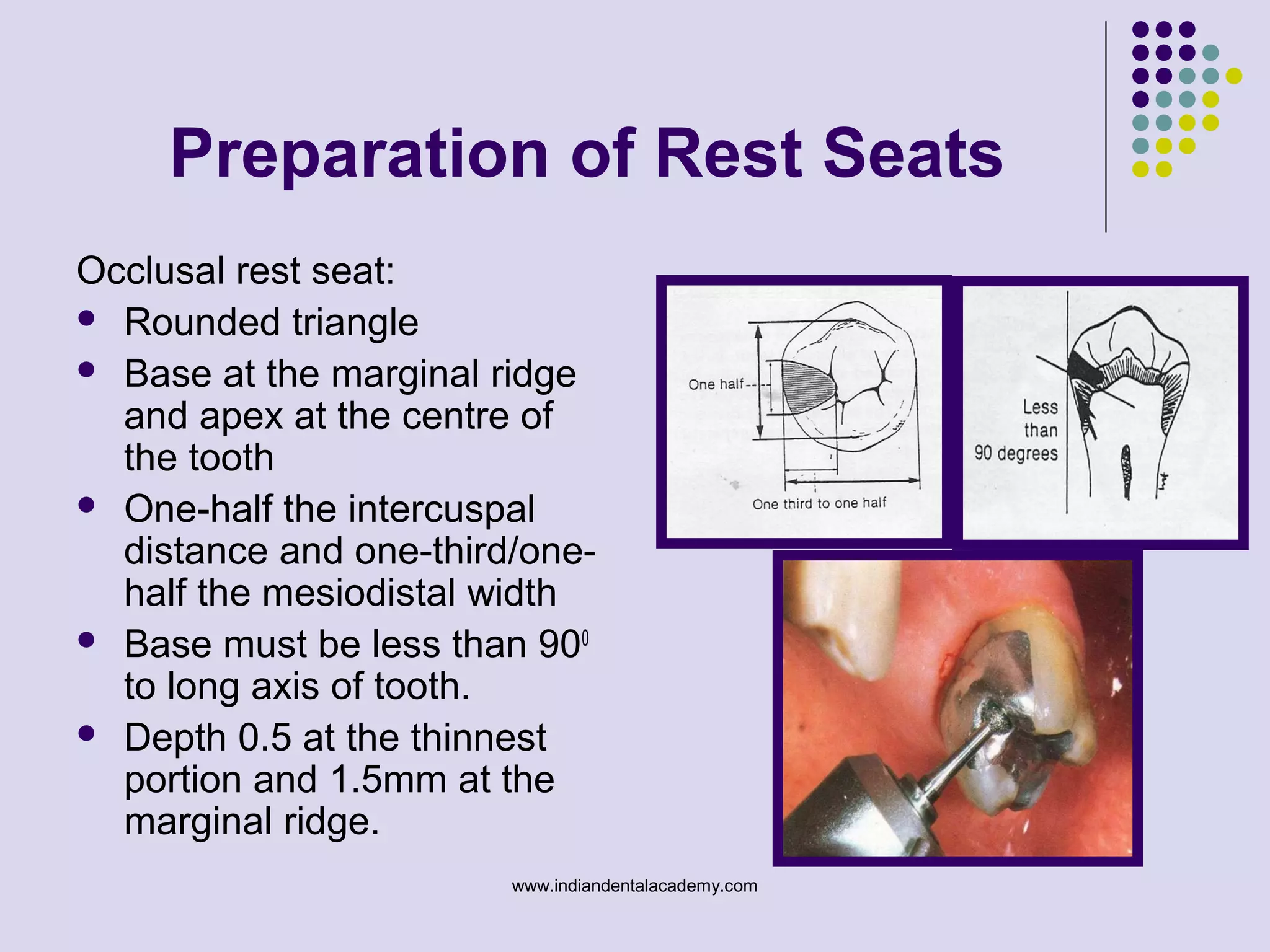
Preparation of Rest Seats
Occlusal rest seat:
 Rounded triangle
 Base at the marginal ridge
and apex at the centre of
the tooth
 One-half the intercuspal
distance and one-third/one-
half the mesiodistal width
 Base must be less than 900
to long axis of tooth.
 Depth 0.5 at the thinnest
portion and 1.5mm at the
marginal ridge.
www.indiandentalacademy.com
Canine Extensions from
Occlusal Rests
To effect indirect
retention by
increasing the
distance from
fulcrum line
Should always be
used with terminal
rests.
www.indiandentalacademy.com
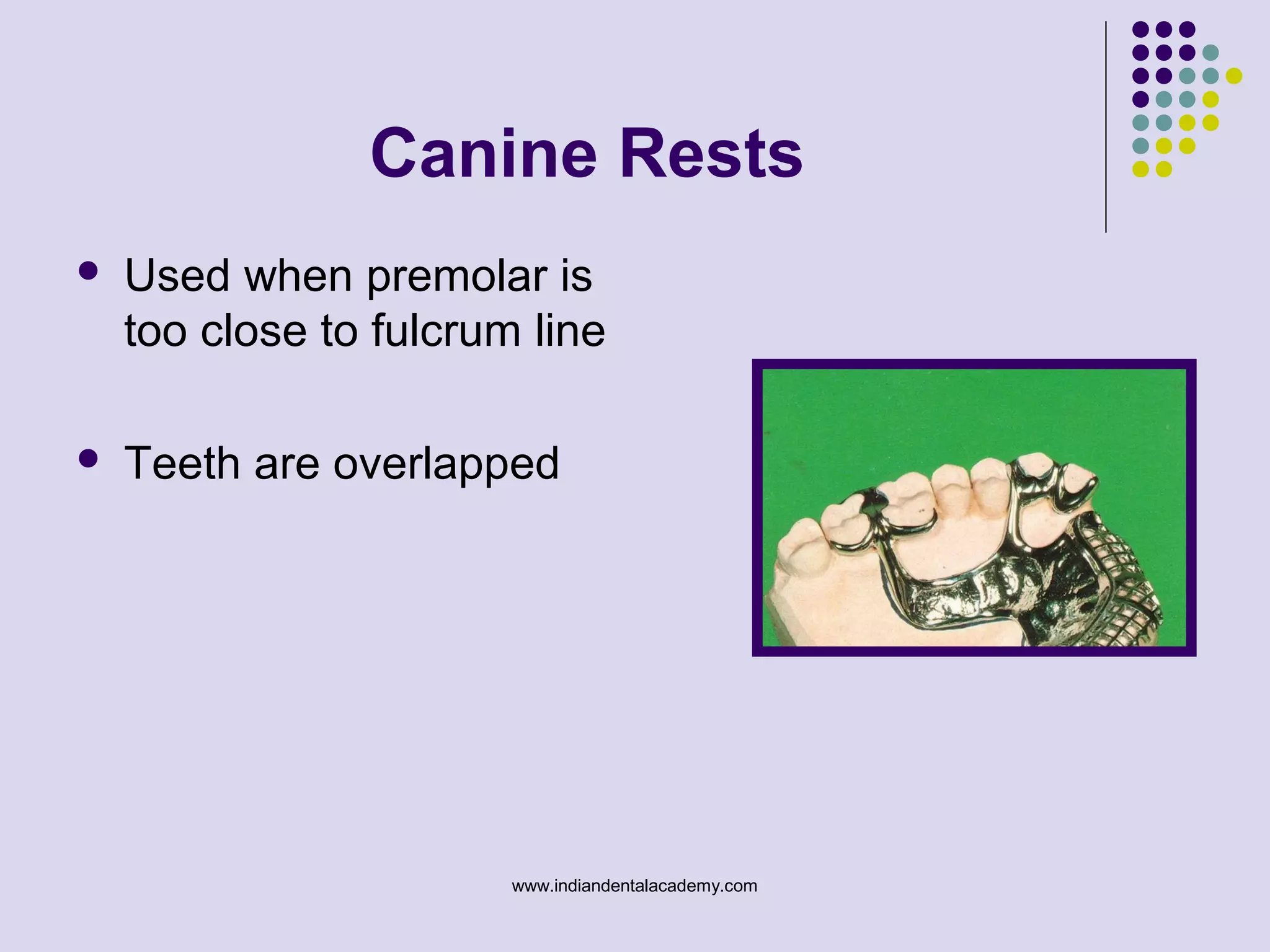
Canine Rests
 Used when premolar is
too close to fulcrum line
 Teeth are overlapped
www.indiandentalacademy.com
Lingual Rest
 Prepared mostly on
maxillary canines.
 Multiple incisors
 Closer to centre of
rotation, more esthetic,
less prone to breakage.
 Rest seat is V-shaped
and half moon shaped
in configuration.
www.indiandentalacademy.com
Cingulum Bar (Continous Bar)
and Lingual Plate
They rest on
unprepared lingual
inclines. Aid the
terminal rests in
indirect retention.
Stress distribution
Reduces the cross
sectional area of
major connector
Splints of weak anterior
teeth
www.indiandentalacademy.com
May cause
orthodontic movement
of teeth
Irritating to tongue
Cannot be used in
deep overbite cases
Retroclined anteriors
www.indiandentalacademy.com
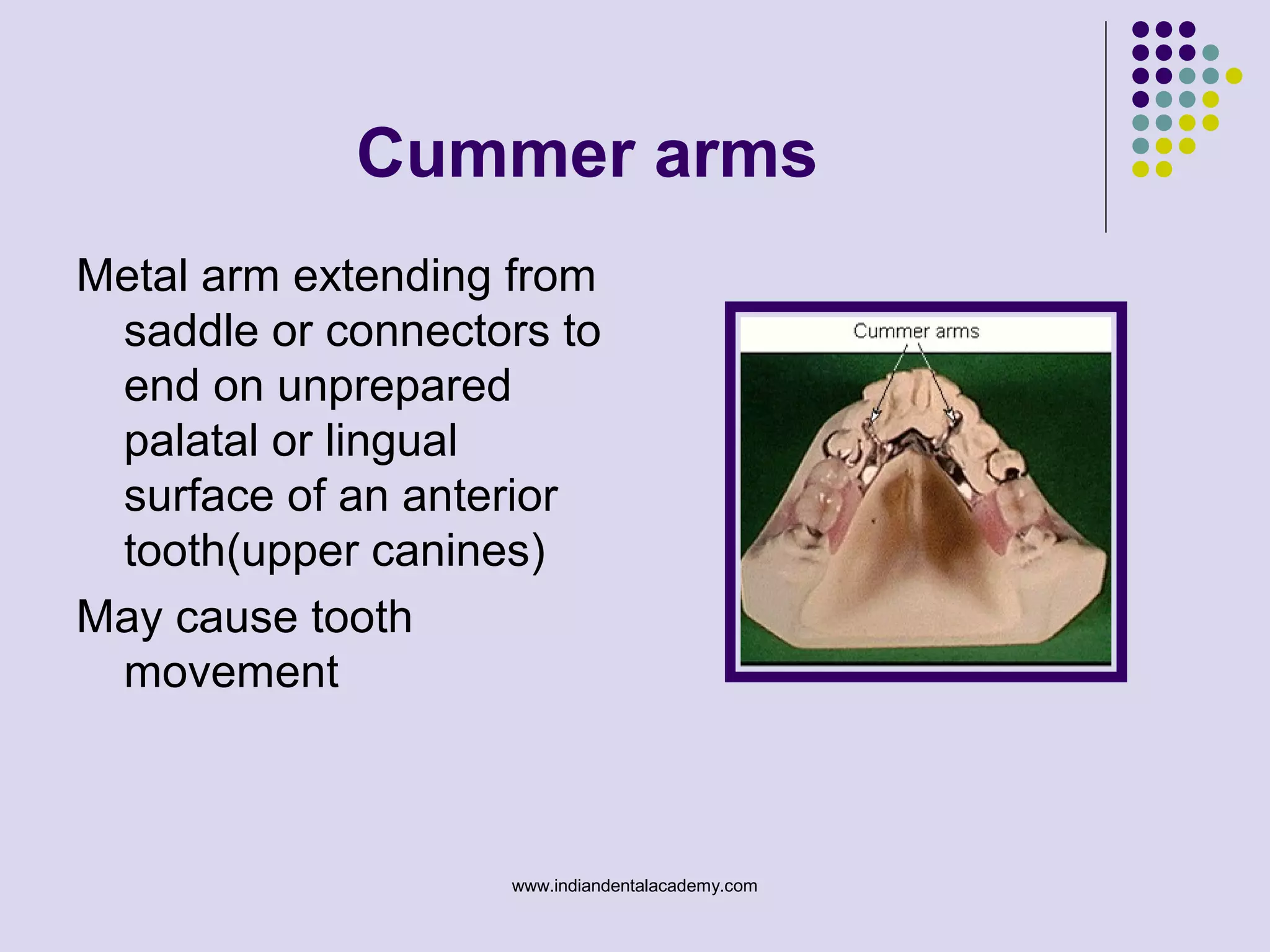
Cummer arms
Metal arm extending from
saddle or connectors to
end on unprepared
palatal or lingual
surface of an anterior
tooth(upper canines)
May cause tooth
movement
www.indiandentalacademy.com
Rugae area
Coverage of rugae area –advocated by some
clinicians as the rugae area is thought to be firm and
will also help in providing support.
Not as effective as positive tooth support.
Usually as palatal arms, palatal bearing connectorswww.indiandentalacademy.com
Summary
 Indirect retainers do not play a role in vertical
movement towards tissues
 They only facilitate the direct retainers in retention
 They act by moving the fulcrum line anterior to the
force
 Principle forms of indirect retainers used are the
occlusal rests
Therefore, proper design and placement of the
component parts of a removable partial denture will
not prevent but at least minimise the displacing
forces. Which will go a long way in assuring the
success of the prosthesis.
www.indiandentalacademy.com
References
 A.A.Grant and W.Johnson,Removable denture Prosthodontics,
ed 2.1992,Churchill livingstone Inc.
 Ernest L.Miller and Joseph E.Grasso,Removable Partial
Prosthodontics, ed 2. 1979,Williams and Willkins.
 Glen P. Mcgivney, Alan B. Carr.Mccraken’s Removable Partial
Prosthodontics, ed10. St. Louis ;2000 ,The C.V. Mosby Co.
 Stewart ,Rudd and Keubker, Clinical Removable Partial
Prosthodontics,ed 2.1997,Ishiyaku EuroAmerica Inc. U.S.A
 William E. Avant.Indirect retention In partial denture Design.J
Prosthet Dent.16:1103-1110
www.indiandentalacademy.com

Indirect retainers/prosthodontic courses

  • 1.
    Indirect Retainers INDIAN DENTALACADEMY Leader in continuing Dental Education www.indiandentalacademy.com
  • 2.
    Contents  Introduction  Principleof levers  Rotation of denture bases around various axes  Definition  Principle of Indirect Retainers  Types of Fulcrum Lines  Factors Influencing Indirect Retainers  Auxillary Functions  Forms of Indirect Retainers  Summary  References www.indiandentalacademy.com
  • 3.
    Introduction William E. Avantsaid “Indirect retention is required on all extension base partial dentures retained by clasps. It is required also when tooth at one end of the denture base is clasped for retention but the tooth at the other end is not suitable for retention. Extension base partial dentures are needed more often than any other type of removable partial denture. If these statements are true, then we need to consider indirect retainers carefully.” www.indiandentalacademy.com
  • 4.
  • 5.
    Mechanical Advantage= EffortArm Resistance Arm www.indiandentalacademy.com
  • 6.
    Rotation Around aTransverseRotation Around a Transverse AxisAxis www.indiandentalacademy.com
  • 7.
    Rotation Around A Longitudinalaxis www.indiandentalacademy.com
  • 8.
    Rotation Around Avertical Axis www.indiandentalacademy.com
  • 9.
    “The component ofa removable partial denture that assists the direct retainer(s) in preventing displacement of the distal extension denture base by functioning through lever action on the opposite side of the fulcrum line when the denture base moves away from the tissues in pure rotation around the fulcrum line.”-GPT Definition www.indiandentalacademy.com
  • 10.
    An indirect retainerdoes not control the movement of the denture base in the tissueward direction Amount of movement =amount of compressible mucosa Fulcrum line runs between the most posterior rests. www.indiandentalacademy.com
  • 11.
    Movement away fromridge  Sticky foods  Functions of tissues at the borders  Gravity (maxillary denture) Fulcrum line runs through retentive tip of direct retainer www.indiandentalacademy.com
  • 12.
    Principle of IndirectRetainer www.indiandentalacademy.com
  • 13.
    Types of FulcrumLines www.indiandentalacademy.com
  • 14.
  • 15.
    Factors Influencing Effectiveness ofIndirect Retainers • Principal Occlusal rests • Fulcrum line 1. Length of extension base 2. Location of fulcrum line 3. Position of indirect retainer • Rigidity of Connectors • Supporting tooth www.indiandentalacademy.com
  • 16.
    Auxiliary Functions  Reduceleverage  Stabilization  Support  Prevent lingual movement  Need to reline www.indiandentalacademy.com
  • 17.
    Form of IndirectRetainer Auxillary Occlusal Rest  Consists of a minor connecter and a rest placed in a rest seat  Class I arch –bilateral rests on mesial marginal ridge of 1st premolar www.indiandentalacademy.com
  • 18.
    Preparation of RestSeats Occlusal rest seat:  Rounded triangle  Base at the marginal ridge and apex at the centre of the tooth  One-half the intercuspal distance and one-third/one- half the mesiodistal width  Base must be less than 900 to long axis of tooth.  Depth 0.5 at the thinnest portion and 1.5mm at the marginal ridge. www.indiandentalacademy.com
  • 19.
    Canine Extensions from OcclusalRests To effect indirect retention by increasing the distance from fulcrum line Should always be used with terminal rests. www.indiandentalacademy.com
  • 20.
    Canine Rests  Usedwhen premolar is too close to fulcrum line  Teeth are overlapped www.indiandentalacademy.com
  • 21.
    Lingual Rest  Preparedmostly on maxillary canines.  Multiple incisors  Closer to centre of rotation, more esthetic, less prone to breakage.  Rest seat is V-shaped and half moon shaped in configuration. www.indiandentalacademy.com
  • 22.
    Cingulum Bar (ContinousBar) and Lingual Plate They rest on unprepared lingual inclines. Aid the terminal rests in indirect retention. Stress distribution Reduces the cross sectional area of major connector Splints of weak anterior teeth www.indiandentalacademy.com
  • 23.
    May cause orthodontic movement ofteeth Irritating to tongue Cannot be used in deep overbite cases Retroclined anteriors www.indiandentalacademy.com
  • 24.
    Cummer arms Metal armextending from saddle or connectors to end on unprepared palatal or lingual surface of an anterior tooth(upper canines) May cause tooth movement www.indiandentalacademy.com
  • 25.
    Rugae area Coverage ofrugae area –advocated by some clinicians as the rugae area is thought to be firm and will also help in providing support. Not as effective as positive tooth support. Usually as palatal arms, palatal bearing connectorswww.indiandentalacademy.com
  • 26.
    Summary  Indirect retainersdo not play a role in vertical movement towards tissues  They only facilitate the direct retainers in retention  They act by moving the fulcrum line anterior to the force  Principle forms of indirect retainers used are the occlusal rests Therefore, proper design and placement of the component parts of a removable partial denture will not prevent but at least minimise the displacing forces. Which will go a long way in assuring the success of the prosthesis. www.indiandentalacademy.com
  • 27.
    References  A.A.Grant andW.Johnson,Removable denture Prosthodontics, ed 2.1992,Churchill livingstone Inc.  Ernest L.Miller and Joseph E.Grasso,Removable Partial Prosthodontics, ed 2. 1979,Williams and Willkins.  Glen P. Mcgivney, Alan B. Carr.Mccraken’s Removable Partial Prosthodontics, ed10. St. Louis ;2000 ,The C.V. Mosby Co.  Stewart ,Rudd and Keubker, Clinical Removable Partial Prosthodontics,ed 2.1997,Ishiyaku EuroAmerica Inc. U.S.A  William E. Avant.Indirect retention In partial denture Design.J Prosthet Dent.16:1103-1110 www.indiandentalacademy.com