SOILAND WATER CONSERVATION
ENGINEERING (1+1)
INDIGENOUS TECHNIQUES OF SOIL
AND WATER CONSERVATION IN NORTH
EASTERN INDIA
BY TO
BASKAR S Dr.P.JANARTHANAN
BATCH-`A` Asst.Professor
CB.AG.U4AGR19018 AGRONOMY
INTRODUCTION
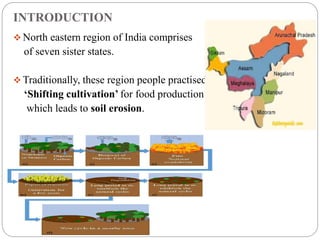
 North eastern region of India comprises
of seven sister states.
 Traditionally, these region people practised
‘Shifting cultivation’ for food production
which leads to soil erosion.
•
 Eventhough, these region people are practising several
indigenous soil and water conserving practices till now.
 Some indigenous practices are
1. Bamboo drip irrigation system
2. Zabo system of farming
3. Paddy-cum-fish culture
 These indigenous techniques are especially followed for
soil and water conservation in sloppy region.
BAMBOO DRIP IRRIGATION SYSTEM
 This system is first introduced in
‘Meghalaya’ state of India.
 This technique is discovered for
application of water on hilly slopes for
plantation crops (Areca nut) and
integrated crop ( Betel vine & Pepper).
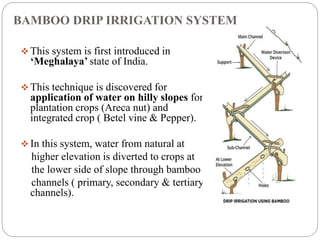
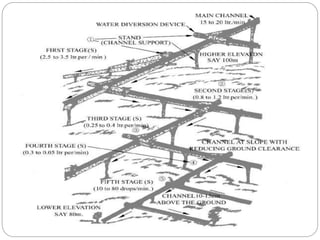
 In this system, water from natural at
higher elevation is diverted to crops at
the lower side of slope through bamboo
channels ( primary, secondary & tertiary
channels).
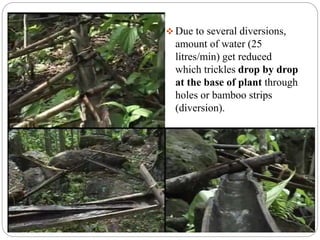
 Due to several diversions,
amount of water (25
litres/min) get reduced
which trickles drop by drop
at the base of plant through
holes or bamboo strips
(diversion).
ZABO SYSTEM OF FARMING
 The word “Zabo” means impounding of water.
 Zabo system is a combination of forestry, animal husbandry
and agriculture.
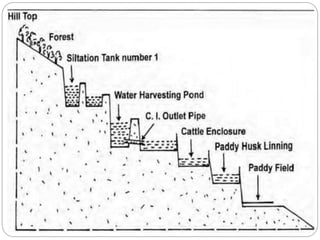
 This system has protected forest land towards the top of hill,
water harvesting tanks in middle and cattle yard and paddy
field at lower side.
 The forest land at top prevents soil erosion and tanks in
middle conserves water for farming in which paddy husk on
bunds and puddling is done for seepage control.
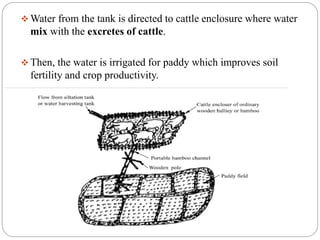
 Water from the tank is directed to cattle enclosure where water
mix with the excretes of cattle.
 Then, the water is irrigated for paddy which improves soil
fertility and crop productivity.
PADDY FISH CULTURE
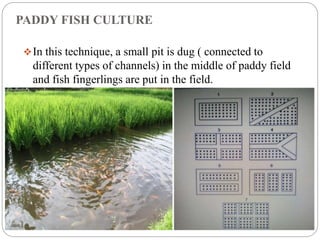
In this technique, a small pit is dug ( connected to
different types of channels) in the middle of paddy field
and fish fingerlings are put in the field.
BENEFITS:
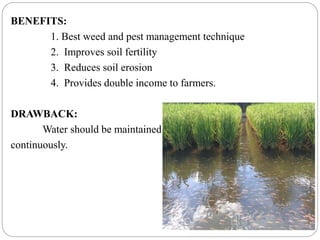
1. Best weed and pest management technique
2. Improves soil fertility
3. Reduces soil erosion
4. Provides double income to farmers.
DRAWBACK:
Water should be maintained
continuously.
REFERENCES
 https://www.tucson.ars.ag.gov/isco/isco12/volumeiii/indigenous
techniquesofsoil.pdf
 https://www.indiawaterportal.org/articles/zabo-art-impounding-
water
 http://agropedia.iitk.ac.in/content/paddy-cum-fish-culture
 https://brainly.in
Indigenous soil & water conservation techniques

Indigenous soil & water conservation techniques

  • 1.
    SOILAND WATER CONSERVATION ENGINEERING(1+1) INDIGENOUS TECHNIQUES OF SOIL AND WATER CONSERVATION IN NORTH EASTERN INDIA BY TO BASKAR S Dr.P.JANARTHANAN BATCH-`A` Asst.Professor CB.AG.U4AGR19018 AGRONOMY
  • 2.
    INTRODUCTION  North easternregion of India comprises of seven sister states.  Traditionally, these region people practised ‘Shifting cultivation’ for food production which leads to soil erosion. •
  • 3.
     Eventhough, theseregion people are practising several indigenous soil and water conserving practices till now.  Some indigenous practices are 1. Bamboo drip irrigation system 2. Zabo system of farming 3. Paddy-cum-fish culture  These indigenous techniques are especially followed for soil and water conservation in sloppy region.
  • 4.
    BAMBOO DRIP IRRIGATIONSYSTEM  This system is first introduced in ‘Meghalaya’ state of India.  This technique is discovered for application of water on hilly slopes for plantation crops (Areca nut) and integrated crop ( Betel vine & Pepper).  In this system, water from natural at higher elevation is diverted to crops at the lower side of slope through bamboo channels ( primary, secondary & tertiary channels).
  • 5.
     Due toseveral diversions, amount of water (25 litres/min) get reduced which trickles drop by drop at the base of plant through holes or bamboo strips (diversion).
  • 7.
    ZABO SYSTEM OFFARMING  The word “Zabo” means impounding of water.  Zabo system is a combination of forestry, animal husbandry and agriculture.  This system has protected forest land towards the top of hill, water harvesting tanks in middle and cattle yard and paddy field at lower side.  The forest land at top prevents soil erosion and tanks in middle conserves water for farming in which paddy husk on bunds and puddling is done for seepage control.
  • 8.
     Water fromthe tank is directed to cattle enclosure where water mix with the excretes of cattle.  Then, the water is irrigated for paddy which improves soil fertility and crop productivity.
  • 10.
    PADDY FISH CULTURE Inthis technique, a small pit is dug ( connected to different types of channels) in the middle of paddy field and fish fingerlings are put in the field.
  • 11.
    BENEFITS: 1. Best weedand pest management technique 2. Improves soil fertility 3. Reduces soil erosion 4. Provides double income to farmers. DRAWBACK: Water should be maintained continuously.
  • 12.