INDIA’S CONTRIBUTION
TO GEOMETRY
AT
BHIDE GIRLS’ HIGH SCHOOL, NAGPUR
1ST
& 2ND
DECEMBER, 2012
CONSTRUCTION OF ISOSCELES
TRAPEZIUM
Presented by-
Rishi Agrawal,
Head, Dept. of Mathematics,
Hislop College, Nagpur.
Tithi Agrawal,
Grade – 7,
Edify School, Nagpur.
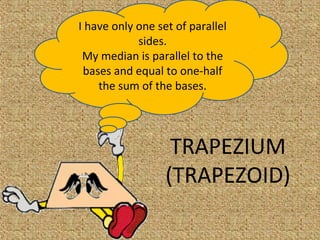
TRAPEZIUM
(TRAPEZOID)
I have only one set of parallel
sides.
My median is parallel to the
bases and equal to one-half
the sum of the bases.
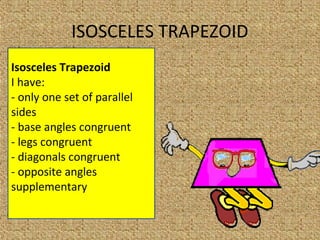
Isosceles Trapezoid
I have:
- only one set of parallel
sides
- base angles congruent
- legs congruent
- diagonals congruent
- opposite angles
supplementary
ISOSCELES TRAPEZOID
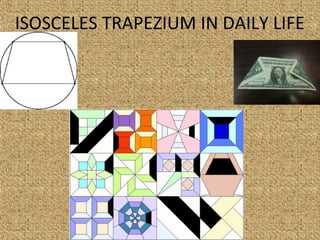
ISOSCELES TRAPEZIUM IN DAILY LIFE
Baudhāyana, (fl. c. 800 BCE) was
an Indian mathematician, who was most likely
also a priest. He is noted as the author of the
earliest Sulba Sūtra—appendices to the Vedas
giving rules for the construction of altars—
called the Baudhāyana Śulbasûtra, which
contained several important mathematical
results.
He is older than the other famous
mathematician Āpastambha. He belongs to
the Yajurveda school.
He is accredited with calculating the
value of pi before pythagoras, and with
discovering what is now known as
the Pythagorean theorem.
Baudhayana made the following constructions :
1)To draw a straight line at right angles to a given
straight line.
2)To draw a straight line at right angles to a given
straight line to a given point from it .
3)To construct a square having a given side.
4)To construct a rectangle of given sides.
5)To construct a isosceles trapezium of a given altitude,
face and base.
6)To construct a parallelogram having given sides at a
given inclination.
7)To draw a square equivalent to n times a given square.
8)To draw a square equivalent to the sum of two
different squares.
9)To draw a square equivalent to two given triangles.
10)To transform a rectangle into square.
11)To transform a square into rectangle.
12)To transform a square into an rectangle which shall
have an given side .
13)To transform a square or a rectangle into an triangle .
14)To transform a square into an rhombus.
15)To transform a rhombus into an square.
DRAWING ISOSCELES
TRAPEZIUM
• Draw two parallel line segments of
equal length, say AB and CD.
• Take P as midpoint of CD.
• Join PA and PB.
• Draw PM as altitude of ΔPAB.
• Consider a point Q on MP produced.
• With the center at M and radius MQ, draw an
arc of a circle, cutting line CD at points E and
F.
• Join AE and BF.
• AEFB is an isosceles trapezium.
DRAWING ISOSCELES
TRAPEZIUM
DRAWING ISOSCELES
TRAPEZIUM
Proof :
Δ APM and BPM are congruent.
Also ME = MF = radius of circle.
Therefore, Δ MEP are MFP are congruent.
=> Δ AEP and BFP are congruent.
=> AE = BF
Therefore, trapezium is isosceles with two non
parallel equal sides.
Thank U!!!

India’s contribution to geometry[1]

  • 1.
    INDIA’S CONTRIBUTION TO GEOMETRY AT BHIDEGIRLS’ HIGH SCHOOL, NAGPUR 1ST & 2ND DECEMBER, 2012
  • 2.
    CONSTRUCTION OF ISOSCELES TRAPEZIUM Presentedby- Rishi Agrawal, Head, Dept. of Mathematics, Hislop College, Nagpur. Tithi Agrawal, Grade – 7, Edify School, Nagpur.
  • 3.
    TRAPEZIUM (TRAPEZOID) I have onlyone set of parallel sides. My median is parallel to the bases and equal to one-half the sum of the bases.
  • 4.
    Isosceles Trapezoid I have: -only one set of parallel sides - base angles congruent - legs congruent - diagonals congruent - opposite angles supplementary ISOSCELES TRAPEZOID
  • 5.
  • 6.
    Baudhāyana, (fl. c.800 BCE) was an Indian mathematician, who was most likely also a priest. He is noted as the author of the earliest Sulba Sūtra—appendices to the Vedas giving rules for the construction of altars— called the Baudhāyana Śulbasûtra, which contained several important mathematical results.
  • 7.
    He is olderthan the other famous mathematician Āpastambha. He belongs to the Yajurveda school. He is accredited with calculating the value of pi before pythagoras, and with discovering what is now known as the Pythagorean theorem.
  • 8.
    Baudhayana made thefollowing constructions : 1)To draw a straight line at right angles to a given straight line. 2)To draw a straight line at right angles to a given straight line to a given point from it . 3)To construct a square having a given side. 4)To construct a rectangle of given sides. 5)To construct a isosceles trapezium of a given altitude, face and base.
  • 9.
    6)To construct aparallelogram having given sides at a given inclination. 7)To draw a square equivalent to n times a given square. 8)To draw a square equivalent to the sum of two different squares. 9)To draw a square equivalent to two given triangles. 10)To transform a rectangle into square.
  • 10.
    11)To transform asquare into rectangle. 12)To transform a square into an rectangle which shall have an given side . 13)To transform a square or a rectangle into an triangle . 14)To transform a square into an rhombus. 15)To transform a rhombus into an square.
  • 11.
    DRAWING ISOSCELES TRAPEZIUM • Drawtwo parallel line segments of equal length, say AB and CD. • Take P as midpoint of CD. • Join PA and PB. • Draw PM as altitude of ΔPAB.
  • 12.
    • Consider apoint Q on MP produced. • With the center at M and radius MQ, draw an arc of a circle, cutting line CD at points E and F. • Join AE and BF. • AEFB is an isosceles trapezium. DRAWING ISOSCELES TRAPEZIUM
  • 13.
    DRAWING ISOSCELES TRAPEZIUM Proof : ΔAPM and BPM are congruent. Also ME = MF = radius of circle. Therefore, Δ MEP are MFP are congruent. => Δ AEP and BFP are congruent. => AE = BF Therefore, trapezium is isosceles with two non parallel equal sides.
  • 14.