SWOT ANALYSIS
Naveen Yakkundi
Indian higher education is one of the best and the second
biggest in the World after U.S.A.
During independence there were 20 Universities, 500 Colleges
with 2,40,000 students.
Today there are more than 300 University level Institutions and
13,000 Colleges with approximately 10 Million students. There
are more than 4,30,000 teachers engaged in teaching in these
Institutions.
7.5% of Indian youth in the age group of 17 - 23 years are
studying in the institutions of higher education whereas 15.22%
of the youth access to the higher education in many other
countries.
INTRODUCTION
Naveen Yakkundi
Naveen Yakkundi
•NAAC by UGC
•NBA by AICTE
SWO
T
Naveen Yakkundi
SWOT
•Richest and most skilled ethnic community in abroad
•highly subsidized and, thus it is accessible to the poorest of the poor
Naveen Yakkundi
SWOT
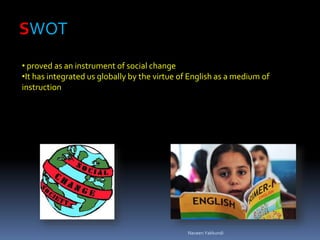
• proved as an instrument of social change
•It has integrated us globally by the virtue of English as a medium of
instruction
Naveen Yakkundi
SWO
T
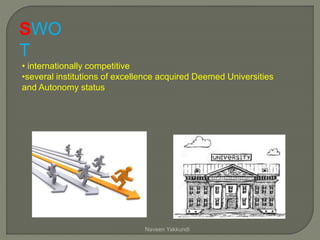
• internationally competitive
•several institutions of excellence acquired Deemed Universities
and Autonomy status
Naveen Yakkundi
SWO
T
• Indian universities are setting-up offshore campuses in abroad.
•IITs, IIMs, TATA and IISC and the laboratories of CSIR are
considered as Centres of excellence with global standards and are
also recognized internationally.
Naveen Yakkundi
Naveen Yakkundi
•No provision of academic audit in Universities and Colleges.
•Lack of quest for quality in majority of institutions.
SWOT
Naveen Yakkundi
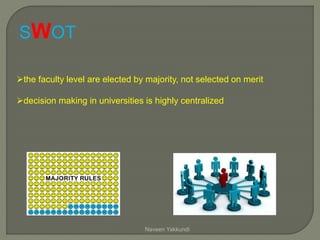
the faculty level are elected by majority, not selected on merit
decision making in universities is highly centralized
SWOT
Naveen Yakkundi
SWOT
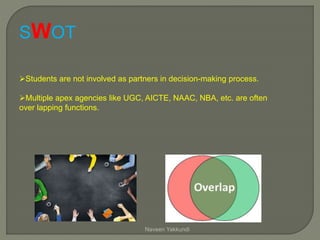
Students are not involved as partners in decision-making process.
Multiple apex agencies like UGC, AICTE, NAAC, NBA, etc. are often
over lapping functions.
Naveen Yakkundi
Lack of equality of educational opportunities.
Uniform fee structure, irrespective of economic status and affordability
of students.
Multiple entrance tests for similar courses burdening students.
No student assessment/feedback.
No campus recruitment as well as part time job likes foreign
universities in higher education.
SWOT
Naveen Yakkundi
Naveen Yakkundi
Autonomy to be given only after NAAC’s accreditation and higher rating
for it.
UGC/AICTE assessment expert committees may be clubbed with
NAAC/NBA’s assessment in the areas of similarity.
AICTE and the universities are in conformity with one another and follow
a similar pattern.
SWOT
Naveen Yakkundi
Universities required to react at pace with the global changes in other
sectors.
Gains in the information technology are to be taken to advantage
education sector.
SWOT
Naveen Yakkundi
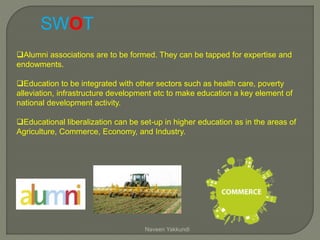
Alumni associations are to be formed. They can be tapped for expertise and
endowments.
Education to be integrated with other sectors such as health care, poverty
alleviation, infrastructure development etc to make education a key element of
national development activity.
Educational liberalization can be set-up in higher education as in the areas of
Agriculture, Commerce, Economy, and Industry.
SWOT
Naveen Yakkundi
Naveen Yakkundi
Professional education to a significant extent is commercialized despite
the intervention of the government.
Majority of the students are studying traditional courses out of
compulsion and lack of alternative but without an interest to pursue them
earnestly.
Art education and science streams have become endangered and hardly
few takers are there for them.
Several courses are run just for sake of survival of those departments
and to sustain the jobs of teachers.
SWOT
Naveen Yakkundi
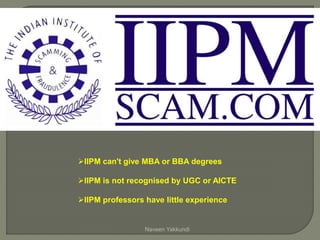
IIPM can't give MBA or BBA degrees
IIPM is not recognised by UGC or AICTE
IIPM professors have little experience
Naveen Yakkundi
State government, which has larger role, has taken insufficient care of
improving the quality of education.
No earnest effort for updating the curriculum development.
Most of the doctoral researcher do not contribute to knowledge but only
create additional data.
Quantitative expansion of higher education.
SWOT
Naveen Yakkundi
The quality of higher education should encompass four components
therefore four E’s
Existence of infrastructure, human and learning resources.
 Extent of use.
Effectiveness of the management process
Effect of the inputs
The advancement of a country can be judged by the standard of higher
education existing in that country. Only certain universities and colleges
are playing vital role in the development and modernization and also
producing men and women of excellence.
Naveen Yakkundi
all the colleges and universities should be evenly distributed with
necessary facilities, for both teaching and research
enforce academic audit in the educational institutions
student bodies are to be involved in academic decision-making
there should be a close interaction between industries and educational
institutions with regard to the industrial field training, project allotment
The Union govt. along with involvement of all state governments, AICTE,
UGC, and the universities has to evolve a common goal and frame policies
for the improvement of the higher education in India.
Naveen Yakkundi
•Wikipedia
•www.scribd.com
•Business today
•www.mhrd.gov.in
Naveen Yakkundi

Indian Higher Education System(SWOT analysis)

  • 1.
  • 2.
    Indian higher educationis one of the best and the second biggest in the World after U.S.A. During independence there were 20 Universities, 500 Colleges with 2,40,000 students. Today there are more than 300 University level Institutions and 13,000 Colleges with approximately 10 Million students. There are more than 4,30,000 teachers engaged in teaching in these Institutions. 7.5% of Indian youth in the age group of 17 - 23 years are studying in the institutions of higher education whereas 15.22% of the youth access to the higher education in many other countries. INTRODUCTION Naveen Yakkundi
  • 3.
  • 4.
    •NAAC by UGC •NBAby AICTE SWO T Naveen Yakkundi
  • 5.
    SWOT •Richest and mostskilled ethnic community in abroad •highly subsidized and, thus it is accessible to the poorest of the poor Naveen Yakkundi
  • 6.
    SWOT • proved asan instrument of social change •It has integrated us globally by the virtue of English as a medium of instruction Naveen Yakkundi
  • 7.
    SWO T • internationally competitive •severalinstitutions of excellence acquired Deemed Universities and Autonomy status Naveen Yakkundi
  • 8.
    SWO T • Indian universitiesare setting-up offshore campuses in abroad. •IITs, IIMs, TATA and IISC and the laboratories of CSIR are considered as Centres of excellence with global standards and are also recognized internationally. Naveen Yakkundi
  • 9.
  • 10.
    •No provision ofacademic audit in Universities and Colleges. •Lack of quest for quality in majority of institutions. SWOT Naveen Yakkundi
  • 11.
    the faculty levelare elected by majority, not selected on merit decision making in universities is highly centralized SWOT Naveen Yakkundi
  • 12.
    SWOT Students are notinvolved as partners in decision-making process. Multiple apex agencies like UGC, AICTE, NAAC, NBA, etc. are often over lapping functions. Naveen Yakkundi
  • 13.
    Lack of equalityof educational opportunities. Uniform fee structure, irrespective of economic status and affordability of students. Multiple entrance tests for similar courses burdening students. No student assessment/feedback. No campus recruitment as well as part time job likes foreign universities in higher education. SWOT Naveen Yakkundi
  • 14.
  • 15.
    Autonomy to begiven only after NAAC’s accreditation and higher rating for it. UGC/AICTE assessment expert committees may be clubbed with NAAC/NBA’s assessment in the areas of similarity. AICTE and the universities are in conformity with one another and follow a similar pattern. SWOT Naveen Yakkundi
  • 16.
    Universities required toreact at pace with the global changes in other sectors. Gains in the information technology are to be taken to advantage education sector. SWOT Naveen Yakkundi
  • 17.
    Alumni associations areto be formed. They can be tapped for expertise and endowments. Education to be integrated with other sectors such as health care, poverty alleviation, infrastructure development etc to make education a key element of national development activity. Educational liberalization can be set-up in higher education as in the areas of Agriculture, Commerce, Economy, and Industry. SWOT Naveen Yakkundi
  • 18.
  • 19.
    Professional education toa significant extent is commercialized despite the intervention of the government. Majority of the students are studying traditional courses out of compulsion and lack of alternative but without an interest to pursue them earnestly. Art education and science streams have become endangered and hardly few takers are there for them. Several courses are run just for sake of survival of those departments and to sustain the jobs of teachers. SWOT Naveen Yakkundi
  • 20.
    IIPM can't giveMBA or BBA degrees IIPM is not recognised by UGC or AICTE IIPM professors have little experience Naveen Yakkundi
  • 21.
    State government, whichhas larger role, has taken insufficient care of improving the quality of education. No earnest effort for updating the curriculum development. Most of the doctoral researcher do not contribute to knowledge but only create additional data. Quantitative expansion of higher education. SWOT Naveen Yakkundi
  • 22.
    The quality ofhigher education should encompass four components therefore four E’s Existence of infrastructure, human and learning resources.  Extent of use. Effectiveness of the management process Effect of the inputs The advancement of a country can be judged by the standard of higher education existing in that country. Only certain universities and colleges are playing vital role in the development and modernization and also producing men and women of excellence. Naveen Yakkundi
  • 23.
    all the collegesand universities should be evenly distributed with necessary facilities, for both teaching and research enforce academic audit in the educational institutions student bodies are to be involved in academic decision-making there should be a close interaction between industries and educational institutions with regard to the industrial field training, project allotment The Union govt. along with involvement of all state governments, AICTE, UGC, and the universities has to evolve a common goal and frame policies for the improvement of the higher education in India. Naveen Yakkundi
  • 24.