“Long years ago we made a tryst with destiny and
now the time comes when we shall redeem our
pledge not wholly or in full measure ,but very
substantially . At the stroke of the midnight hour,
when the world sleeps, India will awake to life and
freedom.”
This was the speech made by Jawaharlal
Nehru as the Prime Minister of an
Independent India , addressing the
constituent assembly and the Indian nation
on 15th August 1947.
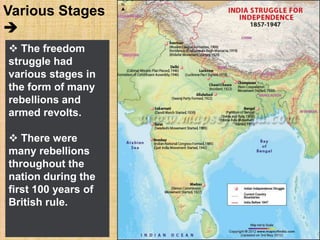
Various Stages

 The freedom
struggle had
various stages in
the form of many
rebellions and
armed revolts.
 There were
many rebellions
throughout the
nation during the
first 100 years of
British rule.
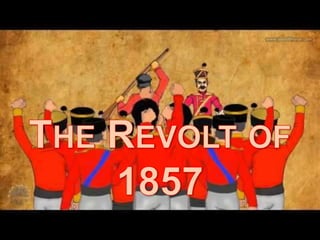
 The traditional opposition finally culminated in the Revolt of 1857, in which
princely rulers, soldiers as well as peasants , alike took part.
 The revolt was the product of accumulated grievances of all these people
towards British imperialism.
Though a failure ,it produced many heroes and also created unity among all
Indians.
Mangal Panday is considered as one of the greatest heroes of the revolt of
1857.
 Some other people who fought in this revolt were Rani Lakshami Bai,
Tantia Tope,Bahadur Shah, Nana Sahib and Begum Hazrat Mahal.
The revolt Shook the very foundation of British Rule in India.
Finally, it led to the power of Indians to be transferred from ………….
East India Company  British crown.
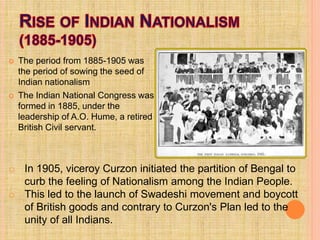
 The period from 1885-1905 was
the period of sowing the seed of
Indian nationalism
 The Indian National Congress was
formed in 1885, under the
leadership of A.O. Hume, a retired
British Civil servant.
o In 1905, viceroy Curzon initiated the partition of Bengal to
curb the feeling of Nationalism among the Indian People.
o This led to the launch of Swadeshi movement and boycott
of British goods and contrary to Curzon's Plan led to the
unity of all Indians.
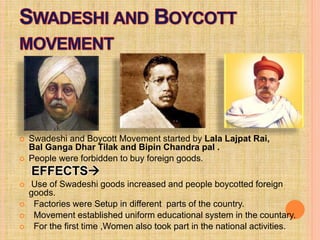
 Swadeshi and Boycott Movement started by Lala Lajpat Rai,
Bal Ganga Dhar Tilak and Bipin Chandra pal .
 People were forbidden to buy foreign goods.
EFFECTS
 Use of Swadeshi goods increased and people boycotted foreign
goods.
 Factories were Setup in different parts of the country.
 Movement established uniform educational system in the countary.
 For the first time ,Women also took part in the national activities.
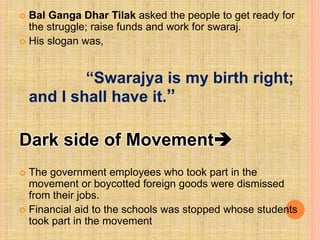
 Bal Ganga Dhar Tilak asked the people to get ready for
the struggle; raise funds and work for swaraj.
 His slogan was,
“Swarajya is my birth right;
and I shall have it.”
Dark side of Movement
 The government employees who took part in the
movement or boycotted foreign goods were dismissed
from their jobs.
 Financial aid to the schools was stopped whose students
took part in the movement
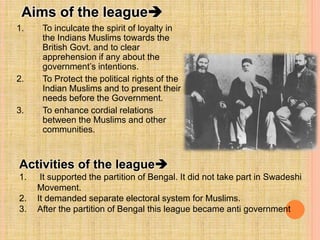
 Muhammadan Educational conference was held in Dacca and the
Muslim leader founded “All India Muslim League” on 30th
December, 1906.
 Aga Khan, Nawa-Salim-ulla Khan, Nawab-Moshine-ul-Mulk and
Nawab-Wakar-ul-mulk played a significant role in founding the
League.
1. British policy of divide and rule.
2. Backwardness of the Muslims
3. Deplorable economic Conditions of the Muslims
4. Muslims did not adopt the English system of education
5. Partition of Bengal ,1905
6. Spread of communal ideas through the study of Indian history
Aims of the league
1. To inculcate the spirit of loyalty in
the Indians Muslims towards the
British Govt. and to clear
apprehension if any about the
government’s intentions.
2. To Protect the political rights of the
Indian Muslims and to present their
needs before the Government.
3. To enhance cordial relations
between the Muslims and other
communities.
Activities of the league
1. It supported the partition of Bengal. It did not take part in Swadeshi
Movement.
2. It demanded separate electoral system for Muslims.
3. After the partition of Bengal this league became anti government
 From 1905 to 1919, the leadership of National Movement was
in the hands of Radicals but humiliating treatment of Indians
abroad ,economic exploitation, terrible plague etc. led to the
birth of Revolutionary movement.
Aims
 To create lawlessness,
 They would not hesitate to sacrifice their life.
 To dislodge the British Rules it was a curse for them
 Main Centers Bengal, Maharashtra, Punjab, Revolutionaries
activities abroad
The Ghadar Party movement was one of the
Revolutionary Movement started by the Indians settled in
America and Canada in 1913.
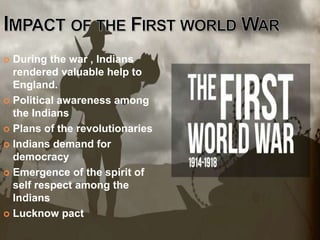
 During the war , Indians
rendered valuable help to
England.
 Political awareness among
the Indians
 Plans of the revolutionaries
 Indians demand for
democracy
 Emergence of the spirit of
self respect among the
Indians
 Lucknow pact
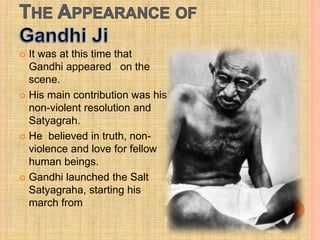
 It was at this time that
Gandhi appeared on the
scene.
 His main contribution was his
non-violent resolution and
Satyagrah.
 He believed in truth, non-
violence and love for fellow
human beings.
 Gandhi launched the Salt
Satyagraha, starting his
march from
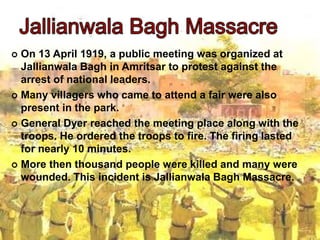
 On 13 April 1919, a public meeting was organized at
Jallianwala Bagh in Amritsar to protest against the
arrest of national leaders.
 Many villagers who came to attend a fair were also
present in the park.
 General Dyer reached the meeting place along with the
troops. He ordered the troops to fire. The firing lasted
for nearly 10 minutes.
 More then thousand people were killed and many were
wounded. This incident is Jallianwala Bagh Massacre.
EFFECTS
 Gandhi ji decided that it was
sin to corporate with
government and started non-
cooperation movement against
the govt. it was the first mass
movement of India.
 Indians developed a great
hatred against the English.
 General dyer was honored as
the ‘Savior of British
empire’.
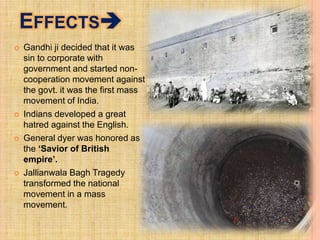
 Jallianwala Bagh Tragedy
transformed the national
movement in a mass
movement.
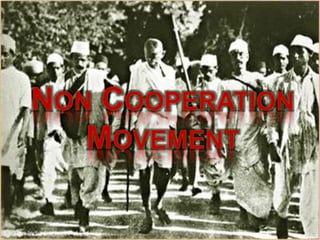
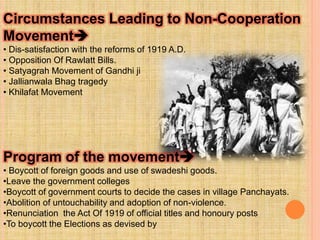
Circumstances Leading to Non-Cooperation
Movement
• Dis-satisfaction with the reforms of 1919 A.D.
• Opposition Of Rawlatt Bills.
• Satyagrah Movement of Gandhi ji
• Jallianwala Bhag tragedy
• Khilafat Movement
Program of the movement
• Boycott of foreign goods and use of swadeshi goods.
•Leave the government colleges
•Boycott of government courts to decide the cases in village Panchayats.
•Abolition of untouchability and adoption of non-violence.
•Renunciation the Act Of 1919 of official titles and honoury posts
•To boycott the Elections as devised by
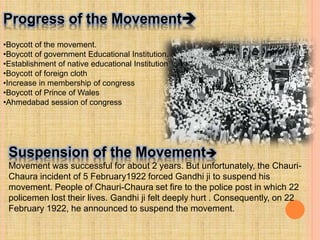
Progress of the Movement
•Boycott of the movement.
•Boycott of government Educational Institution.
•Establishment of native educational Institution
•Boycott of foreign cloth
•Increase in membership of congress
•Boycott of Prince of Wales
•Ahmedabad session of congress
Suspension of the Movement
Movement was successful for about 2 years. But unfortunately, the Chauri-
Chaura incident of 5 February1922 forced Gandhi ji to suspend his
movement. People of Chauri-Chaura set fire to the police post in which 22
policemen lost their lives. Gandhi ji felt deeply hurt . Consequently, on 22
February 1922, he announced to suspend the movement.
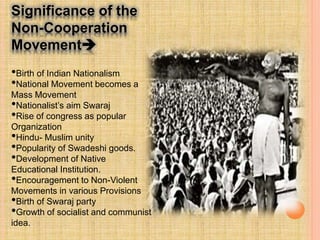
Significance of the
Non-Cooperation
Movement
•Birth of Indian Nationalism
•National Movement becomes a
Mass Movement
•Nationalist’s aim Swaraj
•Rise of congress as popular
Organization
•Hindu- Muslim unity
•Popularity of Swadeshi goods.
•Development of Native
Educational Institution.
•Encouragement to Non-Violent
Movements in various Provisions
•Birth of Swaraj party
•Growth of socialist and communist
idea.
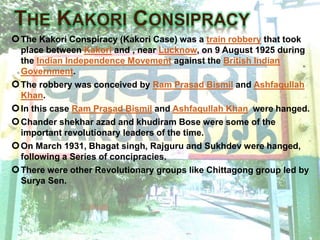
The Kakori Conspiracy (Kakori Case) was a train robbery that took
place between Kakori and , near Lucknow, on 9 August 1925 during
the Indian Independence Movement against the British Indian
Government.
The robbery was conceived by Ram Prasad Bismil and Ashfaqullah
Khan.
In this case Ram Prasad Bismil and Ashfaqullah Khan were hanged.
Chander shekhar azad and khudiram Bose were some of the
important revolutionary leaders of the time.
On March 1931, Bhagat singh, Rajguru and Sukhdev were hanged,
following a Series of concipracies.
There were other Revolutionary groups like Chittagong group led by
Surya Sen.
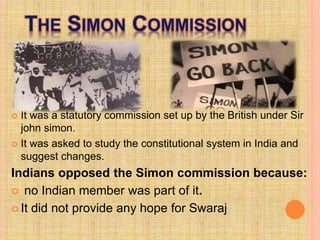
THE SIMON COMMISSION
 It was a statutory commission set up by the British under Sir
john simon.
 It was asked to study the constitutional system in India and
suggest changes.
Indians opposed the Simon commission because:
 no Indian member was part of it.
 It did not provide any hope for Swaraj
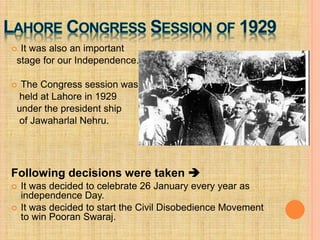
 It was also an important
stage for our Independence.
 The Congress session was
held at Lahore in 1929
under the president ship
of Jawaharlal Nehru.
Following decisions were taken 
 It was decided to celebrate 26 January every year as
independence Day.
 It was decided to start the Civil Disobedience Movement
to win Pooran Swaraj.
 Gandhiji decided to inaugurate the Civil Disobedience
Movement by Breaking the salt law.
 Gandhiji and 78 of his followers started a march on foot from
Sabarmati Ashram to Dandi.[Dandi March]
 Salt March was an active movement carried out in the year
1930.
 It was mainly known as Salt Satyagraha.
 This movement was an essential part of Indian Independence
movement and Non-violent resistance against tax.
 On the 24th day, he vowed to produce more salt without paying
any tax and soon he broke the law for salt.
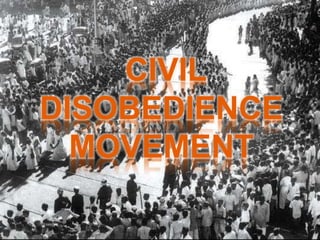
CIVIL
DISOBEDIENCE
MOVEMENT
 Gandhiji led a march on foot from Sabarmati to Dandi.
He broke the Salt Law at Dandi and inaugurated the
Movement.
 People broke salt law in many places. Foreign goods
were boycotted . Liquor shops were picketed.
 Government servants resigned their jobs.
 Forest laws were broken.
 People refused to pay taxes.
 Leaders were arrested
 Workers attacked government offices
 Gandhi ji called off the movement on 5 March 1931
under the Gandhi Irwin act He agreed to attend the
second Round Table Conference.
 It was restarted when Gandhi ji returned from London. It
was finally called of in 1934
 It was the first struggle to win Pooran Swaraj or Complete
Independence.
 It was based on Non violent Satyagrah.
 Women participated in large number in this movement
 It was a real masses movement. Different social groups
participated.
 It was an open challenge to the British rule. The people
openly disobeyed laws.
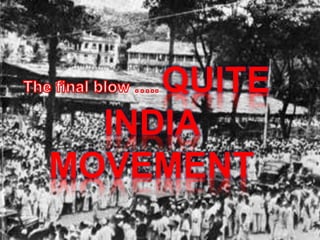
QUITE
INDIA
MOVEMENT
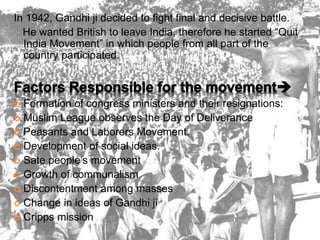
In 1942, Gandhi ji decided to fight final and decisive battle.
He wanted British to leave India, therefore he started “Quit
India Movement” in which people from all part of the
country participated.
 Formation of congress ministers and their resignations:
 Muslim League observes the Day of Deliverance
 Peasants and Laborers Movement.
 Development of social ideas.
 Sate people’s movement
 Growth of communalism
 Discontentment among masses
 Change in ideas of Gandhi ji
 Cripps mission
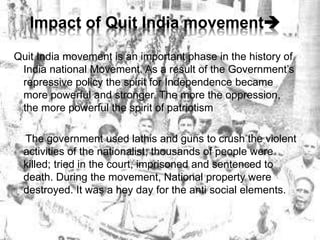
Impact of Quit India movement
Quit India movement is an important phase in the history of
India national Movement. As a result of the Government’s
repressive policy the spirit for Independence became
more powerful and stronger. The more the oppression,
the more powerful the spirit of patriotism
The government used lathis and guns to crush the violent
activities of the nationalist; thousands of people were
killed; tried in the court, imprisoned and sentenced to
death. During the movement, National property were
destroyed. It was a hey day for the anti social elements.
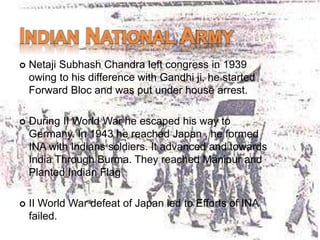
INDIAN NATIONAL ARMY
 Netaji Subhash Chandra left congress in 1939
owing to his difference with Gandhi ji, he started
Forward Bloc and was put under house arrest.
 During II World War he escaped his way to
Germany. In 1943 he reached Japan , he formed
INA with Indians soldiers. It advanced and towards
India Through Burma. They reached Manipur and
Planted Indian Flag
 II World War defeat of Japan led to Efforts of INA
failed.
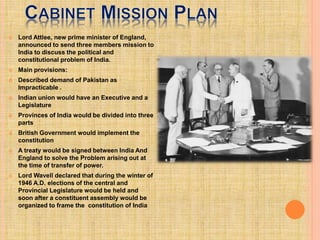
 Lord Attlee, new prime minister of England,
announced to send three members mission to
India to discuss the political and
constitutional problem of India.
 Main provisions:
 Described demand of Pakistan as
Impracticable .
 Indian union would have an Executive and a
Legislature
 Provinces of India would be divided into three
parts
 British Government would implement the
constitution
 A treaty would be signed between India And
England to solve the Problem arising out at
the time of transfer of power.
 Lord Wavell declared that during the winter of
1946 A.D. elections of the central and
Provincial Legislature would be held and
soon after a constituent assembly would be
organized to frame the constitution of India
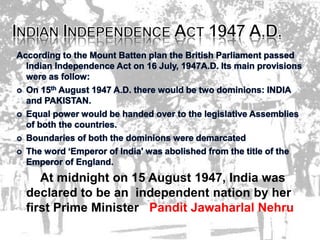
At midnight on 15 August 1947, India was
declared to be an independent nation by her
first Prime Minister Pandit Jawaharlal Nehru
Indian freedom struggle

Indian freedom struggle

  • 2.
    “Long years agowe made a tryst with destiny and now the time comes when we shall redeem our pledge not wholly or in full measure ,but very substantially . At the stroke of the midnight hour, when the world sleeps, India will awake to life and freedom.” This was the speech made by Jawaharlal Nehru as the Prime Minister of an Independent India , addressing the constituent assembly and the Indian nation on 15th August 1947.
  • 3.
    Various Stages   Thefreedom struggle had various stages in the form of many rebellions and armed revolts.  There were many rebellions throughout the nation during the first 100 years of British rule.
  • 5.
     The traditionalopposition finally culminated in the Revolt of 1857, in which princely rulers, soldiers as well as peasants , alike took part.  The revolt was the product of accumulated grievances of all these people towards British imperialism. Though a failure ,it produced many heroes and also created unity among all Indians. Mangal Panday is considered as one of the greatest heroes of the revolt of 1857.  Some other people who fought in this revolt were Rani Lakshami Bai, Tantia Tope,Bahadur Shah, Nana Sahib and Begum Hazrat Mahal. The revolt Shook the very foundation of British Rule in India. Finally, it led to the power of Indians to be transferred from …………. East India Company  British crown.
  • 7.
     The periodfrom 1885-1905 was the period of sowing the seed of Indian nationalism  The Indian National Congress was formed in 1885, under the leadership of A.O. Hume, a retired British Civil servant. o In 1905, viceroy Curzon initiated the partition of Bengal to curb the feeling of Nationalism among the Indian People. o This led to the launch of Swadeshi movement and boycott of British goods and contrary to Curzon's Plan led to the unity of all Indians.
  • 8.
     Swadeshi andBoycott Movement started by Lala Lajpat Rai, Bal Ganga Dhar Tilak and Bipin Chandra pal .  People were forbidden to buy foreign goods. EFFECTS  Use of Swadeshi goods increased and people boycotted foreign goods.  Factories were Setup in different parts of the country.  Movement established uniform educational system in the countary.  For the first time ,Women also took part in the national activities.
  • 9.
     Bal GangaDhar Tilak asked the people to get ready for the struggle; raise funds and work for swaraj.  His slogan was, “Swarajya is my birth right; and I shall have it.” Dark side of Movement  The government employees who took part in the movement or boycotted foreign goods were dismissed from their jobs.  Financial aid to the schools was stopped whose students took part in the movement
  • 10.
     Muhammadan Educationalconference was held in Dacca and the Muslim leader founded “All India Muslim League” on 30th December, 1906.  Aga Khan, Nawa-Salim-ulla Khan, Nawab-Moshine-ul-Mulk and Nawab-Wakar-ul-mulk played a significant role in founding the League. 1. British policy of divide and rule. 2. Backwardness of the Muslims 3. Deplorable economic Conditions of the Muslims 4. Muslims did not adopt the English system of education 5. Partition of Bengal ,1905 6. Spread of communal ideas through the study of Indian history
  • 11.
    Aims of theleague 1. To inculcate the spirit of loyalty in the Indians Muslims towards the British Govt. and to clear apprehension if any about the government’s intentions. 2. To Protect the political rights of the Indian Muslims and to present their needs before the Government. 3. To enhance cordial relations between the Muslims and other communities. Activities of the league 1. It supported the partition of Bengal. It did not take part in Swadeshi Movement. 2. It demanded separate electoral system for Muslims. 3. After the partition of Bengal this league became anti government
  • 12.
     From 1905to 1919, the leadership of National Movement was in the hands of Radicals but humiliating treatment of Indians abroad ,economic exploitation, terrible plague etc. led to the birth of Revolutionary movement. Aims  To create lawlessness,  They would not hesitate to sacrifice their life.  To dislodge the British Rules it was a curse for them  Main Centers Bengal, Maharashtra, Punjab, Revolutionaries activities abroad The Ghadar Party movement was one of the Revolutionary Movement started by the Indians settled in America and Canada in 1913.
  • 13.
     During thewar , Indians rendered valuable help to England.  Political awareness among the Indians  Plans of the revolutionaries  Indians demand for democracy  Emergence of the spirit of self respect among the Indians  Lucknow pact
  • 14.
     It wasat this time that Gandhi appeared on the scene.  His main contribution was his non-violent resolution and Satyagrah.  He believed in truth, non- violence and love for fellow human beings.  Gandhi launched the Salt Satyagraha, starting his march from
  • 15.
     On 13April 1919, a public meeting was organized at Jallianwala Bagh in Amritsar to protest against the arrest of national leaders.  Many villagers who came to attend a fair were also present in the park.  General Dyer reached the meeting place along with the troops. He ordered the troops to fire. The firing lasted for nearly 10 minutes.  More then thousand people were killed and many were wounded. This incident is Jallianwala Bagh Massacre.
  • 16.
    EFFECTS  Gandhi jidecided that it was sin to corporate with government and started non- cooperation movement against the govt. it was the first mass movement of India.  Indians developed a great hatred against the English.  General dyer was honored as the ‘Savior of British empire’.  Jallianwala Bagh Tragedy transformed the national movement in a mass movement.
  • 18.
    Circumstances Leading toNon-Cooperation Movement • Dis-satisfaction with the reforms of 1919 A.D. • Opposition Of Rawlatt Bills. • Satyagrah Movement of Gandhi ji • Jallianwala Bhag tragedy • Khilafat Movement Program of the movement • Boycott of foreign goods and use of swadeshi goods. •Leave the government colleges •Boycott of government courts to decide the cases in village Panchayats. •Abolition of untouchability and adoption of non-violence. •Renunciation the Act Of 1919 of official titles and honoury posts •To boycott the Elections as devised by
  • 19.
    Progress of theMovement •Boycott of the movement. •Boycott of government Educational Institution. •Establishment of native educational Institution •Boycott of foreign cloth •Increase in membership of congress •Boycott of Prince of Wales •Ahmedabad session of congress Suspension of the Movement Movement was successful for about 2 years. But unfortunately, the Chauri- Chaura incident of 5 February1922 forced Gandhi ji to suspend his movement. People of Chauri-Chaura set fire to the police post in which 22 policemen lost their lives. Gandhi ji felt deeply hurt . Consequently, on 22 February 1922, he announced to suspend the movement.
  • 20.
    Significance of the Non-Cooperation Movement •Birthof Indian Nationalism •National Movement becomes a Mass Movement •Nationalist’s aim Swaraj •Rise of congress as popular Organization •Hindu- Muslim unity •Popularity of Swadeshi goods. •Development of Native Educational Institution. •Encouragement to Non-Violent Movements in various Provisions •Birth of Swaraj party •Growth of socialist and communist idea.
  • 21.
    The Kakori Conspiracy(Kakori Case) was a train robbery that took place between Kakori and , near Lucknow, on 9 August 1925 during the Indian Independence Movement against the British Indian Government. The robbery was conceived by Ram Prasad Bismil and Ashfaqullah Khan. In this case Ram Prasad Bismil and Ashfaqullah Khan were hanged. Chander shekhar azad and khudiram Bose were some of the important revolutionary leaders of the time. On March 1931, Bhagat singh, Rajguru and Sukhdev were hanged, following a Series of concipracies. There were other Revolutionary groups like Chittagong group led by Surya Sen.
  • 22.
    THE SIMON COMMISSION It was a statutory commission set up by the British under Sir john simon.  It was asked to study the constitutional system in India and suggest changes. Indians opposed the Simon commission because:  no Indian member was part of it.  It did not provide any hope for Swaraj
  • 23.
     It wasalso an important stage for our Independence.  The Congress session was held at Lahore in 1929 under the president ship of Jawaharlal Nehru. Following decisions were taken   It was decided to celebrate 26 January every year as independence Day.  It was decided to start the Civil Disobedience Movement to win Pooran Swaraj.
  • 24.
     Gandhiji decidedto inaugurate the Civil Disobedience Movement by Breaking the salt law.  Gandhiji and 78 of his followers started a march on foot from Sabarmati Ashram to Dandi.[Dandi March]  Salt March was an active movement carried out in the year 1930.  It was mainly known as Salt Satyagraha.  This movement was an essential part of Indian Independence movement and Non-violent resistance against tax.  On the 24th day, he vowed to produce more salt without paying any tax and soon he broke the law for salt.
  • 25.
  • 26.
     Gandhiji leda march on foot from Sabarmati to Dandi. He broke the Salt Law at Dandi and inaugurated the Movement.  People broke salt law in many places. Foreign goods were boycotted . Liquor shops were picketed.  Government servants resigned their jobs.  Forest laws were broken.  People refused to pay taxes.  Leaders were arrested  Workers attacked government offices  Gandhi ji called off the movement on 5 March 1931 under the Gandhi Irwin act He agreed to attend the second Round Table Conference.  It was restarted when Gandhi ji returned from London. It was finally called of in 1934
  • 27.
     It wasthe first struggle to win Pooran Swaraj or Complete Independence.  It was based on Non violent Satyagrah.  Women participated in large number in this movement  It was a real masses movement. Different social groups participated.  It was an open challenge to the British rule. The people openly disobeyed laws.
  • 28.
  • 29.
    In 1942, Gandhiji decided to fight final and decisive battle. He wanted British to leave India, therefore he started “Quit India Movement” in which people from all part of the country participated.  Formation of congress ministers and their resignations:  Muslim League observes the Day of Deliverance  Peasants and Laborers Movement.  Development of social ideas.  Sate people’s movement  Growth of communalism  Discontentment among masses  Change in ideas of Gandhi ji  Cripps mission
  • 30.
    Impact of QuitIndia movement Quit India movement is an important phase in the history of India national Movement. As a result of the Government’s repressive policy the spirit for Independence became more powerful and stronger. The more the oppression, the more powerful the spirit of patriotism The government used lathis and guns to crush the violent activities of the nationalist; thousands of people were killed; tried in the court, imprisoned and sentenced to death. During the movement, National property were destroyed. It was a hey day for the anti social elements.
  • 31.
    INDIAN NATIONAL ARMY Netaji Subhash Chandra left congress in 1939 owing to his difference with Gandhi ji, he started Forward Bloc and was put under house arrest.  During II World War he escaped his way to Germany. In 1943 he reached Japan , he formed INA with Indians soldiers. It advanced and towards India Through Burma. They reached Manipur and Planted Indian Flag  II World War defeat of Japan led to Efforts of INA failed.
  • 32.
     Lord Attlee,new prime minister of England, announced to send three members mission to India to discuss the political and constitutional problem of India.  Main provisions:  Described demand of Pakistan as Impracticable .  Indian union would have an Executive and a Legislature  Provinces of India would be divided into three parts  British Government would implement the constitution  A treaty would be signed between India And England to solve the Problem arising out at the time of transfer of power.  Lord Wavell declared that during the winter of 1946 A.D. elections of the central and Provincial Legislature would be held and soon after a constituent assembly would be organized to frame the constitution of India
  • 34.
    At midnight on15 August 1947, India was declared to be an independent nation by her first Prime Minister Pandit Jawaharlal Nehru