CHAPTER -2 (HISTORY)
NATIONALISM IN INDIA
NATIONALISM IN EUROPE
Nationalism in Europe came to be associated with the
formation of nation states.
In most countries the making of this new national
identity was a long process.
INDIAN NATIONALISM AND ANTI-
COLONIALISM
 In India, the growth of modern nationalism is intimately
connected to anti nationalism movement.
 People began discovering their unity in the process of their
struggle with colonialism.
 But each class and group felt the effects of colonialism
differently.
 Their nations of freedom were not always the same.
 The Congress under Mahatma Gandhi tried to forge these
groups together within one movement . But the unity did not
emerge without conflict.
THE FIRST WORLD WAR
 The war created a new economic and political situation.
 Prices increased; doubling between 1913 and 1918- leading
to extreme hardship for the common people.
 Forced recruitment in the army caused widespread anger
in the people of the rural areas.
 In 1918-1919 and 1920-1921, crops failed in many areas
and it was accompanied with an influenza pandemic.
THE IDEA OF SATYAGRAHA
Mahatma Gandhi returned to India in 1915. He had come from South
Africa where he had successfully fought the racist regime.
The idea of Satyagraha emphasized the need to search for truth.
People (including the oppressors) had to be persuaded to see the truth,
instead of being forced to accept the truth through the use of violence.
 After returning to India, Mahatma Gandhi successfully
organized satyagraha movements in various places.
 In 1917, he travelled to Champaran in Bihar to inspire
the peasants to struggle against the oppressive plantation
system.
 He organized a satyagraha to support the peasants of the
Kheda district of Gujarat. Affected by a crop failure, the
peasants of Kheda could not pay the revenue, and they
wanted it to be relaxed.
 In 1918, he organized a Satyagraha Movement in
Ahmedabad amongst the cotton mill workers.
THE ROWLATT ACT (1919)
Gandhiji in 1919, decided to launch a
nationwide satyagraha against the proposed
Rowlatt Act.
The act gave the government enormous powers
to repress political activities, and allowed
detention of political prisoners without trial for
two years.
Rallies were organized in various cities, workers
went on strike in railway workshops, and shops
closed down.
THE JALLIANWALLA BAGH
INCIDENT
 On 13 April, the Jallianwalla Bagh incident
took place.
 On that day a large crowd gathered in the
enclosed ground of Jalian Walla Bagh.
 General Dyer entered the area, blocked the
exit points, and opened fire on the crowd,
killing hundreds.
 Seeking violence spread, Mahatma Gandhi
called off the movement.
THE KHILAFAT ISSUE
 There were rumors after the defeat of Ottoman Turkey in
WW1 that a harsh peace treaty was going to be imposed on the
Ottoman empire- the spiritual head of the Islamic world (the
Khalifa).
 Thus, a Khilafat committee was formed in Bombay in March
1919.
 The brothers Muhammad Ali and Shaukat Ali began discussing
with Mahatma Gandhi about the possibility of a united mass
action on the issue.
 In September 1920, he convinced other leaders of the need to
start a non-cooperation movement in support of Khilafat as
well as for swaraj.
NON-COOPERATION MOVEMENT
 Mahatma Gandhi declared the British rule was
established in India with the cooperation of
Indians, and had survived only because of this
cooperation.
If Indians refused to cooperate, British rule in
India would collapse within a year, and swaraj
would come.
DIFFERENT STRANDS WITHIN THE
MOVEMENT
The Non-Cooperation Khilafat Movement began in January 1921.
All the members of the movement responded to the call of swaraj, but
the term meant different things to different people.
THE MOVEMENT IN THE TOWNS
Thousands of students left government controlled schools and
colleges.
The import of foreign cloth halved between 1921 and 1922, its value
dropping from Rs. 102 cr to Rs. 57 cr.
People began discarding imported clothes and wearing only Indian
ones. Production of Indian textile mills and handlooms went up.
DISADVANTAGES OF THE MOVEMENT
 This movement gradually slowed down for a variety of reasons.
 Khadi cloth was often more expensive than mass-produced mill
cloth and poor people could not afford to buy it.
 For the movement to be successful, alternative Indian
institutions had to be set up so that they could be used in place
of the British ones. These were slow to come up.
 So students and teachers began trickling back to government
schools and lawyers joined back work in government courts.
REBELLION OF THE PEASANTS
From the cities, the rebellion passed on to the countryside.
The movement in Awadh was against the Talukdars and landlords who
demanded from peasants exorbitantly high rents and a variety of other
cesses.
Peasants had to do Begar and work at landlord’s farms without any
payment.
The peasant movement demanded reduction of revenue, abolition of
Begar, and social boycott of oppressive landlords.
The peasant movement, however, developed In forms that the
Congress leadership was unhappy with.
The houses of Talukdars and landlords were attacked, bazaars
were looted and grain hoards were taken over.
The name of the Mahatma was being invoked to sanction all
action and aspirations.
REBELLION OF THE TRIBALS
In the Gudem hills of Andhra Pradesh, large areas of forest
were closed by the colonial government, preventing people
from entering the forests to graze their cattle, or to collect
fuelwood and fruits.
This enraged the Hill people as their traditional rights were
being denied.
ALLURI SITARAM RAJU
Alluri Sitaram Raju had a variety of special powers:- he
could make correct astrological predictions and heal
people, and he could even survive bullet shots.
 Raju talked of the greatness of Mahatma Gandhi and
was inspired by the non-cooperation movement.
But at the same Time he asserted that India could be
liberated only by the use of force, not non-violence.
SWARAJ IN THE PLANTATIONS
 For plantation workers in Assam, freedom meant the right to move freely in and
out of the confined place in which they were enclosed.
 Under the Inland Emigration Act of 1859, plantation workers were not
permitted to leave the tea gardens without permission.
 When they heard about the non-cooperation movement, thousands of workers
left the plantations and headed home.
 They believed that Gandhi Raj was coming and everyone would be given land in
their own villages.
The people interpreted the term swaraj in their own
ways, imagining it to be a time when all suffering and all
troubles would be over.
Yet, they were also emotionally relating to an all-India
agitation.
TOWARDS CIVIL DISOBEDIECE
In February 1922, Mahatma Gandhi decided to withdraw
the Non-Cooperation Movement. He felt the Movement
was turning violent in many places.
Within the Congress, some leaders wanted to participate in
elections to the provincial councils that had been set up by
the Government of India Act, 1919.
SIMON COMMISSION
 The commission was to look into the functioning of the
constitutional system in India and suggest changes.
 The problem was that the commission did not have a single
Indian member. The members were all British.
 When the Simon Commission arrived on India in 1928, It
was greeted with the slogan GO BACK SIMON!
 So Lord Irwin, the then Viceroy, a vague offer of ‘dominion
status’ for India in an unspecified future, and a Round Table
Conference to discuss a future constitution
RADICALS WITHIN THE CONGRESS
 The radicals within the Congress, led by Jawaharlal
Nehru and Subhas Chandra Bose, became more
assertive.
 The liberals and moderates, who were proposing a
constitutional system within the framework of British
dominion, gradually lost their influence.
 In December 1929, the Lahore Congress under
Jawaharlal Nehru formalized the demand of ‘Purna
Swaraj’ or full independence for India.
 It was declared that 26 January, 1930 would be
celebrated as the Independence Day.
SALT MARCH
• Mahatma Gandhi found in salt a powerful Symbol that could unite
the nation.
• On 31 January 1930, he sent a letter to Viceroy Irwin stating Il
demands. Some of these were specific demands of different classes,
from industrialists to peasants.
• The idea was to make the demands wide – ranging, so that all classes
within Indian society could identify with them and everyone could
be brought together in a united campaign.
• The most stirring of all was the demand to abolish the salt tax.
• Salt was something consumed by the rich and the poor alike.
• The tax on salt and the government monopoly over its production ,
Mahatma Gandhi declared, revealed the most oppressive face of British
Rule.
DANDI MARCH (CIVIL DISOBEDIENCE
MOVEMENT)
• Mahatma Gandhi’s letter was, in a way, an ultimatum.
• If the demands were not fulfilled by 11 March, the letter stated, the
congress would launch a civil disobedience campaign.
• Irwin was unwilling to negotiate.
• So Mahatma Gandhi started his famous Salt march accompanied by
78 of his trusted volunteers.
• The march was over 240 miles , from
Ghandhiji’s Ashram in Sabarmati to the
Gujarati coastal town of Dandi.
• The volunteers walked for 24 days about 10
miles a day.
• Thousands come to hear Mahatma Gandhi
Wherever he stopped and he told them what he
meant by Swaraj and urged them to peacefully
defy the British.
• On 6th April he reached Dandi, and
ceremonially violated the law, manufacturing
salt by boiling sea water.
• This marked the beginning of the civil
disobedience Movement .
HOW WAS THIS MOVEMENT DIFFERENT FROM THE
NON-COOPERATION MOVEMENT ??
• People were now asked not only to refuse cooperation with the British as they
had done in 1921-22 , but also to break colonial laws.
• As the movement spread, foreign cloth was boycotted, and liquor Shops were
picketed. Peasants refused to pay revenue and chowkidari taxes, village officials
resigned & in many places forest people violated forest laws – going into
Reserved Forests to collect wood and graze cattle.
• Worried by the developments, the colonial government began arresting the
congress leaders one by one. This led to violent clashes in many palaces.
• When Abdul Ghaffar Khan , a devout disciple of Mahatma
Gandhi, was arrested in April 1930, Angry crowds demonstrated
in the streets of Peshawar, facing armoured Cars & Police firing.
Many were killed.
• When Mahatma Gandhi himself was arrested, Industrial workers
n Sholapur attacked police posts, Municipal buildings, law courts
and railway Stations – all structures that symbolised British Rule.
• Peaceful Satyagrahis were attacked, women & children were
beaten, and about 100,000 people were arrested.
GANDHI – IRWIN PACT
• Mahatma Gandhi once again decided to call
off the movement & entered into a pact with
Irwin on 5th March 1931.
• By this Gandhi Irwin pact, Gandhiji consented
to participate in a Round-table conference in
London and the Government agreed to release
the political prisoners.
• In December 1931, Gandhiji went to London
for the conference, but the negotiations broke
down and he returned disappointed.
RELAUNCHING OF CIVIL DISOBEDIENCE
MOVEMENT
•Ghaffar Khan and Jawaharlal Nehru were both in jail, the
congress had been declared illegal , And a series of measures
had been imposed to prevent meetings, demonstrations &
boycotts.
•With great apprehension, Mahatma Gandhi relaunched the
civil disobedience movement .
•For over a year, the movement continued but by 1934 it lost its
momentum.
HOW PARTICIPANTS SAW THE MOVEMENT
•In the countryside rich peasant communities – like the Patidars
of Gujarat & the Jats of Uttar Pradesh were active in the
movement.
•These rich Peasants became enthusiastic supporters of the civil
disobedience movement.
•For them the fight for Swaraj was a struggle ogainst high
revenues.
•So when the movement was restarted in 1932, Many of them
refused to participate.
•The Poorer peasantry were not just interested in the lowering
of the revenue demand.
•They wanted the unpaid rent to the landlord to be remitted.
They joined a variety of radical movements, often led by
Socialists & Communists.
•The congress was unwilling to support ‘no rent’ campaigns in
most places. So the relationship between the poor peasants and
the congress remained uncertain.
WHAT ABOUT THE BUSINESS CLASSES?
•During the First World war, Indian merchants and
industrialists had made huge profits and become powerful.
•Keen on expanding their business, they now reacted against
colonial policies that restricted business activities.
•They wanted protection against imports of foreign goods, and a
rupee-sterling foreign exchange ratio that would discourage
imports.
•To organise business interests, they formed the Indian
Industrial and commercial congress in 1920 and the Federation
of the Indian Chamber of Commerce and Industries (FICCI) in
1927.
•Prominent Industrialists like Purshottamdas Thakurdas and
G.D Birla , The industrialists attacked colonial control over the
Indian economy, and supported the Civil Disobedience
Movement when it was first launched.
•They gave financial assistance and refused to buy or sell
imported goods.
•But after the failure of the Round table conference, business
groups were no longer uniformly enthusiastic.
•The industrial working class did not participate in the Civil
disobedience movement in large numbers, except in the
Nagpur region.
•Civil Disobedience Movement selectively adopting some of the
ideas of the Gandhian programme, like boycott of foreign
goods, as part of their own movements against low wages &
poor working conditions.
•There were strikes by railway workers in 1930 & dockworkers
in 1932.
•In 1930 thousands of workers in Chota nagpur tin mines wore
Gandhi caps and Participated in protest rallies & boycott
campaigns.
•Another feature of the Civil Disobedience Movement was the
large-scale participation of women.
•Moved by Gandhiji’s call, they began to see Service to the
nation as a sacred duty of women.
THE LIMITS OF CIVIL DISOBEDIENCE
• Not all social groups were moved by the abstract concept of Swaraj.
• One such group was the nation’s ‘untouchables’ who from around the
1930s had begun to call themselves dalit or oppressed.
• Mahatma Gandhi declared that Swaraj would not come for a 100 years
if untouchability was not eliminated.
• He called the ‘untouchables’ harijan, or the children of God, organised
satyagraha to secure them entry into temples and access to public wells,
roads & Schools.
• He himself cleaned toilets to dignify the work of the bhangi (the
sweepers) and persuaded upper castes to change their heart and give up
the ‘sin of untouchability’.
• They began organising themselves, demanding reserved seats in
educational institutions, and a separate electorate that would choose
dalit members for legislative councils.
• Dalit participation in the Civil Disobedience Movement was therefore
limited, particularly in the Maharashtra & Nagpur region where their
organization was quite strong.
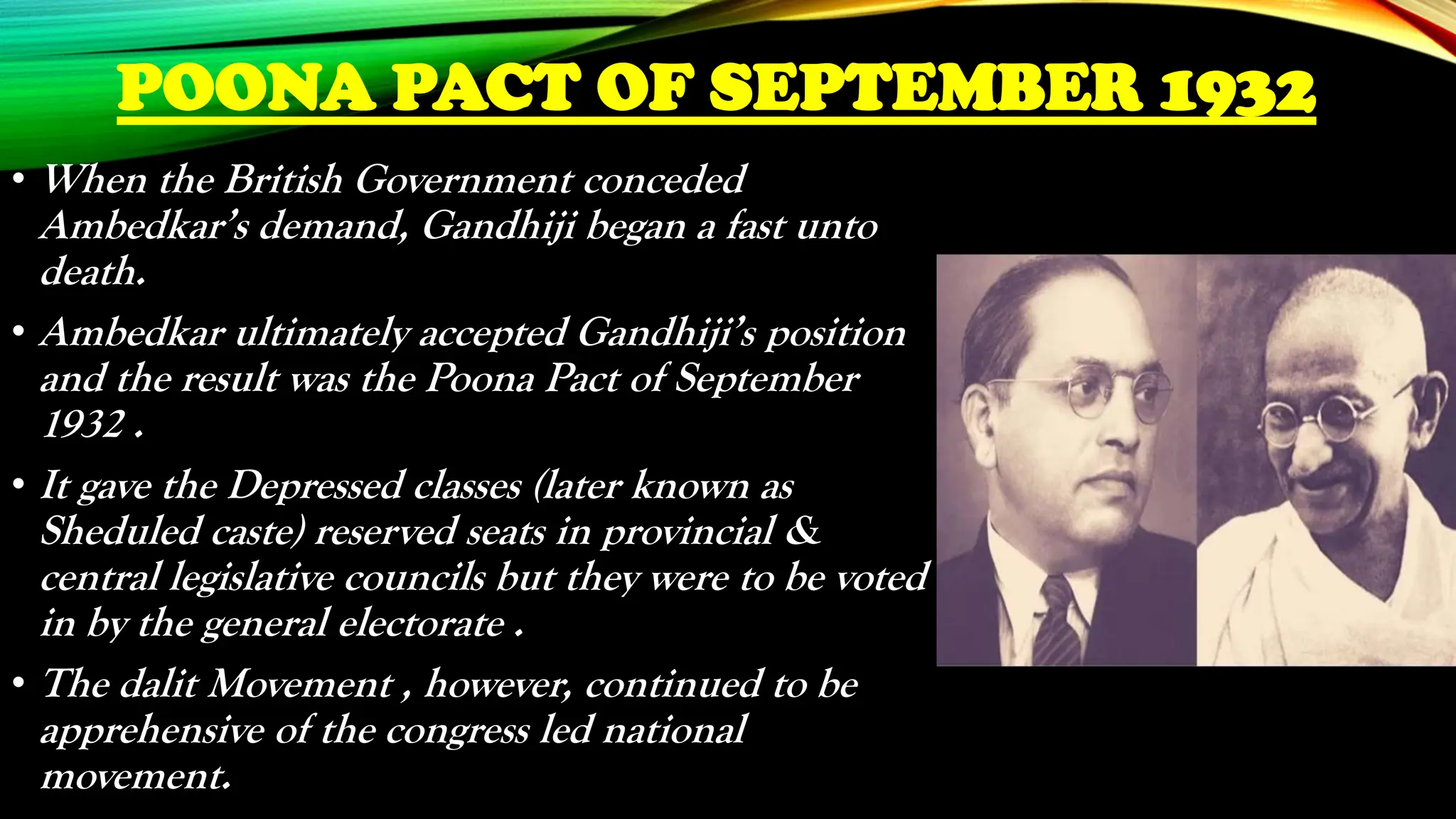
• Dr B.R Ambedkar who organised the dalits into the depressed classes
Association in 1930, clashed with Mahatma Gandhi at the Second
Round Table conference by demanding separate electorates for Dalits.
POONA PACT OF SEPTEMBER 1932
• When the British Government conceded
Ambedkar’s demand, Gandhiji began a fast unto
death.
• Ambedkar ultimately accepted Gandhiji’s position
and the result was the Poona Pact of September
1932 .
• It gave the Depressed classes (later known as
Sheduled caste) reserved seats in provincial &
central legislative councils but they were to be voted
in by the general electorate .
• The dalit Movement , however, continued to be
apprehensive of the congress led national
movement.
•After the decline of the Non- cooperation-Khilafat Movement a
large section of Muslims felt alienated from the congress.
•As relation between Hindus & Muslims worsened, each
community organised religious processions with militant
fervour, provoking Hindu-Muslim communal clashes & riots in
various cities. Every riot deepened the distance between the
two communities .
•The congress and the Muslim league made efforts to
renegotiate an alliance , and in 1927 it appeared that such a
unity could be forged.
• Muhammad Ali Jinnah, one of the leaders of the Muslim league, was willing to
give up the demand for separate electorates if Muslims were assured reserved seat
in the Central Assembly & representation in proportion to population in the
Muslim-dominated provinces (Bengal and Punjab).
• All parties conference in 1928 disappeared when M.R Jayakar of e Hindu
Mahasabha strongly opposed efforts at compromise.
• Alienated from the congress, large sections of Muslim couldn’t respond to the call
for a united Struggle.
• Many Muslim leaders and intellectuals expressed their concern about the status
of Muslims as a minority within India.
• They feared that the cultural & identity of minorities would be submerged under
the domination of a Hindu Majority .
THE SENSE OF COLLECTIVE BELONGING
• Nationalism spreads when people begin to believe that they are all part
of the same notion, when they discover some unity that binds them
together.
• This sense of collective belonging came partly through the experience
of united Struggles. But there were also a variety of cultural processes
through which nationalism captured people’s imagination.
• History & fiction, folklore and songs , polpular prints & Symbols all
played a part in the making of nationalism.
• The identity of the nation is most often symbolised in a figure or an
image.
•It was in the 20th century with the growth of nationalism ,
that the identity of India came to be visually associated
with the image of Bharat Mata.
•The image was first created by Bankim Chandra
chattopadhyay. In the 1870s he wrote ‘Vande Mataram’ as a
hymn to the nation. Later it was included in his novel
Anandhamath & widely sung during the Swadeshi
Movement in Bengal.
•Devotion to this mother figure came to be seen as evidence
of one’s nationalism.
•Ideas of Nationalism also developed through a movement
to revive Indian Folklore.
Bharat Mata
•It was essential to preserve this folk tradition in order to
discover one’s national identity and restore a sense of pride in
one’s past.
•Rabindranath Tagore himself began collecting ballads, nursery
rhymes and myths, & led the movement for folk revival.
•As the national movement developed nationalist leaders
became more and more aware of such icons & Symbol in
unifying people and inspiring in them a feeling of nationalism.
• During the Swadeshi movement in Bengal , A tricolour flag (red, green
& yellow) was designed.
• It had 8 lotuses representing 8 provinces of British India, and a crescent
moon, Representing Hindus & Muslims.
• By 1921 , Gandhiji had designed the Swaraj Flag. It was again a tricolour
(red, green & White) and had a spinning wheel in the centre,
Representing the Gandhian ideal of self-help.
• Carrying the flag holding it aloft, during marches became a symbol of
defiance.
DESIGNING OF A NATIONAL FLAG
• Creating a feeling of nationalism was through reinterpretation of
History.
• Indians began looking into the past to discover India’s great
achievements.
• They wrote about the glorious developments in ancient times when art
and architecture, science & Mathematics, Religion & culture , law and
philosophy, crafts and trade had flourished.
• This glorious time , in their view , was followed by a history of decline,
when India was colonised.
FEELING OF NATIONALISM
CONCLUSION
• A growing anger against the colonial govt was thus bringing together
various groups and classes of Indians into a common struggle for
freedom in the first half of the 20th century.
• The congress under the leadership of Mahatma Gandhi tried to
channel people’s grievances into organised movements for
Independence.
• In other words, what was emerging was a nation with many voices
wanting freedom from colonial rule.
SOME IMPORTANT DATES
 1918-1919- Distressed UP peasants organized by Baba Ramachandra.
 April 1919- Gandhian hartal against Rowlatt Act; Jallianwalla Bagh massacre.
 January 1921- Non-Cooperation and Khilafat Movement launched.
 February 1922- Chauri Chaura; Gandhiji withdraws Non-cooperation movement.
 May 1924- Alluri Sitaram Raju arrested ending a two-year armed tribal struggle.
 December 1929- Lahore Congress; Congress adopts the demand for ‘Purna Swaraj’.
 1930- Ambedkar establishes Depressed Classes association.
 March 1930- Gandhiji begins Civil Disobedience Movement by breaking Salt Law at Dandi.
 March 1931- Gandhiji ends Civil Disobedience Movement.
 December 1931- Second Round Table Conference
 1932- Civil Disobedience Movement re-launched.
GLOSSARY
FORCED RECRUITMENT – A process by which the colonial state
forced people to join the army.
BOYCOTT – The refusal to deal and associate with people, or to
participate in activities, or buy and use things; usually a form of
protest
PICKET – A form of demonstration or protest by which people block
the entrance to a shop, factory or office.
BEGAR – Labor that villagers were forced to contribute without any
payment.
DONE BY VJ LEARNING

chapter2nationalisminindia-210607124728.pdf

  • 1.
  • 2.
    NATIONALISM IN EUROPE Nationalismin Europe came to be associated with the formation of nation states. In most countries the making of this new national identity was a long process.
  • 3.
    INDIAN NATIONALISM ANDANTI- COLONIALISM  In India, the growth of modern nationalism is intimately connected to anti nationalism movement.  People began discovering their unity in the process of their struggle with colonialism.  But each class and group felt the effects of colonialism differently.  Their nations of freedom were not always the same.  The Congress under Mahatma Gandhi tried to forge these groups together within one movement . But the unity did not emerge without conflict.
  • 4.
    THE FIRST WORLDWAR  The war created a new economic and political situation.  Prices increased; doubling between 1913 and 1918- leading to extreme hardship for the common people.  Forced recruitment in the army caused widespread anger in the people of the rural areas.  In 1918-1919 and 1920-1921, crops failed in many areas and it was accompanied with an influenza pandemic.
  • 5.
    THE IDEA OFSATYAGRAHA Mahatma Gandhi returned to India in 1915. He had come from South Africa where he had successfully fought the racist regime. The idea of Satyagraha emphasized the need to search for truth. People (including the oppressors) had to be persuaded to see the truth, instead of being forced to accept the truth through the use of violence.
  • 6.
     After returningto India, Mahatma Gandhi successfully organized satyagraha movements in various places.  In 1917, he travelled to Champaran in Bihar to inspire the peasants to struggle against the oppressive plantation system.  He organized a satyagraha to support the peasants of the Kheda district of Gujarat. Affected by a crop failure, the peasants of Kheda could not pay the revenue, and they wanted it to be relaxed.  In 1918, he organized a Satyagraha Movement in Ahmedabad amongst the cotton mill workers.
  • 7.
    THE ROWLATT ACT(1919) Gandhiji in 1919, decided to launch a nationwide satyagraha against the proposed Rowlatt Act. The act gave the government enormous powers to repress political activities, and allowed detention of political prisoners without trial for two years. Rallies were organized in various cities, workers went on strike in railway workshops, and shops closed down.
  • 8.
    THE JALLIANWALLA BAGH INCIDENT On 13 April, the Jallianwalla Bagh incident took place.  On that day a large crowd gathered in the enclosed ground of Jalian Walla Bagh.  General Dyer entered the area, blocked the exit points, and opened fire on the crowd, killing hundreds.  Seeking violence spread, Mahatma Gandhi called off the movement.
  • 9.
    THE KHILAFAT ISSUE There were rumors after the defeat of Ottoman Turkey in WW1 that a harsh peace treaty was going to be imposed on the Ottoman empire- the spiritual head of the Islamic world (the Khalifa).  Thus, a Khilafat committee was formed in Bombay in March 1919.  The brothers Muhammad Ali and Shaukat Ali began discussing with Mahatma Gandhi about the possibility of a united mass action on the issue.  In September 1920, he convinced other leaders of the need to start a non-cooperation movement in support of Khilafat as well as for swaraj.
  • 10.
    NON-COOPERATION MOVEMENT  MahatmaGandhi declared the British rule was established in India with the cooperation of Indians, and had survived only because of this cooperation. If Indians refused to cooperate, British rule in India would collapse within a year, and swaraj would come.
  • 11.
    DIFFERENT STRANDS WITHINTHE MOVEMENT The Non-Cooperation Khilafat Movement began in January 1921. All the members of the movement responded to the call of swaraj, but the term meant different things to different people.
  • 12.
    THE MOVEMENT INTHE TOWNS Thousands of students left government controlled schools and colleges. The import of foreign cloth halved between 1921 and 1922, its value dropping from Rs. 102 cr to Rs. 57 cr. People began discarding imported clothes and wearing only Indian ones. Production of Indian textile mills and handlooms went up.
  • 13.
    DISADVANTAGES OF THEMOVEMENT  This movement gradually slowed down for a variety of reasons.  Khadi cloth was often more expensive than mass-produced mill cloth and poor people could not afford to buy it.  For the movement to be successful, alternative Indian institutions had to be set up so that they could be used in place of the British ones. These were slow to come up.  So students and teachers began trickling back to government schools and lawyers joined back work in government courts.
  • 14.
    REBELLION OF THEPEASANTS From the cities, the rebellion passed on to the countryside. The movement in Awadh was against the Talukdars and landlords who demanded from peasants exorbitantly high rents and a variety of other cesses. Peasants had to do Begar and work at landlord’s farms without any payment. The peasant movement demanded reduction of revenue, abolition of Begar, and social boycott of oppressive landlords.
  • 15.
    The peasant movement,however, developed In forms that the Congress leadership was unhappy with. The houses of Talukdars and landlords were attacked, bazaars were looted and grain hoards were taken over. The name of the Mahatma was being invoked to sanction all action and aspirations.
  • 16.
    REBELLION OF THETRIBALS In the Gudem hills of Andhra Pradesh, large areas of forest were closed by the colonial government, preventing people from entering the forests to graze their cattle, or to collect fuelwood and fruits. This enraged the Hill people as their traditional rights were being denied.
  • 17.
    ALLURI SITARAM RAJU AlluriSitaram Raju had a variety of special powers:- he could make correct astrological predictions and heal people, and he could even survive bullet shots.  Raju talked of the greatness of Mahatma Gandhi and was inspired by the non-cooperation movement. But at the same Time he asserted that India could be liberated only by the use of force, not non-violence.
  • 18.
    SWARAJ IN THEPLANTATIONS  For plantation workers in Assam, freedom meant the right to move freely in and out of the confined place in which they were enclosed.  Under the Inland Emigration Act of 1859, plantation workers were not permitted to leave the tea gardens without permission.  When they heard about the non-cooperation movement, thousands of workers left the plantations and headed home.  They believed that Gandhi Raj was coming and everyone would be given land in their own villages.
  • 19.
    The people interpretedthe term swaraj in their own ways, imagining it to be a time when all suffering and all troubles would be over. Yet, they were also emotionally relating to an all-India agitation.
  • 20.
    TOWARDS CIVIL DISOBEDIECE InFebruary 1922, Mahatma Gandhi decided to withdraw the Non-Cooperation Movement. He felt the Movement was turning violent in many places. Within the Congress, some leaders wanted to participate in elections to the provincial councils that had been set up by the Government of India Act, 1919.
  • 21.
    SIMON COMMISSION  Thecommission was to look into the functioning of the constitutional system in India and suggest changes.  The problem was that the commission did not have a single Indian member. The members were all British.  When the Simon Commission arrived on India in 1928, It was greeted with the slogan GO BACK SIMON!  So Lord Irwin, the then Viceroy, a vague offer of ‘dominion status’ for India in an unspecified future, and a Round Table Conference to discuss a future constitution
  • 22.
    RADICALS WITHIN THECONGRESS  The radicals within the Congress, led by Jawaharlal Nehru and Subhas Chandra Bose, became more assertive.  The liberals and moderates, who were proposing a constitutional system within the framework of British dominion, gradually lost their influence.  In December 1929, the Lahore Congress under Jawaharlal Nehru formalized the demand of ‘Purna Swaraj’ or full independence for India.  It was declared that 26 January, 1930 would be celebrated as the Independence Day.
  • 23.
    SALT MARCH • MahatmaGandhi found in salt a powerful Symbol that could unite the nation. • On 31 January 1930, he sent a letter to Viceroy Irwin stating Il demands. Some of these were specific demands of different classes, from industrialists to peasants. • The idea was to make the demands wide – ranging, so that all classes within Indian society could identify with them and everyone could be brought together in a united campaign.
  • 24.
    • The moststirring of all was the demand to abolish the salt tax. • Salt was something consumed by the rich and the poor alike. • The tax on salt and the government monopoly over its production , Mahatma Gandhi declared, revealed the most oppressive face of British Rule.
  • 25.
    DANDI MARCH (CIVILDISOBEDIENCE MOVEMENT) • Mahatma Gandhi’s letter was, in a way, an ultimatum. • If the demands were not fulfilled by 11 March, the letter stated, the congress would launch a civil disobedience campaign. • Irwin was unwilling to negotiate. • So Mahatma Gandhi started his famous Salt march accompanied by 78 of his trusted volunteers.
  • 26.
    • The marchwas over 240 miles , from Ghandhiji’s Ashram in Sabarmati to the Gujarati coastal town of Dandi. • The volunteers walked for 24 days about 10 miles a day. • Thousands come to hear Mahatma Gandhi Wherever he stopped and he told them what he meant by Swaraj and urged them to peacefully defy the British. • On 6th April he reached Dandi, and ceremonially violated the law, manufacturing salt by boiling sea water. • This marked the beginning of the civil disobedience Movement .
  • 27.
    HOW WAS THISMOVEMENT DIFFERENT FROM THE NON-COOPERATION MOVEMENT ?? • People were now asked not only to refuse cooperation with the British as they had done in 1921-22 , but also to break colonial laws. • As the movement spread, foreign cloth was boycotted, and liquor Shops were picketed. Peasants refused to pay revenue and chowkidari taxes, village officials resigned & in many places forest people violated forest laws – going into Reserved Forests to collect wood and graze cattle. • Worried by the developments, the colonial government began arresting the congress leaders one by one. This led to violent clashes in many palaces.
  • 28.
    • When AbdulGhaffar Khan , a devout disciple of Mahatma Gandhi, was arrested in April 1930, Angry crowds demonstrated in the streets of Peshawar, facing armoured Cars & Police firing. Many were killed. • When Mahatma Gandhi himself was arrested, Industrial workers n Sholapur attacked police posts, Municipal buildings, law courts and railway Stations – all structures that symbolised British Rule. • Peaceful Satyagrahis were attacked, women & children were beaten, and about 100,000 people were arrested.
  • 29.
    GANDHI – IRWINPACT • Mahatma Gandhi once again decided to call off the movement & entered into a pact with Irwin on 5th March 1931. • By this Gandhi Irwin pact, Gandhiji consented to participate in a Round-table conference in London and the Government agreed to release the political prisoners. • In December 1931, Gandhiji went to London for the conference, but the negotiations broke down and he returned disappointed.
  • 30.
    RELAUNCHING OF CIVILDISOBEDIENCE MOVEMENT •Ghaffar Khan and Jawaharlal Nehru were both in jail, the congress had been declared illegal , And a series of measures had been imposed to prevent meetings, demonstrations & boycotts. •With great apprehension, Mahatma Gandhi relaunched the civil disobedience movement . •For over a year, the movement continued but by 1934 it lost its momentum.
  • 31.
    HOW PARTICIPANTS SAWTHE MOVEMENT •In the countryside rich peasant communities – like the Patidars of Gujarat & the Jats of Uttar Pradesh were active in the movement. •These rich Peasants became enthusiastic supporters of the civil disobedience movement. •For them the fight for Swaraj was a struggle ogainst high revenues. •So when the movement was restarted in 1932, Many of them refused to participate.
  • 32.
    •The Poorer peasantrywere not just interested in the lowering of the revenue demand. •They wanted the unpaid rent to the landlord to be remitted. They joined a variety of radical movements, often led by Socialists & Communists. •The congress was unwilling to support ‘no rent’ campaigns in most places. So the relationship between the poor peasants and the congress remained uncertain.
  • 33.
    WHAT ABOUT THEBUSINESS CLASSES? •During the First World war, Indian merchants and industrialists had made huge profits and become powerful. •Keen on expanding their business, they now reacted against colonial policies that restricted business activities. •They wanted protection against imports of foreign goods, and a rupee-sterling foreign exchange ratio that would discourage imports.
  • 34.
    •To organise businessinterests, they formed the Indian Industrial and commercial congress in 1920 and the Federation of the Indian Chamber of Commerce and Industries (FICCI) in 1927. •Prominent Industrialists like Purshottamdas Thakurdas and G.D Birla , The industrialists attacked colonial control over the Indian economy, and supported the Civil Disobedience Movement when it was first launched. •They gave financial assistance and refused to buy or sell imported goods.
  • 35.
    •But after thefailure of the Round table conference, business groups were no longer uniformly enthusiastic. •The industrial working class did not participate in the Civil disobedience movement in large numbers, except in the Nagpur region. •Civil Disobedience Movement selectively adopting some of the ideas of the Gandhian programme, like boycott of foreign goods, as part of their own movements against low wages & poor working conditions.
  • 36.
    •There were strikesby railway workers in 1930 & dockworkers in 1932. •In 1930 thousands of workers in Chota nagpur tin mines wore Gandhi caps and Participated in protest rallies & boycott campaigns. •Another feature of the Civil Disobedience Movement was the large-scale participation of women. •Moved by Gandhiji’s call, they began to see Service to the nation as a sacred duty of women.
  • 37.
    THE LIMITS OFCIVIL DISOBEDIENCE • Not all social groups were moved by the abstract concept of Swaraj. • One such group was the nation’s ‘untouchables’ who from around the 1930s had begun to call themselves dalit or oppressed. • Mahatma Gandhi declared that Swaraj would not come for a 100 years if untouchability was not eliminated. • He called the ‘untouchables’ harijan, or the children of God, organised satyagraha to secure them entry into temples and access to public wells, roads & Schools.
  • 38.
    • He himselfcleaned toilets to dignify the work of the bhangi (the sweepers) and persuaded upper castes to change their heart and give up the ‘sin of untouchability’. • They began organising themselves, demanding reserved seats in educational institutions, and a separate electorate that would choose dalit members for legislative councils. • Dalit participation in the Civil Disobedience Movement was therefore limited, particularly in the Maharashtra & Nagpur region where their organization was quite strong. • Dr B.R Ambedkar who organised the dalits into the depressed classes Association in 1930, clashed with Mahatma Gandhi at the Second Round Table conference by demanding separate electorates for Dalits.
  • 39.
    POONA PACT OFSEPTEMBER 1932 • When the British Government conceded Ambedkar’s demand, Gandhiji began a fast unto death. • Ambedkar ultimately accepted Gandhiji’s position and the result was the Poona Pact of September 1932 . • It gave the Depressed classes (later known as Sheduled caste) reserved seats in provincial & central legislative councils but they were to be voted in by the general electorate . • The dalit Movement , however, continued to be apprehensive of the congress led national movement.
  • 40.
    •After the declineof the Non- cooperation-Khilafat Movement a large section of Muslims felt alienated from the congress. •As relation between Hindus & Muslims worsened, each community organised religious processions with militant fervour, provoking Hindu-Muslim communal clashes & riots in various cities. Every riot deepened the distance between the two communities . •The congress and the Muslim league made efforts to renegotiate an alliance , and in 1927 it appeared that such a unity could be forged.
  • 41.
    • Muhammad AliJinnah, one of the leaders of the Muslim league, was willing to give up the demand for separate electorates if Muslims were assured reserved seat in the Central Assembly & representation in proportion to population in the Muslim-dominated provinces (Bengal and Punjab). • All parties conference in 1928 disappeared when M.R Jayakar of e Hindu Mahasabha strongly opposed efforts at compromise. • Alienated from the congress, large sections of Muslim couldn’t respond to the call for a united Struggle. • Many Muslim leaders and intellectuals expressed their concern about the status of Muslims as a minority within India. • They feared that the cultural & identity of minorities would be submerged under the domination of a Hindu Majority .
  • 42.
    THE SENSE OFCOLLECTIVE BELONGING • Nationalism spreads when people begin to believe that they are all part of the same notion, when they discover some unity that binds them together. • This sense of collective belonging came partly through the experience of united Struggles. But there were also a variety of cultural processes through which nationalism captured people’s imagination. • History & fiction, folklore and songs , polpular prints & Symbols all played a part in the making of nationalism. • The identity of the nation is most often symbolised in a figure or an image.
  • 43.
    •It was inthe 20th century with the growth of nationalism , that the identity of India came to be visually associated with the image of Bharat Mata. •The image was first created by Bankim Chandra chattopadhyay. In the 1870s he wrote ‘Vande Mataram’ as a hymn to the nation. Later it was included in his novel Anandhamath & widely sung during the Swadeshi Movement in Bengal. •Devotion to this mother figure came to be seen as evidence of one’s nationalism. •Ideas of Nationalism also developed through a movement to revive Indian Folklore.
  • 44.
  • 45.
    •It was essentialto preserve this folk tradition in order to discover one’s national identity and restore a sense of pride in one’s past. •Rabindranath Tagore himself began collecting ballads, nursery rhymes and myths, & led the movement for folk revival. •As the national movement developed nationalist leaders became more and more aware of such icons & Symbol in unifying people and inspiring in them a feeling of nationalism.
  • 46.
    • During theSwadeshi movement in Bengal , A tricolour flag (red, green & yellow) was designed. • It had 8 lotuses representing 8 provinces of British India, and a crescent moon, Representing Hindus & Muslims. • By 1921 , Gandhiji had designed the Swaraj Flag. It was again a tricolour (red, green & White) and had a spinning wheel in the centre, Representing the Gandhian ideal of self-help. • Carrying the flag holding it aloft, during marches became a symbol of defiance. DESIGNING OF A NATIONAL FLAG
  • 47.
    • Creating afeeling of nationalism was through reinterpretation of History. • Indians began looking into the past to discover India’s great achievements. • They wrote about the glorious developments in ancient times when art and architecture, science & Mathematics, Religion & culture , law and philosophy, crafts and trade had flourished. • This glorious time , in their view , was followed by a history of decline, when India was colonised. FEELING OF NATIONALISM
  • 48.
    CONCLUSION • A growinganger against the colonial govt was thus bringing together various groups and classes of Indians into a common struggle for freedom in the first half of the 20th century. • The congress under the leadership of Mahatma Gandhi tried to channel people’s grievances into organised movements for Independence. • In other words, what was emerging was a nation with many voices wanting freedom from colonial rule.
  • 49.
    SOME IMPORTANT DATES 1918-1919- Distressed UP peasants organized by Baba Ramachandra.  April 1919- Gandhian hartal against Rowlatt Act; Jallianwalla Bagh massacre.  January 1921- Non-Cooperation and Khilafat Movement launched.  February 1922- Chauri Chaura; Gandhiji withdraws Non-cooperation movement.  May 1924- Alluri Sitaram Raju arrested ending a two-year armed tribal struggle.  December 1929- Lahore Congress; Congress adopts the demand for ‘Purna Swaraj’.  1930- Ambedkar establishes Depressed Classes association.  March 1930- Gandhiji begins Civil Disobedience Movement by breaking Salt Law at Dandi.  March 1931- Gandhiji ends Civil Disobedience Movement.  December 1931- Second Round Table Conference  1932- Civil Disobedience Movement re-launched.
  • 50.
    GLOSSARY FORCED RECRUITMENT –A process by which the colonial state forced people to join the army. BOYCOTT – The refusal to deal and associate with people, or to participate in activities, or buy and use things; usually a form of protest PICKET – A form of demonstration or protest by which people block the entrance to a shop, factory or office. BEGAR – Labor that villagers were forced to contribute without any payment.
  • 51.
    DONE BY VJLEARNING