The National
Movement and
Mahatma Gandhi
.
By –
RAJ KUMAR
PGT History,
K.V.1 BATHINDA CANTT.
About Gandhiji
• Greatest national leader of India
• Became the undisputed leader of Congress
• Dominated political scene for 3 decades
• Born-2nd
Oct 1869 at Porbandar in Gujarat
• Father- Diwan at Porbandar.
• Gandhiji studied Law in England
• Worked in S.A.
• Returned to India in 1915 and set up an Ashram at Sabarmati
• Inmates of Ashram observed truth, non violence, control of food,
non stealing, non possession, fearlessness and the use of
Swadeshi goods.
Gandhiji’s Methods and Directions
1. Satyagraha
2. Swadeshi
3. Value Based Politics
4. Mass Movement
5. Concern for the poor and the oppressed
6. Social works
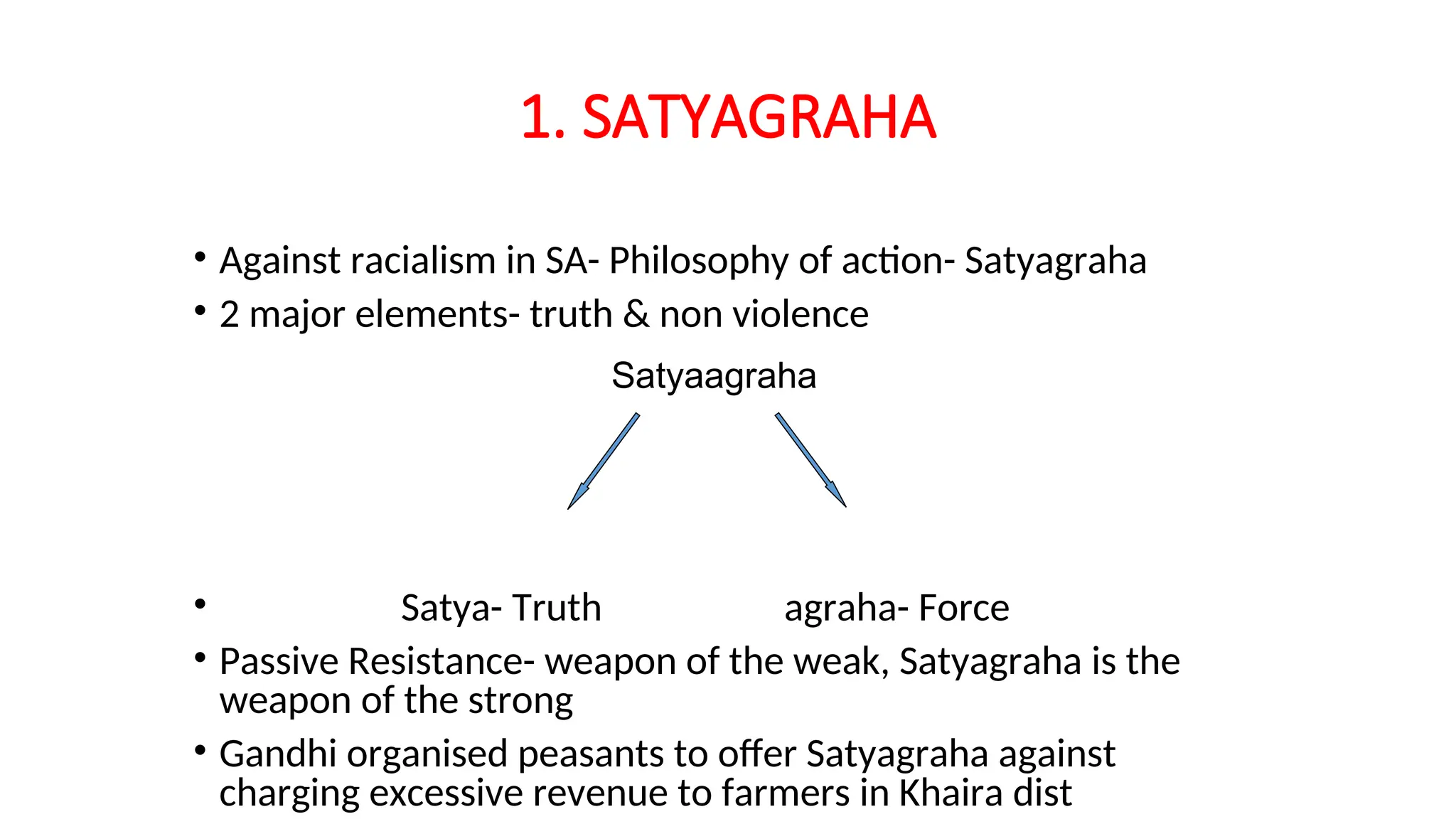
1. SATYAGRAHA
• Against racialism in SA- Philosophy of action- Satyagraha
• 2 major elements- truth & non violence
• Satya- Truth agraha- Force
• Passive Resistance- weapon of the weak, Satyagraha is the
weapon of the strong
• Gandhi organised peasants to offer Satyagraha against
charging excessive revenue to farmers in Khaira dist
Satyaagraha
.
•In POLITICS MAHATMA GANDHI GAVE A
In POLITICS MAHATMA GANDHI GAVE A
PROMINENT PLACE TO SATYAGRAH. THE
WORD SATYAGRAH A COMBINATION OF
2 WORDS - SATYA & AGRAH – MEANS
HOLDING ON TO TRUTH
HOLDING ON TO TRUTH. GANDHI JI
. GANDHI JI
DEFINED IT TO BE THE
DEFINED IT TO BE THE LOVE FORCE
LOVE FORCE, THE
, THE
FORCE WHICH IS BORN OF
FORCE WHICH IS BORN OF TRUTH AND
TRUTH AND
NON VIOLENCE
NON VIOLENCE .
.
2. Swadeshi
•Swadeshi was his watchword
•Spirit in man which restricts him to- the use
and service of his immediate surroundings
to the exclusion of the more remote.
•Directed towards the social and
economic upliftment of society, especially
of the villages.
•Emphasis on manual labour and Charaka.
•Britishers benefit from trade in India
3. Value Based Politics
•Introduced moral values into politics
•Used =courage, patience and suffering to
achieve higher goals in life.
•Advocated legal and extra legal methods to
achieve freedom
•Resorted to fast and penance during the
communal riots in Kolkata.
•Was convinced in not using physical brute
force.
•Won international sympathy for his cause
because of his peace-loving attitude.
4. Mass Movement
• Before Gandhiji National Movement was confined to
cities, towns and the intellectuals.
• He involved masses-women, workers, farmers.
• Masses cooperated with him in the Non –
Cooperation Movement and the Quit India
Movement
• Exploded the myth of the Moderates that India
could be freed with the help of the foreign rulers.
• He made use of the constitutional and extra
constitutional mass action in the freedom struggle.
5 .Concern for the poor and the oppressed
• Loved the poor and oppressed and won over their
sympathy and support
• Worked for the abolition of untouchability.
• Set up the Village Industries Association.
• Advocated the use of Khaadi in order to improve
the lot of the villages.
• 1917- the campaign against the system of
‘indenture’
• Fought for the rights of the indigo cultivators in
Champaran in Bihar. Made the British planters
refund the illegal collections, succeeded in
abolishing illegal practices.
What was the significance of the campaigns initiated
by Gandhiji in Champaran, Ahmedabad and Kheda?
•Champaran movement (1917):- In Champaran
peasants were not free to cultivate the crops of
their choice. The peasants were forced to grew
indigo on their land and sell it at a fixed price. Due
to Gandhi efforts an enquiry was set up and the
“Tinkathia” system (forceful cultivation of indigo)
was abolished. Now the peasants were free to
cultivate the crops of their choice.
.
•Ahmedabad movement (1918):- In 1918,Gandhiji went to
Ahmedabad. Here he intervened in a labour dispute of the
textile mills. The labour was demanding for better working
condtions, 35% increase in wages and job security. Gandhiji
took the charge of this movement in his hand. The mill owners
had to accept all the demand of the labour.
•Kheda movement (1918) :- In 1918, Gandhiji went to Kheda in
Gujrat. Here peasants were fighting for remission of taxes from
the state as the harvest of crops had failed. Peasants won
under the leadership of Vallabh Bhai Patel.
•Significance :- These campaigns had made Gandhiji a true
nationalist. They also showed the sympathetic attitude of
Gandhiji for the poor.
What was Khilafat Movement? Describe briefly.
•Khilafat Movement was started by Muhammed Ali and
Shawkat Ali.
•Aim :- The Khilafat Movement was initiated by the Muslims to
restore the Caliphate.
•cooperation of the Indian Muslims :-The British had fought
against the Sultan of Turkey in the First World War. The British
had also sought cooperation of the Indian Muslims in this war.
The Muslims of India had cooperated with the British on the
condition that the sultan of Turkey would be given a fair
treatment by the British after the war is over.
.
•Beginning of the movement :- But after the end of the war,
the British maltreated the Sultan who was considered as the
Caliph (religious leader). So they started a strong movement
against the colonial rule. This movement was known as the
khilafat movement. An All India Khilafat Conference was held
at Delhi in November, 1919. A resolution was passed in the
conference which exhorted the British to accept the demands
of the Muslims, failing which a struggle against the foreign rule
would be launched.
•Supported by the Gandhiji :- The congress and Mahatama
Gandhi supported the movement to broaden the base of Non-
Cooperation movement of its struggle against the British. He
also wanted to create unity between these two community.
The Khilafat Movement
• Khilafat Movement adopted Non-Cooperation movement programme
to fight against the British.
• Programme :- boycott of Legislative Councils, foreign goods, govt
Schools and colleges, govt functions and surrendering of titles and
distinctions.
• 1921- the Khilafat Movement appealed to all the Muslims not to join
the police or armed forces, and not to pay taxes.
• Vast possibility of Hindu Muslim unity, joint front against British
Government.
• Congress extended its support to Khilafat Movement.
• Hartals (strike), protests, scenes of Hindu Muslim unity were
witnessed in different parts of the country.
• Ali brothers were arrested and jailed in 1921
• End of Khilafat Movement :- Mustafa Kamal Pasha dethroned the
Turkish Sultan and declared Turkey a secular state.
Ali Brithers- Mohammed Ali & Shaukat Ali
NON-COOPERATION
MOVEMENT
.
•How was Non-Cooperation a form of protest?
OR
•Discuss the causes, programmes, progress and significance of
the Non-Cooperation Movement.
OR
•Examine the causes and the contribution of Non-Cooperation
Movement to India’s freedom struggle. Why did Gandhiji
couple Non-Cooperation Movement with Khilafat
Movement? OR
•Describe how Gandhiji knitted Non-Cooperation Movement
as a popular movement. OR Circumstances/ causes/
conditions leading to the Non Cooperation movement
•Congress approved the programme of Non-cooperation in
1920 at its Nagpur session.
•The Rowlatt Act of 1919 :- In 1919, the British Government
had passed the Rowlatt Act which imposed censorship on the
press and permitted detention without trial. The people rose
against this Black Law.
•The Jallianwala Bagh Tragedy :- Gandhiji called for a nation-
wide campaign against the Rowlatt Act. A large meeting of the
people was held at Jallianala Bagh in Amritsar. But General
Michael O’Dyer ordered his troops to open fire on this peaceful
meeting. It killed more than four hundred people and
wounded several others.
.
•No action regarding India’s freedom :- During the First World
War, Gandhiji had helped the British with the hope that they
would set the country free after the end of the war. But all the
hopes of Gandhiji were dashed to the ground after the First
World War.
•Explotation of India :- The Indians had extended full
cooperation to the British during the First World War but after
this war, the British fully exploited all the people of India.
•The spread of the Plague :- The plague had erupted and
spread in many parts of the India during the First World War
but the British did not pay any attention to control it.
Programme and Objectives :-
1.To Surrender or return Titles and Honours.
2.Resignation from nominated posts in the local bodies.
3.Boycott of Government schools, colleges.
4.Boycott of the lawyers from the civil courts.
5.Boycott of foreign goods (Boycott movement)
6.Adoption or use of goods and things manufactured in the country
(Swadeshi movement took place first time 1905-07 during the protest
of the division of Bengal)
7. Boycott of election and other Govt functions.
8. The soldiers, clerks and workers asked to leave
government job.
9. Not to pay taxes
•Progress:-
•Gandhiji started this movement by surrender his title
‘Kaiser-E-Hind’ given by the British government.
Rabindra nath tagor also surrender his title
‘Knighthood’ and ‘Sir’.
•Mahatama Gandhi visited many parts of the country
along with the Muslim leaders like Dr. Ansari, Maulana
Abul Kalam Azad and Ali brothers to widely spread the
programme of the Non-Cooperation Movement.
•Students stopped going to govt. schools and colleges.
•lawyers refused to go to courts.
.
•Labour class of many towns and cities also went on
strike.
•People boycott the foreign goods and foreign cloths
were burnt at the cross-roads
•People began using swadeshi goods (made in country)
such as Khadi.
•Leaders boycott the local assembly elections.
•Many people left government jobs.
•People from all section of the society participate in this
movement in large quantity.
.
•People in Awadh refused to pay
taxes.
•People violate forest laws in
Andhra pradesh region.
•People refused to carry colonial
load in Kumaon.
Repression by the Government
•People began to have strikes everywhere
•Govt declared the Congress an unlawful organization and
arrested many of its members & volunteers.
•People defied Govt orders and were jailed.
•Spirit of Sacrifice and Freedom filled the hearts of the Indians
•December 1921- Session of Congress at Ahmadabad- it was
decided to continue the Non Cooperation Movement with
greater vigour.
End of the Movement:-
•In February, 1922, a group of peasants were marching
peacefully in Chauri Chaura.
•This group was charged (beaten) by the police with sticks.
•The crowed attack on the police. The policemen run and lock
themselves in the police station.
•The crowed attacked on the police station and set it on fire.
22 policemen were killed in this incident.
•Gandhiji was shocked at this violent incident and therefore
called off his non-Cooperation Movement
.
•Gandhiji believed that – Violence
would breed violence.
•Congress leaders were shocked at his
decision.
•Gandhiji was arrested and sentenced
for 6 years imprisonment and the
charge of sedition(rajdroh).
•Significance :-
•Because of Non-Cooperation Movement, Congress
came in direct clash with the British Government.
•For the first time in the history of India, the people
whole-heartedly participated in this movement.
•During the Non-Cooperation Movement, the word
‘Swadeshi’ became quite popular. As a result, the
Indian industry flourished.
•This movement gave a new direction to the freedom-
struggle of India.
What was the resolution passed in the Congress Working
Committee that met at Bardoli?
•The Bardoli Resolution, 1922 suspended the
Non-Cooperation Movement. It asked the
congressmen to devote their time on
constructive programmes-
•Starting national schools
•Removal of untouchability
•Promotion of Hindu-Muslims unity.
The Rowlatt Act 1919- ‘BLACK ACT’
•The British Government could use the extraordinary repressive
powers, it had during the war.
•It violated civil rights of the people. It could arrest any person
without assigning any reason for the arrest, search any place
without a warrant and imprison anyone without trial.
•An all-India hartal (stricke) was observed on 8th April 1919- to
show people’s resentment (anger) to the inhuman repressive
measures.
•Indian Press was banned.
The Jallianwala Bagh Tragedy 13-04-1919
•The protest against Rowlatt act was intense particularly in
Punjab.
•Gandhiji was arrested while proceeding towards Punjab.
Some famous local leaders Dr. saifuddin Kitchlew and Dr.
Satyapalwere were arrested and sent to unknown place.
•Situation became more tense in Punjab. Martial Law was
proclaimed in Punjab.
•People were not informed of this proclamation.
•On 13th
April 1919- people organised a peaceful general
meeting to protest Rowlatt act in Jallianwala Bagh in
Amritsar.
.
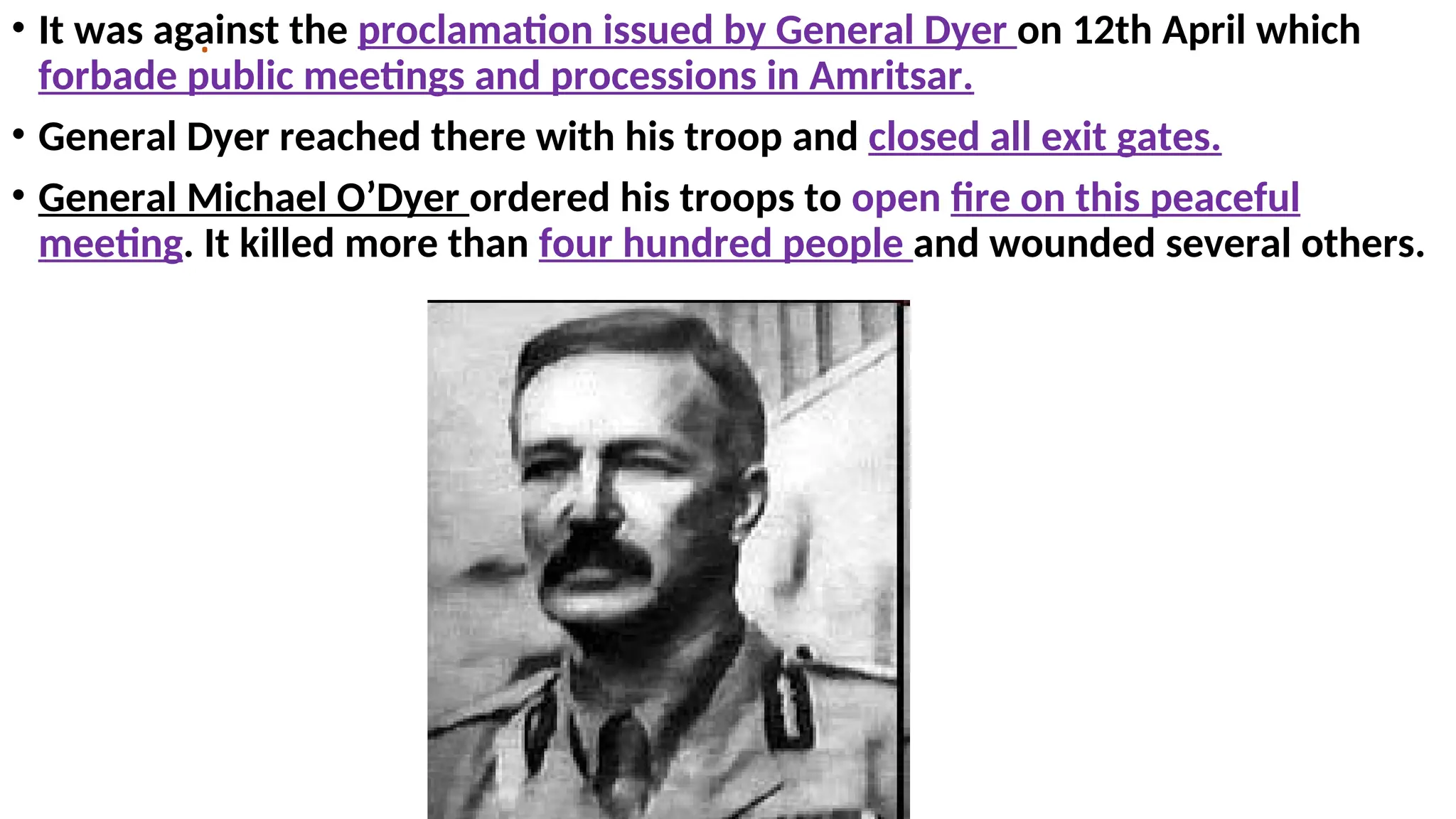
• It was against the proclamation issued by General Dyer on 12th April which
forbade public meetings and processions in Amritsar.
• General Dyer reached there with his troop and closed all exit gates.
• General Michael O’Dyer ordered his troops to open fire on this peaceful
meeting. It killed more than four hundred people and wounded several others.
What did Gandhiji do after his release from prison in 1924 ?
OR
“Gandhiji was as much a social reformer as he was a politician.”
Clarify the statement.
Mahatma Gandhi was arrested in 1922 and was released
from prison in 1924 due to health reason. Now he
devoted his attention to encourage the home spun cloth
(Khadi) and to eradicate untouchability from the society.
He believed that Indians need to remove social evils like
child marriage and untouchability in order to be worthy
of freedom.
.
•He wanted to prepare an
atmosphere of harmony among
different religious communities. He
also believed that Indians had to
learn to become self-reliant on the
economic front. That is why he
emphasized on using Khadi instead
of cloth imported from overseas.
Write a short note on Simon Commission.
• A Commission would be set up to access the merits of the
Government of India Act of 1919 at the end of 10 years, in
order to advise the Government about the next step to be
taken.
• Simon Commission was named after its chairman Sir John
Simon.
• The Commission was to tour the country to meet various
political leaders and tell government about the next
constitutional reforms.
• All members of this commission were white and there was no
Indian member.
.
•It hurt the self respect of the Indians.
•All the political leaders decided to boycott.
•Commission submitted its Report on 27th
May,
1930.
•The Nehru Report and the demand for Poorna
Swaraj were also rejected by this Commission.
•There is nothing about India’s freedom in this
commission report.
Discuss the methods adopted by the British
Government to crush the anti-Simon movement.
•The British adopted a policy of repression to crush the anti-
Simon movement.
•Thousands of unarmed and innocent Indians were beaten up
by the police.
•Even prominent Indian leaders like Govind Ballabh Pant, J.L.
Nehru and Lala Lajpat Rai were handled mercilessly.
•Lala Lajpat Rai died of injuries and Govind Ballabh Pant was
crippled for life.
When was Civil Disobedience Movement launched? What were
its reasons?
•Mahatma Gandhi started his Civil Disobedience Movement in
1930.
•Arrival of the Simon Commission :- In 1928, the Simon
Commission visited India under the leadership of Sir John
Simon. All the members of this Commission were English men.
No member from India was included in this commission. So the
Indians opposed it every where. They raised the slogans
“Simon: Go Back.” Even then, this commission published its
report. So Gandhiji was compelled to start the Civil
Disobedience Movement.
.
•Nehru Report :- In August 1928, Nehru Committee submitted
its report highlighting the demands of the Indians. The British
Government refused to accept this report. Feeling depressed,
Gandhiji started the Civil Disobedience Movement.
•Atrocities on Revolutionaries :- The British Government
had hanged many revolutionaries till death. It generated
discontentment among the Indians. British Government was
crushing brutally the revolutionaries with all its force.
•Impact of the Bardoli Movement :- A peasant satyagraha
was organized at Bardoli under the leadership of Sardar
Vallabh Bhai Patel. The success of these peasants had
emboldened Gandhiji to start Civil Disobedience Movement.
.
•The Congress Session at Lahore :- Annual Session of
Congress was held in Lahore in December, 1929 under the
Chairmanship of Pandit Jawaharlal Nehru. A resolution for
complete independence, ‘Poorna Swaraj’ was passed. First
Independence Day was celebrated on 26th
Jan 1930. Indian
National Flag was hoisted and independence pledge was taken
by Congressmen.
•Gandhiji’s demands :- Gandhiji put forward 11 demands
before the British Government. One of the important demand
was to remove salt tax. But the Viceroy did not accept any of
them. Under these circumstances, Gandhiji had no option
other than starting a Civil Disobedience Movement against the
British rule.
Civil Disobedience Movement
• The Congress Working Committee vested Mahatama Gandhi with full power to launch the Civil
Disobedience Movement.
• Civil Disobedience Movement was organized to disobey the Laws made by the British
Government.
• Programme-
• Non violent Sathyagraha,
• Boycott of Schools and Colleges, courts and foreign goods,
• picketnig of wine shops,
• Burning of foreign cloth,
• Spinning,
• Large scale fighting against untouchability,
• Breaking the salt laws
• ‘No-tax’ campaigns.
Simon-Commission Protest
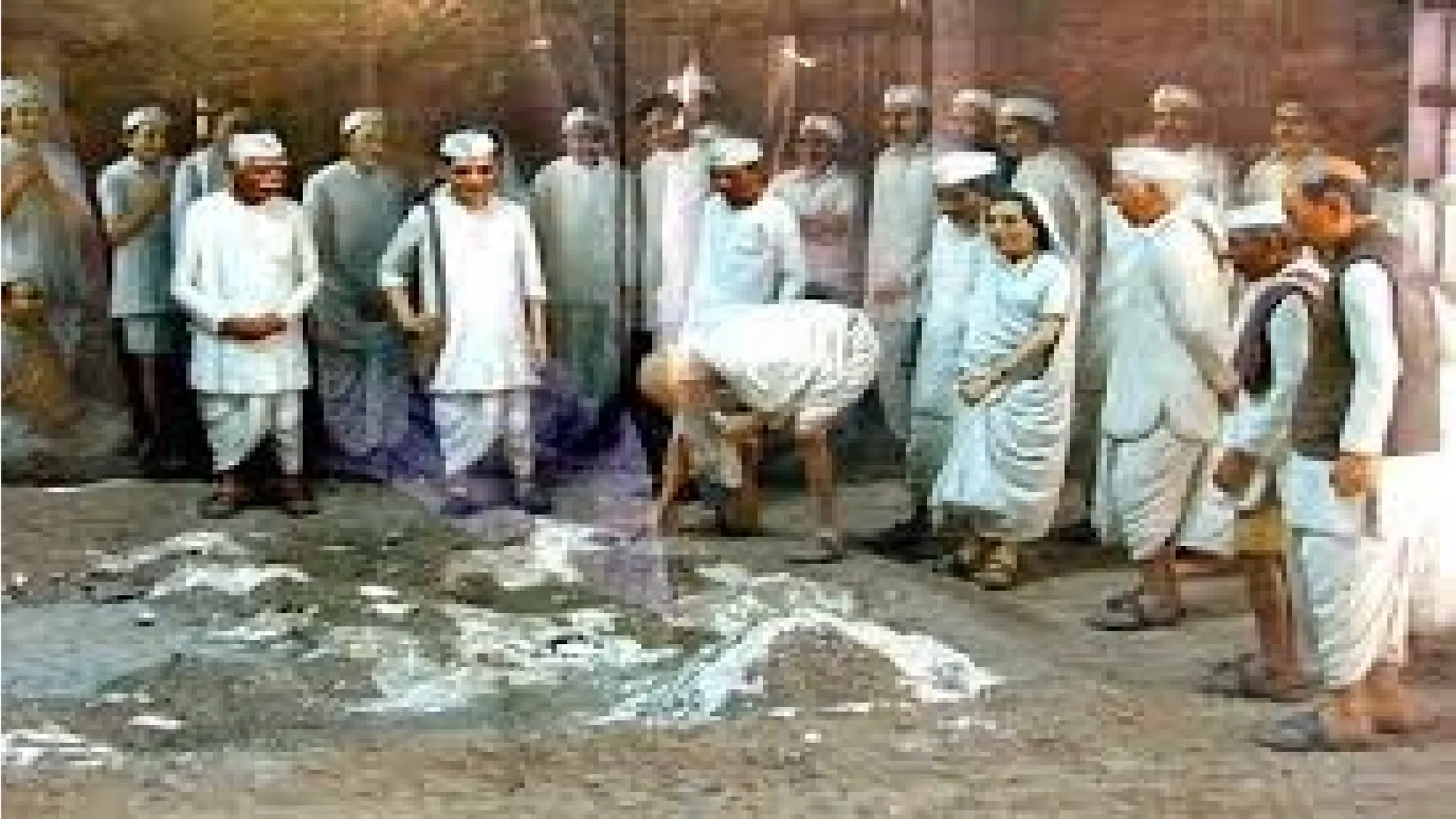
Dandi March
Gandhiji started the Civil Disobedience Movement with his
famous Dandi March. Dandi was a village on the sea-cost of
Gujarat.
Gandhiji started this march on 12 march,1930 from Sabarmati
Ashram in Ahmedabad. He had 78 followers when he started
this march. He walked for 240 miles and reached Dandi on 6
April,1930.
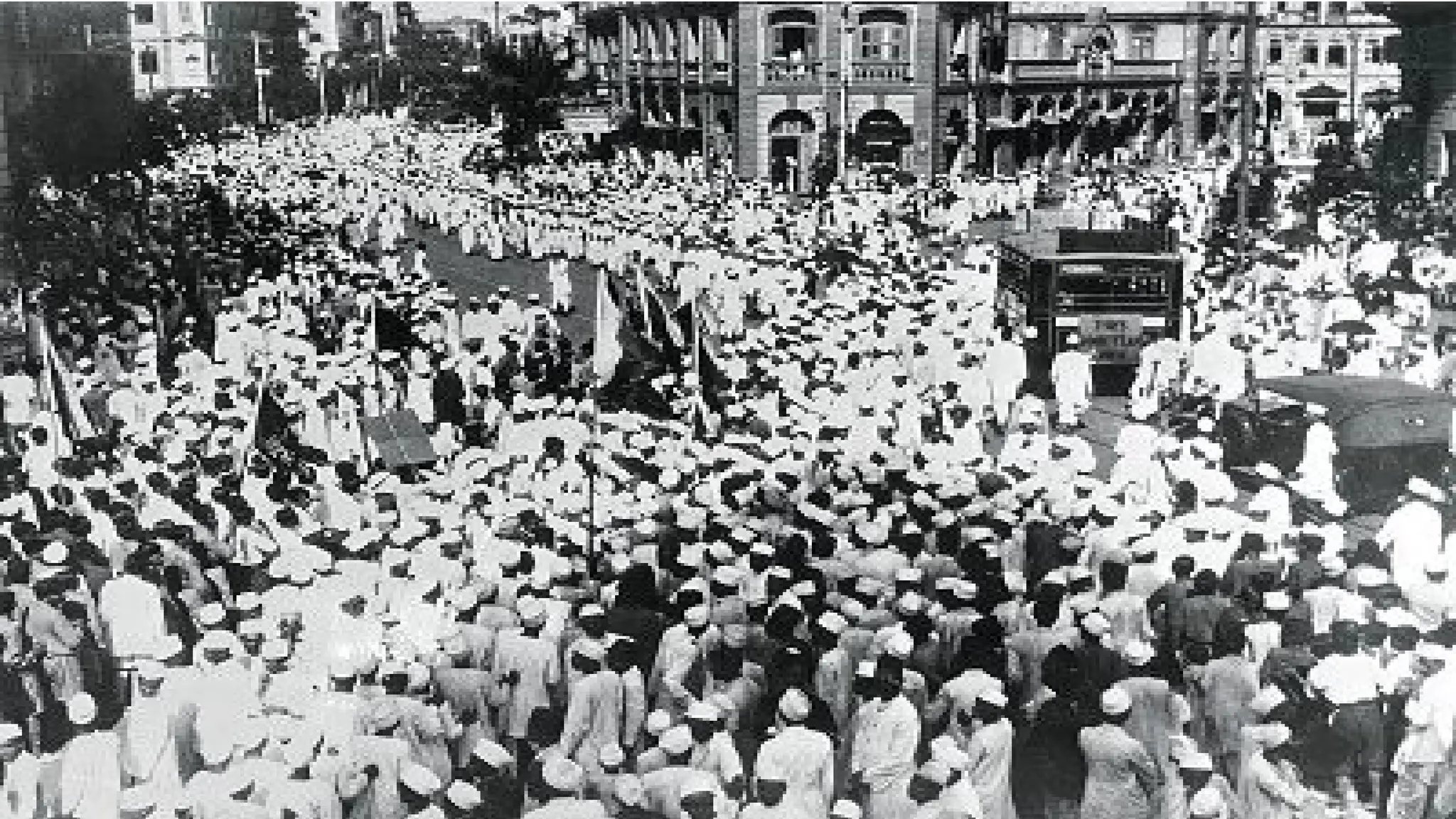
On the way, he went from village to village and told the people
about the programme of Civil Disobedience Movement. People
from every village joined him and When he reached Dandi there
was a great crowed with him.
.
He completed this march in 24 days and travelled average 10
miles per day. On the sea-cost of Dandi, Gandhiji made the salt
from boiling the sea water and break salt law.
Dandi March violated the Government laws which forbade
anyone to manufacture salt. First time in Indian History men &
women were mobilized for the national struggle and worked
together against the British Government.
RESULT
•Midnapur in Bengal went out of the control of the Government.
•Peasants in United Provinces refused to pay taxes to the Government.
• North West Frontier- the Pathans adopted the policy of Non-Cooperation under
the leadership of Khan Abdul Ghaffar Kahn.
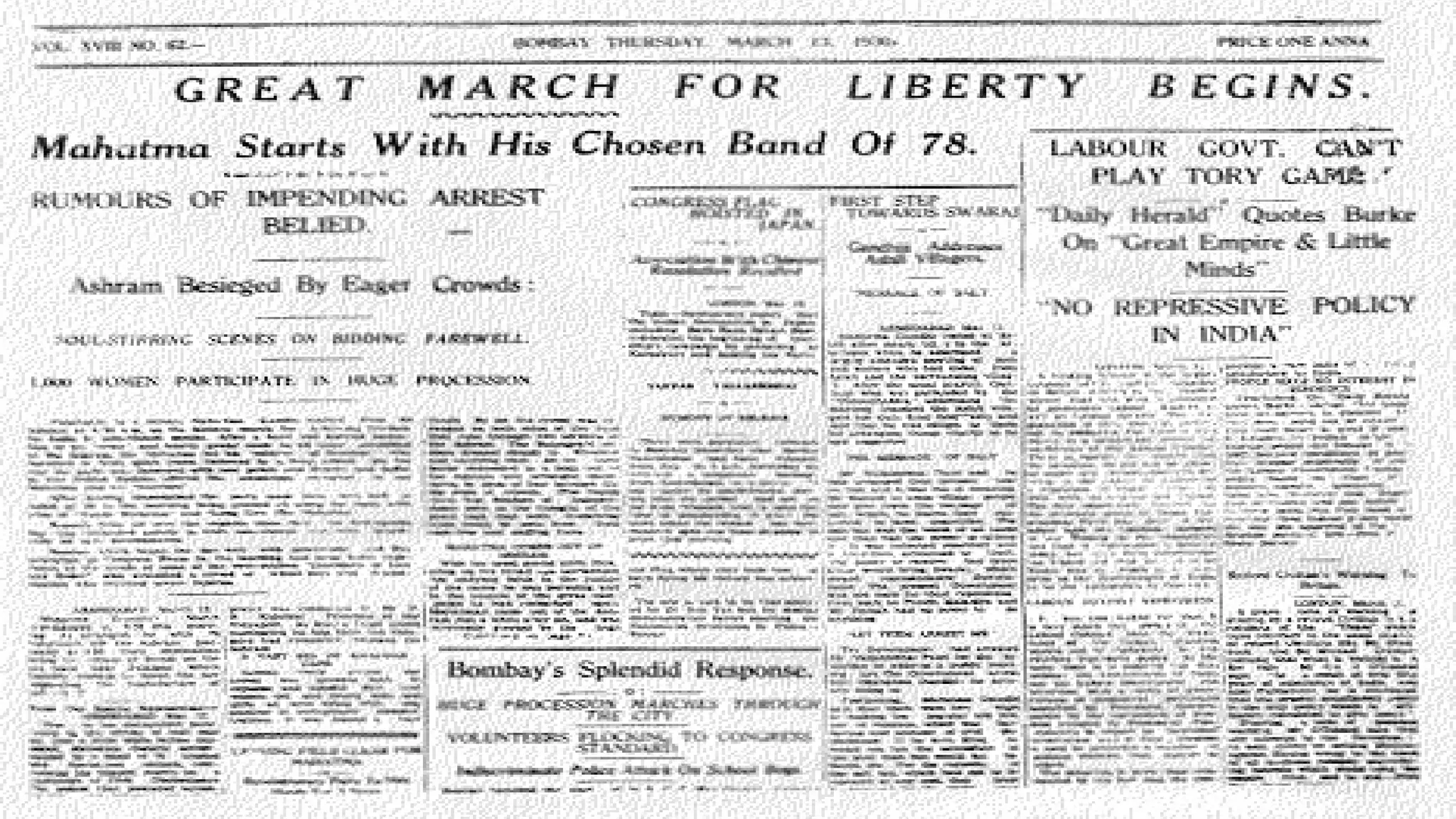
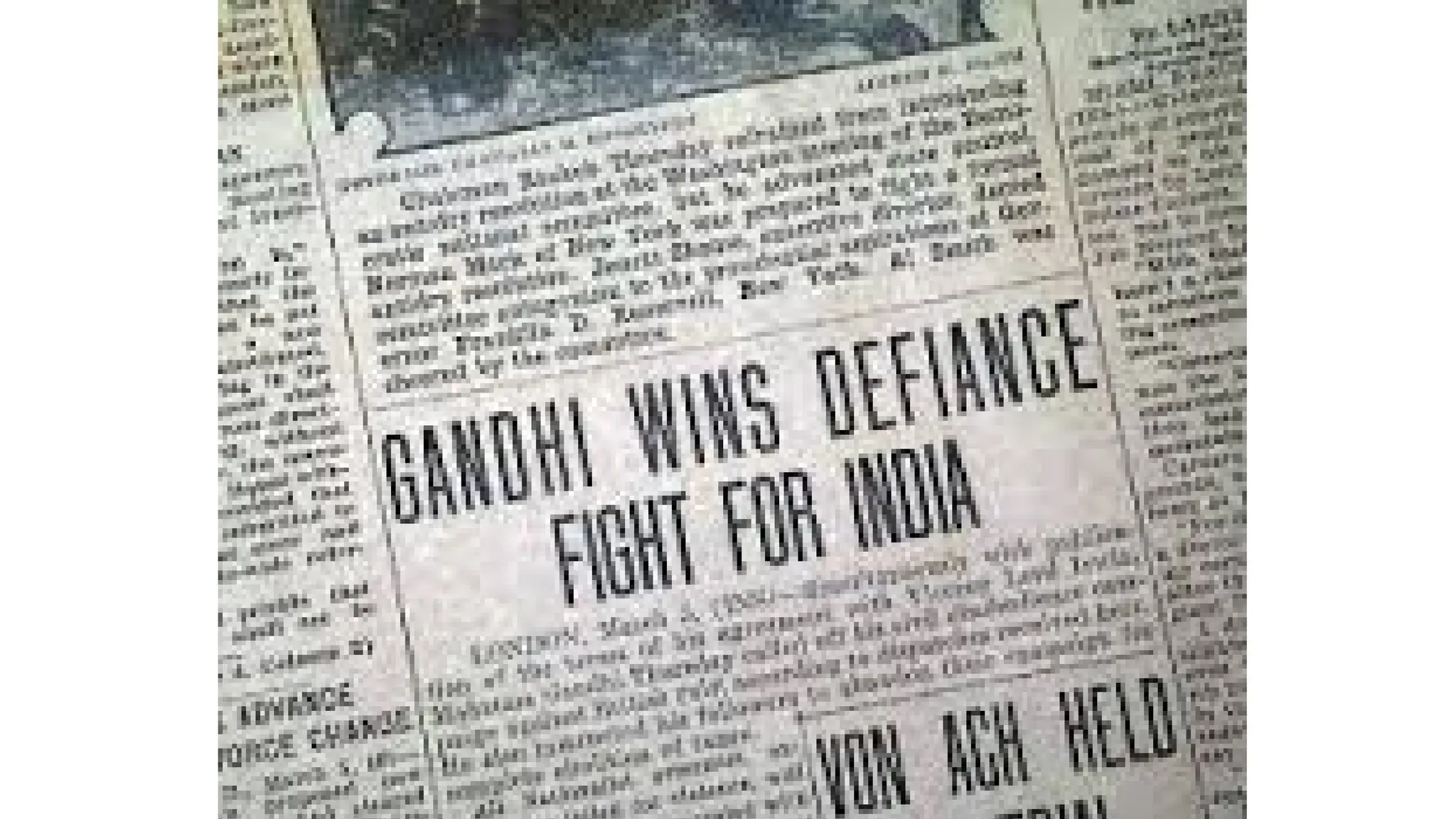
Newspaper report on the
commencement of Dandi
March 12, 1930
Gandhi and fellow
satyagrahis on the march.
A message from Gandhi
Progress of the movement
• Congress was declared illegal. Congress volunteers made
the salt and sell it in the market and break the salt law.
• Hartals or strikes were orgained all over the country. Over
60,000 people were imprisoned. People violated the
government laws all over the country.
• British government failed to suppress the movement.
Congress volunteers were participated with great
determination. Passive resistance of the Congress
volunteers against the Lathi charges and firing aroused
admiration of non-Congressmen.
• North West Frontier Province, joined the National
Movement under the leadership of Khan Abdul Gaffar Khan.
• Disobedience of Government order was a bad Omen (sign)
for the Government and began to think of conciliation
(peace).
1st
Round Table Conference
• Labour Party led by Ramsay Mac Donald formed
government in England.
• Lord Irwin the Viceroy announced that a Round Table
Conference of British statesmen and Representatives of
British India and Indian States would be held in London in
November, 1930.
• Round table conference was held to find an acceptable
solution to the Indian Leaders for a political settlement.
• Congress wanted a Constituent Assembly to draft a
Constitution for India.
• British Government refused and went ahead with its plan of
Round Table Conference.
• Congress decided to Boycott this conference. No important
Indian leader participated in it. This conference failed.
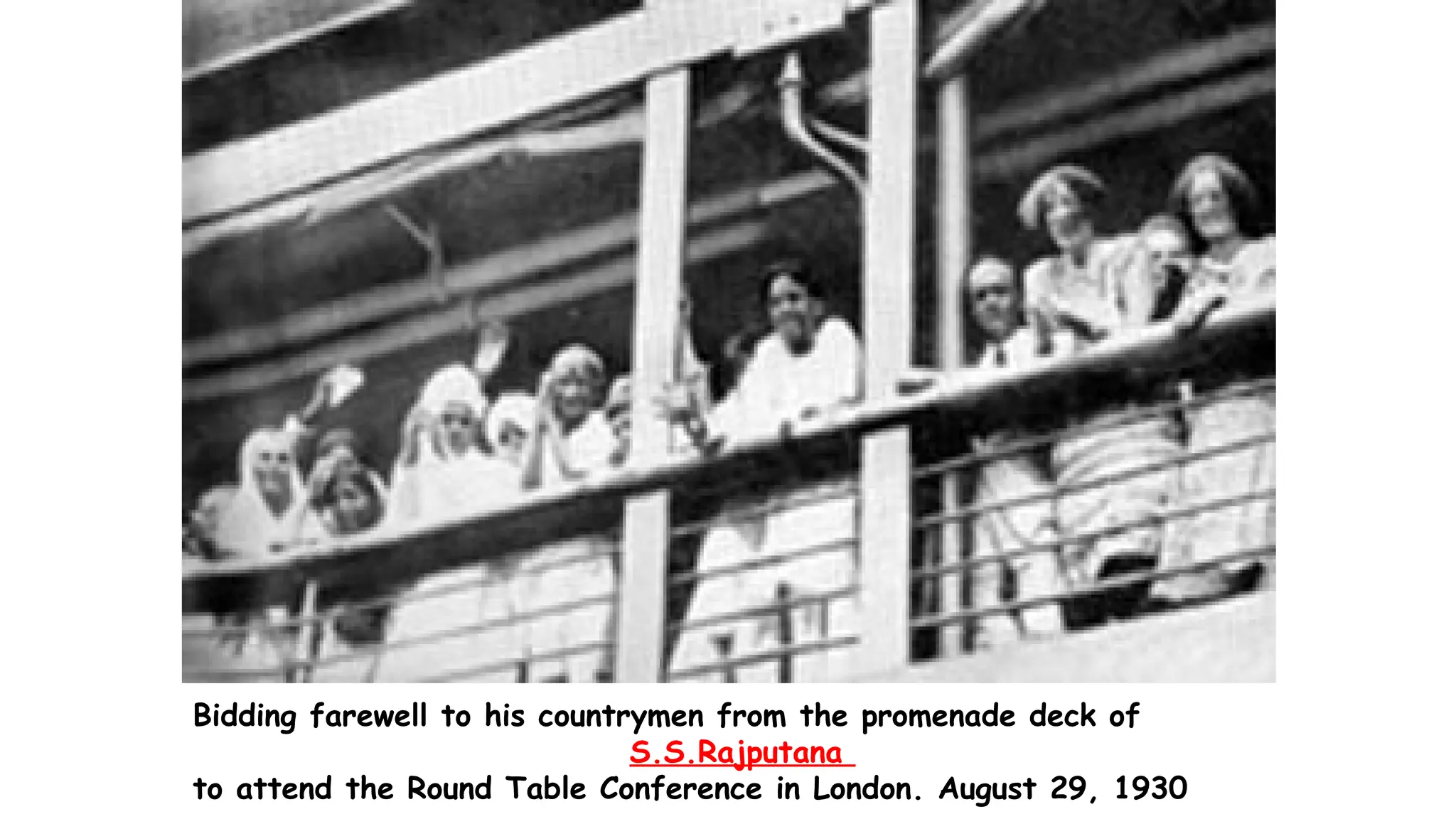
Bidding farewell to his countrymen from the promenade deck of
S.S.Rajputana
to attend the Round Table Conference in London. August 29, 1930
Gandhi Irwin Pact
• The first Round table conference failed because Congress
did not participate in it.
• Sir Tej Bahdur Sapru and D. Jaykar became the mediators
in this agreement.
• This agreement was signed between Gandhiji and Viceroy
lord Irwin on 5 March, 1931. this is known as Gandhi-Irvin
pact.
Gandhiji side :-
• Civil Disobedinece Movement was postponed.
• Gandhiji agreed to attend II Round Table Conference in
London.
• Gandhiji agreed to stop boycotting British goods.
.
Government side :-
Viceroy agreed to withdraw ordinances against
Civil Disobedience Movement.
Government would release people from jail which
were arrested during this movement.
Government allowed the peaceful picketing of
liquor and opium shops.
Government allowed people living within some
distance of the seas shore to collect or manufacture
salt.
2nd Round Table Conference -1931
•Gandhiji attended 2nd
Round table conference in
London. He represented the Congress. Gandhiji
claimed that congress represented all of India.
Mulsim league:- It represent the Indian Muslims.
Princes :- Congress had no stake in their territories.
Sikhs :- congress did not represent Sikhs.
Dr. B.R. Ambedkar:- Congress did not represent the
lower caste people.
.
•Gandhiji pressed for immediate and full
responsible Govt.
•But there was no agreement on communal
representation.
•Disgusted Gandhiji left England in December
1931.
•Gandhiji return to India and relaunched Civil
Disobedience Movement in 1932.
Relaunch and End of Civil Disobedience Movement
•Gandhiji again started the Civil disobedience
Movement.
•The British Government also initiated
repressive measures to control this
movement.
•This movement at last withdrawn in May,
1934.
Significance of Civil disobedience Movement
•This movement brought Gandhiji to world attention.
•European and American press widely covered
Dandi march.
•It was first nationalist activity in which women
actively participated. Kamala Devi Chattopadhyay
had persuaded Gandhiji not to restrict the protest
to men alone breaking the salt or liquor laws.
•The import of foreign cloth declined.
.
•Because of picketing at wine shops, the
collection of government revenue was
reduced.
•Because of the atrocities committed by
the British, the people were determined
to attain freedom.
•British realized that their rule would not
last forever.
The ‘Government of India’ Act - 1935
•The ‘Government of India’ Act was passed in 1935.
•It promised some form of representative government.
•The act proposed an All India Federation consisting of
British Indian states and Indian states or Princely states.
•A two legislature consisting of Legislative Assembly and
Council of States was set up.
•Only 14% of the total population in British India was
given the right to vote.
.
•The Indian Princes were given disproportionately high
representation in the two houses at the centre, and used to
control and check nationalist elements.
•Defence and foreign affairs remained outside its control while
Governor General retained special control over the other
subjects.
•The act introduced provincial autonomy in the provinces. But
the governors were given special veto powers. They were
working under the supervision of the British Governor.
• In 1937, elections were held on the basis of a restricted franchise.
• Congress got huge success in these elections. Congress Chief Ministers
came into power in eight out of eleven provinces.
Why did the Congress ministries in provinces resign?
•The Congress ministries assumed office in eight
provinces in 1937. But in September, 1939, the Second
World War broke out. As mahatma Gandhi and Pandit
Jawaharlal Nehru were critical of Hitler and his policies,
they wanted to support the British on the condition that
the British should promise independence to the Indians
after the end of the war. The British did not accept this
proposal due to which the Congress ministries resigned
in protest in October,1939. Muslim league celebrate
‘Mukti Diwas’ on this day.
Why did the Cripps Mission visit India? What were its main
recommendations?
• During the Second World War, Japan was marching ahead
towards India.
• Besides the Congress had organized a series of Individual
Satyagrahas to pressurise the Britishers to promise
independence to Indians after the end of the World War.
• So in 1942, Winston Churchill, the prime Minister of England,
sent one of his ministers, Sir Stafford Cripps to India.
• Sir Cripps tried to forge (ढालना) a compromise with Gandhiji
and the Congress. But his mission remained unfulfilled as the
talks broke down.
•Recommendations of Cripps Mission:- It recommended to
make India a dominion state after the end of the Second World
War. Gandhiji compared this plan to a post-dated cheque
drawn on the bank that was doomed to fail in the coming days.
•To frame the Constitution for India, a Constituent Assembly
would be established consisting of all elected members.
•The provinces which did not agree to the constitution would
retain their present position.
•In the new Constitution, there would also be a provision to
enable the princely states to participate. However these states
would not be bound by the new Constitution.
.
•After the formation of the Constitution, there would be a
treaty between Britain and India to chalk-out a framework for
the transfer of political power.
•The British also ensured protection of the minorities in the new
system.
•Causes of break down of talk :- Congress stressed that first
of all the Viceroy should appoint any Indian as the Defence
Member in his Executive Council. But talks broke down on this
issue.
Why did the Congress reject Cripps Proposals?
• Acceptance of Cripps Proposals was amounted to recognition of the
Two-Nation theory.
• The proposal ignored the interests of the people of the Indian states
because the representatives of the states were to be selected by the
rulers themselves.
• The proposal did not promise complete independence in the future.
• What the mission promised was as described by Gandhi “a post-dated
cheque on a crashing bank”.
• The proposal did not make any reference to the establishment of
Pakistan. It did not provide the right of self-determination to the Indian
Muslims.
.
•Discuss the progress of the Quit India Movement. What was its
importance in the history of the national movement for
independence in India?
OR
•How was Quit India Movement genuinely a Mass Movement?
Explain.
OR
•Examine why Quit India Movement was started and how do
you think the Quit India Movement was genuinely a mass
movement.
Causes :-
•The quit India Movement started on 9 August, 1942.
•Fear of Japan’s attack :-The main reason for its beginning
was that during the Second World War, Japan had occupied
Burma. It was feared that Japan might attack India to harm the
British interests.
•Permission to start Quit India movement :- At this time,
Congress passed a resolution to start the Quit India Movement
under the leadership of Mahatma Gandhi. This resolution was
passed as many leaders of the Congress felt that Japan would
not attack India if the British left it.
.
•Nothing less than complete independence :-
The Congress also resolved not to accept
anything less than complete independence for
india.
•Failure of Cripps Mission :- Sir Cripps tried to
forge a compromise with Gandhiji and the
Congress. But his mission remained unfulfilled
as the talks broke down. British government
was not ready to free India after the Second
World War.
Beginning and Progress of the Movement:-
•After the failure of the Cripps mission Gandhiji decided to
launch his third major movement against the British rule . This
was Quit India movement.
•There were slogans of ‘Quit India’ and ‘Do or Die’ given by
Gandhiji all over the country.
•The British put their full might to repress this movement. Soon
after the resolution was passed the Congress was banned and
all the important Congress leaders were arrested.
•It infuriated the people who started plundering government
offices, railway stations and post offices.
.
•Younger activists organised demonstration.
•Nation- wide strike in factories, schools & colleges.
•The British government became more adamant and
put innumerable people in jail. The whole country
was turned into a prison.
•End of the movement :- Till February, 1943,
the Quit India Movement continued with success.
But after that, it lost its momentum because of the
repressive policy of the government. It came to an
end slowly and steadily.
Significance of the Quit India movement -
• Mass - movement :- Quit India was a mass movement which had the
participation of lakhs of ordinary people. All leaders were in jail. Common people
itself follow the programme of the Quit India. People protest British rule with
great spirit.
• Discontent in wide - scale :- The British officials had also realized
how wide was the discontent among the people against them and their
rule.
• Complete Independence:- British government came to know that
the ultimate goal of all the Indians was complete independence from
the British rule.
• Timeline for freedom :- The impact of this movement was so intense
that the British had to free India within three years from the end of this
historic movement.
How was Quit India Movement genuinely a Mass Movement?
Explain
•It brought hundreds of thousands of ordinary Indians into the
National Movement.
•It energerised the young in very large numbers many of whom
went to jail.
•As major national leaders were jailed young activitists
organized strikes and acts of sabotage (ruin) all over the
country.
•Underground resistance was also organized in which socialists
members like Jayaprakash Narayan was active.
.
•In several districts such as Satara, Midnapur
independent governments were proclaimed.
•It persisted despite intense repression by the
British.
•Due to its mass base, it took the British more
than a year to suppress the rebellion.
•It brought the British to its knees and
compelled its officials to open a dialogue with
Indian parties regarding transfer of power.
Discuss the formation and role of the Azad Hind fauj.
•The Azad Hind Fauj was organized by Subash Chandra
Bose. He had set up this army with the help of japan and
Germany.
• The objective of this army was to get India free from the
clutches of the British. Subash Chandra Bose had
installed national spirit among all his soldiers. As a result,
this army witnessed a few successes at different places
in the country.
•But as Japan and Germany were defeated in the Second
World War, this army lost its ground.
.
•The British arrested a few prominent leaders
of this army and charged them of treason and
rebellion. Many famous lawyers fight their
case in the court and got success. But owing to
the pressure of the people, they were released
later on.
What was the direct action day?
•When the talks of the Congress and the Muslim
league had failed with the Cabinet Mission,
Mohammad Ali Jinnah gave a call for ‘Direct Action
Day’ to emphasise his demand for the creation of
Pakistan. He fixed 16 August, 1946 as the Direct
Action Day. On that day, bloody riots broke out in
Calcutta. This violence later on engulfed Bengal,
Bihar, United Provinces and Punjab. At some places,
the Hindus suffered the agony. At other places, the
Muslims faced heavy casualities and losses.
How did Mahatma Gandhi seek to identify with the common
people?
• Mixed with people :- He did not behave like a professional or an intellectual.
Rather he mixed with thousands of peasants, workers and artisans.
• Dressed like common man :- He dressed himself like the common man. He also
lived like them and spoke their language. He wore simple dhoti or loin-cloth and did
not like to stand apart from the common people. He liked to mix with them, sit and
talk with them.
• Worked on the Charkha :- He worked on the Charkha everyday. He also
encouraged other nationalists to do the same. In fact, he favoured synthesis (mix)
between mental and manual labour.
• Do not believe in caste system :- He did not believe in the traditional caste
system. He wanted to reduce caste system from India.
• Mother tongue :- He often spoke in the mother tongue. He generally use the
language used by the common people.
Why are newspapers an important source
for the study of the national movement?
•The contemporary newspapers wrote about all
the movements launched by Mahatma Gandhi.
•They reported all the important activities,
speeches an statements of Mahatma Gandhi.
•They also presented views about what ordinary
Indians thought of him.
.
•In what way did Mahatma Gandhi transform the nature of
the national movement?
OR
•How did Mahatma Gandhi turn the national movement into a
mass movement?
OR
•Explain how Gandhiji transformed Indian Nationalism by
1922.
OR
•“in the history of nationalism, Gandhiji is often identified
with the making of a nation.” Describe his role in the freedom
struggle of India.
.
•Principal of Truth and Non-violence.
•Non-Cooperation Movement
•Salt march
•Civil disobedience Movement
•Swadeshi Movement
•Boycott Movement
•Social works
•Quit India Movement
What do private letters and autobiographies tell us about an
individual?
•The letters written to relatives or intimate friends
give us a glimpse of the private thoughts of the
writer.
•These letters express an individual’s anger and pain,
dismay and anxiety, hopes and frustrations.
•Through a lot of light on their ideas.
•Give an account about the views and perceptions of
a leader.
On what two things did the Satyagraha
emphasise?
•Belief in the powere of truth.
•Search for truth and non-
violent protest.
When and where was ‘Poorna Swaraj’
formally proclaimed?
•The demand for Poorna Swaraj was formally
proclaimed by Indian National Congress at its
Lahore Session in December, 1929. This
session was presided over by Pandit
Jawaharlal Nehru. It was decided to celebrate
26 January, 1930 as the Independence Day.
State any two important aspects of the speech
delivered by Gandhiji at Banaras in 1916.
•It was the first public appearance of Gandhiji in Banaras in
1916.
•Gandhiji stated that the Indian elite had no concern for the
laboring poor.
•The freedom can be attained not by lawyers, doctors or rich
landlords but by the participation of farmers. Gandhiji stated
that Indian nationalism was an elite phenomenon. So it must
have mass participation.
What do you mean by Movement for Praja
Mandals?
•Mahatma Gandhi wanted to broaden the basis
of nationalism in India. Indian National
Congress started a series of Praja Mandals. It
promoted the nationalist movement in the
princely states and led nationalism to the
farthest corners of the country.
Why was Charkha chosen as a symbol of nationalism?
• Charkha symbolized a human society that does not glorify machines
and technology.
• The could provide the poor with supplementary income and make
them self-reliant.
• It encouraged growth of cottage/village industry.
• The act of spinning the Charkha allowed Gandhi to break the barrier
that prevailed within the traditional caste system between mental and
manual labour.
• Khadi spinning was an important aspect of constructive work of Gandhi
and was the main channel for recruitment especially of women.
Why did Mahatma Gandhi want to adopt the policy
of Non-Cooperation against the British in India?
•Gandhiji believed that the British rule in India
depended on the cooperation of the local
people. He felt that the foreign rule still existed
due to the cooperation of a few natives.
Mahatma Gandhi launched the policy of Non-
cooperation so that he may end the foreign
rule and introduce self-rule.
Distinguish between the policies of moderates and
Radicals / Extremists (Assertive nationalists.)
•The leaders of the early
phase of the Congress were
called the Moderates.
•Method of protest :-
pacification, petitioning, by
sending political
representation to England.
•Leaders :- Gopal krishan
Gokhle, Dada bhai naroji,
surendernath banerji.
•On the other hand, the
assertive nationalists advocated
strong opposition to the British
rule in India and wanted to oust
the foreign rule by all means.
•Method of protest :- strike,
movement and boycott.
•Leaders :-Lala laj patray, Bal
ganga dhar Tilak, Bipin Chandra
pal. (known as Lal-Bal-Pal)
.
• They wanted to
work within the
framework of law
and adopted
constitutional
methods.
• They preferred a
more gradual and
persuasive approach
of petitioning.
• They rejected
constitutional methods
as weak and advocated
militant opposition to
colonial rule.
• They adopted radical
ways of political
agitation and believed
their demands could be
met by putting pressure
on the government.
Recommendations of the Simon Commission
1. Complete autonomy in the provinces including the
department of Law and order, but the governor should
be given over- riding powers in certain matters like
internal security.
2. There should be a federal Government at the centre,
consisting of British India and the Princely States.
3. British Troops and British Officers should stay on in Indian
regiments for many years.
4. Provincial Legislative Councils should be enlarged.
5. The Governor- General should be free to select and
appoint members of his cabinet.
6. High Courts should be under the administrative control of
the Govt of India.
1. Charkha
• Why was Mahatma Gandhi critical of machines? महात्मा गाँधी मशीनों के आलोचक
क्यों थे?
• Why did Mahatma Gandhi give so much importance to Charkha(spinning wheel)?
महात्मा गाँधी चरखे को अधिक महत्व क्यों देते थे?
• In the views of Gandhiji, what would be the impact on the poor if the machines
saved labour? How it will benefit the rich? Why was this solution not acceptable
to Gandhiji? गांधीजी के विचारो के अनुसार अगर मशीने मेहनत बचाएगी तो इसका गरीबो
पर क्या प्रभाव पड़ेगा? यह अमीरों के लिए किस प्रकार लाभकारी होगा? यह हल गांधीजी को
क्यों स्वीकार नही था?
• According to Gandhiji, what is the relation between Khaddar and machinery?
गांधीजी के अनुसार खद्दर और मशीनों में क्या संबंध है?
2. Ambedkar on separate Electorates
• What were the arguments of Mahtma Gandhi against the Separte
Electprates? प्रथक निर्वाचिका के विरुद्ध गांधीजी ने क्या तर्क दिए?
• How has Dr. B.R. Ambedkar described the social and economic
condition of the Dalits? डॉ.बी.आर. अम्बेडकर ने दलितों की सामाजिक और
आर्थिक स्थितियों का वर्णन कैसे किया है?
• What did he want for the protection of the Dalits? For it, what did he
propose? दलितों की सुरक्षा के लिए वो क्या चाहते थे? इसके लिए उन्होंने क्या
प्रस्ताव रखा?
• What is separate electrates? प्रथक निर्वाचिका किसे कहते है?
3. The problem with separate Electorates
• Where and why were the Round Table conferences held? गोल मेज सम्मेलन कहाँ
और क्यों हुए?
• Why was Gandhi against separate electorates for the untouchables? गांधीजी
अछूतों के लिए प्रथक निर्वाचिका के विरुद्ध क्यों थे?
• What alternative did he want and why? इसके विकल्प के रूप में वो क्यों और क्या चाहते
थे?
• Name any one leader who demanded separate electorates for the untouchables
and the depressed classes.किसी एक नेता का नाम बताओ जिसने अछूतों और दलित वर्ग
के लिए प्रथक निर्वाचिका की मांग की?
4. Tomorrow we shall break the salt tax law
• Where and how did Gandhiji break the Salt Law? गांधीजी ने कहाँ और
कैसे नमक कानून तोडा?
• What was the mental condition of Gandhiji before the Dandi March?
Was he proved right? दांडी मार्च से पहले गांधीजी की मानसिक स्थिति कैसी
थी? क्या वो सही थे?
• Why did Gandhiji praise the British Government? गांधीजी ने ब्रिटिश
सरकार की प्रसंशा क्यों की?
• According to Gandhiji, on what principle was the Salt Movement
based? गांधीजी के अनुसार नमक आन्दोलन किस सिद्धांत पर आधारित था?
5. Why the Salt Satyagraha?
• Why did the British Government destroy salt? ब्रिटिश सरकार नमक को
नष्ट क्यों कर देती थी?
• Why did Gandhiji consider it as an unjustful policy? गांधीजी ने इसे एक
अनुचित निति क्यों माना है?
• By which arguments, Gandhiji proved that the salt monopoly was a
curse? किन तर्को के आधार पर गांधीजी ने सिद्ध किया की नमक एकाधिकार
शाप है?
Thank you
The End

CH.13 (Mahatma Gandhi and National Movements).ppt

  • 1.
    The National Movement and MahatmaGandhi . By – RAJ KUMAR PGT History, K.V.1 BATHINDA CANTT.
  • 2.
    About Gandhiji • Greatestnational leader of India • Became the undisputed leader of Congress • Dominated political scene for 3 decades • Born-2nd Oct 1869 at Porbandar in Gujarat • Father- Diwan at Porbandar. • Gandhiji studied Law in England • Worked in S.A. • Returned to India in 1915 and set up an Ashram at Sabarmati • Inmates of Ashram observed truth, non violence, control of food, non stealing, non possession, fearlessness and the use of Swadeshi goods.
  • 3.
    Gandhiji’s Methods andDirections 1. Satyagraha 2. Swadeshi 3. Value Based Politics 4. Mass Movement 5. Concern for the poor and the oppressed 6. Social works
  • 4.
    1. SATYAGRAHA • Againstracialism in SA- Philosophy of action- Satyagraha • 2 major elements- truth & non violence • Satya- Truth agraha- Force • Passive Resistance- weapon of the weak, Satyagraha is the weapon of the strong • Gandhi organised peasants to offer Satyagraha against charging excessive revenue to farmers in Khaira dist Satyaagraha
  • 5.
    . •In POLITICS MAHATMAGANDHI GAVE A In POLITICS MAHATMA GANDHI GAVE A PROMINENT PLACE TO SATYAGRAH. THE PROMINENT PLACE TO SATYAGRAH. THE WORD SATYAGRAH A COMBINATION OF WORD SATYAGRAH A COMBINATION OF 2 WORDS - SATYA & AGRAH – MEANS 2 WORDS - SATYA & AGRAH – MEANS HOLDING ON TO TRUTH HOLDING ON TO TRUTH. GANDHI JI . GANDHI JI DEFINED IT TO BE THE DEFINED IT TO BE THE LOVE FORCE LOVE FORCE, THE , THE FORCE WHICH IS BORN OF FORCE WHICH IS BORN OF TRUTH AND TRUTH AND NON VIOLENCE NON VIOLENCE . .
  • 6.
    2. Swadeshi •Swadeshi washis watchword •Spirit in man which restricts him to- the use and service of his immediate surroundings to the exclusion of the more remote. •Directed towards the social and economic upliftment of society, especially of the villages. •Emphasis on manual labour and Charaka. •Britishers benefit from trade in India
  • 7.
    3. Value BasedPolitics •Introduced moral values into politics •Used =courage, patience and suffering to achieve higher goals in life. •Advocated legal and extra legal methods to achieve freedom •Resorted to fast and penance during the communal riots in Kolkata. •Was convinced in not using physical brute force. •Won international sympathy for his cause because of his peace-loving attitude.
  • 8.
    4. Mass Movement •Before Gandhiji National Movement was confined to cities, towns and the intellectuals. • He involved masses-women, workers, farmers. • Masses cooperated with him in the Non – Cooperation Movement and the Quit India Movement • Exploded the myth of the Moderates that India could be freed with the help of the foreign rulers. • He made use of the constitutional and extra constitutional mass action in the freedom struggle.
  • 9.
    5 .Concern forthe poor and the oppressed • Loved the poor and oppressed and won over their sympathy and support • Worked for the abolition of untouchability. • Set up the Village Industries Association. • Advocated the use of Khaadi in order to improve the lot of the villages. • 1917- the campaign against the system of ‘indenture’ • Fought for the rights of the indigo cultivators in Champaran in Bihar. Made the British planters refund the illegal collections, succeeded in abolishing illegal practices.
  • 11.
    What was thesignificance of the campaigns initiated by Gandhiji in Champaran, Ahmedabad and Kheda? •Champaran movement (1917):- In Champaran peasants were not free to cultivate the crops of their choice. The peasants were forced to grew indigo on their land and sell it at a fixed price. Due to Gandhi efforts an enquiry was set up and the “Tinkathia” system (forceful cultivation of indigo) was abolished. Now the peasants were free to cultivate the crops of their choice.
  • 12.
    . •Ahmedabad movement (1918):-In 1918,Gandhiji went to Ahmedabad. Here he intervened in a labour dispute of the textile mills. The labour was demanding for better working condtions, 35% increase in wages and job security. Gandhiji took the charge of this movement in his hand. The mill owners had to accept all the demand of the labour. •Kheda movement (1918) :- In 1918, Gandhiji went to Kheda in Gujrat. Here peasants were fighting for remission of taxes from the state as the harvest of crops had failed. Peasants won under the leadership of Vallabh Bhai Patel. •Significance :- These campaigns had made Gandhiji a true nationalist. They also showed the sympathetic attitude of Gandhiji for the poor.
  • 13.
    What was KhilafatMovement? Describe briefly. •Khilafat Movement was started by Muhammed Ali and Shawkat Ali. •Aim :- The Khilafat Movement was initiated by the Muslims to restore the Caliphate. •cooperation of the Indian Muslims :-The British had fought against the Sultan of Turkey in the First World War. The British had also sought cooperation of the Indian Muslims in this war. The Muslims of India had cooperated with the British on the condition that the sultan of Turkey would be given a fair treatment by the British after the war is over.
  • 14.
    . •Beginning of themovement :- But after the end of the war, the British maltreated the Sultan who was considered as the Caliph (religious leader). So they started a strong movement against the colonial rule. This movement was known as the khilafat movement. An All India Khilafat Conference was held at Delhi in November, 1919. A resolution was passed in the conference which exhorted the British to accept the demands of the Muslims, failing which a struggle against the foreign rule would be launched. •Supported by the Gandhiji :- The congress and Mahatama Gandhi supported the movement to broaden the base of Non- Cooperation movement of its struggle against the British. He also wanted to create unity between these two community.
  • 15.
    The Khilafat Movement •Khilafat Movement adopted Non-Cooperation movement programme to fight against the British. • Programme :- boycott of Legislative Councils, foreign goods, govt Schools and colleges, govt functions and surrendering of titles and distinctions. • 1921- the Khilafat Movement appealed to all the Muslims not to join the police or armed forces, and not to pay taxes. • Vast possibility of Hindu Muslim unity, joint front against British Government. • Congress extended its support to Khilafat Movement. • Hartals (strike), protests, scenes of Hindu Muslim unity were witnessed in different parts of the country. • Ali brothers were arrested and jailed in 1921 • End of Khilafat Movement :- Mustafa Kamal Pasha dethroned the Turkish Sultan and declared Turkey a secular state.
  • 16.
    Ali Brithers- MohammedAli & Shaukat Ali
  • 17.
  • 18.
    . •How was Non-Cooperationa form of protest? OR •Discuss the causes, programmes, progress and significance of the Non-Cooperation Movement. OR •Examine the causes and the contribution of Non-Cooperation Movement to India’s freedom struggle. Why did Gandhiji couple Non-Cooperation Movement with Khilafat Movement? OR •Describe how Gandhiji knitted Non-Cooperation Movement as a popular movement. OR Circumstances/ causes/ conditions leading to the Non Cooperation movement
  • 19.
    •Congress approved theprogramme of Non-cooperation in 1920 at its Nagpur session. •The Rowlatt Act of 1919 :- In 1919, the British Government had passed the Rowlatt Act which imposed censorship on the press and permitted detention without trial. The people rose against this Black Law. •The Jallianwala Bagh Tragedy :- Gandhiji called for a nation- wide campaign against the Rowlatt Act. A large meeting of the people was held at Jallianala Bagh in Amritsar. But General Michael O’Dyer ordered his troops to open fire on this peaceful meeting. It killed more than four hundred people and wounded several others.
  • 20.
    . •No action regardingIndia’s freedom :- During the First World War, Gandhiji had helped the British with the hope that they would set the country free after the end of the war. But all the hopes of Gandhiji were dashed to the ground after the First World War. •Explotation of India :- The Indians had extended full cooperation to the British during the First World War but after this war, the British fully exploited all the people of India. •The spread of the Plague :- The plague had erupted and spread in many parts of the India during the First World War but the British did not pay any attention to control it.
  • 21.
    Programme and Objectives:- 1.To Surrender or return Titles and Honours. 2.Resignation from nominated posts in the local bodies. 3.Boycott of Government schools, colleges. 4.Boycott of the lawyers from the civil courts. 5.Boycott of foreign goods (Boycott movement) 6.Adoption or use of goods and things manufactured in the country (Swadeshi movement took place first time 1905-07 during the protest of the division of Bengal)
  • 22.
    7. Boycott ofelection and other Govt functions. 8. The soldiers, clerks and workers asked to leave government job. 9. Not to pay taxes
  • 24.
    •Progress:- •Gandhiji started thismovement by surrender his title ‘Kaiser-E-Hind’ given by the British government. Rabindra nath tagor also surrender his title ‘Knighthood’ and ‘Sir’. •Mahatama Gandhi visited many parts of the country along with the Muslim leaders like Dr. Ansari, Maulana Abul Kalam Azad and Ali brothers to widely spread the programme of the Non-Cooperation Movement. •Students stopped going to govt. schools and colleges. •lawyers refused to go to courts.
  • 25.
    . •Labour class ofmany towns and cities also went on strike. •People boycott the foreign goods and foreign cloths were burnt at the cross-roads •People began using swadeshi goods (made in country) such as Khadi. •Leaders boycott the local assembly elections. •Many people left government jobs. •People from all section of the society participate in this movement in large quantity.
  • 26.
    . •People in Awadhrefused to pay taxes. •People violate forest laws in Andhra pradesh region. •People refused to carry colonial load in Kumaon.
  • 27.
    Repression by theGovernment •People began to have strikes everywhere •Govt declared the Congress an unlawful organization and arrested many of its members & volunteers. •People defied Govt orders and were jailed. •Spirit of Sacrifice and Freedom filled the hearts of the Indians •December 1921- Session of Congress at Ahmadabad- it was decided to continue the Non Cooperation Movement with greater vigour.
  • 28.
    End of theMovement:- •In February, 1922, a group of peasants were marching peacefully in Chauri Chaura. •This group was charged (beaten) by the police with sticks. •The crowed attack on the police. The policemen run and lock themselves in the police station. •The crowed attacked on the police station and set it on fire. 22 policemen were killed in this incident. •Gandhiji was shocked at this violent incident and therefore called off his non-Cooperation Movement
  • 29.
    . •Gandhiji believed that– Violence would breed violence. •Congress leaders were shocked at his decision. •Gandhiji was arrested and sentenced for 6 years imprisonment and the charge of sedition(rajdroh).
  • 30.
    •Significance :- •Because ofNon-Cooperation Movement, Congress came in direct clash with the British Government. •For the first time in the history of India, the people whole-heartedly participated in this movement. •During the Non-Cooperation Movement, the word ‘Swadeshi’ became quite popular. As a result, the Indian industry flourished. •This movement gave a new direction to the freedom- struggle of India.
  • 31.
    What was theresolution passed in the Congress Working Committee that met at Bardoli? •The Bardoli Resolution, 1922 suspended the Non-Cooperation Movement. It asked the congressmen to devote their time on constructive programmes- •Starting national schools •Removal of untouchability •Promotion of Hindu-Muslims unity.
  • 32.
    The Rowlatt Act1919- ‘BLACK ACT’ •The British Government could use the extraordinary repressive powers, it had during the war. •It violated civil rights of the people. It could arrest any person without assigning any reason for the arrest, search any place without a warrant and imprison anyone without trial. •An all-India hartal (stricke) was observed on 8th April 1919- to show people’s resentment (anger) to the inhuman repressive measures. •Indian Press was banned.
  • 33.
    The Jallianwala BaghTragedy 13-04-1919 •The protest against Rowlatt act was intense particularly in Punjab. •Gandhiji was arrested while proceeding towards Punjab. Some famous local leaders Dr. saifuddin Kitchlew and Dr. Satyapalwere were arrested and sent to unknown place. •Situation became more tense in Punjab. Martial Law was proclaimed in Punjab. •People were not informed of this proclamation. •On 13th April 1919- people organised a peaceful general meeting to protest Rowlatt act in Jallianwala Bagh in Amritsar.
  • 34.
    . • It wasagainst the proclamation issued by General Dyer on 12th April which forbade public meetings and processions in Amritsar. • General Dyer reached there with his troop and closed all exit gates. • General Michael O’Dyer ordered his troops to open fire on this peaceful meeting. It killed more than four hundred people and wounded several others.
  • 35.
    What did Gandhijido after his release from prison in 1924 ? OR “Gandhiji was as much a social reformer as he was a politician.” Clarify the statement. Mahatma Gandhi was arrested in 1922 and was released from prison in 1924 due to health reason. Now he devoted his attention to encourage the home spun cloth (Khadi) and to eradicate untouchability from the society. He believed that Indians need to remove social evils like child marriage and untouchability in order to be worthy of freedom.
  • 36.
    . •He wanted toprepare an atmosphere of harmony among different religious communities. He also believed that Indians had to learn to become self-reliant on the economic front. That is why he emphasized on using Khadi instead of cloth imported from overseas.
  • 37.
    Write a shortnote on Simon Commission. • A Commission would be set up to access the merits of the Government of India Act of 1919 at the end of 10 years, in order to advise the Government about the next step to be taken. • Simon Commission was named after its chairman Sir John Simon. • The Commission was to tour the country to meet various political leaders and tell government about the next constitutional reforms. • All members of this commission were white and there was no Indian member.
  • 38.
    . •It hurt theself respect of the Indians. •All the political leaders decided to boycott. •Commission submitted its Report on 27th May, 1930. •The Nehru Report and the demand for Poorna Swaraj were also rejected by this Commission. •There is nothing about India’s freedom in this commission report.
  • 39.
    Discuss the methodsadopted by the British Government to crush the anti-Simon movement. •The British adopted a policy of repression to crush the anti- Simon movement. •Thousands of unarmed and innocent Indians were beaten up by the police. •Even prominent Indian leaders like Govind Ballabh Pant, J.L. Nehru and Lala Lajpat Rai were handled mercilessly. •Lala Lajpat Rai died of injuries and Govind Ballabh Pant was crippled for life.
  • 40.
    When was CivilDisobedience Movement launched? What were its reasons? •Mahatma Gandhi started his Civil Disobedience Movement in 1930. •Arrival of the Simon Commission :- In 1928, the Simon Commission visited India under the leadership of Sir John Simon. All the members of this Commission were English men. No member from India was included in this commission. So the Indians opposed it every where. They raised the slogans “Simon: Go Back.” Even then, this commission published its report. So Gandhiji was compelled to start the Civil Disobedience Movement.
  • 41.
    . •Nehru Report :-In August 1928, Nehru Committee submitted its report highlighting the demands of the Indians. The British Government refused to accept this report. Feeling depressed, Gandhiji started the Civil Disobedience Movement. •Atrocities on Revolutionaries :- The British Government had hanged many revolutionaries till death. It generated discontentment among the Indians. British Government was crushing brutally the revolutionaries with all its force. •Impact of the Bardoli Movement :- A peasant satyagraha was organized at Bardoli under the leadership of Sardar Vallabh Bhai Patel. The success of these peasants had emboldened Gandhiji to start Civil Disobedience Movement.
  • 42.
    . •The Congress Sessionat Lahore :- Annual Session of Congress was held in Lahore in December, 1929 under the Chairmanship of Pandit Jawaharlal Nehru. A resolution for complete independence, ‘Poorna Swaraj’ was passed. First Independence Day was celebrated on 26th Jan 1930. Indian National Flag was hoisted and independence pledge was taken by Congressmen. •Gandhiji’s demands :- Gandhiji put forward 11 demands before the British Government. One of the important demand was to remove salt tax. But the Viceroy did not accept any of them. Under these circumstances, Gandhiji had no option other than starting a Civil Disobedience Movement against the British rule.
  • 43.
    Civil Disobedience Movement •The Congress Working Committee vested Mahatama Gandhi with full power to launch the Civil Disobedience Movement. • Civil Disobedience Movement was organized to disobey the Laws made by the British Government. • Programme- • Non violent Sathyagraha, • Boycott of Schools and Colleges, courts and foreign goods, • picketnig of wine shops, • Burning of foreign cloth, • Spinning, • Large scale fighting against untouchability, • Breaking the salt laws • ‘No-tax’ campaigns.
  • 44.
  • 45.
    Dandi March Gandhiji startedthe Civil Disobedience Movement with his famous Dandi March. Dandi was a village on the sea-cost of Gujarat. Gandhiji started this march on 12 march,1930 from Sabarmati Ashram in Ahmedabad. He had 78 followers when he started this march. He walked for 240 miles and reached Dandi on 6 April,1930. On the way, he went from village to village and told the people about the programme of Civil Disobedience Movement. People from every village joined him and When he reached Dandi there was a great crowed with him.
  • 46.
    . He completed thismarch in 24 days and travelled average 10 miles per day. On the sea-cost of Dandi, Gandhiji made the salt from boiling the sea water and break salt law. Dandi March violated the Government laws which forbade anyone to manufacture salt. First time in Indian History men & women were mobilized for the national struggle and worked together against the British Government. RESULT •Midnapur in Bengal went out of the control of the Government. •Peasants in United Provinces refused to pay taxes to the Government. • North West Frontier- the Pathans adopted the policy of Non-Cooperation under the leadership of Khan Abdul Ghaffar Kahn.
  • 47.
    Newspaper report onthe commencement of Dandi March 12, 1930
  • 51.
    Gandhi and fellow satyagrahison the march. A message from Gandhi
  • 53.
    Progress of themovement • Congress was declared illegal. Congress volunteers made the salt and sell it in the market and break the salt law. • Hartals or strikes were orgained all over the country. Over 60,000 people were imprisoned. People violated the government laws all over the country. • British government failed to suppress the movement. Congress volunteers were participated with great determination. Passive resistance of the Congress volunteers against the Lathi charges and firing aroused admiration of non-Congressmen. • North West Frontier Province, joined the National Movement under the leadership of Khan Abdul Gaffar Khan. • Disobedience of Government order was a bad Omen (sign) for the Government and began to think of conciliation (peace).
  • 54.
    1st Round Table Conference •Labour Party led by Ramsay Mac Donald formed government in England. • Lord Irwin the Viceroy announced that a Round Table Conference of British statesmen and Representatives of British India and Indian States would be held in London in November, 1930. • Round table conference was held to find an acceptable solution to the Indian Leaders for a political settlement. • Congress wanted a Constituent Assembly to draft a Constitution for India. • British Government refused and went ahead with its plan of Round Table Conference. • Congress decided to Boycott this conference. No important Indian leader participated in it. This conference failed.
  • 55.
    Bidding farewell tohis countrymen from the promenade deck of S.S.Rajputana to attend the Round Table Conference in London. August 29, 1930
  • 58.
    Gandhi Irwin Pact •The first Round table conference failed because Congress did not participate in it. • Sir Tej Bahdur Sapru and D. Jaykar became the mediators in this agreement. • This agreement was signed between Gandhiji and Viceroy lord Irwin on 5 March, 1931. this is known as Gandhi-Irvin pact. Gandhiji side :- • Civil Disobedinece Movement was postponed. • Gandhiji agreed to attend II Round Table Conference in London. • Gandhiji agreed to stop boycotting British goods.
  • 59.
    . Government side :- Viceroyagreed to withdraw ordinances against Civil Disobedience Movement. Government would release people from jail which were arrested during this movement. Government allowed the peaceful picketing of liquor and opium shops. Government allowed people living within some distance of the seas shore to collect or manufacture salt.
  • 60.
    2nd Round TableConference -1931 •Gandhiji attended 2nd Round table conference in London. He represented the Congress. Gandhiji claimed that congress represented all of India. Mulsim league:- It represent the Indian Muslims. Princes :- Congress had no stake in their territories. Sikhs :- congress did not represent Sikhs. Dr. B.R. Ambedkar:- Congress did not represent the lower caste people.
  • 61.
    . •Gandhiji pressed forimmediate and full responsible Govt. •But there was no agreement on communal representation. •Disgusted Gandhiji left England in December 1931. •Gandhiji return to India and relaunched Civil Disobedience Movement in 1932.
  • 64.
    Relaunch and Endof Civil Disobedience Movement •Gandhiji again started the Civil disobedience Movement. •The British Government also initiated repressive measures to control this movement. •This movement at last withdrawn in May, 1934.
  • 65.
    Significance of Civildisobedience Movement •This movement brought Gandhiji to world attention. •European and American press widely covered Dandi march. •It was first nationalist activity in which women actively participated. Kamala Devi Chattopadhyay had persuaded Gandhiji not to restrict the protest to men alone breaking the salt or liquor laws. •The import of foreign cloth declined.
  • 66.
    . •Because of picketingat wine shops, the collection of government revenue was reduced. •Because of the atrocities committed by the British, the people were determined to attain freedom. •British realized that their rule would not last forever.
  • 67.
    The ‘Government ofIndia’ Act - 1935 •The ‘Government of India’ Act was passed in 1935. •It promised some form of representative government. •The act proposed an All India Federation consisting of British Indian states and Indian states or Princely states. •A two legislature consisting of Legislative Assembly and Council of States was set up. •Only 14% of the total population in British India was given the right to vote.
  • 68.
    . •The Indian Princeswere given disproportionately high representation in the two houses at the centre, and used to control and check nationalist elements. •Defence and foreign affairs remained outside its control while Governor General retained special control over the other subjects. •The act introduced provincial autonomy in the provinces. But the governors were given special veto powers. They were working under the supervision of the British Governor. • In 1937, elections were held on the basis of a restricted franchise. • Congress got huge success in these elections. Congress Chief Ministers came into power in eight out of eleven provinces.
  • 69.
    Why did theCongress ministries in provinces resign? •The Congress ministries assumed office in eight provinces in 1937. But in September, 1939, the Second World War broke out. As mahatma Gandhi and Pandit Jawaharlal Nehru were critical of Hitler and his policies, they wanted to support the British on the condition that the British should promise independence to the Indians after the end of the war. The British did not accept this proposal due to which the Congress ministries resigned in protest in October,1939. Muslim league celebrate ‘Mukti Diwas’ on this day.
  • 70.
    Why did theCripps Mission visit India? What were its main recommendations? • During the Second World War, Japan was marching ahead towards India. • Besides the Congress had organized a series of Individual Satyagrahas to pressurise the Britishers to promise independence to Indians after the end of the World War. • So in 1942, Winston Churchill, the prime Minister of England, sent one of his ministers, Sir Stafford Cripps to India. • Sir Cripps tried to forge (ढालना) a compromise with Gandhiji and the Congress. But his mission remained unfulfilled as the talks broke down.
  • 71.
    •Recommendations of CrippsMission:- It recommended to make India a dominion state after the end of the Second World War. Gandhiji compared this plan to a post-dated cheque drawn on the bank that was doomed to fail in the coming days. •To frame the Constitution for India, a Constituent Assembly would be established consisting of all elected members. •The provinces which did not agree to the constitution would retain their present position. •In the new Constitution, there would also be a provision to enable the princely states to participate. However these states would not be bound by the new Constitution.
  • 72.
    . •After the formationof the Constitution, there would be a treaty between Britain and India to chalk-out a framework for the transfer of political power. •The British also ensured protection of the minorities in the new system. •Causes of break down of talk :- Congress stressed that first of all the Viceroy should appoint any Indian as the Defence Member in his Executive Council. But talks broke down on this issue.
  • 73.
    Why did theCongress reject Cripps Proposals? • Acceptance of Cripps Proposals was amounted to recognition of the Two-Nation theory. • The proposal ignored the interests of the people of the Indian states because the representatives of the states were to be selected by the rulers themselves. • The proposal did not promise complete independence in the future. • What the mission promised was as described by Gandhi “a post-dated cheque on a crashing bank”. • The proposal did not make any reference to the establishment of Pakistan. It did not provide the right of self-determination to the Indian Muslims.
  • 74.
    . •Discuss the progressof the Quit India Movement. What was its importance in the history of the national movement for independence in India? OR •How was Quit India Movement genuinely a Mass Movement? Explain. OR •Examine why Quit India Movement was started and how do you think the Quit India Movement was genuinely a mass movement.
  • 75.
    Causes :- •The quitIndia Movement started on 9 August, 1942. •Fear of Japan’s attack :-The main reason for its beginning was that during the Second World War, Japan had occupied Burma. It was feared that Japan might attack India to harm the British interests. •Permission to start Quit India movement :- At this time, Congress passed a resolution to start the Quit India Movement under the leadership of Mahatma Gandhi. This resolution was passed as many leaders of the Congress felt that Japan would not attack India if the British left it.
  • 76.
    . •Nothing less thancomplete independence :- The Congress also resolved not to accept anything less than complete independence for india. •Failure of Cripps Mission :- Sir Cripps tried to forge a compromise with Gandhiji and the Congress. But his mission remained unfulfilled as the talks broke down. British government was not ready to free India after the Second World War.
  • 77.
    Beginning and Progressof the Movement:- •After the failure of the Cripps mission Gandhiji decided to launch his third major movement against the British rule . This was Quit India movement. •There were slogans of ‘Quit India’ and ‘Do or Die’ given by Gandhiji all over the country. •The British put their full might to repress this movement. Soon after the resolution was passed the Congress was banned and all the important Congress leaders were arrested. •It infuriated the people who started plundering government offices, railway stations and post offices.
  • 78.
    . •Younger activists organiseddemonstration. •Nation- wide strike in factories, schools & colleges. •The British government became more adamant and put innumerable people in jail. The whole country was turned into a prison. •End of the movement :- Till February, 1943, the Quit India Movement continued with success. But after that, it lost its momentum because of the repressive policy of the government. It came to an end slowly and steadily.
  • 79.
    Significance of theQuit India movement - • Mass - movement :- Quit India was a mass movement which had the participation of lakhs of ordinary people. All leaders were in jail. Common people itself follow the programme of the Quit India. People protest British rule with great spirit. • Discontent in wide - scale :- The British officials had also realized how wide was the discontent among the people against them and their rule. • Complete Independence:- British government came to know that the ultimate goal of all the Indians was complete independence from the British rule. • Timeline for freedom :- The impact of this movement was so intense that the British had to free India within three years from the end of this historic movement.
  • 80.
    How was QuitIndia Movement genuinely a Mass Movement? Explain •It brought hundreds of thousands of ordinary Indians into the National Movement. •It energerised the young in very large numbers many of whom went to jail. •As major national leaders were jailed young activitists organized strikes and acts of sabotage (ruin) all over the country. •Underground resistance was also organized in which socialists members like Jayaprakash Narayan was active.
  • 81.
    . •In several districtssuch as Satara, Midnapur independent governments were proclaimed. •It persisted despite intense repression by the British. •Due to its mass base, it took the British more than a year to suppress the rebellion. •It brought the British to its knees and compelled its officials to open a dialogue with Indian parties regarding transfer of power.
  • 82.
    Discuss the formationand role of the Azad Hind fauj. •The Azad Hind Fauj was organized by Subash Chandra Bose. He had set up this army with the help of japan and Germany. • The objective of this army was to get India free from the clutches of the British. Subash Chandra Bose had installed national spirit among all his soldiers. As a result, this army witnessed a few successes at different places in the country. •But as Japan and Germany were defeated in the Second World War, this army lost its ground.
  • 83.
    . •The British arresteda few prominent leaders of this army and charged them of treason and rebellion. Many famous lawyers fight their case in the court and got success. But owing to the pressure of the people, they were released later on.
  • 84.
    What was thedirect action day? •When the talks of the Congress and the Muslim league had failed with the Cabinet Mission, Mohammad Ali Jinnah gave a call for ‘Direct Action Day’ to emphasise his demand for the creation of Pakistan. He fixed 16 August, 1946 as the Direct Action Day. On that day, bloody riots broke out in Calcutta. This violence later on engulfed Bengal, Bihar, United Provinces and Punjab. At some places, the Hindus suffered the agony. At other places, the Muslims faced heavy casualities and losses.
  • 85.
    How did MahatmaGandhi seek to identify with the common people? • Mixed with people :- He did not behave like a professional or an intellectual. Rather he mixed with thousands of peasants, workers and artisans. • Dressed like common man :- He dressed himself like the common man. He also lived like them and spoke their language. He wore simple dhoti or loin-cloth and did not like to stand apart from the common people. He liked to mix with them, sit and talk with them. • Worked on the Charkha :- He worked on the Charkha everyday. He also encouraged other nationalists to do the same. In fact, he favoured synthesis (mix) between mental and manual labour. • Do not believe in caste system :- He did not believe in the traditional caste system. He wanted to reduce caste system from India. • Mother tongue :- He often spoke in the mother tongue. He generally use the language used by the common people.
  • 86.
    Why are newspapersan important source for the study of the national movement? •The contemporary newspapers wrote about all the movements launched by Mahatma Gandhi. •They reported all the important activities, speeches an statements of Mahatma Gandhi. •They also presented views about what ordinary Indians thought of him.
  • 87.
    . •In what waydid Mahatma Gandhi transform the nature of the national movement? OR •How did Mahatma Gandhi turn the national movement into a mass movement? OR •Explain how Gandhiji transformed Indian Nationalism by 1922. OR •“in the history of nationalism, Gandhiji is often identified with the making of a nation.” Describe his role in the freedom struggle of India.
  • 88.
    . •Principal of Truthand Non-violence. •Non-Cooperation Movement •Salt march •Civil disobedience Movement •Swadeshi Movement •Boycott Movement •Social works •Quit India Movement
  • 89.
    What do privateletters and autobiographies tell us about an individual? •The letters written to relatives or intimate friends give us a glimpse of the private thoughts of the writer. •These letters express an individual’s anger and pain, dismay and anxiety, hopes and frustrations. •Through a lot of light on their ideas. •Give an account about the views and perceptions of a leader.
  • 90.
    On what twothings did the Satyagraha emphasise? •Belief in the powere of truth. •Search for truth and non- violent protest.
  • 91.
    When and wherewas ‘Poorna Swaraj’ formally proclaimed? •The demand for Poorna Swaraj was formally proclaimed by Indian National Congress at its Lahore Session in December, 1929. This session was presided over by Pandit Jawaharlal Nehru. It was decided to celebrate 26 January, 1930 as the Independence Day.
  • 92.
    State any twoimportant aspects of the speech delivered by Gandhiji at Banaras in 1916. •It was the first public appearance of Gandhiji in Banaras in 1916. •Gandhiji stated that the Indian elite had no concern for the laboring poor. •The freedom can be attained not by lawyers, doctors or rich landlords but by the participation of farmers. Gandhiji stated that Indian nationalism was an elite phenomenon. So it must have mass participation.
  • 93.
    What do youmean by Movement for Praja Mandals? •Mahatma Gandhi wanted to broaden the basis of nationalism in India. Indian National Congress started a series of Praja Mandals. It promoted the nationalist movement in the princely states and led nationalism to the farthest corners of the country.
  • 94.
    Why was Charkhachosen as a symbol of nationalism? • Charkha symbolized a human society that does not glorify machines and technology. • The could provide the poor with supplementary income and make them self-reliant. • It encouraged growth of cottage/village industry. • The act of spinning the Charkha allowed Gandhi to break the barrier that prevailed within the traditional caste system between mental and manual labour. • Khadi spinning was an important aspect of constructive work of Gandhi and was the main channel for recruitment especially of women.
  • 95.
    Why did MahatmaGandhi want to adopt the policy of Non-Cooperation against the British in India? •Gandhiji believed that the British rule in India depended on the cooperation of the local people. He felt that the foreign rule still existed due to the cooperation of a few natives. Mahatma Gandhi launched the policy of Non- cooperation so that he may end the foreign rule and introduce self-rule.
  • 96.
    Distinguish between thepolicies of moderates and Radicals / Extremists (Assertive nationalists.) •The leaders of the early phase of the Congress were called the Moderates. •Method of protest :- pacification, petitioning, by sending political representation to England. •Leaders :- Gopal krishan Gokhle, Dada bhai naroji, surendernath banerji. •On the other hand, the assertive nationalists advocated strong opposition to the British rule in India and wanted to oust the foreign rule by all means. •Method of protest :- strike, movement and boycott. •Leaders :-Lala laj patray, Bal ganga dhar Tilak, Bipin Chandra pal. (known as Lal-Bal-Pal)
  • 97.
    . • They wantedto work within the framework of law and adopted constitutional methods. • They preferred a more gradual and persuasive approach of petitioning. • They rejected constitutional methods as weak and advocated militant opposition to colonial rule. • They adopted radical ways of political agitation and believed their demands could be met by putting pressure on the government.
  • 100.
    Recommendations of theSimon Commission 1. Complete autonomy in the provinces including the department of Law and order, but the governor should be given over- riding powers in certain matters like internal security. 2. There should be a federal Government at the centre, consisting of British India and the Princely States. 3. British Troops and British Officers should stay on in Indian regiments for many years. 4. Provincial Legislative Councils should be enlarged. 5. The Governor- General should be free to select and appoint members of his cabinet. 6. High Courts should be under the administrative control of the Govt of India.
  • 101.
    1. Charkha • Whywas Mahatma Gandhi critical of machines? महात्मा गाँधी मशीनों के आलोचक क्यों थे? • Why did Mahatma Gandhi give so much importance to Charkha(spinning wheel)? महात्मा गाँधी चरखे को अधिक महत्व क्यों देते थे? • In the views of Gandhiji, what would be the impact on the poor if the machines saved labour? How it will benefit the rich? Why was this solution not acceptable to Gandhiji? गांधीजी के विचारो के अनुसार अगर मशीने मेहनत बचाएगी तो इसका गरीबो पर क्या प्रभाव पड़ेगा? यह अमीरों के लिए किस प्रकार लाभकारी होगा? यह हल गांधीजी को क्यों स्वीकार नही था? • According to Gandhiji, what is the relation between Khaddar and machinery? गांधीजी के अनुसार खद्दर और मशीनों में क्या संबंध है?
  • 102.
    2. Ambedkar onseparate Electorates • What were the arguments of Mahtma Gandhi against the Separte Electprates? प्रथक निर्वाचिका के विरुद्ध गांधीजी ने क्या तर्क दिए? • How has Dr. B.R. Ambedkar described the social and economic condition of the Dalits? डॉ.बी.आर. अम्बेडकर ने दलितों की सामाजिक और आर्थिक स्थितियों का वर्णन कैसे किया है? • What did he want for the protection of the Dalits? For it, what did he propose? दलितों की सुरक्षा के लिए वो क्या चाहते थे? इसके लिए उन्होंने क्या प्रस्ताव रखा? • What is separate electrates? प्रथक निर्वाचिका किसे कहते है?
  • 103.
    3. The problemwith separate Electorates • Where and why were the Round Table conferences held? गोल मेज सम्मेलन कहाँ और क्यों हुए? • Why was Gandhi against separate electorates for the untouchables? गांधीजी अछूतों के लिए प्रथक निर्वाचिका के विरुद्ध क्यों थे? • What alternative did he want and why? इसके विकल्प के रूप में वो क्यों और क्या चाहते थे? • Name any one leader who demanded separate electorates for the untouchables and the depressed classes.किसी एक नेता का नाम बताओ जिसने अछूतों और दलित वर्ग के लिए प्रथक निर्वाचिका की मांग की?
  • 104.
    4. Tomorrow weshall break the salt tax law • Where and how did Gandhiji break the Salt Law? गांधीजी ने कहाँ और कैसे नमक कानून तोडा? • What was the mental condition of Gandhiji before the Dandi March? Was he proved right? दांडी मार्च से पहले गांधीजी की मानसिक स्थिति कैसी थी? क्या वो सही थे? • Why did Gandhiji praise the British Government? गांधीजी ने ब्रिटिश सरकार की प्रसंशा क्यों की? • According to Gandhiji, on what principle was the Salt Movement based? गांधीजी के अनुसार नमक आन्दोलन किस सिद्धांत पर आधारित था?
  • 105.
    5. Why theSalt Satyagraha? • Why did the British Government destroy salt? ब्रिटिश सरकार नमक को नष्ट क्यों कर देती थी? • Why did Gandhiji consider it as an unjustful policy? गांधीजी ने इसे एक अनुचित निति क्यों माना है? • By which arguments, Gandhiji proved that the salt monopoly was a curse? किन तर्को के आधार पर गांधीजी ने सिद्ध किया की नमक एकाधिकार शाप है?
  • 106.