(INTRODUCTION, HISTORY AND OBJECTIVES)
Nikita Yadav
M.Sc. (Food Technology)
Economy is the term used for the production and
consumption activities that take place in a nation
seeking to efficiently allocate the nation’s resources for
the public benefit.
Limited resources and needs are unlimited.
INDIAN ECONOMY:
 The Economy of India is the fifth-largest in the
world by nominal GDP and the third-largest by
purchasing power parity (PPP). The country is one of
the G-20 major economies, a member of BRICS and a
developing economy among the top 20 global traders
according to the WTO.
The History of Indian economy can be broadly divided into
three Phase:
 Pre-Colonial : The economy history of India since INDUS
VALLEY civilization to 1700AD can be categorized under
this phase. During this Phase Indian economy was very well
developed. It has very good trade relation with other parts of
world. Before the advent of the East India Company each
village in India had sufficient entity and was economically
independent as all the economies needs were fulfilled within
the village.
 Colonial : The arrival of East India Company in India
caused a huge strain to the Indian economy and there was a
two way depletion of resources- The British would buy raw
materials from India at cheaper rates and finished foods were
sold higher than normal price in Indian market.
 During this phase Indians share of world income declined
from 24.4% to 4.2% between 1700 and 1950.
 Post Colonial: After India got independence from colonial rule in
1947, the process of rebuilding started various policies and
schemes were formulated. 1st 5 years plan came in to
implementation in 1952. there 5th year plan started by Indian
government, focused on the needs of the Indian economy.
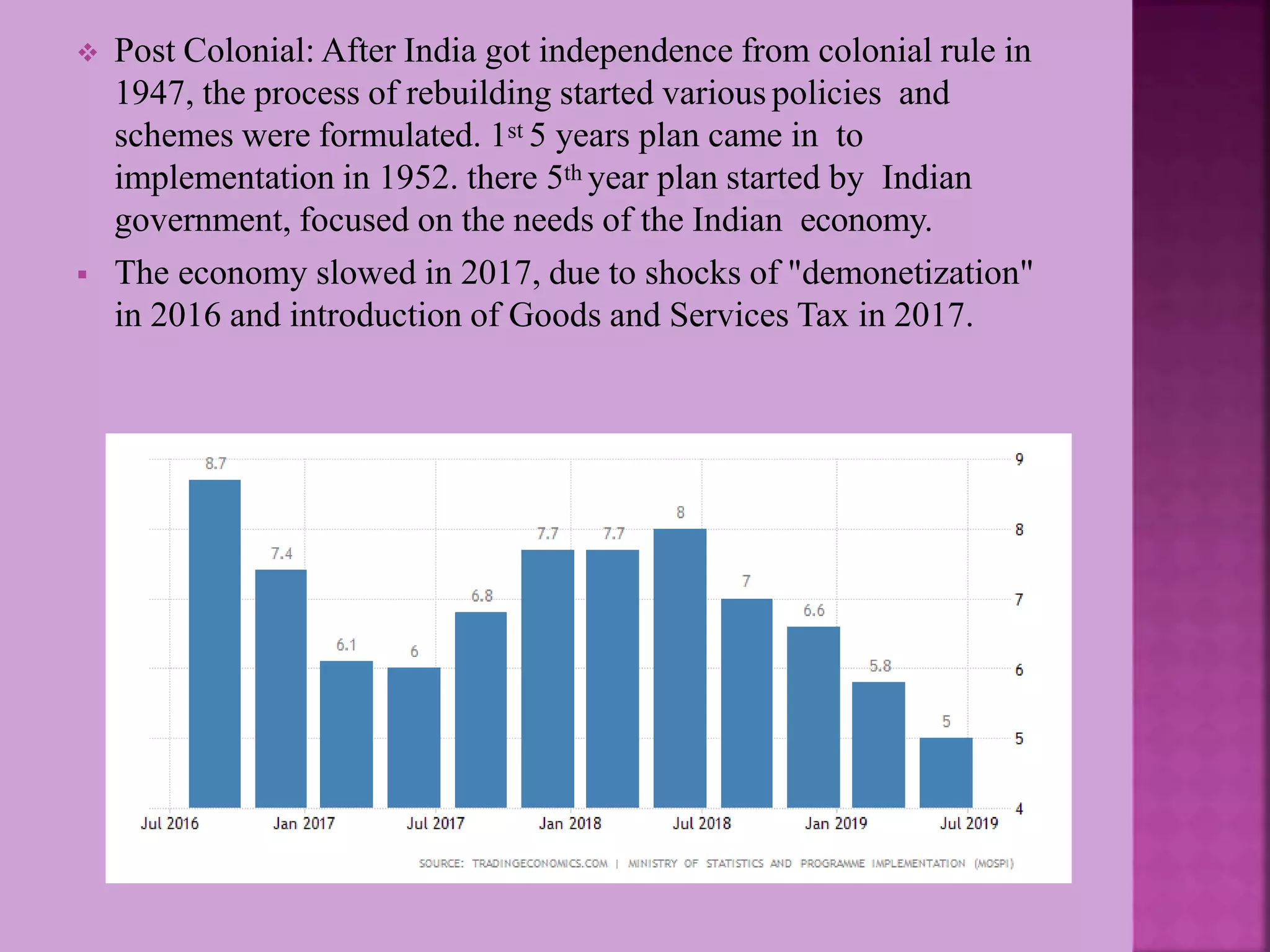
 The economy slowed in 2017, due to shocks of "demonetization"
in 2016 and introduction of Goods and Services Tax in 2017.
 The slowdown in the world economy and Emerging
Market and Developing Economies (EMDEs) in
2018 followed the escalation of US China trade
tensions, tighter credit policies in China, and
financial tightening alongside the normalization of
monetary policy in the larger advanced economies.
 2019 decline in India’s GDP of June quarter to 5.8 is
due to affected automobile sector .
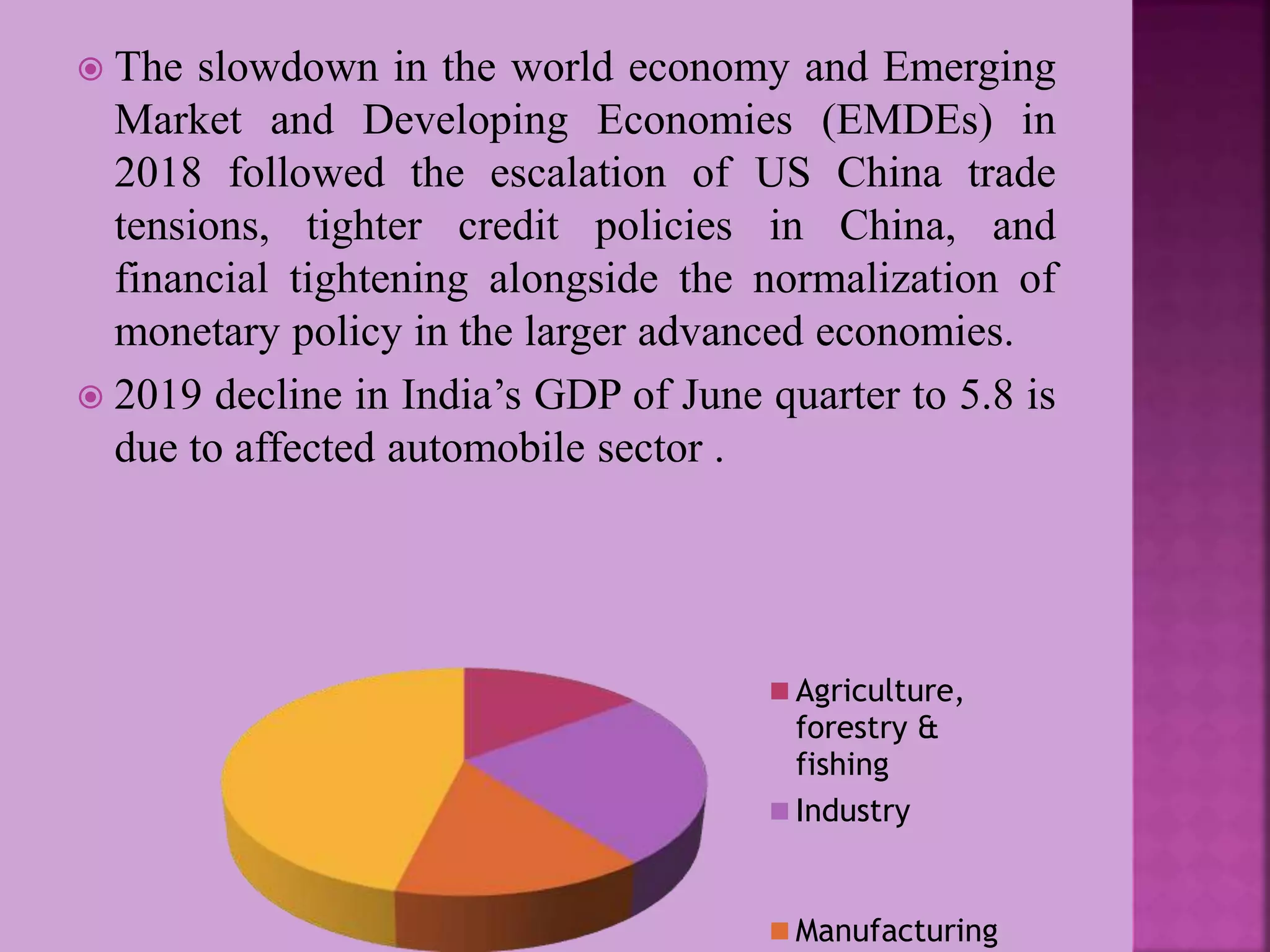
Agriculture,
forestry &
fishing
Industry
Manufacturing
 Primary (Agriculture and agriculture related activities,
forestry and fishing, mining, and extraction of oil and
gas).
 Secondary (Involves manufacturing the industrial
production of physical goods).
 Tertiary (Involves providing intangible goods like
services,attention,advice,experience,and discussion.
Financial services, management consultancy,telephony
and IT are good examples of service sector).
 In economic meaning, globalization refers to the
increased openness of an economy to the international
trade ,capital flows, transfer of technology and free
movements of labor or people.
 For developing countries like India globalization
carries benefits and opportunities as well as cost and
risks both. India and china have been recently using
globalization as an opportunity to accelerate rate of
economic growth so as to catch up with the developed
countries.
 For Food and agricultural products WTO has set
mainly two measures to keep trading effective and
easy, i.e. SPS and TBT.
 Political globalization
 Social globalization
 Economic globalization
 Cultural globalization
 Environmental globalization
 The first Iraq war in 1991 involving gulf countries
resulted in sharp rise in oil prices which landed India in
acute balance of payments. To outcome this crisis and
restore economic health of Indian economy many far
reaching changes in economic policies were made to
promote globalization of the Indian economy.
 The foreign exchanges regulation act (FERA)has been
replaced by foreign exchange management act (FEMA)to
remove a number of constraints earlier applicable to
firms with foreign equity operating in India.
 As a result India became open economy and started
importing and exporting from different countries.
 Advantages :
 There is a decline in the numbers of people living
below the poverty line in due to increased investments
trade and rising emloymement opportunities.
 Free flow of capital and technology enables to speed up
the process of industrialization and lay the path for
faster economic progress.
 Products of superior quality are available in the market
due to increased competition, efficiency and
productivity of the business and this leads to increased
consumer satisfaction.MNC’s bring with them foreign
capital, technology, know-how, machines, technical and
managerial skills which can be used for the
development nations.
 Disadvantages:
• Domestic companies are unable to withstand
competition from efficient MNC’s which here flooded
Indian markets since their liberated entry.
• Skilled and efficient labors get absorbed by these
MNC’s that offer higher pay and incentives leaving
unskilled labor for employment in the domestic
industries.
• With increased dependence on foreign technology
development of indigenous technology has taken a
back set and domestic r and d development has
suffered.
• Globalization poses certain risks for any country in the
form of business cycles, fluctuations, in international
prices.
• It leads to overcrowding of cities and puts pressure on
the amenities and facilities available in urban areas.
Indian Economy and Globalization

Indian Economy and Globalization

  • 1.
    (INTRODUCTION, HISTORY ANDOBJECTIVES) Nikita Yadav M.Sc. (Food Technology)
  • 2.
    Economy is theterm used for the production and consumption activities that take place in a nation seeking to efficiently allocate the nation’s resources for the public benefit. Limited resources and needs are unlimited. INDIAN ECONOMY:  The Economy of India is the fifth-largest in the world by nominal GDP and the third-largest by purchasing power parity (PPP). The country is one of the G-20 major economies, a member of BRICS and a developing economy among the top 20 global traders according to the WTO.
  • 3.
    The History ofIndian economy can be broadly divided into three Phase:  Pre-Colonial : The economy history of India since INDUS VALLEY civilization to 1700AD can be categorized under this phase. During this Phase Indian economy was very well developed. It has very good trade relation with other parts of world. Before the advent of the East India Company each village in India had sufficient entity and was economically independent as all the economies needs were fulfilled within the village.  Colonial : The arrival of East India Company in India caused a huge strain to the Indian economy and there was a two way depletion of resources- The British would buy raw materials from India at cheaper rates and finished foods were sold higher than normal price in Indian market.  During this phase Indians share of world income declined from 24.4% to 4.2% between 1700 and 1950.
  • 4.
     Post Colonial:After India got independence from colonial rule in 1947, the process of rebuilding started various policies and schemes were formulated. 1st 5 years plan came in to implementation in 1952. there 5th year plan started by Indian government, focused on the needs of the Indian economy.  The economy slowed in 2017, due to shocks of "demonetization" in 2016 and introduction of Goods and Services Tax in 2017.
  • 5.
     The slowdownin the world economy and Emerging Market and Developing Economies (EMDEs) in 2018 followed the escalation of US China trade tensions, tighter credit policies in China, and financial tightening alongside the normalization of monetary policy in the larger advanced economies.  2019 decline in India’s GDP of June quarter to 5.8 is due to affected automobile sector . Agriculture, forestry & fishing Industry Manufacturing
  • 6.
     Primary (Agricultureand agriculture related activities, forestry and fishing, mining, and extraction of oil and gas).  Secondary (Involves manufacturing the industrial production of physical goods).  Tertiary (Involves providing intangible goods like services,attention,advice,experience,and discussion. Financial services, management consultancy,telephony and IT are good examples of service sector).
  • 7.
     In economicmeaning, globalization refers to the increased openness of an economy to the international trade ,capital flows, transfer of technology and free movements of labor or people.  For developing countries like India globalization carries benefits and opportunities as well as cost and risks both. India and china have been recently using globalization as an opportunity to accelerate rate of economic growth so as to catch up with the developed countries.  For Food and agricultural products WTO has set mainly two measures to keep trading effective and easy, i.e. SPS and TBT.
  • 8.
     Political globalization Social globalization  Economic globalization  Cultural globalization  Environmental globalization
  • 9.
     The firstIraq war in 1991 involving gulf countries resulted in sharp rise in oil prices which landed India in acute balance of payments. To outcome this crisis and restore economic health of Indian economy many far reaching changes in economic policies were made to promote globalization of the Indian economy.  The foreign exchanges regulation act (FERA)has been replaced by foreign exchange management act (FEMA)to remove a number of constraints earlier applicable to firms with foreign equity operating in India.  As a result India became open economy and started importing and exporting from different countries.
  • 10.
     Advantages : There is a decline in the numbers of people living below the poverty line in due to increased investments trade and rising emloymement opportunities.  Free flow of capital and technology enables to speed up the process of industrialization and lay the path for faster economic progress.  Products of superior quality are available in the market due to increased competition, efficiency and productivity of the business and this leads to increased consumer satisfaction.MNC’s bring with them foreign capital, technology, know-how, machines, technical and managerial skills which can be used for the development nations.
  • 11.
     Disadvantages: • Domesticcompanies are unable to withstand competition from efficient MNC’s which here flooded Indian markets since their liberated entry. • Skilled and efficient labors get absorbed by these MNC’s that offer higher pay and incentives leaving unskilled labor for employment in the domestic industries. • With increased dependence on foreign technology development of indigenous technology has taken a back set and domestic r and d development has suffered. • Globalization poses certain risks for any country in the form of business cycles, fluctuations, in international prices. • It leads to overcrowding of cities and puts pressure on the amenities and facilities available in urban areas.