PROJECT TITLE:
STOCK EXCHANGE
&
ITS ORGANISATIONS
T.Y.B.COM-REGULAR
2009-2010
WHAT IS STOCK EXCHANGE
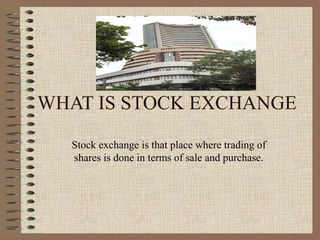
Stock exchange is that place where trading of
shares is done in terms of sale and purchase.
INTRODUCTION :
• There are 23 stock exchanges in the
India. Mumbai's (earlier known as
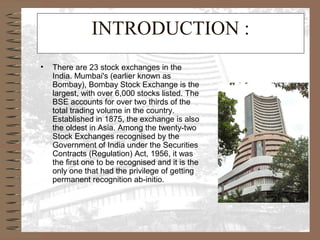
Bombay), Bombay Stock Exchange is the
largest, with over 6,000 stocks listed. The
BSE accounts for over two thirds of the
total trading volume in the country.
Established in 1875, the exchange is also
the oldest in Asia. Among the twenty-two
Stock Exchanges recognised by the
Government of India under the Securities
Contracts (Regulation) Act, 1956, it was
the first one to be recognised and it is the
only one that had the privilege of getting
permanent recognition ab-initio.
Name of Indian stock exchange:
• 1.Bombay stock exchange
• 2.national stock exchange(Mumbai)
• 3.Banglore stock exchange
• 4.Uttar pradesh stock exchange(kanpur)
• 5.Magadh stock exchange(Patna)
• 6.Ahmedabad stock exchange
• 7.Vadodara stock exchange(Baroda)
• 8.Bhubaneswar stock exchange
• 9.Calcutta stock exchange(kolkata)
• 10.Madras stock exchange
CONT…….
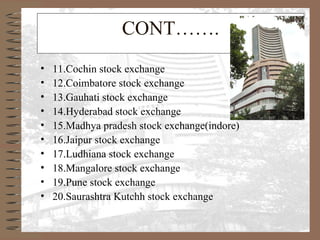
• 11.Cochin stock exchange
• 12.Coimbatore stock exchange
• 13.Gauhati stock exchange
• 14.Hyderabad stock exchange
• 15.Madhya pradesh stock exchange(indore)
• 16.Jaipur stock exchange
• 17.Ludhiana stock exchange
• 18.Mangalore stock exchange
• 19.Pune stock exchange
• 20.Saurashtra Kutchh stock exchange
CONT…….
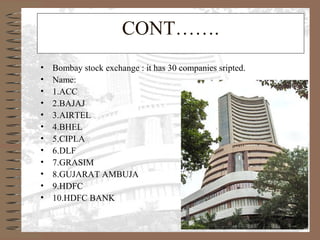
• Bombay stock exchange : it has 30 companies sripted.
• Name:
• 1.ACC
• 2.BAJAJ
• 3.AIRTEL
• 4.BHEL
• 5.CIPLA
• 6.DLF
• 7.GRASIM
• 8.GUJARAT AMBUJA
• 9.HDFC
• 10.HDFC BANK
CONT……
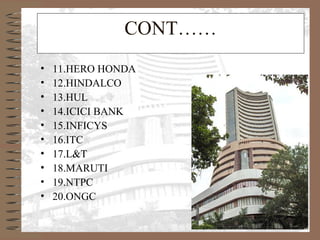
• 11.HERO HONDA
• 12.HINDALCO
• 13.HUL
• 14.ICICI BANK
• 15.INFICYS
• 16.ITC
• 17.L&T
• 18.MARUTI
• 19.NTPC
• 20.ONGC
CONT……
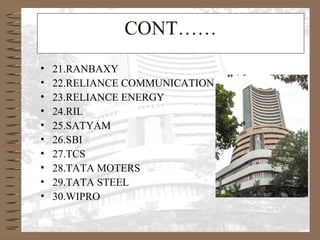
• 21.RANBAXY
• 22.RELIANCE COMMUNICATION
• 23.RELIANCE ENERGY
• 24.RIL
• 25.SATYAM
• 26.SBI
• 27.TCS
• 28.TATA MOTERS
• 29.TATA STEEL
• 30.WIPRO
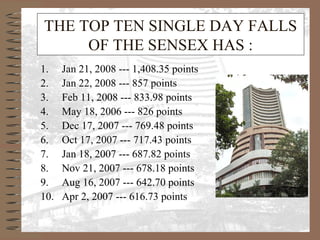
THE TOP TEN SINGLE DAY FALLS
OF THE SENSEX HAS :
1. Jan 21, 2008 --- 1,408.35 points
2. Jan 22, 2008 --- 857 points
3. Feb 11, 2008 --- 833.98 points
4. May 18, 2006 --- 826 points
5. Dec 17, 2007 --- 769.48 points
6. Oct 17, 2007 --- 717.43 points
7. Jan 18, 2007 --- 687.82 points
8. Nov 21, 2007 --- 678.18 points
9. Aug 16, 2007 --- 642.70 points
10. Apr 2, 2007 --- 616.73 points
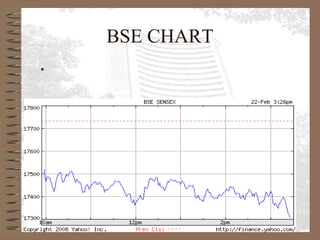
BSE CHART
•
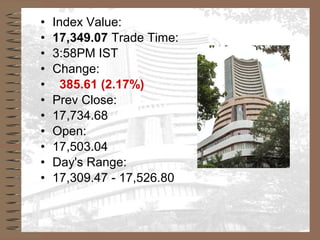
• Index Value:
• 17,349.07 Trade Time:
• 3:58PM IST
• Change:
• 385.61 (2.17%)
• Prev Close:
• 17,734.68
• Open:
• 17,503.04
• Day's Range:
• 17,309.47 - 17,526.80
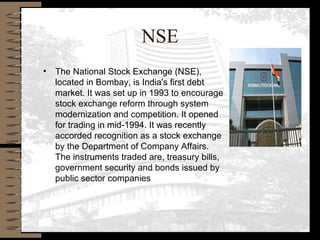
NSE
• The National Stock Exchange (NSE),
located in Bombay, is India's first debt
market. It was set up in 1993 to encourage
stock exchange reform through system
modernization and competition. It opened
for trading in mid-1994. It was recently
accorded recognition as a stock exchange
by the Department of Company Affairs.
The instruments traded are, treasury bills,
government security and bonds issued by
public sector companies
CONT……….
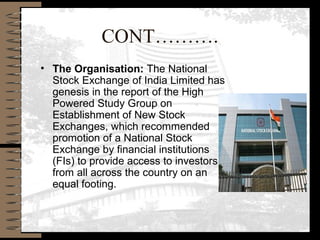
• The Organisation: The National
Stock Exchange of India Limited has
genesis in the report of the High
Powered Study Group on
Establishment of New Stock
Exchanges, which recommended
promotion of a National Stock
Exchange by financial institutions
(FIs) to provide access to investors
from all across the country on an
equal footing.
CONT………
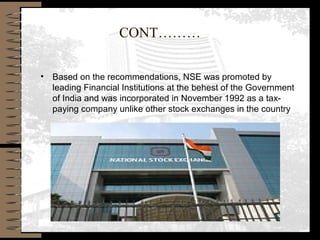
• Based on the recommendations, NSE was promoted by
leading Financial Institutions at the behest of the Government
of India and was incorporated in November 1992 as a tax-
paying company unlike other stock exchanges in the country
CONT……………
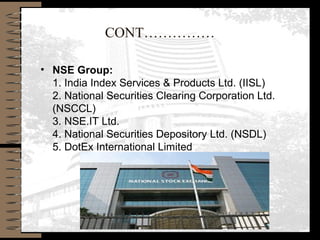
• NSE Group:
1. India Index Services & Products Ltd. (IISL)
2. National Securities Clearing Corporation Ltd.
(NSCCL)
3. NSE.IT Ltd.
4. National Securities Depository Ltd. (NSDL)
5. DotEx International Limited
SPECULATION :
• Definition : it involves the buying,holding,selling,short-
term selling of
stocks,bonds.commodities,currencies,collectibles or any
valuable financial instrument to profit from fluctuations
in its price as opposed to buying it for use or for income
via method like dividends or interest.
Kinds of speculation
• Bull Market (Tejiwala): In case of that they purchase the
shares at current prices to sell at a higher price in the near
future and makes a profit if his expectations come true.he
is also called a long buyer.
• Bear Market (Mandiwala) : He sells security in the hope
that he will be able to buy them back at lesser price.It is
also called “short selling”.
Cont………………
• Lame duck : When a bear has made contracts to sell
securities,find it difficult to meet his commitment due to
non-availability of security,,they always struggling..
• Stag : He is that type of speculator who applies for a large
number of a shares in a new issue with the intention of
selling them at a premium.He is bullish and very
cautious.
FOREX MARKET
CURRENCY IN :
• US.DOLLAR
• 48.44
• EURO
• 68.99
• POUND
• 79.72
• JAPANESE YEN
• 0.513
• SINGAPORE DOLLAR
• 33.63
BENEFITS OF STOCK EXCHANGE
• FROM THE POINT OF VIEW OF COMMUNITY:
• 1.It assist the economis development by providing a body
of interested investors.
• 2.it uploads the position of superior enterprises and assist
them in raising further funds.
• 3.It encourages capital formation
• 4.Government can undertake projects of national
importance and social value raising funds through the
sale of its securities on the stock exchange.
• 5.It is the stock exchanges that central bank of a country
can control credit by undertaking open market operations
(purchase and sale of securities)
FROM THE COMPANY POINT OF VIEW
• 1.A company whose shares quoted on stock
exchange they enjoy better reputation and credit.
• 2.The market for the shares of such a company is
naturally widened.
• 3.The market price of securities is likely to be
higher in relation to its earnings,dividends and
property values.This raises the bargaining power
of the company in the event of a takeover,merger
or amalgamation.
FROM THE INVESTORS POINT OF VIEW
• 1.Liquidity of the investment is increased
• 2.The securities dealt on a stock exchange are good
collateral security for loans.
• 3.The stock exchange safeguards interests of investors
through strict enforcement of rules and regulations.
• 4.The present net worth of investments can be easily
known by the daily quotations.
• 5.His risk is considerably less when he holds or purchases
listed securities.
ROLE PLAYER
• EXTERNAL:----
• 1.SHAREHOLDER
• 2.DEBENTURE HOLDER
SHAREHOLDER
• Shareholders are divided into two parts
• 1.Preference shareholder: Preference shareholder
are those which have preferential right to the
payment of dividend during the life time of the
company,and a preferential right to the return of
the capital when the company is wound up.
CHARACTERISTICS OF PREF.SHAREHOLDER
• 1.The dividend on them is fixed by the articles of
the company.
• 2.They get their fixed rate of dividend before any
dividend is distributed among the other class of
shareholders.
• 3.At the time of winding up of the company, the
preference shareholder must be paid back their
capital before anything is paid to the ordinary
shareholders.
KINDS OF PREF.SHAREHOLDER
• 1.Cumulative shareholder: These shares are
entitled to fixed dividends whether there are
profits or loss.If profits are not sufficient to pay
in a particular year then that will pay on next
year.
• 2.Non Cumulative pref.share: These shares
cannot claim arrears of dividends of any year (if
not paid due to insufficiency of profits ) out of
profits of subsequent year.
CONT…….
• 3.Participating pref. Shares: These shares
receives a fixed rate of dividend in priority to
ordinary shares and further,the right to participate
in balance of profits in an agreed proportion
together with ordinary shares.
• 4.Redeemable pref.shares: These are shares
which can be purchased back by the
company.The company reserves its rights to call
back or purchased these shares at any time .
EQUITY SHARES
• All shares which are not preference shares are
equity shares.These shares do not have a fixed
rate of dividend,they are always irredeemable and
their holders have normal voting rights.
• They are also the owners of the company.
• They take dividend
DEBENTURES
• A document under the company seal which
provides for the payment of a principal sum and
interest there on at regular intervals which is
usually secured by a fixed or floating charge on
the company’s property or undertaking which
acknowledges a loan to the company.
INTERNAL PLAYERS
• The members of the stock exchange can be
divided into two parts:
• A.Broker: He is a commission agent who
transacts business in securities on behalf of non-
members.They may have number of sub-brokers
to canvass and secure business for them.
• B.Jobber: He is an independent dealer
securities.He purchase and sells securities in his
own name. He is not allowed to deal with non-
members directly.He works for profit.
Tarawaniwala
• Non-members : The following categories of non
members are also permitted to enter trading hall
and transact business on the behalf of members.
• Authorized clerks: They are the assistant or
agents.They buy or sell on the behalf of
employers.They can not transact business on
their own account.
• Remisers: They are the sub-brokers. He is also
called the half commission men.
CAUSES OF PRICE FLUCTUATION
• 1.DEMAND AND SUPPLY
• 2.BANK RATE
• 3.SPECULATIVE PRESSURE
• 4.ACTIONS OF UNDERWRITERS AND
OTHER FINANCIAL INSTITUTIONS
• 5.CHANGE IN COMPANY’S BOARD OF
DIRECTORS
• 6.FINANCIAL POSITION OF THE COMPANY
CONT……..
• 7.TRADE CYCLE
• 8.POLITICAL FACTORS
• 9.SYMPATHETIC FLUCTUATIONS
• 10.OTHER FACTORS:
• A.EXPECTED MONSOON
• B.PERSONAL HEALTH OF HEAD OF
GOVERNMENT OR CHAIRMAN OF THE COMPANY
• C.OIL PRICES IN THE INTERNATIONAL MARKET.
CONT…….
• D.CHANGES IN EXCHANGE RATE
• E.BORDER TENSION
• F.STOCK BROKERS SCAM LIKE HARSHAD
MEHTA AND KETHAN PAREKH
• G.STRIKES AND LOCK-OUT OF THE
COMPANY.
• H.NEW BUDGET PROPOSALS
• I.LOBERLIZATION AND PRIVATIZATION
OF THE COMPANY.
SEBI
• It was constituted and made a statutory body by
SEBI act 1992.With the coming into effect of
SEBI, some of the powers and function exercised
by the central government,in respect of
regulation of stock exchanges were transferred to
the SEBI.
OBJECTIVES OF SEBI
• 1.Registring and regulating the working of stock
brokers,sub-brokers,share transfer
agents,underwriters……….who may be associated
securities market in any manner.
• 2.Registering and regulating the working of collective
investment scheme including mutual funds.
• 3.Prohibiting insider trading in securities.
• 4.Regulating substantial acquisition of shares and
takeovers of companies.
CONT……
• 5.Calling for information from,undertaking
inspection,conducting inquiries and audits of
stock exchanges and intermediaries and self
regulatory organizations in the securities market.
• 6.Performing such function and exercising such
powers under the provisions of the capital
issues(control) act 1947 and SCRA 1956,as may
be delegated to it by the central government.
• 7.Performing such other functions as may be
prescribed.
BUY BACK SHARES
• In simple term when company re-purchase of its
own shares that is called buy back shares.
HOW RATING IS GIVEN TO THE COMPANY?
• Basically rating is given after see the company
'image,management quality,assets quality,auditors
quality,accounting accuracy.Rating is not fixed, it may be
change. The rating grades are:
• AAA: HIGHEST SAFTY
• AA: HIGH SAFTY
• A: ADEQUATE SAFTY
• BBB: MODERATE SAFTY
• BB: IN ADEQUATE SAFTY
• BC&D: HIGH RISK AND DEFAULT
CREDIT RATING AGENCY IN INDIA
• 1.CRISIL
• 2.ICRA
• 3.CARE
• 4.DPCR
CONCLUSION
• THE STOCK EXCHANGE IS
CONSIDERED TO BE THE
BAROMETER OF ECONOMIC
ACTIVITY.
Stock exchange & its organisation

Stock exchange & its organisation

  • 1.
    PROJECT TITLE: STOCK EXCHANGE & ITSORGANISATIONS T.Y.B.COM-REGULAR 2009-2010
  • 2.
    WHAT IS STOCKEXCHANGE Stock exchange is that place where trading of shares is done in terms of sale and purchase.
  • 3.
    INTRODUCTION : • Thereare 23 stock exchanges in the India. Mumbai's (earlier known as Bombay), Bombay Stock Exchange is the largest, with over 6,000 stocks listed. The BSE accounts for over two thirds of the total trading volume in the country. Established in 1875, the exchange is also the oldest in Asia. Among the twenty-two Stock Exchanges recognised by the Government of India under the Securities Contracts (Regulation) Act, 1956, it was the first one to be recognised and it is the only one that had the privilege of getting permanent recognition ab-initio.
  • 4.
    Name of Indianstock exchange: • 1.Bombay stock exchange • 2.national stock exchange(Mumbai) • 3.Banglore stock exchange • 4.Uttar pradesh stock exchange(kanpur) • 5.Magadh stock exchange(Patna) • 6.Ahmedabad stock exchange • 7.Vadodara stock exchange(Baroda) • 8.Bhubaneswar stock exchange • 9.Calcutta stock exchange(kolkata) • 10.Madras stock exchange
  • 5.
    CONT……. • 11.Cochin stockexchange • 12.Coimbatore stock exchange • 13.Gauhati stock exchange • 14.Hyderabad stock exchange • 15.Madhya pradesh stock exchange(indore) • 16.Jaipur stock exchange • 17.Ludhiana stock exchange • 18.Mangalore stock exchange • 19.Pune stock exchange • 20.Saurashtra Kutchh stock exchange
  • 6.
    CONT……. • Bombay stockexchange : it has 30 companies sripted. • Name: • 1.ACC • 2.BAJAJ • 3.AIRTEL • 4.BHEL • 5.CIPLA • 6.DLF • 7.GRASIM • 8.GUJARAT AMBUJA • 9.HDFC • 10.HDFC BANK
  • 7.
    CONT…… • 11.HERO HONDA •12.HINDALCO • 13.HUL • 14.ICICI BANK • 15.INFICYS • 16.ITC • 17.L&T • 18.MARUTI • 19.NTPC • 20.ONGC
  • 8.
    CONT…… • 21.RANBAXY • 22.RELIANCECOMMUNICATION • 23.RELIANCE ENERGY • 24.RIL • 25.SATYAM • 26.SBI • 27.TCS • 28.TATA MOTERS • 29.TATA STEEL • 30.WIPRO
  • 9.
    THE TOP TENSINGLE DAY FALLS OF THE SENSEX HAS : 1. Jan 21, 2008 --- 1,408.35 points 2. Jan 22, 2008 --- 857 points 3. Feb 11, 2008 --- 833.98 points 4. May 18, 2006 --- 826 points 5. Dec 17, 2007 --- 769.48 points 6. Oct 17, 2007 --- 717.43 points 7. Jan 18, 2007 --- 687.82 points 8. Nov 21, 2007 --- 678.18 points 9. Aug 16, 2007 --- 642.70 points 10. Apr 2, 2007 --- 616.73 points
  • 10.
  • 11.
    • Index Value: •17,349.07 Trade Time: • 3:58PM IST • Change: • 385.61 (2.17%) • Prev Close: • 17,734.68 • Open: • 17,503.04 • Day's Range: • 17,309.47 - 17,526.80
  • 12.
    NSE • The NationalStock Exchange (NSE), located in Bombay, is India's first debt market. It was set up in 1993 to encourage stock exchange reform through system modernization and competition. It opened for trading in mid-1994. It was recently accorded recognition as a stock exchange by the Department of Company Affairs. The instruments traded are, treasury bills, government security and bonds issued by public sector companies
  • 13.
    CONT………. • The Organisation:The National Stock Exchange of India Limited has genesis in the report of the High Powered Study Group on Establishment of New Stock Exchanges, which recommended promotion of a National Stock Exchange by financial institutions (FIs) to provide access to investors from all across the country on an equal footing.
  • 14.
    CONT……… • Based onthe recommendations, NSE was promoted by leading Financial Institutions at the behest of the Government of India and was incorporated in November 1992 as a tax- paying company unlike other stock exchanges in the country
  • 15.
    CONT…………… • NSE Group: 1.India Index Services & Products Ltd. (IISL) 2. National Securities Clearing Corporation Ltd. (NSCCL) 3. NSE.IT Ltd. 4. National Securities Depository Ltd. (NSDL) 5. DotEx International Limited
  • 16.
    SPECULATION : • Definition: it involves the buying,holding,selling,short- term selling of stocks,bonds.commodities,currencies,collectibles or any valuable financial instrument to profit from fluctuations in its price as opposed to buying it for use or for income via method like dividends or interest.
  • 17.
    Kinds of speculation •Bull Market (Tejiwala): In case of that they purchase the shares at current prices to sell at a higher price in the near future and makes a profit if his expectations come true.he is also called a long buyer. • Bear Market (Mandiwala) : He sells security in the hope that he will be able to buy them back at lesser price.It is also called “short selling”.
  • 18.
    Cont……………… • Lame duck: When a bear has made contracts to sell securities,find it difficult to meet his commitment due to non-availability of security,,they always struggling.. • Stag : He is that type of speculator who applies for a large number of a shares in a new issue with the intention of selling them at a premium.He is bullish and very cautious.
  • 19.
    FOREX MARKET CURRENCY IN: • US.DOLLAR • 48.44 • EURO • 68.99 • POUND • 79.72 • JAPANESE YEN • 0.513 • SINGAPORE DOLLAR • 33.63
  • 20.
    BENEFITS OF STOCKEXCHANGE • FROM THE POINT OF VIEW OF COMMUNITY: • 1.It assist the economis development by providing a body of interested investors. • 2.it uploads the position of superior enterprises and assist them in raising further funds. • 3.It encourages capital formation • 4.Government can undertake projects of national importance and social value raising funds through the sale of its securities on the stock exchange. • 5.It is the stock exchanges that central bank of a country can control credit by undertaking open market operations (purchase and sale of securities)
  • 21.
    FROM THE COMPANYPOINT OF VIEW • 1.A company whose shares quoted on stock exchange they enjoy better reputation and credit. • 2.The market for the shares of such a company is naturally widened. • 3.The market price of securities is likely to be higher in relation to its earnings,dividends and property values.This raises the bargaining power of the company in the event of a takeover,merger or amalgamation.
  • 22.
    FROM THE INVESTORSPOINT OF VIEW • 1.Liquidity of the investment is increased • 2.The securities dealt on a stock exchange are good collateral security for loans. • 3.The stock exchange safeguards interests of investors through strict enforcement of rules and regulations. • 4.The present net worth of investments can be easily known by the daily quotations. • 5.His risk is considerably less when he holds or purchases listed securities.
  • 23.
    ROLE PLAYER • EXTERNAL:---- •1.SHAREHOLDER • 2.DEBENTURE HOLDER
  • 24.
    SHAREHOLDER • Shareholders aredivided into two parts • 1.Preference shareholder: Preference shareholder are those which have preferential right to the payment of dividend during the life time of the company,and a preferential right to the return of the capital when the company is wound up.
  • 25.
    CHARACTERISTICS OF PREF.SHAREHOLDER •1.The dividend on them is fixed by the articles of the company. • 2.They get their fixed rate of dividend before any dividend is distributed among the other class of shareholders. • 3.At the time of winding up of the company, the preference shareholder must be paid back their capital before anything is paid to the ordinary shareholders.
  • 26.
    KINDS OF PREF.SHAREHOLDER •1.Cumulative shareholder: These shares are entitled to fixed dividends whether there are profits or loss.If profits are not sufficient to pay in a particular year then that will pay on next year. • 2.Non Cumulative pref.share: These shares cannot claim arrears of dividends of any year (if not paid due to insufficiency of profits ) out of profits of subsequent year.
  • 27.
    CONT……. • 3.Participating pref.Shares: These shares receives a fixed rate of dividend in priority to ordinary shares and further,the right to participate in balance of profits in an agreed proportion together with ordinary shares. • 4.Redeemable pref.shares: These are shares which can be purchased back by the company.The company reserves its rights to call back or purchased these shares at any time .
  • 28.
    EQUITY SHARES • Allshares which are not preference shares are equity shares.These shares do not have a fixed rate of dividend,they are always irredeemable and their holders have normal voting rights. • They are also the owners of the company. • They take dividend
  • 29.
    DEBENTURES • A documentunder the company seal which provides for the payment of a principal sum and interest there on at regular intervals which is usually secured by a fixed or floating charge on the company’s property or undertaking which acknowledges a loan to the company.
  • 30.
    INTERNAL PLAYERS • Themembers of the stock exchange can be divided into two parts: • A.Broker: He is a commission agent who transacts business in securities on behalf of non- members.They may have number of sub-brokers to canvass and secure business for them. • B.Jobber: He is an independent dealer securities.He purchase and sells securities in his own name. He is not allowed to deal with non- members directly.He works for profit.
  • 31.
    Tarawaniwala • Non-members :The following categories of non members are also permitted to enter trading hall and transact business on the behalf of members. • Authorized clerks: They are the assistant or agents.They buy or sell on the behalf of employers.They can not transact business on their own account. • Remisers: They are the sub-brokers. He is also called the half commission men.
  • 32.
    CAUSES OF PRICEFLUCTUATION • 1.DEMAND AND SUPPLY • 2.BANK RATE • 3.SPECULATIVE PRESSURE • 4.ACTIONS OF UNDERWRITERS AND OTHER FINANCIAL INSTITUTIONS • 5.CHANGE IN COMPANY’S BOARD OF DIRECTORS • 6.FINANCIAL POSITION OF THE COMPANY
  • 33.
    CONT…….. • 7.TRADE CYCLE •8.POLITICAL FACTORS • 9.SYMPATHETIC FLUCTUATIONS • 10.OTHER FACTORS: • A.EXPECTED MONSOON • B.PERSONAL HEALTH OF HEAD OF GOVERNMENT OR CHAIRMAN OF THE COMPANY • C.OIL PRICES IN THE INTERNATIONAL MARKET.
  • 34.
    CONT……. • D.CHANGES INEXCHANGE RATE • E.BORDER TENSION • F.STOCK BROKERS SCAM LIKE HARSHAD MEHTA AND KETHAN PAREKH • G.STRIKES AND LOCK-OUT OF THE COMPANY. • H.NEW BUDGET PROPOSALS • I.LOBERLIZATION AND PRIVATIZATION OF THE COMPANY.
  • 35.
    SEBI • It wasconstituted and made a statutory body by SEBI act 1992.With the coming into effect of SEBI, some of the powers and function exercised by the central government,in respect of regulation of stock exchanges were transferred to the SEBI.
  • 36.
    OBJECTIVES OF SEBI •1.Registring and regulating the working of stock brokers,sub-brokers,share transfer agents,underwriters……….who may be associated securities market in any manner. • 2.Registering and regulating the working of collective investment scheme including mutual funds. • 3.Prohibiting insider trading in securities. • 4.Regulating substantial acquisition of shares and takeovers of companies.
  • 37.
    CONT…… • 5.Calling forinformation from,undertaking inspection,conducting inquiries and audits of stock exchanges and intermediaries and self regulatory organizations in the securities market. • 6.Performing such function and exercising such powers under the provisions of the capital issues(control) act 1947 and SCRA 1956,as may be delegated to it by the central government. • 7.Performing such other functions as may be prescribed.
  • 38.
    BUY BACK SHARES •In simple term when company re-purchase of its own shares that is called buy back shares.
  • 39.
    HOW RATING ISGIVEN TO THE COMPANY? • Basically rating is given after see the company 'image,management quality,assets quality,auditors quality,accounting accuracy.Rating is not fixed, it may be change. The rating grades are: • AAA: HIGHEST SAFTY • AA: HIGH SAFTY • A: ADEQUATE SAFTY • BBB: MODERATE SAFTY • BB: IN ADEQUATE SAFTY • BC&D: HIGH RISK AND DEFAULT
  • 40.
    CREDIT RATING AGENCYIN INDIA • 1.CRISIL • 2.ICRA • 3.CARE • 4.DPCR
  • 41.
    CONCLUSION • THE STOCKEXCHANGE IS CONSIDERED TO BE THE BAROMETER OF ECONOMIC ACTIVITY.