CONTENTS
• Indian economy
•History of the Indian economy
• Indian economy after independence
• Economy after the changes in 1991
• Future of the Indian economy
• Challenges to the growth of the Indian
economy
• conclusion
3.
INDIAN ECONOMY
• Basedon the nominal GDP India is the fifth largest economy
whereas, by PPP, it is the third largest.
• The Indian economy has experienced numerous ups and downs
over the past seven decades. At the time of independence, the
nation's GDP stood at only Rs 2.7 lakh crore; today, it is close to
Rs 150 lakh crore. The Indian economy has a middle-income
developing market economy.
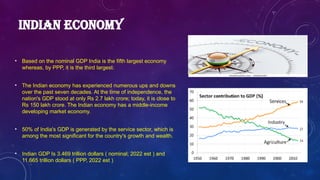
• 50% of India's GDP is generated by the service sector, which is
among the most significant for the country's growth and wealth.
• Indian GDP Is 3.469 trillion dollars ( nominal; 2022 est ) and
11.665 trillion dollars ( PPP, 2022 est )
4.
HISTORY OF THEINDIAN ECONOMY ( PRE COLONIAL)
• India's economic history can be characterized as spanning from the Indus valley civilization until 1700
AD.
• Indian economy at this time was very advanced. With the rest of the world, it has excellent trade
relations.
• When India gained its independence in 1947, its GDP had fallen to 2% from its peak of 25% to 35%
between the years of one AD and 1000 AD.
5.
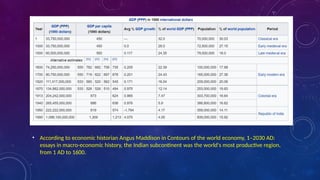
• According toeconomic historian Angus Maddison in Contours of the world economy, 1–2030 AD:
essays in macro-economic history, the Indian subcontinent was the world's most productive region,
from 1 AD to 1600.
6.
INDIAN ECONOMY AFTERINDEPENDENCE ( POST-COLONIAL )
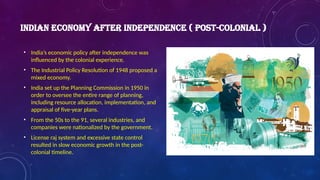
• India’s economic policy after independence was
influenced by the colonial experience.
• The Industrial Policy Resolution of 1948 proposed a
mixed economy.
• India set up the Planning Commission in 1950 in
order to oversee the entire range of planning,
including resource allocation, implementation, and
appraisal of five-year plans.
• From the 50s to the 91, several industries, and
companies were nationalized by the government.
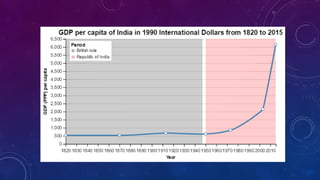
• License raj system and excessive state control
resulted in slow economic growth in the post-
colonial timeline.
8.
THE ECONOMIC REFORMSOF 1991
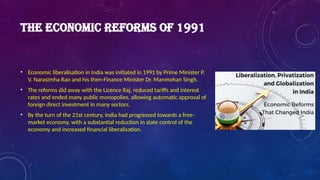
• Economic liberalisation in India was initiated in 1991 by Prime Minister P.
V. Narasimha Rao and his then-Finance Minister Dr. Manmohan Singh.
• The reforms did away with the Licence Raj, reduced tariffs and interest
rates and ended many public monopolies, allowing automatic approval of
foreign direct investment in many sectors.
• By the turn of the 21st century, India had progressed towards a free-
market economy, with a substantial reduction in state control of the
economy and increased financial liberalisation.
9.
FUTURE OF THEINDIAN ECONOMY
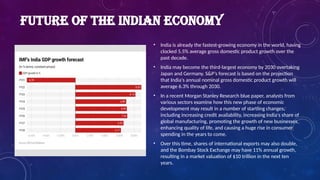
• India is already the fastest-growing economy in the world, having
clocked 5.5% average gross domestic product growth over the
past decade.
• India may become the third-largest economy by 2030 overtaking
Japan and Germany. S&P’s forecast is based on the projection
that India's annual nominal gross domestic product growth will
average 6.3% through 2030.
• In a recent Morgan Stanley Research blue paper, analysts from
various sectors examine how this new phase of economic
development may result in a number of startling changes,
including increasing credit availability, increasing India's share of
global manufacturing, promoting the growth of new businesses,
enhancing quality of life, and causing a huge rise in consumer
spending in the years to come.
• Over this time, shares of international exports may also double,
and the Bombay Stock Exchange may have 11% annual growth,
resulting in a market valuation of $10 trillion in the next ten
years.
10.
CHALLENGES TO THEGROWTH OF INDIAN
ECONOMY
• Low level of national income and per capita income.
• Vast inequalities in wealth and income.
• The predominance of agriculture.
• Tremendous population pressure.
• Massive unemployment.