FINANCIAL ADMINISTRATION
(Monetary & Fiscal Policy)
BY – MANVEE CHAUHAN
Financial Administration
 Financial administration refers to that set of activities which are related to
making available money or funds to the various govt. sectors to enable
them to carry out there objectives.
 Financial administration involves all activities of finance and taxation.
Monetary Policy
 Process by which monetary authority(authority that controls all matters
related to money) , generally central bank controls the supply of money
by exercising it’s control over interest rates in order to maintain price
stability, reduce inflation and to achieve high economic growth.
 The major techniques of the central bank or RBI to implement it’s
monetary policies are:
a) Money supply
b) Interest rates
c) Cash reserve ratio(CRR)
d) Statutory liquidity ratio
e) Bank rate
f) Moral suasion
g) Repo rate and reverse repo rate
Objectives Of Monetary Policy
 Full employment
 Price stability
 Economic growth
 Exchange rate stability
Fiscal Policy
 It refers to a policy concerning the use of state treasury or the govt. finances to
achieve the macro – economic goals.
 Monetary policy and fiscal policy are complimentary to each other and equally
necessary in managing a nation’s economy.
 There are 3 types of fiscal policy:
1) Neutral fiscal poicy:- it implies a policy for a balanced budget where govt.
spending is equal to the revenue/tax collection so there is status quo in the
economy.
2) Expansionary fiscal policy:- when govt. spending exceeds taxation
revenue leading to a larger budget deficit.
3) Contractionary fiscal policy:- when govt. spending is less than what is
collected as revenue. It is usually associated with a budget surplus.
Instruments Of Fiscal Policy
 Public works
 Public expenditure.
 Taxation policy
 Public debt.
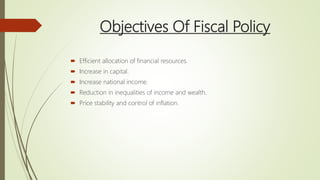
Objectives Of Fiscal Policy
 Efficient allocation of financial resources.
 Increase in capital.
 Increase national income.
 Reduction in inequalities of income and wealth.
 Price stability and control of inflation.
Role Of Finance Ministry
 Ministry of finance plays a very crucial role. It is responsible for the overall
financial management of a country.
 It is responsible for all the fiscal policies made in the nation that leads to
growth and development of the entire nation. Being the head, finance
minister presents the annual union budget in the parliament.
 It is also called as treasury department of government of India.
 The growth and international position depend on the decisions of the
finance minister related to economic affairs. It includes the decisions
related to expenditure, revenue, investment etc.
THANKYOU

Financial administration ppt

  • 1.
    FINANCIAL ADMINISTRATION (Monetary &Fiscal Policy) BY – MANVEE CHAUHAN
  • 2.
    Financial Administration  Financialadministration refers to that set of activities which are related to making available money or funds to the various govt. sectors to enable them to carry out there objectives.  Financial administration involves all activities of finance and taxation.
  • 3.
    Monetary Policy  Processby which monetary authority(authority that controls all matters related to money) , generally central bank controls the supply of money by exercising it’s control over interest rates in order to maintain price stability, reduce inflation and to achieve high economic growth.  The major techniques of the central bank or RBI to implement it’s monetary policies are: a) Money supply b) Interest rates c) Cash reserve ratio(CRR)
  • 4.
    d) Statutory liquidityratio e) Bank rate f) Moral suasion g) Repo rate and reverse repo rate
  • 5.
    Objectives Of MonetaryPolicy  Full employment  Price stability  Economic growth  Exchange rate stability
  • 6.
    Fiscal Policy  Itrefers to a policy concerning the use of state treasury or the govt. finances to achieve the macro – economic goals.  Monetary policy and fiscal policy are complimentary to each other and equally necessary in managing a nation’s economy.  There are 3 types of fiscal policy: 1) Neutral fiscal poicy:- it implies a policy for a balanced budget where govt. spending is equal to the revenue/tax collection so there is status quo in the economy.
  • 7.
    2) Expansionary fiscalpolicy:- when govt. spending exceeds taxation revenue leading to a larger budget deficit. 3) Contractionary fiscal policy:- when govt. spending is less than what is collected as revenue. It is usually associated with a budget surplus.
  • 8.
    Instruments Of FiscalPolicy  Public works  Public expenditure.  Taxation policy  Public debt.
  • 9.
    Objectives Of FiscalPolicy  Efficient allocation of financial resources.  Increase in capital.  Increase national income.  Reduction in inequalities of income and wealth.  Price stability and control of inflation.
  • 10.
    Role Of FinanceMinistry  Ministry of finance plays a very crucial role. It is responsible for the overall financial management of a country.  It is responsible for all the fiscal policies made in the nation that leads to growth and development of the entire nation. Being the head, finance minister presents the annual union budget in the parliament.  It is also called as treasury department of government of India.  The growth and international position depend on the decisions of the finance minister related to economic affairs. It includes the decisions related to expenditure, revenue, investment etc.
  • 11.