www.lawofcompounding.net
3 IN1
Pension Scheme launched by Government of India with
the following objectives-
-To provide old age income
-Reasonable market based returns over long run
-Extending old age security coverage to all citizens
It is based on a unique Permanent Retirement Account
Number (PRAN) which is allotted to each Subscriber
upon joining NPS.
National Pension System (NPS)
www.lawofcompounding.net
Cheapest market linked retirement
plan
Excessively less payment of
incentive/commission to the
intermediaries, it is not getting
promoted by them.
What is National Pension Scheme?
www.lawofcompounding.net
Only 0.25% of the investment is paid to the intermediary as fund
management fee. Let us see how this cost is different from the
costs of the other leading pension plans.
Costs Involved in National Pension Scheme
www.lawofcompounding.net
There are two types of accounts that NPS offers:
Tier-I Account
It is a basic pension account with limitations on withdrawal
Tier-II Account
It is a voluntary savings option from which a person can
withdraw money limitless.
Types of National Pension Schemes
(NPS):
www.lawofcompounding.net
Types of Funds in National Pension Scheme
www.lawofcompounding.net
Class of Fund Invested In Risk
Average Return
Since Launch (%)
E Index based Stocks
Carry market risk like any large
cap equity fund
3.79%
C
Bonds issued by State Govt,
PSUs and Private Firms
Going by the quality of
companies, risk would be low.
8.66%
G Bonds issued by Central Govt.
Lacks default risk but volatility
can't be avoided in long term
bonds.
5.92%
Corpus can be divided among these three fund classes.
Exposure to equity cannot be more than 50%.
If allocation is not specified, the exposure to various classes, especially
equity is decided on the basis of age.
So with increasing age the investment
corpus gets more inclined towards
Debt.
According to the Age of the Investor
www.lawofcompounding.net
Age of the Investor
Percentage of Investment in Various
Classes
Up to 35 Years 50% Equity and 50% Debt
40 Years 40% Equity and 60% Debt
45 Years 30% Equity and 70% Debt
50 Years 20% Equity and 80% Debt
55 Years 10% Equity and 90% Debt
Pros and Cons of NPS
www.lawofcompounding.net
Pros
1. Additional Tax Benefi The Finance Bill 2011-12
permits tax deduction on contribution up to 10 per cent
of basic salary and dearness allowance (DA) made by
an employer towards the national pension scheme
(NPS) account of an employee under Section 80CCE.
1. Additional Tax Benefit.
2. Higher Fee to Intermediaries:
www.lawofcompounding.net
Cons
Funds would be taxed at withdrawal.
60 per cent corpus on maturity can be withdrawn while at least 40 per cent
has to be used to buy annuity.
The proposed Direct Taxes Code (DTC) plans to exempt NPS funds from tax
at withdrawal. However, it is uncertain if the DTC would allow tax exemption
on returns from annuity plans as well.
The tax at withdrawal stands in the way of making NPS the best pension
scheme.
1. Tax on Maturity Proceeds:
Limitation on withdrawal from
Tier-I account, the primary
account for pension savings.
On maturity also, one can
withdraw only around 60 per
cent funds; the rest has to be
used to buy annuity, the
returns from which are not
tax exempted.
2. Mandatory Annuity:
www.lawofcompounding.net
NPS does not offer any particular
interest rate.
In general, the NPS Interest rate is
anywhere between 12% - 14% interest,
which is still on the higher side when
taking other investment options into
consideration.
Interest rates offered by NPS
www.lawofcompounding.net
Subscribers can avail the following NPS Tax Benefits:
(i) Tax deductions under Section 80CCE, which states that
the total amount of deduction shall not be more than Rs 1
lakh under Section 80CCD and Section 80CCC
(ii) Tax deductions under Section 80CCD (2) with regards to
contributions made by the Central Government.
These tax benefits can only be availed by subscribers with
Tier I accounts.
Tax Benefits Under NPS
www.lawofcompounding.net
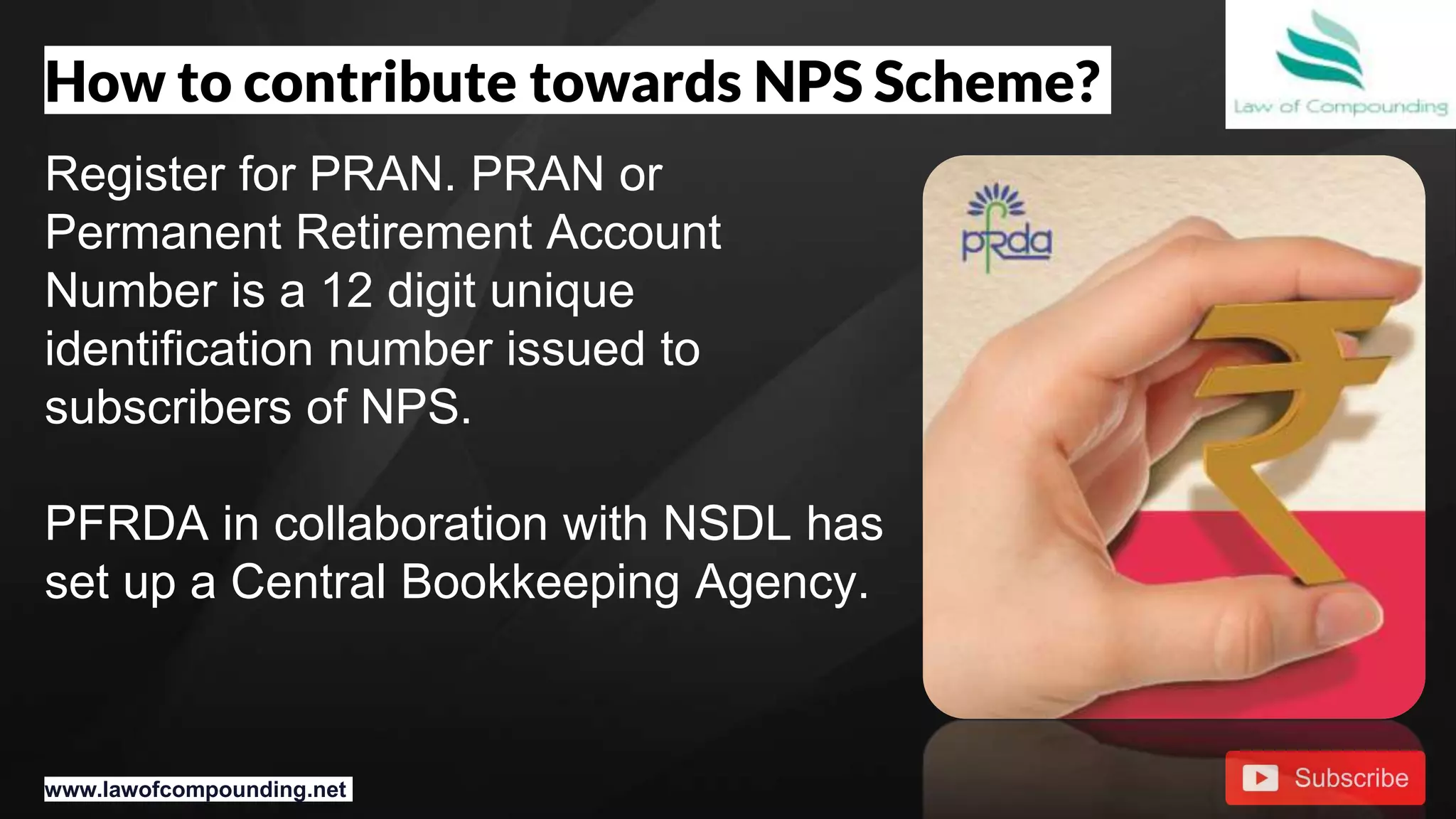
Register for PRAN. PRAN or
Permanent Retirement Account
Number is a 12 digit unique
identification number issued to
subscribers of NPS.
PFRDA in collaboration with NSDL has
set up a Central Bookkeeping Agency.
How to contribute towards NPS Scheme?
www.lawofcompounding.net
-Your PAN card details are needed for issue
of PRAN
-In case you don’t have a PAN card, your
Aadhaar would suffice
-Your bank account details
-Address proof
-Photograph and scanned copies of signature
Documents required for issuing PRAN
www.lawofcompounding.net
THANKS FOR WATCHING
15
/lawofcompounding

What is NPS ? || Benefits || National Pension System ||

  • 1.
  • 2.
    Pension Scheme launchedby Government of India with the following objectives- -To provide old age income -Reasonable market based returns over long run -Extending old age security coverage to all citizens It is based on a unique Permanent Retirement Account Number (PRAN) which is allotted to each Subscriber upon joining NPS. National Pension System (NPS) www.lawofcompounding.net
  • 3.
    Cheapest market linkedretirement plan Excessively less payment of incentive/commission to the intermediaries, it is not getting promoted by them. What is National Pension Scheme? www.lawofcompounding.net
  • 4.
    Only 0.25% ofthe investment is paid to the intermediary as fund management fee. Let us see how this cost is different from the costs of the other leading pension plans. Costs Involved in National Pension Scheme www.lawofcompounding.net
  • 5.
    There are twotypes of accounts that NPS offers: Tier-I Account It is a basic pension account with limitations on withdrawal Tier-II Account It is a voluntary savings option from which a person can withdraw money limitless. Types of National Pension Schemes (NPS): www.lawofcompounding.net
  • 6.
    Types of Fundsin National Pension Scheme www.lawofcompounding.net Class of Fund Invested In Risk Average Return Since Launch (%) E Index based Stocks Carry market risk like any large cap equity fund 3.79% C Bonds issued by State Govt, PSUs and Private Firms Going by the quality of companies, risk would be low. 8.66% G Bonds issued by Central Govt. Lacks default risk but volatility can't be avoided in long term bonds. 5.92% Corpus can be divided among these three fund classes. Exposure to equity cannot be more than 50%. If allocation is not specified, the exposure to various classes, especially equity is decided on the basis of age.
  • 7.
    So with increasingage the investment corpus gets more inclined towards Debt. According to the Age of the Investor www.lawofcompounding.net Age of the Investor Percentage of Investment in Various Classes Up to 35 Years 50% Equity and 50% Debt 40 Years 40% Equity and 60% Debt 45 Years 30% Equity and 70% Debt 50 Years 20% Equity and 80% Debt 55 Years 10% Equity and 90% Debt
  • 8.
    Pros and Consof NPS www.lawofcompounding.net Pros 1. Additional Tax Benefi The Finance Bill 2011-12 permits tax deduction on contribution up to 10 per cent of basic salary and dearness allowance (DA) made by an employer towards the national pension scheme (NPS) account of an employee under Section 80CCE. 1. Additional Tax Benefit. 2. Higher Fee to Intermediaries:
  • 9.
    www.lawofcompounding.net Cons Funds would betaxed at withdrawal. 60 per cent corpus on maturity can be withdrawn while at least 40 per cent has to be used to buy annuity. The proposed Direct Taxes Code (DTC) plans to exempt NPS funds from tax at withdrawal. However, it is uncertain if the DTC would allow tax exemption on returns from annuity plans as well. The tax at withdrawal stands in the way of making NPS the best pension scheme. 1. Tax on Maturity Proceeds:
  • 10.
    Limitation on withdrawalfrom Tier-I account, the primary account for pension savings. On maturity also, one can withdraw only around 60 per cent funds; the rest has to be used to buy annuity, the returns from which are not tax exempted. 2. Mandatory Annuity: www.lawofcompounding.net
  • 11.
    NPS does notoffer any particular interest rate. In general, the NPS Interest rate is anywhere between 12% - 14% interest, which is still on the higher side when taking other investment options into consideration. Interest rates offered by NPS www.lawofcompounding.net
  • 12.
    Subscribers can availthe following NPS Tax Benefits: (i) Tax deductions under Section 80CCE, which states that the total amount of deduction shall not be more than Rs 1 lakh under Section 80CCD and Section 80CCC (ii) Tax deductions under Section 80CCD (2) with regards to contributions made by the Central Government. These tax benefits can only be availed by subscribers with Tier I accounts. Tax Benefits Under NPS www.lawofcompounding.net
  • 13.
    Register for PRAN.PRAN or Permanent Retirement Account Number is a 12 digit unique identification number issued to subscribers of NPS. PFRDA in collaboration with NSDL has set up a Central Bookkeeping Agency. How to contribute towards NPS Scheme? www.lawofcompounding.net
  • 14.
    -Your PAN carddetails are needed for issue of PRAN -In case you don’t have a PAN card, your Aadhaar would suffice -Your bank account details -Address proof -Photograph and scanned copies of signature Documents required for issuing PRAN www.lawofcompounding.net
  • 15.