







PREPARED BY
RAMAKRISHNA DASIGA
rkdasiga@gmail.com, 9030233744
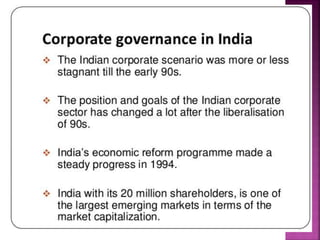
 The Indian Corporate are governed by the
Company’s Act of 1956 that follows more or
less the UK model.
 The pattern of private companies is mostly
that of closely held or dominated by a
founder, his family and associates.
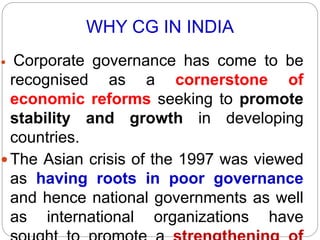
WHY CG IN INDIA
 Corporate governance has come to be
recognised as a cornerstone of
economic reforms seeking to promote
stability and growth in developing
countries.
 The Asian crisis of the 1997 was viewed
as having roots in poor governance
and hence national governments as well
as international organizations have
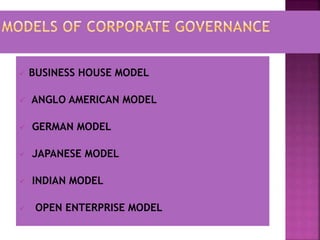
 BUSINESS HOUSE MODEL
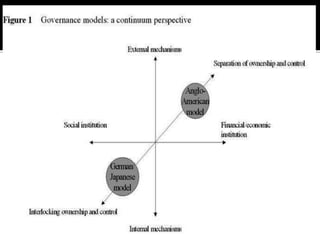
 ANGLO AMERICAN MODEL
 GERMAN MODEL
 JAPANESE MODEL
 INDIAN MODEL
 OPEN ENTERPRISE MODEL
BUSINESS HOUSE MODEL
 In this model the managing agent capitalized on new
business opportunities by promoting new business
ventures.
 The promoters of such ventures became the key
players in Indian’s post-colonial business sector
providing the basis for the emergence of
conglomerates.
 Eg: Birla and Tata groups. They managed to grow and
enter new areas of business.
 A change was triggered in the 1980s, when the
Indian economy was hit by a crisis. So
International Monetary Fund forms millions of
adjustments loans that warranted a
comprehensive reform programme. This led
to a shift from the Business House Model to
Anglo-saxon Model of CG.
ANGLO AMERICAN MODEL
 It is a liberal model of governance in a body corporate.
 shareholders elected the members of the Board of
Directors directly, and
 the Board in turn went on to elect the CEO, giving rise
to a single- tiered system of electing the BOD of a
company, and banks and financial institutions playing
a bare minimum role.
 The protection of shareholder interest is the chief
characteristic of the Anglo-American Model of
Corporate governance and the fundamental principle
behind its existence and global acceptance as the most
favorable Model of governance in a body corporate.
 This model relies on effective communication
between shareholders, board and management
with all important decisions taken after getting
approval of shareholders (by voting).
 There is only less control on foreign
ownership and portfolio investment.
 The firms are allowed to buyback their own
shares in open market operations.
German model
 This is also called as 2 TIER BOARD MODEL as there are 2
boards viz. The SUPERVISORY BOARD and the
MANAGEMENT BOARD.
 It is used in countries like Germany, Holland, France, etc.
 Usually a large majority of shareholders are banks and
financial institutions.
 The shareholder can appoint only 50% of members to
constitute the supervisory board. The rest is appointed by
employees and labour unions.
Japanese model
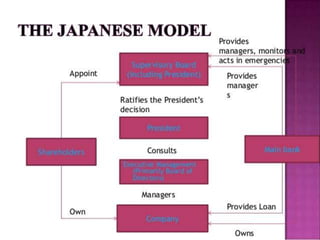
 This model is also called as the business network model.
 usually shareholders are banks/financial institutions, large
family shareholders, corporate with cross-shareholding.
 There is supervisory board which is made up of board of
directors and a president, who are jointly appointed by
shareholder and banks/financial institutions.
 most of the directors are heads of different divisions of the
company
 Outside director or independent directors are rarely found of
the board.
Indian model
 Indian model =Anglo-American + German models.
 This is because in India, there are three types of Corporation
viz. private companies, public companies and public sectors
undertakings.
 Each of these corporation have a distinct pattern of
shareholding.
 e.g. In case of private companies, the promoter and his family
have almost complete control over the company. They depend
less on outside equity capital. Hence in private companies the
German model of corporate governance is followed.
 Diluted principal-agent relationship
 Need for more additional protective measures by market
regulator, ie. SEBI
Open enterprise model
 Goal of enterprise- increase value of share holders
 it demonstrate high standards of integrity, trust,
global stability and social justice.
 it follows four steps run in sequence
 Build foundation of trust through practice of honesty,
accountability and transparency.
 correctness of conduct by reciprocal obligations,
inspiring good values and proper behavior.
 building healthy relationships
 creating values and integrity.
Keys of
Coporate
governance
reforms in India
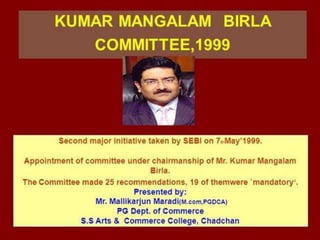
 KUMAR MANGALAM BIRLA COMMITTEE
REPORT [2000]
 NARESH CHANDRA COMMITTEE REPORT
[2002]
 NARAYANA MURTHY COMMITTEE REPORT
[2003]
KUMAR MANGALAM BIRLA COMMITTEE
REPORT [2000] –
• The primary objective of the committee was to view
corporate governance from the perspective of the
investors and shareholders and to prepare a ‘Code’ to
suit the Indian corporate environment.
• The three key constituents, their roles and
responsibilities, their rights in the context of good
corporate governance are recognized by the
committee.
 The Shareholders
 The Board of Directors
 The Management
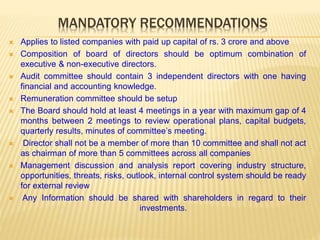
MANDATORY RECOMMENDATIONS
 Applies to listed companies with paid up capital of rs. 3 crore and above
 Composition of board of directors should be optimum combination of
executive & non-executive directors.
 Audit committee should contain 3 independent directors with one having
financial and accounting knowledge.
 Remuneration committee should be setup
 The Board should hold at least 4 meetings in a year with maximum gap of 4
months between 2 meetings to review operational plans, capital budgets,
quarterly results, minutes of committee’s meeting.
 Director shall not be a member of more than 10 committee and shall not act
as chairman of more than 5 committees across all companies
 Management discussion and analysis report covering industry structure,
opportunities, threats, risks, outlook, internal control system should be ready
for external review
 Any Information should be shared with shareholders in regard to their
investments.
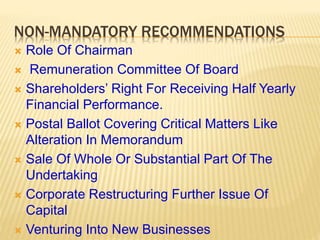
NON-MANDATORY RECOMMENDATIONS
 Role Of Chairman
 Remuneration Committee Of Board
 Shareholders’ Right For Receiving Half Yearly
Financial Performance.
 Postal Ballot Covering Critical Matters Like
Alteration In Memorandum
 Sale Of Whole Or Substantial Part Of The
Undertaking
 Corporate Restructuring Further Issue Of
Capital
 Venturing Into New Businesses
Corporate governance
In the eye of kautilya
 Kautilya’s view regarding governing a
monarchy is equally applicable in
successfully running a corporate sector
in modern business context.
• Strict Corporate Governance can win the
confidence of;
Government ,employees, customers &
other stakeholders
RECOMMENDATIONS:
AUDITOR COMPANY
RELATIONSHIP
AUDTING THE AUDITORS
INDEPENDENT DIRECTORS
OTHER RECOMMENDATIONS
AUDITOR& COMPANYRELATIONSHIP
Certification of annual audited accounts by
CEO & CFO
AUDITINGTHE
There should be established, with
appropriate legislative support, three
independent Quality Review Boards (QRB), one
each for the ICAI, the ICSI and ICWAI, to
periodically examine and review the quality of
audit, secretarial and cost accounting firms,
and pass judgement and comments on the
quality and sufficiency of systems,
infrastructure and practices.
SETTING UP THE
INDEPENDENT QUALITY
REVIEW BOARD
Proposed disciplinary
mechanism for the auditors:
Dealing with the complaint cases
Disciplinary committee framed by ICAI
Publication of the punishment
awarded
Funding
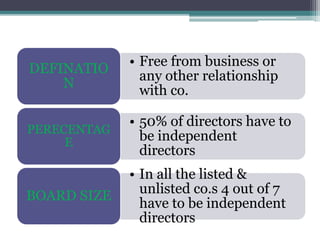
• Free from business or
any other relationship
with co.
DEFINATIO
N
• 50% of directors have to
be independent
directors
PERECENTAG
E
• In all the listed &
unlisted co.s 4 out of 7
have to be independent
directors
BOARD SIZE
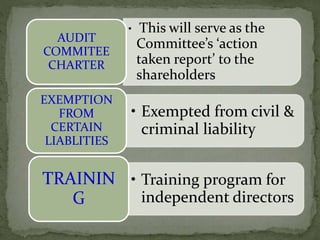
• This will serve as the
Committee’s ‘action
taken report’ to the
shareholders
AUDIT
COMMITEE
CHARTER
• Exempted from civil &
criminal liability
EXEMPTION
FROM
CERTAIN
LIABLITIES
• Training program for
independent directors
TRAININ
G
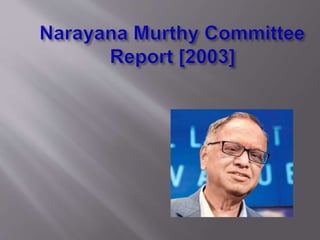
The Committee on Corporate
Governance was constituted by
SEBI, to evaluate the existing
corporate governance practices
and to improve these practices
as the standards themselves
were evolving with market
dynamics.
THE KEY MANDATORY
RECOMMENDATIONS FOCUS ON
 Strengthening the responsibilities of audit committees
 Improving the quality of financial disclosures,
including those related to related party transactions.
 Proceeds from initial public offerings
 Requiring corporate executive boards to assess and
disclose business risks in the annual reports of
companies.
 Should be obligatory for the Board of a company to lay
down the code of conduct for all Board members and
senior management of a company.
 The position of nominee directors
 Improved disclosures relating to compensation paid to
non-executive directors.
 Improved disclosures relating to compensation paid
to non-executive directors.
Non-mandatory recommendations include
moving to a regime where corporate financial
statements are not qualified; instituting a system
of training of board members; and the evaluation
of performance of board members.
Whistle Blower Policy: Personnel who observe an
unethical or improper practice should be able to
approach the audit committee without
necessarily informing their superiors.

Indian cg

  • 1.
  • 2.
     The IndianCorporate are governed by the Company’s Act of 1956 that follows more or less the UK model.  The pattern of private companies is mostly that of closely held or dominated by a founder, his family and associates.
  • 3.
    WHY CG ININDIA  Corporate governance has come to be recognised as a cornerstone of economic reforms seeking to promote stability and growth in developing countries.  The Asian crisis of the 1997 was viewed as having roots in poor governance and hence national governments as well as international organizations have
  • 6.
     BUSINESS HOUSEMODEL  ANGLO AMERICAN MODEL  GERMAN MODEL  JAPANESE MODEL  INDIAN MODEL  OPEN ENTERPRISE MODEL
  • 7.
    BUSINESS HOUSE MODEL In this model the managing agent capitalized on new business opportunities by promoting new business ventures.  The promoters of such ventures became the key players in Indian’s post-colonial business sector providing the basis for the emergence of conglomerates.  Eg: Birla and Tata groups. They managed to grow and enter new areas of business.
  • 8.
     A changewas triggered in the 1980s, when the Indian economy was hit by a crisis. So International Monetary Fund forms millions of adjustments loans that warranted a comprehensive reform programme. This led to a shift from the Business House Model to Anglo-saxon Model of CG.
  • 9.
    ANGLO AMERICAN MODEL It is a liberal model of governance in a body corporate.  shareholders elected the members of the Board of Directors directly, and  the Board in turn went on to elect the CEO, giving rise to a single- tiered system of electing the BOD of a company, and banks and financial institutions playing a bare minimum role.  The protection of shareholder interest is the chief characteristic of the Anglo-American Model of Corporate governance and the fundamental principle behind its existence and global acceptance as the most favorable Model of governance in a body corporate.
  • 10.
     This modelrelies on effective communication between shareholders, board and management with all important decisions taken after getting approval of shareholders (by voting).  There is only less control on foreign ownership and portfolio investment.  The firms are allowed to buyback their own shares in open market operations.
  • 12.
    German model  Thisis also called as 2 TIER BOARD MODEL as there are 2 boards viz. The SUPERVISORY BOARD and the MANAGEMENT BOARD.  It is used in countries like Germany, Holland, France, etc.  Usually a large majority of shareholders are banks and financial institutions.  The shareholder can appoint only 50% of members to constitute the supervisory board. The rest is appointed by employees and labour unions.
  • 14.
    Japanese model  Thismodel is also called as the business network model.  usually shareholders are banks/financial institutions, large family shareholders, corporate with cross-shareholding.  There is supervisory board which is made up of board of directors and a president, who are jointly appointed by shareholder and banks/financial institutions.  most of the directors are heads of different divisions of the company  Outside director or independent directors are rarely found of the board.
  • 15.
    Indian model  Indianmodel =Anglo-American + German models.  This is because in India, there are three types of Corporation viz. private companies, public companies and public sectors undertakings.  Each of these corporation have a distinct pattern of shareholding.  e.g. In case of private companies, the promoter and his family have almost complete control over the company. They depend less on outside equity capital. Hence in private companies the German model of corporate governance is followed.  Diluted principal-agent relationship  Need for more additional protective measures by market regulator, ie. SEBI
  • 16.
    Open enterprise model Goal of enterprise- increase value of share holders  it demonstrate high standards of integrity, trust, global stability and social justice.  it follows four steps run in sequence  Build foundation of trust through practice of honesty, accountability and transparency.  correctness of conduct by reciprocal obligations, inspiring good values and proper behavior.  building healthy relationships  creating values and integrity.
  • 17.
  • 18.
     KUMAR MANGALAMBIRLA COMMITTEE REPORT [2000]  NARESH CHANDRA COMMITTEE REPORT [2002]  NARAYANA MURTHY COMMITTEE REPORT [2003]
  • 20.
    KUMAR MANGALAM BIRLACOMMITTEE REPORT [2000] – • The primary objective of the committee was to view corporate governance from the perspective of the investors and shareholders and to prepare a ‘Code’ to suit the Indian corporate environment. • The three key constituents, their roles and responsibilities, their rights in the context of good corporate governance are recognized by the committee.  The Shareholders  The Board of Directors  The Management
  • 21.
    MANDATORY RECOMMENDATIONS  Appliesto listed companies with paid up capital of rs. 3 crore and above  Composition of board of directors should be optimum combination of executive & non-executive directors.  Audit committee should contain 3 independent directors with one having financial and accounting knowledge.  Remuneration committee should be setup  The Board should hold at least 4 meetings in a year with maximum gap of 4 months between 2 meetings to review operational plans, capital budgets, quarterly results, minutes of committee’s meeting.  Director shall not be a member of more than 10 committee and shall not act as chairman of more than 5 committees across all companies  Management discussion and analysis report covering industry structure, opportunities, threats, risks, outlook, internal control system should be ready for external review  Any Information should be shared with shareholders in regard to their investments.
  • 22.
    NON-MANDATORY RECOMMENDATIONS  RoleOf Chairman  Remuneration Committee Of Board  Shareholders’ Right For Receiving Half Yearly Financial Performance.  Postal Ballot Covering Critical Matters Like Alteration In Memorandum  Sale Of Whole Or Substantial Part Of The Undertaking  Corporate Restructuring Further Issue Of Capital  Venturing Into New Businesses
  • 24.
    Corporate governance In theeye of kautilya  Kautilya’s view regarding governing a monarchy is equally applicable in successfully running a corporate sector in modern business context. • Strict Corporate Governance can win the confidence of; Government ,employees, customers & other stakeholders
  • 25.
    RECOMMENDATIONS: AUDITOR COMPANY RELATIONSHIP AUDTING THEAUDITORS INDEPENDENT DIRECTORS OTHER RECOMMENDATIONS
  • 26.
    AUDITOR& COMPANYRELATIONSHIP Certification ofannual audited accounts by CEO & CFO
  • 27.
  • 28.
    There should beestablished, with appropriate legislative support, three independent Quality Review Boards (QRB), one each for the ICAI, the ICSI and ICWAI, to periodically examine and review the quality of audit, secretarial and cost accounting firms, and pass judgement and comments on the quality and sufficiency of systems, infrastructure and practices. SETTING UP THE INDEPENDENT QUALITY REVIEW BOARD
  • 29.
    Proposed disciplinary mechanism forthe auditors: Dealing with the complaint cases Disciplinary committee framed by ICAI Publication of the punishment awarded Funding
  • 31.
    • Free frombusiness or any other relationship with co. DEFINATIO N • 50% of directors have to be independent directors PERECENTAG E • In all the listed & unlisted co.s 4 out of 7 have to be independent directors BOARD SIZE
  • 32.
    • This willserve as the Committee’s ‘action taken report’ to the shareholders AUDIT COMMITEE CHARTER • Exempted from civil & criminal liability EXEMPTION FROM CERTAIN LIABLITIES • Training program for independent directors TRAININ G
  • 34.
    The Committee onCorporate Governance was constituted by SEBI, to evaluate the existing corporate governance practices and to improve these practices as the standards themselves were evolving with market dynamics.
  • 35.
    THE KEY MANDATORY RECOMMENDATIONSFOCUS ON  Strengthening the responsibilities of audit committees  Improving the quality of financial disclosures, including those related to related party transactions.  Proceeds from initial public offerings  Requiring corporate executive boards to assess and disclose business risks in the annual reports of companies.  Should be obligatory for the Board of a company to lay down the code of conduct for all Board members and senior management of a company.  The position of nominee directors  Improved disclosures relating to compensation paid to non-executive directors.  Improved disclosures relating to compensation paid to non-executive directors.
  • 36.
    Non-mandatory recommendations include movingto a regime where corporate financial statements are not qualified; instituting a system of training of board members; and the evaluation of performance of board members. Whistle Blower Policy: Personnel who observe an unethical or improper practice should be able to approach the audit committee without necessarily informing their superiors.