Presented by-Deepak khandelwal
CorporateA corporation is an organization created (incorporated) by a group of shareholders who have ownership of the corporation.
The elected board of directors appoint and oversee management of the corporation .governanceOxford English dictionary  defines “governance "as the act, manner , fact or function of governing sway control.
The word has Latin origins that suggest the notion of “steering". it deals with the processes and systems by which an organization or society operates.
Governance can be used with reference to all kind of organizational structure e.g.
Ngo –not for profit organization
Municipal corporation /gram panchyat
Central/state government
Partnership firmCorporate governanceIt is a broad concept and has been defined and understood differently  by different groups and at different points of time .
The Cadbury committee report defines it as “the system by which companies are directed and controlled”.
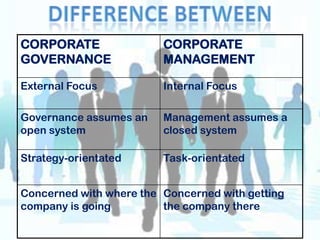
It is generally understood as the framework of rules, relationships, systems and processes  within and by which authority  is exercised and controlled in corporations” Difference between
Brief history of corporate governance in IndiaUnlike South-East and East Asia, the corporate governance initiative in India was not triggered by any serious nationwide financial, banking and economic collapseThe initiative in India was initially driven by an industry association, the Confederation of Indian IndustryIn December 1995, CII set up a task force to design a voluntary code of corporate governance.The final draft of this code was widely circulated in 1997.In April 1998, the code was released. It was called Desirable Corporate Governance: A Code.Between 1998 and 2000, over 25 leading companies voluntarily followed the code: Bajaj Auto, Hindalco, Infosys, Dr. Reddy’s Laboratories, Nicholas Piramal, Bharat Forge, BSES, HDFC, ICICI and many others
Brief history of corporate governance in IndiaFollowing CII’s initiative, the Securities and Exchange Board of India (SEBI) set up a committee under Kumar Mangalam Birla to design a mandatory-cum-recommendatory code for listed companiesThe Birla Committee Report was approved by SEBI in December 2000Became mandatory for listed companies through the listing agreement, and implemented according to a rollout plan:2000-01: All Group A companies of the BSE or those in the S&P CNX Nifty index… 80% of market cap.2001-02: All companies with paid-up capital of Rs.100 million or more or net worth of Rs.250 million or more.2002-03: All companies with paid-up capital of Rs.30 million or more
Brief history of corporate governance in IndiaFollowing CII and SEBI, the Department of Company Affairs (DCA) modified the Companies Act, 1956 to incorporate specific corporate governance provisions regarding independent directors and audit committees.In 2001-02, certain accounting standards were modified to further improve financial disclosures. These were:Disclosure of related party transactions.Disclosure of segment income: revenues, profits and capital employed.Deferred tax liabilities or assets. Consolidation of accounts.Initiatives are being taken to (i) account for ESOPs, (ii) further increase disclosures, and (iii) put in place systems that can further strengthen auditors’ independence.
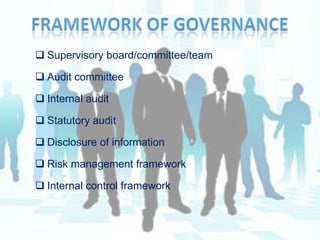
FRAMEWORK OF GOVERNANCESupervisory board/committee/team
Audit committee
Internal audit
Statutory audit
Disclosure of information
Risk management framework
Internal control frameworkOBJECTIVES OF GOOD CORPORATE GOVERNANCESStrengthen management oversight functions and accountability.
Balance skills, experience and independence on the board appropriate to the nature and extent of company operations.
Establish a code to ensure integrity.
Safeguard the integrity of company reporting.

Corporate governence final

  • 1.
  • 2.
    CorporateA corporation isan organization created (incorporated) by a group of shareholders who have ownership of the corporation.
  • 3.
    The elected boardof directors appoint and oversee management of the corporation .governanceOxford English dictionary defines “governance "as the act, manner , fact or function of governing sway control.
  • 4.
    The word hasLatin origins that suggest the notion of “steering". it deals with the processes and systems by which an organization or society operates.
  • 5.
    Governance can beused with reference to all kind of organizational structure e.g.
  • 6.
    Ngo –not forprofit organization
  • 7.
  • 8.
  • 9.
    Partnership firmCorporate governanceItis a broad concept and has been defined and understood differently by different groups and at different points of time .
  • 10.
    The Cadbury committeereport defines it as “the system by which companies are directed and controlled”.
  • 11.
    It is generallyunderstood as the framework of rules, relationships, systems and processes within and by which authority is exercised and controlled in corporations” Difference between
  • 12.
    Brief history ofcorporate governance in IndiaUnlike South-East and East Asia, the corporate governance initiative in India was not triggered by any serious nationwide financial, banking and economic collapseThe initiative in India was initially driven by an industry association, the Confederation of Indian IndustryIn December 1995, CII set up a task force to design a voluntary code of corporate governance.The final draft of this code was widely circulated in 1997.In April 1998, the code was released. It was called Desirable Corporate Governance: A Code.Between 1998 and 2000, over 25 leading companies voluntarily followed the code: Bajaj Auto, Hindalco, Infosys, Dr. Reddy’s Laboratories, Nicholas Piramal, Bharat Forge, BSES, HDFC, ICICI and many others
  • 13.
    Brief history ofcorporate governance in IndiaFollowing CII’s initiative, the Securities and Exchange Board of India (SEBI) set up a committee under Kumar Mangalam Birla to design a mandatory-cum-recommendatory code for listed companiesThe Birla Committee Report was approved by SEBI in December 2000Became mandatory for listed companies through the listing agreement, and implemented according to a rollout plan:2000-01: All Group A companies of the BSE or those in the S&P CNX Nifty index… 80% of market cap.2001-02: All companies with paid-up capital of Rs.100 million or more or net worth of Rs.250 million or more.2002-03: All companies with paid-up capital of Rs.30 million or more
  • 14.
    Brief history ofcorporate governance in IndiaFollowing CII and SEBI, the Department of Company Affairs (DCA) modified the Companies Act, 1956 to incorporate specific corporate governance provisions regarding independent directors and audit committees.In 2001-02, certain accounting standards were modified to further improve financial disclosures. These were:Disclosure of related party transactions.Disclosure of segment income: revenues, profits and capital employed.Deferred tax liabilities or assets. Consolidation of accounts.Initiatives are being taken to (i) account for ESOPs, (ii) further increase disclosures, and (iii) put in place systems that can further strengthen auditors’ independence.
  • 15.
  • 16.
  • 17.
  • 18.
  • 19.
  • 20.
  • 21.
    Internal control frameworkOBJECTIVESOF GOOD CORPORATE GOVERNANCESStrengthen management oversight functions and accountability.
  • 22.
    Balance skills, experienceand independence on the board appropriate to the nature and extent of company operations.
  • 23.
    Establish a codeto ensure integrity.
  • 24.
    Safeguard the integrityof company reporting.