1
INDIA AND SOUTHEAST ASIA
ART 102 Gardners - Chapter 25 and 26
Jean Thobaben
Instructor
The Art of South and Southeast Asia
The Art of China and Korea
BURMA Asian Art
The Art of Thailand
Art of India
An introduction to Later Asian Art
CHINA
KOREA
Spirituality and Power:
• In later periods, Indian and Southeast Asian peoples
experienced various cultural, political, and artistic changes.
• In India, Buddhism neared extinction, Islam grew, and
Hinduism maintained popularity while politically in retreat.
• The British were present in India from the sixteenth century
until 1947.
• In Southeast Asia, there were also major shifts in the
wielding of political power and in religious affiliations.
• Thai, Vietnamese, and Burmese expansions led to the
cultural, political, and artistic transformation of mainland
Southeast Asia.
3
India
• India is the home of the Hindu, Buddhism and Jain
religions.
• As Buddhism spread to East Asia, Indian iconography
and styles of art also had a profound impact on those
culture.
• Muslim traders and merchants began arriving in India
through the Northwest mountain passes as early as the
8th century, but it was not until the 12th century that
Muslim rulers, backed by armies, gained control of India.
4
Hindu Art and Hinduism
• Hinduism originated in northern India and
spread to the south and later to the
mainland of Southeast Asia and Indonesia.
• The religion has no founder but developed
over a period of centuries out of India's
various pantheistic cults.
• Nor is it based on a single text.
• There are countless writings, tales, myths
and legends.
India, Tamil Nadu, Standing Parvati, Chola period (880-
1279), c. first quarter of the 10th century, copper alloy,
height 27 3/8 inches (69.5 cm), Metropolitan Museum of Art,
NY.
5
• One key feature of
Hinduism is the notion that
all living beings form part of
an eternal cycle of
reincarnations from which
humanity can only break free
with immense effort.
• The existence of the world is
also seen as part of this
cycle. Creation came about,
it exists and it will once more
be destroyed.
• In the course of time a new
world era will dawn again.
This process continues
throughout eternity.
India or Bangladesh, West Bengal,
The Goddess Durga Killing the Buffalo
Demon, Mahisha , Pala period
(c. 750-1200), 12th century, mudstone,
height 5 5/16 inches (13.5 cm),
Metropolitan Museum of Art, NY.
The multiple arms are a
popular convention in
Hindu art.
Each arm holds a
different attribute related
to the diety.
6
• Three gods are
central in Hinduism:
Brahma, Shiva and
Vishnu.
• They form a divine
trinity. Of these, it is
Vishnu who
preserves creation
and Shiva who is the
destroyer.
• The Hindu divinities
are worshipped both
in temples and in the
home.
India, c. 950, Siva as the Lord of Dance
(Nataraja), copper alloy, 30 x 22 1/2 x 7 inches
Los Angeles County Museum of Art.
7
• The youthful Krishna--an
incarnation of the supreme
Hindu god Vishnu--is shown
dancing, as he did after
being attacked by the
serpent Kaliya, whom he
subdued without a struggle.
• This image was made to be
carried in processions on
festival days in southern
India.
Krishna, India, Tamil Nadu, Chola dynasty,
late tenth century
Bronze, height 14 1/8 ins
Walters Art Gallery
8
An ancient god
whose authority was
derived from the
Vedas (the
scriptures of the
ancient Aryans),
Brahma retained his
importance as the
creator in Hinduism,
although no cult
comparable in size
to those of Vishnu
and Shiva
developed around
him. Brahma, 10th century A.D.
Granite with traces of gesso and red pigment,
Worcester Art Museum
Looking at the four directions, the four
faces of Brahma symbolize the four Vedas
as well as the cardinal points of the
compass.
Two of the image's four original arms are
now lost. The missing upper hand probably
made the gesture of reassurance, while the
lower one held a lotus.
The upper left hand holds and counts a
rosary; the lower left, now empty, may have
held a pot containing the water from which
the universe was created.
9
• The Hindu god of
auspiciousness,
Ganesha is popularly
accepted as the first son
of Shiva and Parvati.
• As the deity who controls
obstacles—their
invention and removal—
he is worshiped before
any serious undertaking.
• This seated four-armed
Ganesha holds one of his
tusks, two entwined snakes,
an elephant goad, and a box
of sweets, which he tastes
with his trunk.
• The broken tusk in his lower
left hand is a reference to
another well-known tale in
which the portly Ganesha
hurls a tusk at the moon in
retaliation for its amusement
at witnessing his stomach
burst from overeating.
Seated Ganesha, 14th–15th century,
Orissa, India, Ivory; H. 7 1/4 in x
W. 4 3/4 in. Metropolitan Museum if Art,
10
• A Hindu temple was often
envisioned as the world's
central axis, in the form of a
mountain inhabited by a god.
The temple itself was
therefore worshiped.
• This was done by
circumambulation,walking
around the exterior, and by
viewing its small inner
sanctum.
• The outside of the temple
was usually covered with
myriad reliefs
• From early times iconic
representations of deities and holy
figures were augmented by
auspicious images, such as
beautiful women, musicians, and
loving couples (mithunas)
• Couples such as this pair are
understood to have multiple
meanings, ranging from an obvious
celebration of life's pleasures to the
more metaphorical symbolism of a
human soul's longing for union with
the divine.
Loving couple (mithuna), Eastern Ganga dynasty,
13th century, Orissa, India, Ferruginous
stone; H. 72 in.,Metropolitan Museum.
11
• Hidimba Devi temple
stands in the midst of a
sacred cedar forest near the
town of Dunghri at the
verdant foot of the Himalaya
mountains.
• The sanctuary is built over an
enormous rock that juts out
of the ground, worshipped as
a manefestation of Durga,
the "Hill Mother" or goddess
of the earth.
• The temple was constructed
in 1553 by Maharaja
Bahadur Singh.
• The Hidimba Devi temple is 24
meters tall and consists of three
square roofs clad in timber tiles,
surmounted by a cone-shaped
fourth roof that is covered in
brass.
• The interior of the temple is
occupied by the large rock and
contains no usuable space except
for the ground floor.
• The base of the temple is made of
whitewashed mud-covered
stonework. The main doorway
includes an elaborately carved
wooden entrance that is believed
to be over 400 years old.
Hidimba Devi Temple
(1553 and later)
12
13
• The Mahabodhi temple at
Bodhgaya is located on the
spot where the Buddha
attained enlightenment.
• The temple's principle relic is
a distant descendant of the
Bo tree under which the
Buddha sat when his
enlightenment took place.
• The site, having been sacred
to Buddhists since the
earliest days of the faith, is of
unknown antiquity.
• Elements of the temple date
from the 3rd century BC.
• The enormous central tower
(55 m tall) is a 19th century
renovation faithful to the
earlier towers that existed
on the site.
• The tower comprises
numerous horizontal bands
of moldings and arch motifs
that extend upward to an
amalaka topped by
umbrella-shaped forms,
recalling the umbrella motifs
found at Buddhist stupas.
14
• The Hindu Nayak rulers
in south India during
the seventeenth and
eighteenth centuries
oversaw construction of
some of the largest
temple complexes in
India.
• The builders expanded
the temples outward by
erecting ever-larger
enclosure walls with
monumental gopuras.
• Late temples also typically
include numerous large
mandapas and great water tanks.
• Such temples continue to
sponsor many yearly festivals,
attended by thousands of
pilgrims, worshipers, merchants,
and priests.
Great Temple, Madurai, India,
seventeenth century.
15
Detail, Great Temple, Madurai, India, seventeenth century.
16
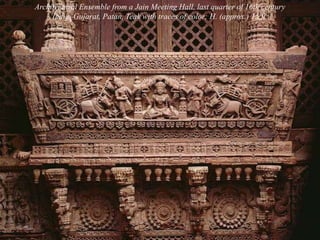
• The next slide shows a section of a
carved wooden dome with miniature
balconies and supports that once
crowned a meeting hall in a Jain temple
in Gujarat.
• The carvings symbolize the splendors of
the celestial realms that all Jains hope to
attain eventually by accruing merit in
their successive lives.
• Every surface of the teak has been
carved with figures, whose size
indicates their importance, and with
animal and floral forms.
The large figures
represent the rulers of
the eight cosmic
directions, who are
responsible for the
orderly working of the
universe and for the
protection of the
temple and its
worshippers.
17
18
Architectural Ensemble from a Jain Meeting Hall, last quarter of 16th century
India, Gujarat, Patan, Teak with traces of color; H. (approx.) 15 ft.
19
Mughal Art in India
• The Islamic dynasty in
India, composed of
nineteen sovereigns who
ruled from 1526 to 1858.
• Many of India's greatest
works of art and
architecture were
produced during the
Mughal period.
The Taj Mahal, 1630 to 1653,
Islamic Tomb, Agra, India
20
It was Shah Jahan (reigned 1627-1658) who built the Taj Mahal as a tomb garden for
his wife, establishing it as the greatest creation of the Mughal dynasty.
21
• The Charminar (Four
Minarets) is striking monument
set in the heart of Hyderabad.
• It was constructed by
Muhammad Quli (1580-1612),
the founder of Hyderabad,
who built the monument to
mark the intersection of the
city's four major roads.
• This unusual building--part
triumphal arch, part mosque--
stands over 55 meters tall and
30 wide. -lower stories
accommodate 4 large arches,
above which is a small
elevated mosque.
22
23
• Next is a "pan-dan," or box, used to
hold pan-rolled betel leaf stuffed with
betel nut, lime paste, and spices.
• The native Hindu custom of eating betel
leaves (to aid digestion and freshen the
breath) was introduced at the Mughal
court in the seventeenth century by
palace ladies, probably Hindu wives of
the Mughal rulers.
Four artisans
collaborated to make
this box: a molder who
created the shape using
the lost-wax technique;
an etcher who drew the
designs on the surface;
an engraver who
chiseled out the areas
around the designs; and
an inlayer who applied
the silver and brass.
The surface was then
blackened to enhance
the beauty of the inlay,
used here to define the
duck's various feathers.
Pan box in the shape of a duck, late 17th–early
18th century, Deccan, India, Tin alloy inlaid with
silver and brass (Bidri ware); H. 5 5/8 in; D. 4 1/2 in. ;
L. 7 1/4 in.
Metropolitan Museum of Art, NY.
24
• Bidri ware, named for
the Deccani city of Bidar,
is a uniquely Indian alloy
of four metals, the main
component of which is
zinc.
• An acid bath renders the
base material very dark,
enhancing its suitability
to set off the contrasting
inlay metals.
With a shape
reminiscent
of tombs of
the Sultanate
Period and
decoration
that is lyrically
Persianate in
style, this box
is probably
one of the
oldest
surviving
examples of
bidri ware.
Box with lid, late 16th century, India, the Deccan (Bidar)
Metal alloy inlaid with brass and silver; H. 3 3/4 in. x W. 5 3/8 in.
25
• With the exception of the palm trees, the landscape
elements, animals, and birds in this grand carpet are taken
from contemporaneous Persian art.
• The repeating full-width pattern unit of the field, reversed
every time it appears, is reminiscent of woven textile design.
• The border, decorated in the "silhouette style," in which floral
motifs of one color appear against a field without outlines, is
closely related to book illumination and to architectural
decorations in manuscript paintings that were also done by
illuminators.
Carpet with pictorial design, late 16th–early 17th century; Mughal Pakistan (Lahore)
Wool pile on cotton foundation; L. 27 ft. 4 in. (833 cm), W. 9 ft. 6 in
26
Indian Painting
• The early tradition of Indian painting is
almost entirely lost due to the
impermanence of the materials.
Krishna
Carried Off by
the Whirlwind
Demon,
from a
Bhagavata
Purana
(Book of the
Lord)
India, Delhi–
Agra , ca. 1520–
30
Opaque
watercolor on
paper.
27
• The pre-Mughal style is represented by a group of
manuscripts and individual paintings often referred to as the
"Chaurapanchasika" group, after a Sanskrit manuscript of
lyric love poems.
• A small group of rare illustrated manuscripts datable from
around 1515 to 1575 has been associated with this style.
• One of these manuscripts, perhaps as well known as the one
for which the series was named, is an illustrated excerpt from
the great Hindu epic, the "Bhagavata Purana" (Ancient
Story of God).
• The page seen next displays the bold patterning, large areas
of contrasting flat colors, and sense of two-dimensionality
common to the illustrations in this manuscript. It is one of the
more lively and accomplished of the set.
28
Krishna Battles the Armies of the Demon Naraka: Page from a Dispersed Bhagavata
Purana (Ancient Stories of Lord Vishnu), ca. 1520–30; Chaurapanchasika m Metropolitan
29
• The clarity of the
composition—the strong crisp
lines depicting Yama's
voluminous physique and the
luxuriant flames encircling
him—and the hint of recession
in the background suggest a
date in the mid-seventeenth to
early eighteenth century for
this piece.
• Yama is the Indian god of
death who was tamed by the
Bodhisattva Manjushri.
• In later Buddhist traditions he
became a protector of the
religion and its adherents.
• In later Buddhist traditions,
Yama became a protector
of the religion and its
adherents.
• He carries a thunderbolt
chopper and skull, and
wears a tiger skin, jewelry,
and a garland of severed
human skulls.
Yama, mid-17th–early 18th century,
Tibet, Distemper on cloth; 72 3/8 x
46 5/8 in, Metropolitan Museum, NY.
30
• In the next painting, Krishna, the blue god, has stolen the
clothes—or in this case, the cholis (blouses)—of the gopis
as they frolic in a stream. (Gopis are female cowherds, the
companions and lovers of Krishna.)
• The gopis in the center have recognized their fate and
stand naked before him—a metaphorical reference to the
openness before god necessary for salvation.
• The ground plane has been tilted back to create a sense of
spatial recession, establishing a foreground, middle ground,
and background.
The Gopis Beseech Krishna to Return Their Clothing: Page from the Dispersed "Isarda"
Bhagavata Purana (Ancient Stories of Lord Vishnu), ca. 1560–65, India,
probably Delhi-Agra areaInk and opaque watercolor on paper; 7 5/8 x 10 1/8 in.
31
• Only Indian paintings from the 15th and 16th
centuries
or later have survived in any numbers.
• Viewers usually kept Indian paintings as books or
albums. Indian paintings after the thirteenth
century are divided into several schools,
including Mughal and Rajput.
• The Hindu kings and their courts in Rajasthan
and the Punjab Hills patronized Rajput painting.
• The Mughal emperors commissioned Mughal
paintings.
32
• The Mughal court,
especially under Akbar,
Jahangir, and Shah Jahan,
lavishly patronized the arts.
• The artist Bichitr (active
early 17th century to late
1650s) painted a Portrait of
Jahangir seated on an
hourglass throne.
Bichitr, Jahangir Preferring a Sufi Shaikh to
Kings, Mughal painting, India, ca. 1615–1618.
Opaque watercolor on paper, 1' 6"-7/8" x 1' 1".
Freer Gallery of Art, Washington.
33
• The Hamzanama tells the
fantastic story of Hamza, an
uncle of the Prophet, who
traveled the world spreading
the teachings of Islam.
• The story was a popular
subject for public recitation
in coffeehouses, so exciting
and full of fantastic elements
were the tales.
• The emperor Akbar
commissioned an illustrated
version of the manuscript
consisting of 1,400 large
illustrations.
• In this painting,
Zambur, a spy,
brings a maid
named Mahiya to
town on a donkey.
The Spy Zambur Brings Mahiya to
Tawariq, Where They Meet Ustad
Khatun: Page from the Hamzanama
(Adventures of Hamza) ca. 1570;
Mughal India, Ink, colors, and gold
on cotton; H. 29 1/8 in.
W. 22 1/2 in.
34
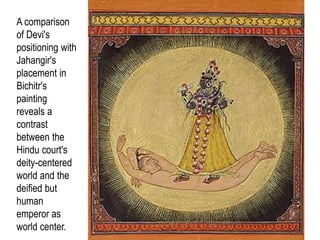
• The bold areas of color,
stylized figures, and flat
picture plane of a work
produced in Basohli, a
Hindu court in the Punjab
Hills, contrast markedly
with the Mughal work's
realism.
• The painting,
accompanied by a
poetic stanza, depicts
Bhadrakali as the force
activating the world
matter.
Bhadrakali within the Rising Sun, folio 10
from the Tantric Devi series, from Punjab Hills,
Basohli, India, ca. 1660–1670. Opaque
watercolor, gold, silver, and beetle-wing cases
on paper, 9-3/4" x 8-1/4".
35
A comparison
of Devi's
positioning with
Jahangir's
placement in
Bichitr's
painting
reveals a
contrast
between the
Hindu court's
deity-centered
world and the
deified but
human
emperor as
world center.
36
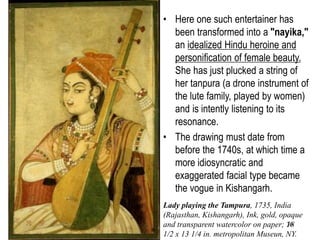
• The Kishangarh atelier is
renowned not only for
paintings but also for large-
scale drawings that were
tinted and highly finished.
Images of women drinking
wine, holding flowers, or
playing instruments became a
popular genre in Rajasthani
painting during the first half of
the eighteenth century.
• They evolved from imperial
Mughal depictions of large
concert parties in which
female entertainers served an
auxiliary function.
• Here one such entertainer has
been transformed into a "nayika,"
an idealized Hindu heroine and
personification of female beauty.
She has just plucked a string of
her tanpura (a drone instrument of
the lute family, played by women)
and is intently listening to its
resonance.
• The drawing must date from
before the 1740s, at which time a
more idiosyncratic and
exaggerated facial type became
the vogue in Kishangarh.
Lady playing the Tampura, 1735, India
(Rajasthan, Kishangarh), Ink, gold, opaque
and transparent watercolor on paper; 18
1/2 x 13 1/4 in. metropolitan Museun, NY.
37
• A popular topic for Punjab
Hill paintings involved
Krishna, an avatar of Vishnu,
and the cowherd's many
amorous adventures.
• Krishna and his favorite lover
sit in a lush garden at night.
• The realism of this picture
relates stylistically to the
Mughal tradition.
• The love between Krishna
and Radha, told in the
poem Song of the
Herdsman, is a model for
the love devotees felt for
the deity.
Krishna and Radha in a Pavilion,
from Punjab Hills, Kangra(?), India,
ca. 1760. Opaque watercolor on paper,
11-1/8" x 7-3/4".
National Museum,
New Delhi.
38
• The maharaja Jaswant
Singh ruled Jodhpur in
Rajasthan when the British
controlled India.
• By this time, India's rulers
and citizenry had been
involved in adapting to
Western culture and ideas.
• Although the maharaja
posed like a British
gentleman in his sitting room,
his regal presence and pride
are clear.
• The two necklaces he
wears exemplify the
combination of his two
worlds, traditional and
Western-influenced.
• The interest in realism in
Indian paintings reached a
climax in works such as this
portrait, which was copied
from a photograph.
Maharaja Jaswant Singh of Marwar,
from Jodhpur, India, ca. 1880. Opaque
watercolor on paper,
1' 3-1/2" x 11-5/8".
The Brooklyn Museum
39
40
Thailand
• Two prominent Buddhist kingdoms, Sukhothai and Ayuthaya,
came to power in Thailand during the thirteenth and early
fourteenth centuries.
• The art produced at Sukhothai set a standard for Thai art to the
present.
41
• Wat Mahathat was the city's most important Buddhist monastery.
• The central monument, a stupa, although not a circular
mound, housed a relic of the Buddha.
• A central lotus-bud tower and eight surrounding towers stand on the
stupa's
lower
podium.
42
• Only a small portion of the brick structure's stucco decoration
remains.
• The halls in front do not survive, but the stone pillars still stand.
• Two monumental standing Buddha images flank the stupa, each
enclosed in a brick building.
Wat Mahathat, Sukhothai, Thailand, fourteenth century.
43
• The Sukhothai
Buddha images were
the city's crowning
artistic achievement.
• In the unique
Sukhothai walking-
Buddha statuary type
the artists intended to
express the Buddha's
beauty and perfection.
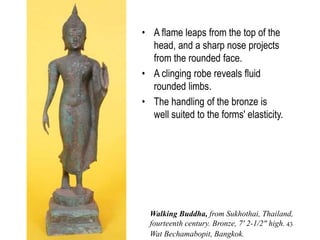
• A flame leaps from the top of the
head, and a sharp nose projects
from the rounded face.
• A clinging robe reveals fluid
rounded limbs.
• The handling of the bronze is
well suited to the forms' elasticity.
Walking Buddha, from Sukhothai, Thailand,
fourteenth century. Bronze, 7' 2-1/2" high.
Wat Bechamabopit, Bangkok.
44
• The Sukhotai
walking-Buddha
statuary type does
not occur elsewhere
in Buddhist art.
Walking Buddha
Thailand; Sukhothai
14th-15th c.
bronze 15.3 cm / 6 in.
45
• Ceramics were produced in some
number in the kingdom of Lan Na
centered in northern Thailand.
• Clay in the area is characterized by
a high percentage of kaolin
producing thinly potted, elegant off-
white or buff bodies.
• Kalong wares are characterized by
their freely painted underglaze
designs in iron brown.
• These are often floral or other
images drawn from the natural
world.
The lively
decoration on this
dish is sometimes
termed "black
crow," in
reference to its
abstract
resemblance to
birds in flight.
The Kalong kilns
also produced a
limited number of
pieces with green
or celadon
glazes.
Dish, 14th–mid-16th century, Thailand, Earthenware with underglaze
iron-brown decoration (Kalong ware); Diam. 8 1/4 in.
46
• Sukothai wares are
characterized by a coarse
body, which fires a dark
brown and is sprinkled with
white particles.
• Iron-brown decoration is
painted both under the
glaze and over a white slip.
• Raised on a low ring, this
next vessel is in the shape
of an elephant has a rider
squatting on its rear haunch.
• The rider's hands
are held in a
prayerlike
gesture.
• The head and
trunk of the
elephant are
raised and a
spout issues forth
from its mouth.
• The legs of the
elephant are
drawn up against
its globular body.
Vessel in the form of an elephant and rider, 14th–mid-16th centuryThailand
Earthenware with underglaze iron-brown decoration H. 5 1/4 in.
47
• Next, Ganesha is seated in
a cross-legged yogic posture
on a raised pedestal with a
decorated molding.
• His dress and adornments
are treated in a very
restrained fashion that
emphasizes the sculptor's
concern with pure modeling
and manipulation of volumes.
• Suggestions of later Khmer motifs
can be seen in the schematic
treatment of the folds of skin
along the cheeks, the rear
arrangement of the section of
garment drawn between the legs,
and, to a lesser extent, the crown.
• But there is also the sense of the
sculptor's delight in emphasizing
the corpulence and sheer bulk of
the shoulders, chest, belly, and
thighs that one finds in South
Indian representations of
Ganesha.
Seated Ganesha, ca. 15th century;
Sukhothai or Lan Na style
Thailand
Bronze; H. 12 3/4 in. W. 7 1/8 in.
48
Temple of the Emerald Buddha
• Wat Phra Keo (the Thai name) is an exuberantly
colored religious compound built inside the Royal
Palace in Bangkok, Thailand
• The temple's architecture is visually striking
49
• The temple's largest and most important building is the Bot
(loosely translated as "house of meditation").
• It is Thailand's most sacred shrine and the king's personal chapel
• Within the Bot resides the world famous Emerald Buddha
(actually made of green jade, not emerald).
50
• This 500-year-old holy
statue is perched so high
above the Bot's golden
altar and is only 66
centimeters or 26 inches
high.
• The sacred image is clad
with one of the three
seasonal costumes
(summer, rainy season,
and winter).
• The costumes are
changed three times a
year in a ceremony
presided over by the King.
51
Burma
• Burma, like Thailand, is
overwhelmingly a Theravada
Buddhist country today.
• One of the largest stupas in the
world is the Shwedagon Pagoda,
which houses two of the
Buddha's hairs.
• The great wealth encrusting the
stupa was a gift to the Buddha
from the Burmese laypeople to
produce merit.
• The stupa is centered in an
enormous complex of buildings,
including wooden shrines filled
with Buddha images.
Schwedagon Pagoda, Rangoon
(Yangon), Burma (Myanmar),
fourteenth century or earlier
(rebuilt several times). Stupa,
gold, silver, and jewel
encrusted, approx. 344' high.
Top of stupa, gold ball inlaid
with 4,351 diamonds, one
approx. 76 carats
52
• This large Buddha image is
seated in the lotus position
with the legs crossed and the
left hand placed in his lap.
• In the fingers of his right hand
is a myrobalan, a small fruit
with medicinal properties.
• Legend tells how the Buddha
received this fruit from the god
Indra shortly after attaining
enlightenment.
• Images of the Buddha as a
healer holding the myrobalan
are unusual outside Myanmar.
This image has been made
using the dry lacquer technique.
The approximate outline of the
finished sculpture is made from
clay. Over this is laid strips of
cloth which have been
impregnated with lacquer sap.
This is then covered with
further layers of lacquer sap
and lacquer putty (sap mixed
with sawdust), with final details
finished separately and then
attached. Once the layers of
lacquer are set, the clay core
can be removed.
Dry lacquer
sculpture of the
Buddha
From Rangoon,
Burma
(Myanmar)
Late 18th or
early 19th
century AD
53
Vietnam
• This exceptional dish, with
its depiction of a kneeling
elephant surrounded by
abstract cloud formations,
must be included among the
dozen or two finest known
early Vietnamese blue-and-
white porcelain dishes.
The refined and sophisticated drawing of the
charming and delightful elephant
and the control of the underglaze
cobalt sets it apart from most
of the known corpus of
important 15th and 16th
century porcelains.
The technique of
manufacture,shape of
the dish, and general
composition of design
are clearly based on early
Ming dynasty blue-and-white
prototypes, but the whimsical
elephant and the particulars of the
subsidiary design are uniquely the
product of Vietnamese artistic sensibilities.
Dish with
Recumbent
Elephant Surrounded by Clouds,
15th–16th century,Vietnam. MMA, NY.
54
• The use of cobalt blue for
underglaze decoration on porcelain
began in Vietnam during the
fourteenth century, about the same
time as its beginnings in China.
• There were distinctive traits in the
decoration of Vietnamese ceramics.
During the fifteenth century, one of
the distinguishing characteristics
was the use of pencil lines that
served both as shading and as a
means of depicting the leaf veins
and flower petals of plant motifs.
• This technique
is well
demonstrated in
the dish
illustrated here
• Given that most
blue-and-white
porcelain was
exported, it is
not surprising
that some of the
best surviving
Vietnamese
pieces are
found outside
the country.
Dish with design of peonies, 15th century, Vietnam
Stoneware with underglaze cobalt-blue decoration; Diam. 17 1/2 in.
55
• Fanciful shapes, including
vessels in the form of birds,
animals, and human figures,
as well as abstract designs
characterize blue-and-white
and other ceramic wares
produced in Vietnam for
domestic use and export.
• An elaborate crest caps the
pronounced head of this
phoenix-shaped ewer.
• His detailed wings cling to the
sides of the body, which is
decorated with scattered
featherlike clumps painted in
underglaze blue.
• A whimsical two-part handle is
placed along the back.
Ewer in the form of a phoenix
ca. 15th–16th century, Vietnam
Stoneware with underglaze
cobalt-blue decoration; H. 11 1/2 in.
56
CHINA
• Ancient Chinese culture laid the foundations for later
East Asian civilization.
• Many elements of culture had attained a high level of
development well before the end of the first millennium.
57
The most common formats in Chinese painting and
calligraphy are the hanging scroll, the handscroll, the
album leaf and the fan painting.
• The vertical hanging scroll was meant to be viewed by a group
of people together, and was used for large landscapes and figure
compositions.
• The handscroll was suited to a small group to unroll and read
section by section, from right to left. The painting and subject
matter were often more delicate than that of the other formats.
• The album contained a series of leaves by a single artist, or
works on a related theme by several artists.
• Fan paintings, either the round or folding arc-shaped type,
showed genre subjects in an unusual compositional format.
58
Yuan Dynasty(1279–1368)
• In 1279, the Song dynasty fell to the Mongol armies led by
Kublai Khan (1215–1294), founder of the Yuan dynasty.
• The Mongols profoundly affected the country's culture,
particularly the art of painting.
• The celebrated Song poet, amateur painter, and statesman
Su Dongpo (1036–1101) championed less polished efforts by
scholar-amateurs over skillful representation.
• These new notions of value in painting continued to gain
momentum during the Yuan dynasty.
• These scholar-artists painted primarily to express their moods,
philosophical ideals, and religious beliefs.
59
• This is a rare example of a signed and dated painting
from the Yuan dynasty. The subject matter is that of
animals and insects feeding off each other.
• A toad lies in wait for ants, which in turn are
dismembering a butterfly; a dragonfly attacks a smaller
insect which the lizard is hunting, and the cicada seems
destined to be eaten by the mantis.
• The beauty and brightness of the natural world cover up
the confusion and disorder caused by the fight for survival.
It reflects the dilemma faced by many Chinese of the
period: whether to work for the Mongols and survive, or to
remain loyal to the fallen imperial dynasty and starve.
Xie Chufang, Fascination of Nature, a handscroll painting , China, Yuan dynasty, 1321.
60
Detail, Fascination of Nature, a handscroll painting , China, Yuan dynasty, 1321
61
Detail, Fascination of Nature, a handscroll painting , China, Yuan dynasty, 1321
62
• Executed entirely in varying shades of ink, an undulating branch of
blossoming plum sweeps gracefully across the paper and culminates
dramatically in a single long tapering stroke.
• The subtle chromatic range of contrasting ink tones, the rich calligraphic
variation of the brushwork, and the expressive lyrical flow of the overall
composition mark this unique painting as a virtuoso performance of the
highest technical and artistic merit.
A Breath of Spring, 1360, Zou Fulei (active mid 14th century), Yuan dynasty, Handscroll; ink on
paper, H: 34.1 W: 221.5 cm ,Freer Gallery, Smithsonian.
63
•Literati painting reached maturity in the Yuan dynasty.
•Because many scholar-artists retreated to the provinces to avoid service
under the Mongols, landscape became a more integral part of their
environment.
• In Dwelling in the Fuchun Mountains, Huang Gongwang (1269–1354)
replaced the misty atmosphere of the Southern Song landscapes with richly
textured fibrous brush strokes that render the landscape's inner structure.
HUANG GONGWANG, Dwelling in the Fuchun Mountains, China, Yuan dynasty, 1347–
1350. Section of a handscroll, ink on paper, 1'1" high. National Palace Museum, Taipei.
64
• This is another painting by
Huang Gongwang.
• Note the writing and the
square red stamps…
• These are
chinese “chops”.
• Small identifying marks that
may denote either the artist or
the owner of the painting.
65
In Western culture we wouldn’t think of
putting our name on the front of a work of
art that we didn’t create.
In China, owners display their ownership
proudly by affixing their personal chop on
the work of art.
66
The Three
Accomplishments
• This painting
demonstrates the three
accomplishments of an
educated Chinese
gentleman:
• painting
• poetry and
• calligraphy
67
• The artist, Ni Zan,
stripped down his
technique to all but the
most essential
brushstrokes.
• His inscription of a poem,
by contrast, is rather
lengthy.
• In it he states that he did
the painting as a present
for a friend leaving to take
up an official post, to
remind him of the joys of
peaceful retirement.
Ni Zan (1301-1374), Still Streams and Winter Pines
68
Calligraphy:
• In theory, the expressiveness of the brushwork makes literati
paintings close to calligraphy.
• Training in calligraphy was fundamental to the education and
self-cultivation of Chinese scholars and officials, and many literati
paintings bear their inscriptions.
69
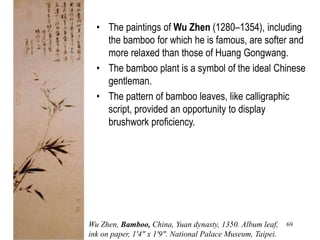
• The paintings of Wu Zhen (1280–1354), including
the bamboo for which he is famous, are softer and
more relaxed than those of Huang Gongwang.
• The bamboo plant is a symbol of the ideal Chinese
gentleman.
• The pattern of bamboo leaves, like calligraphic
script, provided an opportunity to display
brushwork proficiency.
Wu Zhen, Bamboo, China, Yuan dynasty, 1350. Album leaf,
ink on paper, 1'4" x 1'9". National Palace Museum, Taipei.
70
• Zheng Sixiao, the painter of this picture,
wrote the poem on the right, a friend the one on the left.
Zheng Sixiao (1241-1318), Orchid
71
The Invention of Porcelain:
• By the Yuan period, Chinese potters had extended their
mastery to fully developed porcelains.
• A technically brilliant example is a temple vase with cobalt
blue underglaze decoration from the Jingdezhen kilns.
• Cobalt was imported from Persia.
• Phoenixes and dragons may suggest the donor's high
character or invoke prosperity blessings.
• The dragon and the phoenix can be imperial symbols, or may
represent yang (active masculine energy) and ying (passive
feminine energy), respectively.
72
Temple vase, China, Yuan dynasty, 1351.
White porcelain with cobalt blue
underglaze, 2'1" x 8-1/8". Percival
David Foundation of
Chinese Art, London.
Such “blue and white” ware
would be an extremely
valuable commodity in trade
with Europe and the West.
73
Yuan Dynasty (1206-1368) sacrificial-blue
glaze porcelain plum-blossom vase with a
white dragon design, the biggest of its kind
extant and in good condition.
74
Ming Dynasty (1368–1644)
• After the Ming rulers came to power, the court established
workshops to produce luxury goods.
• As early as the Neolithic Age, the Chinese already knew how to use
lacquer to coat eating utensils, ornaments and implements for
sacrificial offerings.
• By the 15th through 18th centuries, the lacquer industry had
accumulated a great deal of manufacturing technique and art.
• Both replicas and originals impart a sense of being highly ornate,
bright and stylish.
• In a cinnabar-colored lacquer masterpiece from the Orchard
factory, the artist carved floral motifs, along with the dragon and
phoenix imperial emblems.
75
Table with drawers, China, Ming dynasty, ca.
1426–1435. Carved red lacquer on a wood core,
3'11" long. Victoria and Albert Museum, London.
Carved Black Lacquer Tray
with Volute Pattern
76
• Stamped by
Jacques Dubois
French, Paris,
about 1755
Oak veneered
with panels of
Chinese lacquer
on a ground of
Nezuko wood and
painted with
vernis Martin;
gilt bronze
mounts; brèche
d'Alep stone top
H: 3 ft. 4 1/2 in.;
W: 3 ft. 9 in.; D: 1
ft. 3 1/8 in.
Cross-cultural
influences:
77
• The painters at the Ming court produced variations on the style
of their Southern Song predecessors.
• Dai Jin (1388–1452), who originally served at the court, founded
the Zhe School of painting in Hangzhou.
• Dai Jin and other Zhe School painters adopted elements of the
Song academic style, but handled it with greater looseness and
freedom.
• Other important local schools of scholar-amateur and professional
painting were centered in Nanjing and Suzhou.
78
Breaking Waves and Autumn Winds. Dai Jin , (Chinese, 1388-1462) Ming dynasty,
Ink on paper, H: 29.9 W: 1112.9 cm, China
79
• The influential critic, statesman, and artist Dong
Qichang (1555–1636) codified the distinction
between scholar-amateur and academic-
professional traditions.
• Dong's glorification of the Yuan period's literati
school reflected his interest in old paintings, and
his own works were true to his ideal of
transforming old styles.
• He attempted to reveal the inner structure and
momentum of nature, radically reorganizing
forms without regard for natural scale and
surface qualities.
Dong Qichang (1555-1636). The Qingbian
Mountains, 1617. Hanging scroll, ink on
paper. Cleveland Museum of Art.
80
Qing Dynasty (1644–1911)
(pronounced Ching)
• The Ming bureaucracy's internal decay permitted the
Manchus to overrun China in the seventeenth century.
• Establishing the Qing dynasty, these northerners quickly
adapted themselves to Chinese life.
• The early Qing emperors cultivated knowledge of China's
arts, and the decorative arts especially flourished under
their direction and patronage.
81
• Qing potters, especially at the imperial kilns at
Jingdezhen, expanded on the Yuan and Ming
achievements in fine porcelain with underglaze
and overglaze decoration.
• A dish with a lobed rim, decorated with positive
symbols, exemplifies the latter technique in
overglaze enamels.
• In the center are the three star gods of
happiness, rank, and longevity, surrounded by
symbols of long life. Dish with lobed rim,
China, Qing dynasty,
ca. 1700. White
porcelain with
overglaze, 2-1/4" x
1'2". The Percival
David Foundation of
Chinese Art,
London.
82
Quing vase, With depressed
pear-shaped body and tall,
slightly tapering, slender neck.
Fine dead white glassy porcelain
painted in 'famille rose' enamels
in 'Gu Yue' style with a rock,
roses, yellow orchids and grasses
on the body, and on the neck with
a poetical inscription in black
and three seals in red enamel.
Percival David Collection
83
Qing Painting
• Literati painting continued to flourish, but other painters
experimented with individualized brushwork and bold compositions.
• Shitao (1642–1707) called for a return to wellsprings of creativity
through use of the "single brush stroke" or "primordial line."
• The chrysanthemum, the favorite flower of the best-known ancient
recluse-poet Tao Qian, was the symbol of reclusion.
• As Shitao prepared to retire, he thought of Tao Qian, just as
countless retired poets and painters had before him, and as others
would in the centuries to follow.
84
The poem reads:
Plum blossoms in October
Sending forth a cold
fragrance,
Are accompanied by
the late-bloomer, the
chrysanthemum;
Since Heaven and Earth
have no special favorites,
Will the plum and
the chrysanthemum
blossom together
again in the Spring?
85
Autumn Mountain
The mountain colors are
a hoary green, the trees
are turning autumnal,
A yellowish mist rises thinly
against a rushing stream;
In a traveler's lodge,
Bitter Melon [Shitao] passes
his time with a brush,
His painting method ought
to put old Guanxiu to
shame.
86
• Leng Mei (active about
1677- about 1742) specialized
in figure painting and
belonged to the atelier
(studio)of the Kangxi emperor.
• He arrived at the imperial
court in about 1700, and took
part in several of the painting
programs instigated by the
emperor.
• These included illustrations
commemorating significant
events, such as the building of
the summer palace at Jehol,
and the emperor's sixtieth
birthday.
• This painting is known as a meiren
hua ('painting of a beauty'), in a
tradition dating back to the Tang
Dynasty.
• The lady sits on a rustic seat holding
a book in her hand. The informality
of her pose, her refined appearance
and her diaphanous clothing suggest
that Leng Mei may have been
depicting a courtesan.
• The artist's skill can be seen in the
delicate rendering of the textile
design and the fluid lines of the
drapery.
Leng Mei, Portrait of a Lady,
a hanging scroll painting , China, Qing dynasty
87
• The Manchus commissioned decorative artworks in vast
quantities. In general, they favored technical brilliance
and elaborate style.
• The kilns at Fuliang (Jingdezhen) produced finely crafted,
superbly decorated porcelains.
• Fine embroidered and woven textiles became more
intricate and delicate.
• By the mid-nineteenth century, however, the huge
workshop system, with specialists working on each
stage of production, had drained much of the vitality
from the decorative arts.
88
Houses and Gardens
• Chinese house and garden designs after the 13th century stem
from two different philosophies, the Confucianist (house) and
the Daoist (garden).
• The two philosophies embrace contrasting, but not necessarily
conflicting, notions of harmony.
• The Confucians seek harmony of the moral and social order,
and the Daoists seek harmony resonant with the forces of
nature.
89
Houses
• Chinese houses are axial groupings of halls and courtyards
within enclosures.
• The house plan expresses the Confucian ideal of a patriarchal
society.
• Strict rules determine the arrangements of spaces in Chinese
houses, depending on fengshui beliefs and concerns regarding
the influence of spiritual forces.
90
• This is the relatively plain exterior of a typical courtyard house.
Courtyard house exterior, Fujian Province, China, primarily Qing dynasty
91
• The modest facade of the house in Wuxi masks its private interior.
Courtyard house interior veranda, Wuxi, Jiangsu Province, China
92
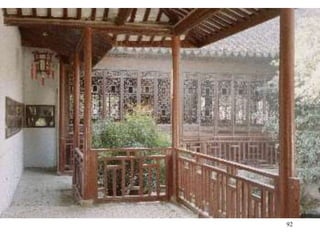
• The private areas may open onto verandas, as seen in a Fujian
Province house, overlooking the garden.
93
Gardens
• Chinese gardens are scenic arrangements of natural
and artificial elements that replicate uncultivated nature, producing
a restorative effect on mind and spirit.
• The typical design, such as Wangshi Yuan (Garden of the Master
of the Fishing Nets),is a sequence of ever-changing vistas.
• Fantastic rockwork represents primitive nature, as at Liu
Yuan (Lingering Garden).
• Chinese gardens are sanctuaries where people commune
with nature as an ever-changing and boundless presence.
Bamboo through window in Dianchun Yi. Wangshi Yuan (Garden of the Master of the Fishing Nets), bridge
and pool, Suzhou, Jiangsu Province, China.
Liu Yuan (Lingering Garden), Suzhou, Jiangsu Province, China.
95
The Forbidden City
• The image most associated with the emperors of China is the
Forbidden City, a walled city, within the modern day city of
Bejing.
• The Taihe Dian (Hall of Supreme Harmony), the Emperor's
throne room and audience hall, is the centerpiece of the axial
design of the Forbidden City.
• A monumental example of the standard Chinese architectural
style, it has a weighty, majestic formality appropriate for sacred
imperial ceremonies.
96
Taihe Dian, Imperial Palace, Forbidden City, Beijing, China, Ming and
Qing dynasties, seventeenth century and later.
Inside is the ornately carved
and gold Dragon Throne.
97
KOREA
• The last of the native Korean dynasties was the Choson (1392–
1910).
• The impressive south gate, or Nandaemun, was built for the new
capital of Seoul.
• It combines imposing stone foundations with an intricately
bracketed wooden superstructure.
• In eastern Asia, elaborate gateways were symbols of the ruler's
authority or of the hallowed nature of what stood on the other
side.
98
• The impressive south gate, or Nandaemun, was built for
the new capital of Seoul.
• It combines imposing stone foundations with an intricately
bracketed wooden superstructure.
• In eastern Asia, elaborate gateways were symbols of the
ruler's authority or of the hallowed nature of what stood on
the other side.
• The modern city of Seoul has grown up around this
medieval structure.
Nandaemun, Seoul, Korea, Choson dynasty, first built in 1398.
99
• The Korean script, han'gul, was invented in the
mid 15th century.
• At that time, Chinese characters were used in
official documents and at court, so han'gul was
invented for the common people, who found
Chinese characters too difficult to learn.
• Han'gul was used at first mostly by women, but
was much popularised in the late Choson dynasty
and today is the main script used in Korea.
• This piece was created by the contemporary
master calligrapher Soh Hwi-hwan, and copies
the original text of the Hunmin Chong'um, or
'proper sounds to instruct the people'
100
• The long reign of Buddhism as Korea's dominant religion ended.
• Neo-Confucianism turned greater attention to public and worldly
concerns.
• The ancient ideals of nature worship reemerged (mingled with
Chinese Daoism) and influenced artistic themes.
• In the eighteenth century, Korean scholar-amateur painters closely
studied Chinese literati styles and produced their own fusions, as
seen in the Kumgang (Diamond) Mountains by
Chong Son (1676–1759).
101
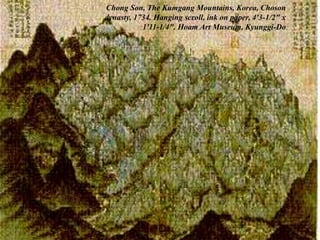
• The artist transformed an actual scene into an imaginative
landscape with a sense of rhythmic vitality using sharper, darker
versions of the fibrous brush strokes favored by Chinese literati.
Chong Son, The Kumgang Mountains, Korea, Choson
dynasty, 1734. Hanging scroll, ink on paper, 4'3-1/2" x
1'11-1/4". Hoam Art Museum, Kyunggi-Do.
102
Chong Son (16761759) Old Pine Tree at Sajik Altar
103
• Ancestor worship and
ceremonial practices
honoring teachers and
leaders gave portraits a vital
role in east Asian cultures.
• In Portrait of Kang Yi-o,
by Yi Chae-Gwan
(1783–1837), the artist's
meticulous rendering of
garments and other attributes,
including the official's winged
silk hat, indicates the sitter's
social identity.
• The sensitive likeness of the
face records personal (and
perhaps family) identity for
posterity.
Portrait of Kang Yi-o, Korea, Choson
dynasty, early nineteenth century. Hanging
scroll, ink and colors on silk,
2'1" high. National Museum
of Korea, Seoul.
104
• The similarities of this portraits suggest
that they are of the same man, and
both painted by Yi Che-gwan (1783-
1837). This portrait appears to be the
later, as the sitter seems to have aged.
• Western painting techniques were
introduced to Korea through Jesuit
missionaries in China in the eighteenth
century. This influence is apparent here,
perhaps in the shape of the eyes, but
certainly in the details of the face, such
as the wrinkles and the use of repeated
minute lines (hatching) to show
shading.
• Earlier Korean
portraits were more
interested in
capturing a sense of
the sitter's 'spirit'
rather than in
portraying an actual
physical likeness.
• However, during the
prosperous 18th
century it became
fashionable in
portraiture as well as
in chin'gyong, or
'true-view' painting, of
real scenes from the
Korean landscape.
Yi Che-gwan (attributed to), Portrait of a Confucian scholar, Korea,
Late Choson dynasty, late 18th - early 19th c., Wearing a traditional horse-hair indoor hat
105
• The late Choson period (from the seventeenth century AD)
was a period of relative prosperity in Korea.
• The arts thrived, particularly under King Yongjo (1724-76)
and King Chongjo (1776-1800), both able rulers who
encouraged economic, social and political stability.
• Chin'gyong, or 'true-view' landscape paintings became
fashionable among the scholar-literati class; they depicted
real scenes from the Korean landscape, rather than those
copied from Chinese paintings.
• Meanwhile, humorous scenes of daily life became popular
among the growing middle class.
106
• Kim Hong-do was one of
the most famous painters
of these scenes.
• This album is one of at
least two known copies of
Hong-do's famous original,
now in the National
Museum of Korea.
• It may have been made in
the late nineteenth century
as a special present for a
dignitary.
• It may have been
made in the late
nineteenth century as
a special present for a
dignitary.
• The painting focuses
on people and their
activities, with the
background barely
illustrated.
• The paintings in the
album include
schoolroom scenes,
wrestling, and other
everyday activities.
Kim Hong-do (after), Album of Scenes from Daily
Life , Korea, Late Choson dynasty, 19th century AD
107
Having a meal. Practicing archery
Planting the fields Dancing
108
• Although Korea was a strict
Confucian state during the
Choson dynasty (1392-1910), by
the 18th and 19th centuries
Buddhism became less
oppressed.
• Buddhist monks were
recognized for their service in
organizing successful campaigns
against the Japanese invasions
of 1592 and 1597.
• Many Buddhist temples were
rebuilt in this period and Buddhist
paintings and sculptures made to
furnish them.
• The future Buddha, Prince
Siddhartha Gautama,
sees the 'four sights': an
old man, a sick man, a
corpse and an ascetic, and
reaches an understanding
about the transience of life.
• He decided to abandon his
comfortable world. Here he
is shown here escaping
from the palace on his
white horse during the
night.
The Great Renunciation, a painting on hemp cloth , Korea, Choson dynasty, early 18th c.
109
• The four guardians of
the cardinal points
(north, east, south
and west) acted as
the defenders of
Buddhism and are
found in paintings
and sculpture at the
entrance to temples.
Although the inscription at top
right indicates that the figure is
the Guardian King of the
North, the lute that he carries is
in fact the attribute of
Dhratarastra, Guardian King
of the East.
The huge size of the canvas, the
dynamic and decorative lines,
and the combination of mineral
colours are typical of Buddhist
paintings from Korea.
Dhratarastra, Guardian King of the East,
a painting on hemp cloth Probably from
Taegu, Kyongsang province, Korea
Choson dynasty,Getty Museum
110
• In Korea, screen paintings were essentially used as
room decorations.
• Screens designed for women's quarters were usually
decorated with peonies, symbols of fertility and
prosperity, while screens for the men's quarters
(sarangbang), were decorated with chaekkori (literally
books and scholarly 'equipment').
• Here we can see books, writing brushes, inkstones,
auspicious fruits with many seeds, and Chinese
porcelain and bronzes.
As a strict Confucian state, the Choson dynasty regarded
scholars as belonging to a very respectable profession, and
having superior social status.
A chaekkori screen was considered ideal for display behind
the desk in a scholar's study, where it conveyed an air of
dignity, luxury and a reverence for scholarship.
111
• The Japanese invasion (1592–1598) transferred many Korean
potters to Kyushu, where they were instrumental in inaugurating
the Japanese porcelain industry.
• The simple forms, spare decoration, and monochrome glazes of
the Choson period Korean tea bowls used in Japan are
demonstrated in this simple celadon bowl.
Stoneware with celadon glaze, H: 9.8 W: 22.7 cm
Korea, Freer Collection, Smithsonian.
112
• White porcelain was the
dominant type of ceramic in
Korea throughout the Choson
period.
• At first, decoration was
commonly executed in
underglaze painting using blue
cobalt. However, the Japanese
invasions, which devastated
Korean porcelain production and
the economy in general, meant
that the expensive cobalt was no
longer imported.
• The potters turned to the use of
underglaze iron.
• This innovation also led to a
change in design. Iron had to be
painted on quickly or it would
be absorbed by the clay body.
The intricate designs
painted in cobalt blue were
replaced with more lively,
playful designs, as
shown on this storage jar.
• The jar is decorated with
stylized orchids, a feature
commonly associated with the
scholar-literati particularly
esteemed by the Confucianist
state.
White porcelain storage jar in underglaze iron , Korea, Choson dynasty
113
Contemporary Art In Asia
• Contemporary art in India and Southeast Asian countries falls into
two general categories—
• art made following the local traditions and
• art created for the international market.
• A fundamental quandary of many contemporary Asian artists
working in the international style is how to define their identity and
situate their work between local and international, traditional and
modern, and non-Western and Western cultures.
114
Summary:
• Indian art is a mixture of Hindu and Muslim influence. Miniatures
dominated painting in the form of small carefully bound books.
• Schools of art grew depending upon region and dominant religious
practices.
• In Southeast Asia we find the tall, tiered towers called gopuras
serving as gateways to temple complexes.
• Throughout Asia the production of high quality porcelains
demonstrate sophisticated technologies in both underglaze
decoration and overglaze enamels.
• The term pagoda describes the gently sloping overlapping roofs in
much Asian architecture.
115
• Chinese art history is measured by dynasties where amateur
scholar-artists practiced the three accomplishments.
• Chinese ceramics are best known for the export of cobalt “blue
and white” ware that was exported to Europe during the Ming
Dynasty.
• Carved and decorated, waterproof, lacquerware was another
popular export.
• Choson artists produced sophisticated portraits in Korea.
• Koreans also produced simple, elegant celadon ceramics that
were highly valued in Japan and infused energy into the Japanese
ceramics industry.
116
LINKS:
• Metropolitan Museum of Art- Asian Collections
• Smithsonain Museum (The Freer Collection)
• Victoria and Albert Museum- London
• National Museum of Korea
• Percival David Foundation of Chinese Art
• Met – East Asia Timelines
• India Revealed- India Sculpture Index
• Asian Historical Architecture

c25-150103082349-conversion-gate0002.ppt

  • 1.
    1 INDIA AND SOUTHEASTASIA ART 102 Gardners - Chapter 25 and 26 Jean Thobaben Instructor The Art of South and Southeast Asia The Art of China and Korea BURMA Asian Art The Art of Thailand Art of India An introduction to Later Asian Art CHINA KOREA
  • 2.
    Spirituality and Power: •In later periods, Indian and Southeast Asian peoples experienced various cultural, political, and artistic changes. • In India, Buddhism neared extinction, Islam grew, and Hinduism maintained popularity while politically in retreat. • The British were present in India from the sixteenth century until 1947. • In Southeast Asia, there were also major shifts in the wielding of political power and in religious affiliations. • Thai, Vietnamese, and Burmese expansions led to the cultural, political, and artistic transformation of mainland Southeast Asia.
  • 3.
    3 India • India isthe home of the Hindu, Buddhism and Jain religions. • As Buddhism spread to East Asia, Indian iconography and styles of art also had a profound impact on those culture. • Muslim traders and merchants began arriving in India through the Northwest mountain passes as early as the 8th century, but it was not until the 12th century that Muslim rulers, backed by armies, gained control of India.
  • 4.
    4 Hindu Art andHinduism • Hinduism originated in northern India and spread to the south and later to the mainland of Southeast Asia and Indonesia. • The religion has no founder but developed over a period of centuries out of India's various pantheistic cults. • Nor is it based on a single text. • There are countless writings, tales, myths and legends. India, Tamil Nadu, Standing Parvati, Chola period (880- 1279), c. first quarter of the 10th century, copper alloy, height 27 3/8 inches (69.5 cm), Metropolitan Museum of Art, NY.
  • 5.
    5 • One keyfeature of Hinduism is the notion that all living beings form part of an eternal cycle of reincarnations from which humanity can only break free with immense effort. • The existence of the world is also seen as part of this cycle. Creation came about, it exists and it will once more be destroyed. • In the course of time a new world era will dawn again. This process continues throughout eternity. India or Bangladesh, West Bengal, The Goddess Durga Killing the Buffalo Demon, Mahisha , Pala period (c. 750-1200), 12th century, mudstone, height 5 5/16 inches (13.5 cm), Metropolitan Museum of Art, NY. The multiple arms are a popular convention in Hindu art. Each arm holds a different attribute related to the diety.
  • 6.
    6 • Three godsare central in Hinduism: Brahma, Shiva and Vishnu. • They form a divine trinity. Of these, it is Vishnu who preserves creation and Shiva who is the destroyer. • The Hindu divinities are worshipped both in temples and in the home. India, c. 950, Siva as the Lord of Dance (Nataraja), copper alloy, 30 x 22 1/2 x 7 inches Los Angeles County Museum of Art.
  • 7.
    7 • The youthfulKrishna--an incarnation of the supreme Hindu god Vishnu--is shown dancing, as he did after being attacked by the serpent Kaliya, whom he subdued without a struggle. • This image was made to be carried in processions on festival days in southern India. Krishna, India, Tamil Nadu, Chola dynasty, late tenth century Bronze, height 14 1/8 ins Walters Art Gallery
  • 8.
    8 An ancient god whoseauthority was derived from the Vedas (the scriptures of the ancient Aryans), Brahma retained his importance as the creator in Hinduism, although no cult comparable in size to those of Vishnu and Shiva developed around him. Brahma, 10th century A.D. Granite with traces of gesso and red pigment, Worcester Art Museum Looking at the four directions, the four faces of Brahma symbolize the four Vedas as well as the cardinal points of the compass. Two of the image's four original arms are now lost. The missing upper hand probably made the gesture of reassurance, while the lower one held a lotus. The upper left hand holds and counts a rosary; the lower left, now empty, may have held a pot containing the water from which the universe was created.
  • 9.
    9 • The Hindugod of auspiciousness, Ganesha is popularly accepted as the first son of Shiva and Parvati. • As the deity who controls obstacles—their invention and removal— he is worshiped before any serious undertaking. • This seated four-armed Ganesha holds one of his tusks, two entwined snakes, an elephant goad, and a box of sweets, which he tastes with his trunk. • The broken tusk in his lower left hand is a reference to another well-known tale in which the portly Ganesha hurls a tusk at the moon in retaliation for its amusement at witnessing his stomach burst from overeating. Seated Ganesha, 14th–15th century, Orissa, India, Ivory; H. 7 1/4 in x W. 4 3/4 in. Metropolitan Museum if Art,
  • 10.
    10 • A Hindutemple was often envisioned as the world's central axis, in the form of a mountain inhabited by a god. The temple itself was therefore worshiped. • This was done by circumambulation,walking around the exterior, and by viewing its small inner sanctum. • The outside of the temple was usually covered with myriad reliefs • From early times iconic representations of deities and holy figures were augmented by auspicious images, such as beautiful women, musicians, and loving couples (mithunas) • Couples such as this pair are understood to have multiple meanings, ranging from an obvious celebration of life's pleasures to the more metaphorical symbolism of a human soul's longing for union with the divine. Loving couple (mithuna), Eastern Ganga dynasty, 13th century, Orissa, India, Ferruginous stone; H. 72 in.,Metropolitan Museum.
  • 11.
    11 • Hidimba Devitemple stands in the midst of a sacred cedar forest near the town of Dunghri at the verdant foot of the Himalaya mountains. • The sanctuary is built over an enormous rock that juts out of the ground, worshipped as a manefestation of Durga, the "Hill Mother" or goddess of the earth. • The temple was constructed in 1553 by Maharaja Bahadur Singh. • The Hidimba Devi temple is 24 meters tall and consists of three square roofs clad in timber tiles, surmounted by a cone-shaped fourth roof that is covered in brass. • The interior of the temple is occupied by the large rock and contains no usuable space except for the ground floor. • The base of the temple is made of whitewashed mud-covered stonework. The main doorway includes an elaborately carved wooden entrance that is believed to be over 400 years old. Hidimba Devi Temple (1553 and later)
  • 12.
  • 13.
    13 • The Mahabodhitemple at Bodhgaya is located on the spot where the Buddha attained enlightenment. • The temple's principle relic is a distant descendant of the Bo tree under which the Buddha sat when his enlightenment took place. • The site, having been sacred to Buddhists since the earliest days of the faith, is of unknown antiquity. • Elements of the temple date from the 3rd century BC. • The enormous central tower (55 m tall) is a 19th century renovation faithful to the earlier towers that existed on the site. • The tower comprises numerous horizontal bands of moldings and arch motifs that extend upward to an amalaka topped by umbrella-shaped forms, recalling the umbrella motifs found at Buddhist stupas.
  • 14.
    14 • The HinduNayak rulers in south India during the seventeenth and eighteenth centuries oversaw construction of some of the largest temple complexes in India. • The builders expanded the temples outward by erecting ever-larger enclosure walls with monumental gopuras. • Late temples also typically include numerous large mandapas and great water tanks. • Such temples continue to sponsor many yearly festivals, attended by thousands of pilgrims, worshipers, merchants, and priests. Great Temple, Madurai, India, seventeenth century.
  • 15.
    15 Detail, Great Temple,Madurai, India, seventeenth century.
  • 16.
    16 • The nextslide shows a section of a carved wooden dome with miniature balconies and supports that once crowned a meeting hall in a Jain temple in Gujarat. • The carvings symbolize the splendors of the celestial realms that all Jains hope to attain eventually by accruing merit in their successive lives. • Every surface of the teak has been carved with figures, whose size indicates their importance, and with animal and floral forms. The large figures represent the rulers of the eight cosmic directions, who are responsible for the orderly working of the universe and for the protection of the temple and its worshippers.
  • 17.
  • 18.
    18 Architectural Ensemble froma Jain Meeting Hall, last quarter of 16th century India, Gujarat, Patan, Teak with traces of color; H. (approx.) 15 ft.
  • 19.
    19 Mughal Art inIndia • The Islamic dynasty in India, composed of nineteen sovereigns who ruled from 1526 to 1858. • Many of India's greatest works of art and architecture were produced during the Mughal period. The Taj Mahal, 1630 to 1653, Islamic Tomb, Agra, India
  • 20.
    20 It was ShahJahan (reigned 1627-1658) who built the Taj Mahal as a tomb garden for his wife, establishing it as the greatest creation of the Mughal dynasty.
  • 21.
    21 • The Charminar(Four Minarets) is striking monument set in the heart of Hyderabad. • It was constructed by Muhammad Quli (1580-1612), the founder of Hyderabad, who built the monument to mark the intersection of the city's four major roads. • This unusual building--part triumphal arch, part mosque-- stands over 55 meters tall and 30 wide. -lower stories accommodate 4 large arches, above which is a small elevated mosque.
  • 22.
  • 23.
    23 • Next isa "pan-dan," or box, used to hold pan-rolled betel leaf stuffed with betel nut, lime paste, and spices. • The native Hindu custom of eating betel leaves (to aid digestion and freshen the breath) was introduced at the Mughal court in the seventeenth century by palace ladies, probably Hindu wives of the Mughal rulers. Four artisans collaborated to make this box: a molder who created the shape using the lost-wax technique; an etcher who drew the designs on the surface; an engraver who chiseled out the areas around the designs; and an inlayer who applied the silver and brass. The surface was then blackened to enhance the beauty of the inlay, used here to define the duck's various feathers. Pan box in the shape of a duck, late 17th–early 18th century, Deccan, India, Tin alloy inlaid with silver and brass (Bidri ware); H. 5 5/8 in; D. 4 1/2 in. ; L. 7 1/4 in. Metropolitan Museum of Art, NY.
  • 24.
    24 • Bidri ware,named for the Deccani city of Bidar, is a uniquely Indian alloy of four metals, the main component of which is zinc. • An acid bath renders the base material very dark, enhancing its suitability to set off the contrasting inlay metals. With a shape reminiscent of tombs of the Sultanate Period and decoration that is lyrically Persianate in style, this box is probably one of the oldest surviving examples of bidri ware. Box with lid, late 16th century, India, the Deccan (Bidar) Metal alloy inlaid with brass and silver; H. 3 3/4 in. x W. 5 3/8 in.
  • 25.
    25 • With theexception of the palm trees, the landscape elements, animals, and birds in this grand carpet are taken from contemporaneous Persian art. • The repeating full-width pattern unit of the field, reversed every time it appears, is reminiscent of woven textile design. • The border, decorated in the "silhouette style," in which floral motifs of one color appear against a field without outlines, is closely related to book illumination and to architectural decorations in manuscript paintings that were also done by illuminators. Carpet with pictorial design, late 16th–early 17th century; Mughal Pakistan (Lahore) Wool pile on cotton foundation; L. 27 ft. 4 in. (833 cm), W. 9 ft. 6 in
  • 26.
    26 Indian Painting • Theearly tradition of Indian painting is almost entirely lost due to the impermanence of the materials. Krishna Carried Off by the Whirlwind Demon, from a Bhagavata Purana (Book of the Lord) India, Delhi– Agra , ca. 1520– 30 Opaque watercolor on paper.
  • 27.
    27 • The pre-Mughalstyle is represented by a group of manuscripts and individual paintings often referred to as the "Chaurapanchasika" group, after a Sanskrit manuscript of lyric love poems. • A small group of rare illustrated manuscripts datable from around 1515 to 1575 has been associated with this style. • One of these manuscripts, perhaps as well known as the one for which the series was named, is an illustrated excerpt from the great Hindu epic, the "Bhagavata Purana" (Ancient Story of God). • The page seen next displays the bold patterning, large areas of contrasting flat colors, and sense of two-dimensionality common to the illustrations in this manuscript. It is one of the more lively and accomplished of the set.
  • 28.
    28 Krishna Battles theArmies of the Demon Naraka: Page from a Dispersed Bhagavata Purana (Ancient Stories of Lord Vishnu), ca. 1520–30; Chaurapanchasika m Metropolitan
  • 29.
    29 • The clarityof the composition—the strong crisp lines depicting Yama's voluminous physique and the luxuriant flames encircling him—and the hint of recession in the background suggest a date in the mid-seventeenth to early eighteenth century for this piece. • Yama is the Indian god of death who was tamed by the Bodhisattva Manjushri. • In later Buddhist traditions he became a protector of the religion and its adherents. • In later Buddhist traditions, Yama became a protector of the religion and its adherents. • He carries a thunderbolt chopper and skull, and wears a tiger skin, jewelry, and a garland of severed human skulls. Yama, mid-17th–early 18th century, Tibet, Distemper on cloth; 72 3/8 x 46 5/8 in, Metropolitan Museum, NY.
  • 30.
    30 • In thenext painting, Krishna, the blue god, has stolen the clothes—or in this case, the cholis (blouses)—of the gopis as they frolic in a stream. (Gopis are female cowherds, the companions and lovers of Krishna.) • The gopis in the center have recognized their fate and stand naked before him—a metaphorical reference to the openness before god necessary for salvation. • The ground plane has been tilted back to create a sense of spatial recession, establishing a foreground, middle ground, and background. The Gopis Beseech Krishna to Return Their Clothing: Page from the Dispersed "Isarda" Bhagavata Purana (Ancient Stories of Lord Vishnu), ca. 1560–65, India, probably Delhi-Agra areaInk and opaque watercolor on paper; 7 5/8 x 10 1/8 in.
  • 31.
    31 • Only Indianpaintings from the 15th and 16th centuries or later have survived in any numbers. • Viewers usually kept Indian paintings as books or albums. Indian paintings after the thirteenth century are divided into several schools, including Mughal and Rajput. • The Hindu kings and their courts in Rajasthan and the Punjab Hills patronized Rajput painting. • The Mughal emperors commissioned Mughal paintings.
  • 32.
    32 • The Mughalcourt, especially under Akbar, Jahangir, and Shah Jahan, lavishly patronized the arts. • The artist Bichitr (active early 17th century to late 1650s) painted a Portrait of Jahangir seated on an hourglass throne. Bichitr, Jahangir Preferring a Sufi Shaikh to Kings, Mughal painting, India, ca. 1615–1618. Opaque watercolor on paper, 1' 6"-7/8" x 1' 1". Freer Gallery of Art, Washington.
  • 33.
    33 • The Hamzanamatells the fantastic story of Hamza, an uncle of the Prophet, who traveled the world spreading the teachings of Islam. • The story was a popular subject for public recitation in coffeehouses, so exciting and full of fantastic elements were the tales. • The emperor Akbar commissioned an illustrated version of the manuscript consisting of 1,400 large illustrations. • In this painting, Zambur, a spy, brings a maid named Mahiya to town on a donkey. The Spy Zambur Brings Mahiya to Tawariq, Where They Meet Ustad Khatun: Page from the Hamzanama (Adventures of Hamza) ca. 1570; Mughal India, Ink, colors, and gold on cotton; H. 29 1/8 in. W. 22 1/2 in.
  • 34.
    34 • The boldareas of color, stylized figures, and flat picture plane of a work produced in Basohli, a Hindu court in the Punjab Hills, contrast markedly with the Mughal work's realism. • The painting, accompanied by a poetic stanza, depicts Bhadrakali as the force activating the world matter. Bhadrakali within the Rising Sun, folio 10 from the Tantric Devi series, from Punjab Hills, Basohli, India, ca. 1660–1670. Opaque watercolor, gold, silver, and beetle-wing cases on paper, 9-3/4" x 8-1/4".
  • 35.
    35 A comparison of Devi's positioningwith Jahangir's placement in Bichitr's painting reveals a contrast between the Hindu court's deity-centered world and the deified but human emperor as world center.
  • 36.
    36 • The Kishangarhatelier is renowned not only for paintings but also for large- scale drawings that were tinted and highly finished. Images of women drinking wine, holding flowers, or playing instruments became a popular genre in Rajasthani painting during the first half of the eighteenth century. • They evolved from imperial Mughal depictions of large concert parties in which female entertainers served an auxiliary function. • Here one such entertainer has been transformed into a "nayika," an idealized Hindu heroine and personification of female beauty. She has just plucked a string of her tanpura (a drone instrument of the lute family, played by women) and is intently listening to its resonance. • The drawing must date from before the 1740s, at which time a more idiosyncratic and exaggerated facial type became the vogue in Kishangarh. Lady playing the Tampura, 1735, India (Rajasthan, Kishangarh), Ink, gold, opaque and transparent watercolor on paper; 18 1/2 x 13 1/4 in. metropolitan Museun, NY.
  • 37.
    37 • A populartopic for Punjab Hill paintings involved Krishna, an avatar of Vishnu, and the cowherd's many amorous adventures. • Krishna and his favorite lover sit in a lush garden at night. • The realism of this picture relates stylistically to the Mughal tradition. • The love between Krishna and Radha, told in the poem Song of the Herdsman, is a model for the love devotees felt for the deity. Krishna and Radha in a Pavilion, from Punjab Hills, Kangra(?), India, ca. 1760. Opaque watercolor on paper, 11-1/8" x 7-3/4". National Museum, New Delhi.
  • 38.
    38 • The maharajaJaswant Singh ruled Jodhpur in Rajasthan when the British controlled India. • By this time, India's rulers and citizenry had been involved in adapting to Western culture and ideas. • Although the maharaja posed like a British gentleman in his sitting room, his regal presence and pride are clear. • The two necklaces he wears exemplify the combination of his two worlds, traditional and Western-influenced. • The interest in realism in Indian paintings reached a climax in works such as this portrait, which was copied from a photograph. Maharaja Jaswant Singh of Marwar, from Jodhpur, India, ca. 1880. Opaque watercolor on paper, 1' 3-1/2" x 11-5/8". The Brooklyn Museum
  • 39.
  • 40.
    40 Thailand • Two prominentBuddhist kingdoms, Sukhothai and Ayuthaya, came to power in Thailand during the thirteenth and early fourteenth centuries. • The art produced at Sukhothai set a standard for Thai art to the present.
  • 41.
    41 • Wat Mahathatwas the city's most important Buddhist monastery. • The central monument, a stupa, although not a circular mound, housed a relic of the Buddha. • A central lotus-bud tower and eight surrounding towers stand on the stupa's lower podium.
  • 42.
    42 • Only asmall portion of the brick structure's stucco decoration remains. • The halls in front do not survive, but the stone pillars still stand. • Two monumental standing Buddha images flank the stupa, each enclosed in a brick building. Wat Mahathat, Sukhothai, Thailand, fourteenth century.
  • 43.
    43 • The Sukhothai Buddhaimages were the city's crowning artistic achievement. • In the unique Sukhothai walking- Buddha statuary type the artists intended to express the Buddha's beauty and perfection. • A flame leaps from the top of the head, and a sharp nose projects from the rounded face. • A clinging robe reveals fluid rounded limbs. • The handling of the bronze is well suited to the forms' elasticity. Walking Buddha, from Sukhothai, Thailand, fourteenth century. Bronze, 7' 2-1/2" high. Wat Bechamabopit, Bangkok.
  • 44.
    44 • The Sukhotai walking-Buddha statuarytype does not occur elsewhere in Buddhist art. Walking Buddha Thailand; Sukhothai 14th-15th c. bronze 15.3 cm / 6 in.
  • 45.
    45 • Ceramics wereproduced in some number in the kingdom of Lan Na centered in northern Thailand. • Clay in the area is characterized by a high percentage of kaolin producing thinly potted, elegant off- white or buff bodies. • Kalong wares are characterized by their freely painted underglaze designs in iron brown. • These are often floral or other images drawn from the natural world. The lively decoration on this dish is sometimes termed "black crow," in reference to its abstract resemblance to birds in flight. The Kalong kilns also produced a limited number of pieces with green or celadon glazes. Dish, 14th–mid-16th century, Thailand, Earthenware with underglaze iron-brown decoration (Kalong ware); Diam. 8 1/4 in.
  • 46.
    46 • Sukothai waresare characterized by a coarse body, which fires a dark brown and is sprinkled with white particles. • Iron-brown decoration is painted both under the glaze and over a white slip. • Raised on a low ring, this next vessel is in the shape of an elephant has a rider squatting on its rear haunch. • The rider's hands are held in a prayerlike gesture. • The head and trunk of the elephant are raised and a spout issues forth from its mouth. • The legs of the elephant are drawn up against its globular body. Vessel in the form of an elephant and rider, 14th–mid-16th centuryThailand Earthenware with underglaze iron-brown decoration H. 5 1/4 in.
  • 47.
    47 • Next, Ganeshais seated in a cross-legged yogic posture on a raised pedestal with a decorated molding. • His dress and adornments are treated in a very restrained fashion that emphasizes the sculptor's concern with pure modeling and manipulation of volumes. • Suggestions of later Khmer motifs can be seen in the schematic treatment of the folds of skin along the cheeks, the rear arrangement of the section of garment drawn between the legs, and, to a lesser extent, the crown. • But there is also the sense of the sculptor's delight in emphasizing the corpulence and sheer bulk of the shoulders, chest, belly, and thighs that one finds in South Indian representations of Ganesha. Seated Ganesha, ca. 15th century; Sukhothai or Lan Na style Thailand Bronze; H. 12 3/4 in. W. 7 1/8 in.
  • 48.
    48 Temple of theEmerald Buddha • Wat Phra Keo (the Thai name) is an exuberantly colored religious compound built inside the Royal Palace in Bangkok, Thailand • The temple's architecture is visually striking
  • 49.
    49 • The temple'slargest and most important building is the Bot (loosely translated as "house of meditation"). • It is Thailand's most sacred shrine and the king's personal chapel • Within the Bot resides the world famous Emerald Buddha (actually made of green jade, not emerald).
  • 50.
    50 • This 500-year-oldholy statue is perched so high above the Bot's golden altar and is only 66 centimeters or 26 inches high. • The sacred image is clad with one of the three seasonal costumes (summer, rainy season, and winter). • The costumes are changed three times a year in a ceremony presided over by the King.
  • 51.
    51 Burma • Burma, likeThailand, is overwhelmingly a Theravada Buddhist country today. • One of the largest stupas in the world is the Shwedagon Pagoda, which houses two of the Buddha's hairs. • The great wealth encrusting the stupa was a gift to the Buddha from the Burmese laypeople to produce merit. • The stupa is centered in an enormous complex of buildings, including wooden shrines filled with Buddha images. Schwedagon Pagoda, Rangoon (Yangon), Burma (Myanmar), fourteenth century or earlier (rebuilt several times). Stupa, gold, silver, and jewel encrusted, approx. 344' high. Top of stupa, gold ball inlaid with 4,351 diamonds, one approx. 76 carats
  • 52.
    52 • This largeBuddha image is seated in the lotus position with the legs crossed and the left hand placed in his lap. • In the fingers of his right hand is a myrobalan, a small fruit with medicinal properties. • Legend tells how the Buddha received this fruit from the god Indra shortly after attaining enlightenment. • Images of the Buddha as a healer holding the myrobalan are unusual outside Myanmar. This image has been made using the dry lacquer technique. The approximate outline of the finished sculpture is made from clay. Over this is laid strips of cloth which have been impregnated with lacquer sap. This is then covered with further layers of lacquer sap and lacquer putty (sap mixed with sawdust), with final details finished separately and then attached. Once the layers of lacquer are set, the clay core can be removed. Dry lacquer sculpture of the Buddha From Rangoon, Burma (Myanmar) Late 18th or early 19th century AD
  • 53.
    53 Vietnam • This exceptionaldish, with its depiction of a kneeling elephant surrounded by abstract cloud formations, must be included among the dozen or two finest known early Vietnamese blue-and- white porcelain dishes. The refined and sophisticated drawing of the charming and delightful elephant and the control of the underglaze cobalt sets it apart from most of the known corpus of important 15th and 16th century porcelains. The technique of manufacture,shape of the dish, and general composition of design are clearly based on early Ming dynasty blue-and-white prototypes, but the whimsical elephant and the particulars of the subsidiary design are uniquely the product of Vietnamese artistic sensibilities. Dish with Recumbent Elephant Surrounded by Clouds, 15th–16th century,Vietnam. MMA, NY.
  • 54.
    54 • The useof cobalt blue for underglaze decoration on porcelain began in Vietnam during the fourteenth century, about the same time as its beginnings in China. • There were distinctive traits in the decoration of Vietnamese ceramics. During the fifteenth century, one of the distinguishing characteristics was the use of pencil lines that served both as shading and as a means of depicting the leaf veins and flower petals of plant motifs. • This technique is well demonstrated in the dish illustrated here • Given that most blue-and-white porcelain was exported, it is not surprising that some of the best surviving Vietnamese pieces are found outside the country. Dish with design of peonies, 15th century, Vietnam Stoneware with underglaze cobalt-blue decoration; Diam. 17 1/2 in.
  • 55.
    55 • Fanciful shapes,including vessels in the form of birds, animals, and human figures, as well as abstract designs characterize blue-and-white and other ceramic wares produced in Vietnam for domestic use and export. • An elaborate crest caps the pronounced head of this phoenix-shaped ewer. • His detailed wings cling to the sides of the body, which is decorated with scattered featherlike clumps painted in underglaze blue. • A whimsical two-part handle is placed along the back. Ewer in the form of a phoenix ca. 15th–16th century, Vietnam Stoneware with underglaze cobalt-blue decoration; H. 11 1/2 in.
  • 56.
    56 CHINA • Ancient Chineseculture laid the foundations for later East Asian civilization. • Many elements of culture had attained a high level of development well before the end of the first millennium.
  • 57.
    57 The most commonformats in Chinese painting and calligraphy are the hanging scroll, the handscroll, the album leaf and the fan painting. • The vertical hanging scroll was meant to be viewed by a group of people together, and was used for large landscapes and figure compositions. • The handscroll was suited to a small group to unroll and read section by section, from right to left. The painting and subject matter were often more delicate than that of the other formats. • The album contained a series of leaves by a single artist, or works on a related theme by several artists. • Fan paintings, either the round or folding arc-shaped type, showed genre subjects in an unusual compositional format.
  • 58.
    58 Yuan Dynasty(1279–1368) • In1279, the Song dynasty fell to the Mongol armies led by Kublai Khan (1215–1294), founder of the Yuan dynasty. • The Mongols profoundly affected the country's culture, particularly the art of painting. • The celebrated Song poet, amateur painter, and statesman Su Dongpo (1036–1101) championed less polished efforts by scholar-amateurs over skillful representation. • These new notions of value in painting continued to gain momentum during the Yuan dynasty. • These scholar-artists painted primarily to express their moods, philosophical ideals, and religious beliefs.
  • 59.
    59 • This isa rare example of a signed and dated painting from the Yuan dynasty. The subject matter is that of animals and insects feeding off each other. • A toad lies in wait for ants, which in turn are dismembering a butterfly; a dragonfly attacks a smaller insect which the lizard is hunting, and the cicada seems destined to be eaten by the mantis. • The beauty and brightness of the natural world cover up the confusion and disorder caused by the fight for survival. It reflects the dilemma faced by many Chinese of the period: whether to work for the Mongols and survive, or to remain loyal to the fallen imperial dynasty and starve. Xie Chufang, Fascination of Nature, a handscroll painting , China, Yuan dynasty, 1321.
  • 60.
    60 Detail, Fascination ofNature, a handscroll painting , China, Yuan dynasty, 1321
  • 61.
    61 Detail, Fascination ofNature, a handscroll painting , China, Yuan dynasty, 1321
  • 62.
    62 • Executed entirelyin varying shades of ink, an undulating branch of blossoming plum sweeps gracefully across the paper and culminates dramatically in a single long tapering stroke. • The subtle chromatic range of contrasting ink tones, the rich calligraphic variation of the brushwork, and the expressive lyrical flow of the overall composition mark this unique painting as a virtuoso performance of the highest technical and artistic merit. A Breath of Spring, 1360, Zou Fulei (active mid 14th century), Yuan dynasty, Handscroll; ink on paper, H: 34.1 W: 221.5 cm ,Freer Gallery, Smithsonian.
  • 63.
    63 •Literati painting reachedmaturity in the Yuan dynasty. •Because many scholar-artists retreated to the provinces to avoid service under the Mongols, landscape became a more integral part of their environment. • In Dwelling in the Fuchun Mountains, Huang Gongwang (1269–1354) replaced the misty atmosphere of the Southern Song landscapes with richly textured fibrous brush strokes that render the landscape's inner structure. HUANG GONGWANG, Dwelling in the Fuchun Mountains, China, Yuan dynasty, 1347– 1350. Section of a handscroll, ink on paper, 1'1" high. National Palace Museum, Taipei.
  • 64.
    64 • This isanother painting by Huang Gongwang. • Note the writing and the square red stamps… • These are chinese “chops”. • Small identifying marks that may denote either the artist or the owner of the painting.
  • 65.
    65 In Western culturewe wouldn’t think of putting our name on the front of a work of art that we didn’t create. In China, owners display their ownership proudly by affixing their personal chop on the work of art.
  • 66.
    66 The Three Accomplishments • Thispainting demonstrates the three accomplishments of an educated Chinese gentleman: • painting • poetry and • calligraphy
  • 67.
    67 • The artist,Ni Zan, stripped down his technique to all but the most essential brushstrokes. • His inscription of a poem, by contrast, is rather lengthy. • In it he states that he did the painting as a present for a friend leaving to take up an official post, to remind him of the joys of peaceful retirement. Ni Zan (1301-1374), Still Streams and Winter Pines
  • 68.
    68 Calligraphy: • In theory,the expressiveness of the brushwork makes literati paintings close to calligraphy. • Training in calligraphy was fundamental to the education and self-cultivation of Chinese scholars and officials, and many literati paintings bear their inscriptions.
  • 69.
    69 • The paintingsof Wu Zhen (1280–1354), including the bamboo for which he is famous, are softer and more relaxed than those of Huang Gongwang. • The bamboo plant is a symbol of the ideal Chinese gentleman. • The pattern of bamboo leaves, like calligraphic script, provided an opportunity to display brushwork proficiency. Wu Zhen, Bamboo, China, Yuan dynasty, 1350. Album leaf, ink on paper, 1'4" x 1'9". National Palace Museum, Taipei.
  • 70.
    70 • Zheng Sixiao,the painter of this picture, wrote the poem on the right, a friend the one on the left. Zheng Sixiao (1241-1318), Orchid
  • 71.
    71 The Invention ofPorcelain: • By the Yuan period, Chinese potters had extended their mastery to fully developed porcelains. • A technically brilliant example is a temple vase with cobalt blue underglaze decoration from the Jingdezhen kilns. • Cobalt was imported from Persia. • Phoenixes and dragons may suggest the donor's high character or invoke prosperity blessings. • The dragon and the phoenix can be imperial symbols, or may represent yang (active masculine energy) and ying (passive feminine energy), respectively.
  • 72.
    72 Temple vase, China,Yuan dynasty, 1351. White porcelain with cobalt blue underglaze, 2'1" x 8-1/8". Percival David Foundation of Chinese Art, London. Such “blue and white” ware would be an extremely valuable commodity in trade with Europe and the West.
  • 73.
    73 Yuan Dynasty (1206-1368)sacrificial-blue glaze porcelain plum-blossom vase with a white dragon design, the biggest of its kind extant and in good condition.
  • 74.
    74 Ming Dynasty (1368–1644) •After the Ming rulers came to power, the court established workshops to produce luxury goods. • As early as the Neolithic Age, the Chinese already knew how to use lacquer to coat eating utensils, ornaments and implements for sacrificial offerings. • By the 15th through 18th centuries, the lacquer industry had accumulated a great deal of manufacturing technique and art. • Both replicas and originals impart a sense of being highly ornate, bright and stylish. • In a cinnabar-colored lacquer masterpiece from the Orchard factory, the artist carved floral motifs, along with the dragon and phoenix imperial emblems.
  • 75.
    75 Table with drawers,China, Ming dynasty, ca. 1426–1435. Carved red lacquer on a wood core, 3'11" long. Victoria and Albert Museum, London. Carved Black Lacquer Tray with Volute Pattern
  • 76.
    76 • Stamped by JacquesDubois French, Paris, about 1755 Oak veneered with panels of Chinese lacquer on a ground of Nezuko wood and painted with vernis Martin; gilt bronze mounts; brèche d'Alep stone top H: 3 ft. 4 1/2 in.; W: 3 ft. 9 in.; D: 1 ft. 3 1/8 in. Cross-cultural influences:
  • 77.
    77 • The paintersat the Ming court produced variations on the style of their Southern Song predecessors. • Dai Jin (1388–1452), who originally served at the court, founded the Zhe School of painting in Hangzhou. • Dai Jin and other Zhe School painters adopted elements of the Song academic style, but handled it with greater looseness and freedom. • Other important local schools of scholar-amateur and professional painting were centered in Nanjing and Suzhou.
  • 78.
    78 Breaking Waves andAutumn Winds. Dai Jin , (Chinese, 1388-1462) Ming dynasty, Ink on paper, H: 29.9 W: 1112.9 cm, China
  • 79.
    79 • The influentialcritic, statesman, and artist Dong Qichang (1555–1636) codified the distinction between scholar-amateur and academic- professional traditions. • Dong's glorification of the Yuan period's literati school reflected his interest in old paintings, and his own works were true to his ideal of transforming old styles. • He attempted to reveal the inner structure and momentum of nature, radically reorganizing forms without regard for natural scale and surface qualities. Dong Qichang (1555-1636). The Qingbian Mountains, 1617. Hanging scroll, ink on paper. Cleveland Museum of Art.
  • 80.
    80 Qing Dynasty (1644–1911) (pronouncedChing) • The Ming bureaucracy's internal decay permitted the Manchus to overrun China in the seventeenth century. • Establishing the Qing dynasty, these northerners quickly adapted themselves to Chinese life. • The early Qing emperors cultivated knowledge of China's arts, and the decorative arts especially flourished under their direction and patronage.
  • 81.
    81 • Qing potters,especially at the imperial kilns at Jingdezhen, expanded on the Yuan and Ming achievements in fine porcelain with underglaze and overglaze decoration. • A dish with a lobed rim, decorated with positive symbols, exemplifies the latter technique in overglaze enamels. • In the center are the three star gods of happiness, rank, and longevity, surrounded by symbols of long life. Dish with lobed rim, China, Qing dynasty, ca. 1700. White porcelain with overglaze, 2-1/4" x 1'2". The Percival David Foundation of Chinese Art, London.
  • 82.
    82 Quing vase, Withdepressed pear-shaped body and tall, slightly tapering, slender neck. Fine dead white glassy porcelain painted in 'famille rose' enamels in 'Gu Yue' style with a rock, roses, yellow orchids and grasses on the body, and on the neck with a poetical inscription in black and three seals in red enamel. Percival David Collection
  • 83.
    83 Qing Painting • Literatipainting continued to flourish, but other painters experimented with individualized brushwork and bold compositions. • Shitao (1642–1707) called for a return to wellsprings of creativity through use of the "single brush stroke" or "primordial line." • The chrysanthemum, the favorite flower of the best-known ancient recluse-poet Tao Qian, was the symbol of reclusion. • As Shitao prepared to retire, he thought of Tao Qian, just as countless retired poets and painters had before him, and as others would in the centuries to follow.
  • 84.
    84 The poem reads: Plumblossoms in October Sending forth a cold fragrance, Are accompanied by the late-bloomer, the chrysanthemum; Since Heaven and Earth have no special favorites, Will the plum and the chrysanthemum blossom together again in the Spring?
  • 85.
    85 Autumn Mountain The mountaincolors are a hoary green, the trees are turning autumnal, A yellowish mist rises thinly against a rushing stream; In a traveler's lodge, Bitter Melon [Shitao] passes his time with a brush, His painting method ought to put old Guanxiu to shame.
  • 86.
    86 • Leng Mei(active about 1677- about 1742) specialized in figure painting and belonged to the atelier (studio)of the Kangxi emperor. • He arrived at the imperial court in about 1700, and took part in several of the painting programs instigated by the emperor. • These included illustrations commemorating significant events, such as the building of the summer palace at Jehol, and the emperor's sixtieth birthday. • This painting is known as a meiren hua ('painting of a beauty'), in a tradition dating back to the Tang Dynasty. • The lady sits on a rustic seat holding a book in her hand. The informality of her pose, her refined appearance and her diaphanous clothing suggest that Leng Mei may have been depicting a courtesan. • The artist's skill can be seen in the delicate rendering of the textile design and the fluid lines of the drapery. Leng Mei, Portrait of a Lady, a hanging scroll painting , China, Qing dynasty
  • 87.
    87 • The Manchuscommissioned decorative artworks in vast quantities. In general, they favored technical brilliance and elaborate style. • The kilns at Fuliang (Jingdezhen) produced finely crafted, superbly decorated porcelains. • Fine embroidered and woven textiles became more intricate and delicate. • By the mid-nineteenth century, however, the huge workshop system, with specialists working on each stage of production, had drained much of the vitality from the decorative arts.
  • 88.
    88 Houses and Gardens •Chinese house and garden designs after the 13th century stem from two different philosophies, the Confucianist (house) and the Daoist (garden). • The two philosophies embrace contrasting, but not necessarily conflicting, notions of harmony. • The Confucians seek harmony of the moral and social order, and the Daoists seek harmony resonant with the forces of nature.
  • 89.
    89 Houses • Chinese housesare axial groupings of halls and courtyards within enclosures. • The house plan expresses the Confucian ideal of a patriarchal society. • Strict rules determine the arrangements of spaces in Chinese houses, depending on fengshui beliefs and concerns regarding the influence of spiritual forces.
  • 90.
    90 • This isthe relatively plain exterior of a typical courtyard house. Courtyard house exterior, Fujian Province, China, primarily Qing dynasty
  • 91.
    91 • The modestfacade of the house in Wuxi masks its private interior. Courtyard house interior veranda, Wuxi, Jiangsu Province, China
  • 92.
    92 • The privateareas may open onto verandas, as seen in a Fujian Province house, overlooking the garden.
  • 93.
    93 Gardens • Chinese gardensare scenic arrangements of natural and artificial elements that replicate uncultivated nature, producing a restorative effect on mind and spirit. • The typical design, such as Wangshi Yuan (Garden of the Master of the Fishing Nets),is a sequence of ever-changing vistas. • Fantastic rockwork represents primitive nature, as at Liu Yuan (Lingering Garden). • Chinese gardens are sanctuaries where people commune with nature as an ever-changing and boundless presence.
  • 94.
    Bamboo through windowin Dianchun Yi. Wangshi Yuan (Garden of the Master of the Fishing Nets), bridge and pool, Suzhou, Jiangsu Province, China. Liu Yuan (Lingering Garden), Suzhou, Jiangsu Province, China.
  • 95.
    95 The Forbidden City •The image most associated with the emperors of China is the Forbidden City, a walled city, within the modern day city of Bejing. • The Taihe Dian (Hall of Supreme Harmony), the Emperor's throne room and audience hall, is the centerpiece of the axial design of the Forbidden City. • A monumental example of the standard Chinese architectural style, it has a weighty, majestic formality appropriate for sacred imperial ceremonies.
  • 96.
    96 Taihe Dian, ImperialPalace, Forbidden City, Beijing, China, Ming and Qing dynasties, seventeenth century and later. Inside is the ornately carved and gold Dragon Throne.
  • 97.
    97 KOREA • The lastof the native Korean dynasties was the Choson (1392– 1910). • The impressive south gate, or Nandaemun, was built for the new capital of Seoul. • It combines imposing stone foundations with an intricately bracketed wooden superstructure. • In eastern Asia, elaborate gateways were symbols of the ruler's authority or of the hallowed nature of what stood on the other side.
  • 98.
    98 • The impressivesouth gate, or Nandaemun, was built for the new capital of Seoul. • It combines imposing stone foundations with an intricately bracketed wooden superstructure. • In eastern Asia, elaborate gateways were symbols of the ruler's authority or of the hallowed nature of what stood on the other side. • The modern city of Seoul has grown up around this medieval structure. Nandaemun, Seoul, Korea, Choson dynasty, first built in 1398.
  • 99.
    99 • The Koreanscript, han'gul, was invented in the mid 15th century. • At that time, Chinese characters were used in official documents and at court, so han'gul was invented for the common people, who found Chinese characters too difficult to learn. • Han'gul was used at first mostly by women, but was much popularised in the late Choson dynasty and today is the main script used in Korea. • This piece was created by the contemporary master calligrapher Soh Hwi-hwan, and copies the original text of the Hunmin Chong'um, or 'proper sounds to instruct the people'
  • 100.
    100 • The longreign of Buddhism as Korea's dominant religion ended. • Neo-Confucianism turned greater attention to public and worldly concerns. • The ancient ideals of nature worship reemerged (mingled with Chinese Daoism) and influenced artistic themes. • In the eighteenth century, Korean scholar-amateur painters closely studied Chinese literati styles and produced their own fusions, as seen in the Kumgang (Diamond) Mountains by Chong Son (1676–1759).
  • 101.
    101 • The artisttransformed an actual scene into an imaginative landscape with a sense of rhythmic vitality using sharper, darker versions of the fibrous brush strokes favored by Chinese literati. Chong Son, The Kumgang Mountains, Korea, Choson dynasty, 1734. Hanging scroll, ink on paper, 4'3-1/2" x 1'11-1/4". Hoam Art Museum, Kyunggi-Do.
  • 102.
    102 Chong Son (16761759)Old Pine Tree at Sajik Altar
  • 103.
    103 • Ancestor worshipand ceremonial practices honoring teachers and leaders gave portraits a vital role in east Asian cultures. • In Portrait of Kang Yi-o, by Yi Chae-Gwan (1783–1837), the artist's meticulous rendering of garments and other attributes, including the official's winged silk hat, indicates the sitter's social identity. • The sensitive likeness of the face records personal (and perhaps family) identity for posterity. Portrait of Kang Yi-o, Korea, Choson dynasty, early nineteenth century. Hanging scroll, ink and colors on silk, 2'1" high. National Museum of Korea, Seoul.
  • 104.
    104 • The similaritiesof this portraits suggest that they are of the same man, and both painted by Yi Che-gwan (1783- 1837). This portrait appears to be the later, as the sitter seems to have aged. • Western painting techniques were introduced to Korea through Jesuit missionaries in China in the eighteenth century. This influence is apparent here, perhaps in the shape of the eyes, but certainly in the details of the face, such as the wrinkles and the use of repeated minute lines (hatching) to show shading. • Earlier Korean portraits were more interested in capturing a sense of the sitter's 'spirit' rather than in portraying an actual physical likeness. • However, during the prosperous 18th century it became fashionable in portraiture as well as in chin'gyong, or 'true-view' painting, of real scenes from the Korean landscape. Yi Che-gwan (attributed to), Portrait of a Confucian scholar, Korea, Late Choson dynasty, late 18th - early 19th c., Wearing a traditional horse-hair indoor hat
  • 105.
    105 • The lateChoson period (from the seventeenth century AD) was a period of relative prosperity in Korea. • The arts thrived, particularly under King Yongjo (1724-76) and King Chongjo (1776-1800), both able rulers who encouraged economic, social and political stability. • Chin'gyong, or 'true-view' landscape paintings became fashionable among the scholar-literati class; they depicted real scenes from the Korean landscape, rather than those copied from Chinese paintings. • Meanwhile, humorous scenes of daily life became popular among the growing middle class.
  • 106.
    106 • Kim Hong-dowas one of the most famous painters of these scenes. • This album is one of at least two known copies of Hong-do's famous original, now in the National Museum of Korea. • It may have been made in the late nineteenth century as a special present for a dignitary. • It may have been made in the late nineteenth century as a special present for a dignitary. • The painting focuses on people and their activities, with the background barely illustrated. • The paintings in the album include schoolroom scenes, wrestling, and other everyday activities. Kim Hong-do (after), Album of Scenes from Daily Life , Korea, Late Choson dynasty, 19th century AD
  • 107.
    107 Having a meal.Practicing archery Planting the fields Dancing
  • 108.
    108 • Although Koreawas a strict Confucian state during the Choson dynasty (1392-1910), by the 18th and 19th centuries Buddhism became less oppressed. • Buddhist monks were recognized for their service in organizing successful campaigns against the Japanese invasions of 1592 and 1597. • Many Buddhist temples were rebuilt in this period and Buddhist paintings and sculptures made to furnish them. • The future Buddha, Prince Siddhartha Gautama, sees the 'four sights': an old man, a sick man, a corpse and an ascetic, and reaches an understanding about the transience of life. • He decided to abandon his comfortable world. Here he is shown here escaping from the palace on his white horse during the night. The Great Renunciation, a painting on hemp cloth , Korea, Choson dynasty, early 18th c.
  • 109.
    109 • The fourguardians of the cardinal points (north, east, south and west) acted as the defenders of Buddhism and are found in paintings and sculpture at the entrance to temples. Although the inscription at top right indicates that the figure is the Guardian King of the North, the lute that he carries is in fact the attribute of Dhratarastra, Guardian King of the East. The huge size of the canvas, the dynamic and decorative lines, and the combination of mineral colours are typical of Buddhist paintings from Korea. Dhratarastra, Guardian King of the East, a painting on hemp cloth Probably from Taegu, Kyongsang province, Korea Choson dynasty,Getty Museum
  • 110.
    110 • In Korea,screen paintings were essentially used as room decorations. • Screens designed for women's quarters were usually decorated with peonies, symbols of fertility and prosperity, while screens for the men's quarters (sarangbang), were decorated with chaekkori (literally books and scholarly 'equipment'). • Here we can see books, writing brushes, inkstones, auspicious fruits with many seeds, and Chinese porcelain and bronzes. As a strict Confucian state, the Choson dynasty regarded scholars as belonging to a very respectable profession, and having superior social status. A chaekkori screen was considered ideal for display behind the desk in a scholar's study, where it conveyed an air of dignity, luxury and a reverence for scholarship.
  • 111.
    111 • The Japaneseinvasion (1592–1598) transferred many Korean potters to Kyushu, where they were instrumental in inaugurating the Japanese porcelain industry. • The simple forms, spare decoration, and monochrome glazes of the Choson period Korean tea bowls used in Japan are demonstrated in this simple celadon bowl. Stoneware with celadon glaze, H: 9.8 W: 22.7 cm Korea, Freer Collection, Smithsonian.
  • 112.
    112 • White porcelainwas the dominant type of ceramic in Korea throughout the Choson period. • At first, decoration was commonly executed in underglaze painting using blue cobalt. However, the Japanese invasions, which devastated Korean porcelain production and the economy in general, meant that the expensive cobalt was no longer imported. • The potters turned to the use of underglaze iron. • This innovation also led to a change in design. Iron had to be painted on quickly or it would be absorbed by the clay body. The intricate designs painted in cobalt blue were replaced with more lively, playful designs, as shown on this storage jar. • The jar is decorated with stylized orchids, a feature commonly associated with the scholar-literati particularly esteemed by the Confucianist state. White porcelain storage jar in underglaze iron , Korea, Choson dynasty
  • 113.
    113 Contemporary Art InAsia • Contemporary art in India and Southeast Asian countries falls into two general categories— • art made following the local traditions and • art created for the international market. • A fundamental quandary of many contemporary Asian artists working in the international style is how to define their identity and situate their work between local and international, traditional and modern, and non-Western and Western cultures.
  • 114.
    114 Summary: • Indian artis a mixture of Hindu and Muslim influence. Miniatures dominated painting in the form of small carefully bound books. • Schools of art grew depending upon region and dominant religious practices. • In Southeast Asia we find the tall, tiered towers called gopuras serving as gateways to temple complexes. • Throughout Asia the production of high quality porcelains demonstrate sophisticated technologies in both underglaze decoration and overglaze enamels. • The term pagoda describes the gently sloping overlapping roofs in much Asian architecture.
  • 115.
    115 • Chinese arthistory is measured by dynasties where amateur scholar-artists practiced the three accomplishments. • Chinese ceramics are best known for the export of cobalt “blue and white” ware that was exported to Europe during the Ming Dynasty. • Carved and decorated, waterproof, lacquerware was another popular export. • Choson artists produced sophisticated portraits in Korea. • Koreans also produced simple, elegant celadon ceramics that were highly valued in Japan and infused energy into the Japanese ceramics industry.
  • 116.
    116 LINKS: • Metropolitan Museumof Art- Asian Collections • Smithsonain Museum (The Freer Collection) • Victoria and Albert Museum- London • National Museum of Korea • Percival David Foundation of Chinese Art • Met – East Asia Timelines • India Revealed- India Sculpture Index • Asian Historical Architecture