Cu = D60/D10
Cc = (D30)2 / (D60 × D10)
Given: Cu = 4, Cc = 1
Cu = 4 => D60/D10 = 4
Cc = 1 => (D30)2 = D60 × D10
=> D30 = 2D10
=> D30/D10 = 2
The ratio D30/D10 is 2. The answer is B.
Topic change
• Pileunder laterally loading
• Origin of soil, soil structure and fabric - Westergaards theory
3.
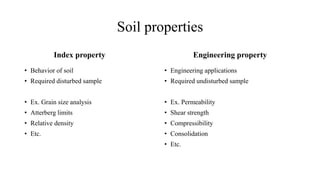
Soil properties
Index property
•Behavior of soil
• Required disturbed sample
• Ex. Grain size analysis
• Atterberg limits
• Relative density
• Etc.
Engineering property
• Engineering applications
• Required undisturbed sample
• Ex. Permeability
• Shear strength
• Compressibility
• Consolidation
• Etc.
4.
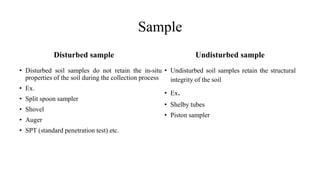
Sample
Disturbed sample
• Disturbedsoil samples do not retain the in-situ
properties of the soil during the collection process
• Ex.
• Split spoon sampler
• Shovel
• Auger
• SPT (standard penetration test) etc.
Undisturbed sample
• Undisturbed soil samples retain the structural
integrity of the soil
• Ex.
• Shelby tubes
• Piston sampler
based on graph
D10= 10% finer particle
D30 = 30% finer particle
D60 = 60% finer particle
Co-efficient of uniformity:
It measure of particle size range
1< Cu <2 = uniformly graded soil
Cu > 4 = well graded gravel
Cu > 6 = well graded sand
D30
Co-efficient of curvature : well graded soil 1 < Cc < 3
7.
Sedimentation analysis
• Performon less than 75µ grain size of soil
• Based on stokes law
• Stokes law valid for only 0.2µ to 0.2mm
8.
Sedimentation method
Pipette method
•Standard method
• Accurate method
• Dispersion solution 33gm sodium hexameta
phosphate and 7gm sodium carbonate mix in 1
liter solution
• Process of removal organic matter and
calcium compounds is known as pretreatment
Hydrometer
• Correction for hydrometer
• Meniscus correction +ve
• Dispersing correction –ve
• Temperature correction >27 degree +ve
• Temperature correction < 27 degree -ve
9.
Relative Density
Density index
Stateof
compaction
0-15% Very loose
15-35 Loose
35-65 Medium
65-85 Dense
85-100% Very dense
Ƴd = GƳw / ( 1+e)
Indicate compactness of soil
10.
Consistency chart /Atterberg limit
1. Liquid state
2. Plastic state
3. Semi- solid state
4. Solid state
Liquid limit
(WL )
Plastic limit
(WP)
shrinkage
limit(WS)
Degree of saturation Sr = 100%
Shrinkage limit (Ws)
Shrinkagelimit (Ws ) = [ { (Vd- Vs) × γw } / Wd ] × 100
Ws = e / G
Volumetric shrinkage =VS = [(V1 -Vd)/Vd] × 100
Shrinkage Ratio = SR = γd / γw
Shrinkage Ratio = SR = { [(V1 –V2)/Vd] × 100 } / (W1- W2)
15.
Important Indices
Plasticity index(Ip)
• Ip = WL-WP
• WL < Wp then Ip = 0
• Ip = 0.73(WL – 20%) A-line
• Ip = 0.9(WL – 8%) U-line
Range of soil condition
Ip Condition
0 Non – plastic
<7 Low plastic
7-17 Medium plastic
>17 Highly plastic
Important Indices
Liquidity index(IL)
• IL= [ W-Wp ] ×100
Ip
Consistency index (IC)
• IC= [ WL-W ] ×100
Ip
• Note : IC + IL = 1 or 100 %
Range of soil condition
Ic Condition
0-25 Very soft
25-50 Soft
50-75 Medium
75-100 Stiff
>100 Very stiff
18.
Activity (A)
• A= Ip/C
• C = percentage of clay fraction
• Water holding capacity
A Condition
<0.75 Inactive
0.75 to 1.25 Normal
>1.25 Active
>4 Highly Active
19.
Q & A
Thecoefficients of uniformity and curvature of a soil are 4 and 1 respectively the ratio D30/D10 will be
A) 1
B) 2
C) 3
D) 4
20.
Q & A
Thecoefficients of uniformity and curvature of a soil are 4 and 1 respectively the ratio D30/D10 will be
A) 1
B) 2
C) 3
D) 4




![Shrinkage limit (Ws)
Shrinkage limit (Ws ) = [ { (Vd- Vs) × γw } / Wd ] × 100
Ws = e / G
Volumetric shrinkage =VS = [(V1 -Vd)/Vd] × 100
Shrinkage Ratio = SR = γd / γw
Shrinkage Ratio = SR = { [(V1 –V2)/Vd] × 100 } / (W1- W2)](https://image.slidesharecdn.com/indexproperty-201111060249/85/Index-property-14-320.jpg)


![Important Indices
Liquidity index (IL)
• IL= [ W-Wp ] ×100
Ip
Consistency index (IC)
• IC= [ WL-W ] ×100
Ip
• Note : IC + IL = 1 or 100 %
Range of soil condition
Ic Condition
0-25 Very soft
25-50 Soft
50-75 Medium
75-100 Stiff
>100 Very stiff](https://image.slidesharecdn.com/indexproperty-201111060249/85/Index-property-17-320.jpg)


