STATISTICS
Presentation No. 1
Presented To
Prof. Kashif Noor
Presented By:
Danyal Ahmad
INTRODUCTION
 An Index Number measures the relative
change in price, quantity, value, or some other
item of interest from one time period to other.
 A simple index number measures the relative
change in one or more then one variable
DEFINITION
Index number is method which is used to
measure the change in price level. It is normally
expressed in terms of percentage.
CHARACTERISTICS OF INDEX NUMBER
oIndex numbers are specialized averages.
o Index numbers measures the change in the level
of phenomenon (situations, current happenings,
facts).
o Index number measures the effect of changes
over the period of time.
USES OF INDEX NUMBERS
o Compare:
* Prices
* Quantities
* Uses
of different items of different years with respect
to some specific year.
o Index numbers reveal the trends and
tendencies.
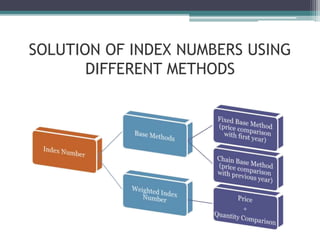
SOLUTION OF INDEX NUMBERS USING
DIFFERENT METHODS
FIXED BASE METHOD
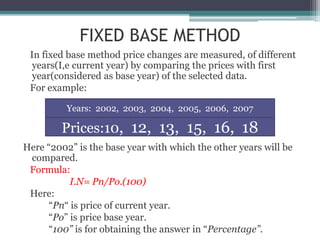
In fixed base method price changes are measured, of different
years(I,e current year) by comparing the prices with first
year(considered as base year) of the selected data.
For example:
Here “2002” is the base year with which the other years will be
compared.
Formula:
I.N= Pn/Po.(100)
Here:
“Pn“ is price of current year.
“Po” is price base year.
“100” is for obtaining the answer in “Percentage”.
Years: 2002, 2003, 2004, 2005, 2006, 2007
Prices:10, 12, 13, 15, 16, 18
SOLVING FIXED BASE METHOD
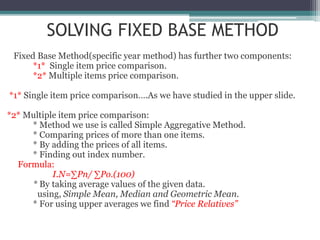
Fixed Base Method(specific year method) has further two components:
*1* Single item price comparison.
*2* Multiple items price comparison.
*1* Single item price comparison….As we have studied in the upper slide.
*2* Multiple item price comparison:
* Method we use is called Simple Aggregative Method.
* Comparing prices of more than one items.
* By adding the prices of all items.
* Finding out index number.
Formula:
I.N=∑Pn/ ∑Po.(100)
* By taking average values of the given data.
using, Simple Mean, Median and Geometric Mean.
* For using upper averages we find “Price Relatives”
CHAIN BASE METHOD
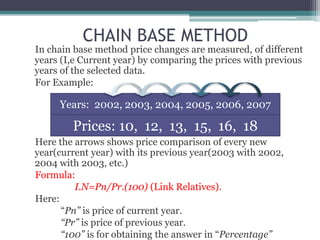
In chain base method price changes are measured, of different
years (I,e Current year) by comparing the prices with previous
years of the selected data.
For Example:
Here the arrows shows price comparison of every new
year(current year) with its previous year(2003 with 2002,
2004 with 2003, etc.)
Formula:
I.N=Pn/Pr.(100) (Link Relatives).
Here:
“Pn” is price of current year.
“Pr” is price of previous year.
“100” is for obtaining the answer in “Percentage”
Years: 2002, 2003, 2004, 2005, 2006, 2007
Prices: 10, 12, 13, 15, 16, 18
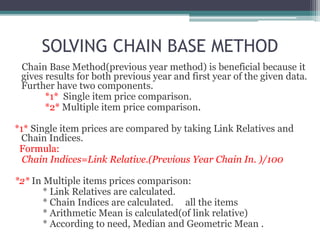
SOLVING CHAIN BASE METHOD
Chain Base Method(previous year method) is beneficial because it
gives results for both previous year and first year of the given data.
Further have two components.
*1* Single item price comparison.
*2* Multiple item price comparison.
*1* Single item prices are compared by taking Link Relatives and
Chain Indices.
Formula:
Chain Indices=Link Relative.(Previous Year Chain In. )/100
*2* In Multiple items prices comparison:
* Link Relatives are calculated.
* Chain Indices are calculated. all the items
* Arithmetic Mean is calculated(of link relative)
* According to need, Median and Geometric Mean .
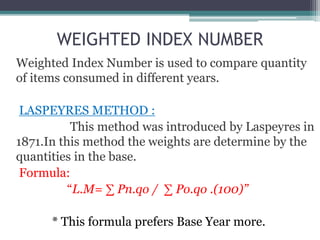
WEIGHTED INDEX NUMBER
Weighted Index Number is used to compare quantity
of items consumed in different years.
LASPEYRES METHOD :
This method was introduced by Laspeyres in
1871.In this method the weights are determine by the
quantities in the base.
Formula:
“L.M= ∑ Pn.qo / ∑ Po.qo .(100)”
* This formula prefers Base Year more.
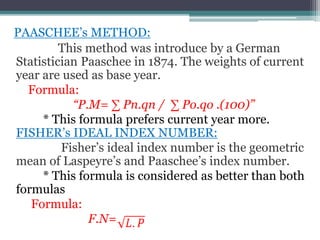
PAASCHEE’s METHOD:
This method was introduce by a German
Statistician Paaschee in 1874. The weights of current
year are used as base year.
Formula:
“P.M= ∑ Pn.qn / ∑ Po.qo .(100)”
* This formula prefers current year more.
FISHER’s IDEAL INDEX NUMBER:
Fisher’s ideal index number is the geometric
mean of Laspeyre’s and Paaschee’s index number.
* This formula is considered as better than both
formulas
Formula:
F.N=
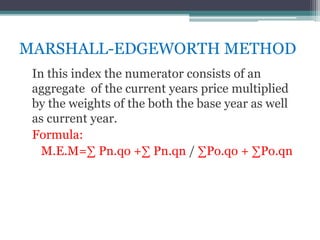
MARSHALL-EDGEWORTH METHOD
In this index the numerator consists of an
aggregate of the current years price multiplied
by the weights of the both the base year as well
as current year.
Formula:
M.E.M=∑ Pn.qo +∑ Pn.qn / ∑Po.qo + ∑Po.qn

Index number

  • 1.
    STATISTICS Presentation No. 1 PresentedTo Prof. Kashif Noor Presented By: Danyal Ahmad
  • 2.
    INTRODUCTION  An IndexNumber measures the relative change in price, quantity, value, or some other item of interest from one time period to other.  A simple index number measures the relative change in one or more then one variable
  • 3.
    DEFINITION Index number ismethod which is used to measure the change in price level. It is normally expressed in terms of percentage.
  • 4.
    CHARACTERISTICS OF INDEXNUMBER oIndex numbers are specialized averages. o Index numbers measures the change in the level of phenomenon (situations, current happenings, facts). o Index number measures the effect of changes over the period of time.
  • 5.
    USES OF INDEXNUMBERS o Compare: * Prices * Quantities * Uses of different items of different years with respect to some specific year. o Index numbers reveal the trends and tendencies.
  • 6.
    SOLUTION OF INDEXNUMBERS USING DIFFERENT METHODS
  • 7.
    FIXED BASE METHOD Infixed base method price changes are measured, of different years(I,e current year) by comparing the prices with first year(considered as base year) of the selected data. For example: Here “2002” is the base year with which the other years will be compared. Formula: I.N= Pn/Po.(100) Here: “Pn“ is price of current year. “Po” is price base year. “100” is for obtaining the answer in “Percentage”. Years: 2002, 2003, 2004, 2005, 2006, 2007 Prices:10, 12, 13, 15, 16, 18
  • 8.
    SOLVING FIXED BASEMETHOD Fixed Base Method(specific year method) has further two components: *1* Single item price comparison. *2* Multiple items price comparison. *1* Single item price comparison….As we have studied in the upper slide. *2* Multiple item price comparison: * Method we use is called Simple Aggregative Method. * Comparing prices of more than one items. * By adding the prices of all items. * Finding out index number. Formula: I.N=∑Pn/ ∑Po.(100) * By taking average values of the given data. using, Simple Mean, Median and Geometric Mean. * For using upper averages we find “Price Relatives”
  • 9.
    CHAIN BASE METHOD Inchain base method price changes are measured, of different years (I,e Current year) by comparing the prices with previous years of the selected data. For Example: Here the arrows shows price comparison of every new year(current year) with its previous year(2003 with 2002, 2004 with 2003, etc.) Formula: I.N=Pn/Pr.(100) (Link Relatives). Here: “Pn” is price of current year. “Pr” is price of previous year. “100” is for obtaining the answer in “Percentage” Years: 2002, 2003, 2004, 2005, 2006, 2007 Prices: 10, 12, 13, 15, 16, 18
  • 10.
    SOLVING CHAIN BASEMETHOD Chain Base Method(previous year method) is beneficial because it gives results for both previous year and first year of the given data. Further have two components. *1* Single item price comparison. *2* Multiple item price comparison. *1* Single item prices are compared by taking Link Relatives and Chain Indices. Formula: Chain Indices=Link Relative.(Previous Year Chain In. )/100 *2* In Multiple items prices comparison: * Link Relatives are calculated. * Chain Indices are calculated. all the items * Arithmetic Mean is calculated(of link relative) * According to need, Median and Geometric Mean .
  • 11.
    WEIGHTED INDEX NUMBER WeightedIndex Number is used to compare quantity of items consumed in different years. LASPEYRES METHOD : This method was introduced by Laspeyres in 1871.In this method the weights are determine by the quantities in the base. Formula: “L.M= ∑ Pn.qo / ∑ Po.qo .(100)” * This formula prefers Base Year more.
  • 12.
    PAASCHEE’s METHOD: This methodwas introduce by a German Statistician Paaschee in 1874. The weights of current year are used as base year. Formula: “P.M= ∑ Pn.qn / ∑ Po.qo .(100)” * This formula prefers current year more. FISHER’s IDEAL INDEX NUMBER: Fisher’s ideal index number is the geometric mean of Laspeyre’s and Paaschee’s index number. * This formula is considered as better than both formulas Formula: F.N=
  • 13.
    MARSHALL-EDGEWORTH METHOD In thisindex the numerator consists of an aggregate of the current years price multiplied by the weights of the both the base year as well as current year. Formula: M.E.M=∑ Pn.qo +∑ Pn.qn / ∑Po.qo + ∑Po.qn