


Challenges in Systematic Reviews—Can Using Existing Reviews Save   Time? Be Valid?   Evelyn P. Whitlock, MD, MPH Associate Director, Oregon Evidence-based Practice Center Senior Investigator, Center for Health Research, KPNW Jennifer Lin, MD, MCR Center for Health Research, KPNW Roger Chou, MD Oregon Health & Science University July 11, 2008
Acknowledgments Karen Robinson, MSc Paul Shekelle, MD, PhD Ed Reid, MS The USPSTF review team at Oregon EPC
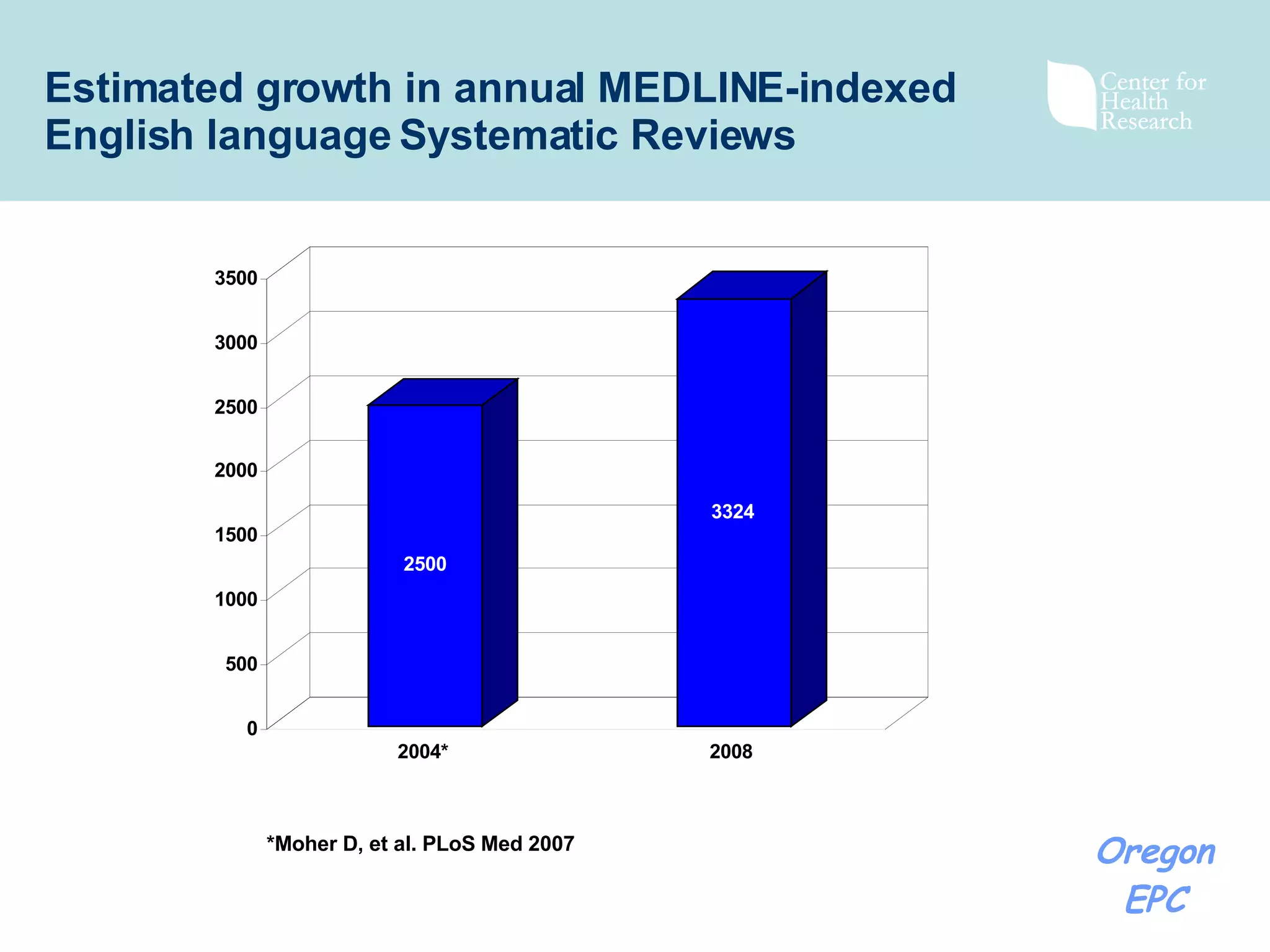
There has been an   exponential growth   in the production of systematic reviews Reviewers of commissioned reviews must address   whether and how to use existing systematic reviews   in their new reviews Current systematic review methods do not clearly address this   common practice Background
Estimated growth in annual MEDLINE-indexed English language Systematic Reviews   *Moher D, et al. PLoS Med 2007
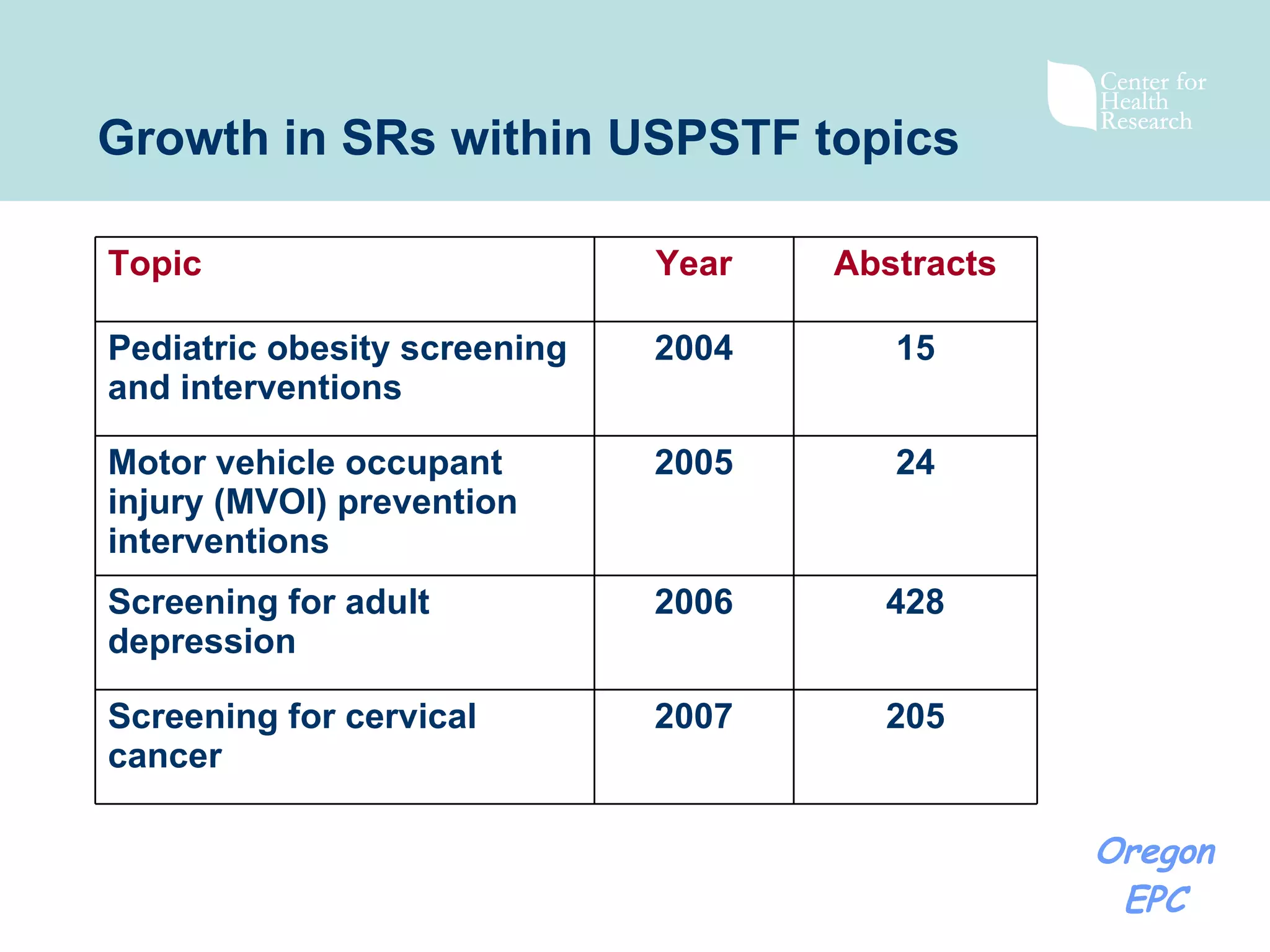
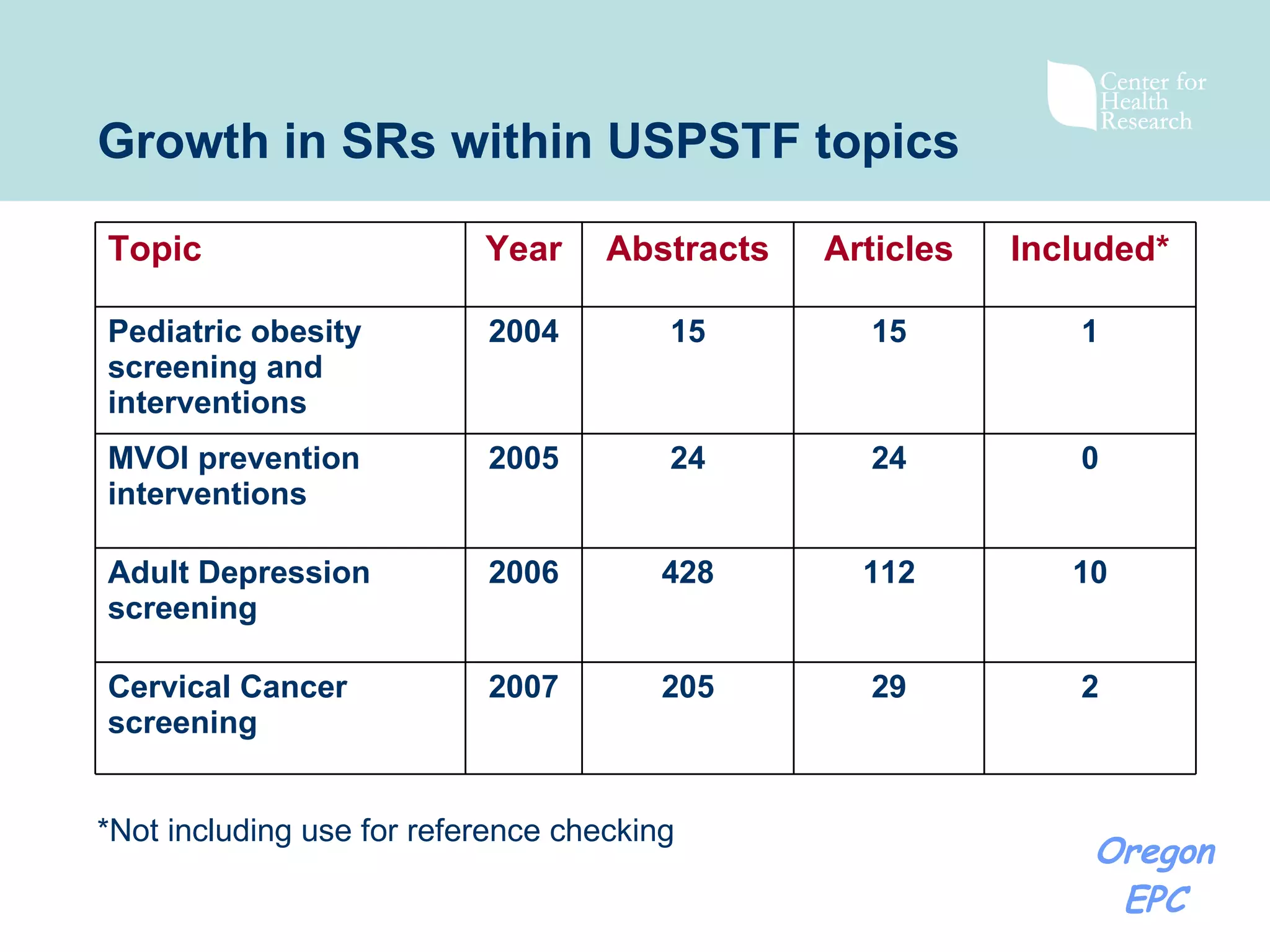
Growth in SRs within USPSTF topics 205 2007 Screening for cervical cancer  428 2006 Screening for adult depression 24 2005 Motor vehicle occupant injury (MVOI) prevention interventions 15 2004 Pediatric obesity screening and interventions Abstracts Year Topic
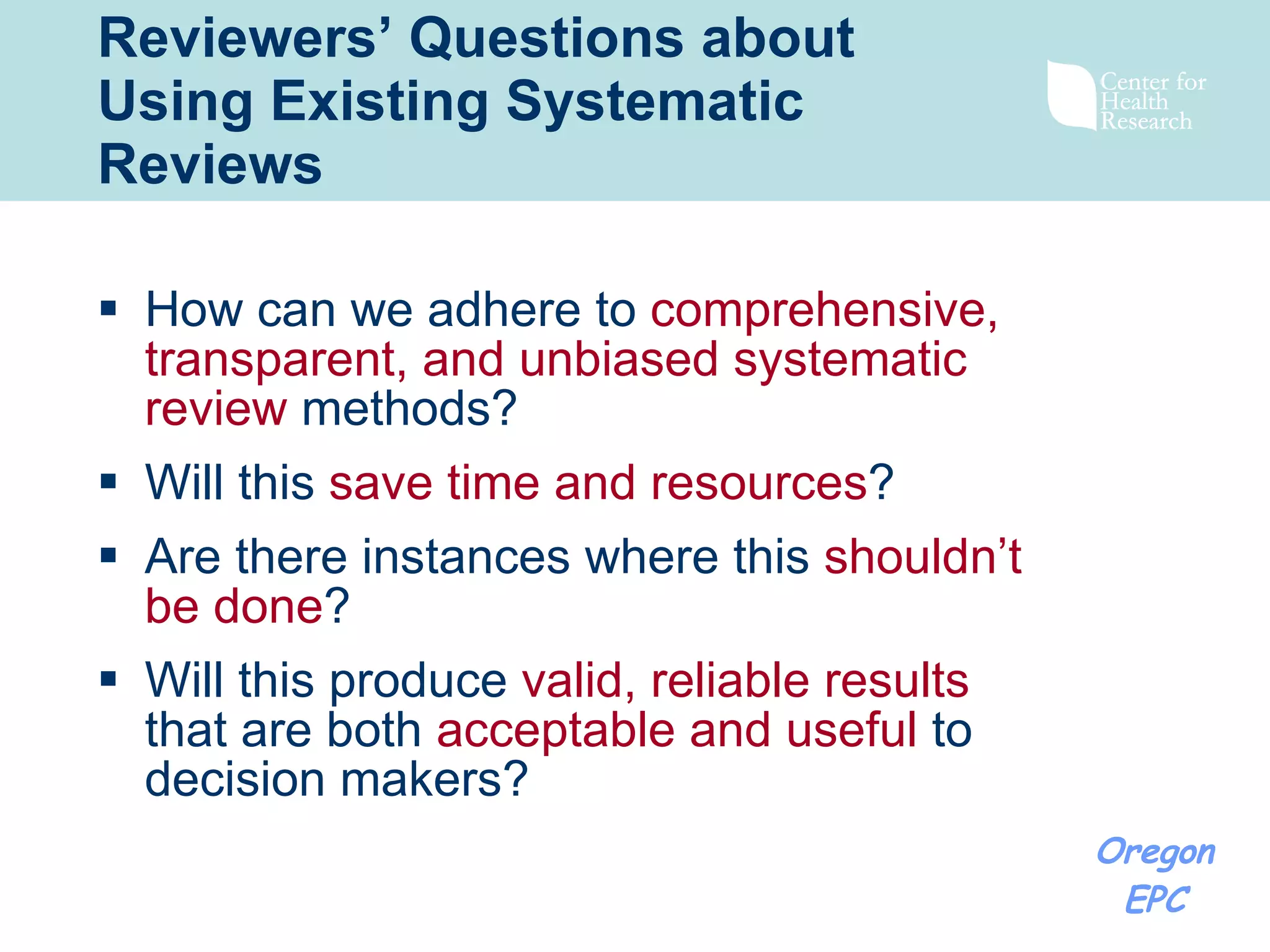
Reviewers’ Questions about Using Existing Systematic Reviews How can we adhere to  comprehensive, transparent, and unbiased systematic review  methods?  Will this  save time and resources ?  Are there instances where this  shouldn’t be done ? Will this produce  valid, reliable results  that are both  acceptable and useful  to decision makers?
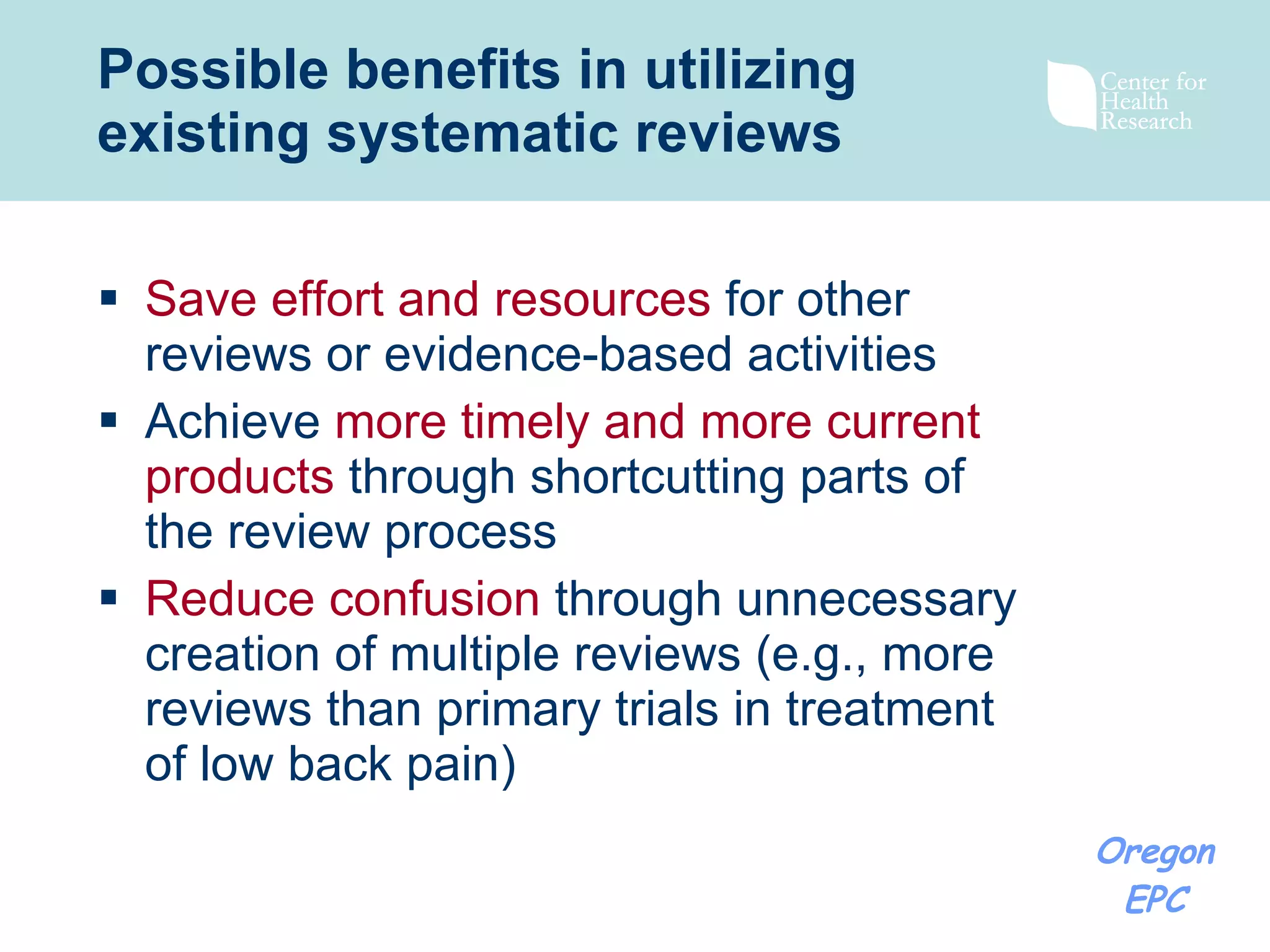
Possible benefits in utilizing existing systematic reviews Save effort and resources  for other reviews or evidence-based activities Achieve  more timely and more current products  through shortcutting parts of the review process Reduce confusion  through unnecessary creation of multiple reviews (e.g., more reviews than primary trials in treatment of low back pain)
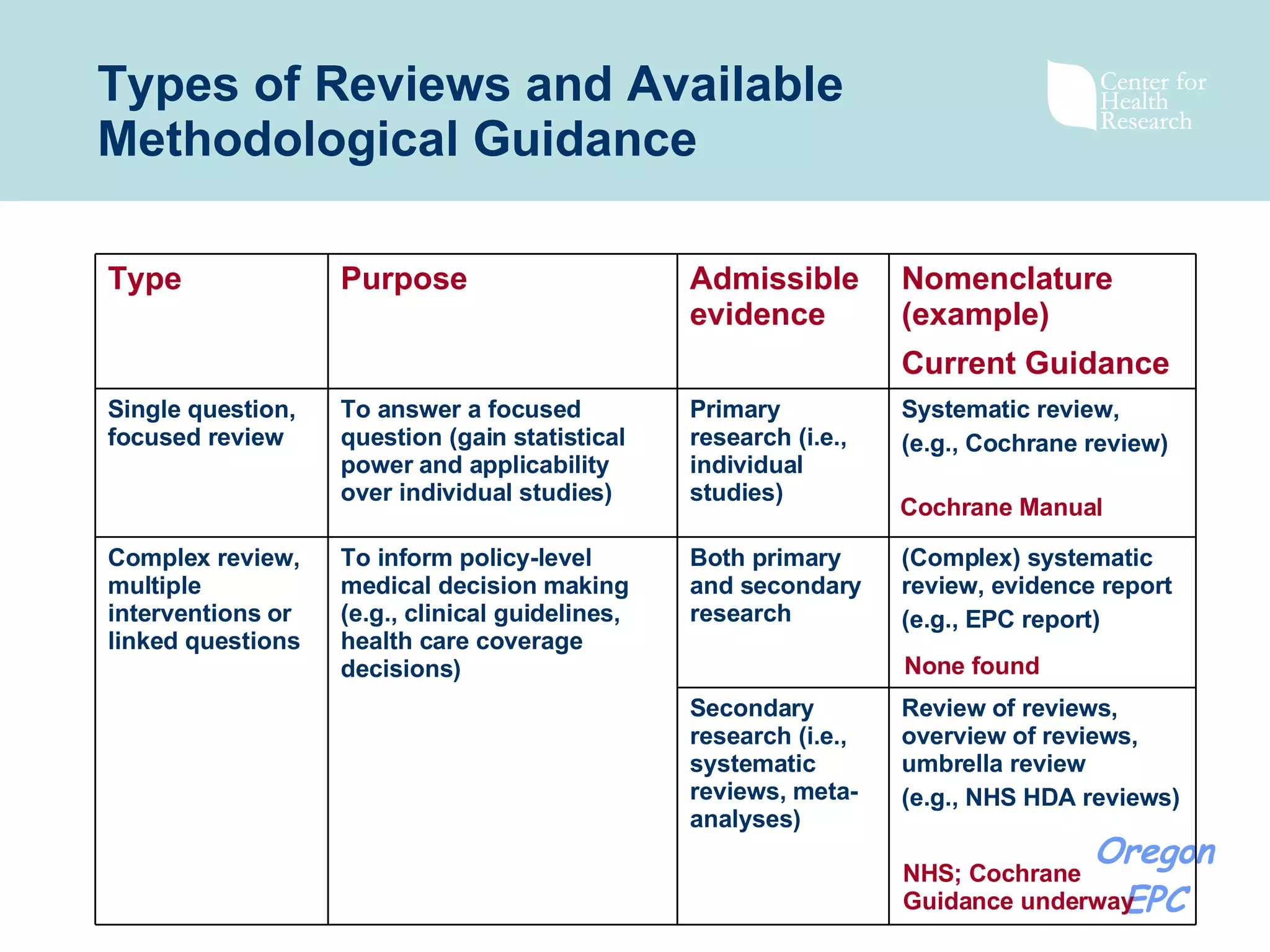
Types of Reviews and Available Methodological Guidance Current Guidance NHS; Cochrane Guidance underway Cochrane Manual None found Review of reviews, overview of reviews, umbrella review (e.g., NHS HDA reviews) Secondary research (i.e., systematic reviews, meta-analyses) (Complex) systematic review, evidence report  (e.g., EPC report) Both primary and secondary research To inform policy-level medical decision making (e.g., clinical guidelines, health care coverage decisions) Complex review, multiple interventions or linked questions Systematic review,  (e.g., Cochrane review) Primary research (i.e., individual studies) To answer a focused question (gain statistical power and applicability over individual studies) Single question, focused review Nomenclature (example) Admissible evidence Purpose Type
 
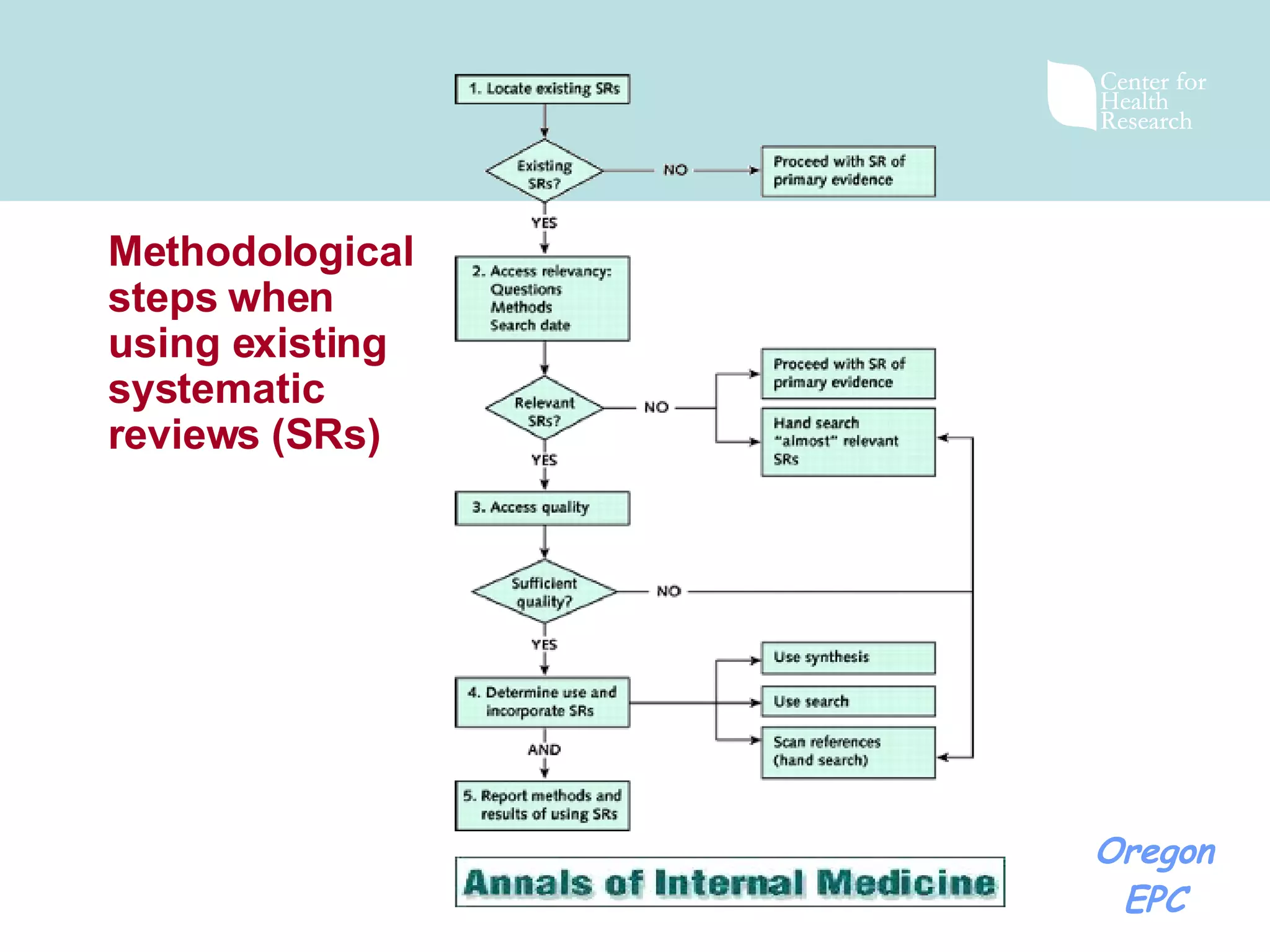
Methodological steps when using existing systematic reviews (SRs)
Does it save time/resources?
Growth in SRs within USPSTF topics *Not including use for reference checking 2 29 205 2007 Cervical Cancer screening 10 112 428 2006 Adult Depression screening 0 24 24 2005 MVOI prevention interventions 1 15 15 2004 Pediatric obesity screening and interventions Included* Articles Abstracts Year Topic
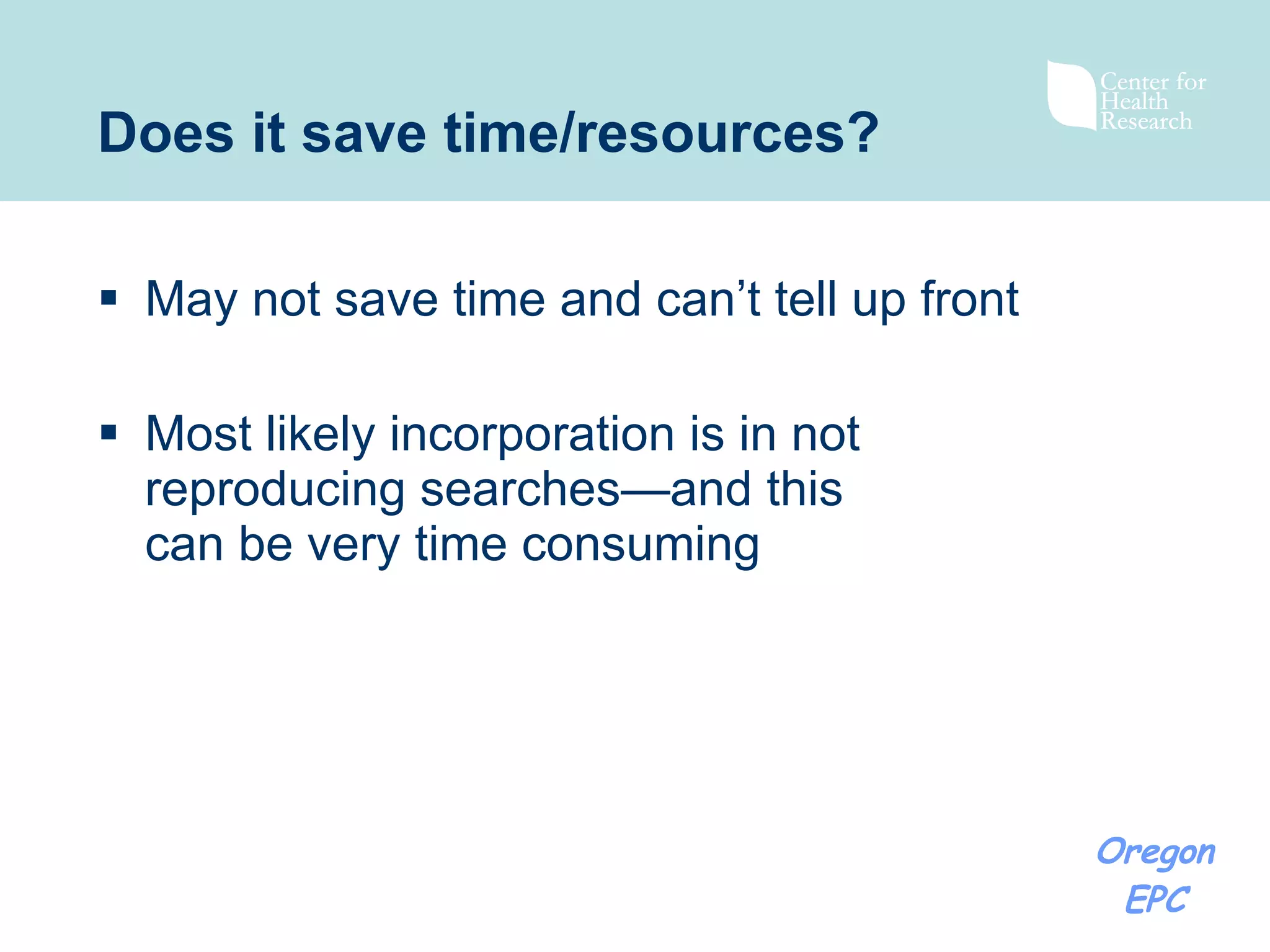
Does it save time/resources? May not save time and can’t tell up front Most likely incorporation is in not reproducing searches—and this can be very time consuming
When may a new review be needed? Discordant reviews High-profile topics Substantial differences in methods employed Substantial differences in research questions
Other possible hazards in using existing SR Prior review may not always be valid Propagation of error Incomplete methods/relative inexperience  may introduce reviewer bias or random error HOWEVER, rejecting prior reviews out of hand is illogical
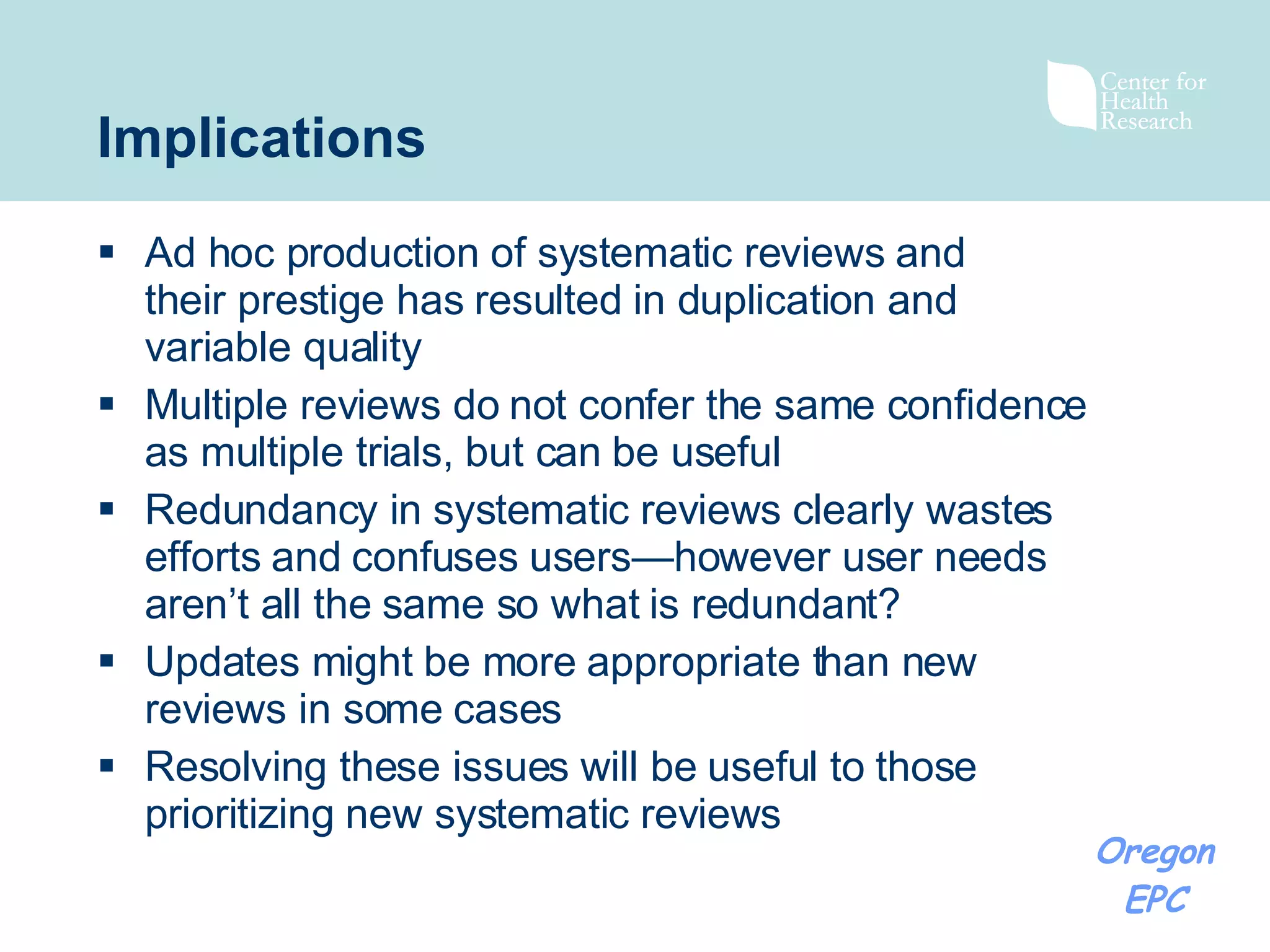
Implications Ad hoc production of systematic reviews and their prestige has resulted in duplication and variable quality Multiple reviews do not confer the same confidence as multiple trials, but can be useful Redundancy in systematic reviews clearly wastes efforts and confuses users—however user needs aren’t all the same so what is redundant? Updates might be more appropriate than new reviews in some cases Resolving these issues will be useful to those prioritizing new systematic reviews
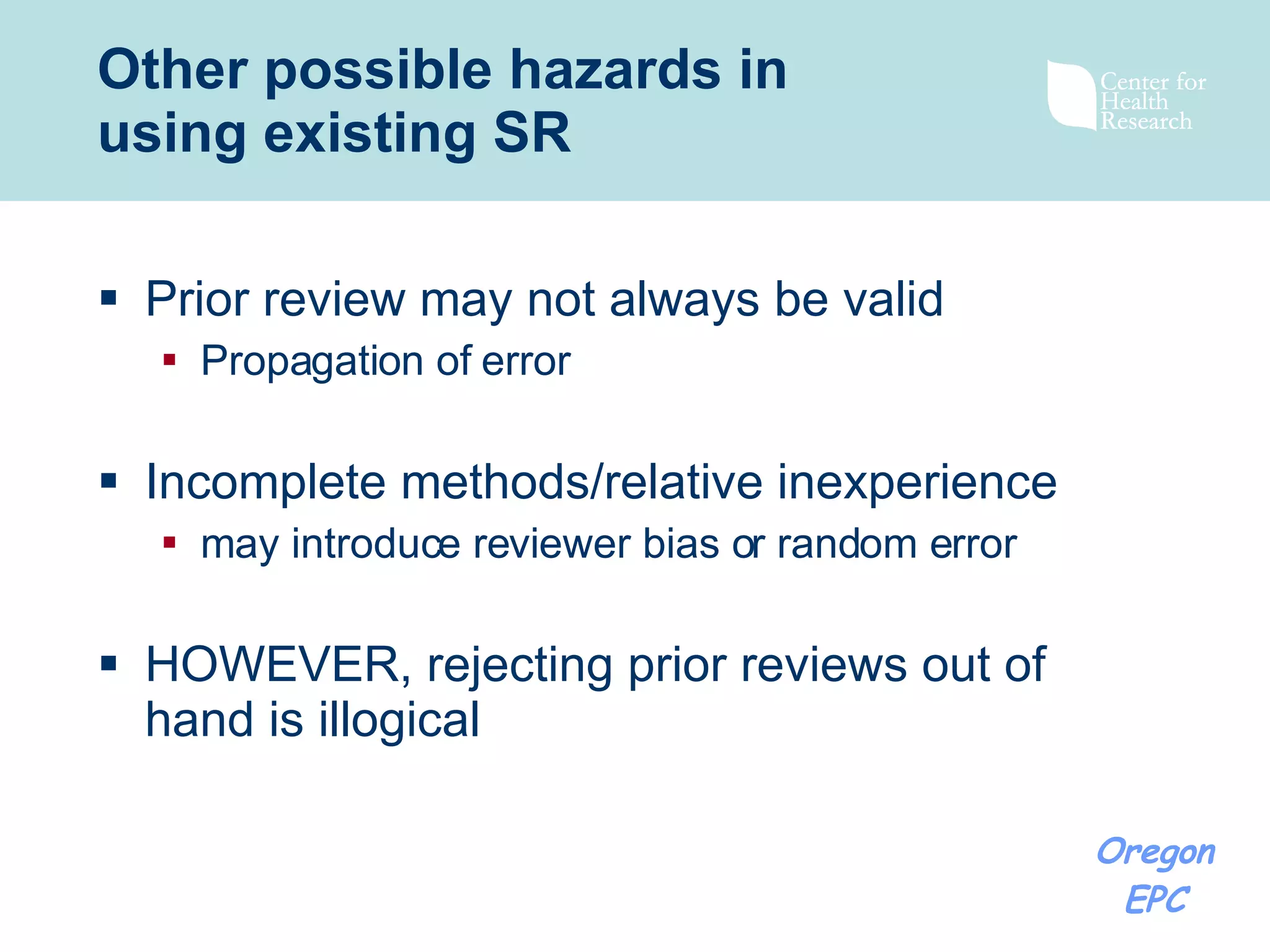
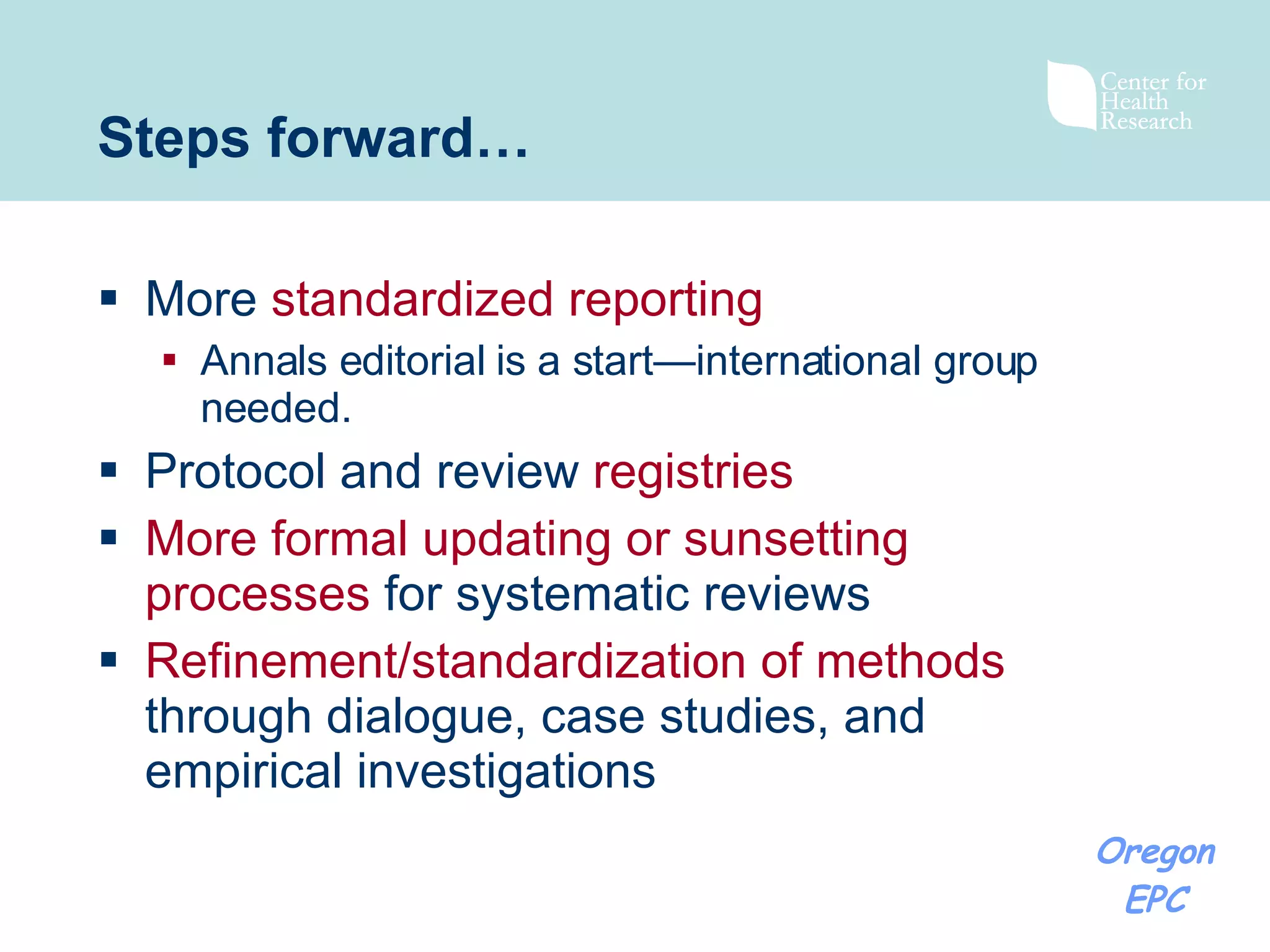
Steps forward… More  standardized reporting   Annals editorial is a start—international group needed. Protocol and review  registries More formal updating or sunsetting processes   for systematic reviews Refinement/standardization of methods  through dialogue, case studies, and empirical investigations
 
OHSU EPC –   http://www.ohsu.edu/epc KPCHR   –   http://www.kpchr.org/public/default.aspx AHRQ’s   Effective Health Care Program –   http://effectivehealthcare.ahrq.gov/ USPSTF   –   http://www.ahrq.gov/clinic/uspstfix.htm Websites
Comments & Questions

Incorporating systematic reviews into other systematic reviews: Can we save time and be valid?

  • 1.
    Challenges in SystematicReviews—Can Using Existing Reviews Save   Time? Be Valid? Evelyn P. Whitlock, MD, MPH Associate Director, Oregon Evidence-based Practice Center Senior Investigator, Center for Health Research, KPNW Jennifer Lin, MD, MCR Center for Health Research, KPNW Roger Chou, MD Oregon Health & Science University July 11, 2008
  • 2.
    Acknowledgments Karen Robinson,MSc Paul Shekelle, MD, PhD Ed Reid, MS The USPSTF review team at Oregon EPC
  • 3.
    There has beenan exponential growth in the production of systematic reviews Reviewers of commissioned reviews must address whether and how to use existing systematic reviews in their new reviews Current systematic review methods do not clearly address this common practice Background
  • 4.
    Estimated growth inannual MEDLINE-indexed English language Systematic Reviews *Moher D, et al. PLoS Med 2007
  • 5.
    Growth in SRswithin USPSTF topics 205 2007 Screening for cervical cancer 428 2006 Screening for adult depression 24 2005 Motor vehicle occupant injury (MVOI) prevention interventions 15 2004 Pediatric obesity screening and interventions Abstracts Year Topic
  • 6.
    Reviewers’ Questions aboutUsing Existing Systematic Reviews How can we adhere to comprehensive, transparent, and unbiased systematic review methods? Will this save time and resources ? Are there instances where this shouldn’t be done ? Will this produce valid, reliable results that are both acceptable and useful to decision makers?
  • 7.
    Possible benefits inutilizing existing systematic reviews Save effort and resources for other reviews or evidence-based activities Achieve more timely and more current products through shortcutting parts of the review process Reduce confusion through unnecessary creation of multiple reviews (e.g., more reviews than primary trials in treatment of low back pain)
  • 8.
    Types of Reviewsand Available Methodological Guidance Current Guidance NHS; Cochrane Guidance underway Cochrane Manual None found Review of reviews, overview of reviews, umbrella review (e.g., NHS HDA reviews) Secondary research (i.e., systematic reviews, meta-analyses) (Complex) systematic review, evidence report (e.g., EPC report) Both primary and secondary research To inform policy-level medical decision making (e.g., clinical guidelines, health care coverage decisions) Complex review, multiple interventions or linked questions Systematic review, (e.g., Cochrane review) Primary research (i.e., individual studies) To answer a focused question (gain statistical power and applicability over individual studies) Single question, focused review Nomenclature (example) Admissible evidence Purpose Type
  • 9.
  • 10.
    Methodological steps whenusing existing systematic reviews (SRs)
  • 11.
    Does it savetime/resources?
  • 12.
    Growth in SRswithin USPSTF topics *Not including use for reference checking 2 29 205 2007 Cervical Cancer screening 10 112 428 2006 Adult Depression screening 0 24 24 2005 MVOI prevention interventions 1 15 15 2004 Pediatric obesity screening and interventions Included* Articles Abstracts Year Topic
  • 13.
    Does it savetime/resources? May not save time and can’t tell up front Most likely incorporation is in not reproducing searches—and this can be very time consuming
  • 14.
    When may anew review be needed? Discordant reviews High-profile topics Substantial differences in methods employed Substantial differences in research questions
  • 15.
    Other possible hazardsin using existing SR Prior review may not always be valid Propagation of error Incomplete methods/relative inexperience may introduce reviewer bias or random error HOWEVER, rejecting prior reviews out of hand is illogical
  • 16.
    Implications Ad hocproduction of systematic reviews and their prestige has resulted in duplication and variable quality Multiple reviews do not confer the same confidence as multiple trials, but can be useful Redundancy in systematic reviews clearly wastes efforts and confuses users—however user needs aren’t all the same so what is redundant? Updates might be more appropriate than new reviews in some cases Resolving these issues will be useful to those prioritizing new systematic reviews
  • 17.
    Steps forward… More standardized reporting Annals editorial is a start—international group needed. Protocol and review registries More formal updating or sunsetting processes for systematic reviews Refinement/standardization of methods through dialogue, case studies, and empirical investigations
  • 18.
  • 19.
    OHSU EPC – http://www.ohsu.edu/epc KPCHR – http://www.kpchr.org/public/default.aspx AHRQ’s Effective Health Care Program – http://effectivehealthcare.ahrq.gov/ USPSTF – http://www.ahrq.gov/clinic/uspstfix.htm Websites
  • 20.

Editor's Notes

  • #2 As a reminder, the conference is about setting priorities in systematic reviews, so I would steer you towards this perspective in your talks.  In the new talk on using systematic reviews, I would think the discussion would center around the resource savings accomplished by using existing reviews (and thus the ability to do more reviews or update more existing reviews) vs the potential for quality loss. You cover these items in you paper, I just wanted to make sure we focus the talks in the same direction as the conference as a whole.