Evidence Based Practice
       Carolyn Schubert
      schubecf@jmu.edu
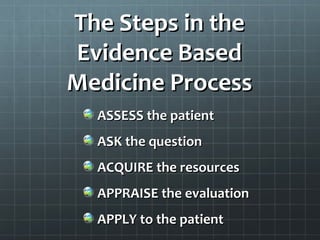
The Steps in the
Evidence Based
Medicine Process
  ASSESS the patient
  ASK the question
  ACQUIRE the resources
  APPRAISE the evaluation
  APPLY to the patient
Begin with a Question
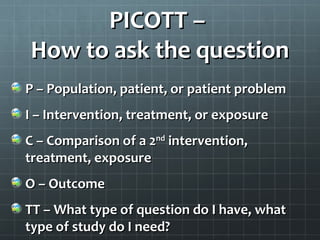
PICO or PICOTT –
How to ask the question
P – Population, patient, or patient problem
I – Intervention, treatment, or exposure
C – Comparison of a 2nd intervention,
treatment, exposure
O – Outcome
TT – What type of question do I have, what
type of study do I need?
For Some
Practice Developing
    PICO(TT)s

    Click Here
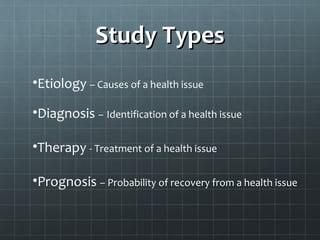
Study Types
•Etiology – Causes of a health issue

•Diagnosis – Identification of a health issue

•Therapy - Treatment of a health issue

•Prognosis – Probability of recovery
Mining the Article
         Databases
With a well-formed PICOTT question, now
 you are ready to start searching for and
       collecting groups of results
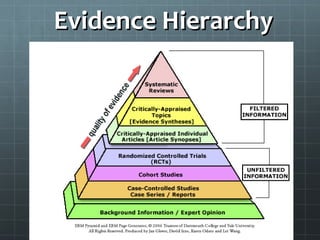
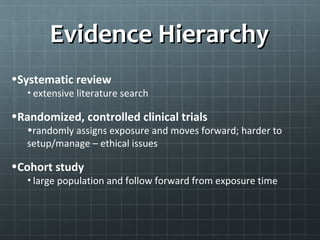
Evidence Hierarchy
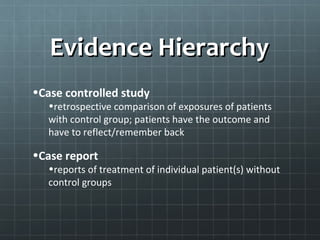
Evidence Hierarchy
•Systematic review
   • extensive literature search


•Randomized, controlled clinical trials
   •randomly assigns exposure and moves forward; harder to
   setup/manage – ethical issues

•Cohort study
   • large population and follow forward from exposure time
Evidence Hierarchy
•Case controlled study
  •retrospective comparison of exposures of patients
  with control group; patients have the outcome and
  have to reflect/remember back

•Case report
  •reports of treatment of individual patient(s) without
  control groups
Evaluating the Quality of
    Individual Articles
With a smaller list of key articles, now you
need to use a fine tooth comb to evaluate
   if the article results are reliable and
         applicable to your patient
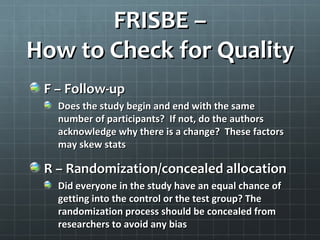
FRISBE –
How to Check for Quality
 F – Follow-up
   Does the study begin and end with the same
   number of participants? If not, do the authors
   acknowledge why there is a change? These factors
   may skew stats

 R – Randomization/concealed allocation
   Did everyone in the study have an equal chance of
   getting into the control or the test group? The
   randomization process should be concealed from
   researchers to avoid any bias
FRISBE –
How to Check for Quality
• I – Intention to treat
  • Although some patients may refuse or be
    noncompliant with treatment (real or placebo), you
    still need to count them in the results and note the
    intention

• S – Similar at baseline
  • Patients should be similar so you don’t compare
    very different populations (imagine athletes vs
    morbidly obese people testing a diet pill)
FRISBE –
How to Check for Quality
• B – Blinding
  • In the healthcare setting, the health care providers must
    be blinded from knowing who is getting the test and
    who is getting the placebo to avoid bias

• E – Equal treatment
  • Treatments (other than the test) should be the same
    across groups, otherwise you can’t determine if that
    specific intervention did or didn’t work or if other
    factors affected the results
Questions for
     Systematic
Reviews/Meta-Analysis
Was the question focused?
Was a thorough review of the literature
(including grey literature) completed?
Do they have clear validity criteria?
Are the assessments reproducible?
For Some
Practice with Evidence
   Based Practice

   QUIZ Yourself!

Evidence Based Practice

  • 1.
    Evidence Based Practice Carolyn Schubert schubecf@jmu.edu
  • 2.
    The Steps inthe Evidence Based Medicine Process ASSESS the patient ASK the question ACQUIRE the resources APPRAISE the evaluation APPLY to the patient
  • 3.
    Begin with aQuestion
  • 4.
    PICO or PICOTT– How to ask the question P – Population, patient, or patient problem I – Intervention, treatment, or exposure C – Comparison of a 2nd intervention, treatment, exposure O – Outcome TT – What type of question do I have, what type of study do I need?
  • 5.
    For Some Practice Developing PICO(TT)s Click Here
  • 6.
    Study Types •Etiology –Causes of a health issue •Diagnosis – Identification of a health issue •Therapy - Treatment of a health issue •Prognosis – Probability of recovery
  • 7.
    Mining the Article Databases With a well-formed PICOTT question, now you are ready to start searching for and collecting groups of results
  • 8.
  • 9.
    Evidence Hierarchy •Systematic review • extensive literature search •Randomized, controlled clinical trials •randomly assigns exposure and moves forward; harder to setup/manage – ethical issues •Cohort study • large population and follow forward from exposure time
  • 10.
    Evidence Hierarchy •Case controlledstudy •retrospective comparison of exposures of patients with control group; patients have the outcome and have to reflect/remember back •Case report •reports of treatment of individual patient(s) without control groups
  • 11.
    Evaluating the Qualityof Individual Articles With a smaller list of key articles, now you need to use a fine tooth comb to evaluate if the article results are reliable and applicable to your patient
  • 12.
    FRISBE – How toCheck for Quality F – Follow-up Does the study begin and end with the same number of participants? If not, do the authors acknowledge why there is a change? These factors may skew stats R – Randomization/concealed allocation Did everyone in the study have an equal chance of getting into the control or the test group? The randomization process should be concealed from researchers to avoid any bias
  • 13.
    FRISBE – How toCheck for Quality • I – Intention to treat • Although some patients may refuse or be noncompliant with treatment (real or placebo), you still need to count them in the results and note the intention • S – Similar at baseline • Patients should be similar so you don’t compare very different populations (imagine athletes vs morbidly obese people testing a diet pill)
  • 14.
    FRISBE – How toCheck for Quality • B – Blinding • In the healthcare setting, the health care providers must be blinded from knowing who is getting the test and who is getting the placebo to avoid bias • E – Equal treatment • Treatments (other than the test) should be the same across groups, otherwise you can’t determine if that specific intervention did or didn’t work or if other factors affected the results
  • 15.
    Questions for Systematic Reviews/Meta-Analysis Was the question focused? Was a thorough review of the literature (including grey literature) completed? Do they have clear validity criteria? Are the assessments reproducible?
  • 16.
    For Some Practice withEvidence Based Practice QUIZ Yourself!

Editor's Notes

  • #13 Follow up – Randomization/concealed allocation –Intention to treat – Similar at baseline –Blinding – Equal treatment –