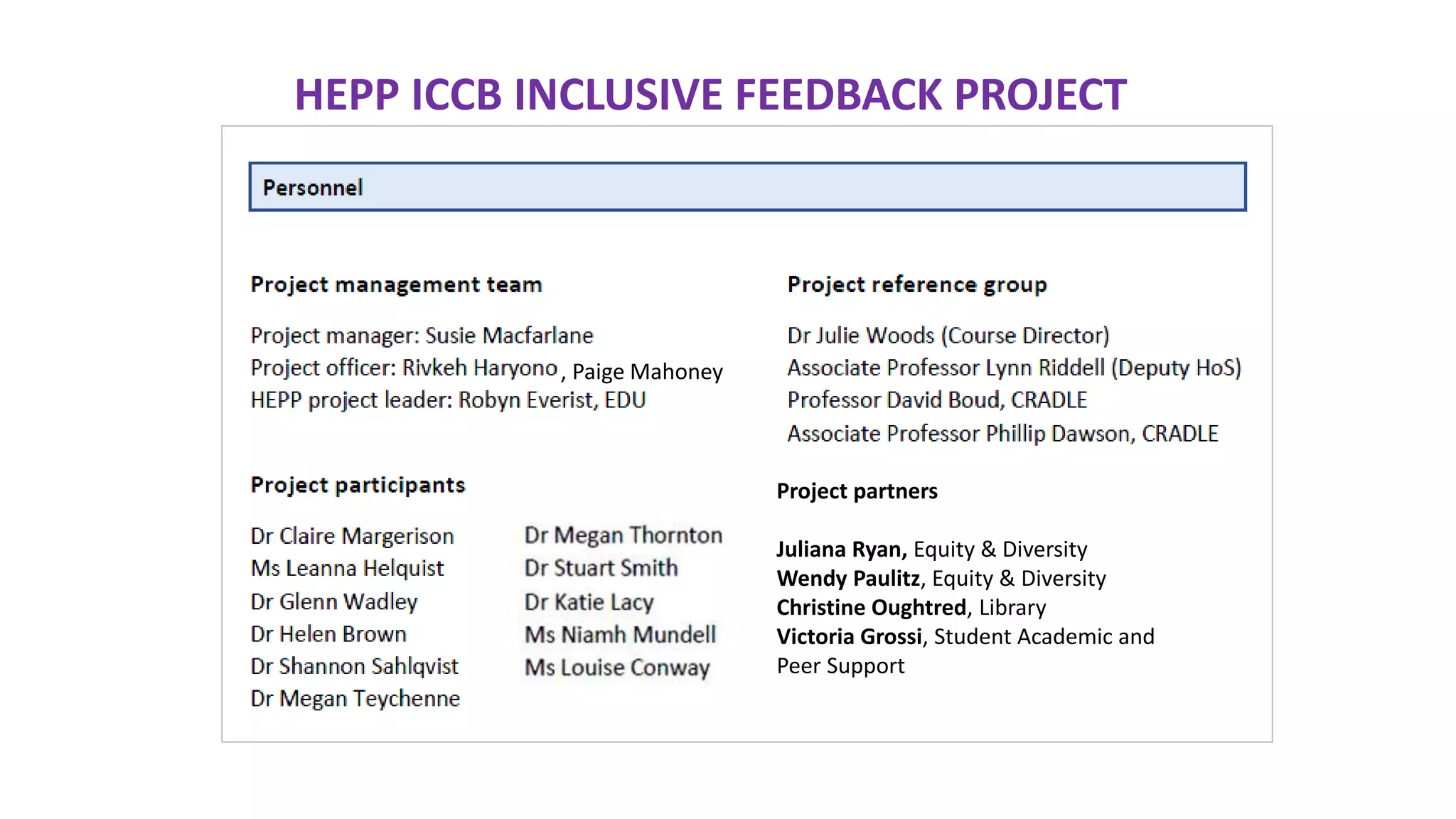
HEPP ICCB INCLUSIVE FEEDBACK PROJECT
, Paige Mahoney
Project partners
Juliana Ryan, Equity & Diversity
Wendy Paulitz, Equity & Diversity
Christine Oughtred, Library
Victoria Grossi, Student Academic and
Peer Support
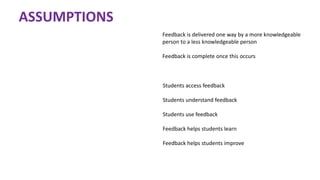
ASSUMPTIONS
Feedback is delivered one way by a more knowledgeable
person to a less knowledgeable person
Feedback is complete once this occurs
Students access feedback
Students understand feedback
Students use feedback
Feedback helps students learn
Feedback helps students improve
STUDENT PERSPECTIVES
WHAT IS THE PURPOSE OF FEEDBACK?
Feedback should clearly articulate strengths and weakness, particularly in how
future assessments could be improved.
To help students improve their work and learning
(1) To provide comments on what is done really well. (2) To provide constructive
criticism on what could be improved.
Room for improvement, knowing what you are good at and what you need help
with. It's vital for learning.
To inform the student on what they are doing well and what they need to improve
on.
STUDENT PERSPECTIVES
WHAT IS THE PURPOSE OF FEEDBACK?
Feedback should clearly articulate strengths and weakness, particularly in how
future assessments could be improved.
To help students improve their work and learning
(1) To provide comments on what is done really well. (2) To provide constructive
criticism on what could be improved.
Room for improvement, knowing what you are good at and what you need help
with. It's vital for learning.
To inform the student on what they are doing well and what they need to improve
on.
STUDENT PERSPECTIVES
IMPORTANCE OF FEEDBACK MODEL
I liked it however I felt some comments could have
been further explained with a bit more detail to fully
understand why we were marked the way we were
and how to improve our work. I also would have liked
to know where I lost marks as I was told I did a great
job but the marking didn't really match
INCLUSIVE FEEDBACK PROJECT
PILOT PROJECT
Phase 1: Research and consultation
• Interviewed and survey continuing and sessional staff
• Literature review
David Nicol John Hattie
David Boud
& Elizabeth Molloy
David Carless
INCLUSIVE FEEDBACK PROJECT
PILOT PROJECT
Phase 1: Research and consultation
• Interviewed and survey continuing and sessional staff
• Literature review
Phase 2: Develop Inclusive Feedback model
• Disseminate for feedback
• Reviewed by Reference group
PROFESSIONAL DEVELOPMENT
Assessment and Feedback workshops with sessional staff
Integrated unit marking meetings
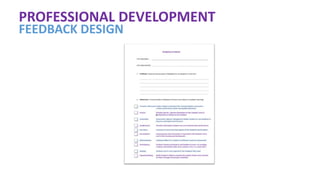
PROFESSIONAL DEVELOPMENT
FEEDBACK DESIGN
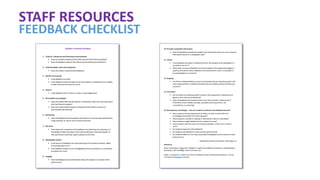
STAFF RESOURCES
FEEDBACK CHECKLIST
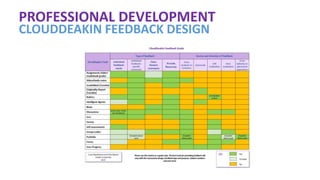
PROFESSIONAL DEVELOPMENT
CLOUDDEAKIN FEEDBACK DESIGN
INCLUSIVE FEEDBACK PROJECT
PILOT PROJECT
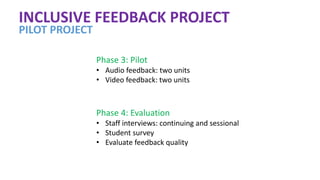
Phase 3: Pilot
• Audio feedback: two units
• Video feedback: two units
Phase 4: Evaluation
• Staff interviews: continuing and sessional
• Student survey
• Evaluate feedback quality
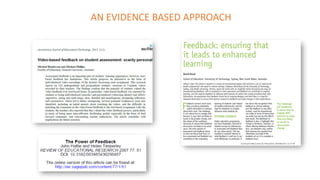
AN EVIDENCE BASED APPROACH
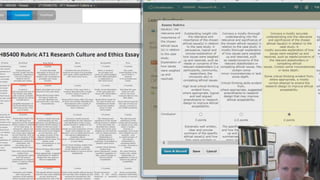
My principles for video feedback:
What is the best feedback you’ve ever had?
What is the purpose of feedback?
How can it improve my teaching?
http://air.deakin.edu.au/public/media/0_anktxych
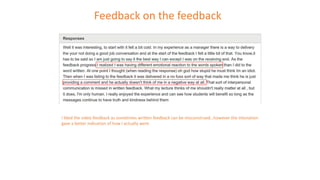
I liked the video feedback as sometimes written feedback can be misconstrued…however the intonation
gave a better indication of how I actually went
Feedback on the feedback
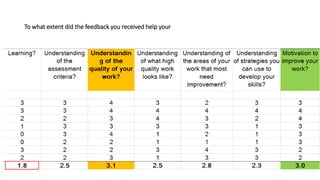
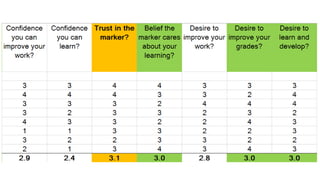
To what extent did the feedback you received help your
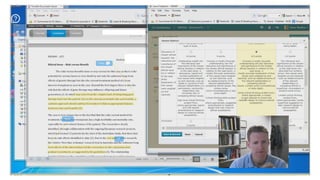
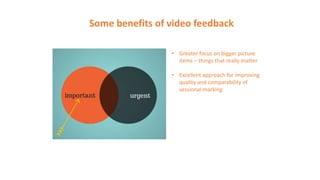
Some benefits of video feedback
• Greater focus on bigger picture
items – things that really matter
• Excellent approach for improving
quality and comparability of
sessional marking
STUDENT FEEDBACK
ON AUDIO FEEDBACK
“Hi Unit Chair (and everyone involved in marking),
I just wanted to say out of all the external uni courses I have
done, the feedback on this assignment (audio, comments,
comments within the assignment and Unit Chair’s personal
feedback) was the most helpful I have ever received.
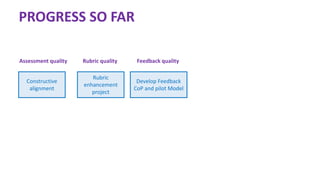
PROGRESS SO FAR
Rubric
enhancement
project
Develop Feedback
CoP and pilot Model
Constructive
alignment
Assessment quality Rubric quality Feedback quality
“Educational interventions that focus only on enhancing
the quality and quantity of teacher feedback are not
sufficient if we wish to develop students' ability to make
their own judgements about the quality of work. To
achieve this, students also need direct practice in
assessing work and generating feedback on it. “
BUT…
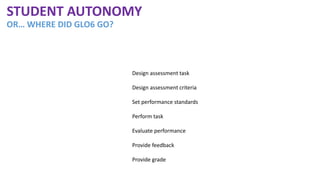
Design assessment task
Design assessment criteria
Set performance standards
Perform task
Evaluate performance
Provide feedback
Provide grade
STUDENT AUTONOMY
OR… WHERE DID GLO6 GO?
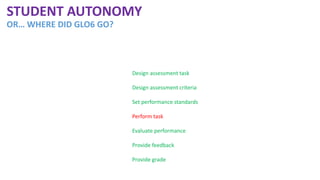
Design assessment task
Design assessment criteria
Set performance standards
Perform task
Evaluate performance
Provide feedback
Provide grade
STUDENT AUTONOMY
OR… WHERE DID GLO6 GO?
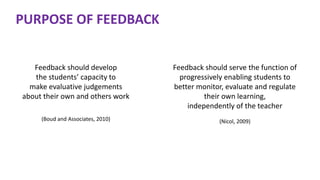
Feedback should serve the function of
progressively enabling students to
better monitor, evaluate and regulate
their own learning,
independently of the teacher
(Nicol, 2009)
PURPOSE OF FEEDBACK
Feedback should develop
the students’ capacity to
make evaluative judgements
about their own and others work
(Boud and Associates, 2010)
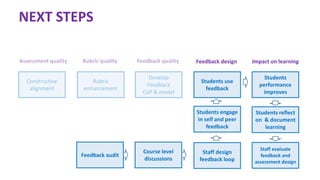
NEXT STEPS
Rubric
enhancement
Develop
Feedback
CoP & model
Constructive
alignment
Assessment quality Rubric quality Feedback quality
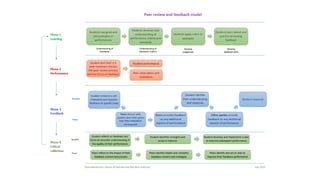
Students use
feedback
Feedback design
Students
performance
improves
Impact on learning
Staff design
feedback loop
Students reflect
on & document
learning
Students engage
in self and peer
feedback
Staff evaluate
feedback and
assessment design
Feedback audit
Course level
discussions
Susie Macfarlane
Glenn Wadley
School of Exercise and Nutrition Sciences
Discussion / Questions

Inclusive feedback project

  • 1.
    HEPP ICCB INCLUSIVEFEEDBACK PROJECT , Paige Mahoney Project partners Juliana Ryan, Equity & Diversity Wendy Paulitz, Equity & Diversity Christine Oughtred, Library Victoria Grossi, Student Academic and Peer Support
  • 2.
    ASSUMPTIONS Feedback is deliveredone way by a more knowledgeable person to a less knowledgeable person Feedback is complete once this occurs Students access feedback Students understand feedback Students use feedback Feedback helps students learn Feedback helps students improve
  • 3.
    STUDENT PERSPECTIVES WHAT ISTHE PURPOSE OF FEEDBACK? Feedback should clearly articulate strengths and weakness, particularly in how future assessments could be improved. To help students improve their work and learning (1) To provide comments on what is done really well. (2) To provide constructive criticism on what could be improved. Room for improvement, knowing what you are good at and what you need help with. It's vital for learning. To inform the student on what they are doing well and what they need to improve on.
  • 4.
    STUDENT PERSPECTIVES WHAT ISTHE PURPOSE OF FEEDBACK? Feedback should clearly articulate strengths and weakness, particularly in how future assessments could be improved. To help students improve their work and learning (1) To provide comments on what is done really well. (2) To provide constructive criticism on what could be improved. Room for improvement, knowing what you are good at and what you need help with. It's vital for learning. To inform the student on what they are doing well and what they need to improve on.
  • 5.
    STUDENT PERSPECTIVES IMPORTANCE OFFEEDBACK MODEL I liked it however I felt some comments could have been further explained with a bit more detail to fully understand why we were marked the way we were and how to improve our work. I also would have liked to know where I lost marks as I was told I did a great job but the marking didn't really match
  • 6.
    INCLUSIVE FEEDBACK PROJECT PILOTPROJECT Phase 1: Research and consultation • Interviewed and survey continuing and sessional staff • Literature review
  • 7.
    David Nicol JohnHattie David Boud & Elizabeth Molloy David Carless
  • 8.
    INCLUSIVE FEEDBACK PROJECT PILOTPROJECT Phase 1: Research and consultation • Interviewed and survey continuing and sessional staff • Literature review Phase 2: Develop Inclusive Feedback model • Disseminate for feedback • Reviewed by Reference group
  • 14.
    PROFESSIONAL DEVELOPMENT Assessment andFeedback workshops with sessional staff Integrated unit marking meetings
  • 15.
  • 16.
  • 17.
  • 18.
    INCLUSIVE FEEDBACK PROJECT PILOTPROJECT Phase 3: Pilot • Audio feedback: two units • Video feedback: two units Phase 4: Evaluation • Staff interviews: continuing and sessional • Student survey • Evaluate feedback quality
  • 19.
  • 20.
    My principles forvideo feedback: What is the best feedback you’ve ever had? What is the purpose of feedback? How can it improve my teaching? http://air.deakin.edu.au/public/media/0_anktxych
  • 23.
    I liked thevideo feedback as sometimes written feedback can be misconstrued…however the intonation gave a better indication of how I actually went Feedback on the feedback
  • 24.
    To what extentdid the feedback you received help your
  • 26.
    Some benefits ofvideo feedback • Greater focus on bigger picture items – things that really matter • Excellent approach for improving quality and comparability of sessional marking
  • 27.
    STUDENT FEEDBACK ON AUDIOFEEDBACK “Hi Unit Chair (and everyone involved in marking), I just wanted to say out of all the external uni courses I have done, the feedback on this assignment (audio, comments, comments within the assignment and Unit Chair’s personal feedback) was the most helpful I have ever received.
  • 28.
    PROGRESS SO FAR Rubric enhancement project DevelopFeedback CoP and pilot Model Constructive alignment Assessment quality Rubric quality Feedback quality
  • 29.
    “Educational interventions thatfocus only on enhancing the quality and quantity of teacher feedback are not sufficient if we wish to develop students' ability to make their own judgements about the quality of work. To achieve this, students also need direct practice in assessing work and generating feedback on it. “ BUT…
  • 30.
    Design assessment task Designassessment criteria Set performance standards Perform task Evaluate performance Provide feedback Provide grade STUDENT AUTONOMY OR… WHERE DID GLO6 GO?
  • 31.
    Design assessment task Designassessment criteria Set performance standards Perform task Evaluate performance Provide feedback Provide grade STUDENT AUTONOMY OR… WHERE DID GLO6 GO?
  • 32.
    Feedback should servethe function of progressively enabling students to better monitor, evaluate and regulate their own learning, independently of the teacher (Nicol, 2009) PURPOSE OF FEEDBACK Feedback should develop the students’ capacity to make evaluative judgements about their own and others work (Boud and Associates, 2010)
  • 34.
    NEXT STEPS Rubric enhancement Develop Feedback CoP &model Constructive alignment Assessment quality Rubric quality Feedback quality Students use feedback Feedback design Students performance improves Impact on learning Staff design feedback loop Students reflect on & document learning Students engage in self and peer feedback Staff evaluate feedback and assessment design Feedback audit Course level discussions
  • 35.
    Susie Macfarlane Glenn Wadley Schoolof Exercise and Nutrition Sciences Discussion / Questions

Editor's Notes

  • #2 Handout 4: Designing Feedback Get the participants to move outside where they can use the desks and laptops Activity:  Participants design a feedback activity by selecting one principle and one tool to address the principle with.  Then actually create samples in their sandpit/real sites. 
  • #3 Handout 4: Designing Feedback Get the participants to move outside where they can use the desks and laptops Activity:  Participants design a feedback activity by selecting one principle and one tool to address the principle with.  Then actually create samples in their sandpit/real sites. 
  • #4 Handout 4: Designing Feedback Get the participants to move outside where they can use the desks and laptops Activity:  Participants design a feedback activity by selecting one principle and one tool to address the principle with.  Then actually create samples in their sandpit/real sites. 
  • #5 Handout 4: Designing Feedback Get the participants to move outside where they can use the desks and laptops Activity:  Participants design a feedback activity by selecting one principle and one tool to address the principle with.  Then actually create samples in their sandpit/real sites. 
  • #6 Handout 4: Designing Feedback Get the participants to move outside where they can use the desks and laptops Activity:  Participants design a feedback activity by selecting one principle and one tool to address the principle with.  Then actually create samples in their sandpit/real sites. 
  • #7 Handout 4: Designing Feedback Get the participants to move outside where they can use the desks and laptops Activity:  Participants design a feedback activity by selecting one principle and one tool to address the principle with.  Then actually create samples in their sandpit/real sites. 
  • #8 Handout 4: Designing Feedback Get the participants to move outside where they can use the desks and laptops Activity:  Participants design a feedback activity by selecting one principle and one tool to address the principle with.  Then actually create samples in their sandpit/real sites. 
  • #9 Handout 4: Designing Feedback Get the participants to move outside where they can use the desks and laptops Activity:  Participants design a feedback activity by selecting one principle and one tool to address the principle with.  Then actually create samples in their sandpit/real sites. 
  • #15 Handout 4: Designing Feedback Get the participants to move outside where they can use the desks and laptops Activity:  Participants design a feedback activity by selecting one principle and one tool to address the principle with.  Then actually create samples in their sandpit/real sites. 
  • #16 Handout 4: Designing Feedback Get the participants to move outside where they can use the desks and laptops Activity:  Participants design a feedback activity by selecting one principle and one tool to address the principle with.  Then actually create samples in their sandpit/real sites. 
  • #17 Handout 4: Designing Feedback Get the participants to move outside where they can use the desks and laptops Activity:  Participants design a feedback activity by selecting one principle and one tool to address the principle with.  Then actually create samples in their sandpit/real sites. 
  • #18 Handout 4: Designing Feedback Get the participants to move outside where they can use the desks and laptops Activity:  Participants design a feedback activity by selecting one principle and one tool to address the principle with.  Then actually create samples in their sandpit/real sites. 
  • #19 Handout 4: Designing Feedback Get the participants to move outside where they can use the desks and laptops Activity:  Participants design a feedback activity by selecting one principle and one tool to address the principle with.  Then actually create samples in their sandpit/real sites. 
  • #28 Handout 4: Designing Feedback Get the participants to move outside where they can use the desks and laptops Activity:  Participants design a feedback activity by selecting one principle and one tool to address the principle with.  Then actually create samples in their sandpit/real sites. 
  • #29 Handout 4: Designing Feedback Get the participants to move outside where they can use the desks and laptops Activity:  Participants design a feedback activity by selecting one principle and one tool to address the principle with.  Then actually create samples in their sandpit/real sites. 
  • #30 Handout 4: Designing Feedback Get the participants to move outside where they can use the desks and laptops Activity:  Participants design a feedback activity by selecting one principle and one tool to address the principle with.  Then actually create samples in their sandpit/real sites. 
  • #31 Handout 4: Designing Feedback Get the participants to move outside where they can use the desks and laptops Activity:  Participants design a feedback activity by selecting one principle and one tool to address the principle with.  Then actually create samples in their sandpit/real sites. 
  • #32 Handout 4: Designing Feedback Get the participants to move outside where they can use the desks and laptops Activity:  Participants design a feedback activity by selecting one principle and one tool to address the principle with.  Then actually create samples in their sandpit/real sites. 
  • #33 Handout 4: Designing Feedback Get the participants to move outside where they can use the desks and laptops Activity:  Participants design a feedback activity by selecting one principle and one tool to address the principle with.  Then actually create samples in their sandpit/real sites. 
  • #34 Handout 4: Designing Feedback Get the participants to move outside where they can use the desks and laptops Activity:  Participants design a feedback activity by selecting one principle and one tool to address the principle with.  Then actually create samples in their sandpit/real sites. 
  • #36 Handout 4: Designing Feedback Get the participants to move outside where they can use the desks and laptops Activity:  Participants design a feedback activity by selecting one principle and one tool to address the principle with.  Then actually create samples in their sandpit/real sites. 
  • #37 Handout 4: Designing Feedback Get the participants to move outside where they can use the desks and laptops Activity:  Participants design a feedback activity by selecting one principle and one tool to address the principle with.  Then actually create samples in their sandpit/real sites.