Making Schools Inclusive
ED 104 - Foundation in Special and Inclusive Education
Introduction
✤ Diversity is the new “normal”
✤ Inclusive practices must be dynamic and collaborative
✤ To be truly inclusive, educators must always check for the presence,
participation, and achievement of their learners.
✤ Differentiation plays an important role in the success of inclusive education
practices.
Competencies
This chapter aims for you to develop the following competencies:
1. The ability to respond effectively to educational needs of students with
additional needs; and
2. The ability to create safe, inclusive, and culturally responsive learning
environments for students with additional needs.
A Unifying Framework
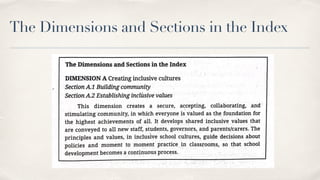
In 2002, Booth and Ainscow came up with an Index for Inclusion, which
aims to direct educational institutions toward developing their own next steps
and action plans if they want to restructure into becoming more inclusive. “It
takes on the social model of disability as its starting point, builds on good
practice, and then organizes the index work around a cycle of activities which
guide schools through stages of preparation, investigation, development, and
review (UNESCO 2005:30).
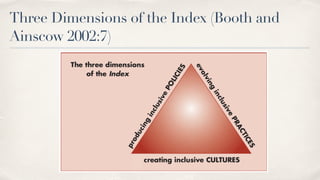
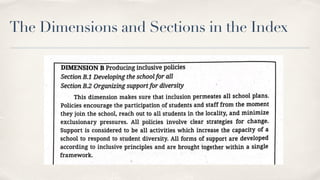
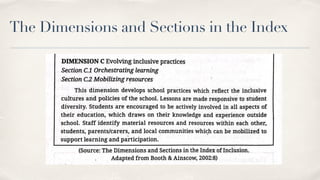
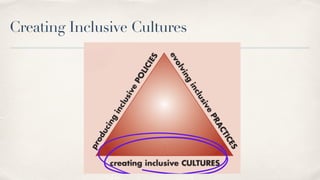
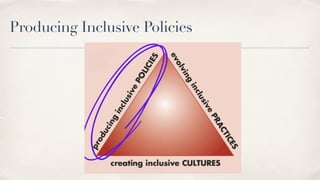
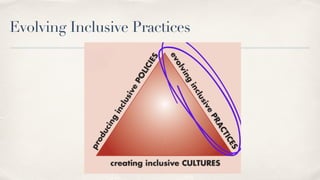
Three Dimensions of the Index (Booth and
Ainscow
2
0
0
2
:
7
)
The Dimensions and Sections in the Index
Creating Inclusive Cultures
1. What Stakeholders Can do
The rights-based approach to educational programming “insists that no right can exist
without a corresponding governmental obligation” (Van den Brule-Balescut & Sandkull
2005). The following are some steps stakeholders can take to create inclusive cultures:
Set the parameters for inclusion. The government has identi
fi
ed key people and
professions, and highlighted important factors leading to the success of inclusive
education - i.e., placement process, committees, staf
fi
ng and responsibilities, teacher
training and compensation, incentives for private sector participation, and
collaboration of the Department of Education with other branches of government.
Creating Inclusive Cultures
Build key people. The government recognizes the need for teacher training, both
in the special needs education and general education levels. It also pushes for the
use of evidence-based teaching frameworks, provision of student assistance, and
access to instructional materials. Most importantly, calls are made for continuing
research and forming of policies to be initiated by agencies such as the
Department of Education so as to further re
fi
ne the inclusive process and have it
tailored to
fi
t to the needs of children with additional needs.
Creating Inclusive Cultures
Identify and eradicate barriers. UNESCO’s Guide for Inclusion (2005) advocates
for the identi
fi
cation and removal of obstacles that have to do with transforming
prevailing attitudes and values on a systemic level. The Philippine government
seems to be in consonance with this aspect in the light of its existing legislative
policies that ground the undeniable importance of inclusion. It is also continuously
reorganizing structures in education and implementing programs that highlight
the need for primary stakeholders like the school, the parents, and other policy
makers, to acquire more understanding and capacity-building to manage an
inclusive environment.
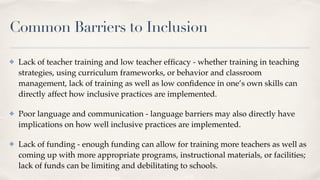
Common Barriers to Inclusion
✤ Attitudes, values systems, misconceptions, and societal norms - can lead to
prejudices and/or actual resistance to implement inclusive practices
( UNESCO 2005).
✤ Physical barriers - the lack of building, facility, transportation, or road
accessibility are types of physical barriers that can literally affect one’s mobility.
✤ Curriculum - a rigid “one size
fi
ts all” type of curriculum that does not allow
room for individual differences can signi
fi
cantly stunt one’s learning and
opportunity for growth.
Common Barriers to Inclusion
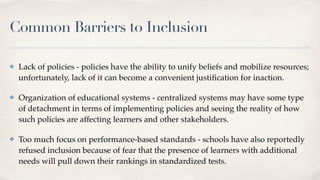
✤ Lack of teacher training and low teacher ef
fi
cacy - whether training in teaching
strategies, using curriculum frameworks, or behavior and classroom
management, lack of training as well as low con
fi
dence in one’s own skills can
directly affect how inclusive practices are implemented.
✤ Poor language and communication - language barriers may also directly have
implications on how well inclusive practices are implemented.
✤ Lack of funding - enough funding can allow for training more teachers as well as
coming up with more appropriate programs, instructional materials, or facilities;
lack of funds can be limiting and debilitating to schools.
Common Barriers to Inclusion
✤ Lack of policies - policies have the ability to unify beliefs and mobilize resources;
unfortunately, lack of it can become a convenient justi
fi
cation for inaction.
✤ Organization of educational systems - centralized systems may have some type
of detachment in terms of implementing policies and seeing the reality of how
such policies are affecting learners and other stakeholders.
✤ Too much focus on performance-based standards - schools have also reportedly
refused inclusion because of fear that the presence of learners with additional
needs will pull down their rankings in standardized tests.
Creating Inclusive Cultures
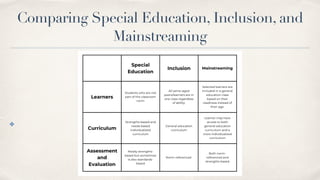
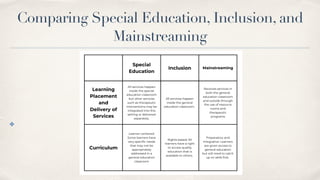
2. Special Education vs Mainstreaming vs Inclusive Education
Part of what needs to occur when creating cultures is to also determine
distinctions among frameworks and practices. Most important in this scenario
is to understand how different special education, mainstreaming, and
inclusive education are from each other.
Comparing Special Education, Inclusion, and
Mainstreaming
✤
Comparing Special Education, Inclusion, and
Mainstreaming
✤
Producing Inclusive Policies
✤ UNESCO (2005) realistically acknowledges that a societal change in attitude
need not be initially present in a community before inclusion can be fully
practiced. Rather, it must be viewed as a perspective or an ideal to work
toward. Without this realization, differences in standards and quality of
education may surface as potential problems.
✤ Pre-service curriculum was restructured so that special needs education
units are not only given to special needs education majors but to other
education majors as well which is a huge step for teachers and a nod to
inclusive education.
List of possible steps that educators can take to facilitate
the much-needed societal shift and inform policy:
✤ Involve other sectors of society.
✤ Collaborate
✤ Recognize the shift in roles of the teachers
✤ Include transitions in planning
Evolving Inclusive Practices
✤ Evolving inclusive practices is the third dimension to Booth and Ainscow’s
framework for schools (2002), where administrators must
fi
rst try to create
an inclusive culture among its stakeholders, then build better, more all-
encompassing policies.
✤ Moreover, the term “evolving” assumes that we already have strategies in
place which we already have strategies in place which we just have to
revisit for possible tweaking.
Evolving Inclusive Practices
Two effective evidence-based inclusive practices that can be used in the
classroom are:
✤ Universal Design for Learning (UDL)
✤ Differentiated Instruction
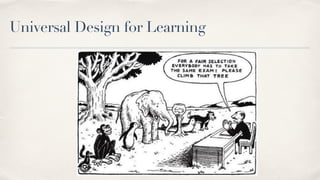
Universal Design for Learning
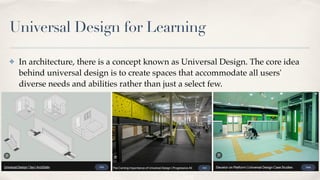
✤ In architecture, there is a concept known as Universal Design. The core idea
behind universal design is to create spaces that accommodate all users'
diverse needs and abilities rather than just a select few.
Universal Design for Learning
Universal Design for Learning (UDL)
✤ UDL refers to the design of instructional materials and activities to make
the content information accessible to all children (Rose & Meyer 2006).
✤ It is best used in a general education classroom where learners are different.
Through the provision of delivering content and allowing student to
construct learning in more than one way, UDL ensures that all students
learn genuinely.
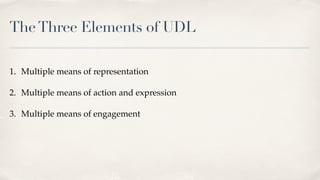
TheThree Elements of UDL
1. Multiple means of representation
2. Multiple means of action and expression
3. Multiple means of engagement
Universal Design for Learning
✤ https://www.youtube.com/watch?v=U1B6yQXsr0c
Differentiated Instruction
✤ According to Tomlinson (2010), differentiated (or differentiating) instruction
is a teacher’s response to students’ varying needs, interests, and learning
styles.
✤ It refers to a systematic approach to planning curriculum and instruction
for academically diverse learners.
✤ When teachers differentiate instruction, they use a variety of teaching and
learning strategies that are necessary to meet the diverse needs of students
in any class (Friend & Burdock, 2009).
Why Differentiate Instruction?
✤ Differentiating Instruction (DI) helps ensure that learners are engaged in
respectful tasks and provide diverse means of learning that re
fl
ect their
strengths and address their needs simultaneously.
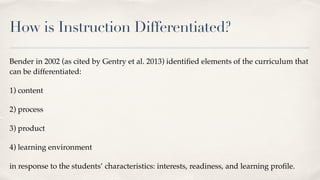
How is Instruction Differentiated?
Bender in 2002 (as cited by Gentry et al. 2013) identi
fi
ed elements of the curriculum that
can be differentiated:
1) content
2) process
3) product
4) learning environment
in response to the students’ characteristics: interests, readiness, and learning pro
fi
le.

Topic3-Making Schools Inclusive .pdf Making Schools Inclusive

  • 1.
    Making Schools Inclusive ED104 - Foundation in Special and Inclusive Education
  • 2.
    Introduction ✤ Diversity isthe new “normal” ✤ Inclusive practices must be dynamic and collaborative ✤ To be truly inclusive, educators must always check for the presence, participation, and achievement of their learners. ✤ Differentiation plays an important role in the success of inclusive education practices.
  • 3.
    Competencies This chapter aimsfor you to develop the following competencies: 1. The ability to respond effectively to educational needs of students with additional needs; and 2. The ability to create safe, inclusive, and culturally responsive learning environments for students with additional needs.
  • 4.
    A Unifying Framework In2002, Booth and Ainscow came up with an Index for Inclusion, which aims to direct educational institutions toward developing their own next steps and action plans if they want to restructure into becoming more inclusive. “It takes on the social model of disability as its starting point, builds on good practice, and then organizes the index work around a cycle of activities which guide schools through stages of preparation, investigation, development, and review (UNESCO 2005:30).
  • 5.
    Three Dimensions ofthe Index (Booth and Ainscow 2 0 0 2 : 7 )
  • 6.
    The Dimensions andSections in the Index
  • 7.
    The Dimensions andSections in the Index
  • 8.
    The Dimensions andSections in the Index
  • 9.
  • 10.
    Creating Inclusive Cultures 1.What Stakeholders Can do The rights-based approach to educational programming “insists that no right can exist without a corresponding governmental obligation” (Van den Brule-Balescut & Sandkull 2005). The following are some steps stakeholders can take to create inclusive cultures: Set the parameters for inclusion. The government has identi fi ed key people and professions, and highlighted important factors leading to the success of inclusive education - i.e., placement process, committees, staf fi ng and responsibilities, teacher training and compensation, incentives for private sector participation, and collaboration of the Department of Education with other branches of government.
  • 11.
    Creating Inclusive Cultures Buildkey people. The government recognizes the need for teacher training, both in the special needs education and general education levels. It also pushes for the use of evidence-based teaching frameworks, provision of student assistance, and access to instructional materials. Most importantly, calls are made for continuing research and forming of policies to be initiated by agencies such as the Department of Education so as to further re fi ne the inclusive process and have it tailored to fi t to the needs of children with additional needs.
  • 12.
    Creating Inclusive Cultures Identifyand eradicate barriers. UNESCO’s Guide for Inclusion (2005) advocates for the identi fi cation and removal of obstacles that have to do with transforming prevailing attitudes and values on a systemic level. The Philippine government seems to be in consonance with this aspect in the light of its existing legislative policies that ground the undeniable importance of inclusion. It is also continuously reorganizing structures in education and implementing programs that highlight the need for primary stakeholders like the school, the parents, and other policy makers, to acquire more understanding and capacity-building to manage an inclusive environment.
  • 13.
    Common Barriers toInclusion ✤ Attitudes, values systems, misconceptions, and societal norms - can lead to prejudices and/or actual resistance to implement inclusive practices ( UNESCO 2005). ✤ Physical barriers - the lack of building, facility, transportation, or road accessibility are types of physical barriers that can literally affect one’s mobility. ✤ Curriculum - a rigid “one size fi ts all” type of curriculum that does not allow room for individual differences can signi fi cantly stunt one’s learning and opportunity for growth.
  • 14.
    Common Barriers toInclusion ✤ Lack of teacher training and low teacher ef fi cacy - whether training in teaching strategies, using curriculum frameworks, or behavior and classroom management, lack of training as well as low con fi dence in one’s own skills can directly affect how inclusive practices are implemented. ✤ Poor language and communication - language barriers may also directly have implications on how well inclusive practices are implemented. ✤ Lack of funding - enough funding can allow for training more teachers as well as coming up with more appropriate programs, instructional materials, or facilities; lack of funds can be limiting and debilitating to schools.
  • 15.
    Common Barriers toInclusion ✤ Lack of policies - policies have the ability to unify beliefs and mobilize resources; unfortunately, lack of it can become a convenient justi fi cation for inaction. ✤ Organization of educational systems - centralized systems may have some type of detachment in terms of implementing policies and seeing the reality of how such policies are affecting learners and other stakeholders. ✤ Too much focus on performance-based standards - schools have also reportedly refused inclusion because of fear that the presence of learners with additional needs will pull down their rankings in standardized tests.
  • 16.
    Creating Inclusive Cultures 2.Special Education vs Mainstreaming vs Inclusive Education Part of what needs to occur when creating cultures is to also determine distinctions among frameworks and practices. Most important in this scenario is to understand how different special education, mainstreaming, and inclusive education are from each other.
  • 17.
    Comparing Special Education,Inclusion, and Mainstreaming ✤
  • 18.
    Comparing Special Education,Inclusion, and Mainstreaming ✤
  • 19.
  • 20.
    Producing Inclusive Policies ✤UNESCO (2005) realistically acknowledges that a societal change in attitude need not be initially present in a community before inclusion can be fully practiced. Rather, it must be viewed as a perspective or an ideal to work toward. Without this realization, differences in standards and quality of education may surface as potential problems. ✤ Pre-service curriculum was restructured so that special needs education units are not only given to special needs education majors but to other education majors as well which is a huge step for teachers and a nod to inclusive education.
  • 21.
    List of possiblesteps that educators can take to facilitate the much-needed societal shift and inform policy: ✤ Involve other sectors of society. ✤ Collaborate ✤ Recognize the shift in roles of the teachers ✤ Include transitions in planning
  • 22.
  • 23.
    Evolving Inclusive Practices ✤Evolving inclusive practices is the third dimension to Booth and Ainscow’s framework for schools (2002), where administrators must fi rst try to create an inclusive culture among its stakeholders, then build better, more all- encompassing policies. ✤ Moreover, the term “evolving” assumes that we already have strategies in place which we already have strategies in place which we just have to revisit for possible tweaking.
  • 24.
    Evolving Inclusive Practices Twoeffective evidence-based inclusive practices that can be used in the classroom are: ✤ Universal Design for Learning (UDL) ✤ Differentiated Instruction
  • 25.
    Universal Design forLearning ✤ In architecture, there is a concept known as Universal Design. The core idea behind universal design is to create spaces that accommodate all users' diverse needs and abilities rather than just a select few.
  • 26.
  • 27.
    Universal Design forLearning (UDL) ✤ UDL refers to the design of instructional materials and activities to make the content information accessible to all children (Rose & Meyer 2006). ✤ It is best used in a general education classroom where learners are different. Through the provision of delivering content and allowing student to construct learning in more than one way, UDL ensures that all students learn genuinely.
  • 28.
    TheThree Elements ofUDL 1. Multiple means of representation 2. Multiple means of action and expression 3. Multiple means of engagement
  • 29.
    Universal Design forLearning ✤ https://www.youtube.com/watch?v=U1B6yQXsr0c
  • 30.
    Differentiated Instruction ✤ Accordingto Tomlinson (2010), differentiated (or differentiating) instruction is a teacher’s response to students’ varying needs, interests, and learning styles. ✤ It refers to a systematic approach to planning curriculum and instruction for academically diverse learners. ✤ When teachers differentiate instruction, they use a variety of teaching and learning strategies that are necessary to meet the diverse needs of students in any class (Friend & Burdock, 2009).
  • 31.
    Why Differentiate Instruction? ✤Differentiating Instruction (DI) helps ensure that learners are engaged in respectful tasks and provide diverse means of learning that re fl ect their strengths and address their needs simultaneously.
  • 32.
    How is InstructionDifferentiated? Bender in 2002 (as cited by Gentry et al. 2013) identi fi ed elements of the curriculum that can be differentiated: 1) content 2) process 3) product 4) learning environment in response to the students’ characteristics: interests, readiness, and learning pro fi le.