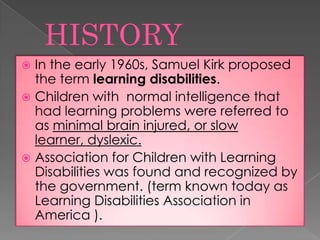
 In the early 1960s, Samuel Kirk proposed
the term learning disabilities.
 Children with normal intelligence that
had learning problems were referred to
as minimal brain injured, or slow
learner, dyslexic.
 Association for Children with Learning
Disabilities was found and recognized by
the government. (term known today as
Learning Disabilities Association in
America ).
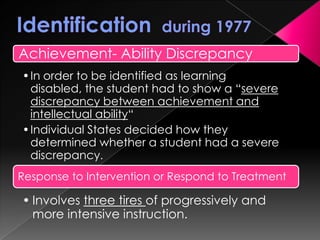
Achievement- Ability Discrepancy
•In order to be identified as learning
disabled, the student had to show a “severe
discrepancy between achievement and
intellectual ability“
•Individual States decided how they
determined whether a student had a severe
discrepancy.
Response to Intervention or Respond to Treatment
• Involves three tires of progressively and
more intensive instruction.
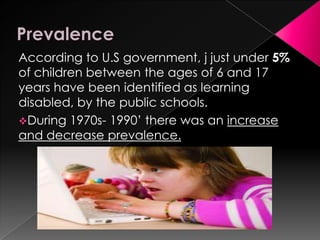
According to U.S government, j just under 5%
of children between the ages of 6 and 17
years have been identified as learning
disabled, by the public schools.
During 1970s- 1990’ there was an increase
and decrease prevalence.
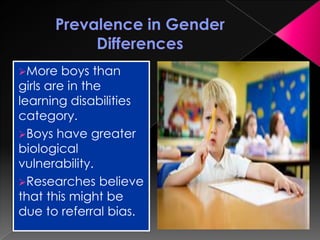
More boys than
girls are in the
learning disabilities
category.
Boys have greater
biological
vulnerability.
Researches believe
that this might be
due to referral bias.
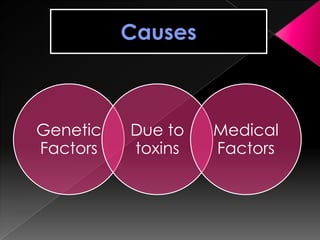
Genetic
Factors
Due to
toxins
Medical
Factors
•Children with Learning Disabilities may
have reading, writing, speaking, and
math problems.
•Most students with Learning Disabilities
struggle the most with reading.
Academic Achievement
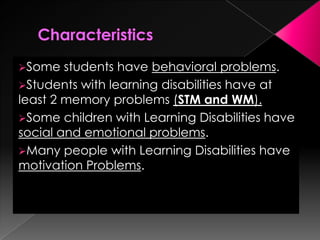
Some students have behavioral problems.
Students with learning disabilities have at
least 2 memory problems (STM and WM).
Some children with Learning Disabilities have
social and emotional problems.
Many people with Learning Disabilities have
motivation Problems.
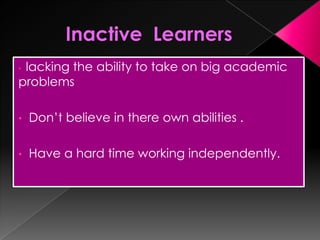
• lacking the ability to take on big academic
problems
• Don’t believe in there own abilities .
• Have a hard time working independently.
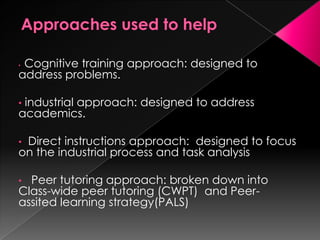
• Cognitive training approach: designed to
address problems.
• industrial approach: designed to address
academics.
• Direct instructions approach: designed to focus
on the industrial process and task analysis
• Peer tutoring approach: broken down into
Class-wide peer tutoring (CWPT) and Peer-
assited learning strategy(PALS)
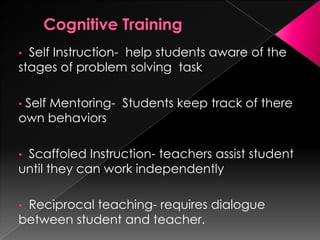
• Self Instruction- help students aware of the
stages of problem solving task
• Self Mentoring- Students keep track of there
own behaviors
• Scaffoled Instruction- teachers assist student
until they can work independently
• Reciprocal teaching- requires dialogue
between student and teacher.
• Phonological awareness: small unites of
sound
• Phonemic awareness: knowing word
are made up of sounds
• teachers uses CMB to monitor
academic progress and keeping
track of students responsiveness
• focus on students correct words per
minute
• There are very little learning disability in
preschool programs
• Before going off to a postsecondary
program students need a Summary of
performance (SOP)
• drop out rates for students with a
learning disability is 25 %
•12th Edition Exceptional Learners (An Introduction to Special
Education) Daniel P. Hallahan, James M. Kauffman, Paige C.
Pullen.
Learners with learning disabilities

Learners with learning disabilities

  • 2.
     In theearly 1960s, Samuel Kirk proposed the term learning disabilities.  Children with normal intelligence that had learning problems were referred to as minimal brain injured, or slow learner, dyslexic.  Association for Children with Learning Disabilities was found and recognized by the government. (term known today as Learning Disabilities Association in America ).
  • 4.
    Achievement- Ability Discrepancy •Inorder to be identified as learning disabled, the student had to show a “severe discrepancy between achievement and intellectual ability“ •Individual States decided how they determined whether a student had a severe discrepancy. Response to Intervention or Respond to Treatment • Involves three tires of progressively and more intensive instruction.
  • 5.
    According to U.Sgovernment, j just under 5% of children between the ages of 6 and 17 years have been identified as learning disabled, by the public schools. During 1970s- 1990’ there was an increase and decrease prevalence.
  • 6.
    More boys than girlsare in the learning disabilities category. Boys have greater biological vulnerability. Researches believe that this might be due to referral bias.
  • 7.
  • 8.
    •Children with LearningDisabilities may have reading, writing, speaking, and math problems. •Most students with Learning Disabilities struggle the most with reading. Academic Achievement
  • 9.
    Some students havebehavioral problems. Students with learning disabilities have at least 2 memory problems (STM and WM). Some children with Learning Disabilities have social and emotional problems. Many people with Learning Disabilities have motivation Problems.
  • 10.
    • lacking theability to take on big academic problems • Don’t believe in there own abilities . • Have a hard time working independently.
  • 11.
    • Cognitive trainingapproach: designed to address problems. • industrial approach: designed to address academics. • Direct instructions approach: designed to focus on the industrial process and task analysis • Peer tutoring approach: broken down into Class-wide peer tutoring (CWPT) and Peer- assited learning strategy(PALS)
  • 12.
    • Self Instruction-help students aware of the stages of problem solving task • Self Mentoring- Students keep track of there own behaviors • Scaffoled Instruction- teachers assist student until they can work independently • Reciprocal teaching- requires dialogue between student and teacher.
  • 13.
    • Phonological awareness:small unites of sound • Phonemic awareness: knowing word are made up of sounds
  • 14.
    • teachers usesCMB to monitor academic progress and keeping track of students responsiveness • focus on students correct words per minute
  • 15.
    • There arevery little learning disability in preschool programs • Before going off to a postsecondary program students need a Summary of performance (SOP) • drop out rates for students with a learning disability is 25 %
  • 16.
    •12th Edition ExceptionalLearners (An Introduction to Special Education) Daniel P. Hallahan, James M. Kauffman, Paige C. Pullen.