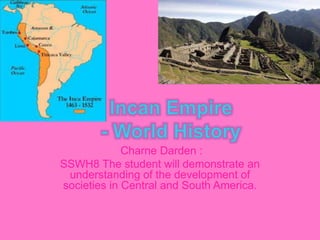
Charne Darden :
SSWH8 The student will demonstrate an
understanding of the development of
societies in Central and South America.
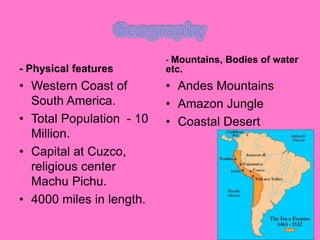
- Physical features
• Western Coast of
South America.
• Total Population - 10
Million.
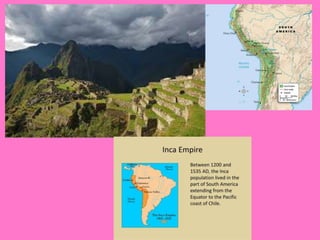
• Capital at Cuzco,
religious center
Machu Pichu.
• 4000 miles in length.
- Mountains, Bodies of water
etc.
• Andes Mountains
• Amazon Jungle
• Coastal Desert
- Dress Code, Eat,
Communicate, etc.
 The official language of the empire
was Quechua.
 Clothing was an important aspect
in Inca society. Just looking at the
dress of a person, status of that
person in that society can be
readily perceived.
 The Inca state developed a
huge farming apparatus, where
crops and herds were
commandeered from conquered
peoples and the people
themselves were periodically
commandeered to work on state-
owned farms. Incas grew their
own crops for food.
- More Information
 Inca society was made up of ayllus,
which were clans of families who
lived and worked together. Each
allyu was supervised by a curacao
or chief. Families lived in thatched-
roof houses built of stone and mud.
• Government and power was held
at Cuzco.
• Inca government, employing a vast
network of administrators, governed
over a patchwork empire which, in
practice, touched local populations
to varying degrees. Inca
government, therefore, relied heavily
on a combination of personal
relations, state largesse, ritual
exchange, law enforcement and
military might.
• The leaders of the Inca Empire were the following:
Pachacuti (1438-1471), Túpac Inca Yupanqui (1471-
1493), Huayna Capac (1493-1525), Huascar (1525-
1532), Atahualpa (1532-1533), Manco Inca Yupanqui
(1533-1544),
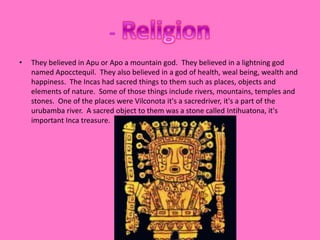
• They believed in Apu or Apo a mountain god. They believed in a lightning god
named Apocctequil. They also believed in a god of health, weal being, wealth and
happiness. The Incas had sacred things to them such as places, objects and
elements of nature. Some of those things include rivers, mountains, temples and
stones. One of the places were Vilconota it's a sacredriver, it's a part of the
urubamba river. A sacred object to them was a stone called Intihuatona, it's
important Inca treasure.
o The Inca military was organized very much like our modern army.
Based on decimal units; a troop of ten men had a corporal, and five
groups of ten had a sergeant. This order continued with officers
overseeing groups of 100, 500, 1,000, and 5,000. The ultimate
commander was the sapa inca (emperor). Outstanding service in the
military was rewarded regardless of the warriors social position.
o Inca military strategy was not complicated. They divided their forces
into three groups. The first group attacked from the front while the
other two groups circled and attacked from the rear. The Inca also
cut off water supplies, communication, and food supplies. As the
Incas approached their enemies they made earsplitting noise. They
blew conch horns, whistles, beat drums, danced, and shouted. This
strategy would frighten the opposing forces. Sometimes the Inca
military would add to their arsenals the weapons of the countries
that they had defeated. This is how they discovered the bola which
was very effective against the Spanish horses. The bola was a rope
with three stones attached, and when thrown correctly it could
encircle the arms and legs of the enemy.
• The Incas two main products were pottery & cloth.
• They had an elaborate calendar like the Aztecs &
Mayans.
• They did not use the wheel and had no system of writing,
but through a system if knots know they were able to
keep track of numbers.
• Even with out the use of modern tools or the use of the
wheel, the Incas were able to create sturdy architecture
in an area prone to earthquakes.
• Service Tax: huge free labor force.
• Technology: terrace farming, surplus crops, irrigation
systems.
• Strong Central Government: all powerful Inca, strict laws,
basic needs satisfied.

Inca

  • 1.
    Charne Darden : SSWH8The student will demonstrate an understanding of the development of societies in Central and South America.
  • 2.
    - Physical features •Western Coast of South America. • Total Population - 10 Million. • Capital at Cuzco, religious center Machu Pichu. • 4000 miles in length. - Mountains, Bodies of water etc. • Andes Mountains • Amazon Jungle • Coastal Desert
  • 4.
    - Dress Code,Eat, Communicate, etc.  The official language of the empire was Quechua.  Clothing was an important aspect in Inca society. Just looking at the dress of a person, status of that person in that society can be readily perceived.  The Inca state developed a huge farming apparatus, where crops and herds were commandeered from conquered peoples and the people themselves were periodically commandeered to work on state- owned farms. Incas grew their own crops for food. - More Information  Inca society was made up of ayllus, which were clans of families who lived and worked together. Each allyu was supervised by a curacao or chief. Families lived in thatched- roof houses built of stone and mud. • Government and power was held at Cuzco. • Inca government, employing a vast network of administrators, governed over a patchwork empire which, in practice, touched local populations to varying degrees. Inca government, therefore, relied heavily on a combination of personal relations, state largesse, ritual exchange, law enforcement and military might.
  • 6.
    • The leadersof the Inca Empire were the following: Pachacuti (1438-1471), Túpac Inca Yupanqui (1471- 1493), Huayna Capac (1493-1525), Huascar (1525- 1532), Atahualpa (1532-1533), Manco Inca Yupanqui (1533-1544),
  • 7.
    • They believedin Apu or Apo a mountain god. They believed in a lightning god named Apocctequil. They also believed in a god of health, weal being, wealth and happiness. The Incas had sacred things to them such as places, objects and elements of nature. Some of those things include rivers, mountains, temples and stones. One of the places were Vilconota it's a sacredriver, it's a part of the urubamba river. A sacred object to them was a stone called Intihuatona, it's important Inca treasure.
  • 8.
    o The Incamilitary was organized very much like our modern army. Based on decimal units; a troop of ten men had a corporal, and five groups of ten had a sergeant. This order continued with officers overseeing groups of 100, 500, 1,000, and 5,000. The ultimate commander was the sapa inca (emperor). Outstanding service in the military was rewarded regardless of the warriors social position. o Inca military strategy was not complicated. They divided their forces into three groups. The first group attacked from the front while the other two groups circled and attacked from the rear. The Inca also cut off water supplies, communication, and food supplies. As the Incas approached their enemies they made earsplitting noise. They blew conch horns, whistles, beat drums, danced, and shouted. This strategy would frighten the opposing forces. Sometimes the Inca military would add to their arsenals the weapons of the countries that they had defeated. This is how they discovered the bola which was very effective against the Spanish horses. The bola was a rope with three stones attached, and when thrown correctly it could encircle the arms and legs of the enemy.
  • 9.
    • The Incastwo main products were pottery & cloth. • They had an elaborate calendar like the Aztecs & Mayans. • They did not use the wheel and had no system of writing, but through a system if knots know they were able to keep track of numbers. • Even with out the use of modern tools or the use of the wheel, the Incas were able to create sturdy architecture in an area prone to earthquakes. • Service Tax: huge free labor force. • Technology: terrace farming, surplus crops, irrigation systems. • Strong Central Government: all powerful Inca, strict laws, basic needs satisfied.