
Privacy and Trust in Business Processes: Challenges and Opportunities
In processes we trust
Marlon Dumas
marlon.dumas@ut.ee
SOAMED Workshop – Berlin 9-10 June 2016
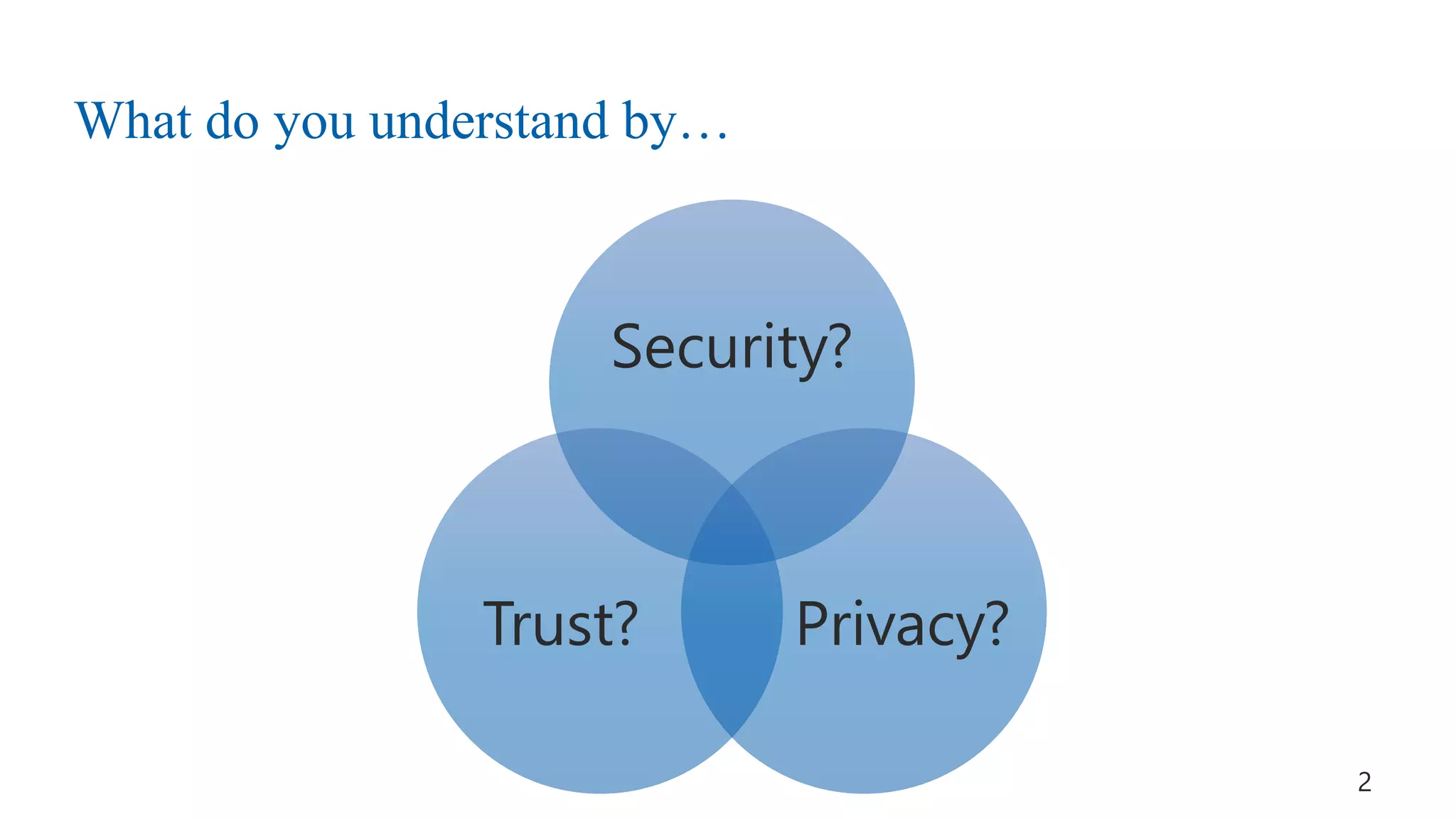
What do you understand by…
Security?
Privacy?Trust?
2
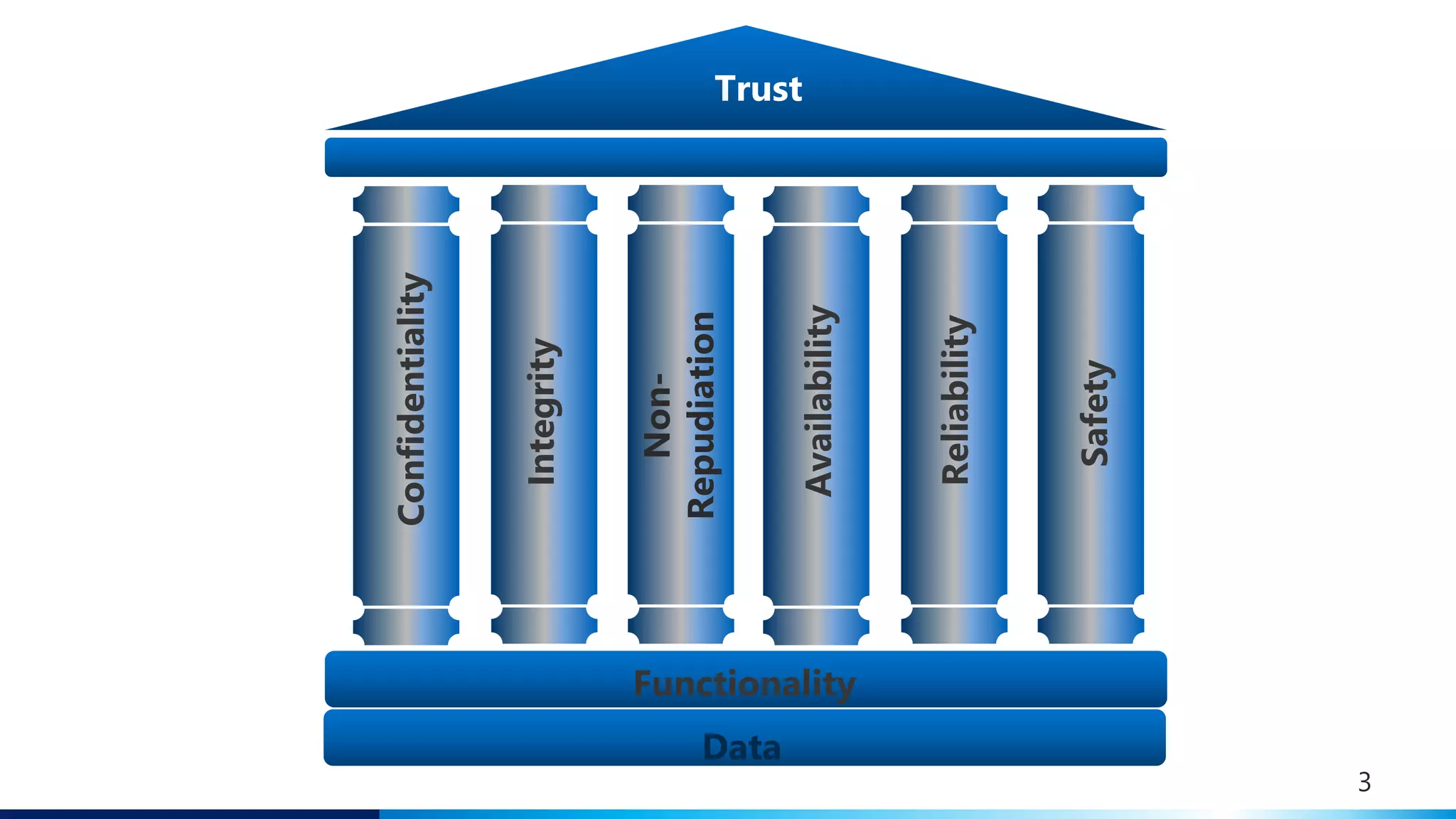
Trust
Confidentiality
Integrity
Non-
Repudiation
Availability
Reliability
Safety
Functionality
Data
3
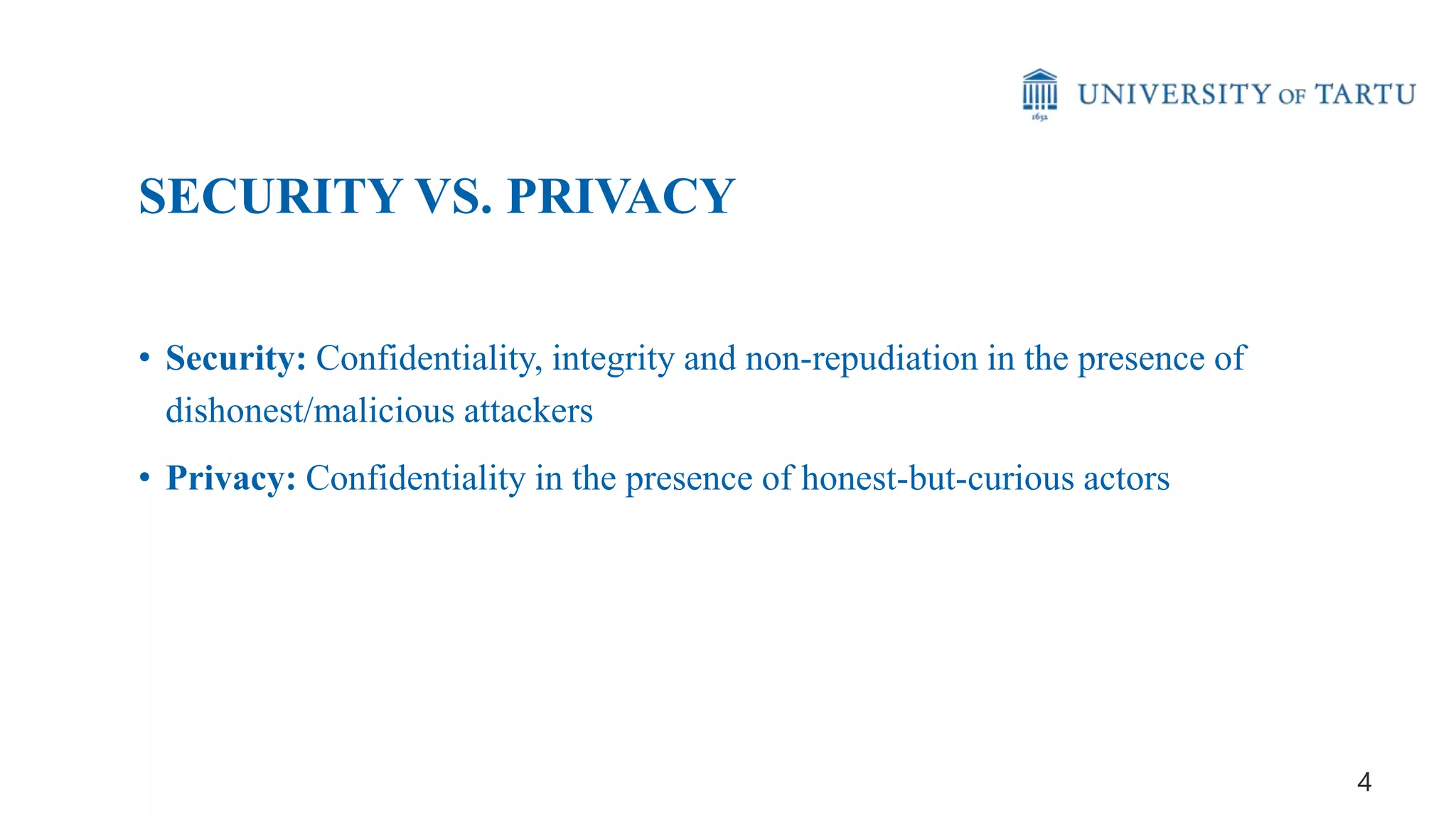
• Security: Confidentiality, integrity and non-repudiation in the presence of
dishonest/malicious attackers
• Privacy: Confidentiality in the presence of honest-but-curious actors
SECURITY VS. PRIVACY
4
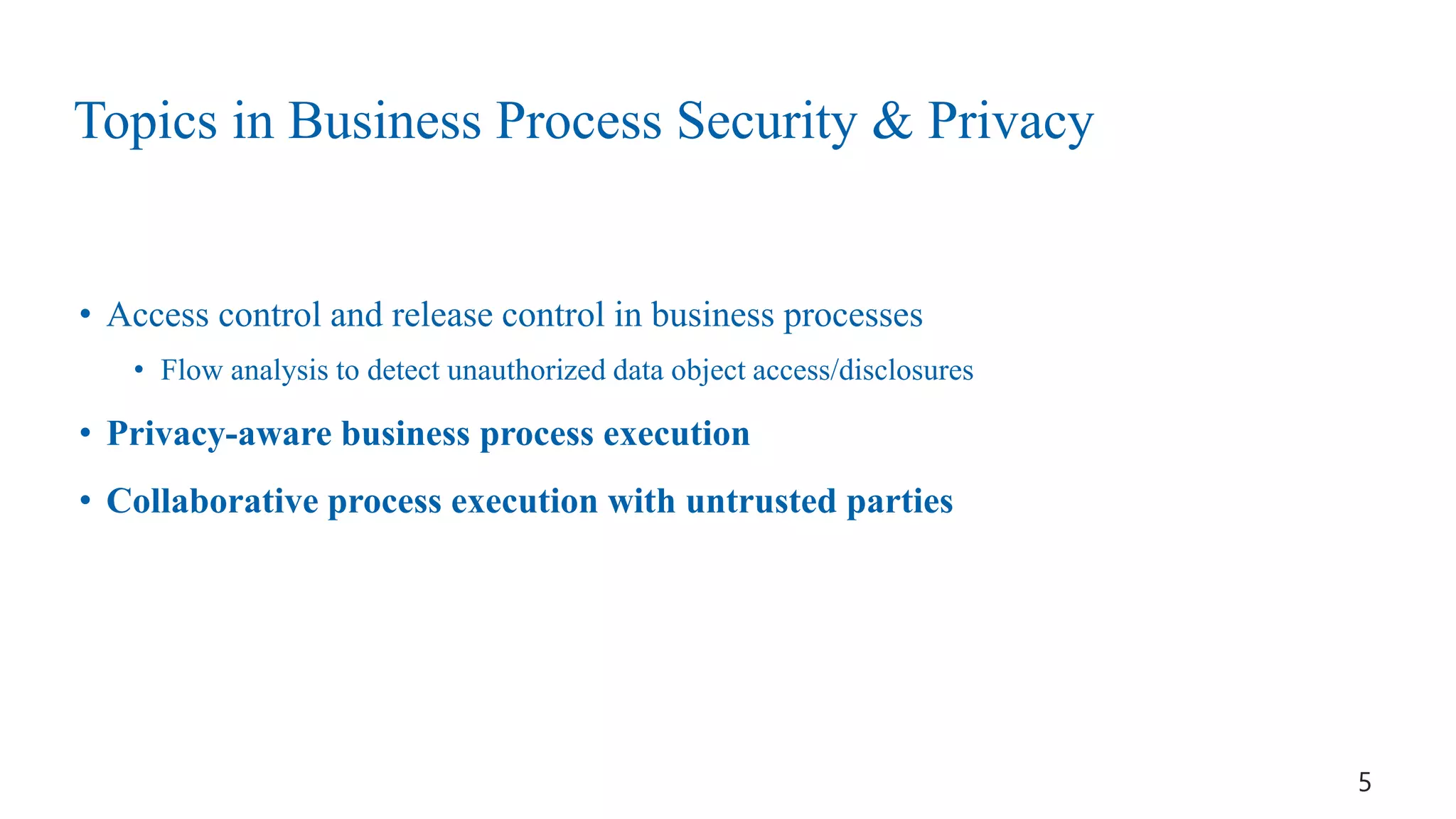
Topics in Business Process Security & Privacy
• Access control and release control in business processes
• Flow analysis to detect unauthorized data object access/disclosures
• Privacy-aware business process execution
• Collaborative process execution with untrusted parties
5
Privacy-Aware Business
Processes
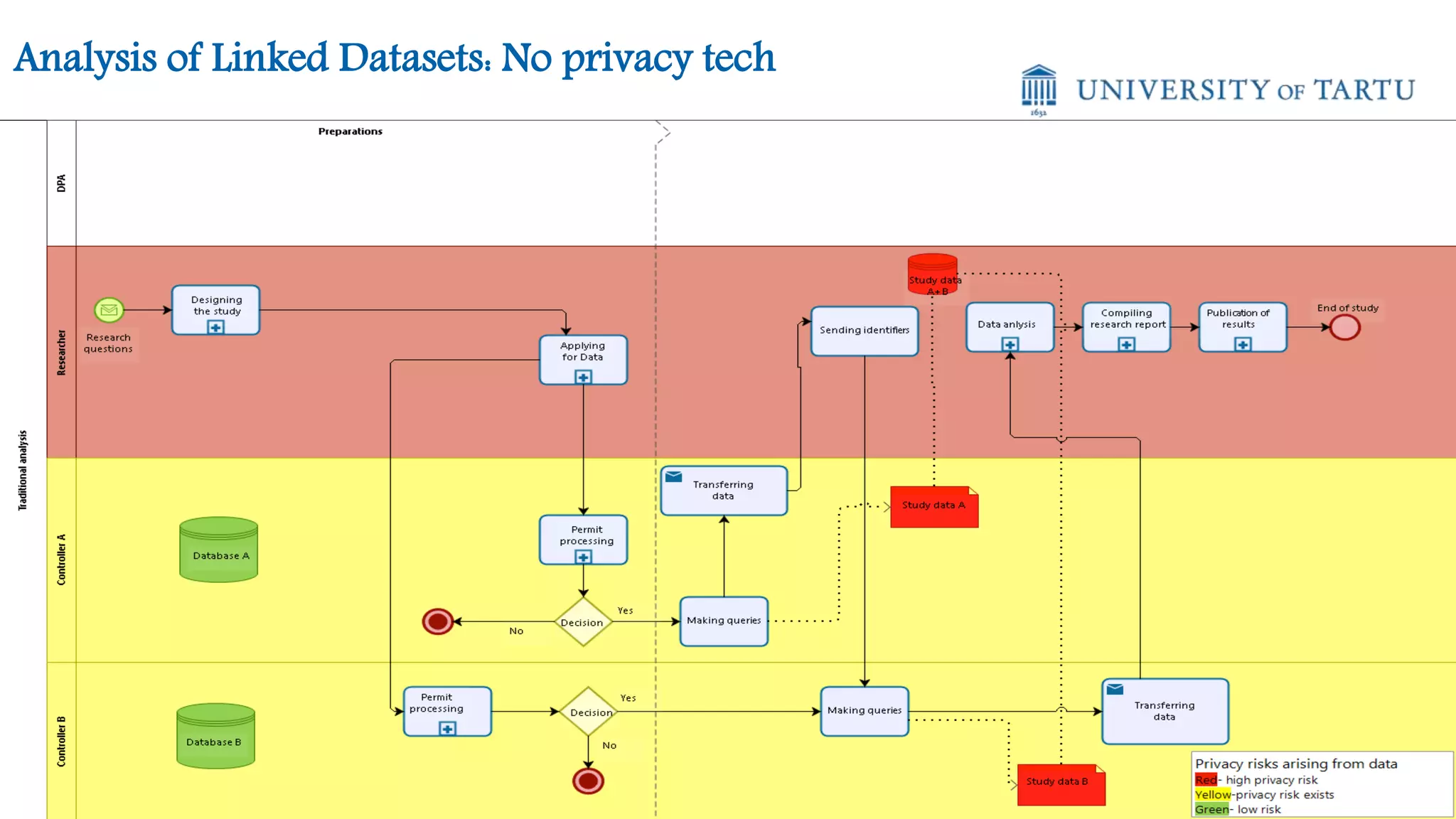
Analysis of Linked Datasets: No privacy tech
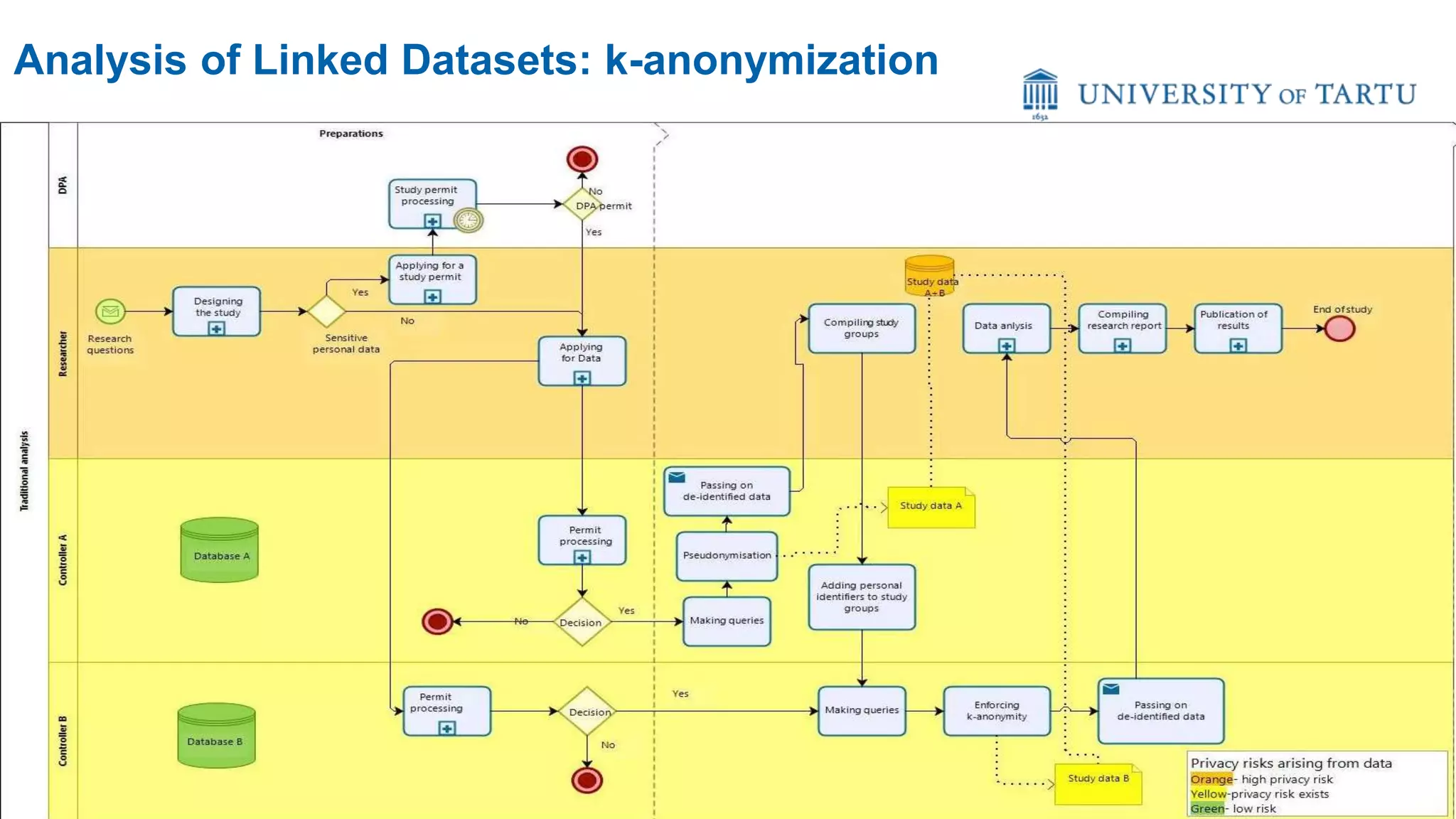
Analysis of Linked Datasets: k-anonymization
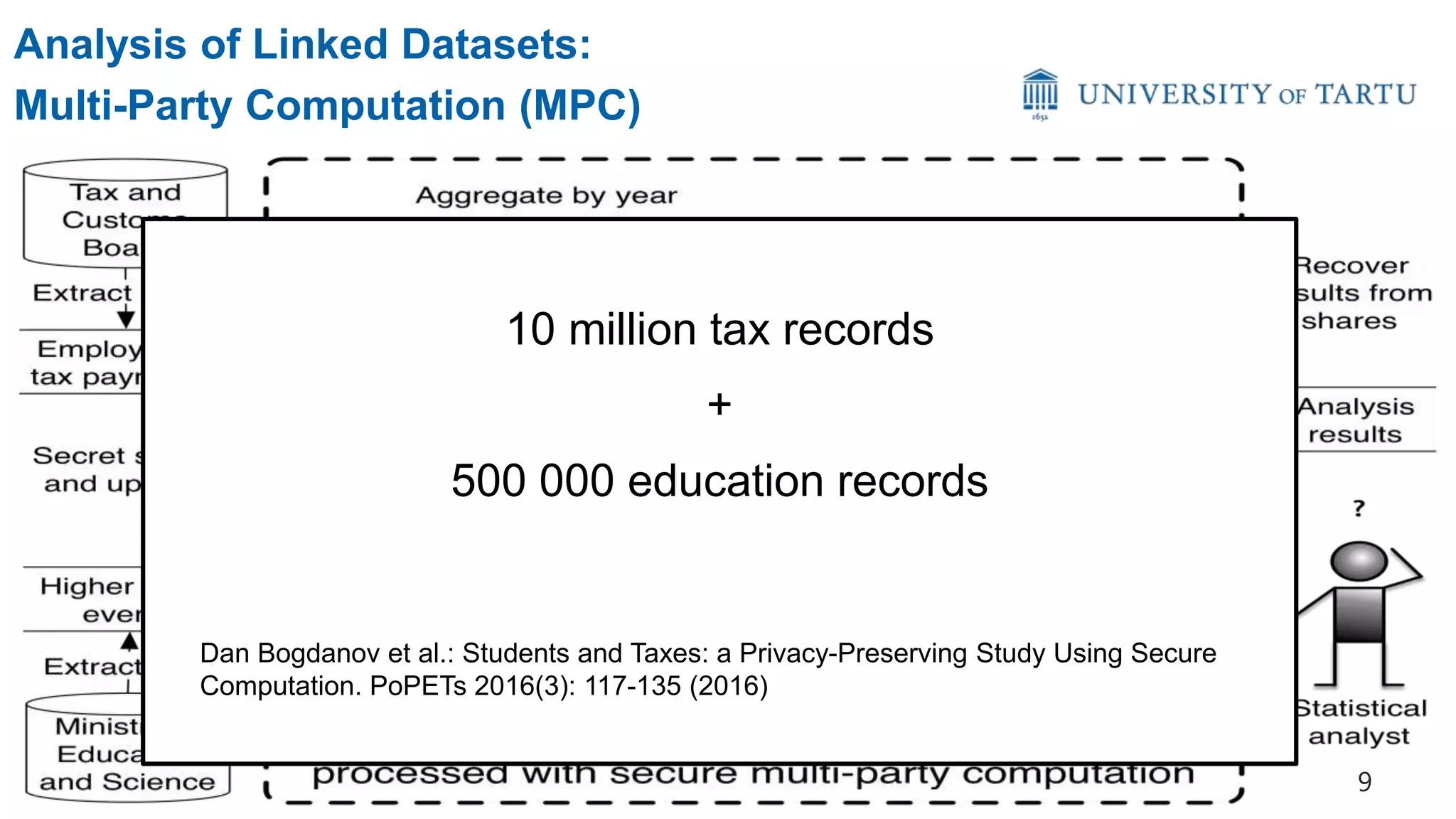
Analysis of Linked Datasets:
Multi-Party Computation (MPC)
10 million tax records
+
500 000 education records
Dan Bogdanov et al.: Students and Taxes: a Privacy-Preserving Study Using Secure
Computation. PoPETs 2016(3): 117-135 (2016)
9
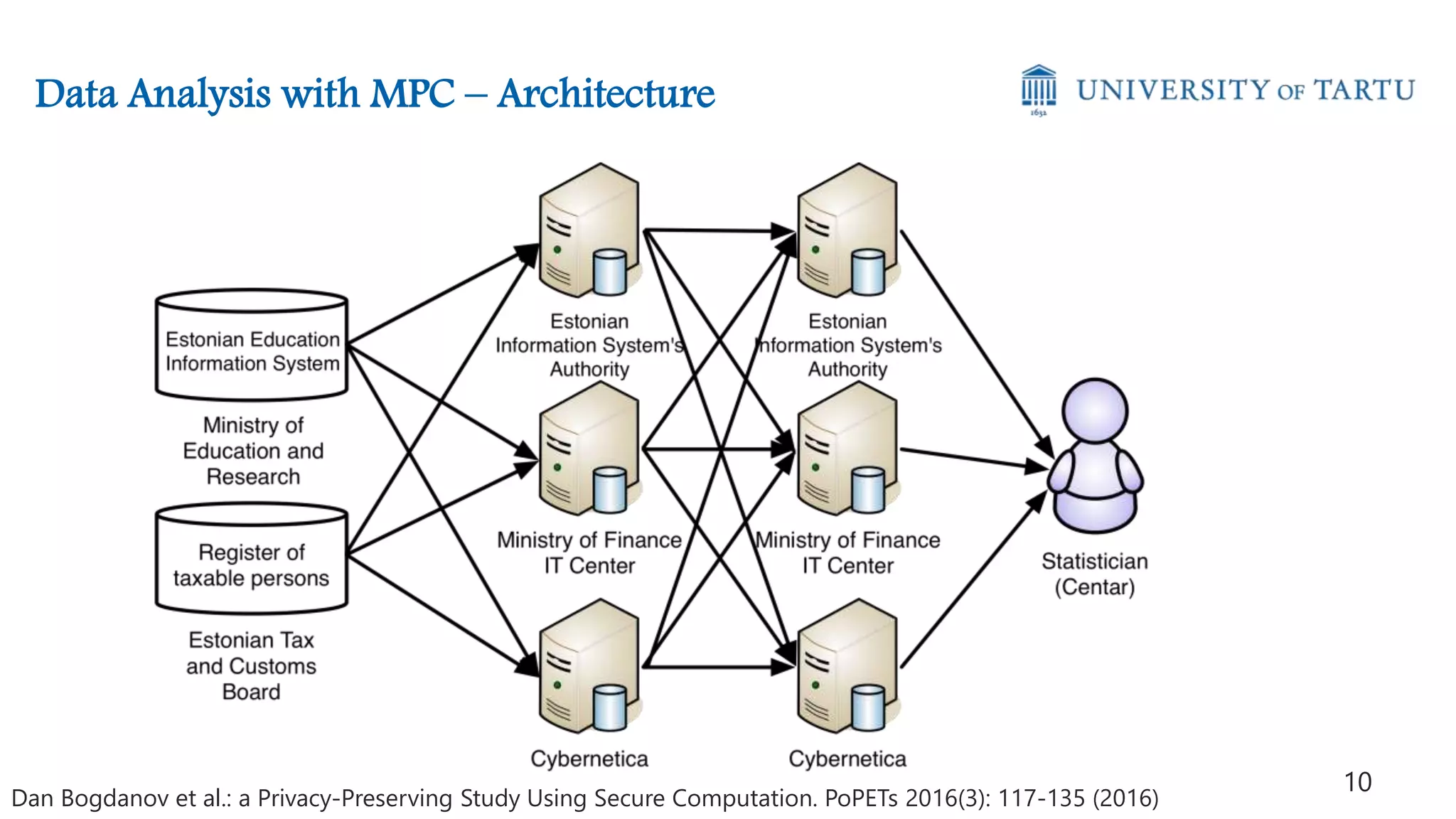
Dan Bogdanov et al.: a Privacy-Preserving Study Using Secure Computation. PoPETs 2016(3): 117-135 (2016)
Data Analysis with MPC – Architecture
10
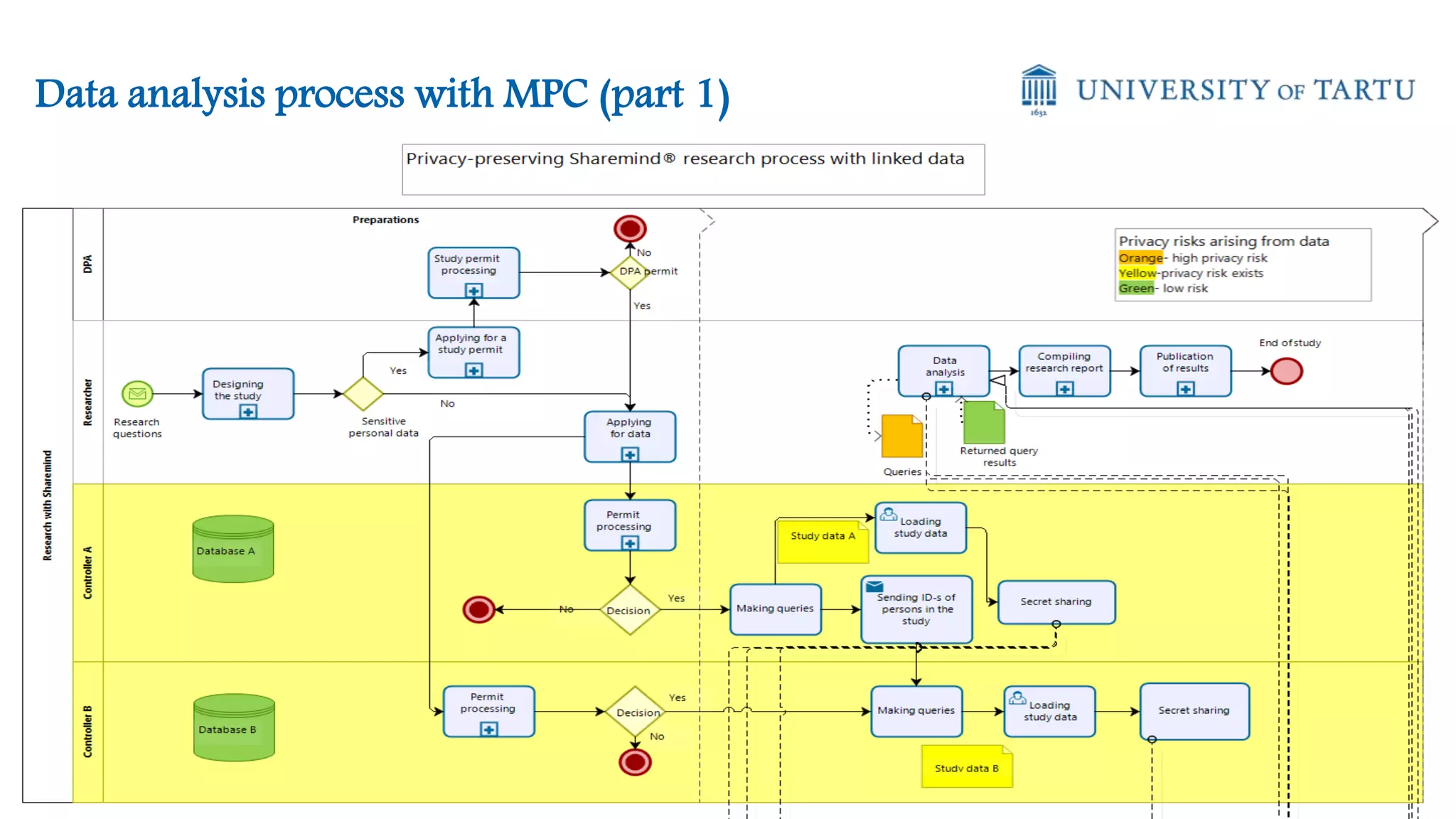
Data analysis process with MPC (part 1)
11
12
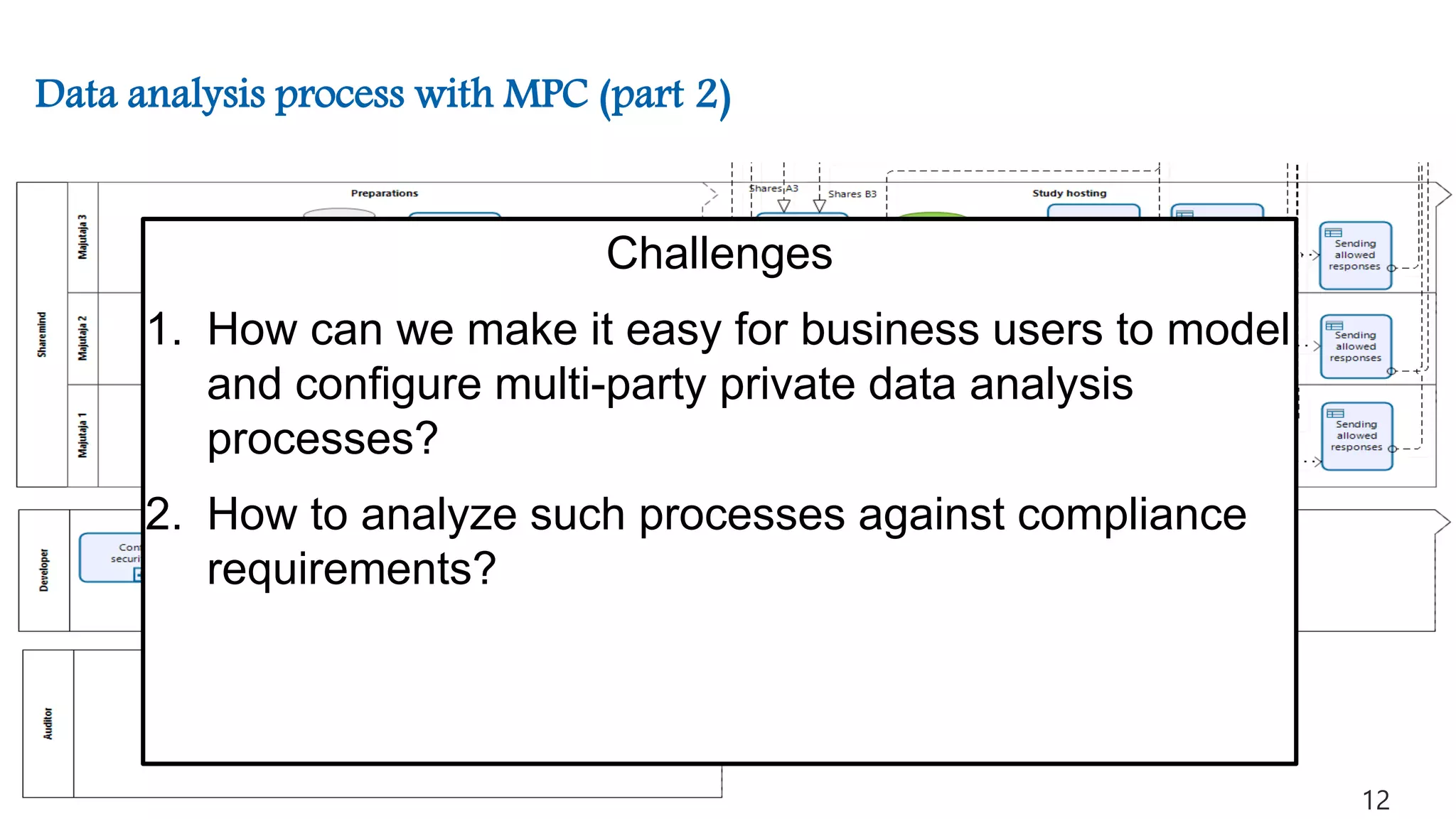
Data analysis process with MPC (part 2)
Challenges
1. How can we make it easy for business users to model
and configure multi-party private data analysis
processes?
2. How to analyze such processes against compliance
requirements?
12
Scope of MPC
• Allows a computation to be performed across parties without them disclosing
anything but the output
• But the output is visible to the analyst…
• What if the analyst issues several (authorized) queries? What can they learn about individuals?
• Information release control
• K-anonymity, t-closeness
• Differential privacy
13
Differential Privacy (Dwork 2006)
K gives e-differential privacy if for all values of DB, DB’
differing in a single element, and all S in Range(K )
Pr[ K (DB) in S]
Pr[ K (DB’) in S]
≤ eε ~ (1+ε)
ratio bounded
Pr [t]
14
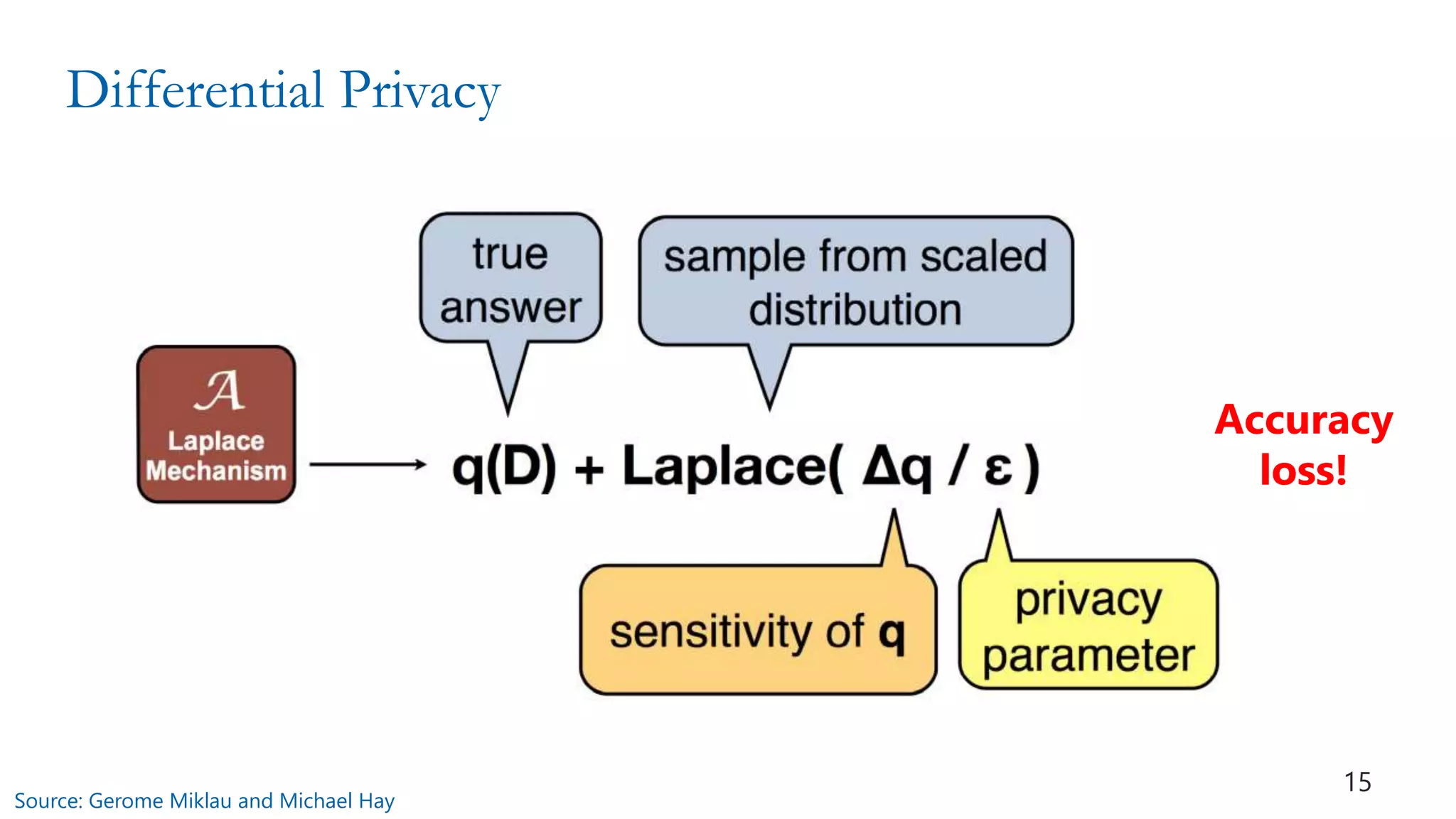
Differential Privacy
Source: Gerome Miklau and Michael Hay
Accuracy
loss!
15
Dan Bogdanov et al.: a Privacy-Preserving Study Using Secure Computation. PoPETs 2016(3): 117-135 (2016)
Data Analysis with MPC – Architecture
Differentially
Private Release
Mechanism
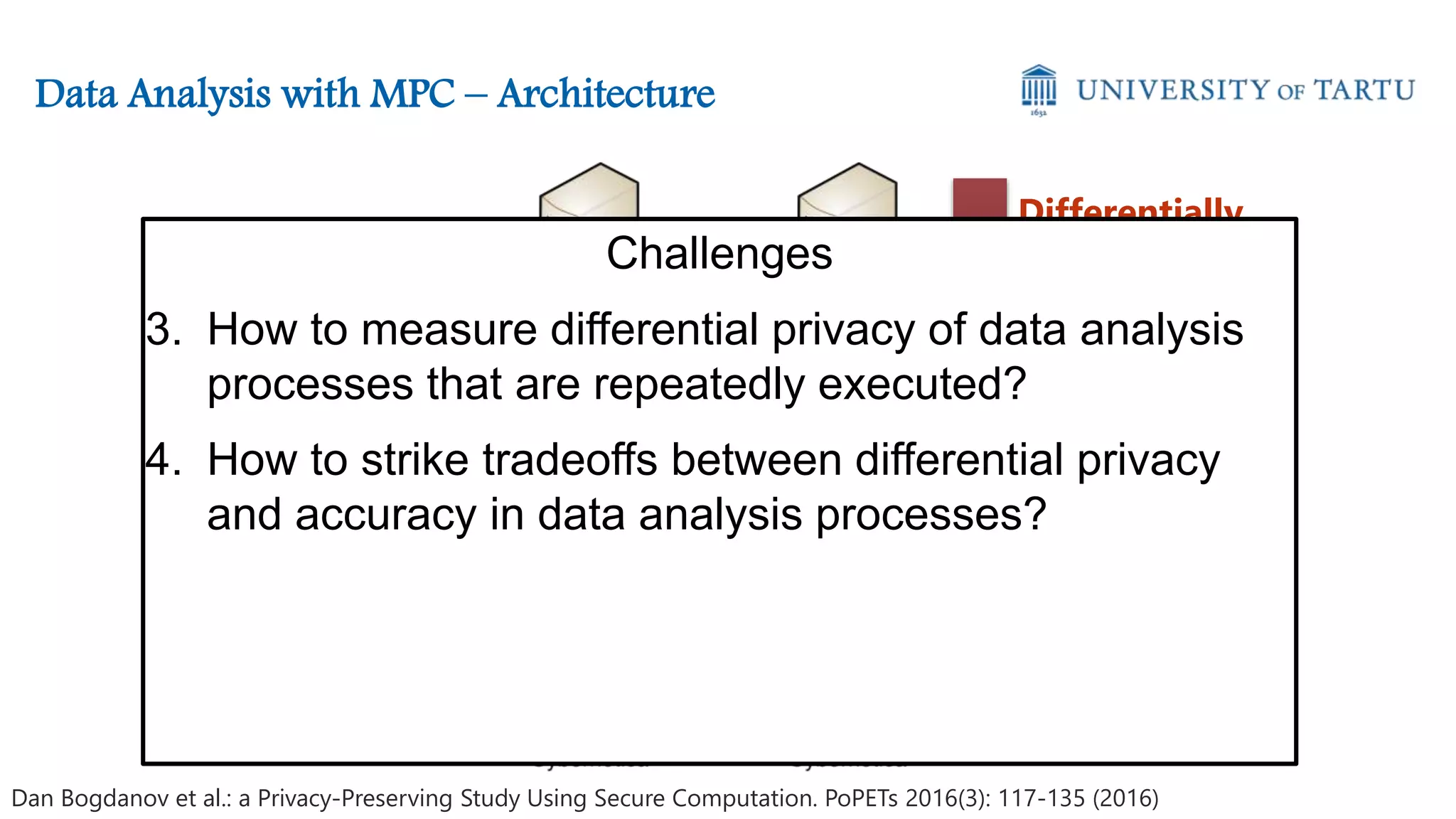
Challenges
3. How to measure differential privacy of data analysis
processes that are repeatedly executed?
4. How to strike tradeoffs between differential privacy
and accuracy in data analysis processes?
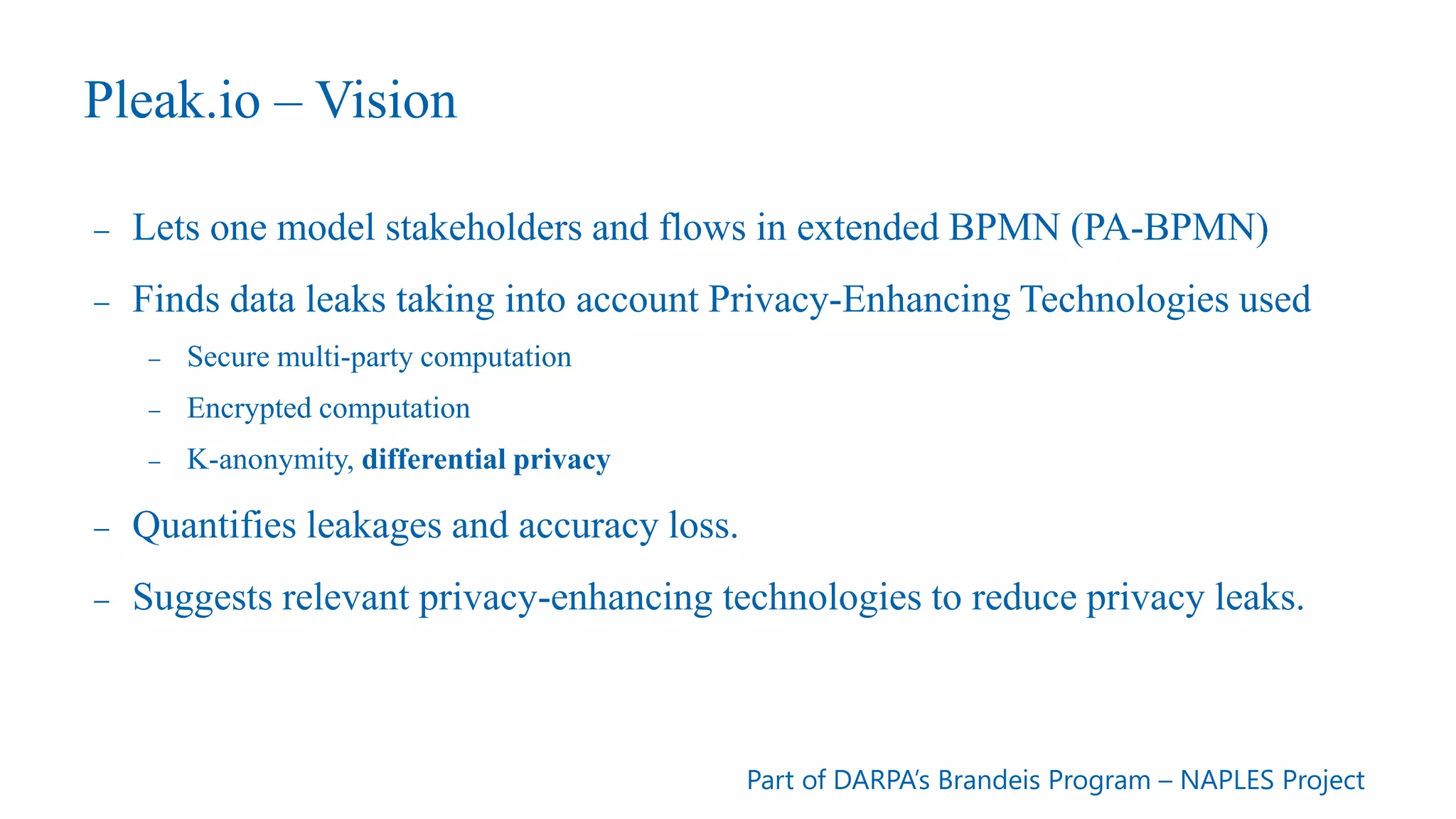
Pleak.io – Vision
- Lets one model stakeholders and flows in extended BPMN (PA-BPMN)
- Finds data leaks taking into account Privacy-Enhancing Technologies used
- Secure multi-party computation
- Encrypted computation
- K-anonymity, differential privacy
- Quantifies leakages and accuracy loss.
- Suggests relevant privacy-enhancing technologies to reduce privacy leaks.
Part of DARPA’s Brandeis Program – NAPLES Project
18
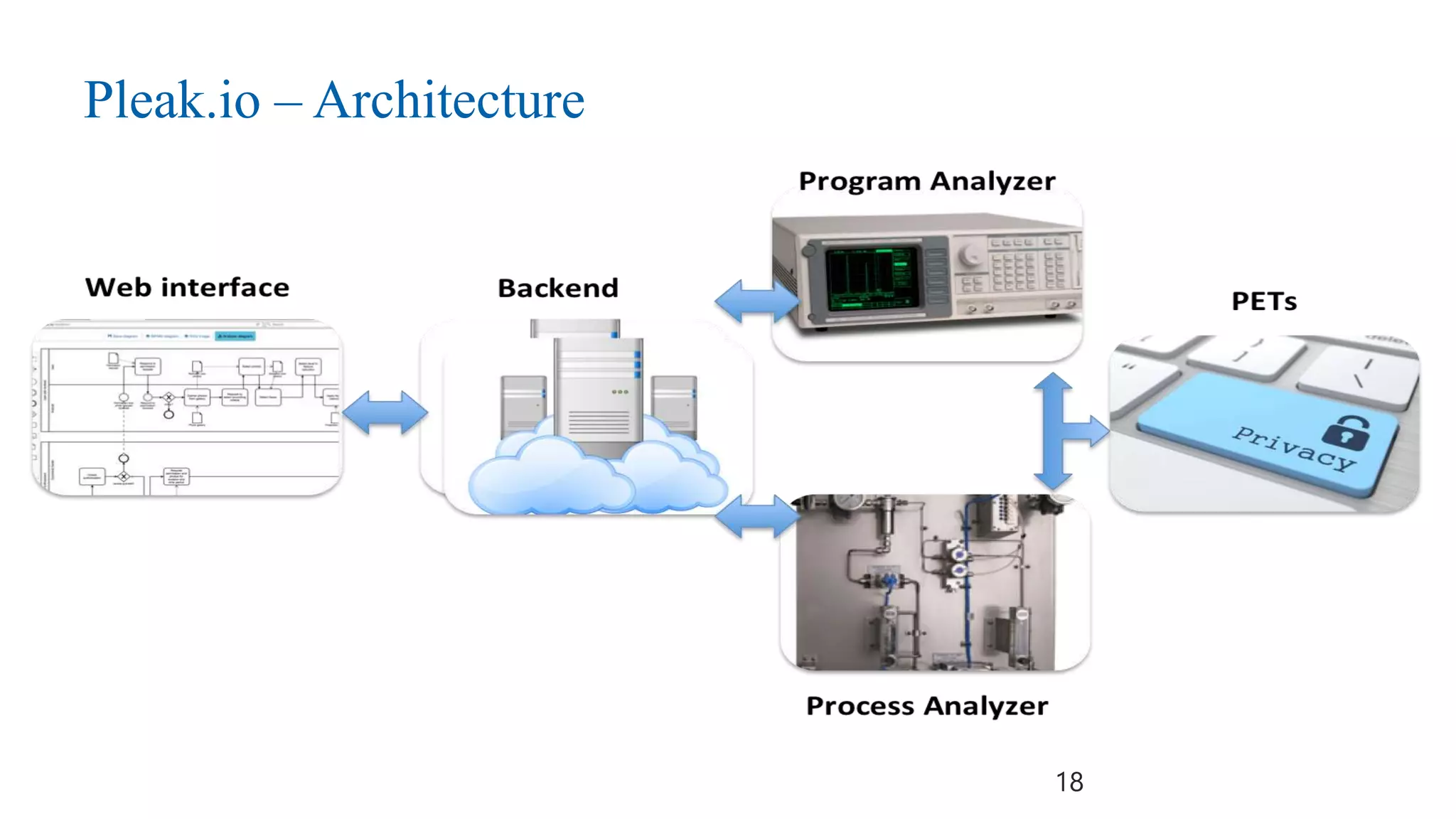
Pleak.io – Architecture
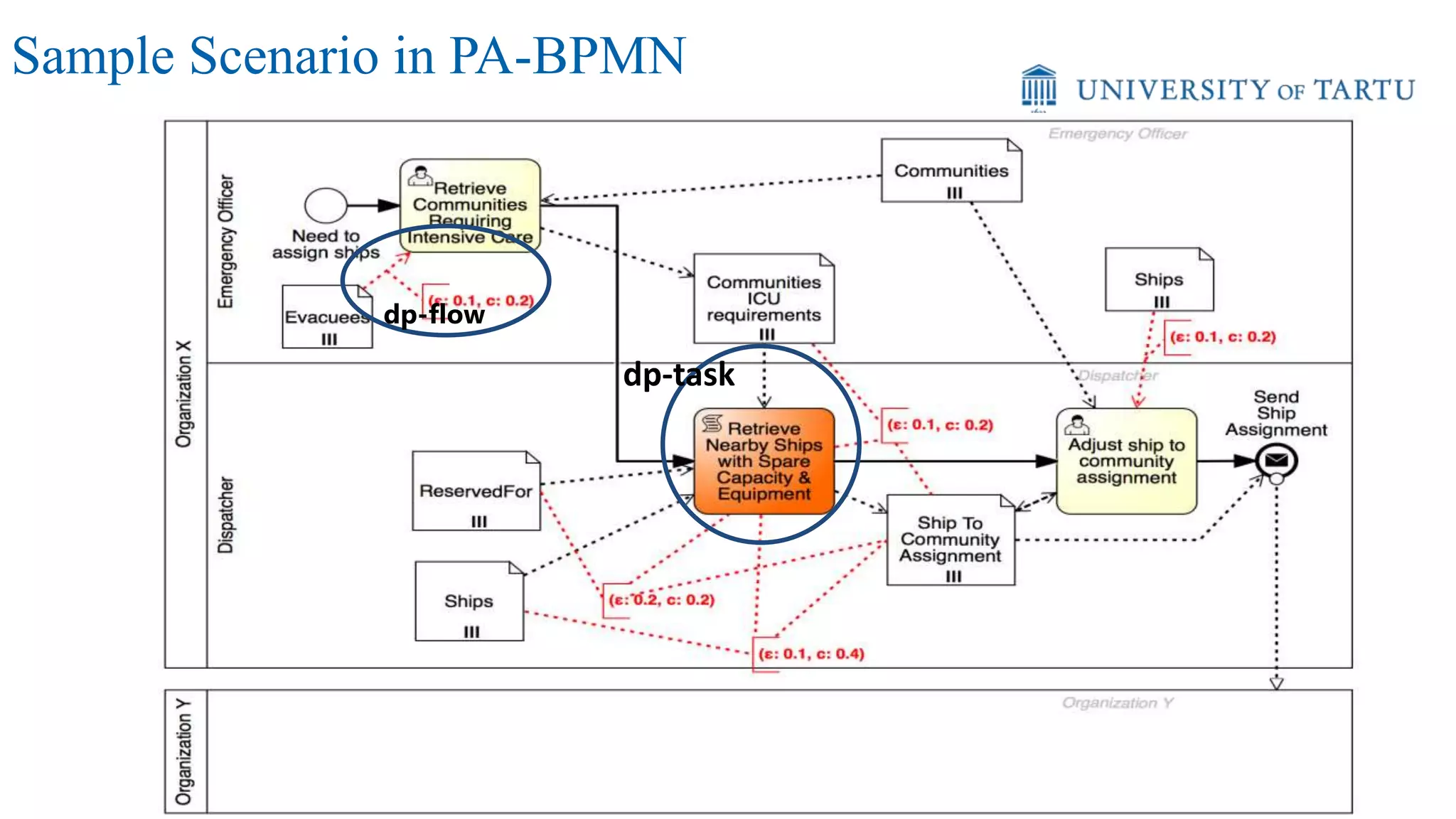
Sample Scenario in PA-BPMN
19
dp-flow
dp-task
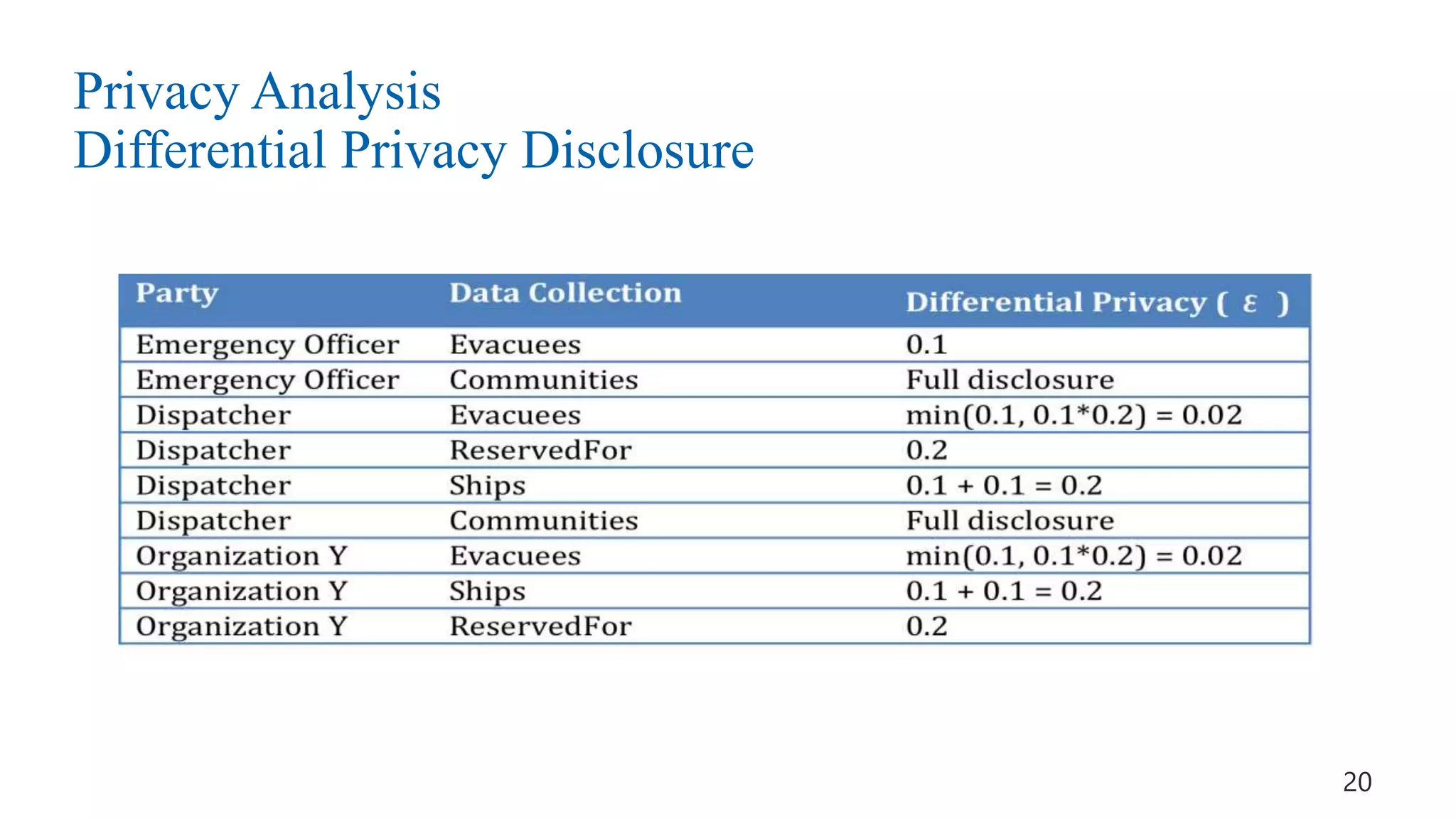
Privacy Analysis
Differential Privacy Disclosure
20
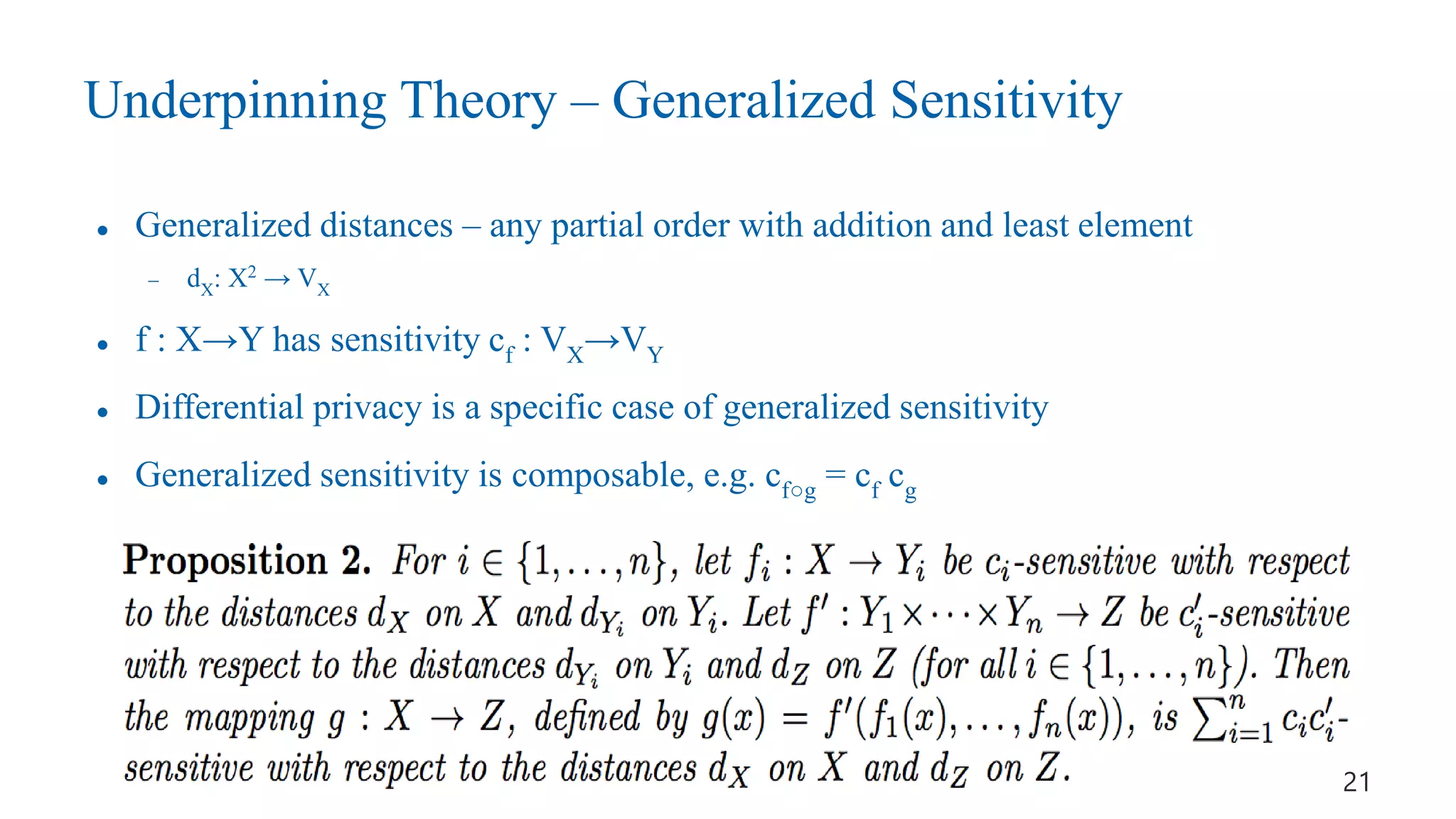
Underpinning Theory – Generalized Sensitivity
 Generalized distances – any partial order with addition and least element
- dX: X2
→ VX
 f : X→Y has sensitivity cf : VX→VY
 Differential privacy is a specific case of generalized sensitivity
 Generalized sensitivity is composable, e.g. cf○g = cf cg
21
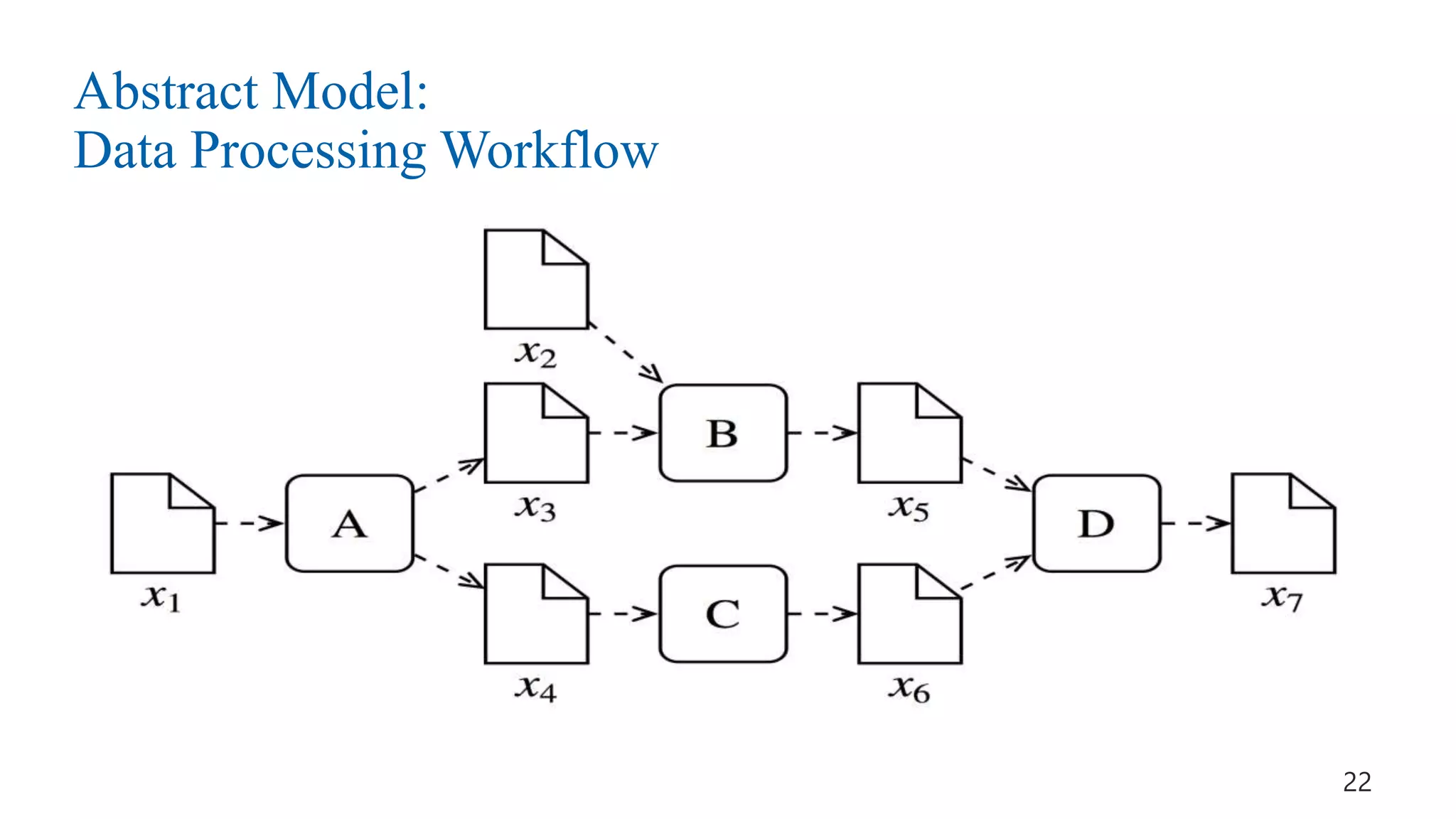
Abstract Model:
Data Processing Workflow
22
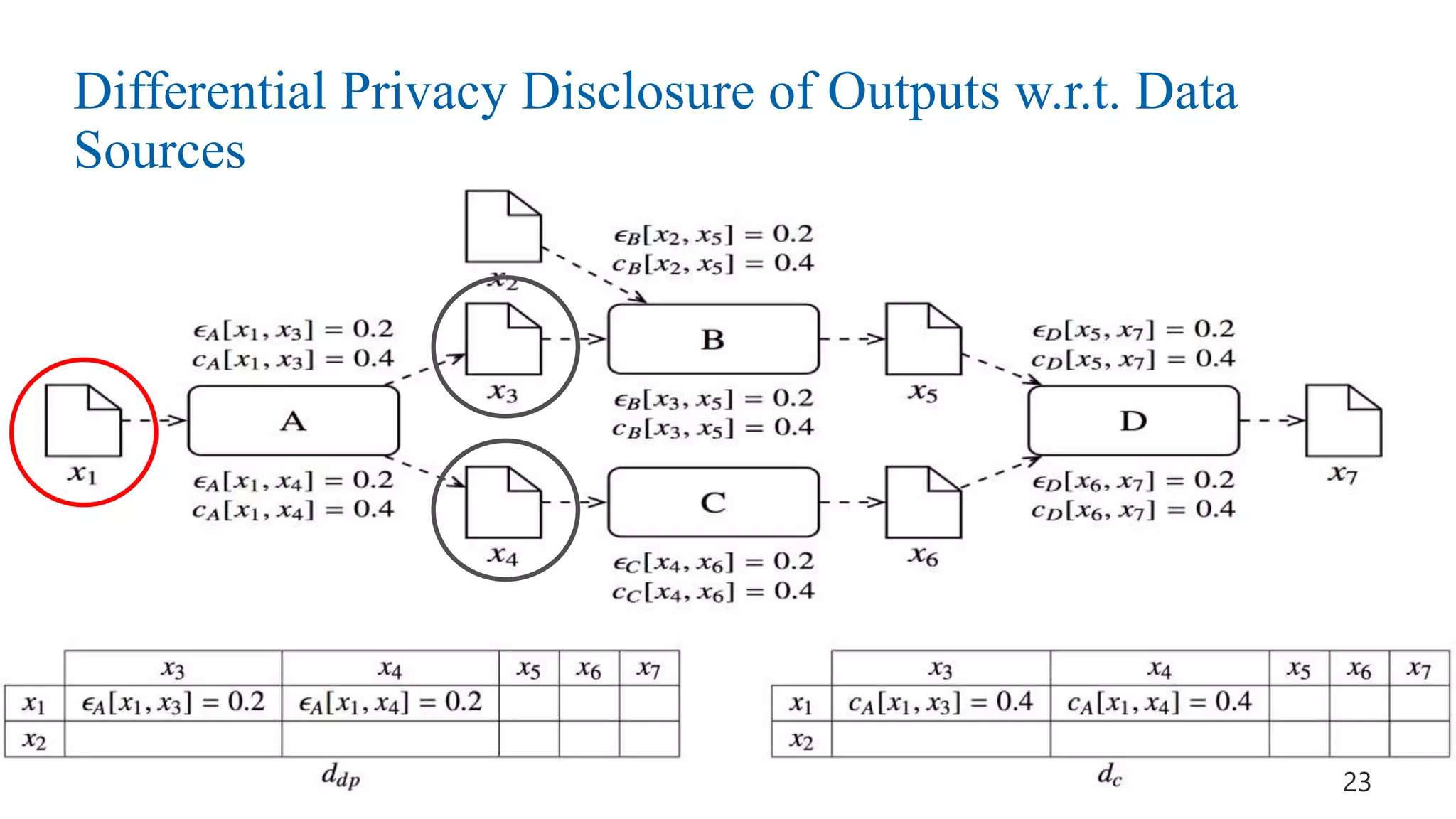
Differential Privacy Disclosure of Outputs w.r.t. Data
Sources
23
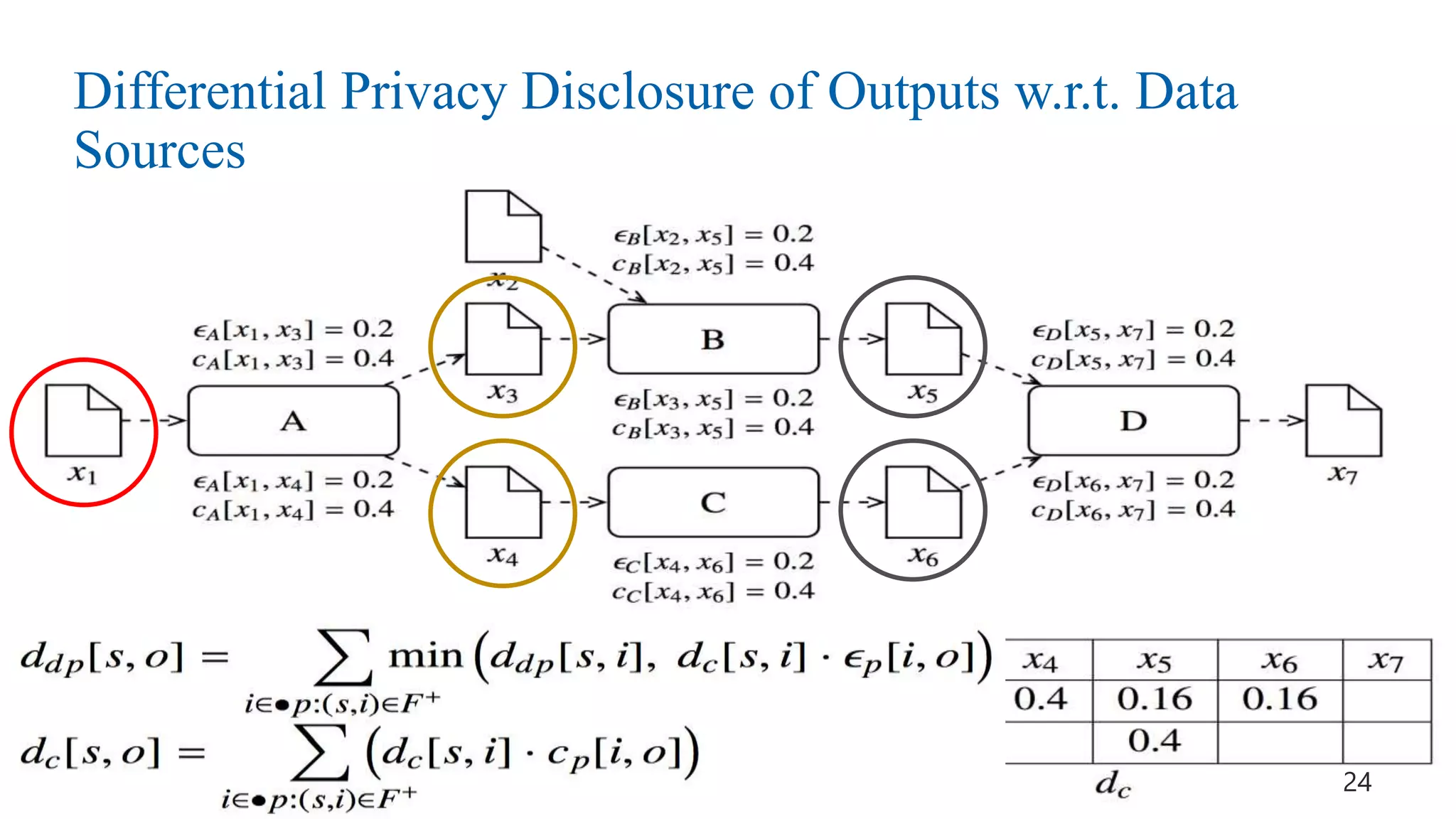
Differential Privacy Disclosure of Outputs w.r.t. Data
Sources
24
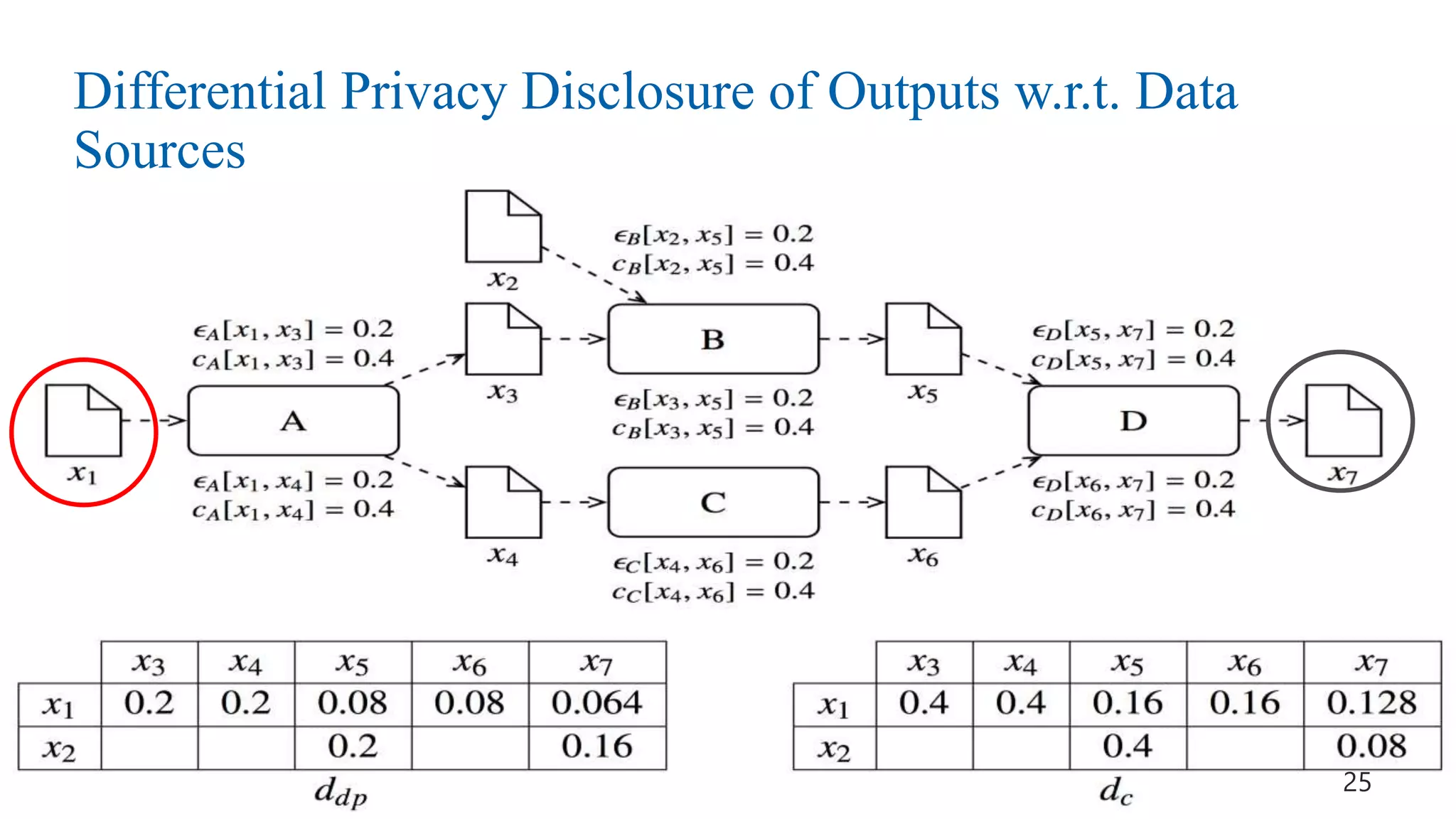
Differential Privacy Disclosure of Outputs w.r.t. Data
Sources
25
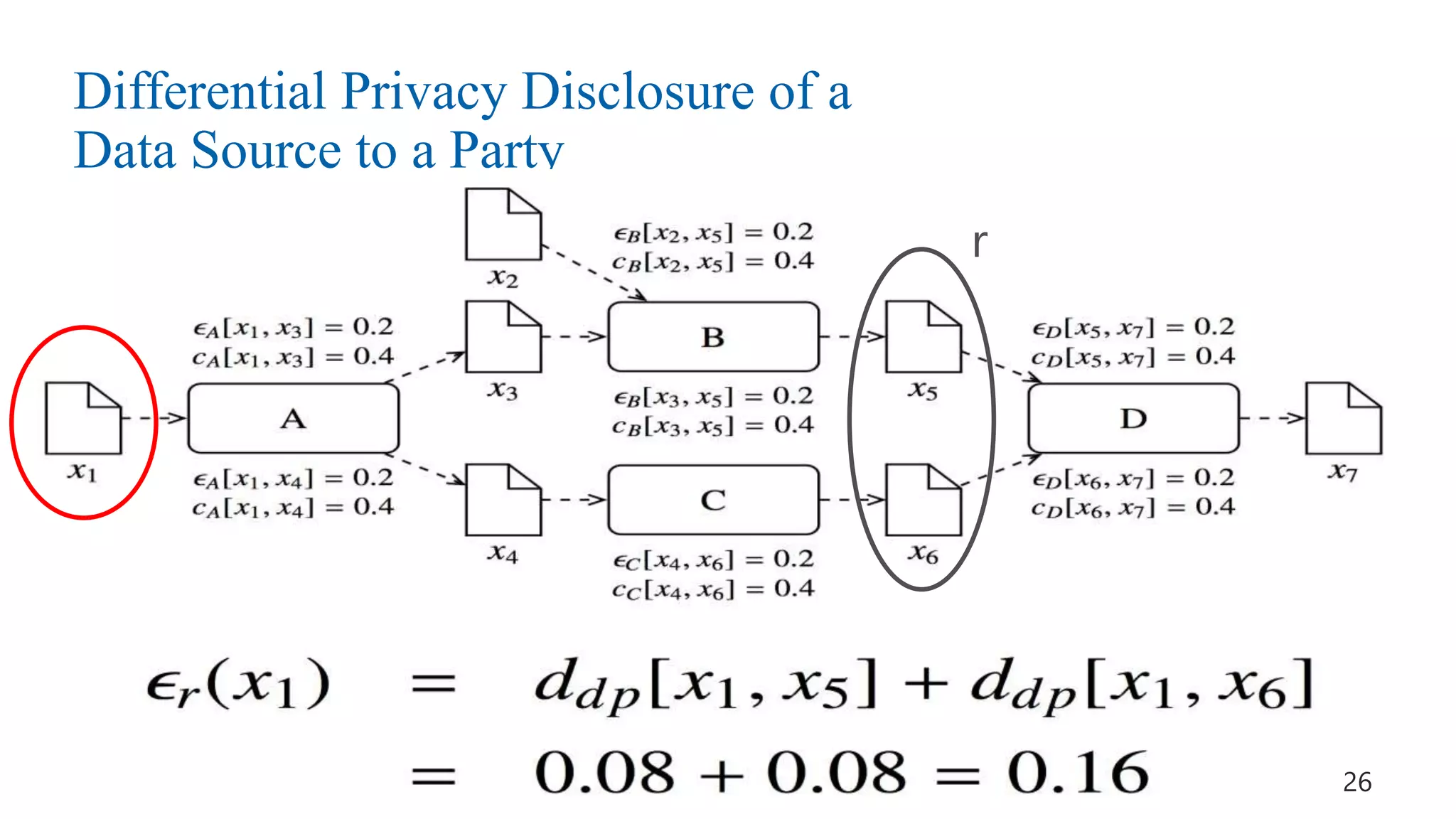
Differential Privacy Disclosure of a
Data Source to a Party
r
26
(ships, disaster) -> {
avail_food = 0;
avail_ships = [];
for (ship in ships) do {
fuzzed_loc = ship.loc() + Lap2
(3);
if (dist(fuzzed_loc, disaster.loc()) / ship.speed() <= 2
&& ship.cargo_type() == "food"
&& !ship.contains(dangerous_materials) ) {
avail_food += ship.cargo();
avail_ships.append({ship.name(), fuzzed_loc});
}
}
avail_food += Lap(2);
return (avail_food, avail_ships);
}
Collaborative processes with
untrusted parties
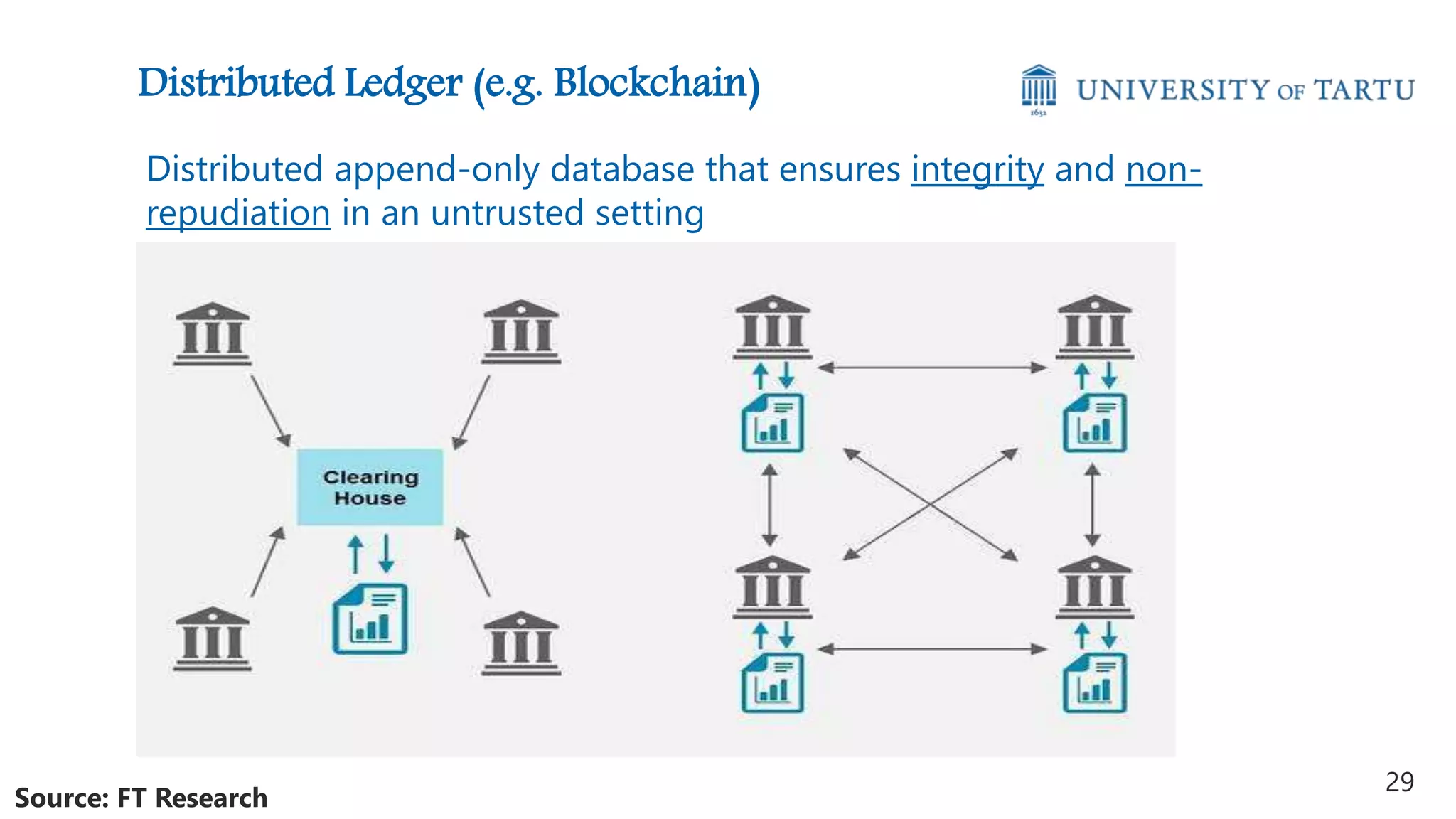
Distributed Ledger (e.g. Blockchain)
29
Source: FT Research
Distributed append-only database that ensures integrity and non-
repudiation in an untrusted setting
• Programs living on the blockchain (e.g. Ethereum) with their own memory and
code
• Invoked when certain transactions are sent to them
• Can store data, send transactions, interact with other contracts or with “agents”
Smart Contracts
30
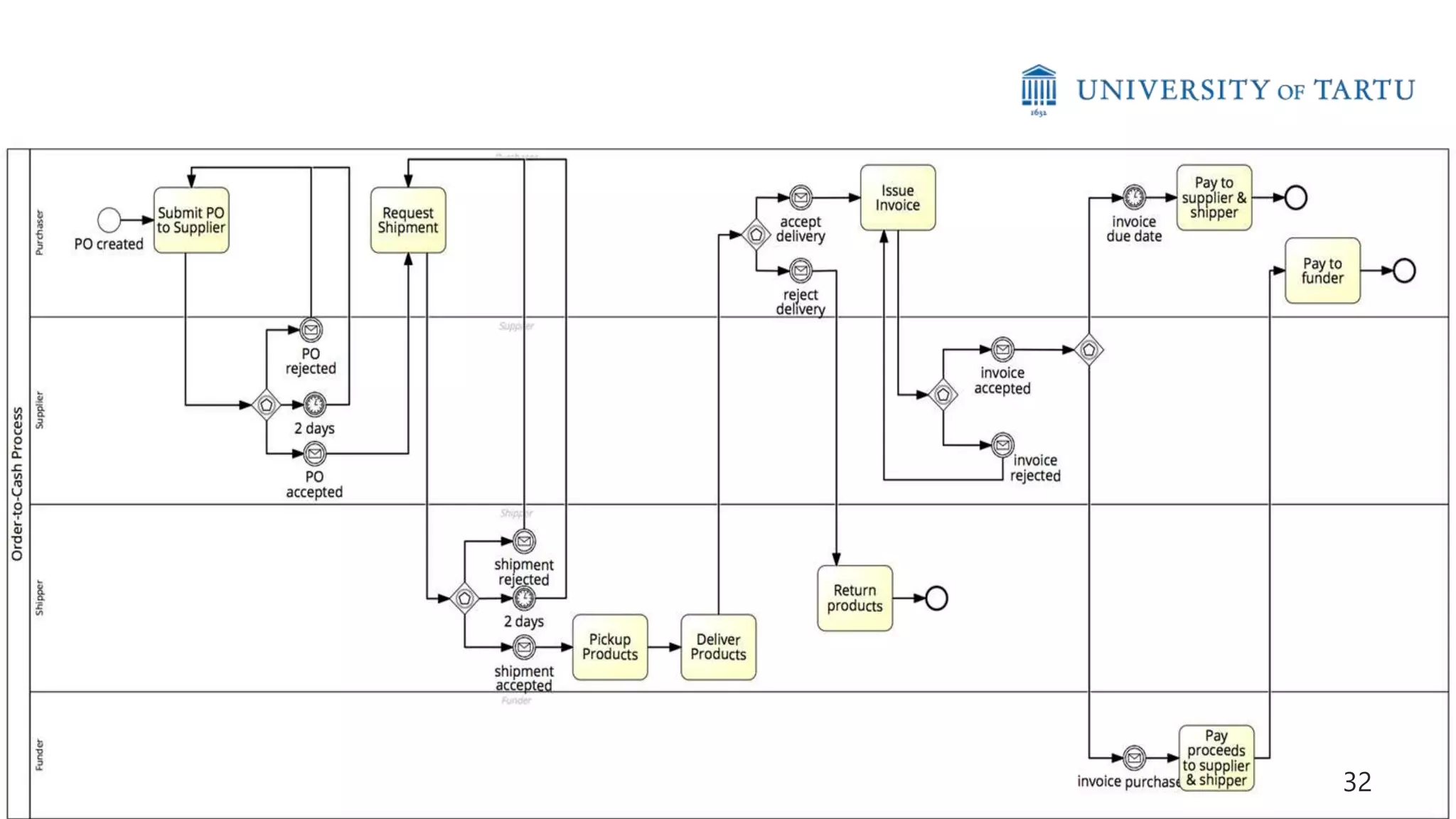
Distributed Ledgers for Collaborative Processes
- Participants agree on a collaborative process and a model for it
31
32
32
Distributed Ledgers for Collaborative Processes
- Participants agree on a collaborative process and a model for it
- The model is translated to a smart contract(s) to be executed on the blockchain
- Smart contracts listen to process execution events and interact with agents or
other smart contracts in order to monitor and/or execute the process
33
1. Audit trail: Record all events in the process, which can be used later to retrace
the execution of a given process instance.
2. Monitoring: Deploy a smart contract for every instance of the process to verify
and/or enforce the constraints captured in the process model.
3. Active coordination: Deploy a smart contract for every process instance, which
observes every event occurring in the process instance and triggers the next step
by notifying the agent(s) of the corresponding actors.
34
Distributed Ledgers for Collaborative Processes
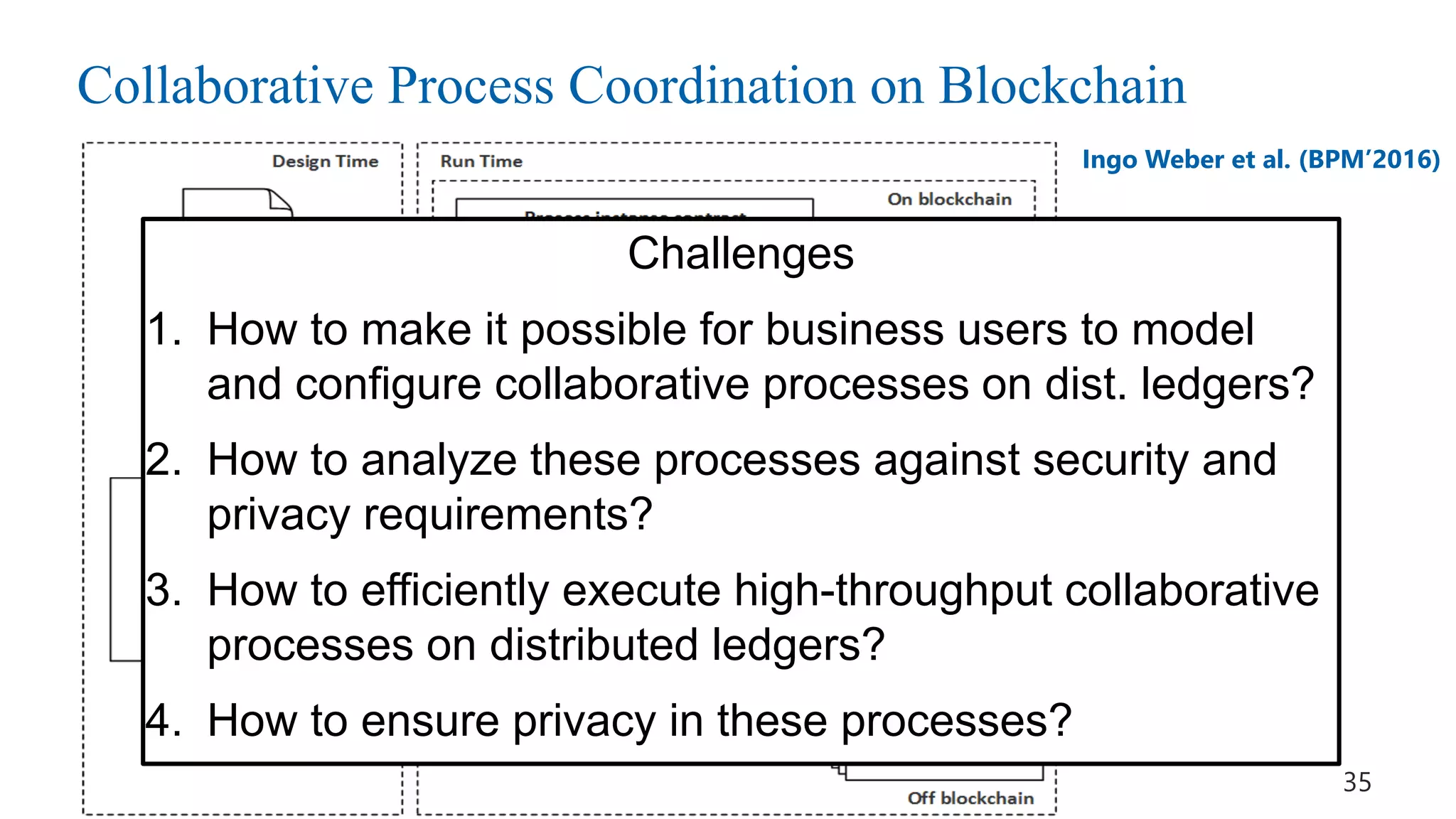
Collaborative Process Coordination on Blockchain
35
Ingo Weber et al. (BPM’2016)
Challenges
1. How to make it possible for business users to model
and configure collaborative processes on dist. ledgers?
2. How to analyze these processes against security and
privacy requirements?
3. How to efficiently execute high-throughput collaborative
processes on distributed ledgers?
4. How to ensure privacy in these processes?
Join us…
Reference(s)
[1] Dan Bogdanov et al.: Students and Taxes: a Privacy-Preserving Study Using
Secure Computation. PoPETs 2016(3):117-135, 2016
[2] Marlon Dumas, Luciano Garcia-Banuelos, Peeter Laud: Differential Privacy of
Data Processing Workflows. In Proc. of GraMSec’2016
[3] Ingo Weber, Xiwei Xu, Regis Riveret, Guido Governatori, Alexander
Ponomarev, Jan Mendling. Untrusted Business Process Monitoring and Execution
Using Blockchain. In Proc. of BPM’2016
37
Research funded by DARPA (Brandeis
program 2015-2019)
Thanks!

In Processes We Trust: Privacy and Trust in Business Processes

  • 1.
    Privacy and Trustin Business Processes: Challenges and Opportunities In processes we trust Marlon Dumas marlon.dumas@ut.ee SOAMED Workshop – Berlin 9-10 June 2016
  • 2.
    What do youunderstand by… Security? Privacy?Trust? 2
  • 3.
  • 4.
    • Security: Confidentiality,integrity and non-repudiation in the presence of dishonest/malicious attackers • Privacy: Confidentiality in the presence of honest-but-curious actors SECURITY VS. PRIVACY 4
  • 5.
    Topics in BusinessProcess Security & Privacy • Access control and release control in business processes • Flow analysis to detect unauthorized data object access/disclosures • Privacy-aware business process execution • Collaborative process execution with untrusted parties 5
  • 6.
  • 7.
    Analysis of LinkedDatasets: No privacy tech
  • 8.
    Analysis of LinkedDatasets: k-anonymization
  • 9.
    Analysis of LinkedDatasets: Multi-Party Computation (MPC) 10 million tax records + 500 000 education records Dan Bogdanov et al.: Students and Taxes: a Privacy-Preserving Study Using Secure Computation. PoPETs 2016(3): 117-135 (2016) 9
  • 10.
    Dan Bogdanov etal.: a Privacy-Preserving Study Using Secure Computation. PoPETs 2016(3): 117-135 (2016) Data Analysis with MPC – Architecture 10
  • 11.
    Data analysis processwith MPC (part 1) 11
  • 12.
    12 Data analysis processwith MPC (part 2) Challenges 1. How can we make it easy for business users to model and configure multi-party private data analysis processes? 2. How to analyze such processes against compliance requirements? 12
  • 13.
    Scope of MPC •Allows a computation to be performed across parties without them disclosing anything but the output • But the output is visible to the analyst… • What if the analyst issues several (authorized) queries? What can they learn about individuals? • Information release control • K-anonymity, t-closeness • Differential privacy 13
  • 14.
    Differential Privacy (Dwork2006) K gives e-differential privacy if for all values of DB, DB’ differing in a single element, and all S in Range(K ) Pr[ K (DB) in S] Pr[ K (DB’) in S] ≤ eε ~ (1+ε) ratio bounded Pr [t] 14
  • 15.
    Differential Privacy Source: GeromeMiklau and Michael Hay Accuracy loss! 15
  • 16.
    Dan Bogdanov etal.: a Privacy-Preserving Study Using Secure Computation. PoPETs 2016(3): 117-135 (2016) Data Analysis with MPC – Architecture Differentially Private Release Mechanism Challenges 3. How to measure differential privacy of data analysis processes that are repeatedly executed? 4. How to strike tradeoffs between differential privacy and accuracy in data analysis processes?
  • 17.
    Pleak.io – Vision -Lets one model stakeholders and flows in extended BPMN (PA-BPMN) - Finds data leaks taking into account Privacy-Enhancing Technologies used - Secure multi-party computation - Encrypted computation - K-anonymity, differential privacy - Quantifies leakages and accuracy loss. - Suggests relevant privacy-enhancing technologies to reduce privacy leaks. Part of DARPA’s Brandeis Program – NAPLES Project
  • 18.
  • 19.
    Sample Scenario inPA-BPMN 19 dp-flow dp-task
  • 20.
  • 21.
    Underpinning Theory –Generalized Sensitivity  Generalized distances – any partial order with addition and least element - dX: X2 → VX  f : X→Y has sensitivity cf : VX→VY  Differential privacy is a specific case of generalized sensitivity  Generalized sensitivity is composable, e.g. cf○g = cf cg 21
  • 22.
  • 23.
    Differential Privacy Disclosureof Outputs w.r.t. Data Sources 23
  • 24.
    Differential Privacy Disclosureof Outputs w.r.t. Data Sources 24
  • 25.
    Differential Privacy Disclosureof Outputs w.r.t. Data Sources 25
  • 26.
    Differential Privacy Disclosureof a Data Source to a Party r 26
  • 27.
    (ships, disaster) ->{ avail_food = 0; avail_ships = []; for (ship in ships) do { fuzzed_loc = ship.loc() + Lap2 (3); if (dist(fuzzed_loc, disaster.loc()) / ship.speed() <= 2 && ship.cargo_type() == "food" && !ship.contains(dangerous_materials) ) { avail_food += ship.cargo(); avail_ships.append({ship.name(), fuzzed_loc}); } } avail_food += Lap(2); return (avail_food, avail_ships); }
  • 28.
  • 29.
    Distributed Ledger (e.g.Blockchain) 29 Source: FT Research Distributed append-only database that ensures integrity and non- repudiation in an untrusted setting
  • 30.
    • Programs livingon the blockchain (e.g. Ethereum) with their own memory and code • Invoked when certain transactions are sent to them • Can store data, send transactions, interact with other contracts or with “agents” Smart Contracts 30
  • 31.
    Distributed Ledgers forCollaborative Processes - Participants agree on a collaborative process and a model for it 31
  • 32.
  • 33.
    Distributed Ledgers forCollaborative Processes - Participants agree on a collaborative process and a model for it - The model is translated to a smart contract(s) to be executed on the blockchain - Smart contracts listen to process execution events and interact with agents or other smart contracts in order to monitor and/or execute the process 33
  • 34.
    1. Audit trail:Record all events in the process, which can be used later to retrace the execution of a given process instance. 2. Monitoring: Deploy a smart contract for every instance of the process to verify and/or enforce the constraints captured in the process model. 3. Active coordination: Deploy a smart contract for every process instance, which observes every event occurring in the process instance and triggers the next step by notifying the agent(s) of the corresponding actors. 34 Distributed Ledgers for Collaborative Processes
  • 35.
    Collaborative Process Coordinationon Blockchain 35 Ingo Weber et al. (BPM’2016) Challenges 1. How to make it possible for business users to model and configure collaborative processes on dist. ledgers? 2. How to analyze these processes against security and privacy requirements? 3. How to efficiently execute high-throughput collaborative processes on distributed ledgers? 4. How to ensure privacy in these processes?
  • 36.
  • 37.
    Reference(s) [1] Dan Bogdanovet al.: Students and Taxes: a Privacy-Preserving Study Using Secure Computation. PoPETs 2016(3):117-135, 2016 [2] Marlon Dumas, Luciano Garcia-Banuelos, Peeter Laud: Differential Privacy of Data Processing Workflows. In Proc. of GraMSec’2016 [3] Ingo Weber, Xiwei Xu, Regis Riveret, Guido Governatori, Alexander Ponomarev, Jan Mendling. Untrusted Business Process Monitoring and Execution Using Blockchain. In Proc. of BPM’2016 37
  • 38.
    Research funded byDARPA (Brandeis program 2015-2019) Thanks!