Process Mining and
Predictive Process
Monitoring
Marlon Dumas
University of Tartu, Estonia
marlon.dumas@ut.ee
1https://www.slideshare.net/MarlonDumas
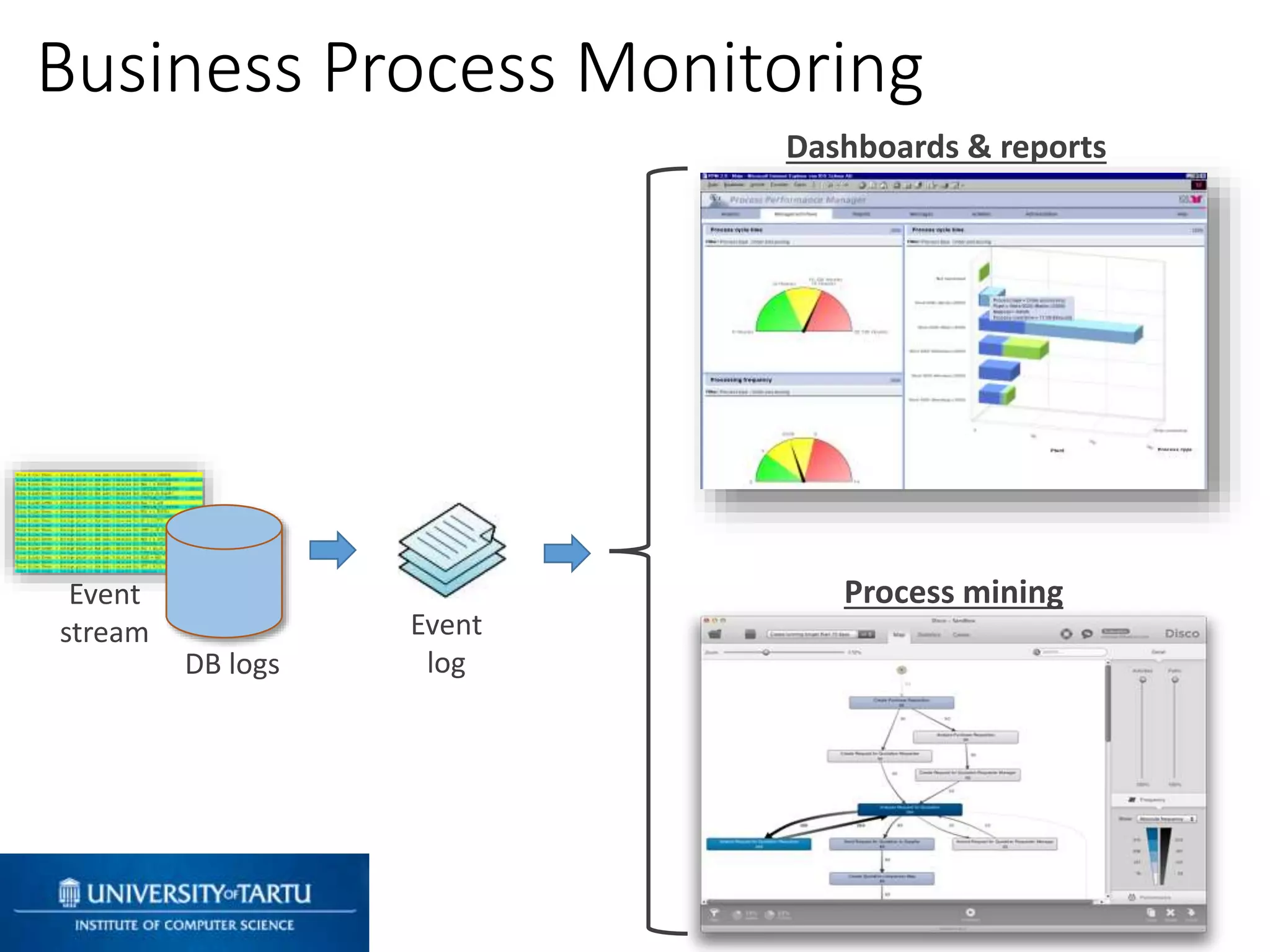
Business Process Monitoring
Dashboards & reports
Process miningEvent
stream
DB logs
Event
log
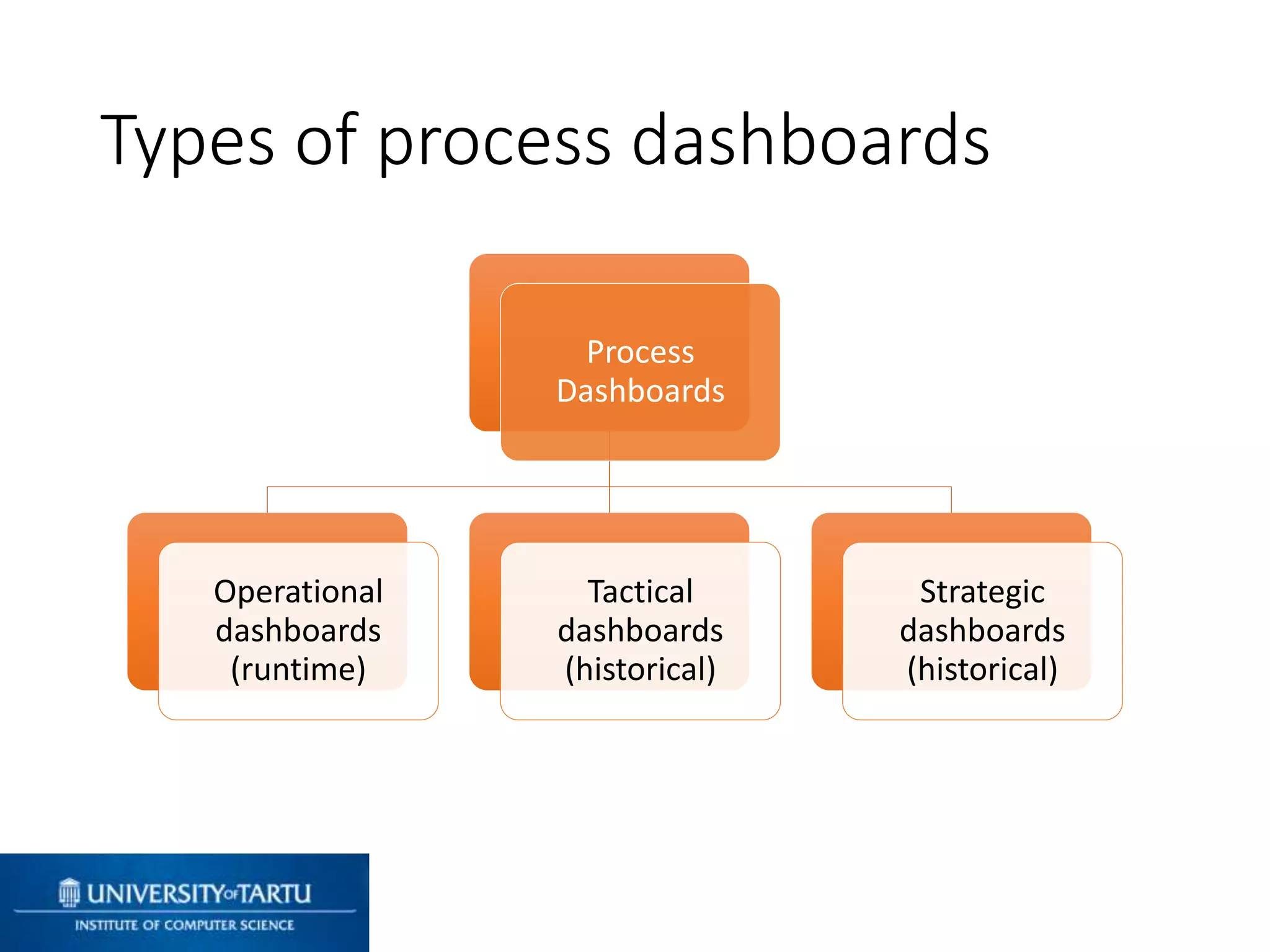
Process
Dashboards
Operational
dashboards
(runtime)
Tactical
dashboards
(historical)
Strategic
dashboards
(historical)
Types of process dashboards
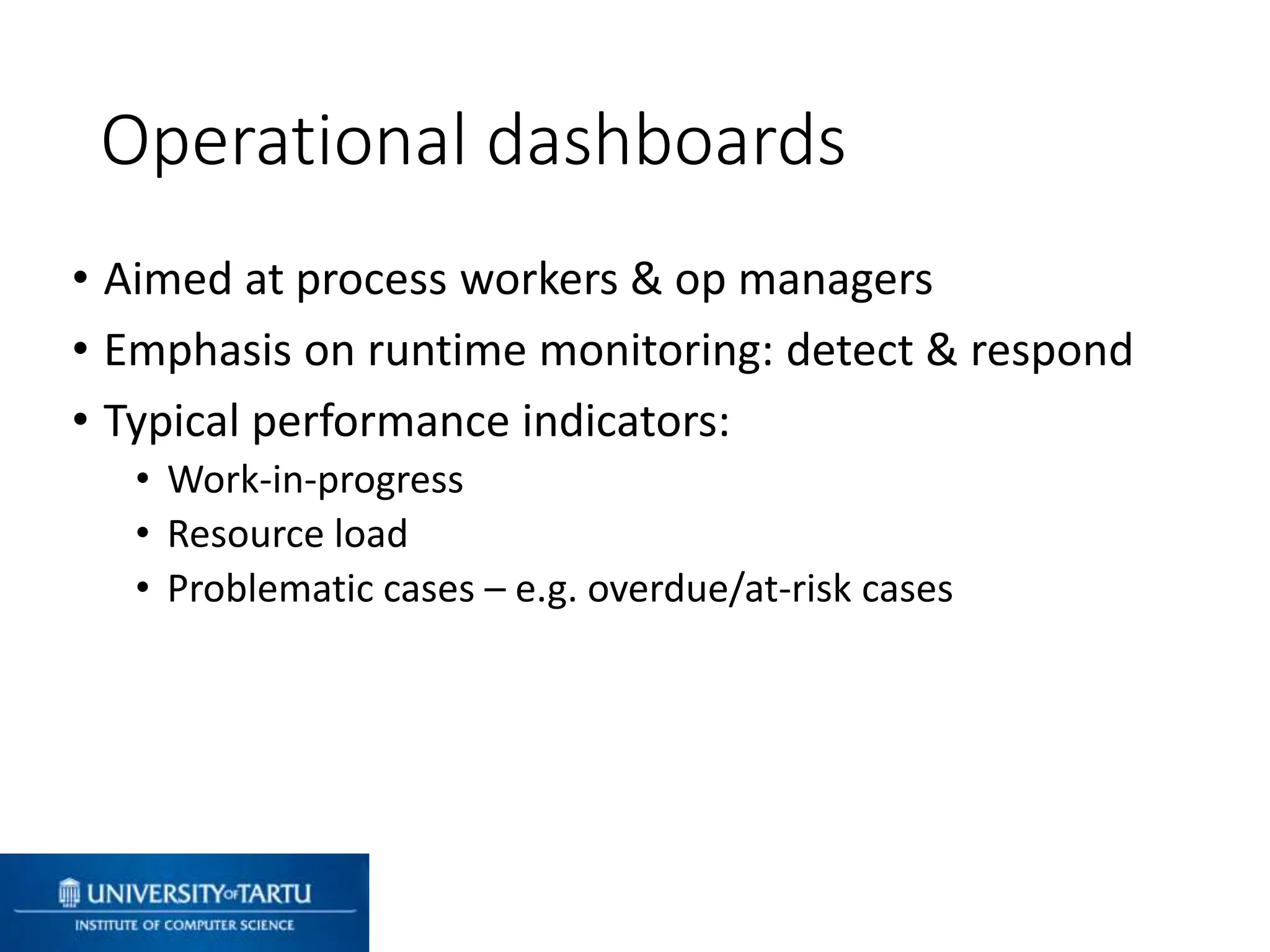
• Aimed at process workers & op managers
• Emphasis on runtime monitoring: detect & respond
• Typical performance indicators:
• Work-in-progress
• Resource load
• Problematic cases – e.g. overdue/at-risk cases
Operational dashboards
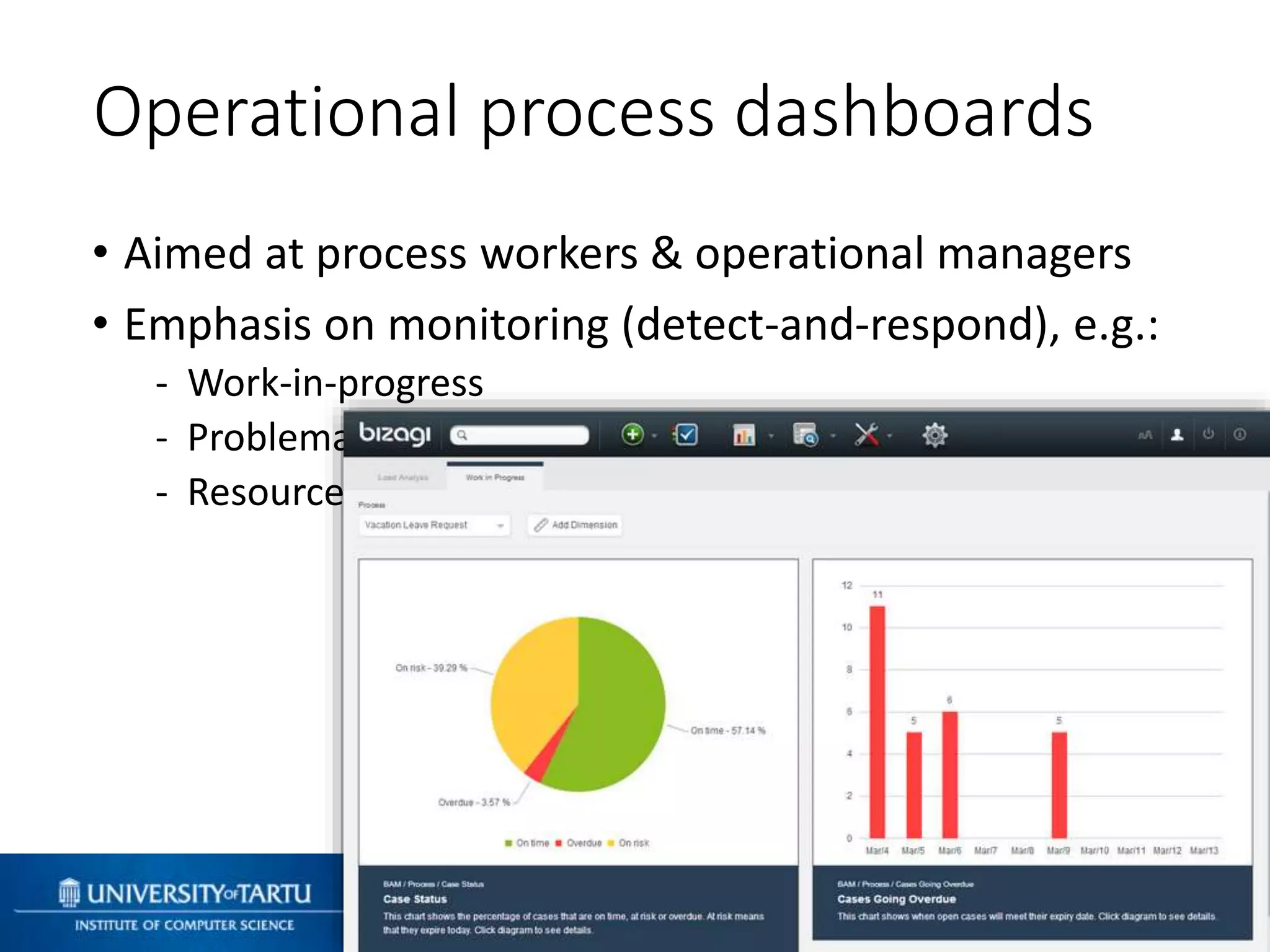
Operational process dashboards
• Aimed at process workers & operational managers
• Emphasis on monitoring (detect-and-respond), e.g.:
- Work-in-progress
- Problematic cases – e.g. overdue/at-risk cases
- Resource load
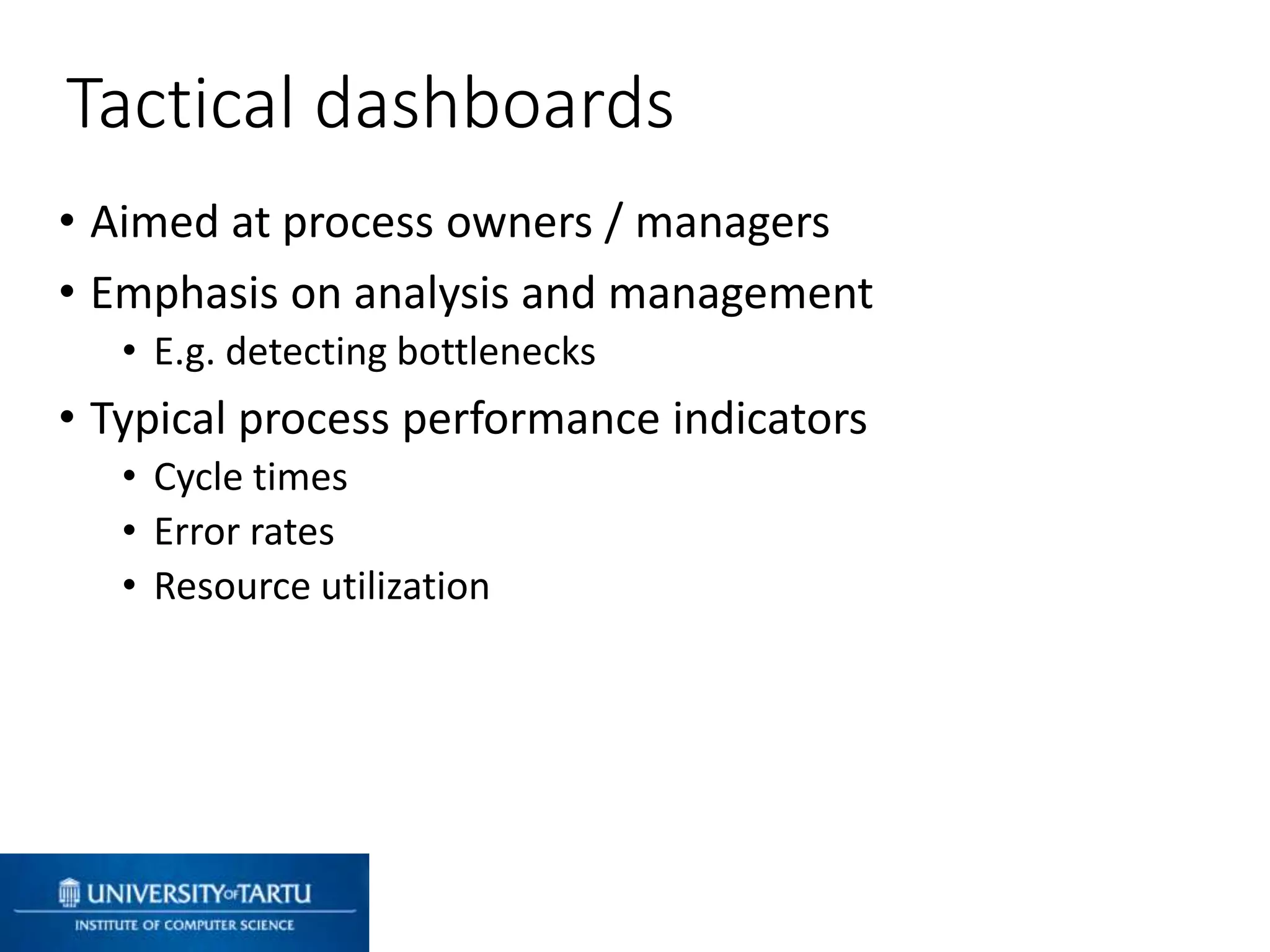
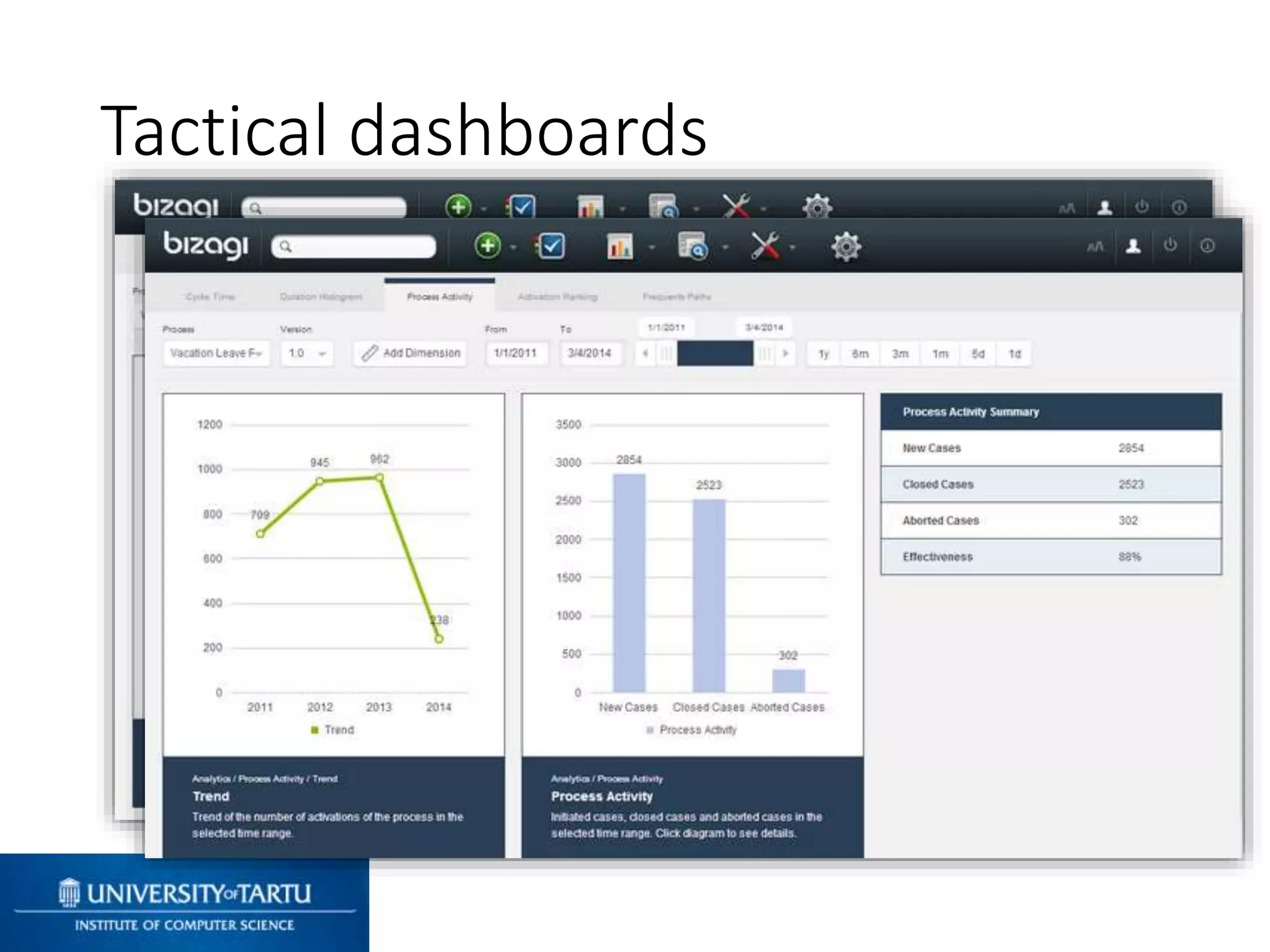
• Aimed at process owners / managers
• Emphasis on analysis and management
• E.g. detecting bottlenecks
• Typical process performance indicators
• Cycle times
• Error rates
• Resource utilization
Tactical dashboards
Tactical dashboards
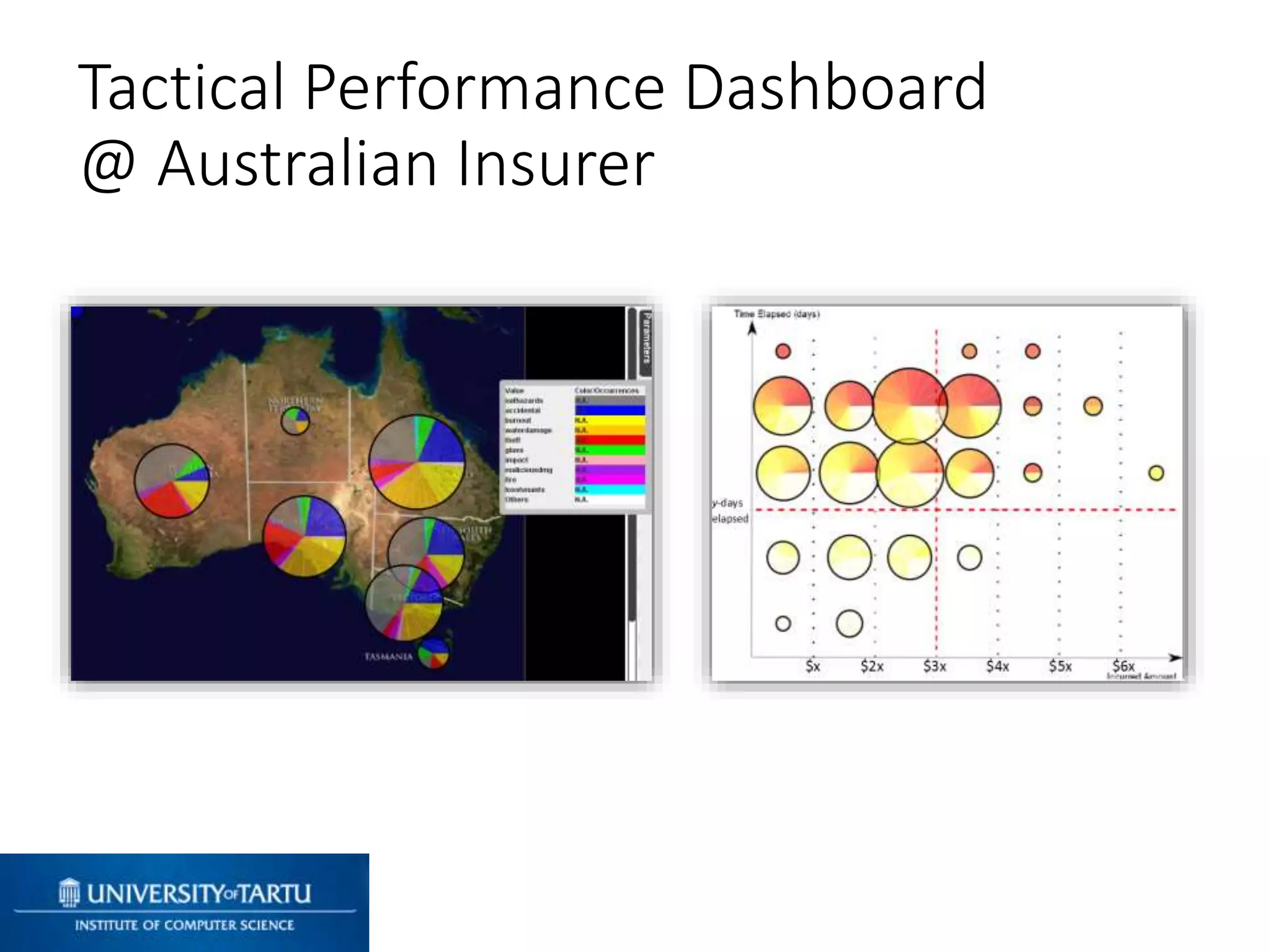
Tactical Performance Dashboard
@ Australian Insurer
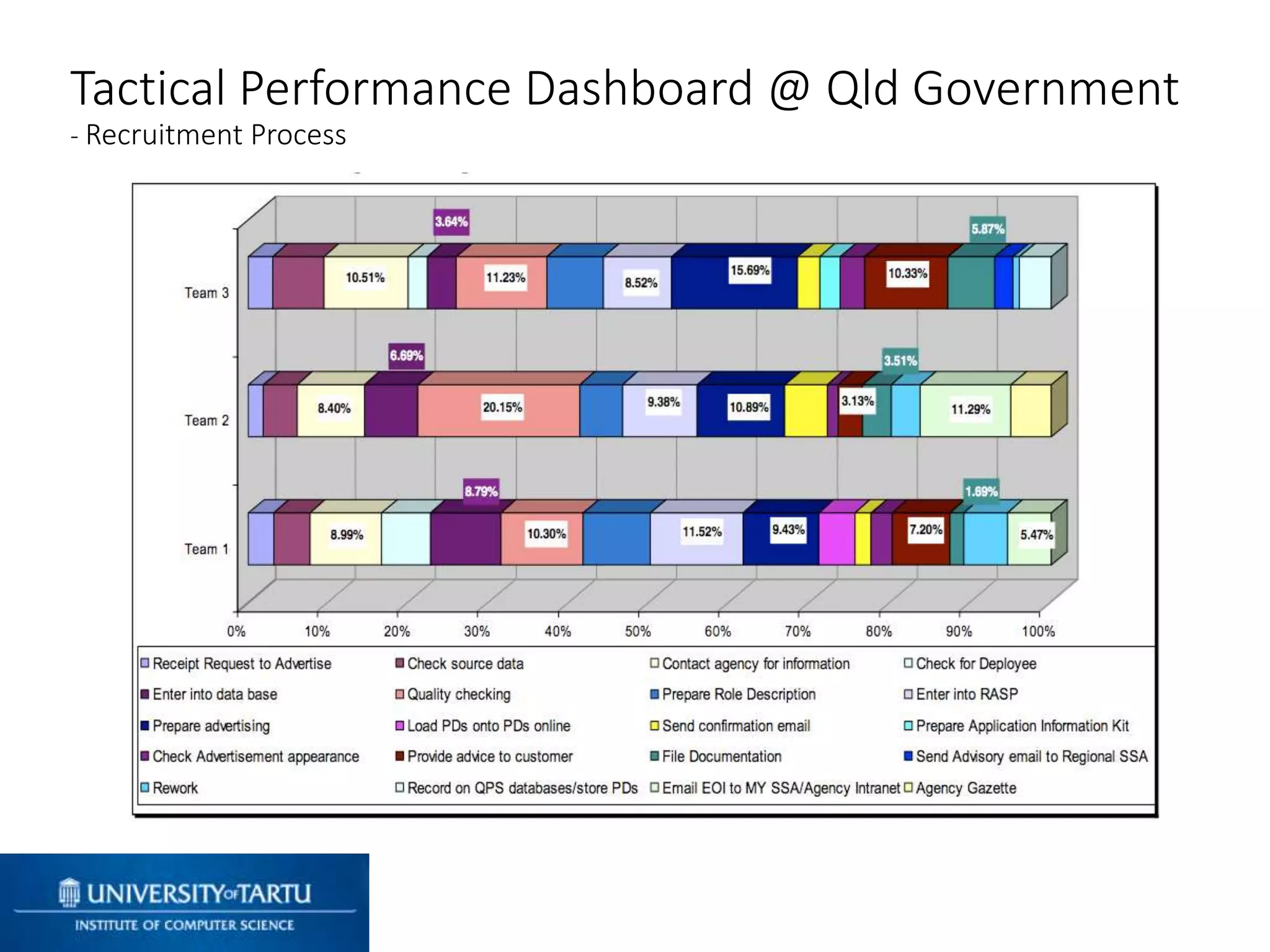
Tactical Performance Dashboard @ Qld Government
- Recruitment Process
• Aimed at executives & managers
• Emphasis on management
• Link process performance to strategic objectives
• Often based on scorecards, e.g. balanced scorecard
Strategic dashboards
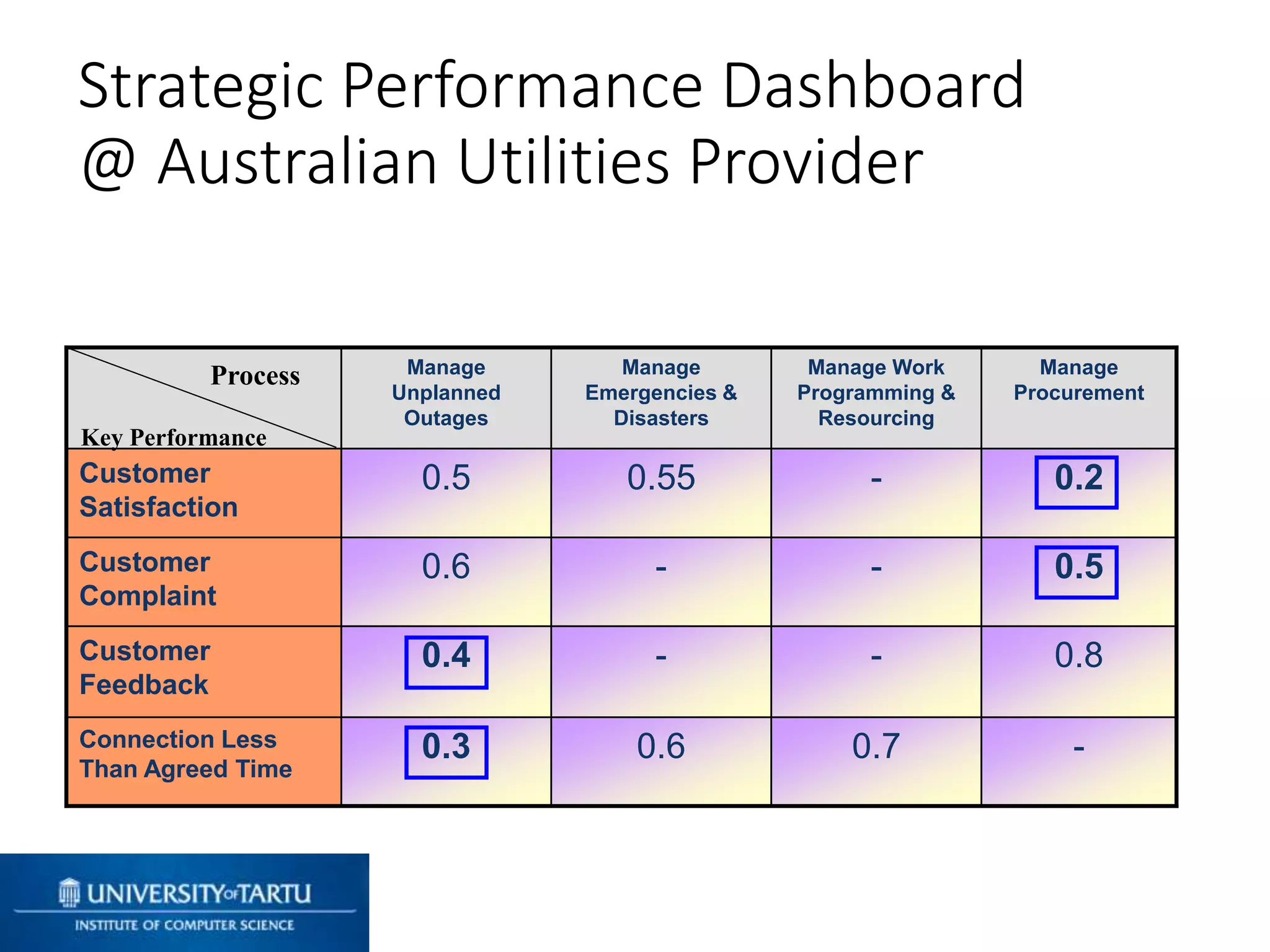
Manage
Unplanned
Outages
Manage
Emergencies &
Disasters
Manage Work
Programming &
Resourcing
Manage
Procurement
Customer
Satisfaction
0.5 0.55 - 0.2
Customer
Complaint
0.6 - - 0.5
Customer
Feedback
0.4 - - 0.8
Connection Less
Than Agreed Time
0.3 0.6 0.7 -
Key Performance
Process
Strategic Performance Dashboard
@ Australian Utilities Provider
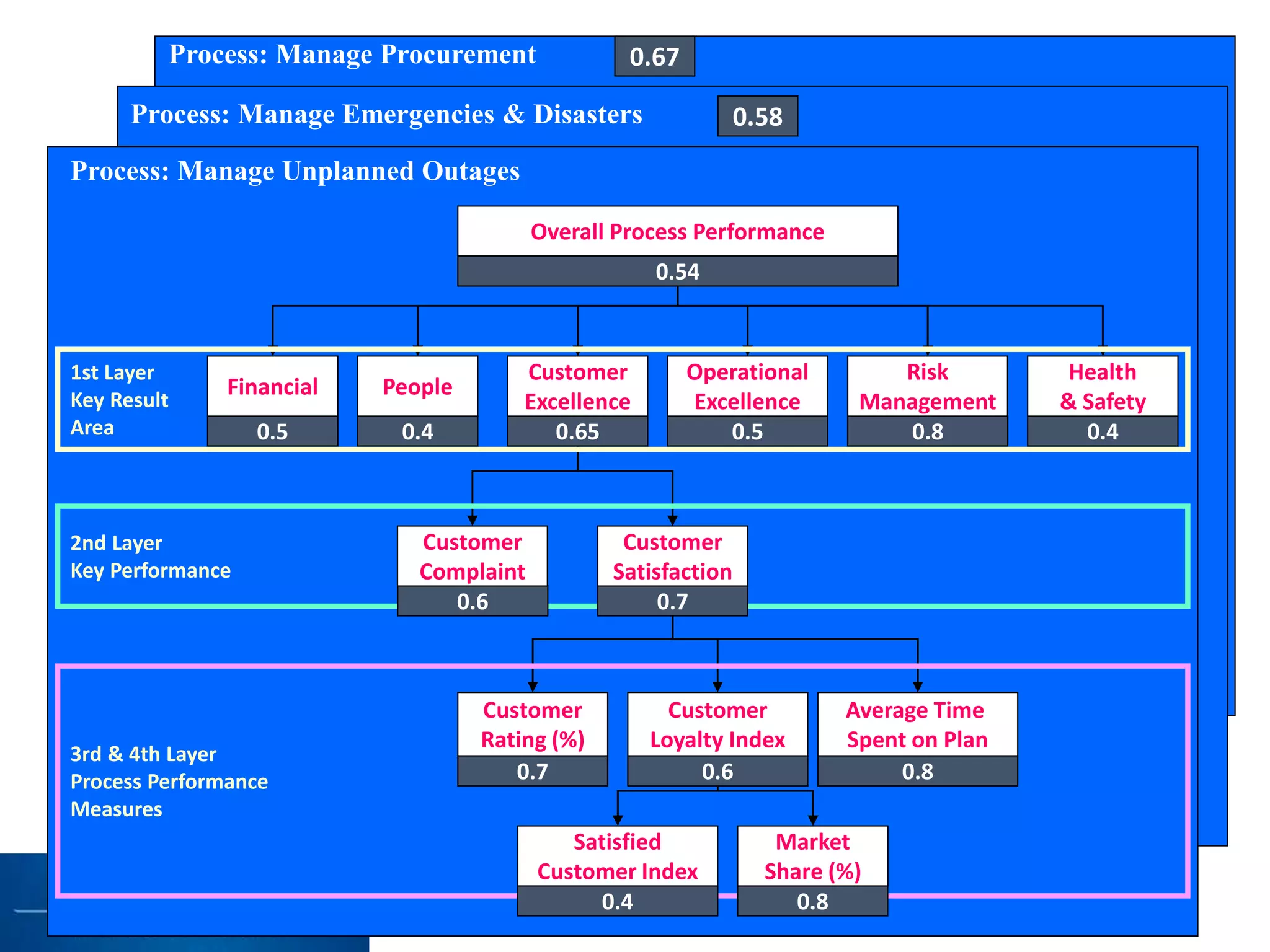
Process: Manage Emergencies & Disasters
Process: Manage Procurement
Process: Manage Unplanned Outages
Overall Process Performance
Financial People
Customer
Excellence
Operational
Excellence
Risk
Management
Health
& Safety
Customer
Satisfaction
Customer
Complaint
Customer
Rating (%)
Customer
Loyalty Index
Average Time
Spent on Plan
1st Layer
Key Result
Area
2nd Layer
Key Performance
Satisfied
Customer Index
Market
Share (%)
3rd & 4th Layer
Process Performance
Measures
0.65
0.6 0.7
0.7 0.6 0.8
0.4 0.8
0.5 0.4 0.5 0.8 0.4
0.54
0.58
0.67
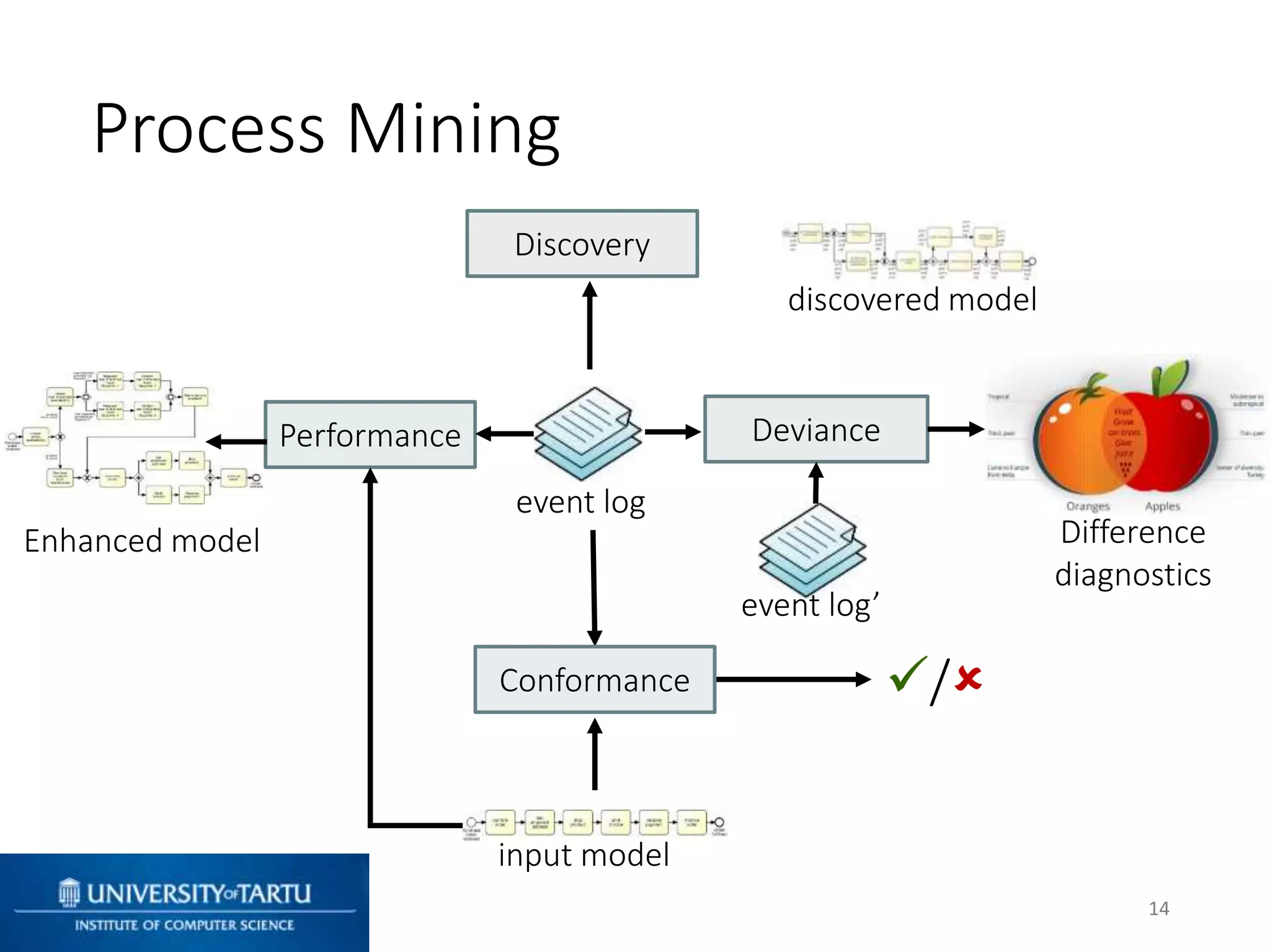
Process Mining
14
/
event log
discovered model
Discovery
Conformance
Deviance
Difference
diagnostics
Performance
input model
Enhanced model
event log’
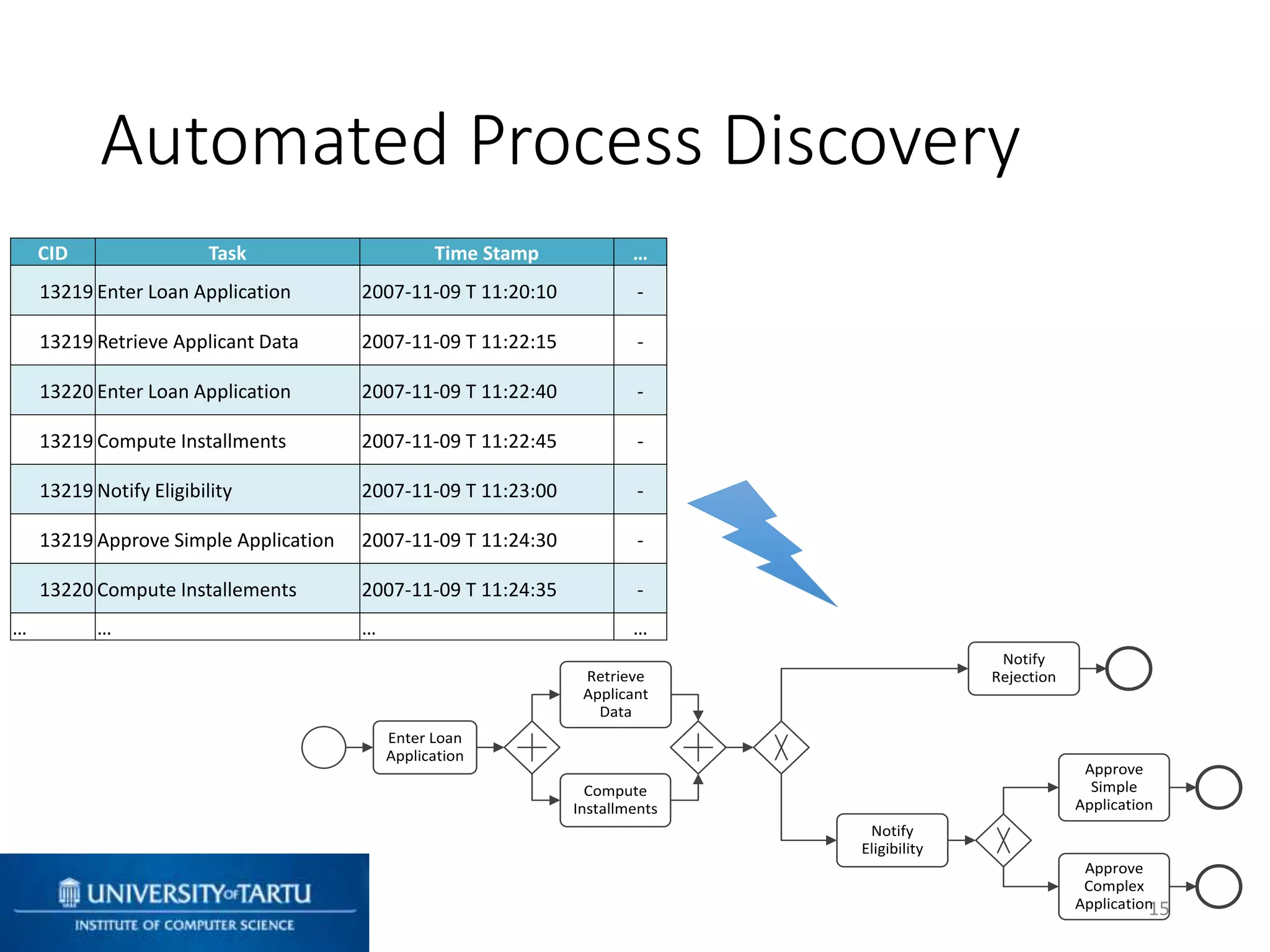
Automated Process Discovery
15
Enter Loan
Application
Retrieve
Applicant
Data
Compute
Installments
Approve
Simple
Application
Approve
Complex
Application
Notify
Rejection
Notify
Eligibility
CID Task Time Stamp …
13219 Enter Loan Application 2007-11-09 T 11:20:10 -
13219 Retrieve Applicant Data 2007-11-09 T 11:22:15 -
13220 Enter Loan Application 2007-11-09 T 11:22:40 -
13219 Compute Installments 2007-11-09 T 11:22:45 -
13219 Notify Eligibility 2007-11-09 T 11:23:00 -
13219 Approve Simple Application 2007-11-09 T 11:24:30 -
13220 Compute Installements 2007-11-09 T 11:24:35 -
… … … …
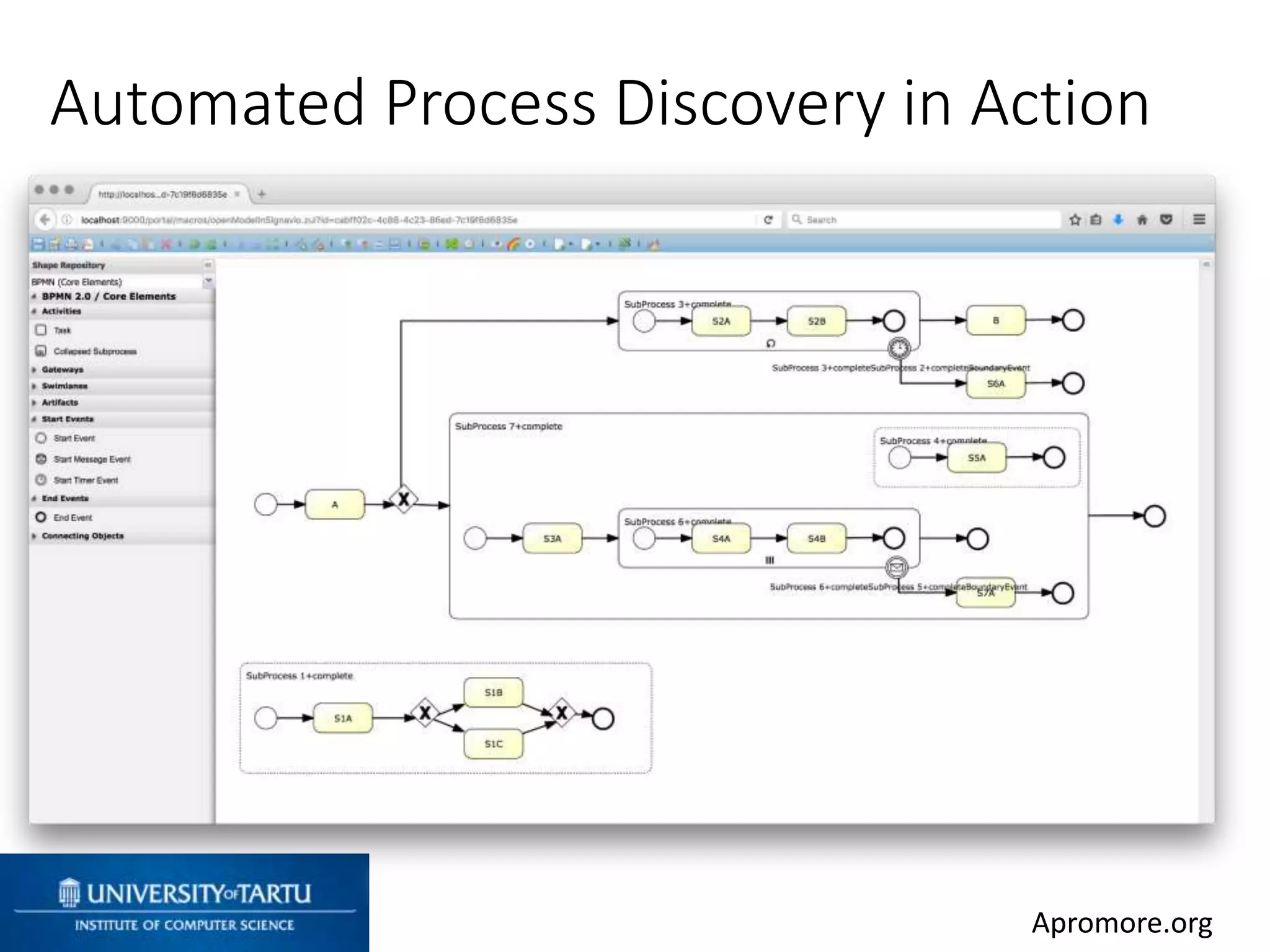
Automated Process Discovery in Action
Apromore.org
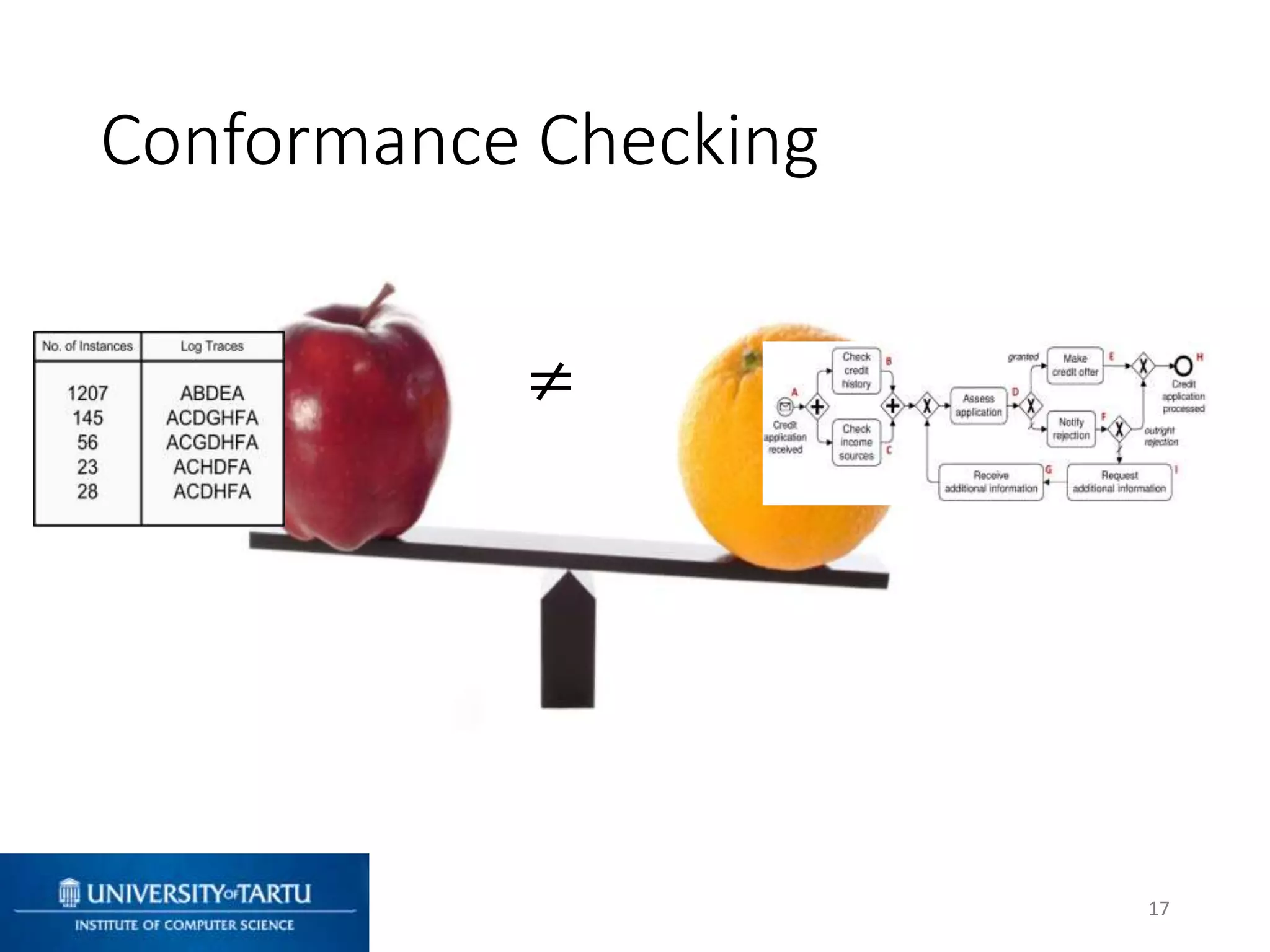
Conformance Checking
17
≠
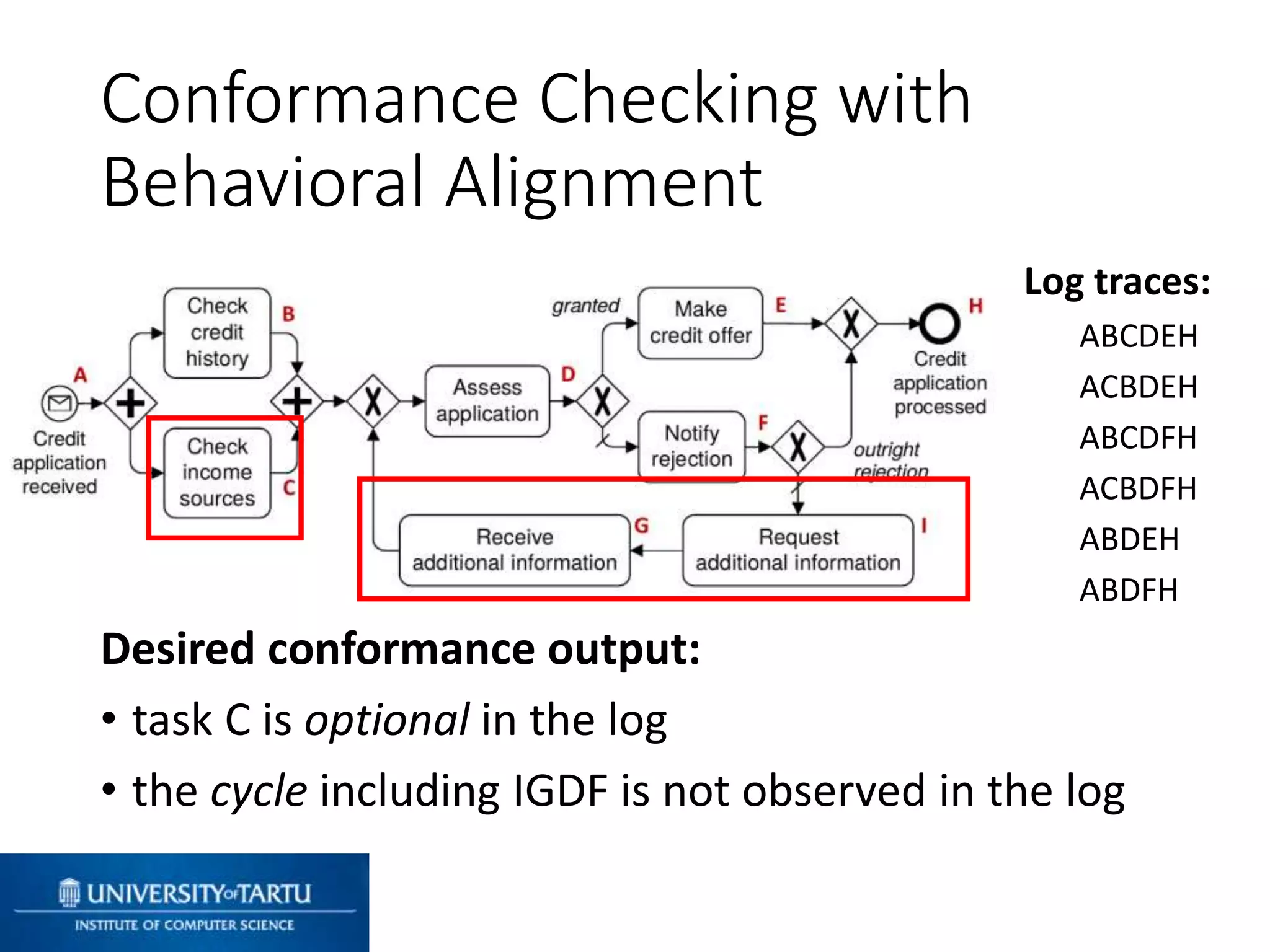
Conformance Checking with
Behavioral Alignment
Desired conformance output:
• task C is optional in the log
• the cycle including IGDF is not observed in the log
Log traces:
ABCDEH
ACBDEH
ABCDFH
ACBDFH
ABDEH
ABDFH
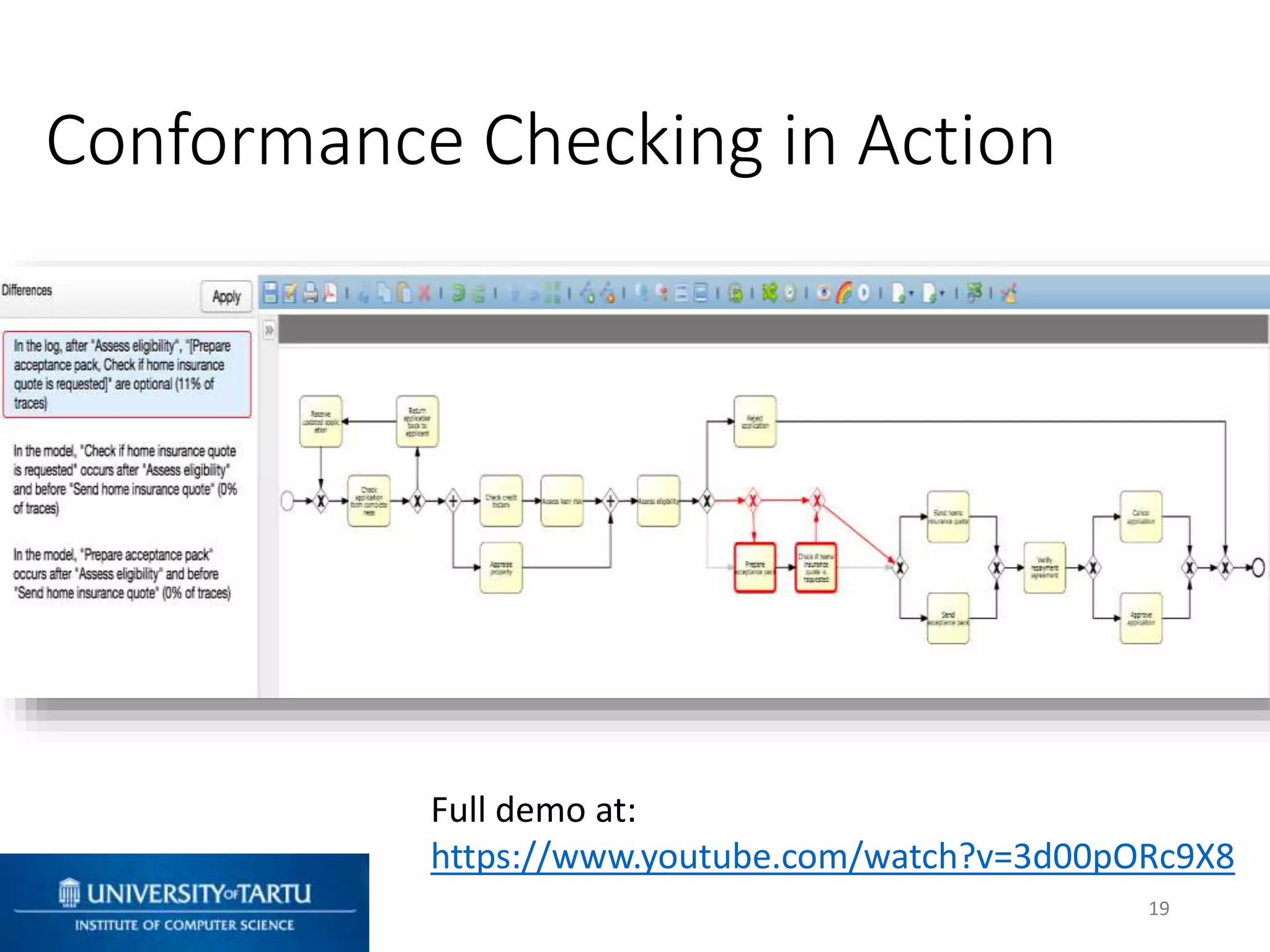
Conformance Checking in Action
19
Full demo at:
https://www.youtube.com/watch?v=3d00pORc9X8
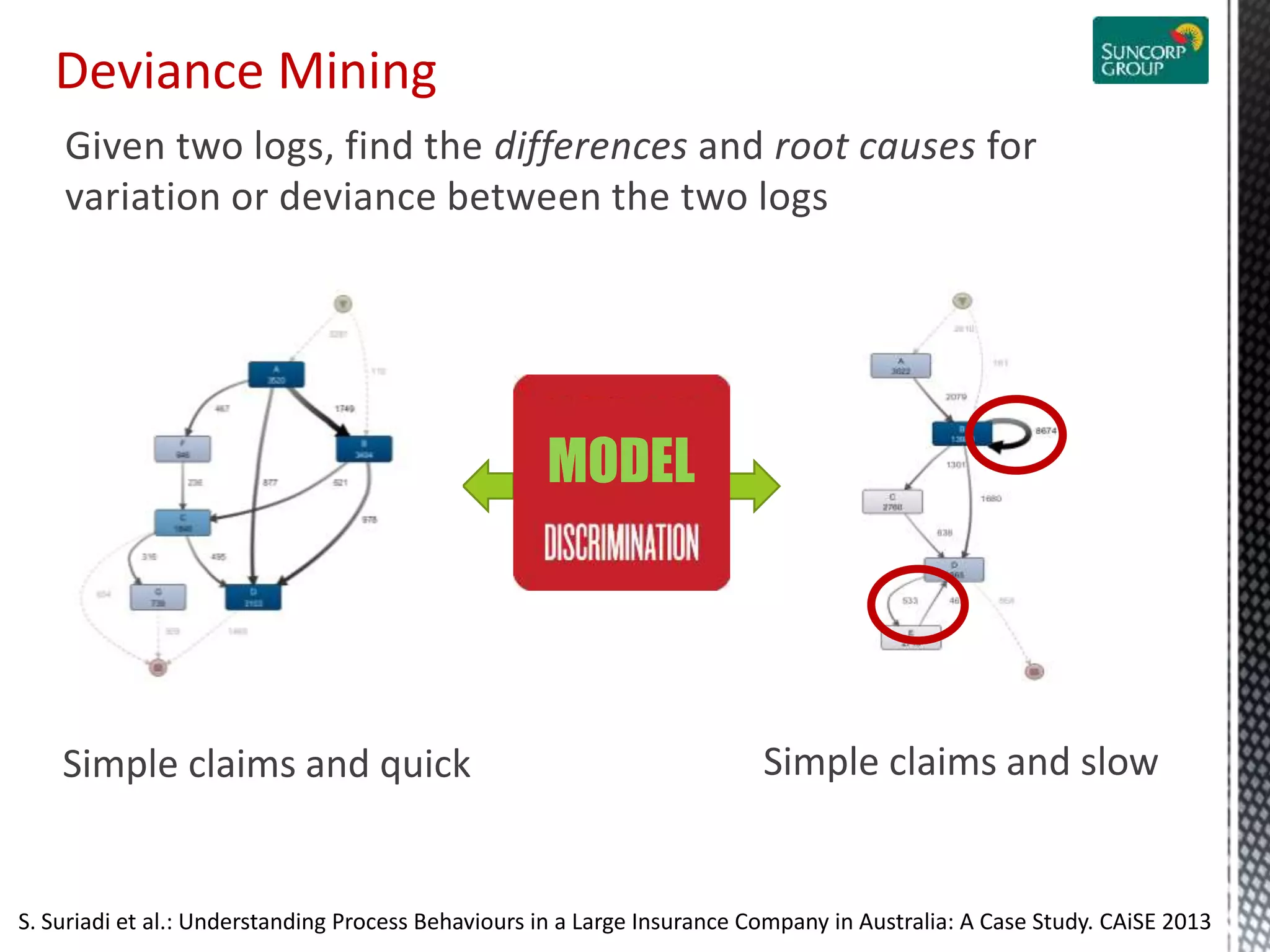
Given two logs, find the differences and root causes for
variation or deviance between the two logs
Simple claims and quick Simple claims and slow
Deviance Mining
MODEL
S. Suriadi et al.: Understanding Process Behaviours in a Large Insurance Company in Australia: A Case Study. CAiSE 2013
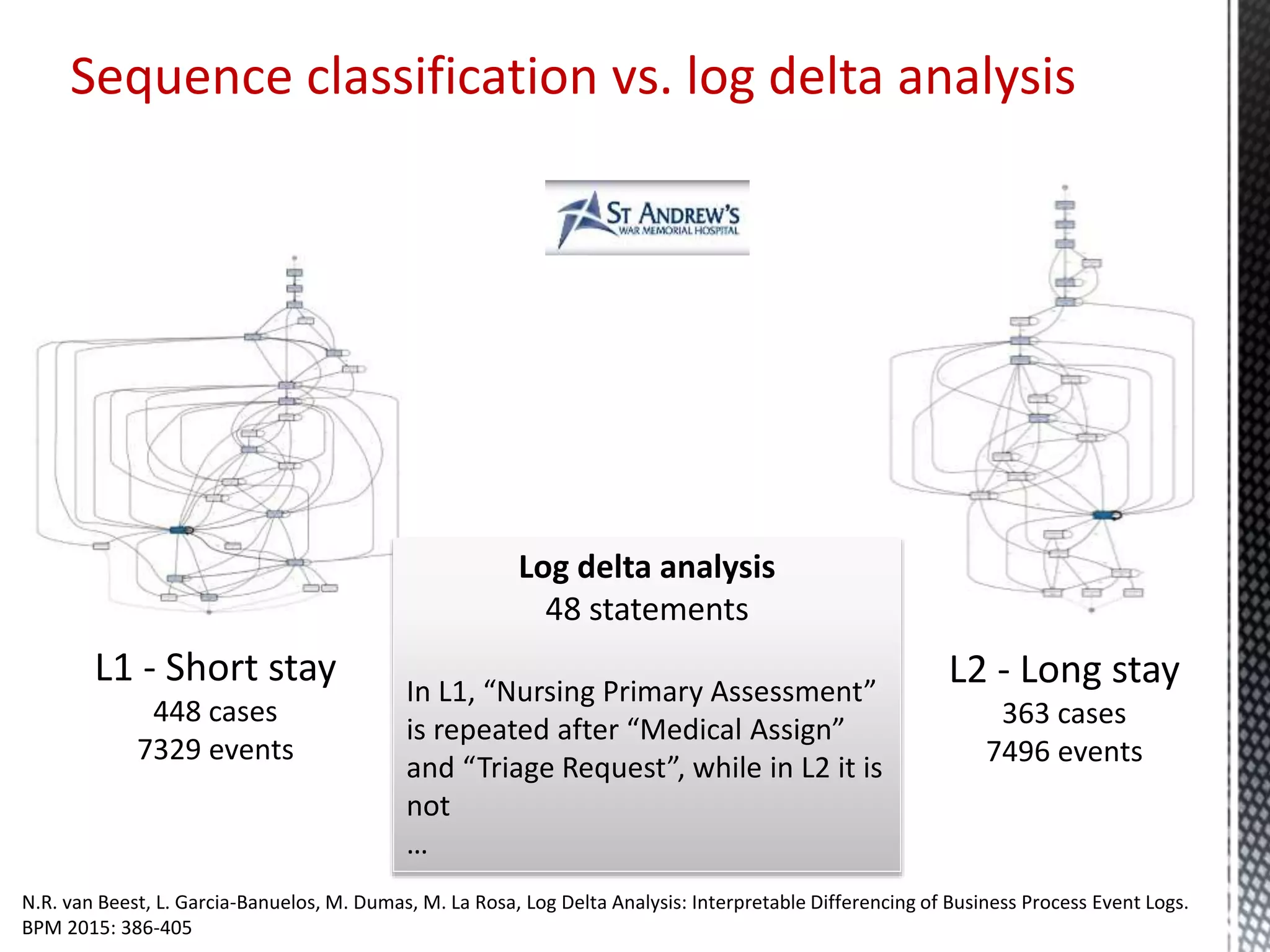
Sequence classification vs. log delta analysis
L1 - Short stay
448 cases
7329 events
L2 - Long stay
363 cases
7496 events
Log delta analysis
48 statements
In L1, “Nursing Primary Assessment”
is repeated after “Medical Assign”
and “Triage Request”, while in L2 it is
not
…
N.R. van Beest, L. Garcia-Banuelos, M. Dumas, M. La Rosa, Log Delta Analysis: Interpretable Differencing of Business Process Event Logs.
BPM 2015: 386-405
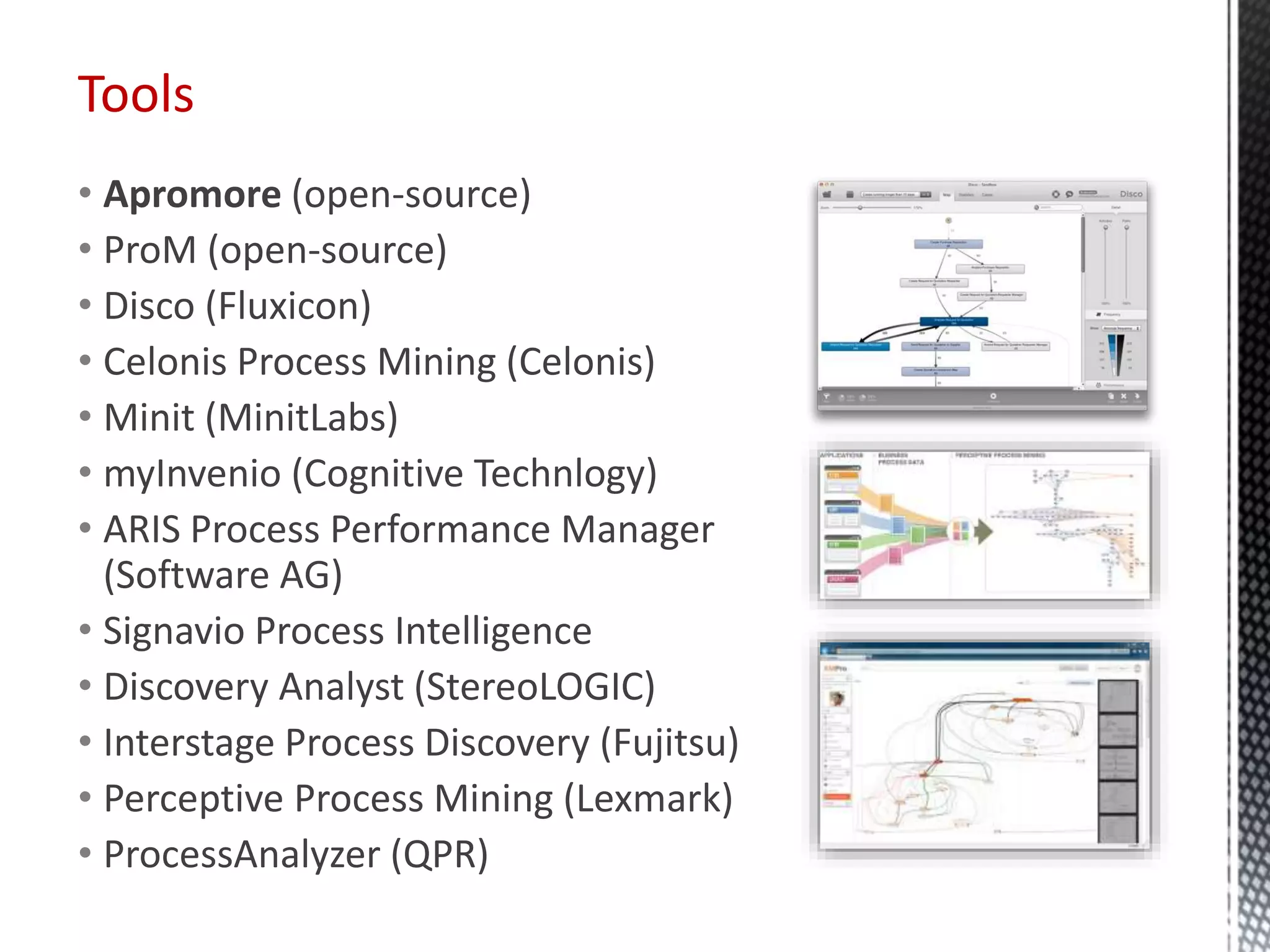
Tools
• Apromore (open-source)
• ProM (open-source)
• Disco (Fluxicon)
• Celonis Process Mining (Celonis)
• Minit (MinitLabs)
• myInvenio (Cognitive Technlogy)
• ARIS Process Performance Manager
(Software AG)
• Signavio Process Intelligence
• Discovery Analyst (StereoLOGIC)
• Interstage Process Discovery (Fujitsu)
• Perceptive Process Mining (Lexmark)
• ProcessAnalyzer (QPR)
22
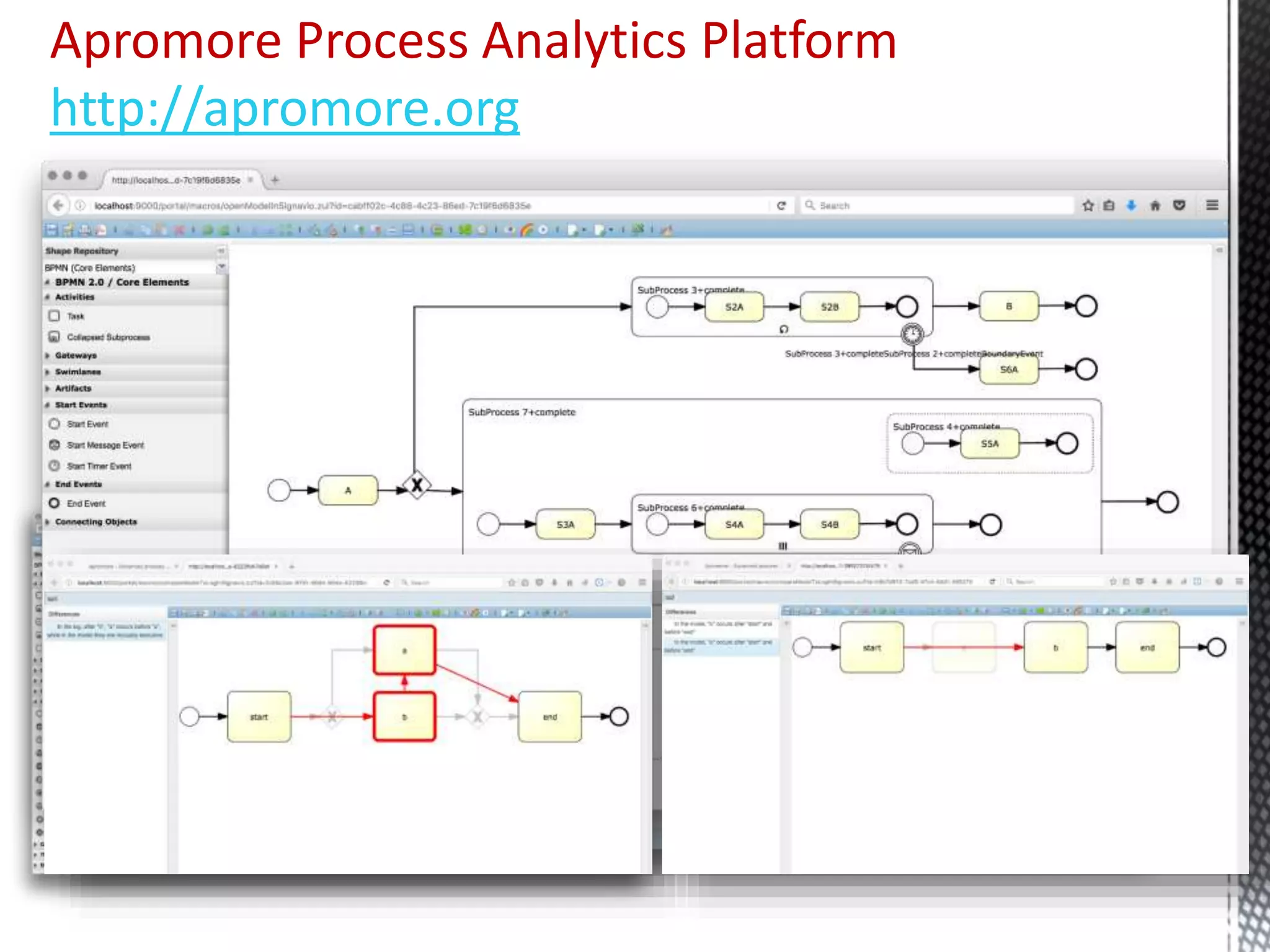
Apromore Process Analytics Platform
http://apromore.org
Open-source, highly scalable, SaaS BPM analytics platform
• Insurance
- Suncorp, Australia
• Government
- Qld Treasury & Trade, Australia
• Health
- AMC Hospital, The Netherlands
- São Sebastião Hospital, Portugal
- Chania Hospital, Greece
- EHR Workflow Inc., USA
• Transport
- ANA Airports, Portugal
- Busan Port, South Korea
- Kuehne + Nagel, Switzerland-Germany
• Electronics
- Phillips, The Netherlands
• Banking, construction… etc.
Process Mining: Where is it used?
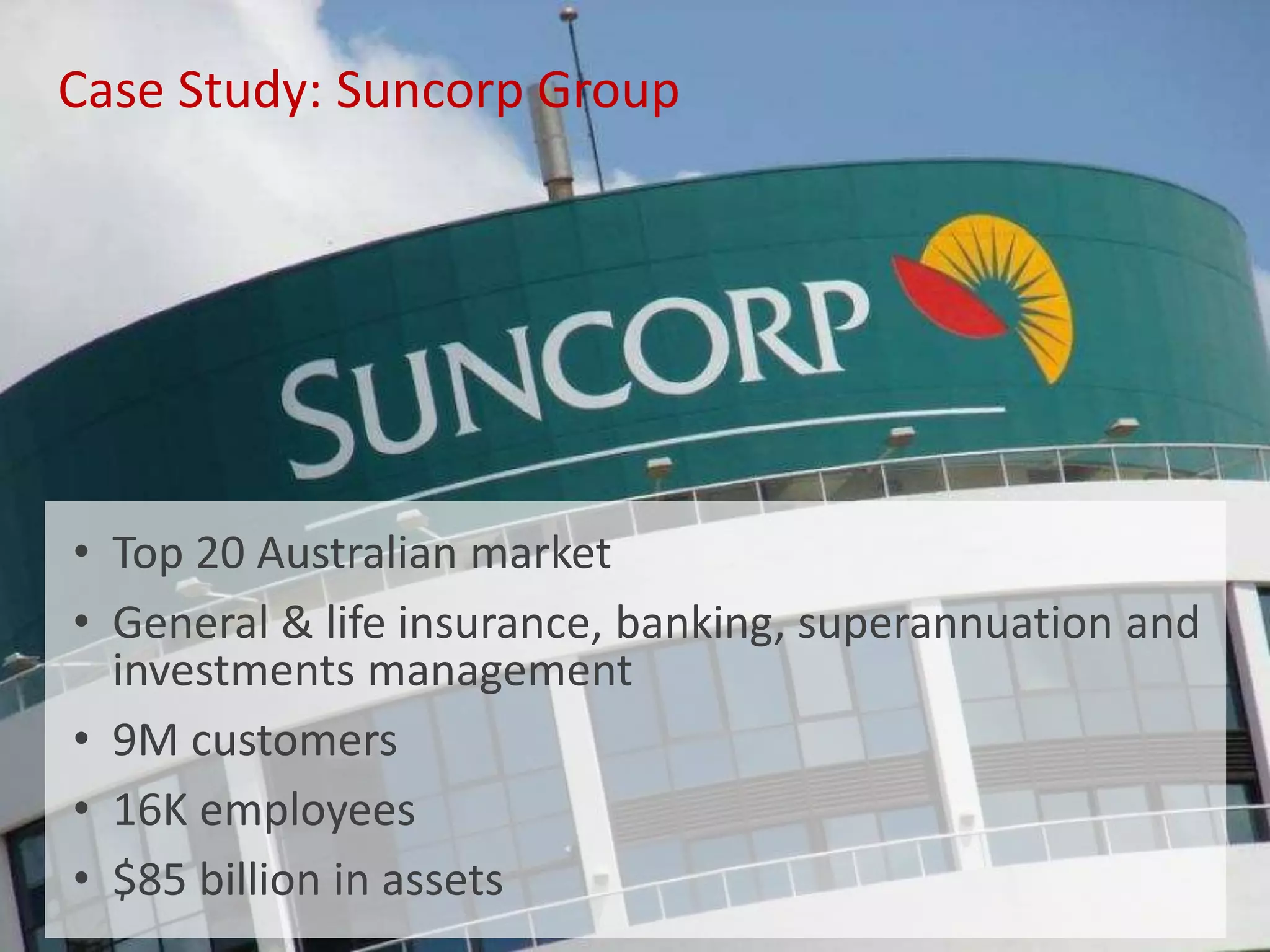
Case Study: Suncorp Group
• Top 20 Australian market
• General & life insurance, banking, superannuation and
investments management
• 9M customers
• 16K employees
• $85 billion in assets
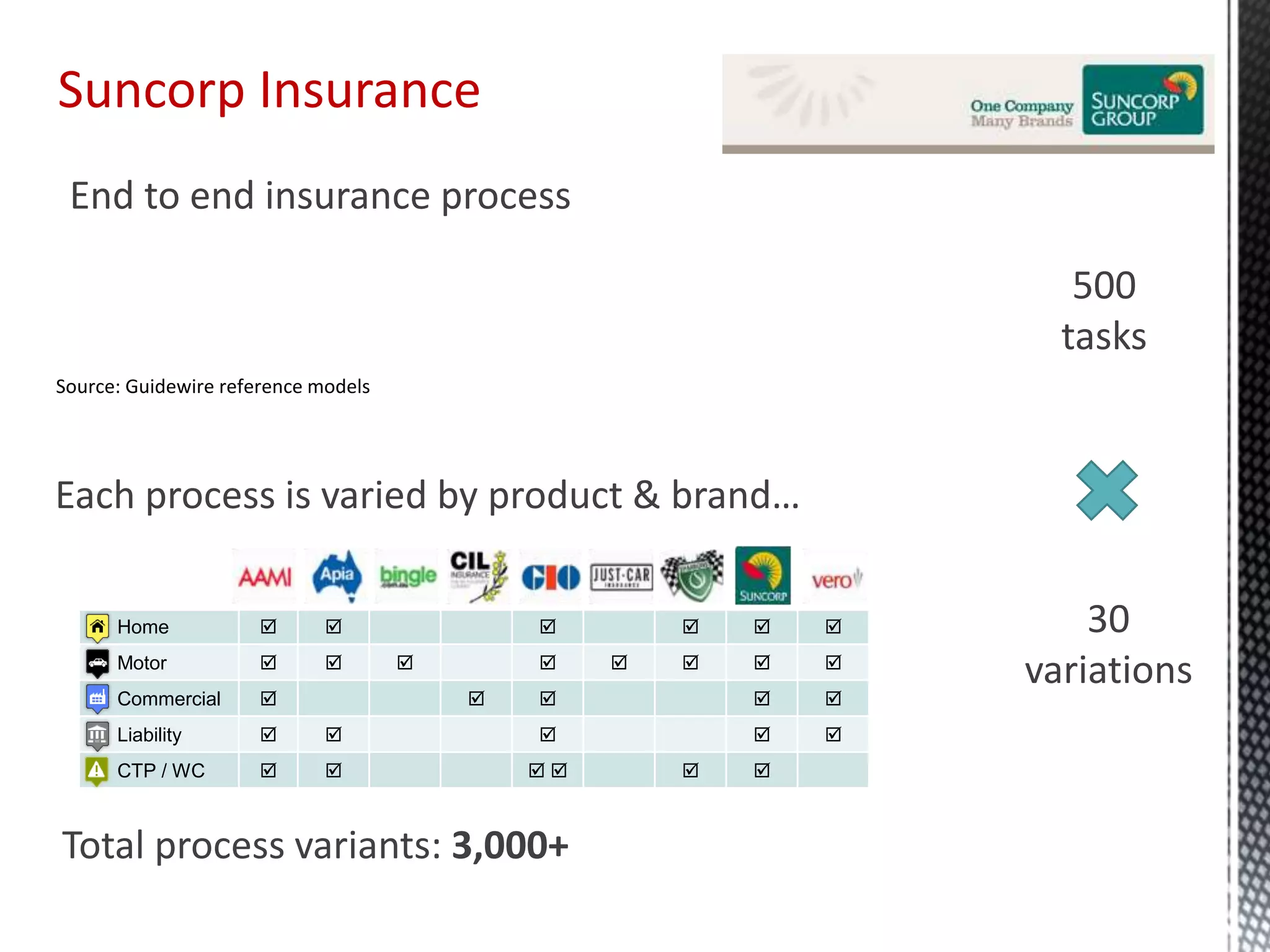
Each process is varied by product & brand…
End to end insurance process
Source: Guidewire reference models
Total process variants: 3,000+
30
variations
500
tasks
Home      
Motor        
Commercial     
Liability     
CTP / WC      
Suncorp Insurance
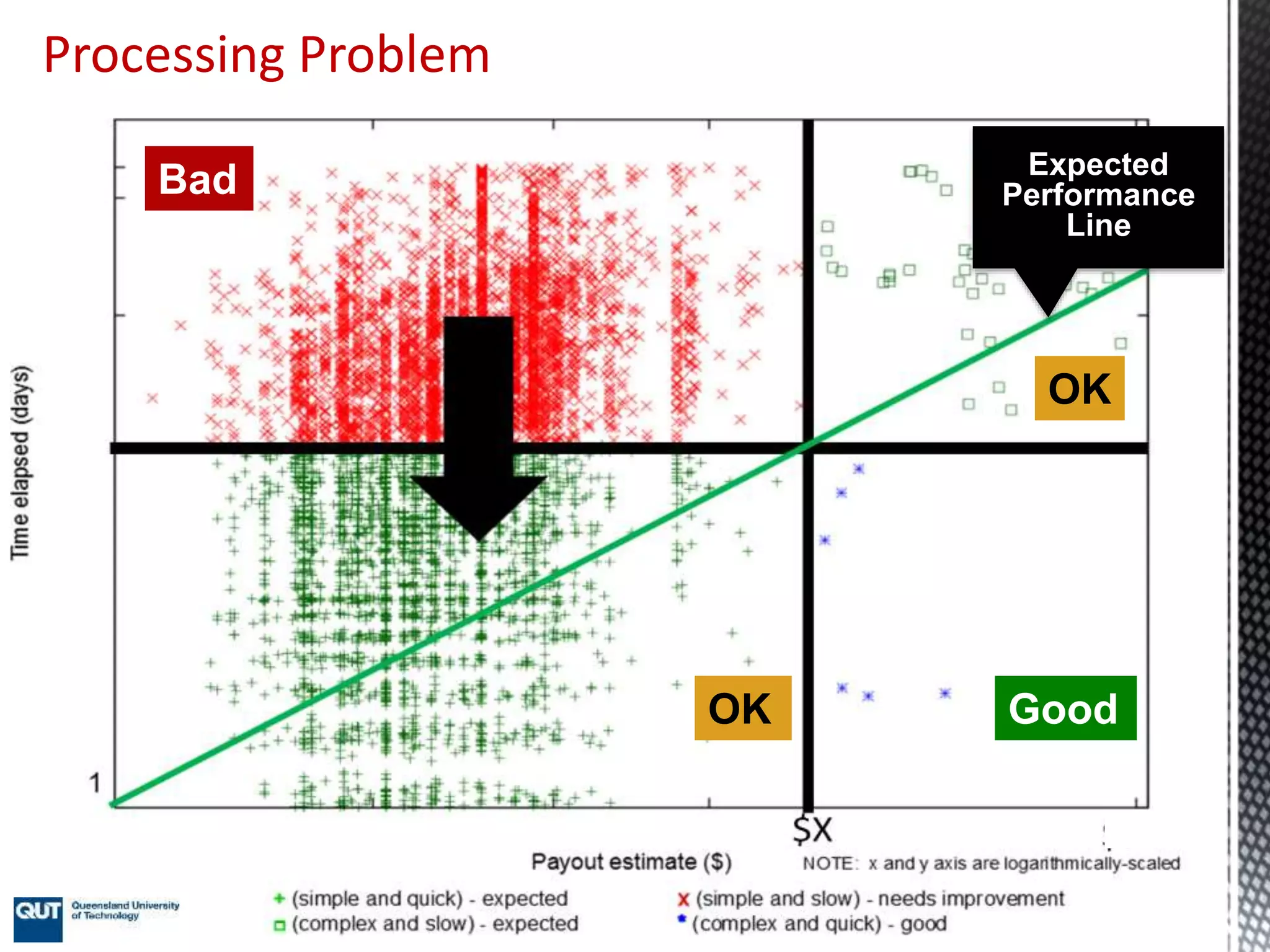
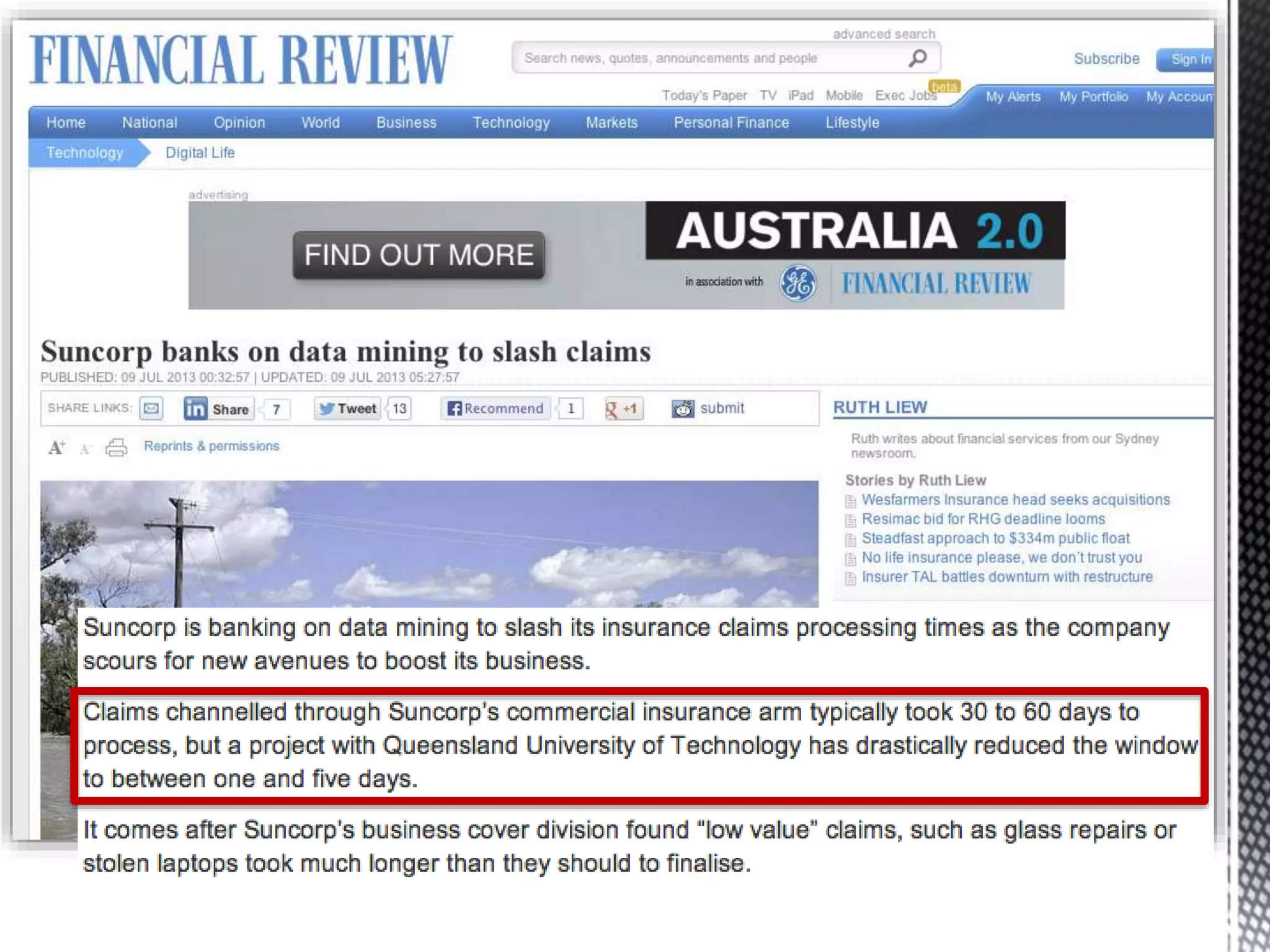
Processing Problem
OK
OK Good
Bad Expected
Performance
Line
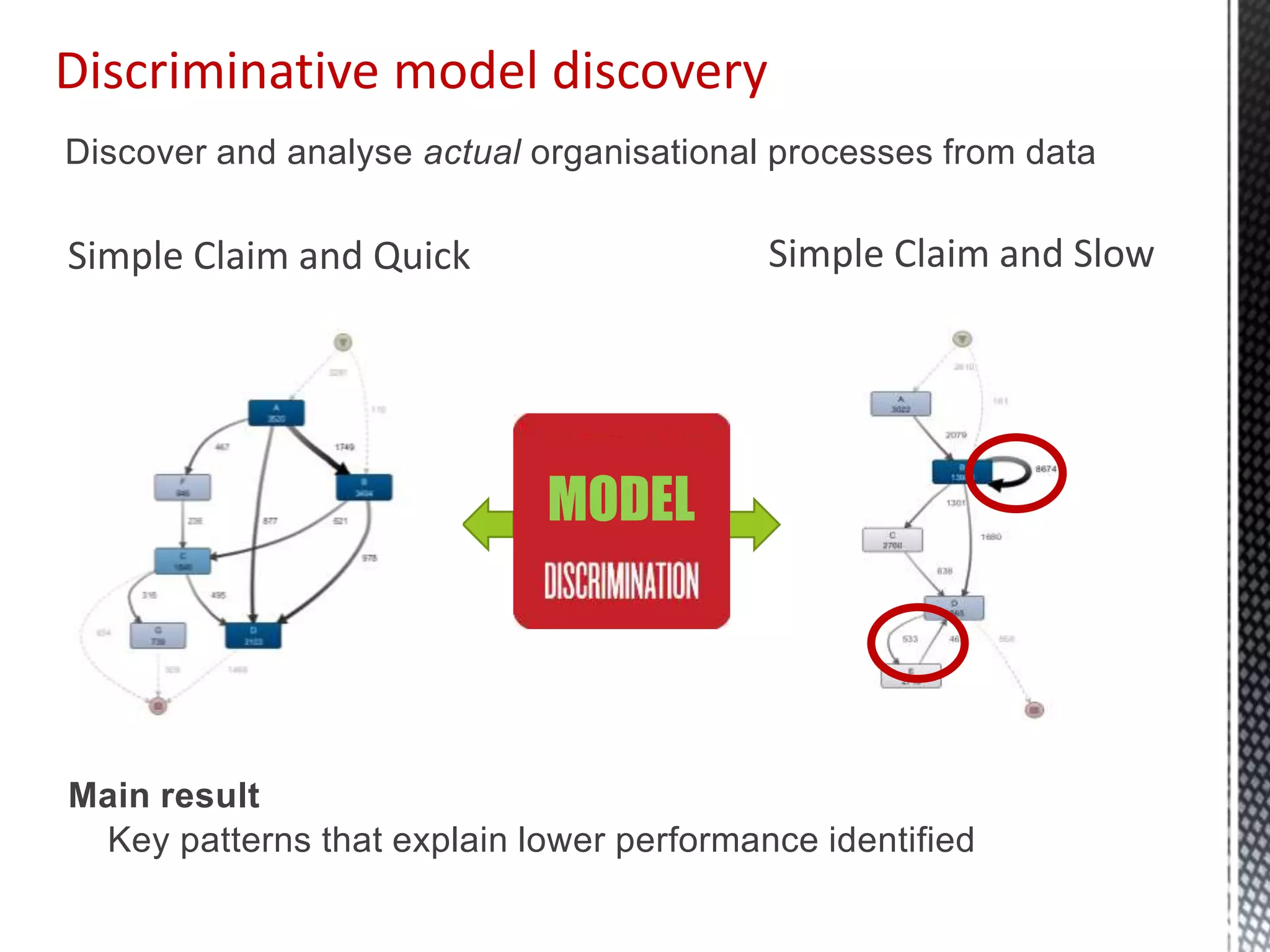
Discover and analyse actual organisational processes from data
Main result
Key patterns that explain lower performance identified
Simple Claim and Quick Simple Claim and Slow
Discriminative model discovery
MODEL
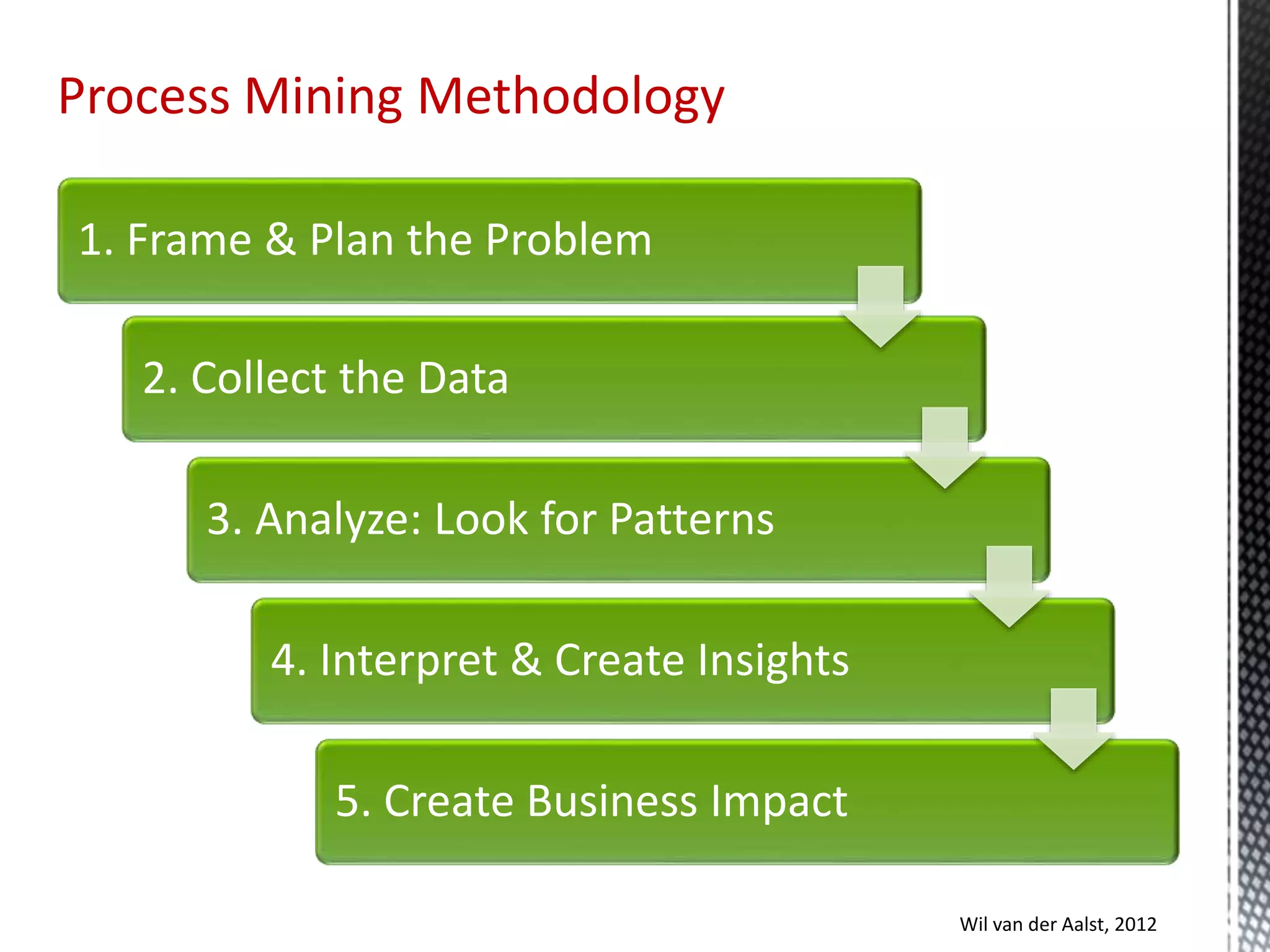
1. Frame & Plan the Problem
2. Collect the Data
3. Analyze: Look for Patterns
4. Interpret & Create Insights
5. Create Business Impact
Wil van der Aalst, 2012
Process Mining Methodology
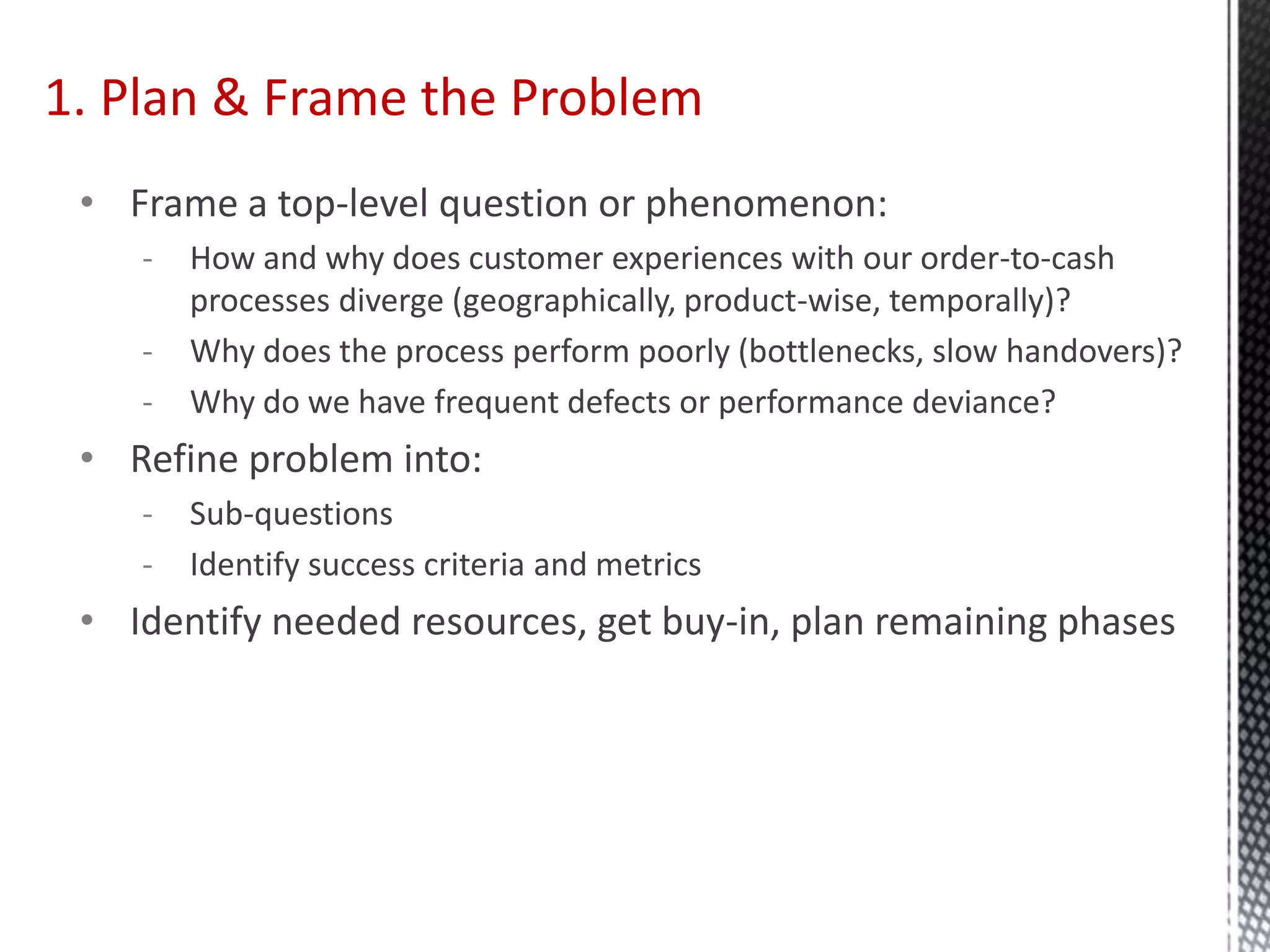
1. Plan & Frame the Problem
• Frame a top-level question or phenomenon:
- How and why does customer experiences with our order-to-cash
processes diverge (geographically, product-wise, temporally)?
- Why does the process perform poorly (bottlenecks, slow handovers)?
- Why do we have frequent defects or performance deviance?
• Refine problem into:
- Sub-questions
- Identify success criteria and metrics
• Identify needed resources, get buy-in, plan remaining phases
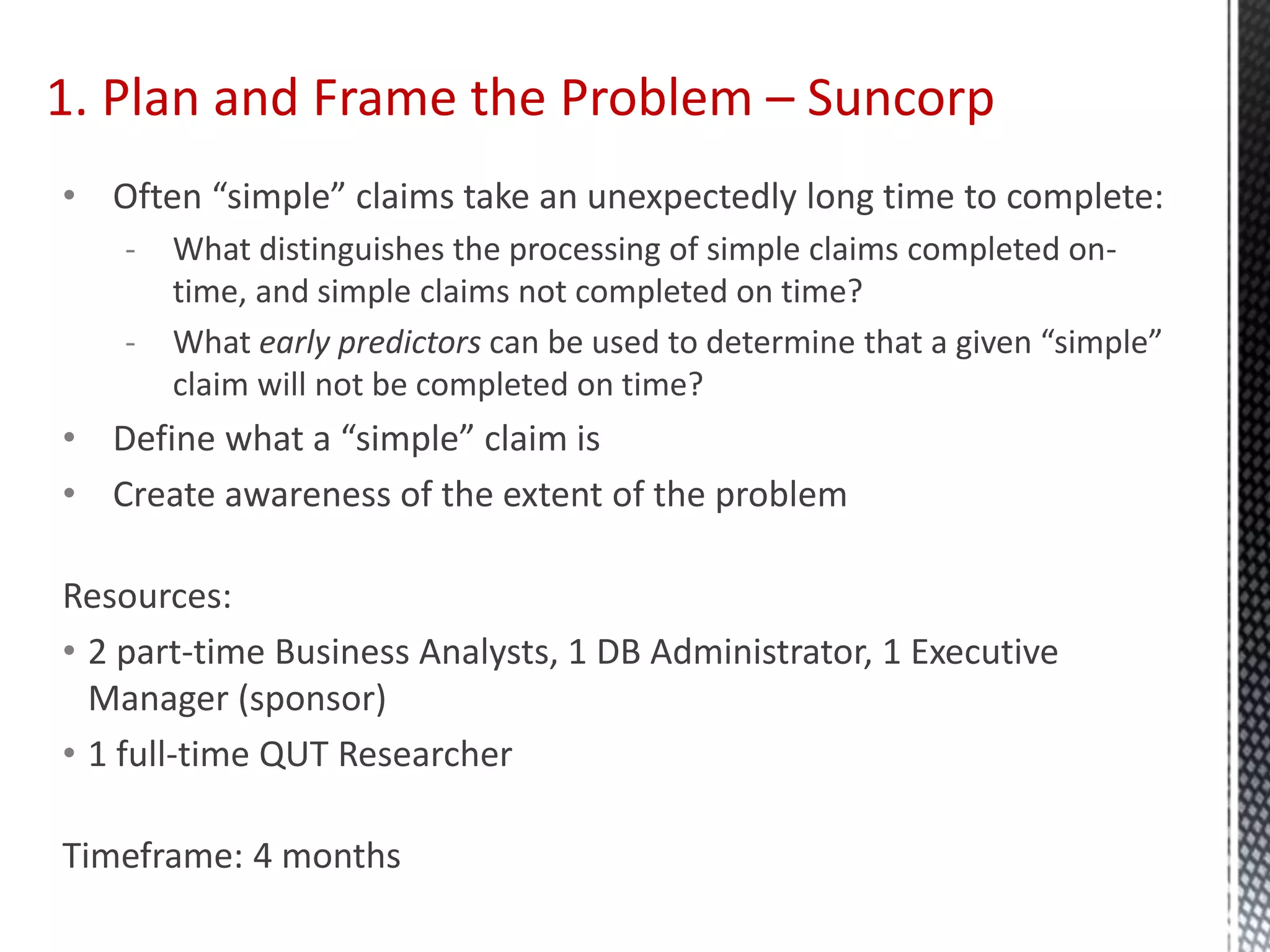
1. Plan and Frame the Problem – Suncorp
• Often “simple” claims take an unexpectedly long time to complete:
- What distinguishes the processing of simple claims completed on-
time, and simple claims not completed on time?
- What early predictors can be used to determine that a given “simple”
claim will not be completed on time?
• Define what a “simple” claim is
• Create awareness of the extent of the problem
Resources:
• 2 part-time Business Analysts, 1 DB Administrator, 1 Executive
Manager (sponsor)
• 1 full-time QUT Researcher
Timeframe: 4 months
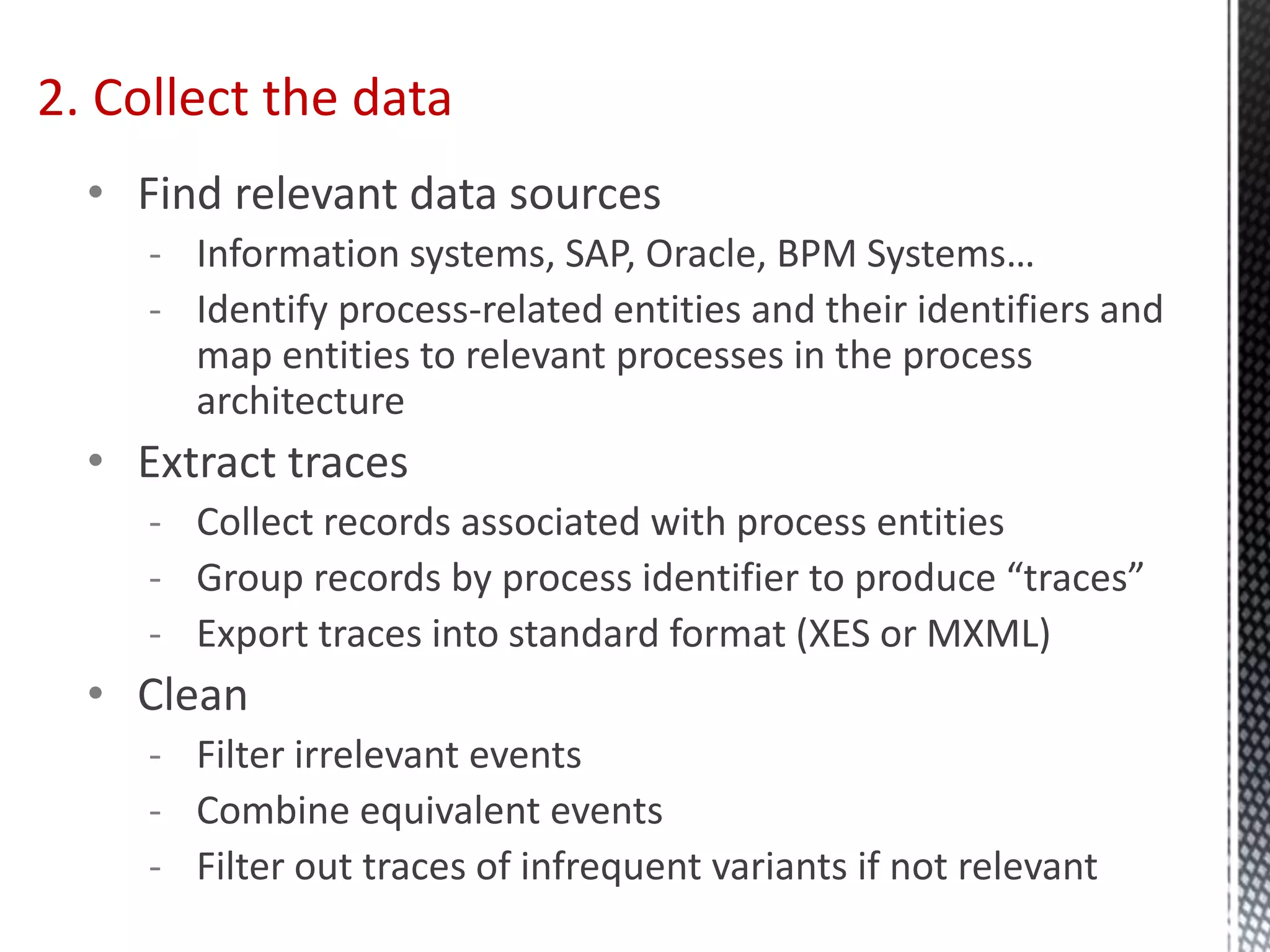
• Find relevant data sources
- Information systems, SAP, Oracle, BPM Systems…
- Identify process-related entities and their identifiers and
map entities to relevant processes in the process
architecture
• Extract traces
- Collect records associated with process entities
- Group records by process identifier to produce “traces”
- Export traces into standard format (XES or MXML)
• Clean
- Filter irrelevant events
- Combine equivalent events
- Filter out traces of infrequent variants if not relevant
2. Collect the data
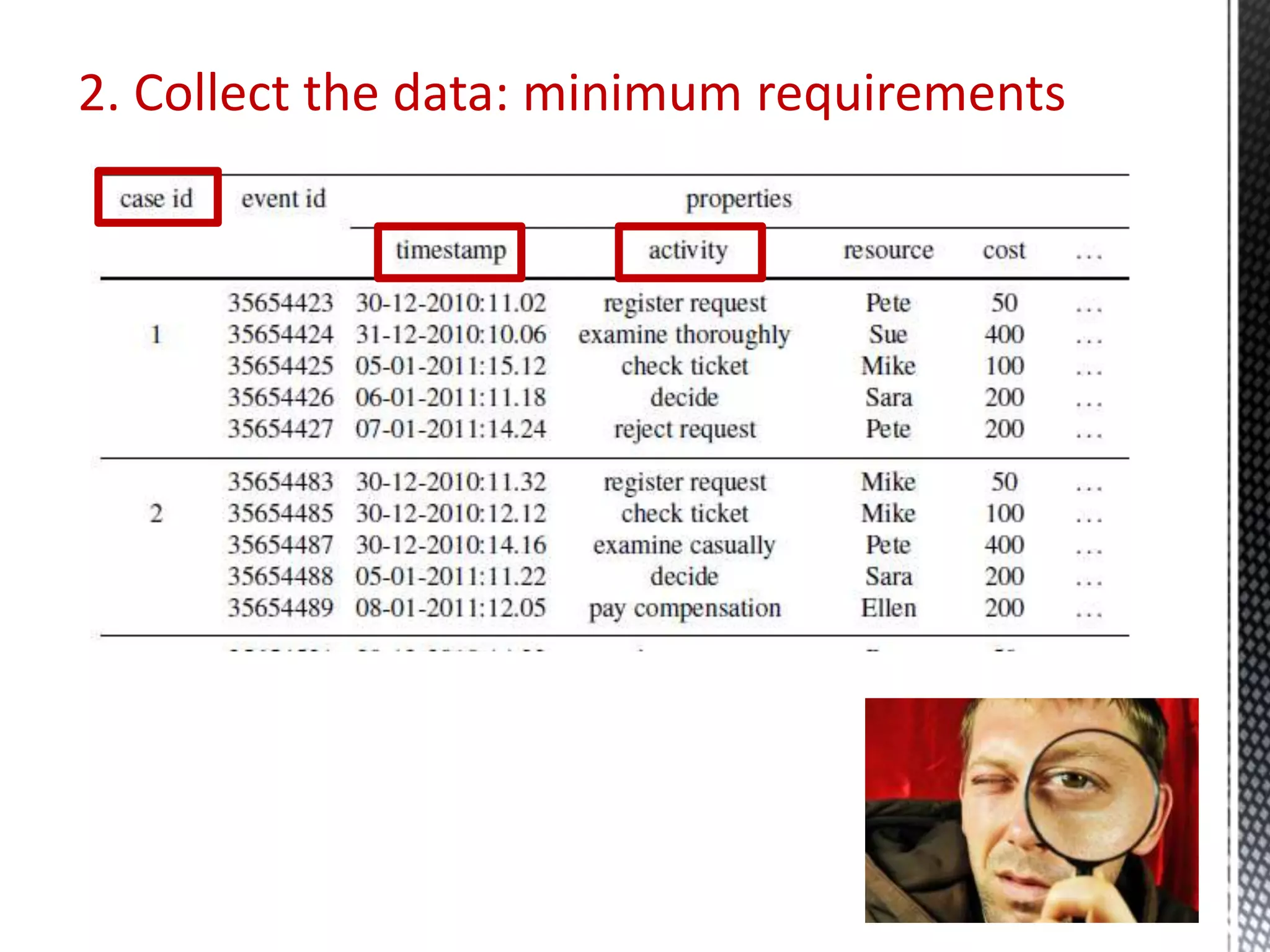
2. Collect the data: minimum requirements
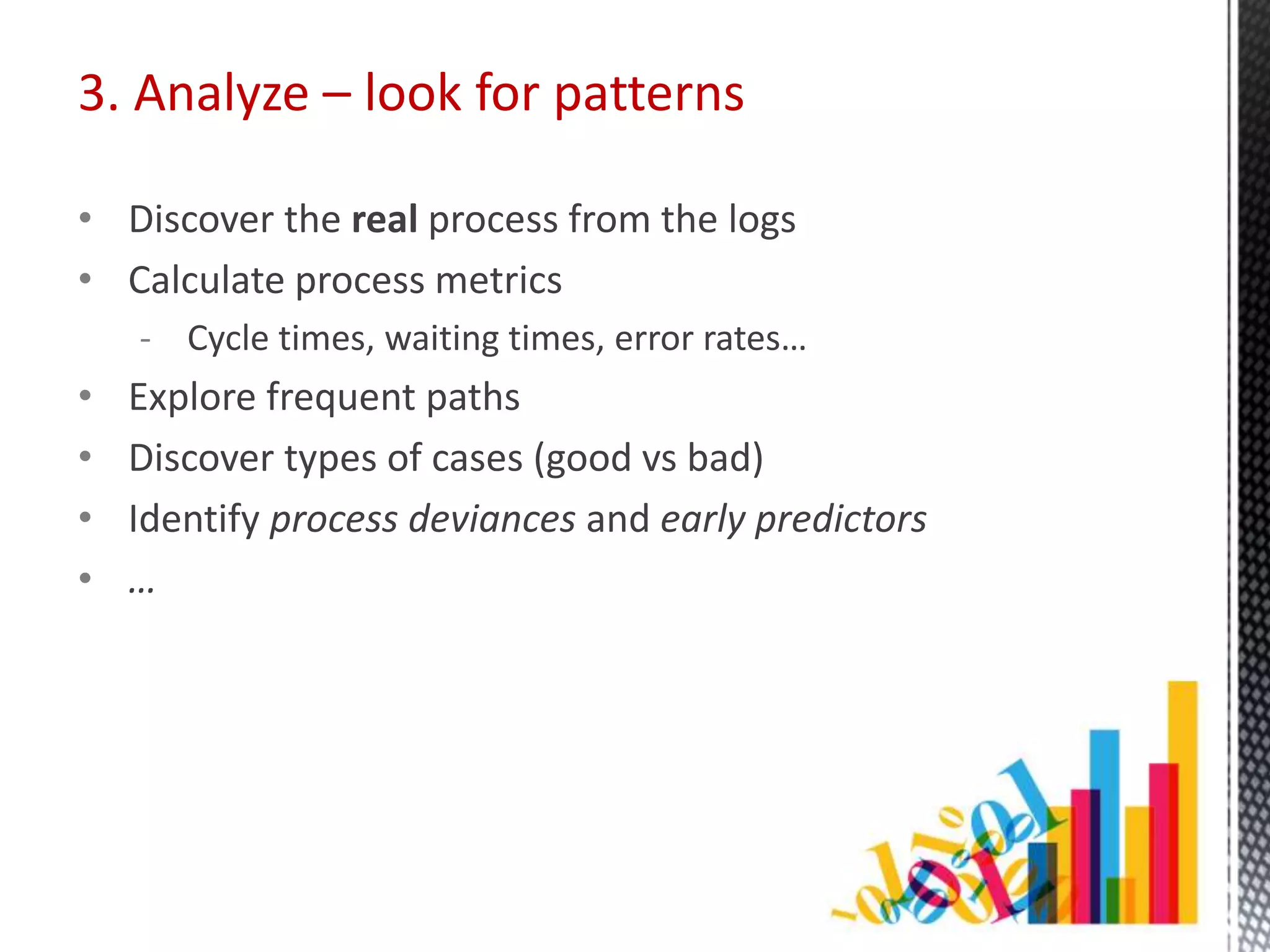
• Discover the real process from the logs
• Calculate process metrics
- Cycle times, waiting times, error rates…
• Explore frequent paths
• Discover types of cases (good vs bad)
• Identify process deviances and early predictors
• …
3. Analyze – look for patterns
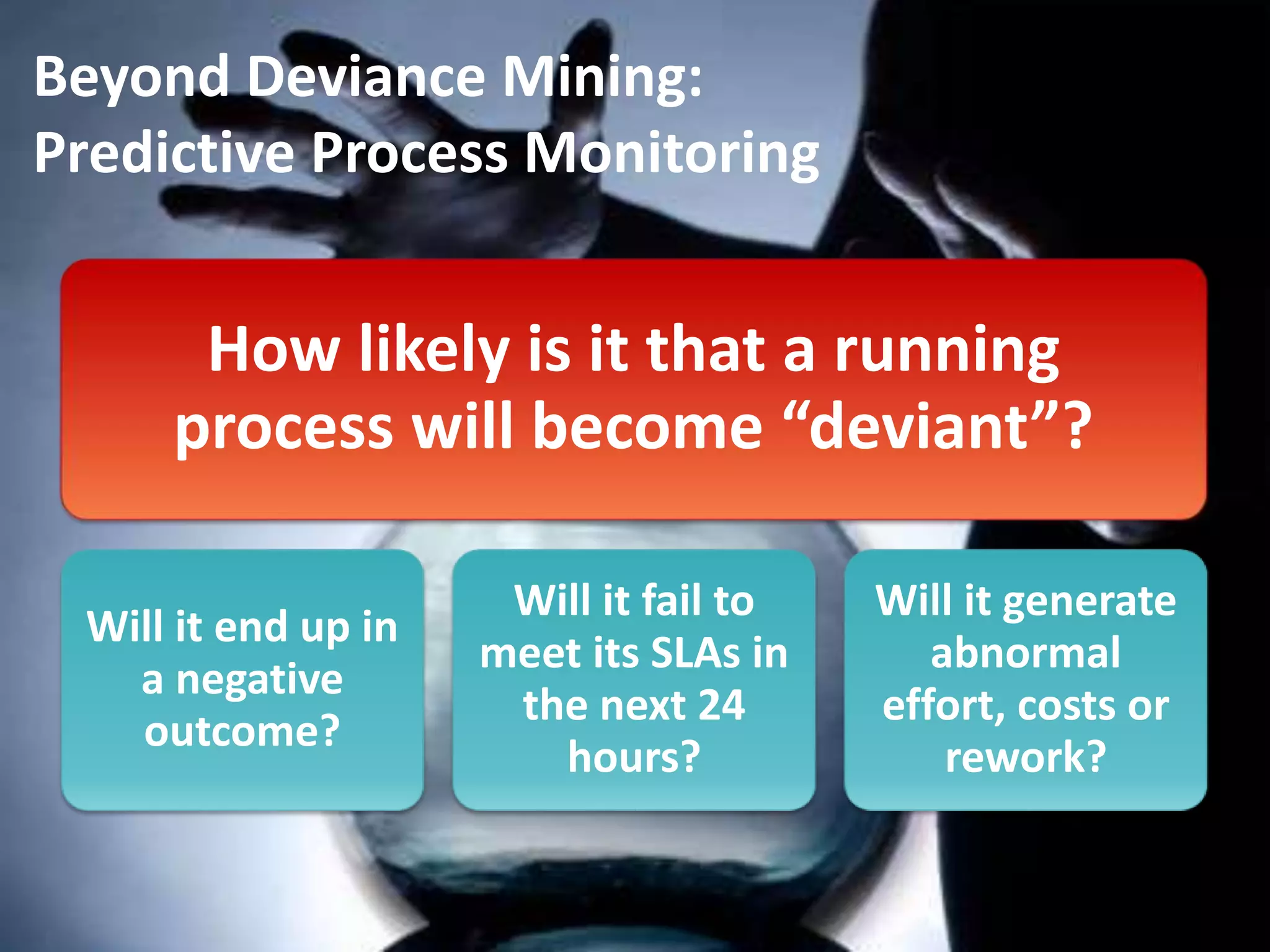
How likely is it that a running
process will become “deviant”?
Will it end up in
a negative
outcome?
Will it fail to
meet its SLAs in
the next 24
hours?
Will it generate
abnormal
effort, costs or
rework?
Beyond Deviance Mining:
Predictive Process Monitoring
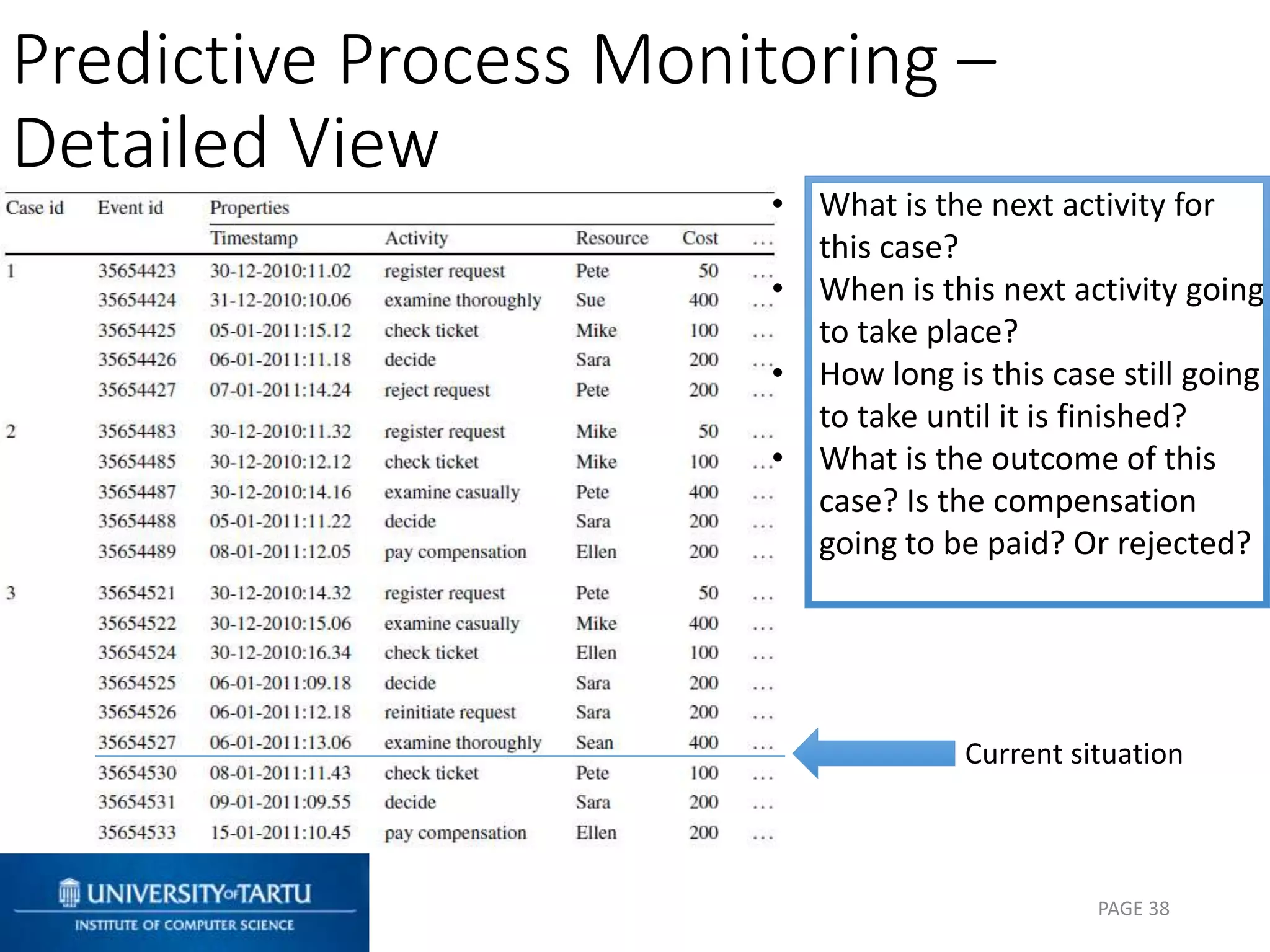
Predictive Process Monitoring –
Detailed View
PAGE 38
Current situation
• What is the next activity for
this case?
• When is this next activity going
to take place?
• How long is this case still going
to take until it is finished?
• What is the outcome of this
case? Is the compensation
going to be paid? Or rejected?
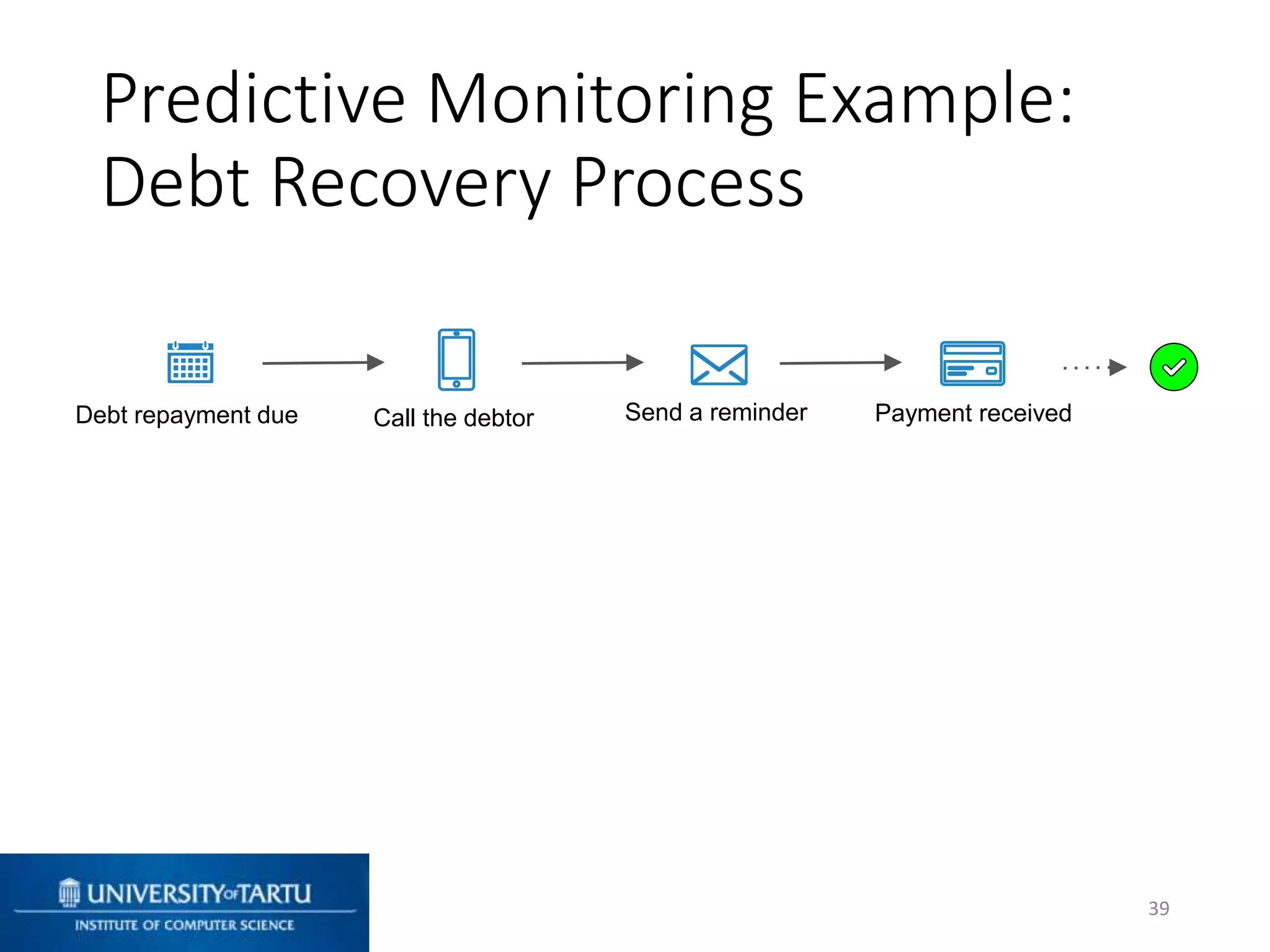
Predictive Monitoring Example:
Debt Recovery Process
39
Debt repayment due Call the debtor Send a reminder Payment received
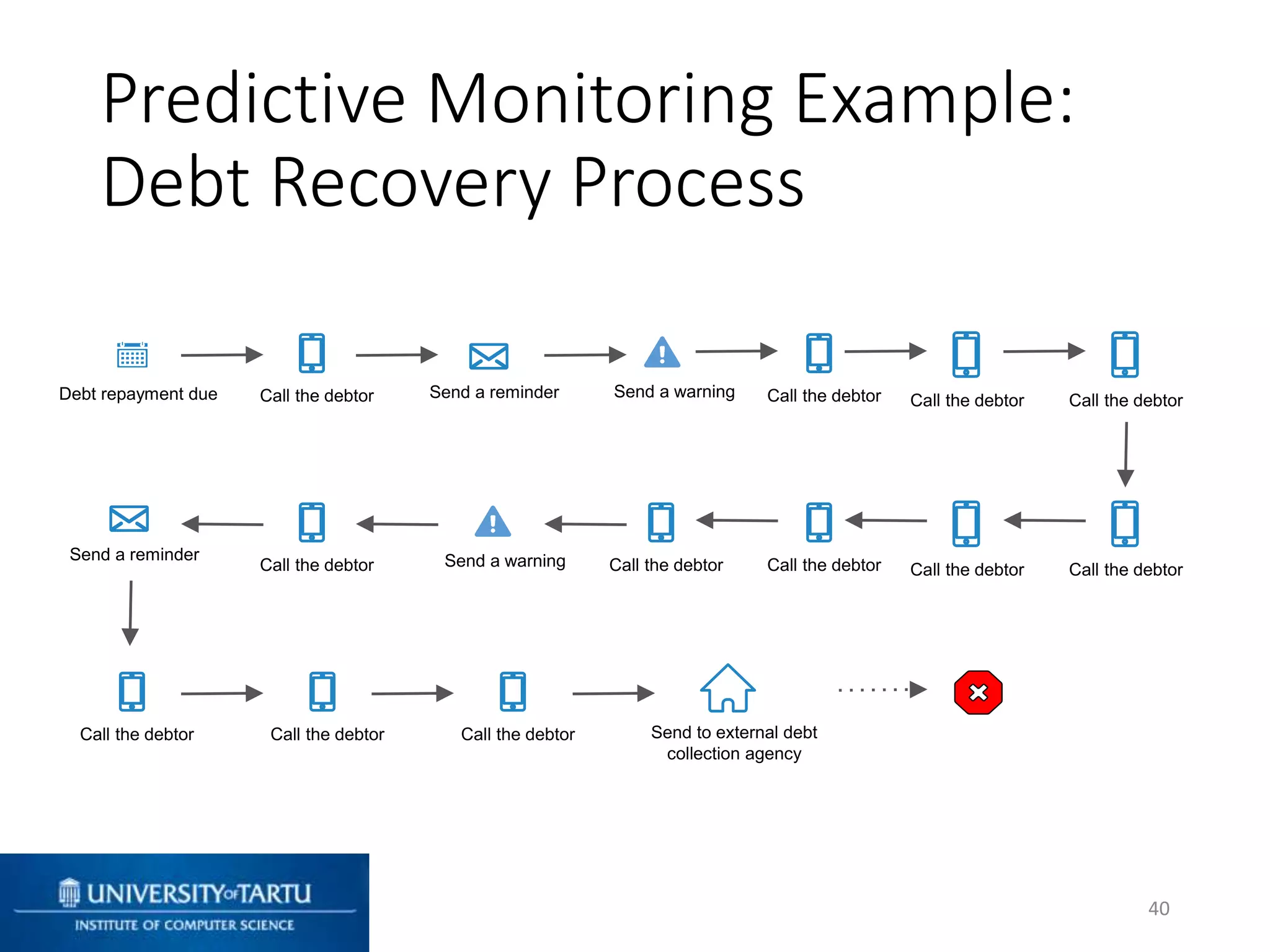
Debt repayment due Call the debtor Send a reminder Send a warning Call the debtor Call the debtor
Send to external debt
collection agency
Call the debtor
Send a reminder Send a warning Call the debtor Call the debtorCall the debtor
Call the debtor
Call the debtor
Call the debtor
Call the debtor Call the debtor
Predictive Monitoring Example:
Debt Recovery Process
40
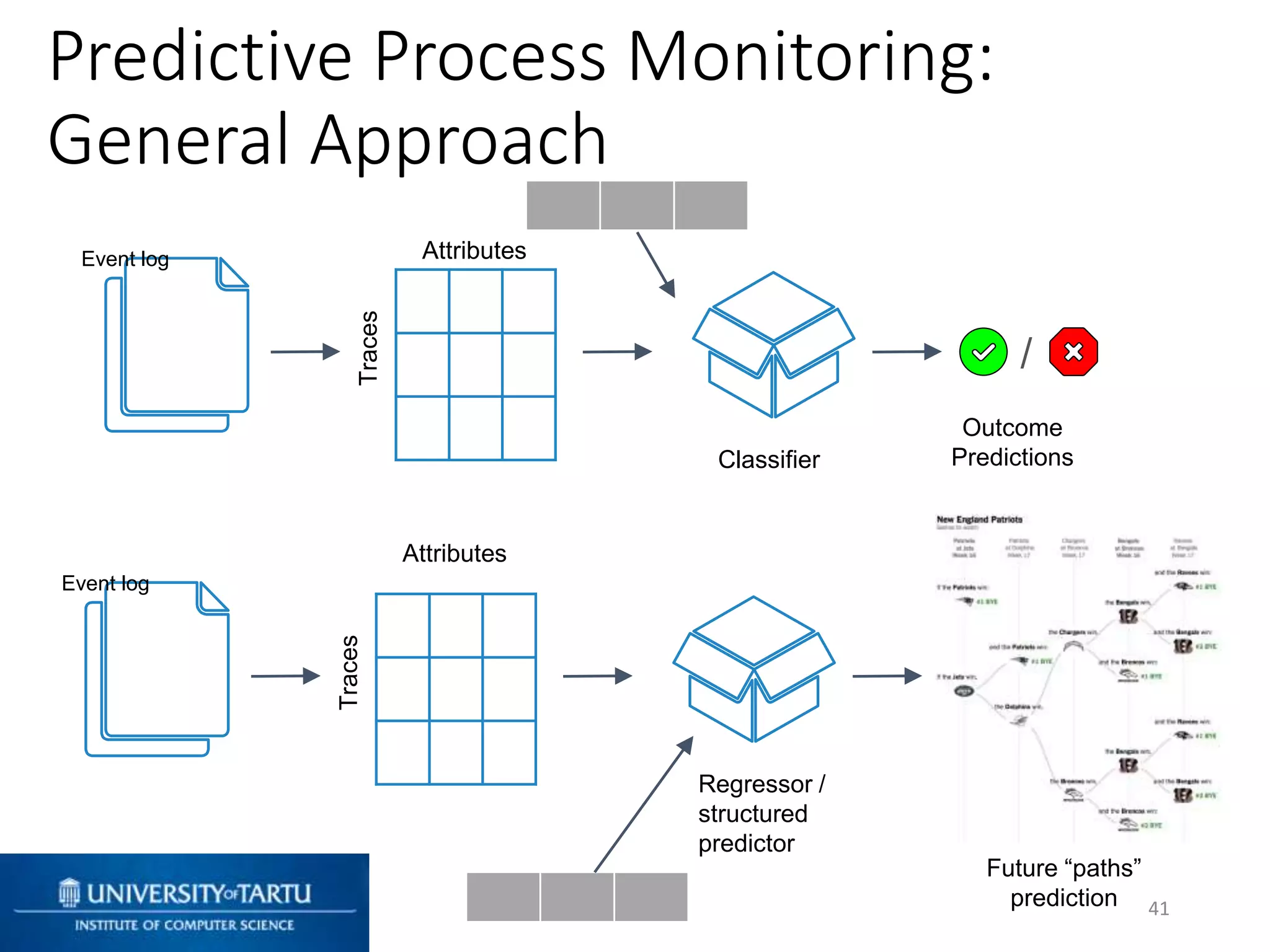
Event log
Classifier
/
Outcome
Predictions
Attributes
Traces
Predictive Process Monitoring:
General Approach
41
Event log
Regressor /
structured
predictor
Future “paths”
prediction
Attributes
Traces
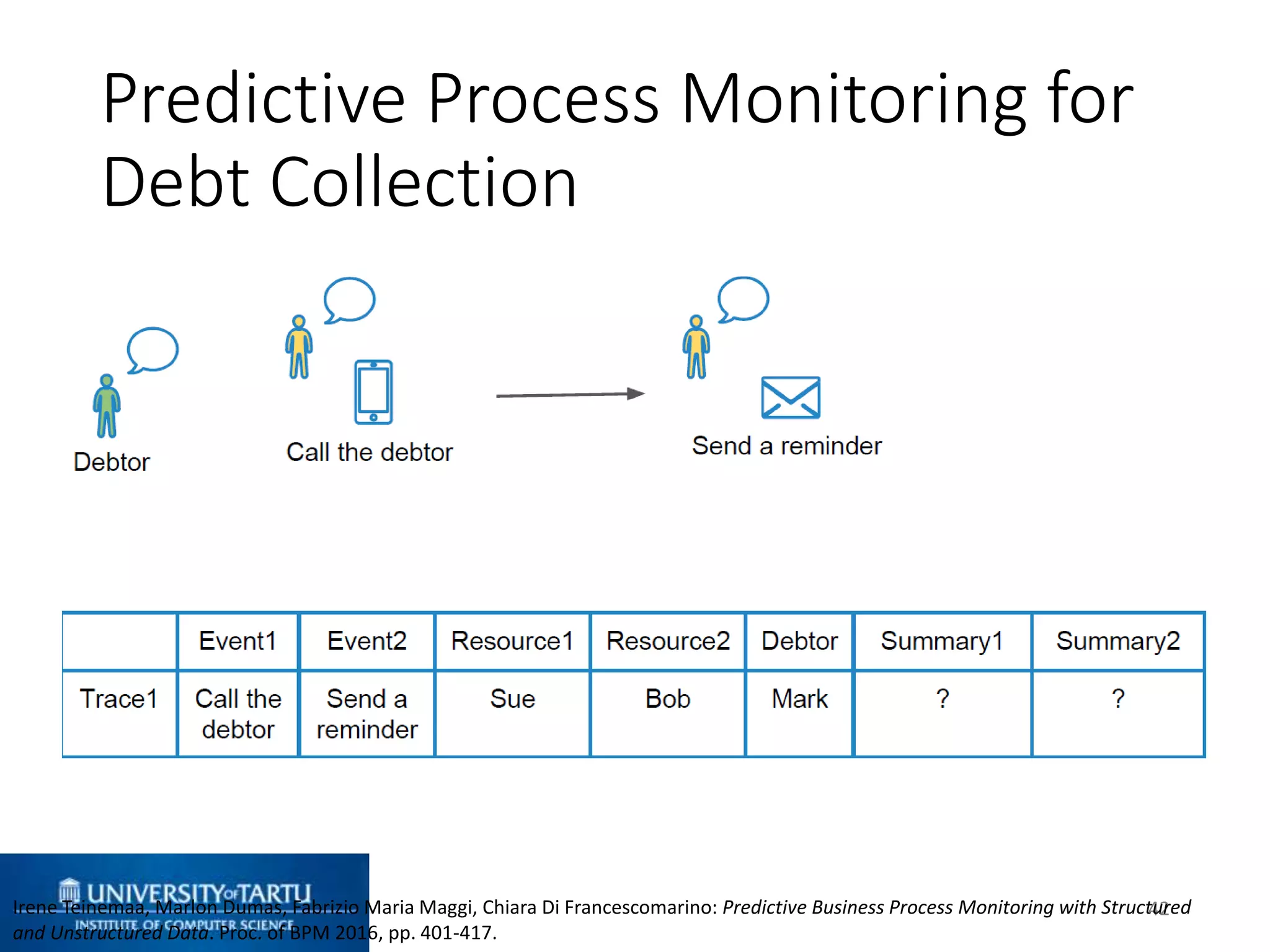
Predictive Process Monitoring for
Debt Collection
42Irene Teinemaa, Marlon Dumas, Fabrizio Maria Maggi, Chiara Di Francescomarino: Predictive Business Process Monitoring with Structured
and Unstructured Data. Proc. of BPM 2016, pp. 401-417.
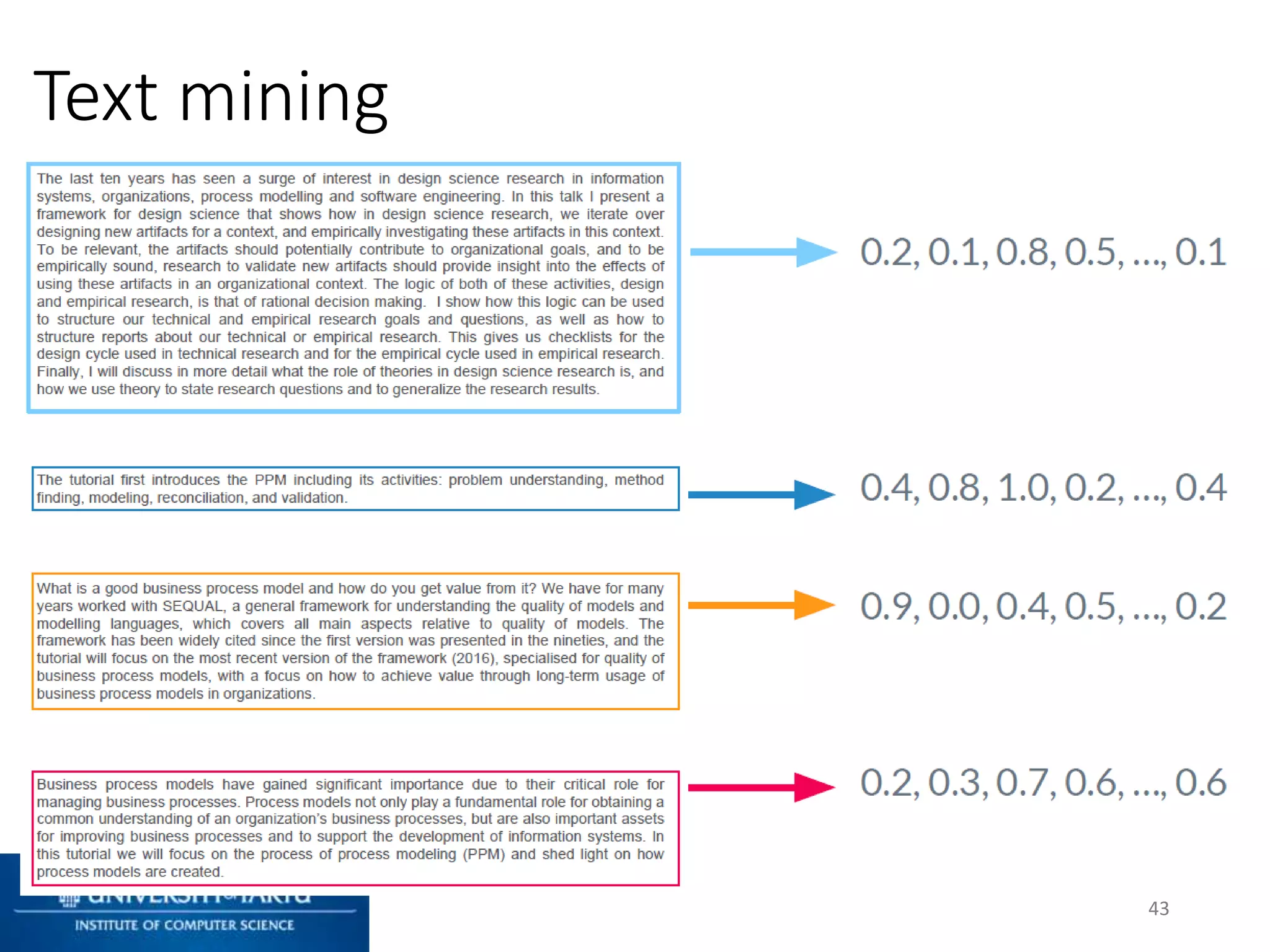
Text mining
43
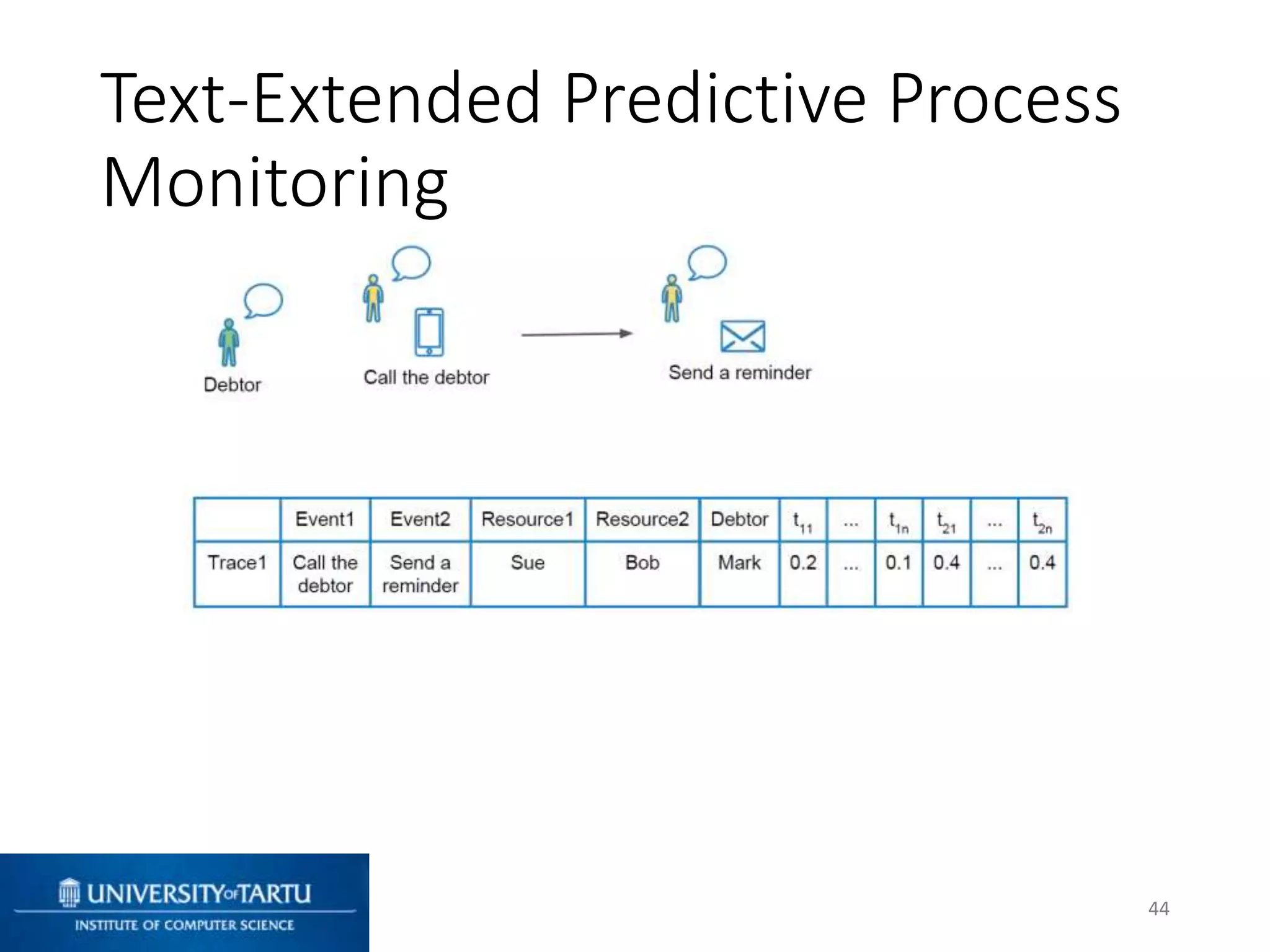
Text-Extended Predictive Process
Monitoring
44
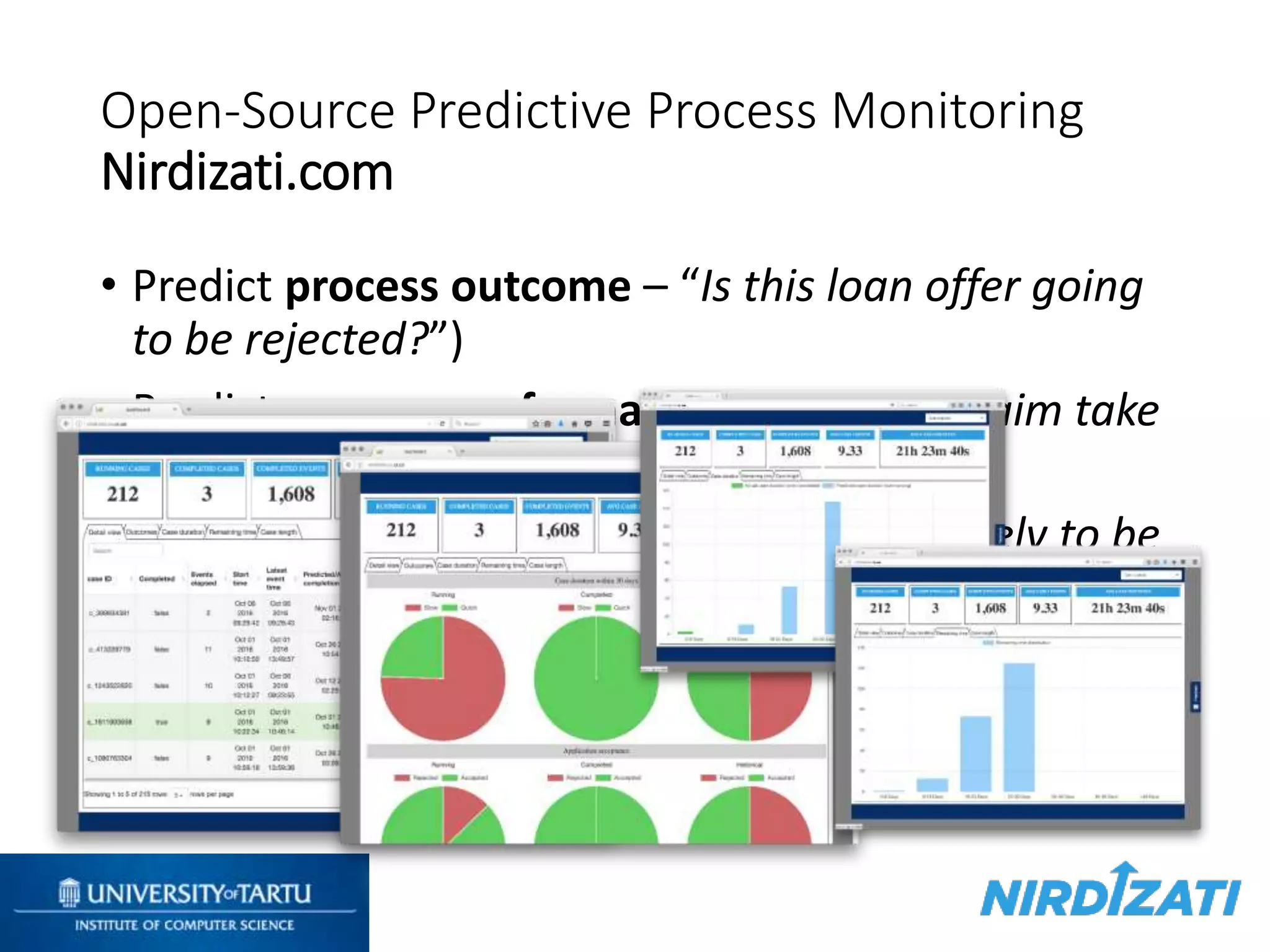
Open-Source Predictive Process Monitoring
Nirdizati.com
• Predict process outcome – “Is this loan offer going
to be rejected?”)
• Predict process performance – “Will this claim take
longer than 5 days to be handled?”
• Predict future events – “What activity is likely to be
executed next? And after that?”
Predictive Process Monitoring:
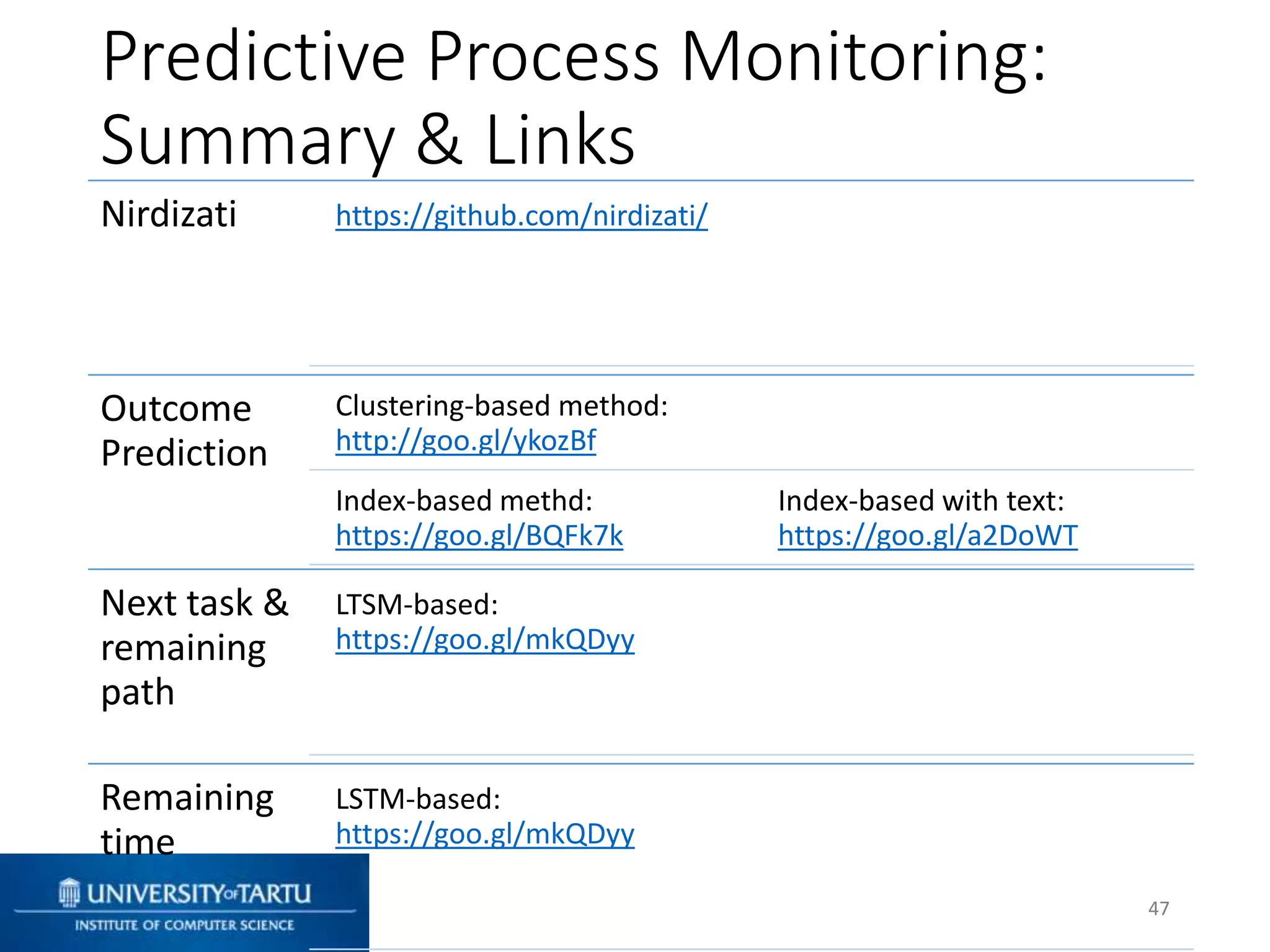
Summary & Links
47
Nirdizati https://github.com/nirdizati/
Outcome
Prediction
Clustering-based method:
http://goo.gl/ykozBf
Index-based methd:
https://goo.gl/BQFk7k
Index-based with text:
https://goo.gl/a2DoWT
Next task &
remaining
path
LTSM-based:
https://goo.gl/mkQDyy
Remaining
time
LSTM-based:
https://goo.gl/mkQDyy
48

Process Mining and Predictive Process Monitoring

  • 1.
    Process Mining and PredictiveProcess Monitoring Marlon Dumas University of Tartu, Estonia marlon.dumas@ut.ee 1https://www.slideshare.net/MarlonDumas
  • 2.
    Business Process Monitoring Dashboards& reports Process miningEvent stream DB logs Event log
  • 3.
  • 4.
    • Aimed atprocess workers & op managers • Emphasis on runtime monitoring: detect & respond • Typical performance indicators: • Work-in-progress • Resource load • Problematic cases – e.g. overdue/at-risk cases Operational dashboards
  • 5.
    Operational process dashboards •Aimed at process workers & operational managers • Emphasis on monitoring (detect-and-respond), e.g.: - Work-in-progress - Problematic cases – e.g. overdue/at-risk cases - Resource load
  • 6.
    • Aimed atprocess owners / managers • Emphasis on analysis and management • E.g. detecting bottlenecks • Typical process performance indicators • Cycle times • Error rates • Resource utilization Tactical dashboards
  • 7.
  • 8.
  • 9.
    Tactical Performance Dashboard@ Qld Government - Recruitment Process
  • 10.
    • Aimed atexecutives & managers • Emphasis on management • Link process performance to strategic objectives • Often based on scorecards, e.g. balanced scorecard Strategic dashboards
  • 11.
    Manage Unplanned Outages Manage Emergencies & Disasters Manage Work Programming& Resourcing Manage Procurement Customer Satisfaction 0.5 0.55 - 0.2 Customer Complaint 0.6 - - 0.5 Customer Feedback 0.4 - - 0.8 Connection Less Than Agreed Time 0.3 0.6 0.7 - Key Performance Process Strategic Performance Dashboard @ Australian Utilities Provider
  • 12.
    Process: Manage Emergencies& Disasters Process: Manage Procurement Process: Manage Unplanned Outages Overall Process Performance Financial People Customer Excellence Operational Excellence Risk Management Health & Safety Customer Satisfaction Customer Complaint Customer Rating (%) Customer Loyalty Index Average Time Spent on Plan 1st Layer Key Result Area 2nd Layer Key Performance Satisfied Customer Index Market Share (%) 3rd & 4th Layer Process Performance Measures 0.65 0.6 0.7 0.7 0.6 0.8 0.4 0.8 0.5 0.4 0.5 0.8 0.4 0.54 0.58 0.67
  • 14.
    Process Mining 14 / event log discoveredmodel Discovery Conformance Deviance Difference diagnostics Performance input model Enhanced model event log’
  • 15.
    Automated Process Discovery 15 EnterLoan Application Retrieve Applicant Data Compute Installments Approve Simple Application Approve Complex Application Notify Rejection Notify Eligibility CID Task Time Stamp … 13219 Enter Loan Application 2007-11-09 T 11:20:10 - 13219 Retrieve Applicant Data 2007-11-09 T 11:22:15 - 13220 Enter Loan Application 2007-11-09 T 11:22:40 - 13219 Compute Installments 2007-11-09 T 11:22:45 - 13219 Notify Eligibility 2007-11-09 T 11:23:00 - 13219 Approve Simple Application 2007-11-09 T 11:24:30 - 13220 Compute Installements 2007-11-09 T 11:24:35 - … … … …
  • 16.
    Automated Process Discoveryin Action Apromore.org
  • 17.
  • 18.
    Conformance Checking with BehavioralAlignment Desired conformance output: • task C is optional in the log • the cycle including IGDF is not observed in the log Log traces: ABCDEH ACBDEH ABCDFH ACBDFH ABDEH ABDFH
  • 19.
    Conformance Checking inAction 19 Full demo at: https://www.youtube.com/watch?v=3d00pORc9X8
  • 20.
    Given two logs,find the differences and root causes for variation or deviance between the two logs Simple claims and quick Simple claims and slow Deviance Mining MODEL S. Suriadi et al.: Understanding Process Behaviours in a Large Insurance Company in Australia: A Case Study. CAiSE 2013
  • 21.
    Sequence classification vs.log delta analysis L1 - Short stay 448 cases 7329 events L2 - Long stay 363 cases 7496 events Log delta analysis 48 statements In L1, “Nursing Primary Assessment” is repeated after “Medical Assign” and “Triage Request”, while in L2 it is not … N.R. van Beest, L. Garcia-Banuelos, M. Dumas, M. La Rosa, Log Delta Analysis: Interpretable Differencing of Business Process Event Logs. BPM 2015: 386-405
  • 22.
    Tools • Apromore (open-source) •ProM (open-source) • Disco (Fluxicon) • Celonis Process Mining (Celonis) • Minit (MinitLabs) • myInvenio (Cognitive Technlogy) • ARIS Process Performance Manager (Software AG) • Signavio Process Intelligence • Discovery Analyst (StereoLOGIC) • Interstage Process Discovery (Fujitsu) • Perceptive Process Mining (Lexmark) • ProcessAnalyzer (QPR) 22
  • 23.
    Apromore Process AnalyticsPlatform http://apromore.org Open-source, highly scalable, SaaS BPM analytics platform
  • 24.
    • Insurance - Suncorp,Australia • Government - Qld Treasury & Trade, Australia • Health - AMC Hospital, The Netherlands - São Sebastião Hospital, Portugal - Chania Hospital, Greece - EHR Workflow Inc., USA • Transport - ANA Airports, Portugal - Busan Port, South Korea - Kuehne + Nagel, Switzerland-Germany • Electronics - Phillips, The Netherlands • Banking, construction… etc. Process Mining: Where is it used?
  • 25.
    Case Study: SuncorpGroup • Top 20 Australian market • General & life insurance, banking, superannuation and investments management • 9M customers • 16K employees • $85 billion in assets
  • 26.
    Each process isvaried by product & brand… End to end insurance process Source: Guidewire reference models Total process variants: 3,000+ 30 variations 500 tasks Home       Motor         Commercial      Liability      CTP / WC       Suncorp Insurance
  • 27.
    Processing Problem OK OK Good BadExpected Performance Line
  • 28.
    Discover and analyseactual organisational processes from data Main result Key patterns that explain lower performance identified Simple Claim and Quick Simple Claim and Slow Discriminative model discovery MODEL
  • 30.
    1. Frame &Plan the Problem 2. Collect the Data 3. Analyze: Look for Patterns 4. Interpret & Create Insights 5. Create Business Impact Wil van der Aalst, 2012 Process Mining Methodology
  • 31.
    1. Plan &Frame the Problem • Frame a top-level question or phenomenon: - How and why does customer experiences with our order-to-cash processes diverge (geographically, product-wise, temporally)? - Why does the process perform poorly (bottlenecks, slow handovers)? - Why do we have frequent defects or performance deviance? • Refine problem into: - Sub-questions - Identify success criteria and metrics • Identify needed resources, get buy-in, plan remaining phases
  • 32.
    1. Plan andFrame the Problem – Suncorp • Often “simple” claims take an unexpectedly long time to complete: - What distinguishes the processing of simple claims completed on- time, and simple claims not completed on time? - What early predictors can be used to determine that a given “simple” claim will not be completed on time? • Define what a “simple” claim is • Create awareness of the extent of the problem Resources: • 2 part-time Business Analysts, 1 DB Administrator, 1 Executive Manager (sponsor) • 1 full-time QUT Researcher Timeframe: 4 months
  • 33.
    • Find relevantdata sources - Information systems, SAP, Oracle, BPM Systems… - Identify process-related entities and their identifiers and map entities to relevant processes in the process architecture • Extract traces - Collect records associated with process entities - Group records by process identifier to produce “traces” - Export traces into standard format (XES or MXML) • Clean - Filter irrelevant events - Combine equivalent events - Filter out traces of infrequent variants if not relevant 2. Collect the data
  • 34.
    2. Collect thedata: minimum requirements
  • 35.
    • Discover thereal process from the logs • Calculate process metrics - Cycle times, waiting times, error rates… • Explore frequent paths • Discover types of cases (good vs bad) • Identify process deviances and early predictors • … 3. Analyze – look for patterns
  • 36.
    How likely isit that a running process will become “deviant”? Will it end up in a negative outcome? Will it fail to meet its SLAs in the next 24 hours? Will it generate abnormal effort, costs or rework? Beyond Deviance Mining: Predictive Process Monitoring
  • 37.
    Predictive Process Monitoring– Detailed View PAGE 38 Current situation • What is the next activity for this case? • When is this next activity going to take place? • How long is this case still going to take until it is finished? • What is the outcome of this case? Is the compensation going to be paid? Or rejected?
  • 38.
    Predictive Monitoring Example: DebtRecovery Process 39 Debt repayment due Call the debtor Send a reminder Payment received
  • 39.
    Debt repayment dueCall the debtor Send a reminder Send a warning Call the debtor Call the debtor Send to external debt collection agency Call the debtor Send a reminder Send a warning Call the debtor Call the debtorCall the debtor Call the debtor Call the debtor Call the debtor Call the debtor Call the debtor Predictive Monitoring Example: Debt Recovery Process 40
  • 40.
    Event log Classifier / Outcome Predictions Attributes Traces Predictive ProcessMonitoring: General Approach 41 Event log Regressor / structured predictor Future “paths” prediction Attributes Traces
  • 41.
    Predictive Process Monitoringfor Debt Collection 42Irene Teinemaa, Marlon Dumas, Fabrizio Maria Maggi, Chiara Di Francescomarino: Predictive Business Process Monitoring with Structured and Unstructured Data. Proc. of BPM 2016, pp. 401-417.
  • 42.
  • 43.
  • 44.
    Open-Source Predictive ProcessMonitoring Nirdizati.com • Predict process outcome – “Is this loan offer going to be rejected?”) • Predict process performance – “Will this claim take longer than 5 days to be handled?” • Predict future events – “What activity is likely to be executed next? And after that?”
  • 45.
    Predictive Process Monitoring: Summary& Links 47 Nirdizati https://github.com/nirdizati/ Outcome Prediction Clustering-based method: http://goo.gl/ykozBf Index-based methd: https://goo.gl/BQFk7k Index-based with text: https://goo.gl/a2DoWT Next task & remaining path LTSM-based: https://goo.gl/mkQDyy Remaining time LSTM-based: https://goo.gl/mkQDyy
  • 46.