Multidimensional Model Order Selection


                                         1
Motivation
 Stock Markets: One example of [1]


 ⇒ Information: Long Term Government Bond interest rates.
                Canada, USA, 6 European countries and Japan.
 ⇒ Result: by visual inspection of the Eigenvalues (EVD).
           Three main components: Europe, Asia and North America.
[1]: M. Loteran, “Generating market risk scenarios using principal components analysis: methodological and
     practical considerations”, in the Federal Reserve Board, March, 1997.


                                                                                                         2
Motivation
 Ultraviolet-visible (UV-vis) Spectrometry [2]


                                                                         Wavelength
                                                                                      Oxidation state


                                                                    pH
Radiation
                      Non-identified substance
                                                                                         samples

 ⇒ Result: successful application of tensor calculus.
           In [2], the model order is estimated via the core consistency
           analysis (CORCONDIA) by visual inspection.
[2]: K. S. Von Age, R. Bro, and P. Geladi, “Multi-way analysis with applications in the chemical sciences,”
     Wiley, Aug. 2004.


                                                                                                              3
Motivation
 Sound source localization


                                                           Sound source 1


                                                           Sound source 2
                        Microphone array

   ⇒ Applications: interfaces between humans and robots and data
                   processing.
   ⇒ MOS:          Corrected Frequency Exponential Fitting Test [3]
[3]: A. Quinlan and F. Asano, “Detection of overlapping speech in meeting recordings using the modified
     exponential fitting test,” in Proc. 15th European Signal Processing Conference (EUSIPCO 2007),
     Poznan, Poland.


                                                                                                          4
Motivation
 Wind tunnel evaluation

                                 Array


                                                                             W ind


                                                                              Source: Carine El Kassis [4].
   ⇒ MOS: No technique is applied. [4]
[4]: C. El Kassis, “High-resolution parameter estimation schemes for non-uniform antenna arrays,” PhD
     Thesis, SUPELEC, Universite Paris-Sud XI, 2009. (Wind tunnel photo provided by Renault)


                                                                                                         5
Motivation
Channel model
 Direction of Departure (DOD)
 Transmit array: 1-D or 2-D

                                                          Direction of Arrival (DOA)
                                                          Receive array: 1-D or 2-D


                                Frequency       Delay
                                Time      Doppler shift


                                                                                   6
Motivation
An unlimited list of applications
 ⇒ Radar;
 ⇒ Sonar;
 ⇒ Communications;
 ⇒ Medical imaging;
 ⇒ Chemistry;
 ⇒ Food industry;
 ⇒ Pharmacy;
 ⇒ Psychometrics;
 ⇒ Reflection seismology;
 ⇒ EEG;
 ⇒…


                                           7
Outline
Motivation
Introduction
Tensor calculus
One dimensional Model Order Selection
 ⇒ Exponential Fitting Test
Multidimensional Model Order Selection (R-D MOS)
 ⇒ Novel contributions
      • R-D Exponential Fitting Test (R-D EFT)
      • Closed-form PARAFAC based model order selection (CFP-MOS)
Comparisons
Conclusions


                                                                    8
Outline
Motivation
Introduction
Tensor calculus
One dimensional Model Order Selection
 ⇒ Exponential Fitting Test
Multidimensional Model Order Selection (R-D MOS)
 ⇒ Novel contributions
      • R-D Exponential Fitting Test (R-D EFT)
      • Closed-form PARAFAC based model order selection (CFP-MOS)
Comparisons
Conclusions


                                                                    9
Introduction
 The model order selection (MOS)
  ⇒ is required for the principal component analysis (PCA).
  ⇒ is the amount of principal components of the data.
  ⇒ has several schemes based on the Eigenvalue Decomposition (EVD).
  ⇒ can be estimated via other properties of the data, e.g., removing
    components until reaching the noise level or shift invariance property of
    the data.
 The multidimensional model order selection (R-D MOS)
  ⇒ requires a multidimensional structure of the data, which is taken into
    account (this additional information is ignored by one dimensional MOS).
  ⇒ gives an improved performance compared to the MOS.
  ⇒ based on tensor calculus, e.g., instead of EVD and SVD, the Higher Order
    Singular Value Decomposition (HOSVD) [5] is computed.

[5]: L. de Lathauwer, B. de Moor, and J. Vanderwalle, “A multilinear singular value decomposition”, SIAM J.
     Matrix Anal. Appl., vol. 21(4), 2000.


                                                                                                          10
Introduction
 A large number of model order selection (MOS) schemes have been proposed in
 the literature. However,
  ⇒ most of the proposed MOS schemes are compared only to Akaike’s
      Information Criterion (AIC) [6] and Minimum Description Length (MDL) [6];
  ⇒ the Probability of correct Detection (PoD) of these schemes is a function of
      the array size (number of snapshots and number of sensors).
 In [7], we have proposed expressions for the 1-D AIC and 1-D MDL. Moreover, for
 matrix based data in the presence of white Gaussian noise, the Modified
 Exponential Fitting Test (M-EFT)
  ⇒ outperforms 12 state-of-the-art matrix based model order selection
      techniques for different array sizes.
 For colored noise, the M-EFT is not suitable, as well as several other MOS
 schemes, and the RADOI [8] reaches the best PoD according to our comparisons.
[6]: M. Wax and T. Kailath “Detection of signals by information theoretic criteria”, in IEEE Trans. on
     Acoustics, Speech, and Signal Processing, vol. ASSP-33, pp. 387-392, 1974.
[7]: J. P. C. L. da Costa, A. Thakre, F. Roemer, and M. Haardt, “Comparison of model order selection
     techniques for high-resolution parameter estimation algorithms,” in Proc. 54th International Scientific
     Colloquium (IWK), (Ilmenau, Germany), Sept. 2009.
[8]: E. Radoi and A. Quinquis, “A new method for estimating the number of harmonic components in noise
     with application in high resolution radar,” EURASIP Journal on Applied Signal Processing, 2004.


                                                                                                          11
Introduction
 One of the most well-known multidimensional model order selection schemes in the
 literature is the Core Consistency Analysis (CORCONDIA) [9]
   ⇒ a subjective MOS scheme, i.e., depends on the visual interpretation.
 In [10], we have proposed the Threshold-CORCONDIA (T-CORCONDIA)
   ⇒ which is non-subjective, and its PoD is close, but still inferior to the 1-D AIC and
      1-D MDL.
 By taking into account the multidimensional structure of the data, we extend the
 M-EFT to the R-D EFT [10] for applications with white Gaussian noise.
 For applications with colored noise, we proposed the Closed-Form PARAFAC
 based Model Order Selection (CFP-MOS) scheme,
   ⇒ which outperforms the state-of-the-art colored noise scheme RADOI [11].
[9]: R. Bro and H.A.L. Kiers. A new efficient method for determining the number of components in
      PARAFAC models. Journal of Chemometrics, 17:274–286,2003.
[10]: J. P. C. L. da Costa, M. Haardt, and F. Roemer, “Robust methods based on the HOSVD for estimating
      the model order in PARAFAC models,” in Proc. 5-th IEEE Sensor Array and Multichannel Signal
      Processing Workshop (SAM 2008), (Darmstadt, Germany), pp. 510 - 514, July 2008.
[11]: J. P. C. L. da Costa, F. Roemer, and M. Haardt, “Multidimensional model order via closed-form
      PARAFAC for arbitrary noise correlations,” submitted to ITG Workshop on Smart Antennas 2010.


                                                                                                      12
Outline
Motivation
Introduction
Tensor calculus
One dimensional Model Order Selection
 ⇒ Exponential Fitting Test
Multidimensional Model Order Selection (R-D MOS)
 ⇒ Novel contributions
      • R-D Exponential Fitting Test (R-D EFT)
      • Closed-form PARAFAC based model order selection (CFP-MOS)
Comparisons
Conclusions


                                                                    13
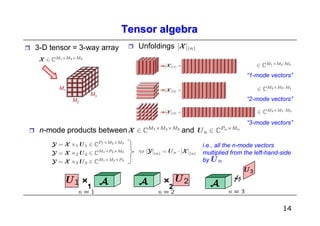
Tensor algebra
3-D tensor = 3-way array      Unfoldings


                                                                  “1-mode vectors”

      M1
                M3
           M2                                                     “2-mode vectors”


                                                                  “3-mode vectors”
 n-mode products between                   and
                                                 i.e., all the n-mode vectors
                                                 multiplied from the left-hand-side
                                                 by


                1                     2


                                                                               14
The Higher-Order SVD (HOSVD)
   Singular Value Decomposition              Higher-Order SVD (Tucker3)
“Full SVD”
                                          “Full HOSVD”


“Economy size SVD”                        “Economy size HOSVD”


                                          Low-rank approximation (truncated HOSVD)
Low-rank approximation


                                             Tensor data model
                                                                                 rank d
   Matrix data model             rank d

        signal part      noise part                                signal part    noise part


                                                                                               15
Outline
Motivation
Introduction
Tensor calculus
One dimensional Model Order Selection
 ⇒ Exponential Fitting Test
Multidimensional Model Order Selection (R-D MOS)
 ⇒ Novel contributions
      • R-D Exponential Fitting Test (R-D EFT)
      • Closed-form PARAFAC based model order selection (CFP-MOS)
Comparisons
Conclusions


                                                                    16
Exponential Fitting Test (EFT)
Observation is a superposition of noise and signal
 ⇒ The noise eigenvalues still exhibit the exponential profile [12,13]
 ⇒ We can predict the profile
   of the noise eigenvalues
   to find the “breaking point”
 ⇒ Let P denote the number
   of candidate noise eigenvalues.
       • choose the largest P
         such that the P noise
         eigenvalues can be fitted
         with a decaying exponential
      d = 3, M = 8, SNR = 20 dB, N = 10
[12]: J. Grouffaud, P. Larzabal, and H. Clergeot, “Some properties of ordered eigenvalues of a wishart
      matrix: application in detection test and model order selection,” in Proceedings of the IEEE
      International Conference on Acoustics, Speech and Signal Processing (ICASSP’96).
[13]: A. Quinlan, J.-P. Barbot, P. Larzabal, and M. Haardt, “Model order selection for short data: An
      exponential fitting test (EFT),” EURASIP Journal on Applied Signal Processing, 2007


                                                                                                         17
Exponential Fitting Test (EFT)


Start with P = 1

 ⇒ Predict λM-1 based on λM             d = 3, M = 8, SNR = 20 dB, N = 10


 ⇒ Compare this prediction
   with actual eigenvalue

 ⇒ relative distance:


 ⇒ In our case it agrees, we continue

                                                                            18
Exponential Fitting Test (EFT)


Now, P = 2

⇒ Predict λM-2 based on       d = 3, M = 8, SNR = 20 dB, N = 10
  λM-1 and λM

⇒ relative distance


                                                                  19
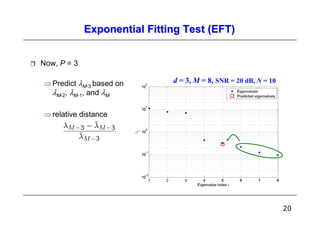
Exponential Fitting Test (EFT)


Now, P = 3

⇒ Predict λM-3 based on       d = 3, M = 8, SNR = 20 dB, N = 10
  λM-2, λM-1, and λM

⇒ relative distance


                                                                  20
Exponential Fitting Test (EFT)


Now, P = 4

⇒ Predict λM-4 based on       d = 3, M = 8, SNR = 20 dB, N = 10
  λM-3, λM-2, λM-1, and λM

⇒ relative distance


                                                                  21
Exponential Fitting Test (EFT)


Now, P = 5

⇒ Predict λM-5 based on             d = 3, M = 8, SNR = 20 dB, N = 10
  λM-4 , λM-3, λM-2, λM-1, and λM

⇒ relative distance


⇒ The relative distance
  becomes very big, we have
  found the break point.


                                                                        22
Outline
Motivation
Introduction
Tensor calculus
One dimensional Model Order Selection
 ⇒ Exponential Fitting Test
Multidimensional Model Order Selection (R-D MOS)
 ⇒ Novel contributions
      • R-D Exponential Fitting Test (R-D EFT)
      • Closed-form PARAFAC based model order selection (CFP-MOS)
Comparisons
Conclusions


                                                                    23
R-D Exponential Fitting Test
r-mode eigenvalues
 ⇒ In the R-D case, we have a measurement tensor

⇒ This allows to define the r-mode sample covariance matrices


⇒ The eigenvalues of        are denoted by      for

⇒ They are related to the higher-order singular values of the
  HOSVD of       through


                                                                24
R-D Exponential Fitting Test
R-D exponential profile
 ⇒ The R-mode eigenvalues exhibit an exponential profile for every R


 ⇒ Assume                      . Then we can define global eigenvalues


 ⇒ The global eigenvalues also follow an exponential profile, since


 ⇒ The product across modes enhances the signal-to-noise ratio and
   improves the fit to an exponential profile

                                                                         25
R-D Exponential Fitting Test
R-D exponential profile
 ⇒ Comparison between the global eigenvalues profile and the profile
   of the last unfolding


                                                                       26
R-D Exponential Fitting Test
R-D EFT
  ⇒ Is an extended version of the M-EFT operating on the

  ⇒ Exploits the fact that the global eigenvalues still exhibit an exponential
    profile

  ⇒ The enhanced SNR and the improved fit lead to significant
    improvements in the performance

  ⇒ Is able to adapt to arrays of arbitrary size and dimension through the
    adaptive definition of global eigenvalues


                                                                             27
Outline
Motivation
Introduction
Tensor calculus
One dimensional Model Order Selection
 ⇒ Exponential Fitting Test
Multidimensional Model Order Selection (R-D MOS)
 ⇒ Novel contributions
      • R-D Exponential Fitting Test (R-D EFT)
      • Closed-form PARAFAC based model order selection (CFP-MOS)
Comparisons
Conclusions


                                                                    28
SVD and PARAFAC
Another way to look at the SVD


      =                   +                 +
 ⇒ decomposition into a sum of rank one matrices
 ⇒ also referred to as principal components (PCA)
Tensor case:


           =              +                +


                                                    29
HOSVD and PARAFAC
     HOSVD                                                PARAFAC


     Core tensor                                          Identity tensor


• Core tensor usually is full. R-D STE [14]          • Identity tensor is always diagonal. CFP-PE [15]
  [14]: M. Haardt, F. Roemer, and G. Del Galdo, ``Higher-order SVD based subspace estimation to improve
        the parameter estimation accuracy in multi-dimensional harmonic retrieval problems,'' IEEE
        Trans. Signal Processing, vol. 56, pp. 3198 - 3213, July 2008.
  [15]: J. P. C. L. da Costa, F. Roemer, and M. Haardt, “Robust R-D parameter estimation via closed-form
        PARAFAC,” submitted to ITG Workshop on Smart Antennas 2010.


                                                                                                           30
Closed-form solution to PARAFAC
    The task of PARAFAC analysis: Given (noisy) measurements


    and the model order d, find
    such that

    Here       is the higher-order Frobenius norm (sum of squared magnitude of all
    elements).

    Our approach: based on simultaneous matrix diagonalizations (“closed-form”).
    By applying the closed-form PARAFAC (CFP) [16]
     ⇒ R*(R-1)       simultaneous matrix diagonalizations (SMD) are possible;
     ⇒ R*(R-1)       estimates for each factor are possible;
     ⇒ selection of the best solution by different heuristics (residuals of the SMD) is
        done
[16]:F. Roemer and M. Haardt, “A closed-form solution for multilinear PARAFAC decompositions,” in
     Proc. 5-th IEEE Sensor Array and Multichannel Signal Processing Workshop (SAM 2008), (Darmstadt,
     Germany), pp. 487 - 491, July 2008.


                                                                                                        31
Closed-form PARAFAC based
                             Model Order Selection
For P = 2, i.e., P < d                            For P = 4, i.e., P > d


               =              +                              =            +           +          +


               =             +                               =            +           +          +

        Assuming that d = 3, and solutions with the two smallest residuals of the SMD.
        Using the same principle as in [17], the error is minimized when P = d.
        Due to the permutation ambiguities, the components of different tensors are
        ordered using the amplitude based approach proposed in [18].
[17]:J.-M. Papy, L. De Lathauwer, and S. Van Huffel, “A shift invariance-based order-selection technique for
     exponential data modelling,” in IEEE Signal Processing Letters, vol. 14, No. 7, pp. 473 - 476, July 2007.
[18]:M. Weis, F. Roemer, M. Haardt, D. Jannek, and P. Husar, “Multi-dimensional Space-Time-Frequency
     component analysis of event-related EEG data using closed-form PARAFAC,” in Proc. IEEE
     Int. Conf. Acoust., Speech, and Signal Processing (ICASSP), (Taipei, Taiwan), pp. 349-352, Apr. 2009.


                                                                                                            32
Outline
Motivation
Introduction
Tensor calculus
One dimensional Model Order Selection
 ⇒ Exponential Fitting Test
Multidimensional Model Order Selection (R-D MOS)
 ⇒ Novel contributions
      • R-D Exponential Fitting Test (R-D EFT)
      • Closed-form PARAFAC based model order selection (CFP-MOS)
Comparisons
Conclusions


                                                                    33
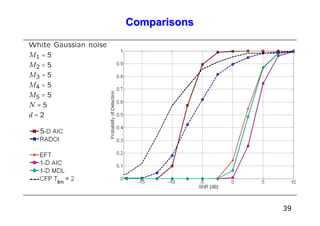
Comparisons


              34
Comparisons


              35
Comparisons


              36
Comparisons


              37
Comparisons


              38
Comparisons


              39
Comparisons


              40
Comparisons


              41
Comparisons


              42
Comparisons


              43
Comparisons


              44
Comparisons


              45
Comparisons


              46
Comparisons


              47
Comparisons


              48
Comparisons


              49
Comparisons


              50
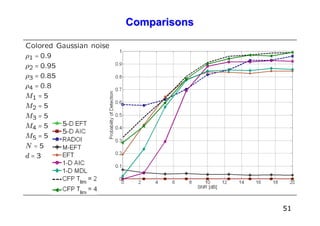
Comparisons


              51
Outline
Motivation
Introduction
Tensor calculus
One dimensional Model Order Selection
 ⇒ Exponential Fitting Test
Multidimensional Model Order Selection (R-D MOS)
 ⇒ Novel contributions
      • R-D Exponential Fitting Test (R-D EFT)
      • Closed-form PARAFAC based model order selection (CFP-MOS)
Comparisons
Conclusions


                                                                    52
Conclusions
State-of-the-art one dimensional and multidimensional model order selection
techniques were presented;
For one dimensional scenarios:
 ⇒ in the presence of white Gaussian noise
     • Modified Exponential Fitting Test (M-EFT)
 ⇒ in the presence of severe colored Gaussian noise
     • RADOI
For multidimensional scenarios:
 ⇒ in the presence of white Gaussian noise
     • R-dimensional Exponential Fitting Test (R-D EFT)
 ⇒ in the presence of colored noise
     • Closed-form PARAFAC based Model Order Selection (CFP-MOS)
        scheme
The mentioned schemes are applicable to problems with a PARAFAC data
model, which are found in several scientific fields.


                                                                              53
Thank you for your attention!
Vielen Dank für Ihre Aufmerksamkeit!


                                   54

In it seminar_r_d_mos_cut

  • 1.
  • 2.
    Motivation Stock Markets:One example of [1] ⇒ Information: Long Term Government Bond interest rates. Canada, USA, 6 European countries and Japan. ⇒ Result: by visual inspection of the Eigenvalues (EVD). Three main components: Europe, Asia and North America. [1]: M. Loteran, “Generating market risk scenarios using principal components analysis: methodological and practical considerations”, in the Federal Reserve Board, March, 1997. 2
  • 3.
    Motivation Ultraviolet-visible (UV-vis)Spectrometry [2] Wavelength Oxidation state pH Radiation Non-identified substance samples ⇒ Result: successful application of tensor calculus. In [2], the model order is estimated via the core consistency analysis (CORCONDIA) by visual inspection. [2]: K. S. Von Age, R. Bro, and P. Geladi, “Multi-way analysis with applications in the chemical sciences,” Wiley, Aug. 2004. 3
  • 4.
    Motivation Sound sourcelocalization Sound source 1 Sound source 2 Microphone array ⇒ Applications: interfaces between humans and robots and data processing. ⇒ MOS: Corrected Frequency Exponential Fitting Test [3] [3]: A. Quinlan and F. Asano, “Detection of overlapping speech in meeting recordings using the modified exponential fitting test,” in Proc. 15th European Signal Processing Conference (EUSIPCO 2007), Poznan, Poland. 4
  • 5.
    Motivation Wind tunnelevaluation Array W ind Source: Carine El Kassis [4]. ⇒ MOS: No technique is applied. [4] [4]: C. El Kassis, “High-resolution parameter estimation schemes for non-uniform antenna arrays,” PhD Thesis, SUPELEC, Universite Paris-Sud XI, 2009. (Wind tunnel photo provided by Renault) 5
  • 6.
    Motivation Channel model Directionof Departure (DOD) Transmit array: 1-D or 2-D Direction of Arrival (DOA) Receive array: 1-D or 2-D Frequency Delay Time Doppler shift 6
  • 7.
    Motivation An unlimited listof applications ⇒ Radar; ⇒ Sonar; ⇒ Communications; ⇒ Medical imaging; ⇒ Chemistry; ⇒ Food industry; ⇒ Pharmacy; ⇒ Psychometrics; ⇒ Reflection seismology; ⇒ EEG; ⇒… 7
  • 8.
    Outline Motivation Introduction Tensor calculus One dimensionalModel Order Selection ⇒ Exponential Fitting Test Multidimensional Model Order Selection (R-D MOS) ⇒ Novel contributions • R-D Exponential Fitting Test (R-D EFT) • Closed-form PARAFAC based model order selection (CFP-MOS) Comparisons Conclusions 8
  • 9.
    Outline Motivation Introduction Tensor calculus One dimensionalModel Order Selection ⇒ Exponential Fitting Test Multidimensional Model Order Selection (R-D MOS) ⇒ Novel contributions • R-D Exponential Fitting Test (R-D EFT) • Closed-form PARAFAC based model order selection (CFP-MOS) Comparisons Conclusions 9
  • 10.
    Introduction The modelorder selection (MOS) ⇒ is required for the principal component analysis (PCA). ⇒ is the amount of principal components of the data. ⇒ has several schemes based on the Eigenvalue Decomposition (EVD). ⇒ can be estimated via other properties of the data, e.g., removing components until reaching the noise level or shift invariance property of the data. The multidimensional model order selection (R-D MOS) ⇒ requires a multidimensional structure of the data, which is taken into account (this additional information is ignored by one dimensional MOS). ⇒ gives an improved performance compared to the MOS. ⇒ based on tensor calculus, e.g., instead of EVD and SVD, the Higher Order Singular Value Decomposition (HOSVD) [5] is computed. [5]: L. de Lathauwer, B. de Moor, and J. Vanderwalle, “A multilinear singular value decomposition”, SIAM J. Matrix Anal. Appl., vol. 21(4), 2000. 10
  • 11.
    Introduction A largenumber of model order selection (MOS) schemes have been proposed in the literature. However, ⇒ most of the proposed MOS schemes are compared only to Akaike’s Information Criterion (AIC) [6] and Minimum Description Length (MDL) [6]; ⇒ the Probability of correct Detection (PoD) of these schemes is a function of the array size (number of snapshots and number of sensors). In [7], we have proposed expressions for the 1-D AIC and 1-D MDL. Moreover, for matrix based data in the presence of white Gaussian noise, the Modified Exponential Fitting Test (M-EFT) ⇒ outperforms 12 state-of-the-art matrix based model order selection techniques for different array sizes. For colored noise, the M-EFT is not suitable, as well as several other MOS schemes, and the RADOI [8] reaches the best PoD according to our comparisons. [6]: M. Wax and T. Kailath “Detection of signals by information theoretic criteria”, in IEEE Trans. on Acoustics, Speech, and Signal Processing, vol. ASSP-33, pp. 387-392, 1974. [7]: J. P. C. L. da Costa, A. Thakre, F. Roemer, and M. Haardt, “Comparison of model order selection techniques for high-resolution parameter estimation algorithms,” in Proc. 54th International Scientific Colloquium (IWK), (Ilmenau, Germany), Sept. 2009. [8]: E. Radoi and A. Quinquis, “A new method for estimating the number of harmonic components in noise with application in high resolution radar,” EURASIP Journal on Applied Signal Processing, 2004. 11
  • 12.
    Introduction One ofthe most well-known multidimensional model order selection schemes in the literature is the Core Consistency Analysis (CORCONDIA) [9] ⇒ a subjective MOS scheme, i.e., depends on the visual interpretation. In [10], we have proposed the Threshold-CORCONDIA (T-CORCONDIA) ⇒ which is non-subjective, and its PoD is close, but still inferior to the 1-D AIC and 1-D MDL. By taking into account the multidimensional structure of the data, we extend the M-EFT to the R-D EFT [10] for applications with white Gaussian noise. For applications with colored noise, we proposed the Closed-Form PARAFAC based Model Order Selection (CFP-MOS) scheme, ⇒ which outperforms the state-of-the-art colored noise scheme RADOI [11]. [9]: R. Bro and H.A.L. Kiers. A new efficient method for determining the number of components in PARAFAC models. Journal of Chemometrics, 17:274–286,2003. [10]: J. P. C. L. da Costa, M. Haardt, and F. Roemer, “Robust methods based on the HOSVD for estimating the model order in PARAFAC models,” in Proc. 5-th IEEE Sensor Array and Multichannel Signal Processing Workshop (SAM 2008), (Darmstadt, Germany), pp. 510 - 514, July 2008. [11]: J. P. C. L. da Costa, F. Roemer, and M. Haardt, “Multidimensional model order via closed-form PARAFAC for arbitrary noise correlations,” submitted to ITG Workshop on Smart Antennas 2010. 12
  • 13.
    Outline Motivation Introduction Tensor calculus One dimensionalModel Order Selection ⇒ Exponential Fitting Test Multidimensional Model Order Selection (R-D MOS) ⇒ Novel contributions • R-D Exponential Fitting Test (R-D EFT) • Closed-form PARAFAC based model order selection (CFP-MOS) Comparisons Conclusions 13
  • 14.
    Tensor algebra 3-D tensor= 3-way array Unfoldings “1-mode vectors” M1 M3 M2 “2-mode vectors” “3-mode vectors” n-mode products between and i.e., all the n-mode vectors multiplied from the left-hand-side by 1 2 14
  • 15.
    The Higher-Order SVD(HOSVD) Singular Value Decomposition Higher-Order SVD (Tucker3) “Full SVD” “Full HOSVD” “Economy size SVD” “Economy size HOSVD” Low-rank approximation (truncated HOSVD) Low-rank approximation Tensor data model rank d Matrix data model rank d signal part noise part signal part noise part 15
  • 16.
    Outline Motivation Introduction Tensor calculus One dimensionalModel Order Selection ⇒ Exponential Fitting Test Multidimensional Model Order Selection (R-D MOS) ⇒ Novel contributions • R-D Exponential Fitting Test (R-D EFT) • Closed-form PARAFAC based model order selection (CFP-MOS) Comparisons Conclusions 16
  • 17.
    Exponential Fitting Test(EFT) Observation is a superposition of noise and signal ⇒ The noise eigenvalues still exhibit the exponential profile [12,13] ⇒ We can predict the profile of the noise eigenvalues to find the “breaking point” ⇒ Let P denote the number of candidate noise eigenvalues. • choose the largest P such that the P noise eigenvalues can be fitted with a decaying exponential d = 3, M = 8, SNR = 20 dB, N = 10 [12]: J. Grouffaud, P. Larzabal, and H. Clergeot, “Some properties of ordered eigenvalues of a wishart matrix: application in detection test and model order selection,” in Proceedings of the IEEE International Conference on Acoustics, Speech and Signal Processing (ICASSP’96). [13]: A. Quinlan, J.-P. Barbot, P. Larzabal, and M. Haardt, “Model order selection for short data: An exponential fitting test (EFT),” EURASIP Journal on Applied Signal Processing, 2007 17
  • 18.
    Exponential Fitting Test(EFT) Start with P = 1 ⇒ Predict λM-1 based on λM d = 3, M = 8, SNR = 20 dB, N = 10 ⇒ Compare this prediction with actual eigenvalue ⇒ relative distance: ⇒ In our case it agrees, we continue 18
  • 19.
    Exponential Fitting Test(EFT) Now, P = 2 ⇒ Predict λM-2 based on d = 3, M = 8, SNR = 20 dB, N = 10 λM-1 and λM ⇒ relative distance 19
  • 20.
    Exponential Fitting Test(EFT) Now, P = 3 ⇒ Predict λM-3 based on d = 3, M = 8, SNR = 20 dB, N = 10 λM-2, λM-1, and λM ⇒ relative distance 20
  • 21.
    Exponential Fitting Test(EFT) Now, P = 4 ⇒ Predict λM-4 based on d = 3, M = 8, SNR = 20 dB, N = 10 λM-3, λM-2, λM-1, and λM ⇒ relative distance 21
  • 22.
    Exponential Fitting Test(EFT) Now, P = 5 ⇒ Predict λM-5 based on d = 3, M = 8, SNR = 20 dB, N = 10 λM-4 , λM-3, λM-2, λM-1, and λM ⇒ relative distance ⇒ The relative distance becomes very big, we have found the break point. 22
  • 23.
    Outline Motivation Introduction Tensor calculus One dimensionalModel Order Selection ⇒ Exponential Fitting Test Multidimensional Model Order Selection (R-D MOS) ⇒ Novel contributions • R-D Exponential Fitting Test (R-D EFT) • Closed-form PARAFAC based model order selection (CFP-MOS) Comparisons Conclusions 23
  • 24.
    R-D Exponential FittingTest r-mode eigenvalues ⇒ In the R-D case, we have a measurement tensor ⇒ This allows to define the r-mode sample covariance matrices ⇒ The eigenvalues of are denoted by for ⇒ They are related to the higher-order singular values of the HOSVD of through 24
  • 25.
    R-D Exponential FittingTest R-D exponential profile ⇒ The R-mode eigenvalues exhibit an exponential profile for every R ⇒ Assume . Then we can define global eigenvalues ⇒ The global eigenvalues also follow an exponential profile, since ⇒ The product across modes enhances the signal-to-noise ratio and improves the fit to an exponential profile 25
  • 26.
    R-D Exponential FittingTest R-D exponential profile ⇒ Comparison between the global eigenvalues profile and the profile of the last unfolding 26
  • 27.
    R-D Exponential FittingTest R-D EFT ⇒ Is an extended version of the M-EFT operating on the ⇒ Exploits the fact that the global eigenvalues still exhibit an exponential profile ⇒ The enhanced SNR and the improved fit lead to significant improvements in the performance ⇒ Is able to adapt to arrays of arbitrary size and dimension through the adaptive definition of global eigenvalues 27
  • 28.
    Outline Motivation Introduction Tensor calculus One dimensionalModel Order Selection ⇒ Exponential Fitting Test Multidimensional Model Order Selection (R-D MOS) ⇒ Novel contributions • R-D Exponential Fitting Test (R-D EFT) • Closed-form PARAFAC based model order selection (CFP-MOS) Comparisons Conclusions 28
  • 29.
    SVD and PARAFAC Anotherway to look at the SVD = + + ⇒ decomposition into a sum of rank one matrices ⇒ also referred to as principal components (PCA) Tensor case: = + + 29
  • 30.
    HOSVD and PARAFAC HOSVD PARAFAC Core tensor Identity tensor • Core tensor usually is full. R-D STE [14] • Identity tensor is always diagonal. CFP-PE [15] [14]: M. Haardt, F. Roemer, and G. Del Galdo, ``Higher-order SVD based subspace estimation to improve the parameter estimation accuracy in multi-dimensional harmonic retrieval problems,'' IEEE Trans. Signal Processing, vol. 56, pp. 3198 - 3213, July 2008. [15]: J. P. C. L. da Costa, F. Roemer, and M. Haardt, “Robust R-D parameter estimation via closed-form PARAFAC,” submitted to ITG Workshop on Smart Antennas 2010. 30
  • 31.
    Closed-form solution toPARAFAC The task of PARAFAC analysis: Given (noisy) measurements and the model order d, find such that Here is the higher-order Frobenius norm (sum of squared magnitude of all elements). Our approach: based on simultaneous matrix diagonalizations (“closed-form”). By applying the closed-form PARAFAC (CFP) [16] ⇒ R*(R-1) simultaneous matrix diagonalizations (SMD) are possible; ⇒ R*(R-1) estimates for each factor are possible; ⇒ selection of the best solution by different heuristics (residuals of the SMD) is done [16]:F. Roemer and M. Haardt, “A closed-form solution for multilinear PARAFAC decompositions,” in Proc. 5-th IEEE Sensor Array and Multichannel Signal Processing Workshop (SAM 2008), (Darmstadt, Germany), pp. 487 - 491, July 2008. 31
  • 32.
    Closed-form PARAFAC based Model Order Selection For P = 2, i.e., P < d For P = 4, i.e., P > d = + = + + + = + = + + + Assuming that d = 3, and solutions with the two smallest residuals of the SMD. Using the same principle as in [17], the error is minimized when P = d. Due to the permutation ambiguities, the components of different tensors are ordered using the amplitude based approach proposed in [18]. [17]:J.-M. Papy, L. De Lathauwer, and S. Van Huffel, “A shift invariance-based order-selection technique for exponential data modelling,” in IEEE Signal Processing Letters, vol. 14, No. 7, pp. 473 - 476, July 2007. [18]:M. Weis, F. Roemer, M. Haardt, D. Jannek, and P. Husar, “Multi-dimensional Space-Time-Frequency component analysis of event-related EEG data using closed-form PARAFAC,” in Proc. IEEE Int. Conf. Acoust., Speech, and Signal Processing (ICASSP), (Taipei, Taiwan), pp. 349-352, Apr. 2009. 32
  • 33.
    Outline Motivation Introduction Tensor calculus One dimensionalModel Order Selection ⇒ Exponential Fitting Test Multidimensional Model Order Selection (R-D MOS) ⇒ Novel contributions • R-D Exponential Fitting Test (R-D EFT) • Closed-form PARAFAC based model order selection (CFP-MOS) Comparisons Conclusions 33
  • 34.
  • 35.
  • 36.
  • 37.
  • 38.
  • 39.
  • 40.
  • 41.
  • 42.
  • 43.
  • 44.
  • 45.
  • 46.
  • 47.
  • 48.
  • 49.
  • 50.
  • 51.
  • 52.
    Outline Motivation Introduction Tensor calculus One dimensionalModel Order Selection ⇒ Exponential Fitting Test Multidimensional Model Order Selection (R-D MOS) ⇒ Novel contributions • R-D Exponential Fitting Test (R-D EFT) • Closed-form PARAFAC based model order selection (CFP-MOS) Comparisons Conclusions 52
  • 53.
    Conclusions State-of-the-art one dimensionaland multidimensional model order selection techniques were presented; For one dimensional scenarios: ⇒ in the presence of white Gaussian noise • Modified Exponential Fitting Test (M-EFT) ⇒ in the presence of severe colored Gaussian noise • RADOI For multidimensional scenarios: ⇒ in the presence of white Gaussian noise • R-dimensional Exponential Fitting Test (R-D EFT) ⇒ in the presence of colored noise • Closed-form PARAFAC based Model Order Selection (CFP-MOS) scheme The mentioned schemes are applicable to problems with a PARAFAC data model, which are found in several scientific fields. 53
  • 54.
    Thank you foryour attention! Vielen Dank für Ihre Aufmerksamkeit! 54