Inborn errors
of Amino Acid
Metabolism
•Garrod first proposed
the concept of
“inborn errors of
metabolism” in 1909
•More than 1000 IEM
discovered thereafter
Metabolic disorders which impair the synthesis and
degradation of amino acids.
Caused by inherited enzyme defects of catabolic pathways or
intracellular transport of amino acids.
accumulation of (1) the parent amino acid, (2) its by-products
or (3) the catabolic products (organic acids), depending on the
location of the enzyme block.
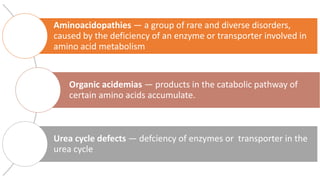
Aminoacidopathies — a group of rare and diverse disorders,
caused by the deficiency of an enzyme or transporter involved in
amino acid metabolism
Organic acidemias — products in the catabolic pathway of
certain amino acids accumulate.
Urea cycle defects — defciency of enzymes or transporter in the
urea cycle
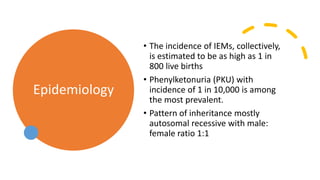
Epidemiology
• The incidence of IEMs, collectively,
is estimated to be as high as 1 in
800 live births
• Phenylketonuria (PKU) with
incidence of 1 in 10,000 is among
the most prevalent.
• Pattern of inheritance mostly
autosomal recessive with male:
female ratio 1:1
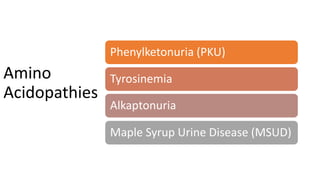
Amino
Acidopathies
Phenylketonuria (PKU)
Tyrosinemia
Alkaptonuria
Maple Syrup Urine Disease (MSUD)
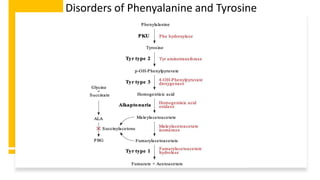
Disorders of Phenyalanine and Tyrosine
Phenylketonuria (PKU)
• Hyperphenylalaninaemia (HPA):
• Mutations within the gene for the hepatic enzyme
phenylalanine hydroxylase (PAH)
• Mutations within those genes involving production or
recycling of tetrahydrobiopterin metabolism
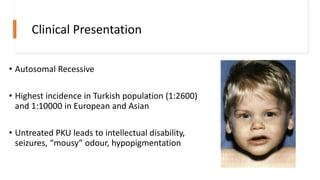
Clinical Presentation
• Autosomal Recessive
• Highest incidence in Turkish population (1:2600)
and 1:10000 in European and Asian
• Untreated PKU leads to intellectual disability,
seizures, “mousy” odour, hypopigmentation
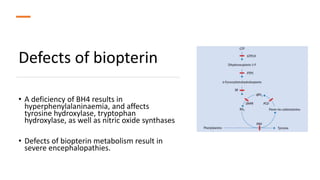
Defects of biopterin
• A deficiency of BH4 results in
hyperphenylalaninaemia, and affects
tyrosine hydroxylase, tryptophan
hydroxylase, as well as nitric oxide synthases
• Defects of biopterin metabolism result in
severe encephalopathies.
Diagnosis
• Phenylalanine level >20 mg/dl
• Tandem mass spectrometry
• Guthrie test
• Ferric chloride
• DNA analysis
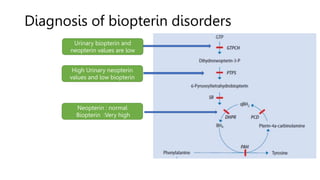
Diagnosis of biopterin disorders
Urinary biopterin and
neopterin values are low
High Urinary neopterin
values and low biopterin
Neopterin : normal
Biopterin :Very high
Maternal PKU
• Offspring of women with untreated classical PKU suffer developmental delay,
microcephaly, cardiac defects, low birth weight and dysmorphic features.
• The risk of CHD increases with increasing PHE exposure.
• Strict dietary control for pregnant women with PKU and, preferably before conception
and throughout pregnancy is associated with normal outcomes
Treatment
• Most important therapeutic intervention in PKU is phenylalanine-restricted dietary
treatment.
• Guanosine triphosphate cyclohydrolase deficiency and 6-pyruvoyltetrahydrobiopterin
deficiency: administration of BH4
• Dihydropteridine reductase deficiency: low-phenylalanine diet, neurotransmitter
precursors and folinic acid
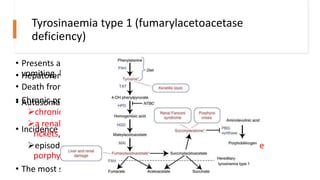
Tyrosinaemia type 1 (fumarylacetoacetase
deficiency)
• Presents acutely in the early weeks of life with failure to thrive,
vomiting, hepatomegaly, fever, oedema, and epistaxis;
• Death from hepatic failure often occurs in infancy.
• Chronic presentation:
chronic liver disease,
a renal tubular Fanconi syndrome with hypophosphataemic
rickets, and
episodic abdominal pain and neuropathy suggestive of acute
porphyria.
• The most serious complication is hepatocellular carcinoma
• Hepatorenal Tyrosinemia
• Autosomal Recessive
• Incidence 1.5:1000
Diagnosis
• Urine –
• Tyrosine
• Parahydroxy phenyl pyruvic acid
• Hydroxyphenyl lactic acid
• Serum –
• Tyrosine
• Succinylacetone
Treatment
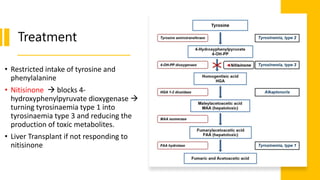
• Restricted intake of tyrosine and
phenylalanine
• Nitisinone  blocks 4-
hydroxyphenylpyruvate dioxygenase 
turning tyrosinaemia type 1 into
tyrosinaemia type 3 and reducing the
production of toxic metabolites.
• Liver Transplant if not responding to
nitisinone
Tyrosinaemia type 2
(tyrosine
aminotransferase
deficiency)
• Oculocutaneous/Richner-
Hanhart Syndrome
• Incidence - less than 1/250,000
• Diagnosis: There is increased
excretion of tyrosine, and
tyramine,; there is no Fanconi
syndrome and no increase in
succinylacetone.
• Treatment – Restricted Phe, Tyr
diet
Tyrosinaemia type 3 (4-Hydroxyphenylpyruvate
dioxygenase deficiency)
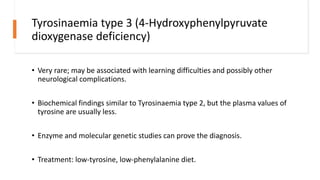
• Very rare; may be associated with learning difficulties and possibly other
neurological complications.
• Biochemical findings similar to Tyrosinaemia type 2, but the plasma values of
tyrosine are usually less.
• Enzyme and molecular genetic studies can prove the diagnosis.
• Treatment: low-tyrosine, low-phenylalanine diet.
Albinism (type 1)
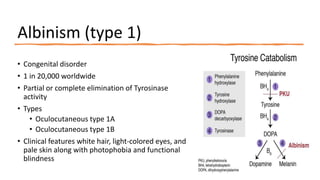
• Congenital disorder
• 1 in 20,000 worldwide
• Partial or complete elimination of Tyrosinase
activity
• Types
• Oculocutaneous type 1A
• Oculocutaneous type 1B
• Clinical features white hair, light-colored eyes, and
pale skin along with photophobia and functional
blindness
Alkaptonuria
• 1st IEM described by
Garrod.
• Caused by
deficiency of
homogentisate
dioxygenase
• 1 in 250,000
Diagnosis and Treatment
• Homogentisic acid : urinary organic acid analysis.
• Homogentisic acid can be decreased by a low-protein diet.
• Nitisinone reduces overproduction of homogentisic acid in
alkaptonuria.
Maple Syrup Urine Disease
• Prevalence of approximately 1 in 200 000 newborns
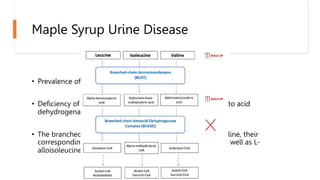
• Deficiency of the thiamine-dependent branched chain α-keto acid
dehydrogenase complex
• The branched chain amino acids leucine, isoleucine, and valine, their
corresponding α-keto acids and hydroxy acid derivatives as well as L-
alloisoleucine are increased in physiological fluids.
Clinical Presentation
• Classic MSUD -
• Presents in the first few days of life
• lethargy, irritability, poor feeding, and neurological deterioration.
• Intermediate MSUD -
• Late onset,
• failure to thrive,
• developmental delay, and seizures
• Intermittent MSUD -
• Normal growth and intellectual development
• Infections or physiological stress leads to clinical and biochemical features of classic MSUD
Diagnosis
• Odour of maple syrup
• Confirmation - increased plasma concentrations of leucine,
isoleucine, and valine and/or by increased urinary excretion of α-
keto and hydroxy acids.
• Rothera positive
Treatment
•Diet low in BCAA
•Thiamine
•Liver transplantation
Treatment
• Currently no highly effective treatment
• Low-protein diets have only a limited effect on decreasing plasma
glycine concentrations.
• Sodium benzoate to increase glycine excretion has lowered plasma
and cerebrospinal fluid levels of glycine and reduced seizures.
• Dextromethorphan is commonly used to reduce seizures and
improve alertness
Thank you
In born errors of metabolism

In born errors of metabolism

  • 1.
    Inborn errors of AminoAcid Metabolism
  • 2.
    •Garrod first proposed theconcept of “inborn errors of metabolism” in 1909 •More than 1000 IEM discovered thereafter
  • 3.
    Metabolic disorders whichimpair the synthesis and degradation of amino acids. Caused by inherited enzyme defects of catabolic pathways or intracellular transport of amino acids. accumulation of (1) the parent amino acid, (2) its by-products or (3) the catabolic products (organic acids), depending on the location of the enzyme block.
  • 4.
    Aminoacidopathies — agroup of rare and diverse disorders, caused by the deficiency of an enzyme or transporter involved in amino acid metabolism Organic acidemias — products in the catabolic pathway of certain amino acids accumulate. Urea cycle defects — defciency of enzymes or transporter in the urea cycle
  • 5.
    Epidemiology • The incidenceof IEMs, collectively, is estimated to be as high as 1 in 800 live births • Phenylketonuria (PKU) with incidence of 1 in 10,000 is among the most prevalent. • Pattern of inheritance mostly autosomal recessive with male: female ratio 1:1
  • 6.
  • 7.
  • 8.
    Phenylketonuria (PKU) • Hyperphenylalaninaemia(HPA): • Mutations within the gene for the hepatic enzyme phenylalanine hydroxylase (PAH) • Mutations within those genes involving production or recycling of tetrahydrobiopterin metabolism
  • 9.
    Clinical Presentation • AutosomalRecessive • Highest incidence in Turkish population (1:2600) and 1:10000 in European and Asian • Untreated PKU leads to intellectual disability, seizures, “mousy” odour, hypopigmentation
  • 11.
    Defects of biopterin •A deficiency of BH4 results in hyperphenylalaninaemia, and affects tyrosine hydroxylase, tryptophan hydroxylase, as well as nitric oxide synthases • Defects of biopterin metabolism result in severe encephalopathies.
  • 12.
    Diagnosis • Phenylalanine level>20 mg/dl • Tandem mass spectrometry • Guthrie test • Ferric chloride • DNA analysis
  • 14.
    Diagnosis of biopterindisorders Urinary biopterin and neopterin values are low High Urinary neopterin values and low biopterin Neopterin : normal Biopterin :Very high
  • 15.
    Maternal PKU • Offspringof women with untreated classical PKU suffer developmental delay, microcephaly, cardiac defects, low birth weight and dysmorphic features. • The risk of CHD increases with increasing PHE exposure. • Strict dietary control for pregnant women with PKU and, preferably before conception and throughout pregnancy is associated with normal outcomes
  • 16.
    Treatment • Most importanttherapeutic intervention in PKU is phenylalanine-restricted dietary treatment. • Guanosine triphosphate cyclohydrolase deficiency and 6-pyruvoyltetrahydrobiopterin deficiency: administration of BH4 • Dihydropteridine reductase deficiency: low-phenylalanine diet, neurotransmitter precursors and folinic acid
  • 17.
    Tyrosinaemia type 1(fumarylacetoacetase deficiency) • Presents acutely in the early weeks of life with failure to thrive, vomiting, hepatomegaly, fever, oedema, and epistaxis; • Death from hepatic failure often occurs in infancy. • Chronic presentation: chronic liver disease, a renal tubular Fanconi syndrome with hypophosphataemic rickets, and episodic abdominal pain and neuropathy suggestive of acute porphyria. • The most serious complication is hepatocellular carcinoma • Hepatorenal Tyrosinemia • Autosomal Recessive • Incidence 1.5:1000
  • 18.
    Diagnosis • Urine – •Tyrosine • Parahydroxy phenyl pyruvic acid • Hydroxyphenyl lactic acid • Serum – • Tyrosine • Succinylacetone
  • 19.
    Treatment • Restricted intakeof tyrosine and phenylalanine • Nitisinone  blocks 4- hydroxyphenylpyruvate dioxygenase  turning tyrosinaemia type 1 into tyrosinaemia type 3 and reducing the production of toxic metabolites. • Liver Transplant if not responding to nitisinone
  • 20.
    Tyrosinaemia type 2 (tyrosine aminotransferase deficiency) •Oculocutaneous/Richner- Hanhart Syndrome • Incidence - less than 1/250,000 • Diagnosis: There is increased excretion of tyrosine, and tyramine,; there is no Fanconi syndrome and no increase in succinylacetone. • Treatment – Restricted Phe, Tyr diet
  • 21.
    Tyrosinaemia type 3(4-Hydroxyphenylpyruvate dioxygenase deficiency) • Very rare; may be associated with learning difficulties and possibly other neurological complications. • Biochemical findings similar to Tyrosinaemia type 2, but the plasma values of tyrosine are usually less. • Enzyme and molecular genetic studies can prove the diagnosis. • Treatment: low-tyrosine, low-phenylalanine diet.
  • 22.
    Albinism (type 1) •Congenital disorder • 1 in 20,000 worldwide • Partial or complete elimination of Tyrosinase activity • Types • Oculocutaneous type 1A • Oculocutaneous type 1B • Clinical features white hair, light-colored eyes, and pale skin along with photophobia and functional blindness
  • 23.
    Alkaptonuria • 1st IEMdescribed by Garrod. • Caused by deficiency of homogentisate dioxygenase • 1 in 250,000
  • 24.
    Diagnosis and Treatment •Homogentisic acid : urinary organic acid analysis. • Homogentisic acid can be decreased by a low-protein diet. • Nitisinone reduces overproduction of homogentisic acid in alkaptonuria.
  • 25.
    Maple Syrup UrineDisease • Prevalence of approximately 1 in 200 000 newborns • Deficiency of the thiamine-dependent branched chain α-keto acid dehydrogenase complex • The branched chain amino acids leucine, isoleucine, and valine, their corresponding α-keto acids and hydroxy acid derivatives as well as L- alloisoleucine are increased in physiological fluids.

  • 26.
    Clinical Presentation • ClassicMSUD - • Presents in the first few days of life • lethargy, irritability, poor feeding, and neurological deterioration. • Intermediate MSUD - • Late onset, • failure to thrive, • developmental delay, and seizures • Intermittent MSUD - • Normal growth and intellectual development • Infections or physiological stress leads to clinical and biochemical features of classic MSUD
  • 27.
    Diagnosis • Odour ofmaple syrup • Confirmation - increased plasma concentrations of leucine, isoleucine, and valine and/or by increased urinary excretion of α- keto and hydroxy acids. • Rothera positive
  • 28.
    Treatment •Diet low inBCAA •Thiamine •Liver transplantation
  • 29.
    Treatment • Currently nohighly effective treatment • Low-protein diets have only a limited effect on decreasing plasma glycine concentrations. • Sodium benzoate to increase glycine excretion has lowered plasma and cerebrospinal fluid levels of glycine and reduced seizures. • Dextromethorphan is commonly used to reduce seizures and improve alertness
  • 30.

Editor's Notes

  • #6 The incidence of IEMs, collectively, is estimated to be as high as 1 in 800 live births, [1] but it varies greatly and depends on the population.
  • #9 The incidence varies depending on the population, with the highest incidence in the Turkish population (approximately 1:2,600), and as high as 1:10,000 in Northern European and East Asian populations)
  • #10 Intellectual disability iq 50. Seizures, tremors, agitation, hyperactivity – phe interfere with neurotransmitter synthesis plus phenyl alanine and toxic metabolites act as neurotoxins hypopigmentation – decreased melanin Mousy odor – phenyl acetic acid
  • #12 Neurological symptoms even with phe restriction Five separate genetic conditions affect BH4 synthesis or regeneration: deficiency of GTP cyclohydrolase I, 6-pyruvoyl tetrahydropterin synthase, sepiapterin reductase, dihydropteridine reductase (DHPR) and pterin-4alpha-carbinolamine dehydratase.
  • #13 Ferric chloride – phenyl ketones in urine will give transient blue green colour
  • #14 The Guthrie test is a semiquantitative assay designed to detect elevated blood levels of the amino acid phenylalanine, using the ability of phenylalanine to facilitate bacterial growth in a culture medium with an inhibitor. A drop of blood is usually obtained by pricking the heel of a newborn infant in a hospital nursery on the second or third day of life. The blood is collected on a piece of filter paper and mailed to a central laboratory. A small disk of the filter paper is punched out and placed on an agar gel plate containing Bacillus subtilis and B-2-thienylalanine. Each gel holds 60-80 disks. The agar gel is able to support bacterial growth but the B-2-thienylalanine inhibits bacterial growth. However, in the presence of extra phenylalanine leached from the impregnated filter paper disk, the inhibition is overcome and the bacteria grow. Within a day the bacterial growth surrounding the paper disk is visible to the eye. The amount of growth, measured as the diameter of the colony, is roughly proportional to the amount of phenylalanine in the serum. The result is read by comparing the diameter of each sample disk's colony to the colonies of a series of reference disks with standard phenylalanine content included on each large plate. It should be remembered that phenylalanine levels are lower in the first days of life as the infant has not yet been introduced to protein feeds, thus mild elevations of phenylalanine on the newborn screen are frequently higher on follow-up testing. Newborn screening programs typically use the ratio of phenylalanine to specific amino acids to identify hyperphenylalaninemia as early as 24 hours of life, for example a phenylalanine to tyrosine ratio >3 is helpful diagnostically. Newborn screening positive infants should also undergo screening for defects in biopterin synthesis or recycling as these can also lead to elevated phenylalanine levels.
  • #15 : deficiency of GTP cyclohydrolase I, 6-pyruvoyl tetrahydropterin synthase, sepiapterin reductase, dihydropteridine reductase (DHPR) and pterin-4alpha-carbinolamine dehydratase.
  • #17 phenylalanine levels between 120–360 µmol/L . Patients with residual enzyme activity may benefit from supplementation with the biopterin cofactor sapropterin (currently approved for ages four and older), which can reduce phenylalanine levels in some. Pegvalaise is an injected form of phenylalanine ammonium lyase recently approved for adults with PKU that can, in many cases, normalize blood phenylalanine levels. Experimental treatments include gene therapy or hepatocyte transplantation.
  • #18 Known as hepatorenal tyrosinosis
  • #19 Fumarylacetoacetate hydrolyase can be assayed in lymphocytes or fibroblasts. It is nonspecifically depressed in the liver in a variety of liver diseases. The measurement of succinylacetone in amniotic fluid and activity of fumarylacetoacetate hydrolyase in cultured amniocytes or chorionic villus samples forms the basis of prenatal diagnosis.
  • #20 Restricted intake of tyrosine and phenylalanine Reduce the excretion of succinylacetone and produce regression of the Fanconi tubular defects, (2-(2-nitro-4-trifluoromethylbenzoyl)1-3-cyclohexanedione) Nitisinone  blocks 4-hydroxyphenylpyruvate dioxygenase  turning tyrosinaemia type 1 into tyrosinaemia type 3 and reducing the production of toxic metabolites. Treatment with nitisinone should start as soon as the diagnosis is made. In most patients there is a rapid improvement in liver and renal function; succinylacetone disappear from the urine within 1 week of treatment. Liver transplantation remains the treatment of choice for a few patients who do not respond to nitisinone and if there is any suggestion of malignant change.
  • #21 Corneal ulcerations, corneal opacity Skin leasions – palmar plantar hyper keratosis , hyper hidrosis
  • #24 Caused by deficiency of homogentisate dioxygenase resulting in the accumulation of homogentisic acid and its oxidized derivative benzoquinone acetic acid. alkaptone bodies Patients accumulate homogentisic acid, and by the third decade of life experience pigmentation of connective tissue (particularly visible in the sclerae or ear cartilage), arthritis of joints and spine, cardiac valve involvement, kidney and prostate stones. In children it can be diagnosed due to darkened urine when exposed to air. 
  • #25 Enzymatic as well as molecular confirmation is possible. Plasma tyrosine concentrations are normal.
  • #27 Mental retardation Vomitting acidosios Coma death
  • #28 ↑ BCAAs in plasma ↑ plasma alloisoleucine ↑ BCKAs in urine Ketonuria

  • #29 Intermittent thiamine
  • #30 Sodium benzoate is used to reduce serum glycine levels. Benzoate binds to glycine in the body to form hippurate, which is excreted in the urine.  Dextromethorphan binds to NMDA receptors in the brain. These receptors are over-stimulated in individuals with NKH due to increased glycine levels in the brain. Glutamate is the neurotransmitter that predominately binds to these receptors. Dextromethorphan binds to the NMDA receptors, blocking glutamate from binding to the receptor.