Urea cycle disorders
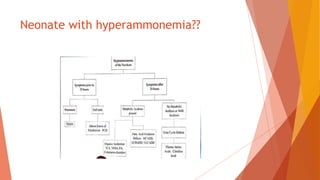
Neonate with hyperammonemia??
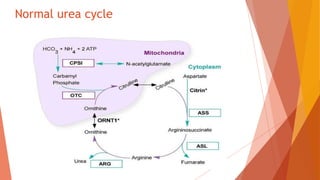
What is urea cycle??
 The urea cycle is the metabolic pathway that transforms
nitrogen to urea for excretion from the body
Normal urea cycle
Urea cycle disorders:
 The urea cycle disorders (UCD) result from genetic mutations
causing defects in the metabolism of the extra nitrogen produced
by the breakdown of protein and other nitrogen-containing
molecules.
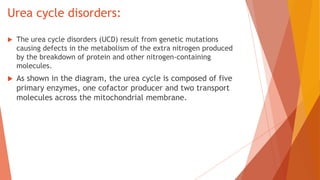
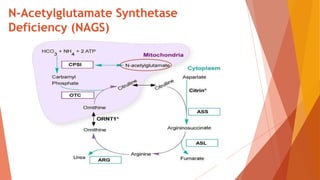
 As shown in the diagram, the urea cycle is composed of five
primary enzymes, one cofactor producer and two transport
molecules across the mitochondrial membrane.
Symptoms of Newborns with Urea Cycle
Defects
• Normal appearance at birth
• Irritability progressing to somnolence, lethargy, then coma
• Loss of thermoregulation (hypothermia)
• Feeding disruption (increases catabolism)
• Neurologic posturing (from cerebral edema)
• Seizures
• Hyperventilation and then hypoventilation
Common Clinical Features for Late
Onset Urea Cycle Disorders
 Dramatic and rapid Increase in Nitrogen Load from
-Trauma
-Rapid weight loss and auto-catabolism
-Increase in protein turnover from steroids
 Tend to avoid protein in their diet
 Often have history of behavioral or psychiatric illnesses
 Rapid deterioration of neurologic status.
 Severe encephalopathy inconsistent with medical condition.
Common Clinical Features for Late
Onset Urea Cycle Disorders
 Evidence for cerebral edema by clinical exam or radiograph
 Seizures in some cases.
 Decrease in oral intake leading up to decompensation
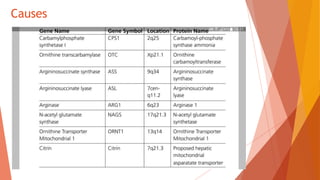
Causes
Causes
 Deficiencies of CPS1, ASS, ASL, ARG, NAGS, ORNT1 and Citrin
are inherited in an autosomal recessive manner. OTC deficiency
is inherited in an X-linked manner.
N-Acetylglutamate Synthetase
Deficiency (NAGS)
N-Acetylglutamate Synthetase
Deficiency (NAGS)
 Affects the body’s ability to make n-acetylglutamate (NAG)
which is a required cofactor for the function of carbamyl
phosphate synthetase I. Without NAG, CPSI cannot convert
ammonia into carbamyl phosphate.
 Along with OTC deficiency and CPSI, deficiency of N
acetylglutamate is the most severe of the urea cycle
disorders. Patients with complete NAGS deficiency rapidly
develop hyperammonemia in the newborn period.
Carbamoylphosphate Synthetase I
Deficiency (CPSI Deficiency)
Carbamoylphosphate Synthetase I
Deficiency (CPSI Deficiency)
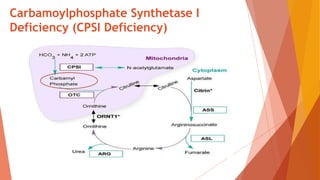
 This enzyme takes ammonia and through the use of
bicarbonate and ATP produces carbamyl phosphate. This
enzyme requires the presence of its cofactor n-
acetylglutamate. Along with OTC deficiency and NAGS,
deficiency of CPSI is the most severe of the urea cycle
disorders.
 Patients with complete CPSI deficiency rapidly develop
hyperammonemia in the newborn period.
 Patients who are successfully rescued from crisis are
chronically at risk for repeated bouts of hyperammonemia
Patients with partial CPSI deficiency can present at almost
any time of life with a stressful triggering event.
Ornithine Transcarbamylase (OTC)
Deficiency
Ornithine Transcarbamylase (OTC)
Deficiency
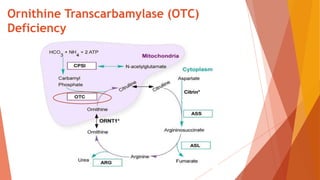
 OTC combines carbamyl phosphate with ornithine to make
citrulline which is subsequently processed into urea
 Along with CPSI and NAGS deficiency, OTC deficiency is the
most severe of the urea cycle disorders.
 Patients with complete OTC deficiency rapidly develop
hyperammonemia in the newborn period. Patients who are
successfully rescued from crisis are chronically at risk for
repeated bouts of hyperammonemia.
 OTC is located on the X-chromosome which results in the
majority of severe patients being male.
Ornithine Transcarbamylase (OTC)
Deficiency
 Females can also be affected but tend to present outside
the neonatal period.
Argininosuccinate Synthetase
Deficiency (ASSD) (Citrullinemia I)
Argininosuccinate Synthetase
Deficiency (ASSD) (Citrullinemia I)
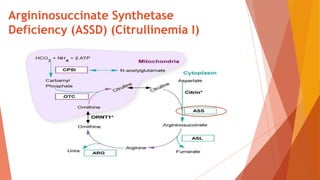
 This enzyme combines citrulline with aspartate to form
argininosuccinate. Patients with complete ASSD present with
severe hyperammonemia in the newborn period.
 The use of arginine in these patients allows some ammonia to
be incorporated into the urea cycle which makes treatment
somewhat easier than other defects in the cycle.
 Citrulline levels in these patients can be 100s of times the
normal values
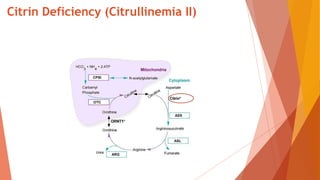
Citrin Deficiency (Citrullinemia II)
 autosomal disorder that results in defective transport of
Aspartate in the liver, resulting in limitation of activity for
the enzyme argininosuccinic acid synthase which combines
aspartate and citrulline to make argininosuccinic acid.
 This defect can present with classic newborn
hyperammonemia, intrahepatic cholestatis, jaundice an fatty
liver, but is more likely to present with insidious neurologic
findings, hyperammonia, hypercitrullinemia and
hyperlipidemia in adulthood
 majority of patients reported are Japanese or Asian sharing a
common mutation.
 Patients tend to avoid carbohydrates rather than protiens
Argininosuccinate Lyase Deficiency
(Argininosuccinic Aciduria)
Argininosuccinate Lyase Deficiency
(Argininosuccinic Aciduria)
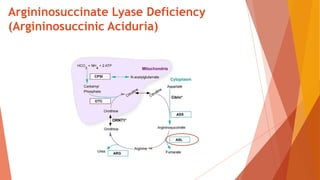
 Deficiency of this enzyme prevents the conversion of
argininosuccinate to the amino acid arginine which affects
the urea cycle and other biochemical pathways.
 This enzyme defect is past the point in the metabolic
pathway at which all the waste nitrogen has been
incorporated into the cycle as argininosuccinate
 Severe defects often present with rapid onset
hyperammonemia in the newborn period
Argininosuccinate Lyase Deficiency
(Argininosuccinic Aciduria)
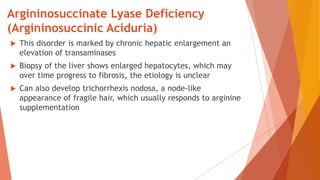
 This disorder is marked by chronic hepatic enlargement an
elevation of transaminases
 Biopsy of the liver shows enlarged hepatocytes, which may
over time progress to fibrosis, the etiology is unclear
 Can also develop trichorrhexis nodosa, a node-like
appearance of fragile hair, which usually responds to arginine
supplementation
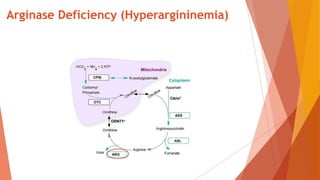
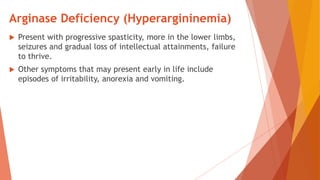
Arginase Deficiency (Hyperargininemia)
 Present with progressive spasticity, more in the lower limbs,
seizures and gradual loss of intellectual attainments, failure
to thrive.
 Other symptoms that may present early in life include
episodes of irritability, anorexia and vomiting.
Ornithine Translocase Deficiency (HHH
Syndrome)
Ornithine Translocase Deficiency (HHH
Syndrome)
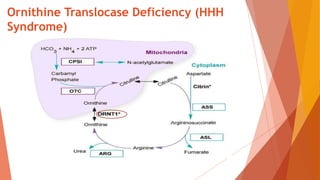
 The HHH (hyperornithinemia, hyperammonemia,
homocitrullinuria)
 Defect in ornithine translocase results in diminished ornithine
transport into the mitochondria with ornithine accumulation
in the cytoplasm and reduced intramitochondrial ornithine
causing impaired ureagenesis and orotic aciduria
 Homocitrulline is thought to originate from
transcarbamylation of lysine.
Ornithine Translocase Deficiency (HHH
Syndrome)
 Most patients have intermittent hyperammonemia
accompanied by vomiting, lethargy and coma (in extreme
cases), growth failure and intellectual disabilities.
 Seizures and spasticity are common
Common Stressors affecting urea cycle
function
• Genetic defect in an enzyme
• Damage to the liver (both chronic and acutely)
• Chemical toxins (ETOH, industrial etc.)
• Other Metabolic Diseases
- Organic acidemias (such as methylmalonic, propionic, etc.)
- Pyruvate carboxylase deficiency
- Fatty acid oxidation defects
- Galactosemia
- Tyrosinemia
- Glycogen storage disease Infectious or viral processes
Common Stressors affecting urea cycle
function
Drug effects on the cycle
- Direct Interference with Enzymes
- Valproic acid (Depakote)
- Chemotherapy (particularly cyclophosphamide)
- Damage or general disruption of hepatic function
- Systemic antifungals
- Chemotherapy from hepatotoxic effects
- Acetaminophen
- Corticosteroids (catabolic effects)
Common Stressors affecting urea cycle
function
• Vascular bypass of the liver by scarring or vascular bypass
• Nitrogen overload of the System
- Massive hemolysis (such as large bone fracture or trauma)
- Total parenteral nutrition
- Protein catabolism from starvation or bariatric surgery
- Post partum stress
- Heart Lung Transplant
- Renal Disease
- GI bleeding
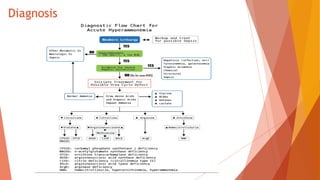
Diagnosis
The most important step in
diagnosing urea cycle disorders
is clinical suspicion of
hyperammonemia.
Diagnosis
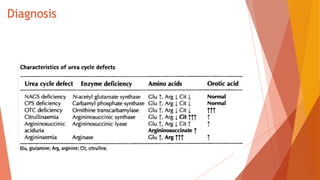
 plasma ammonia: 150μmol/L (>260 μg/dl) or higher in
neonates, 100μmol/l (175 μg/dl) or higher in older children
and adults (proper technique and handling required)
 Normal anion gap
 Normal blood glucose
 pH and CO2 can vary with the degree of cerebral edema and
hyper- or hypo-ventilation.
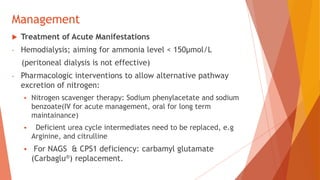
 Quantitative plasma amino acid analysis
 Specific enzyme activity
 Genetic testing
Diagnosis
Diagnosis
 For CPSI, OTC, and NAGS, enzymatic diagnosis is made on a
liver biopsy
 Enzymatic testing for ASS, ASL can be done on fibroblast
samples
 Arginase can be tested on red blood cells
Diagnosis
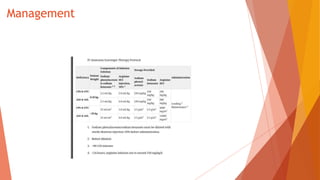
Management
 Treatment of Acute Manifestations
- Hemodialysis; aiming for ammonia level < 150µmol/L
(peritoneal dialysis is not effective)
- Pharmacologic interventions to allow alternative pathway
excretion of nitrogen:
 Nitrogen scavenger therapy: Sodium phenylacetate and sodium
benzoate(IV for acute management, oral for long term
maintainance)
 Deficient urea cycle intermediates need to be replaced, e.g
Arginine, and citrulline
 For NAGS & CPS1 deficiency: carbamyl glutamate
(Carbaglu®) replacement.
Management
Management
- Treat catabolic state with calories from glucose, fats, and
essential amino acids
 Complete restriction of protein should not exceed 12-24
hours
 Enteral nutrition is preferred
 The placement of a NGT/NJT at admission may be required
 Other strategies: e.g low-dose continuous infusion of
insulin with maintenance of adequate glucose delivery
Management
 Long-Term Treatment of Manifestations:
- Decrease nitrogen load: Infants require 1.2 to 2 g of
protein/kg body weight. Typically half of the required protein
is provided as essential amino acids and half as natural
protein.
- Use nitrogen scavengers to provide alternative routes for
nitrogen disposal.
- Prompt replacement of citrulline or arginine
- Carbamyl glutamate (Carbaglu®)
- Liver transplantation
Management
 Other factors:
-Minimize risk of respiratory and gastrointestinal illnesse
through home care.
-Immunize on the usual schedule.
-Provide multivitamin and fluoride supplementation.
-Use antipyretics appropriately. Note: Ibuprofen is preferred
over acetaminophen.
QUESTIONS??
references
 GeneReviews®
 NORD Guides for Physicians

Urea cycle defects

  • 1.
  • 2.
  • 3.
    What is ureacycle??  The urea cycle is the metabolic pathway that transforms nitrogen to urea for excretion from the body
  • 4.
  • 5.
    Urea cycle disorders: The urea cycle disorders (UCD) result from genetic mutations causing defects in the metabolism of the extra nitrogen produced by the breakdown of protein and other nitrogen-containing molecules.  As shown in the diagram, the urea cycle is composed of five primary enzymes, one cofactor producer and two transport molecules across the mitochondrial membrane.
  • 6.
    Symptoms of Newbornswith Urea Cycle Defects • Normal appearance at birth • Irritability progressing to somnolence, lethargy, then coma • Loss of thermoregulation (hypothermia) • Feeding disruption (increases catabolism) • Neurologic posturing (from cerebral edema) • Seizures • Hyperventilation and then hypoventilation
  • 7.
    Common Clinical Featuresfor Late Onset Urea Cycle Disorders  Dramatic and rapid Increase in Nitrogen Load from -Trauma -Rapid weight loss and auto-catabolism -Increase in protein turnover from steroids  Tend to avoid protein in their diet  Often have history of behavioral or psychiatric illnesses  Rapid deterioration of neurologic status.  Severe encephalopathy inconsistent with medical condition.
  • 8.
    Common Clinical Featuresfor Late Onset Urea Cycle Disorders  Evidence for cerebral edema by clinical exam or radiograph  Seizures in some cases.  Decrease in oral intake leading up to decompensation
  • 9.
  • 10.
    Causes  Deficiencies ofCPS1, ASS, ASL, ARG, NAGS, ORNT1 and Citrin are inherited in an autosomal recessive manner. OTC deficiency is inherited in an X-linked manner.
  • 11.
  • 12.
    N-Acetylglutamate Synthetase Deficiency (NAGS) Affects the body’s ability to make n-acetylglutamate (NAG) which is a required cofactor for the function of carbamyl phosphate synthetase I. Without NAG, CPSI cannot convert ammonia into carbamyl phosphate.  Along with OTC deficiency and CPSI, deficiency of N acetylglutamate is the most severe of the urea cycle disorders. Patients with complete NAGS deficiency rapidly develop hyperammonemia in the newborn period.
  • 13.
  • 14.
    Carbamoylphosphate Synthetase I Deficiency(CPSI Deficiency)  This enzyme takes ammonia and through the use of bicarbonate and ATP produces carbamyl phosphate. This enzyme requires the presence of its cofactor n- acetylglutamate. Along with OTC deficiency and NAGS, deficiency of CPSI is the most severe of the urea cycle disorders.  Patients with complete CPSI deficiency rapidly develop hyperammonemia in the newborn period.  Patients who are successfully rescued from crisis are chronically at risk for repeated bouts of hyperammonemia Patients with partial CPSI deficiency can present at almost any time of life with a stressful triggering event.
  • 15.
  • 16.
    Ornithine Transcarbamylase (OTC) Deficiency OTC combines carbamyl phosphate with ornithine to make citrulline which is subsequently processed into urea  Along with CPSI and NAGS deficiency, OTC deficiency is the most severe of the urea cycle disorders.  Patients with complete OTC deficiency rapidly develop hyperammonemia in the newborn period. Patients who are successfully rescued from crisis are chronically at risk for repeated bouts of hyperammonemia.  OTC is located on the X-chromosome which results in the majority of severe patients being male.
  • 17.
    Ornithine Transcarbamylase (OTC) Deficiency Females can also be affected but tend to present outside the neonatal period.
  • 18.
  • 19.
    Argininosuccinate Synthetase Deficiency (ASSD)(Citrullinemia I)  This enzyme combines citrulline with aspartate to form argininosuccinate. Patients with complete ASSD present with severe hyperammonemia in the newborn period.  The use of arginine in these patients allows some ammonia to be incorporated into the urea cycle which makes treatment somewhat easier than other defects in the cycle.  Citrulline levels in these patients can be 100s of times the normal values
  • 20.
  • 21.
    Citrin Deficiency (CitrullinemiaII)  autosomal disorder that results in defective transport of Aspartate in the liver, resulting in limitation of activity for the enzyme argininosuccinic acid synthase which combines aspartate and citrulline to make argininosuccinic acid.  This defect can present with classic newborn hyperammonemia, intrahepatic cholestatis, jaundice an fatty liver, but is more likely to present with insidious neurologic findings, hyperammonia, hypercitrullinemia and hyperlipidemia in adulthood  majority of patients reported are Japanese or Asian sharing a common mutation.  Patients tend to avoid carbohydrates rather than protiens
  • 22.
  • 23.
    Argininosuccinate Lyase Deficiency (ArgininosuccinicAciduria)  Deficiency of this enzyme prevents the conversion of argininosuccinate to the amino acid arginine which affects the urea cycle and other biochemical pathways.  This enzyme defect is past the point in the metabolic pathway at which all the waste nitrogen has been incorporated into the cycle as argininosuccinate  Severe defects often present with rapid onset hyperammonemia in the newborn period
  • 24.
    Argininosuccinate Lyase Deficiency (ArgininosuccinicAciduria)  This disorder is marked by chronic hepatic enlargement an elevation of transaminases  Biopsy of the liver shows enlarged hepatocytes, which may over time progress to fibrosis, the etiology is unclear  Can also develop trichorrhexis nodosa, a node-like appearance of fragile hair, which usually responds to arginine supplementation
  • 25.
  • 26.
    Arginase Deficiency (Hyperargininemia) Present with progressive spasticity, more in the lower limbs, seizures and gradual loss of intellectual attainments, failure to thrive.  Other symptoms that may present early in life include episodes of irritability, anorexia and vomiting.
  • 27.
  • 28.
    Ornithine Translocase Deficiency(HHH Syndrome)  The HHH (hyperornithinemia, hyperammonemia, homocitrullinuria)  Defect in ornithine translocase results in diminished ornithine transport into the mitochondria with ornithine accumulation in the cytoplasm and reduced intramitochondrial ornithine causing impaired ureagenesis and orotic aciduria  Homocitrulline is thought to originate from transcarbamylation of lysine.
  • 29.
    Ornithine Translocase Deficiency(HHH Syndrome)  Most patients have intermittent hyperammonemia accompanied by vomiting, lethargy and coma (in extreme cases), growth failure and intellectual disabilities.  Seizures and spasticity are common
  • 30.
    Common Stressors affectingurea cycle function • Genetic defect in an enzyme • Damage to the liver (both chronic and acutely) • Chemical toxins (ETOH, industrial etc.) • Other Metabolic Diseases - Organic acidemias (such as methylmalonic, propionic, etc.) - Pyruvate carboxylase deficiency - Fatty acid oxidation defects - Galactosemia - Tyrosinemia - Glycogen storage disease Infectious or viral processes
  • 31.
    Common Stressors affectingurea cycle function Drug effects on the cycle - Direct Interference with Enzymes - Valproic acid (Depakote) - Chemotherapy (particularly cyclophosphamide) - Damage or general disruption of hepatic function - Systemic antifungals - Chemotherapy from hepatotoxic effects - Acetaminophen - Corticosteroids (catabolic effects)
  • 32.
    Common Stressors affectingurea cycle function • Vascular bypass of the liver by scarring or vascular bypass • Nitrogen overload of the System - Massive hemolysis (such as large bone fracture or trauma) - Total parenteral nutrition - Protein catabolism from starvation or bariatric surgery - Post partum stress - Heart Lung Transplant - Renal Disease - GI bleeding
  • 33.
    Diagnosis The most importantstep in diagnosing urea cycle disorders is clinical suspicion of hyperammonemia.
  • 34.
    Diagnosis  plasma ammonia:150μmol/L (>260 μg/dl) or higher in neonates, 100μmol/l (175 μg/dl) or higher in older children and adults (proper technique and handling required)  Normal anion gap  Normal blood glucose  pH and CO2 can vary with the degree of cerebral edema and hyper- or hypo-ventilation.  Quantitative plasma amino acid analysis  Specific enzyme activity  Genetic testing
  • 35.
  • 36.
    Diagnosis  For CPSI,OTC, and NAGS, enzymatic diagnosis is made on a liver biopsy  Enzymatic testing for ASS, ASL can be done on fibroblast samples  Arginase can be tested on red blood cells
  • 37.
  • 38.
    Management  Treatment ofAcute Manifestations - Hemodialysis; aiming for ammonia level < 150µmol/L (peritoneal dialysis is not effective) - Pharmacologic interventions to allow alternative pathway excretion of nitrogen:  Nitrogen scavenger therapy: Sodium phenylacetate and sodium benzoate(IV for acute management, oral for long term maintainance)  Deficient urea cycle intermediates need to be replaced, e.g Arginine, and citrulline  For NAGS & CPS1 deficiency: carbamyl glutamate (Carbaglu®) replacement.
  • 39.
  • 40.
    Management - Treat catabolicstate with calories from glucose, fats, and essential amino acids  Complete restriction of protein should not exceed 12-24 hours  Enteral nutrition is preferred  The placement of a NGT/NJT at admission may be required  Other strategies: e.g low-dose continuous infusion of insulin with maintenance of adequate glucose delivery
  • 41.
    Management  Long-Term Treatmentof Manifestations: - Decrease nitrogen load: Infants require 1.2 to 2 g of protein/kg body weight. Typically half of the required protein is provided as essential amino acids and half as natural protein. - Use nitrogen scavengers to provide alternative routes for nitrogen disposal. - Prompt replacement of citrulline or arginine - Carbamyl glutamate (Carbaglu®) - Liver transplantation
  • 42.
    Management  Other factors: -Minimizerisk of respiratory and gastrointestinal illnesse through home care. -Immunize on the usual schedule. -Provide multivitamin and fluoride supplementation. -Use antipyretics appropriately. Note: Ibuprofen is preferred over acetaminophen.
  • 43.
  • 44.