

LET’S SEE WHARE WE ARE AT…..


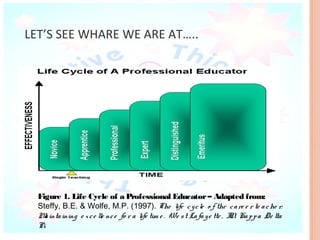
  Figure 1. Life Cycle of a Professional Educator – Adapted from:
  Steffy, B.E. & Wolfe, M.P. (1997). The life c y c le o f the c a re e r te a c he r:
  M inta ining e x c e lle nc e fo r a life tim e . We s t La fa y e tte , I : Ka p p a De lta
    a                                                                      N
  Pi.
A course in
               ‘PDAI’
(Professional Development through
        Appreciative Inquiry)
ACTIVITY 1
 Writedown any three good points about
 your colleague…………..

 1…………………………………………..


 2…………………………………………..


 3…………………………………………..
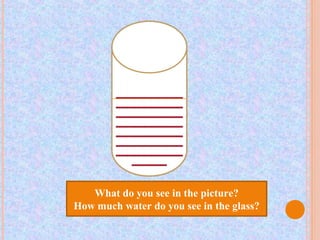
What do you see in the picture?
How much water do you see in the glass?
READ AND HAVE A FUN


A man was washing his new car when his neighbor asked
Him, “When did you get the car?” He replied, “My brother
gave it to me.” The neighbor said, “I wish I had a car like
that.” The man replied, “You should wish to have a
   brother
like that.” The neighbor’s wife was listening to the
conversation and she interrupted, “I wish I was a brother
like that.”
                What a positive way to think!
“WE SEE THE THING NOT THE WAY THEY
     ARE, BUT THE WAY WE ARE…”
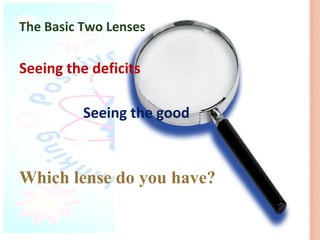
The Basic Two Lenses

Seeing the deficits

          Seeing the good


Which lense do you have?
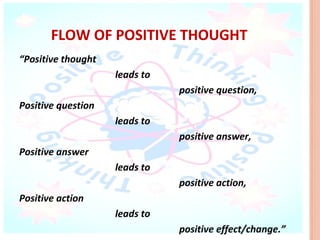
FLOW OF POSITIVE THOUGHT
“Positive thought
                    leads to
                               positive question,
Positive question
                    leads to
                               positive answer,
Positive answer
                    leads to
                               positive action,
Positive action
                    leads to
                               positive effect/change.”
A healthy body, a healthy mind, positive
personal      behaviors        and     good
relationships with other people are
important life skills that will help you get
the best out of your self, your life, and
others
Negative thinking
Negative thinking causes stress because
it damages your confidence that you are
       equal to the task you face.
Negative thinking
  You are thinking negatively when:

  you put yourself down,
  criticize yourself for errors,
  doubt your abilities,
  expect failure, etc.

     It is the negative side of suggestion –
it damages confidence, harms performance and
              paralyses mental skills.
“Winners recognize their limitations but focus on their
                      strength”


 “Losers recognize their strengths but focus on their
                      weakness”
FEELING                              BEHAVIOR

           What’s the relationship?


If you feel good, you do good,
If you do good, you feel good.
VALUE YOURSELF
A well known speaker started off his seminar by
 holding up a $100 note. In the room of 200, he
 asked, “Who would like this note?” hands started
 going up. He said, “I’m going to give this note to
 one of you, but first let me do this.” He proceed to
 crumple the note up. He then asked, “Who still
 wants it?” Still the hands were up in the air.
 “Well!” he replied, “What if I do this?” and he
 dropped it on the ground and started to grind it into
 the floor with the shoe. He picked it up, now all
 crumpled and dirty. “Now who still wants it?” Still
 the hands went into the air.
            What’s the moral of the story?
  WE ALL ARE VERY SPECIAL AND VALUABLE
Examples of positive self-esteem are:
1. I can do this.
2. I can achieve my goals.
3. I am completely myself and people will like me for
   myself.
4. I am completely in control of my life.
5. I learn from my mistakes. They increase the basis of
   experience on which I can draw.
6. I am a good valued person in my own right.
Let’s Define What a Life is.
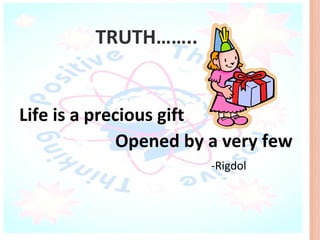
TRUTH……..


Life is a precious gift
              Opened by a very few
                       -Rigdol
AN ACTIVITY…….
 Write down any 5 strengths/ good points that you
  possess.
 1…………………………………………..


   2…………………………………………..

   3…………………………………………..

   4……………………………………………….

   5…………………………………………………..
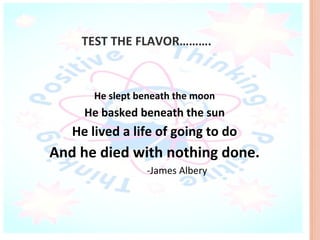
TEST THE FLAVOR……….


       He slept beneath the moon
     He basked beneath the sun
   He lived a life of going to do
And he died with nothing done.
                 -James Albery
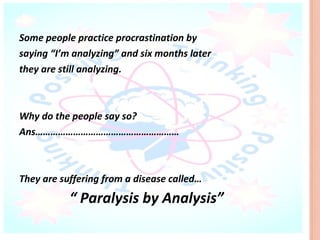
Some people practice procrastination by
saying “I’m analyzing” and six months later
they are still analyzing.


Why do the people say so?
Ans…………………………………………………


They are suffering from a disease called…
           “ Paralysis by Analysis”
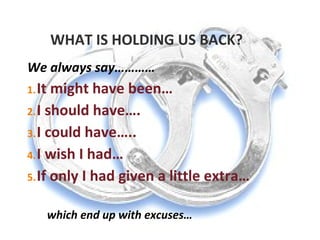
WHAT IS HOLDING US BACK?
We always say…………
1. It might have been…
2. I should have….
3. I could have…..
4. I wish I had…
5. If only I had given a little extra…


        which end up with excuses…
WHY DO PEOPLE GIVE UP…?

 ……………because  people either work for
 others or want other people appreciate
 them.

 But the truth is Human beings never
 appreciate others so easily.
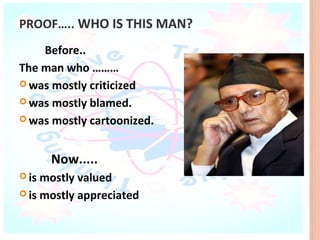
PROOF….. WHO IS THIS MAN?
    Before..
The man who ………
 was mostly criticized

 was mostly blamed.

 was mostly cartoonized.


       Now.....
 is mostly valued
 is mostly appreciated
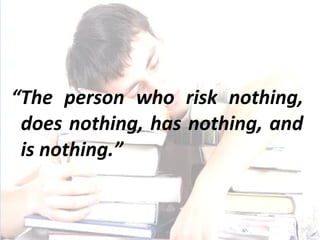
“The person who risk nothing,
 does nothing, has nothing, and
 is nothing.”
“Life is like a ten-speed bicycle.
 Most of us have gears we
 never use.”
                         -Charles Schultz
Many people seek for shortcut or easy way
        to accomplish the task.


 But the easier way may actually be the
              tougher way.
AN ACTIVITY…


Make    a day’s plan to keep yourself
 busy.
“Spend so much time improving yourself
   that you’ve no time left to criticize
                others”
AN ACTIVITY:


   What can be Negative Influences around us?
IT’S LITTLE THING THAT MAKE A BIG
                  DIFFERENCE

A ten-year-old boy went to an
ice-cream shop, sat at a table,
and asked the waitress, “How
much is an ice-cream cone?”
She  said, “Seventy-five cents.” The
 boy started counting the coins he
 had in his hand. Then he asked how
 much a small cup of ice-cream was.
The   waitress impatiently replied,
 “sixty-five cents.” The boy said, “I
 will have the small ice-cream cup.”
The   boy ate his ice-cream, paid the
 bill and left.
When   the waitress came to pick up
the empty plate, she was touched.
Underneath were ten one-cent coins
left as the tip.
MAKE OUR ACTION PLAN
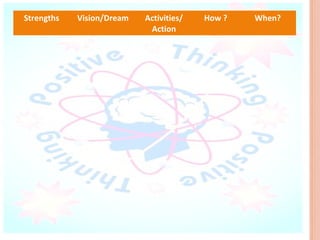
Strengths   Vision/Dream   Activities/   How ?   When?
                            Action
Pd through setting positive attitude

Pd through setting positive attitude

  • 2.
    LET’S SEE WHAREWE ARE AT….. Figure 1. Life Cycle of a Professional Educator – Adapted from: Steffy, B.E. & Wolfe, M.P. (1997). The life c y c le o f the c a re e r te a c he r: M inta ining e x c e lle nc e fo r a life tim e . We s t La fa y e tte , I : Ka p p a De lta a N Pi.
  • 3.
    A course in ‘PDAI’ (Professional Development through Appreciative Inquiry)
  • 5.
    ACTIVITY 1  Writedownany three good points about your colleague…………..  1…………………………………………..  2…………………………………………..  3…………………………………………..
  • 6.
    What do yousee in the picture? How much water do you see in the glass?
  • 7.
    READ AND HAVEA FUN A man was washing his new car when his neighbor asked Him, “When did you get the car?” He replied, “My brother gave it to me.” The neighbor said, “I wish I had a car like that.” The man replied, “You should wish to have a brother like that.” The neighbor’s wife was listening to the conversation and she interrupted, “I wish I was a brother like that.” What a positive way to think!
  • 8.
    “WE SEE THETHING NOT THE WAY THEY ARE, BUT THE WAY WE ARE…”
  • 9.
    The Basic TwoLenses Seeing the deficits Seeing the good Which lense do you have?
  • 10.
    FLOW OF POSITIVETHOUGHT “Positive thought leads to positive question, Positive question leads to positive answer, Positive answer leads to positive action, Positive action leads to positive effect/change.”
  • 11.
    A healthy body,a healthy mind, positive personal behaviors and good relationships with other people are important life skills that will help you get the best out of your self, your life, and others
  • 12.
    Negative thinking Negative thinkingcauses stress because it damages your confidence that you are equal to the task you face.
  • 13.
    Negative thinking You are thinking negatively when: you put yourself down, criticize yourself for errors, doubt your abilities, expect failure, etc. It is the negative side of suggestion – it damages confidence, harms performance and paralyses mental skills.
  • 15.
    “Winners recognize theirlimitations but focus on their strength” “Losers recognize their strengths but focus on their weakness”
  • 16.
    FEELING BEHAVIOR What’s the relationship? If you feel good, you do good, If you do good, you feel good.
  • 17.
    VALUE YOURSELF A wellknown speaker started off his seminar by holding up a $100 note. In the room of 200, he asked, “Who would like this note?” hands started going up. He said, “I’m going to give this note to one of you, but first let me do this.” He proceed to crumple the note up. He then asked, “Who still wants it?” Still the hands were up in the air. “Well!” he replied, “What if I do this?” and he dropped it on the ground and started to grind it into the floor with the shoe. He picked it up, now all crumpled and dirty. “Now who still wants it?” Still the hands went into the air. What’s the moral of the story? WE ALL ARE VERY SPECIAL AND VALUABLE
  • 19.
    Examples of positiveself-esteem are: 1. I can do this. 2. I can achieve my goals. 3. I am completely myself and people will like me for myself. 4. I am completely in control of my life. 5. I learn from my mistakes. They increase the basis of experience on which I can draw. 6. I am a good valued person in my own right.
  • 20.
  • 21.
    TRUTH…….. Life is aprecious gift Opened by a very few -Rigdol
  • 22.
    AN ACTIVITY…….  Writedown any 5 strengths/ good points that you possess.  1…………………………………………..  2…………………………………………..  3…………………………………………..  4……………………………………………….  5…………………………………………………..
  • 24.
    TEST THE FLAVOR………. He slept beneath the moon He basked beneath the sun He lived a life of going to do And he died with nothing done. -James Albery
  • 25.
    Some people practiceprocrastination by saying “I’m analyzing” and six months later they are still analyzing. Why do the people say so? Ans………………………………………………… They are suffering from a disease called… “ Paralysis by Analysis”
  • 26.
    WHAT IS HOLDINGUS BACK? We always say………… 1. It might have been… 2. I should have…. 3. I could have….. 4. I wish I had… 5. If only I had given a little extra… which end up with excuses…
  • 28.
    WHY DO PEOPLEGIVE UP…?  ……………because people either work for others or want other people appreciate them.  But the truth is Human beings never appreciate others so easily.
  • 29.
    PROOF….. WHO ISTHIS MAN? Before.. The man who ………  was mostly criticized  was mostly blamed.  was mostly cartoonized. Now.....  is mostly valued  is mostly appreciated
  • 31.
    “The person whorisk nothing, does nothing, has nothing, and is nothing.”
  • 32.
    “Life is likea ten-speed bicycle. Most of us have gears we never use.” -Charles Schultz
  • 33.
    Many people seekfor shortcut or easy way to accomplish the task. But the easier way may actually be the tougher way.
  • 35.
    AN ACTIVITY… Make a day’s plan to keep yourself busy.
  • 36.
    “Spend so muchtime improving yourself that you’ve no time left to criticize others”
  • 38.
    AN ACTIVITY:  What can be Negative Influences around us?
  • 40.
    IT’S LITTLE THINGTHAT MAKE A BIG DIFFERENCE A ten-year-old boy went to an ice-cream shop, sat at a table, and asked the waitress, “How much is an ice-cream cone?”
  • 41.
    She said,“Seventy-five cents.” The boy started counting the coins he had in his hand. Then he asked how much a small cup of ice-cream was.
  • 42.
    The waitress impatiently replied, “sixty-five cents.” The boy said, “I will have the small ice-cream cup.”
  • 43.
    The boy ate his ice-cream, paid the bill and left.
  • 44.
    When the waitress came to pick up the empty plate, she was touched. Underneath were ten one-cent coins left as the tip.
  • 46.
  • 47.
    Strengths Vision/Dream Activities/ How ? When? Action