IMPORTANT GROUPS
OF PROKARYOTES
BY:
Sharovardhini.A
Department of microbiology
Introduction
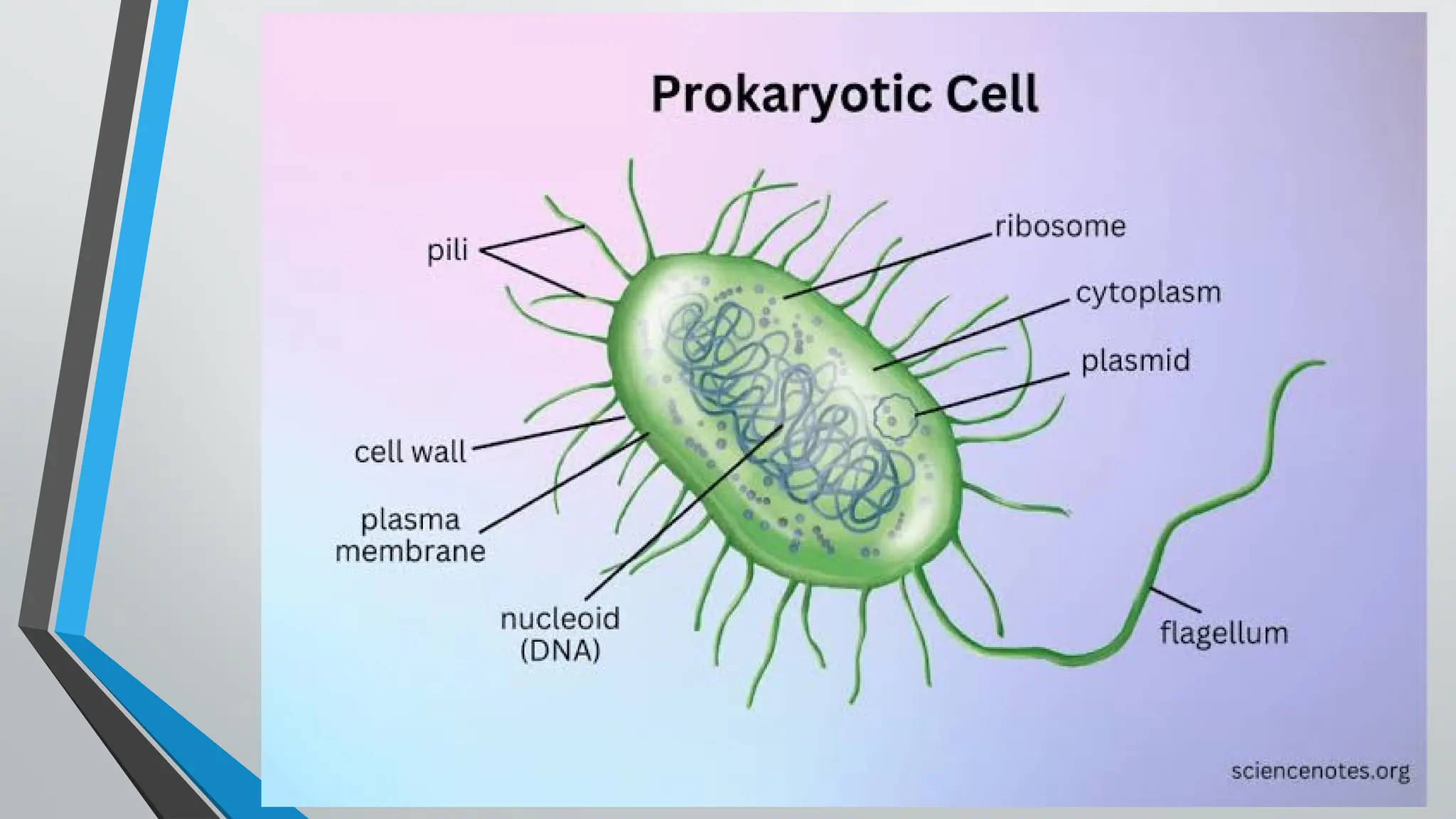
Prokaryotes are a group of microorganisms that lack a cell nucleus and other
membrane-bound organelles. They are typically small, simple cells that
reproduce rapidly.
1. Bacteria (Domain Bacteria)
2. Archaea (Domain Archaea)
Vital groups of Prokaryotes:
1. Bacteria:
Proteobacteria, Firmicutes and Actinobacteria
2. Archaea
Methanogens, Halophiles , Acidophiles and Thermophiles
Bacteria
Bacteria are a vast and diverse group of microorganisms that play important roles in
various ecosystems and industries.
Proteobacteria
Proteobacteria is a diverse phylum of Gram-negative bacteria, encompassing over 460 genera
and 1600 species. Named after the Greek god Proteus, this group includes significant pathogens
such as Escherichia, Salmonella, and Vibrio, as well as nitrogen-fixing bacteria.
Rod-shaped, spiral, or vibrio-shaped cells and it has Aerobic or anaerobic metabolism
Include many pathogens (e.g., E. coli, Salmonella, Pseudomonas)
 Nitrogen-fixing bacteria (e.g., Rhizobia, Azotobacter)
 Decomposers (e.g., Pseudomonas, Alcaligenes) , Include symbiotic bacteria (e.g., Rhizobia)
Subgroups
1. Alpha Proteobacteria (e.g., Rhizobia, Agrobacterium)
2. Beta Proteobacteria (e.g., Neisseria, Bordetella)
3. Gamma Proteobacteria (e.g., E. coli, Salmonella, Pseudomonas)
4. Delta Proteobacteria (e.g., Myxobacteria, Bdellovibrio)
5. Epsilon Proteobacteria (e.g., Campylobacter, Helicobacter)
6. Zeta proteobacteria (Mariprofundus ferrooxydans – Iron oxidation)
Each exhibiting unique metabolic capabilities and ecological roles.
Proteobacteria play crucial roles in various environments, including human
health, where they are linked to several diseases.
Firmicutes
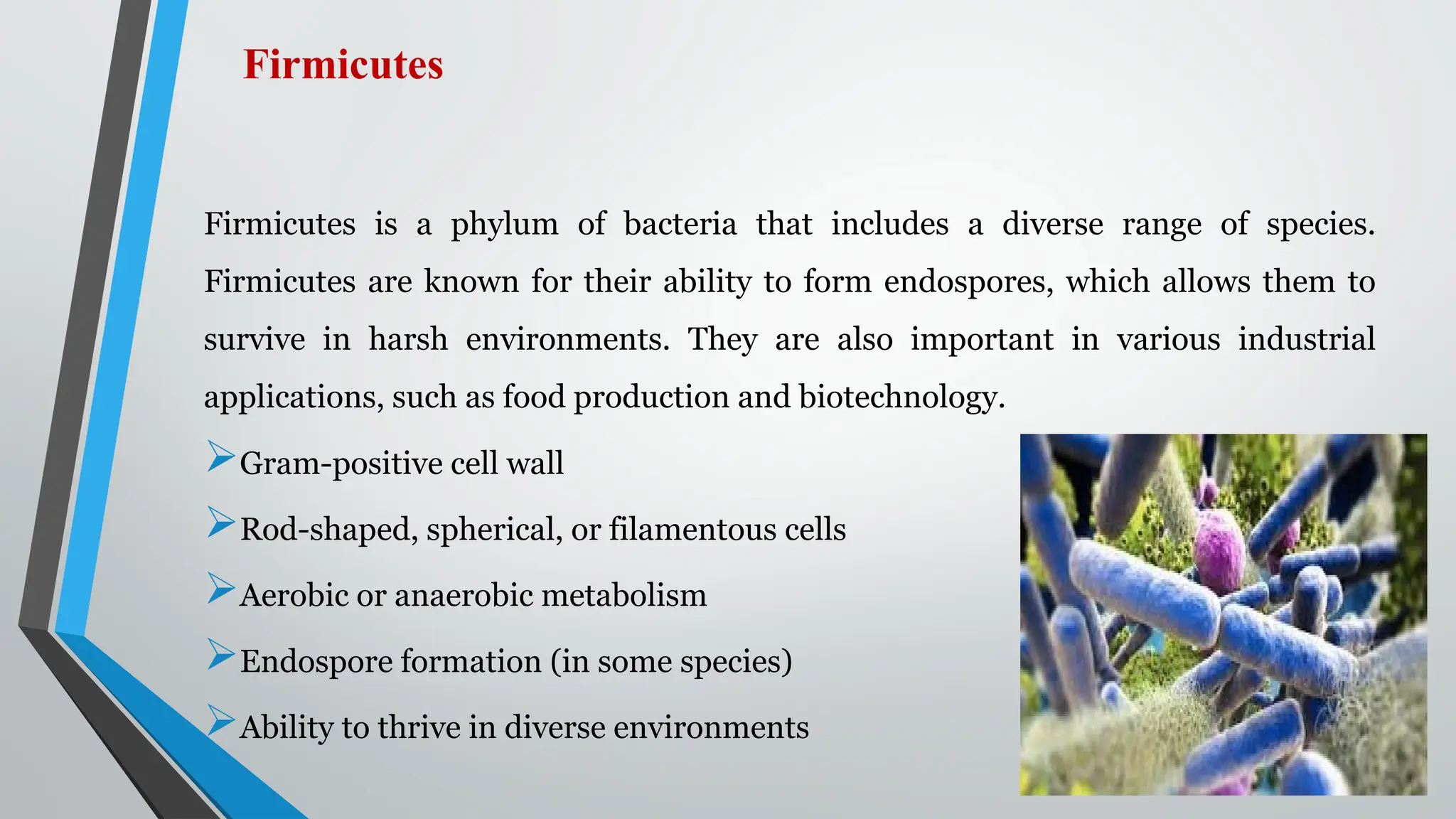
Firmicutes is a phylum of bacteria that includes a diverse range of species.
Firmicutes are known for their ability to form endospores, which allows them to
survive in harsh environments. They are also important in various industrial
applications, such as food production and biotechnology.
Gram-positive cell wall
Rod-shaped, spherical, or filamentous cells
Aerobic or anaerobic metabolism
Endospore formation (in some species)
Ability to thrive in diverse environments
 Human health (pathogens and probiotics)
 Food production (fermentation, yogurt, cheese)
 Agriculture (soil microorganisms, plant symbiosis)
 Biotechnology (enzyme production, biofuels)
 Environment (decomposition, nutrient cycling)
Some notable Firmicutes include:
1. Bacillus subtilis (model organism, probiotic)
2. Clostridium difficile (pathogen)
3. Lactobacillus acidophilus (probiotic)
4. Enterococcus faecalis (pathogen)
Actinobacteria
Actinobacteria is a phylum of Gram-positive, rod-shaped or
filamentous bacteria that are known for their ability to produce
antibiotics and other secondary metabolites. Characteristics:
Gram-positive cell wall
Rod-shaped or filamentous cells
Aerobic or anaerobic metabolism
High G+C content in DNA
Ability to form branching filaments (in some species)
Sub Groups
• Actinomycetales (e.g., Streptomyces, Actinomyces)
• Bifidobacteriales (e.g., Bifidobacterium)
• Micrococcales (e.g., Micrococcus)
• Bifidobacteriales (e.g., Bifidobacterium)
Actinobacteria play important roles in:
1. Antibiotic production (e.g., streptomycin, tetracycline)
2. Soil ecology (decomposition, nutrient cycling)
3. Plant symbiosis (e.g., Frankia, nitrogen-fixing)
4. Human health (pathogens and probiotics)
Some notable Actinobacteria include:
Streptomyces coelicolor (model organism, antibiotic producer)
Actinomyces israelii (pathogen)
Bifidobacterium bifidum (probiotic)
Corynebacterium glutamicum (biotechnology applications)
Frankia alni (nitrogen-fixing symbiont)
Actinobacteria are known for their ability to produce a wide range of
secondary metabolites, including antibiotics, antifungals, and
antivirals. They are also important in soil ecology and plant symbiosis.
Archaea
Archaea is a domain of single-celled microorganisms that are prokaryotic, meaning they lack
a cell nucleus. They are known for their ability to thrive in extreme environments, such as:
High temperatures (thermophiles), High salinity (halophiles), High acidity (acidophiles) and
High pressure (piezophiles).
Characteristics:
1. Prokaryotic cell structure- Lack of cell nucleus
2. Ether lipids in cell membranes
3. Distinct metabolic processes (e.g., methanogenesis)
4. Ability to survive in extreme environments
Archaea play important roles in:
 Methane production (biogas),Carbon cycling ,Nitrogen cycle ,Sulfur cycling, and Extreme
Methanogens
Methanogens are a group of microorganisms that produce methane gas as a by product of
their metabolism. They are found in various environments, including Wetlands, Rice paddies,
Ruminant animals (e.g., cows, sheep), Termites, Marine sediments, Hydrothermal vents.
Characteristics
1. Produce methane (CH4) as a metabolic by product
2. Anaerobic, meaning they thrive in environments without oxygen
3. Use carbon dioxide (CO2) and hydrogen (H2) as energy sources
4. Have unique enzymes and coenzymes (e.g., coenzyme M)
5. Belong to the domain Archaea
Halophiles
Halophiles are a group of microorganisms that thrive
in environments with high salt concentrations,
typically above 1-2% NaCl (sodium chloride).
They are found in various environments, including
Salt lakes (e.g., Great Salt Lake, Dead Sea), Salt mines,
Salt springs Marine environments (e.g., saltwater
lakes, estuaries) and Fermented foods (e.g., soy sauce,
fish sauce)
Types of halophiles:
1. Obligate halophiles (require high salt concentrations)
2. Facultative halophiles (can grow in high salt, but not
required)
3. Halotolerant (can tolerate high salt, but not require)
Examples of halophiles:
• Halobacterium salinarum (Archaea)
• Halomonas elongata (Bacteria)
• Dunaliella salina (Eukarya, algae)
• Halococcus morrhuae (Archaea)
Thermophiles
Thermophiles are microorganisms that thrive in high-
temperature environments, typically above 45°C (113°F). They
are found in various environments, including Hot springs,
Geothermal vents, Volcanic regions, Deep-sea hydrothermal
vents, Composting piles.
Characteristics:
➢ Ability to survive and grow in high temperatures
➢ Unique enzymes and biochemical pathways
➢ Adaptations to maintain cellular stability and function
➢ Belong to various taxonomic groups (Bacteria, Archaea)
Types of thermophiles:
1. Moderate thermophiles (45-60°C / 113-140°F)
2. Extreme thermophiles (60-80°C / 140-176°F)
3. Hyperthermophiles (above 80°C / 176°F)
Examples of thermophiles:
1. Pyrococcus furiosus (Archaea)
2. Thermococcus kodakarensis (Archaea)
3. Bacillus thermophilus (Bacteria)
4. Thermus aquaticus (Bacteria)
Acidophiles
Acidophiles are microorganisms that thrive in acidic
environments, typically with a pH below 3 .They are found in
various environments, including Acid mine drainage, Hot
springs, Volcanic lakes, Peat bogs and Stomach of animals
(e.g., humans, cows)
Ability to survive and grow in acidic environments
➢ Unique enzymes and biochemical pathways
➢ Adaptations to maintain cellular stability and function
➢ Belong to various taxonomic groups (Bacteria, Archaea,
Eukarya)
Types of acidophiles:
1. Obligate acidophiles (require acidic environments)
2. Facultative acidophiles (can grow in acidic
environments, but not required)
3. Acid-tolerant (can survive in acidic environments, but
not require)
Examples of acidophiles:
1. Sulfolobus acidocaldarius (Archaea)
2. Thermoplasma acidophilum (Archaea)
3. Acidithiobacillus ferrooxidans (Bacteria)
4. Candida albicans (Eukarya, fungus)
Important groups of prokaryotes : Bacteria & Archaea , it’s Subgroups

Important groups of prokaryotes : Bacteria & Archaea , it’s Subgroups

  • 1.
  • 2.
    Introduction Prokaryotes are agroup of microorganisms that lack a cell nucleus and other membrane-bound organelles. They are typically small, simple cells that reproduce rapidly. 1. Bacteria (Domain Bacteria) 2. Archaea (Domain Archaea) Vital groups of Prokaryotes: 1. Bacteria: Proteobacteria, Firmicutes and Actinobacteria 2. Archaea Methanogens, Halophiles , Acidophiles and Thermophiles
  • 4.
    Bacteria Bacteria are avast and diverse group of microorganisms that play important roles in various ecosystems and industries. Proteobacteria Proteobacteria is a diverse phylum of Gram-negative bacteria, encompassing over 460 genera and 1600 species. Named after the Greek god Proteus, this group includes significant pathogens such as Escherichia, Salmonella, and Vibrio, as well as nitrogen-fixing bacteria. Rod-shaped, spiral, or vibrio-shaped cells and it has Aerobic or anaerobic metabolism Include many pathogens (e.g., E. coli, Salmonella, Pseudomonas)  Nitrogen-fixing bacteria (e.g., Rhizobia, Azotobacter)  Decomposers (e.g., Pseudomonas, Alcaligenes) , Include symbiotic bacteria (e.g., Rhizobia)
  • 5.
    Subgroups 1. Alpha Proteobacteria(e.g., Rhizobia, Agrobacterium) 2. Beta Proteobacteria (e.g., Neisseria, Bordetella) 3. Gamma Proteobacteria (e.g., E. coli, Salmonella, Pseudomonas) 4. Delta Proteobacteria (e.g., Myxobacteria, Bdellovibrio) 5. Epsilon Proteobacteria (e.g., Campylobacter, Helicobacter) 6. Zeta proteobacteria (Mariprofundus ferrooxydans – Iron oxidation) Each exhibiting unique metabolic capabilities and ecological roles. Proteobacteria play crucial roles in various environments, including human health, where they are linked to several diseases.
  • 6.
    Firmicutes Firmicutes is aphylum of bacteria that includes a diverse range of species. Firmicutes are known for their ability to form endospores, which allows them to survive in harsh environments. They are also important in various industrial applications, such as food production and biotechnology. Gram-positive cell wall Rod-shaped, spherical, or filamentous cells Aerobic or anaerobic metabolism Endospore formation (in some species) Ability to thrive in diverse environments
  • 7.
     Human health(pathogens and probiotics)  Food production (fermentation, yogurt, cheese)  Agriculture (soil microorganisms, plant symbiosis)  Biotechnology (enzyme production, biofuels)  Environment (decomposition, nutrient cycling) Some notable Firmicutes include: 1. Bacillus subtilis (model organism, probiotic) 2. Clostridium difficile (pathogen) 3. Lactobacillus acidophilus (probiotic) 4. Enterococcus faecalis (pathogen)
  • 8.
    Actinobacteria Actinobacteria is aphylum of Gram-positive, rod-shaped or filamentous bacteria that are known for their ability to produce antibiotics and other secondary metabolites. Characteristics: Gram-positive cell wall Rod-shaped or filamentous cells Aerobic or anaerobic metabolism High G+C content in DNA Ability to form branching filaments (in some species)
  • 9.
    Sub Groups • Actinomycetales(e.g., Streptomyces, Actinomyces) • Bifidobacteriales (e.g., Bifidobacterium) • Micrococcales (e.g., Micrococcus) • Bifidobacteriales (e.g., Bifidobacterium) Actinobacteria play important roles in: 1. Antibiotic production (e.g., streptomycin, tetracycline) 2. Soil ecology (decomposition, nutrient cycling) 3. Plant symbiosis (e.g., Frankia, nitrogen-fixing) 4. Human health (pathogens and probiotics)
  • 10.
    Some notable Actinobacteriainclude: Streptomyces coelicolor (model organism, antibiotic producer) Actinomyces israelii (pathogen) Bifidobacterium bifidum (probiotic) Corynebacterium glutamicum (biotechnology applications) Frankia alni (nitrogen-fixing symbiont) Actinobacteria are known for their ability to produce a wide range of secondary metabolites, including antibiotics, antifungals, and antivirals. They are also important in soil ecology and plant symbiosis.
  • 11.
    Archaea Archaea is adomain of single-celled microorganisms that are prokaryotic, meaning they lack a cell nucleus. They are known for their ability to thrive in extreme environments, such as: High temperatures (thermophiles), High salinity (halophiles), High acidity (acidophiles) and High pressure (piezophiles). Characteristics: 1. Prokaryotic cell structure- Lack of cell nucleus 2. Ether lipids in cell membranes 3. Distinct metabolic processes (e.g., methanogenesis) 4. Ability to survive in extreme environments Archaea play important roles in:  Methane production (biogas),Carbon cycling ,Nitrogen cycle ,Sulfur cycling, and Extreme
  • 12.
    Methanogens Methanogens are agroup of microorganisms that produce methane gas as a by product of their metabolism. They are found in various environments, including Wetlands, Rice paddies, Ruminant animals (e.g., cows, sheep), Termites, Marine sediments, Hydrothermal vents. Characteristics 1. Produce methane (CH4) as a metabolic by product 2. Anaerobic, meaning they thrive in environments without oxygen 3. Use carbon dioxide (CO2) and hydrogen (H2) as energy sources 4. Have unique enzymes and coenzymes (e.g., coenzyme M) 5. Belong to the domain Archaea
  • 13.
    Halophiles Halophiles are agroup of microorganisms that thrive in environments with high salt concentrations, typically above 1-2% NaCl (sodium chloride). They are found in various environments, including Salt lakes (e.g., Great Salt Lake, Dead Sea), Salt mines, Salt springs Marine environments (e.g., saltwater lakes, estuaries) and Fermented foods (e.g., soy sauce, fish sauce)
  • 14.
    Types of halophiles: 1.Obligate halophiles (require high salt concentrations) 2. Facultative halophiles (can grow in high salt, but not required) 3. Halotolerant (can tolerate high salt, but not require) Examples of halophiles: • Halobacterium salinarum (Archaea) • Halomonas elongata (Bacteria) • Dunaliella salina (Eukarya, algae) • Halococcus morrhuae (Archaea)
  • 15.
    Thermophiles Thermophiles are microorganismsthat thrive in high- temperature environments, typically above 45°C (113°F). They are found in various environments, including Hot springs, Geothermal vents, Volcanic regions, Deep-sea hydrothermal vents, Composting piles. Characteristics: ➢ Ability to survive and grow in high temperatures ➢ Unique enzymes and biochemical pathways ➢ Adaptations to maintain cellular stability and function ➢ Belong to various taxonomic groups (Bacteria, Archaea)
  • 16.
    Types of thermophiles: 1.Moderate thermophiles (45-60°C / 113-140°F) 2. Extreme thermophiles (60-80°C / 140-176°F) 3. Hyperthermophiles (above 80°C / 176°F) Examples of thermophiles: 1. Pyrococcus furiosus (Archaea) 2. Thermococcus kodakarensis (Archaea) 3. Bacillus thermophilus (Bacteria) 4. Thermus aquaticus (Bacteria)
  • 17.
    Acidophiles Acidophiles are microorganismsthat thrive in acidic environments, typically with a pH below 3 .They are found in various environments, including Acid mine drainage, Hot springs, Volcanic lakes, Peat bogs and Stomach of animals (e.g., humans, cows) Ability to survive and grow in acidic environments ➢ Unique enzymes and biochemical pathways ➢ Adaptations to maintain cellular stability and function ➢ Belong to various taxonomic groups (Bacteria, Archaea, Eukarya)
  • 18.
    Types of acidophiles: 1.Obligate acidophiles (require acidic environments) 2. Facultative acidophiles (can grow in acidic environments, but not required) 3. Acid-tolerant (can survive in acidic environments, but not require) Examples of acidophiles: 1. Sulfolobus acidocaldarius (Archaea) 2. Thermoplasma acidophilum (Archaea) 3. Acidithiobacillus ferrooxidans (Bacteria) 4. Candida albicans (Eukarya, fungus)