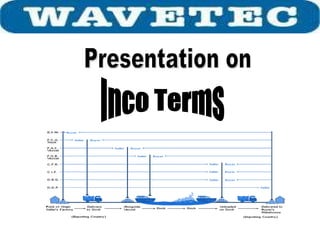
Created By: Haris Bin Zakir Inco Terms Presentation on
“ Incoterms or international commerce terms are a series of international sales terms, published by International Chamber of Commerce (ICC) and widely used in international commercial transactions. These are accepted by governments, legal authorities and practitioners worldwide for the interpretation of most commonly used terms in international trade. This reduces or remove altogether uncertainties arising from different interpretation of such terms in different countries. Scope of this is limited to matters relating to right and obligations of the parties to the contract of sale with respect to the delivery of goods sold”.  Incoterms
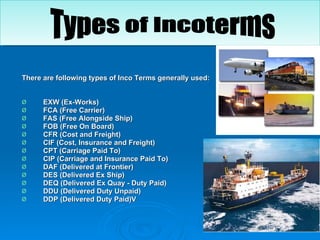
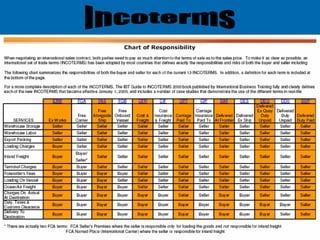
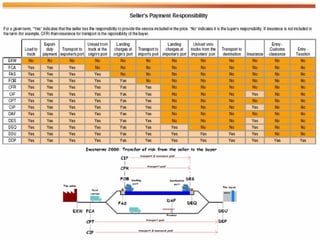
There are following types of Inco Terms generally used: EXW (Ex-Works) FCA (Free Carrier) FAS (Free Alongside Ship) FOB (Free On Board) CFR (Cost and Freight) CIF (Cost, Insurance and Freight) CPT (Carriage Paid To) CIP (Carriage and Insurance Paid To) DAF (Delivered at Frontier) DES (Delivered Ex Ship) DEQ (Delivered Ex Quay - Duty Paid) DDU (Delivered Duty Unpaid) DDP (Delivered Duty Paid)V Types of Incoterms
“ One of the simplest and most basic shipment arrangements places the minimum responsibility on the seller with greater responsibility on the buyer. In an EX-Works transaction, goods are basically made available for pickup at the shipper/seller's factory or warehouse and "delivery" is accomplished when the merchandise is released to the consignee's freight forwarder. The buyer is responsible for making arrangements with their forwarder for insurance, export clearance and handling all other paperwork”.  EXW (Ex-Works)
“ One of the most commonly used-and misused-terms, FOB means that the shipper/seller uses his freight forwarder to move the merchandise to the port or designated point of origin. Though frequently used to describe inland movement of cargo, FOB specifically refers to ocean or inland waterway transportation of goods. "Delivery" is accomplished when the shipper/seller releases the goods to the buyer's forwarder. The buyer's responsibility for insurance and transportation begins at the same moment”.  FOB (Free On Board)
“ In this type of transaction, the seller is responsible for arranging transportation. In FCA the seller chooses and works with the freight forwarder or the carrier. "Delivery" is accomplished at a predetermined port or destination point and the buyer is responsible for Insurance”.  FCA (Free Carrier)
“ In these transactions, the buyer bears all the transportation costs and the risk of loss of goods. FAS requires the shipper/seller to clear goods for export, which is a reversal from past practices. Companies selling on these terms will ordinarily use their freight forwarder to clear the goods for export. "Delivery" is accomplished when the goods are turned over to the Buyers Forwarder for insurance and transportation”.  FAS (Free Alongside Ship)
This term formerly known as CNF (C&F) defines two distinct and separate responsibilities-one is dealing with the actual cost of merchandise "C" and the other "F" refers to the freight charges to a predetermined destination point. It is the shipper/seller's responsibility to get goods from their door to the port of destination. "Delivery" is accomplished at this time. It is the buyer's responsibility to cover insurance from the port of origin or port of shipment to buyer's door. Given that the shipper is responsible for transportation, the shipper also chooses the forwarder.  CFR (Cost and Freight)
“ This arrangement similar to CFR, but instead of the buyer insuring the goods for the maritime phase of the voyage, the shipper/seller will insure the merchandise. In this arrangement, the seller usually chooses the forwarder. "Delivery" as above, is accomplished at the port of destination”.  CIF (Cost, Insurance and Freight)
“ In CPT transactions the shipper/seller has the same obligations found with CIF, with the addition that the seller has to buy cargo insurance, naming the buyer as the insured while the goods are in transit”.  CPT (Carriage Paid To)
“ This term is primarily used for multimodal transport. Because it relies on the carrier's insurance, the shipper/seller is only required to purchase minimum coverage. When this particular agreement is in force, Freight Forwarders often act in effect, as carriers. The buyer's insurance is effective when the goods are turned over to the Forwarder”.  CIP (Carriage and Insurance Paid To)
“ Here the seller's responsibility is to hire a forwarder to take goods to a named frontier, which usually a border crossing point, and clear them for export. "Delivery" occurs at this time. The buyer's responsibility is to arrange with their forwarder for the pick up of the goods after they are cleared for export, carry them across the border, clear them for importation and effect delivery. In most cases, the buyer's forwarder handles the task of accepting the goods at the border across the foreign soil”.  DAF (Delivered At Frontier)
“ In this type of transaction, it is the seller's responsibility to get the goods to the port of destination or to engage the forwarder to the move cargo to the port of destination uncleared. "Delivery" occurs at this time. Any destination charges that occur after the ship is docked are the buyer's responsibility”. DES (Delivered Ex Ship)
“ In this arrangement, the buyer/consignee is responsible for duties and charges and the seller is responsible for delivering the goods to the quay, wharf or port of destination. In a reversal of previous practice, the buyer must also arrange for customs clearance”.  DEQ (Delivered Ex Quay)
“ DDP terms tend to be used in intermodal or courier-type shipments. Whereby, the shipper/seller is responsible for dealing with all the tasks involved in moving goods from the manufacturing plant to the buyer/consignee's door. It is the shipper/seller's responsibility to insure the goods and absorb all costs and risks including the payment of duty and fees”.  DDP (Delivered Duty Paid)
“ This arrangement is basically the same as with DDP, except for the fact that the buyer is responsible for the duty, fees and taxes”.  DDU (Delivered Duty Unpaid)
Incoterms
 
Quote:  'If you think you can......you can. If you think you can't..... you're right.‘ Thank You

Inco Terms

  • 1.
    Created By: HarisBin Zakir Inco Terms Presentation on
  • 2.
    “ Incoterms orinternational commerce terms are a series of international sales terms, published by International Chamber of Commerce (ICC) and widely used in international commercial transactions. These are accepted by governments, legal authorities and practitioners worldwide for the interpretation of most commonly used terms in international trade. This reduces or remove altogether uncertainties arising from different interpretation of such terms in different countries. Scope of this is limited to matters relating to right and obligations of the parties to the contract of sale with respect to the delivery of goods sold”. Incoterms
  • 3.
    There are followingtypes of Inco Terms generally used: EXW (Ex-Works) FCA (Free Carrier) FAS (Free Alongside Ship) FOB (Free On Board) CFR (Cost and Freight) CIF (Cost, Insurance and Freight) CPT (Carriage Paid To) CIP (Carriage and Insurance Paid To) DAF (Delivered at Frontier) DES (Delivered Ex Ship) DEQ (Delivered Ex Quay - Duty Paid) DDU (Delivered Duty Unpaid) DDP (Delivered Duty Paid)V Types of Incoterms
  • 4.
    “ One ofthe simplest and most basic shipment arrangements places the minimum responsibility on the seller with greater responsibility on the buyer. In an EX-Works transaction, goods are basically made available for pickup at the shipper/seller's factory or warehouse and "delivery" is accomplished when the merchandise is released to the consignee's freight forwarder. The buyer is responsible for making arrangements with their forwarder for insurance, export clearance and handling all other paperwork”. EXW (Ex-Works)
  • 5.
    “ One ofthe most commonly used-and misused-terms, FOB means that the shipper/seller uses his freight forwarder to move the merchandise to the port or designated point of origin. Though frequently used to describe inland movement of cargo, FOB specifically refers to ocean or inland waterway transportation of goods. "Delivery" is accomplished when the shipper/seller releases the goods to the buyer's forwarder. The buyer's responsibility for insurance and transportation begins at the same moment”. FOB (Free On Board)
  • 6.
    “ In thistype of transaction, the seller is responsible for arranging transportation. In FCA the seller chooses and works with the freight forwarder or the carrier. "Delivery" is accomplished at a predetermined port or destination point and the buyer is responsible for Insurance”. FCA (Free Carrier)
  • 7.
    “ In thesetransactions, the buyer bears all the transportation costs and the risk of loss of goods. FAS requires the shipper/seller to clear goods for export, which is a reversal from past practices. Companies selling on these terms will ordinarily use their freight forwarder to clear the goods for export. "Delivery" is accomplished when the goods are turned over to the Buyers Forwarder for insurance and transportation”. FAS (Free Alongside Ship)
  • 8.
    This term formerlyknown as CNF (C&F) defines two distinct and separate responsibilities-one is dealing with the actual cost of merchandise "C" and the other "F" refers to the freight charges to a predetermined destination point. It is the shipper/seller's responsibility to get goods from their door to the port of destination. "Delivery" is accomplished at this time. It is the buyer's responsibility to cover insurance from the port of origin or port of shipment to buyer's door. Given that the shipper is responsible for transportation, the shipper also chooses the forwarder. CFR (Cost and Freight)
  • 9.
    “ This arrangementsimilar to CFR, but instead of the buyer insuring the goods for the maritime phase of the voyage, the shipper/seller will insure the merchandise. In this arrangement, the seller usually chooses the forwarder. "Delivery" as above, is accomplished at the port of destination”. CIF (Cost, Insurance and Freight)
  • 10.
    “ In CPTtransactions the shipper/seller has the same obligations found with CIF, with the addition that the seller has to buy cargo insurance, naming the buyer as the insured while the goods are in transit”. CPT (Carriage Paid To)
  • 11.
    “ This termis primarily used for multimodal transport. Because it relies on the carrier's insurance, the shipper/seller is only required to purchase minimum coverage. When this particular agreement is in force, Freight Forwarders often act in effect, as carriers. The buyer's insurance is effective when the goods are turned over to the Forwarder”. CIP (Carriage and Insurance Paid To)
  • 12.
    “ Here theseller's responsibility is to hire a forwarder to take goods to a named frontier, which usually a border crossing point, and clear them for export. "Delivery" occurs at this time. The buyer's responsibility is to arrange with their forwarder for the pick up of the goods after they are cleared for export, carry them across the border, clear them for importation and effect delivery. In most cases, the buyer's forwarder handles the task of accepting the goods at the border across the foreign soil”. DAF (Delivered At Frontier)
  • 13.
    “ In thistype of transaction, it is the seller's responsibility to get the goods to the port of destination or to engage the forwarder to the move cargo to the port of destination uncleared. "Delivery" occurs at this time. Any destination charges that occur after the ship is docked are the buyer's responsibility”. DES (Delivered Ex Ship)
  • 14.
    “ In thisarrangement, the buyer/consignee is responsible for duties and charges and the seller is responsible for delivering the goods to the quay, wharf or port of destination. In a reversal of previous practice, the buyer must also arrange for customs clearance”. DEQ (Delivered Ex Quay)
  • 15.
    “ DDP termstend to be used in intermodal or courier-type shipments. Whereby, the shipper/seller is responsible for dealing with all the tasks involved in moving goods from the manufacturing plant to the buyer/consignee's door. It is the shipper/seller's responsibility to insure the goods and absorb all costs and risks including the payment of duty and fees”. DDP (Delivered Duty Paid)
  • 16.
    “ This arrangementis basically the same as with DDP, except for the fact that the buyer is responsible for the duty, fees and taxes”. DDU (Delivered Duty Unpaid)
  • 17.
  • 18.
  • 19.
    Quote: 'Ifyou think you can......you can. If you think you can't..... you're right.‘ Thank You