Segmenting for  Success Designing an implementation plan Presented by: Susan Abbott
Valid and reliable doesn’t always mean useful … 200 CEOs surveyed in 2004 59% had conducted a major segmentation exercise within the past two years 14% said they derived value from it Yankelovich and Meer, Harvard Business Review, 2006, reporting on study by Marakon Associates and Economist Intelligence Unit 59%  Paid for segmentation project 200 CEOs 14%  “ Valuable”
The most critical point of this presentation … For segmentation to be useful, you must  be able to  act on it… Then you need to coordinate action in the organization.  Marketing can’t do it alone.
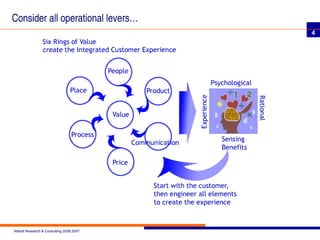
Consider all operational levers…
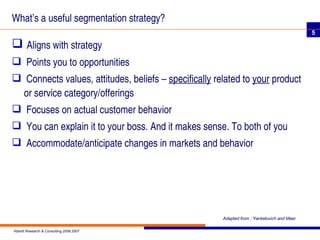
What’s a useful segmentation strategy? Aligns with strategy Points you to opportunities  Connects values, attitudes, beliefs –  specifically  related to  your  product or service category/offerings Focuses on actual customer behavior You can explain it to your boss. And it makes sense. To both of you Accommodate/anticipate changes in markets and behavior Adapted from : Yankelovich and Meer
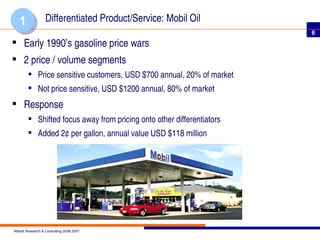
Differentiated Product/Service: Mobil Oil Early 1990’s gasoline price wars 2 price / volume segments Price sensitive customers, USD $700 annual, 20% of market Not price sensitive, USD $1200 annual, 80% of market Response Shifted focus away from pricing onto other differentiators Added 2¢ per gallon, annual value USD $118 million  1
Mobil Oil Example Benefit Matrix Ask yourself: can you still buy gas here if you are not in the target segment? Yes, of course.  But they are not tailoring their offering to you.  Spend USD $1200 per year  Spend average of USD $700 per year Behaviour 80% of market 20% of market Size of segment ? ? Demographics Something besides price (Service? Convenience stores?) Lowest price of gasoline at the pump Principal Benefit sought Price Insensitive Price Sensitive Basis for Segment
Price and Benefits Differentiation: Loblaw using a multi-format approach to maximize market share over the longer term focusing on food but serving the consumer’s everyday household needs creating customer loyalty and enhancing price competitiveness through a superior control label program Source: 2005 annual report 3
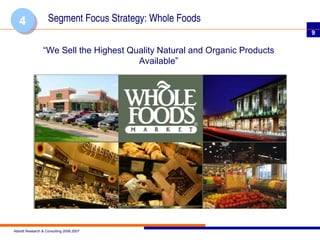
Segment Focus Strategy: Whole Foods 4 “ We Sell the Highest Quality Natural and Organic Products Available”
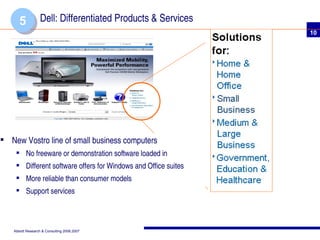
Dell: Differentiated Products & Services New Vostro line of small business computers No freeware or demonstration software loaded in Different software offers for Windows and Office suites  More reliable than consumer models Support services 5
Competing with Starbucks 6
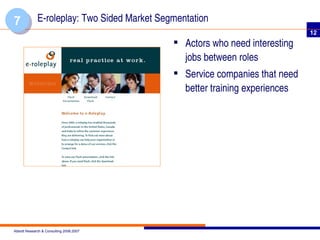
E-roleplay: Two Sided Market Segmentation Actors who need interesting jobs between roles Service companies that need better training experiences 7
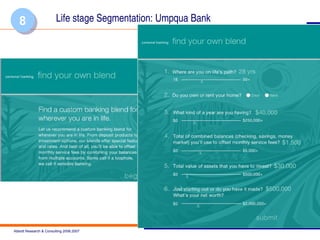
Life stage Segmentation: Umpqua Bank 8
Umpqua’s Day-to-Day Banking Segments Bright and full bodied to bring out all the flavor of your better years A rich blend with those who have achieved their goals with room to grow A crisp and lively blend for those working toward their dreams Specially blended to give a quick lift to those just starting out Description High spending, low balances, no investments yet Young Families in asset acquisition stage Unlimited transactions $7.50 monthly. Includes safety deposit box. Reach Moving into retirement, or semi-retirement Have savings and investments Low balances Behavioral Correlate 50+  Well-established, mid-life. Building investments Students and young adults Demographic Correlate Low or no charges on most services, unlimited transactions Membership in Club Carefree $10 monthly, but accounts earn interest Free notary services Free investment consultation Low service charges Low minimum required balance Principle Benefit Sought Cruise Savor Go Label
Differentiated Communication 9 Same product
The Marketing Concept Understand  your customers' needs and preferences Group  your customers into segments based on their needs and preferences  Target   segment(s) you can best meet their needs and preferences  This includes targeting and competitive analysis  Branding Not merely awareness but brand positioning  Provide superior service or products to meet your targeted customers' needs and preferences.  Happy customers, profitable sustainable growth
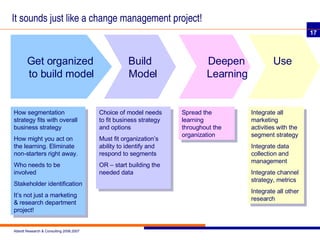
It sounds just like a change management project! Get organized  to build model Deepen  Learning Build  Model Use  How segmentation strategy fits with overall business strategy How might you act on the learning. Eliminate non-starters right away. Who needs to be involved Stakeholder identification It’s not just a marketing & research department project! Choice of model needs to fit business strategy and options Must fit organization’s ability to identify and respond to segments OR – start building the needed data Spread the learning throughout the organization Integrate all marketing activities with the segment strategy Integrate data collection and management Integrate channel strategy, metrics Integrate all other research
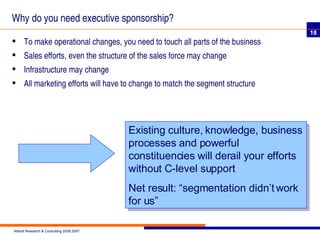
Why do you need executive sponsorship? To make operational changes, you need to touch all parts of the business Sales efforts, even the structure of the sales force may change Infrastructure may change All marketing efforts will have to change to match the segment structure Existing culture, knowledge, business processes and powerful constituencies will derail your efforts without C-level support Net result: “segmentation didn’t work for us”
Choosing a Model
“ The basic difficulty is that value-based segments generally don't fit neatly into demographic ones”   McKinsey Quarterly, A segmentation you can act on, 1999
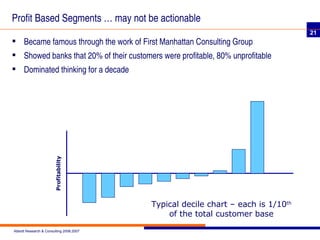
Profit Based Segments … may not be actionable Became famous through the work of First Manhattan Consulting Group Showed banks that 20% of their customers were profitable, 80% unprofitable Dominated thinking for a decade Profitability Typical decile chart – each is 1/10 th  of the total customer base
More actionable … Some examples of new segments for men Male spas offering manicures, pedicures, etc. Phillips Bodygroom shaver, designed to remove hair below the neck
“ No matter what claims are made for a method’s theoretical validity and statistical sophistication, if it can’t be shown that there is a consistent empirical relationship between product usage and psychographic segments, the method is essentially useless to the marketer….  To get the most out of segmentation research, it is important to be concerned more with consistent empirical relationships than with elegant theoretical models” Chakrapani & Deal
The critical questions you need to ask Can we see different product, promotion, communication, distribution or profit opportunities with this segmentation model? 1
Can we measure the segments? Can we obtain realistic data to consider segment potential?  2
What are the desires of each segment? What do they want from us? Do they make different tradeoffs? Which attitudes matter for the purchase decision? 3
Does senior management understand the segmentation model? Does it fit with their deep knowledge of the business? 4
Is this segmentation model responsive to changes in the market and our customers? 5
Can we differentiate competitor offerings with this segmentation model? 6
Can we  reach  segment(s)? 7
3 Major Segment Strategies One product to all segments  Example, discount airlines – one price,  one level of service One product for one segment  Niche markets Luxury goods typically handled this way e.g. adventure travel Multiple products designed for and targeted at multiple segments Typical strategy in financial services and broad based consumer products Example: how many kinds of toothpaste can you buy?
The most critical point of this presentation … For segmentation to be useful, you must  be able to  act on it… Then you need to coordinate action in the organization.  Marketing can’t do it alone.
Thank you! Susan Abbott Web: www.abbottresearch.com E-mail:  [email_address] Blog:  www.arc.typepad.com/customercrossroads Phone: 416-481-7409 or 888-244-0285

Implementing a Segmentation Strategy

  • 1.
    Segmenting for Success Designing an implementation plan Presented by: Susan Abbott
  • 2.
    Valid and reliabledoesn’t always mean useful … 200 CEOs surveyed in 2004 59% had conducted a major segmentation exercise within the past two years 14% said they derived value from it Yankelovich and Meer, Harvard Business Review, 2006, reporting on study by Marakon Associates and Economist Intelligence Unit 59% Paid for segmentation project 200 CEOs 14% “ Valuable”
  • 3.
    The most criticalpoint of this presentation … For segmentation to be useful, you must be able to act on it… Then you need to coordinate action in the organization. Marketing can’t do it alone.
  • 4.
  • 5.
    What’s a usefulsegmentation strategy? Aligns with strategy Points you to opportunities Connects values, attitudes, beliefs – specifically related to your product or service category/offerings Focuses on actual customer behavior You can explain it to your boss. And it makes sense. To both of you Accommodate/anticipate changes in markets and behavior Adapted from : Yankelovich and Meer
  • 6.
    Differentiated Product/Service: MobilOil Early 1990’s gasoline price wars 2 price / volume segments Price sensitive customers, USD $700 annual, 20% of market Not price sensitive, USD $1200 annual, 80% of market Response Shifted focus away from pricing onto other differentiators Added 2¢ per gallon, annual value USD $118 million 1
  • 7.
    Mobil Oil ExampleBenefit Matrix Ask yourself: can you still buy gas here if you are not in the target segment? Yes, of course. But they are not tailoring their offering to you. Spend USD $1200 per year Spend average of USD $700 per year Behaviour 80% of market 20% of market Size of segment ? ? Demographics Something besides price (Service? Convenience stores?) Lowest price of gasoline at the pump Principal Benefit sought Price Insensitive Price Sensitive Basis for Segment
  • 8.
    Price and BenefitsDifferentiation: Loblaw using a multi-format approach to maximize market share over the longer term focusing on food but serving the consumer’s everyday household needs creating customer loyalty and enhancing price competitiveness through a superior control label program Source: 2005 annual report 3
  • 9.
    Segment Focus Strategy:Whole Foods 4 “ We Sell the Highest Quality Natural and Organic Products Available”
  • 10.
    Dell: Differentiated Products& Services New Vostro line of small business computers No freeware or demonstration software loaded in Different software offers for Windows and Office suites More reliable than consumer models Support services 5
  • 11.
  • 12.
    E-roleplay: Two SidedMarket Segmentation Actors who need interesting jobs between roles Service companies that need better training experiences 7
  • 13.
  • 14.
    Umpqua’s Day-to-Day BankingSegments Bright and full bodied to bring out all the flavor of your better years A rich blend with those who have achieved their goals with room to grow A crisp and lively blend for those working toward their dreams Specially blended to give a quick lift to those just starting out Description High spending, low balances, no investments yet Young Families in asset acquisition stage Unlimited transactions $7.50 monthly. Includes safety deposit box. Reach Moving into retirement, or semi-retirement Have savings and investments Low balances Behavioral Correlate 50+ Well-established, mid-life. Building investments Students and young adults Demographic Correlate Low or no charges on most services, unlimited transactions Membership in Club Carefree $10 monthly, but accounts earn interest Free notary services Free investment consultation Low service charges Low minimum required balance Principle Benefit Sought Cruise Savor Go Label
  • 15.
  • 16.
    The Marketing ConceptUnderstand your customers' needs and preferences Group your customers into segments based on their needs and preferences Target segment(s) you can best meet their needs and preferences This includes targeting and competitive analysis Branding Not merely awareness but brand positioning Provide superior service or products to meet your targeted customers' needs and preferences. Happy customers, profitable sustainable growth
  • 17.
    It sounds justlike a change management project! Get organized to build model Deepen Learning Build Model Use How segmentation strategy fits with overall business strategy How might you act on the learning. Eliminate non-starters right away. Who needs to be involved Stakeholder identification It’s not just a marketing & research department project! Choice of model needs to fit business strategy and options Must fit organization’s ability to identify and respond to segments OR – start building the needed data Spread the learning throughout the organization Integrate all marketing activities with the segment strategy Integrate data collection and management Integrate channel strategy, metrics Integrate all other research
  • 18.
    Why do youneed executive sponsorship? To make operational changes, you need to touch all parts of the business Sales efforts, even the structure of the sales force may change Infrastructure may change All marketing efforts will have to change to match the segment structure Existing culture, knowledge, business processes and powerful constituencies will derail your efforts without C-level support Net result: “segmentation didn’t work for us”
  • 19.
  • 20.
    “ The basicdifficulty is that value-based segments generally don't fit neatly into demographic ones” McKinsey Quarterly, A segmentation you can act on, 1999
  • 21.
    Profit Based Segments… may not be actionable Became famous through the work of First Manhattan Consulting Group Showed banks that 20% of their customers were profitable, 80% unprofitable Dominated thinking for a decade Profitability Typical decile chart – each is 1/10 th of the total customer base
  • 22.
    More actionable …Some examples of new segments for men Male spas offering manicures, pedicures, etc. Phillips Bodygroom shaver, designed to remove hair below the neck
  • 23.
    “ No matterwhat claims are made for a method’s theoretical validity and statistical sophistication, if it can’t be shown that there is a consistent empirical relationship between product usage and psychographic segments, the method is essentially useless to the marketer…. To get the most out of segmentation research, it is important to be concerned more with consistent empirical relationships than with elegant theoretical models” Chakrapani & Deal
  • 24.
    The critical questionsyou need to ask Can we see different product, promotion, communication, distribution or profit opportunities with this segmentation model? 1
  • 25.
    Can we measurethe segments? Can we obtain realistic data to consider segment potential? 2
  • 26.
    What are thedesires of each segment? What do they want from us? Do they make different tradeoffs? Which attitudes matter for the purchase decision? 3
  • 27.
    Does senior managementunderstand the segmentation model? Does it fit with their deep knowledge of the business? 4
  • 28.
    Is this segmentationmodel responsive to changes in the market and our customers? 5
  • 29.
    Can we differentiatecompetitor offerings with this segmentation model? 6
  • 30.
    Can we reach segment(s)? 7
  • 31.
    3 Major SegmentStrategies One product to all segments Example, discount airlines – one price, one level of service One product for one segment Niche markets Luxury goods typically handled this way e.g. adventure travel Multiple products designed for and targeted at multiple segments Typical strategy in financial services and broad based consumer products Example: how many kinds of toothpaste can you buy?
  • 32.
    The most criticalpoint of this presentation … For segmentation to be useful, you must be able to act on it… Then you need to coordinate action in the organization. Marketing can’t do it alone.
  • 33.
    Thank you! SusanAbbott Web: www.abbottresearch.com E-mail: [email_address] Blog: www.arc.typepad.com/customercrossroads Phone: 416-481-7409 or 888-244-0285