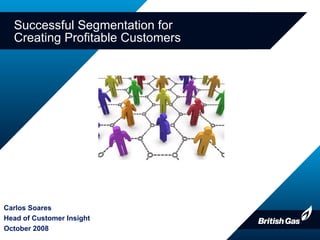
Successful Segmentation for  Creating Profitable Customers Carlos Soares Head of Customer Insight October 2008
1. Introduction 2. Renewing our understanding 3. Profiting through segmentation 4. Investing to action segmentation 5. Making it happen  Contents
Introduction Renewing our understanding What is segmentation really? And why do we use it? Communicate the learning and drive understanding throughout the business Profiting through segmentation Understanding who our customers are? What drives and motivates their behaviour? Understanding how to drive value for both parties. Determine risk and value. Developing customer and targeting strategies. Strategic and tactical. Investing to action segmentation What tools and skills are necessary What system implementations are there? Making it happen Demonstrating through action, testing and hypothesising.   The myth of the average customer Internal Passion
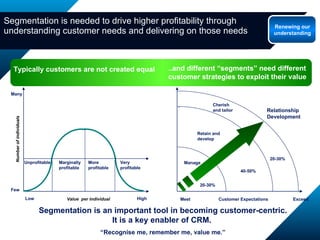
Segmentation is needed to drive higher profitability through understanding customer needs and delivering on those needs Meet Exceed Relationship  Development Retain and develop Manage Customer Expectations Cherish  and tailor Number of individuals Few Many Low High Value  per individual Unprofitable Marginally profitable More profitable Very profitable Segmentation is an important tool in becoming customer-centric. It is a key enabler of CRM.  “ Recognise me, remember me, value me.” Typically customers are not created equal ..and different “segments” need different customer strategies to exploit their value Renewing our understanding 20-30% 40-50% 20-30%
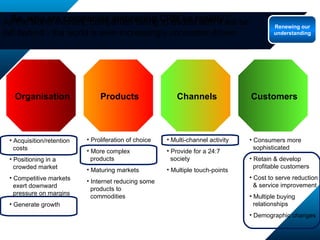
So, why are companies embracing CRM so rapidly? As the world evolves, companies failing to evolve with it will be left behind - the world is ever-increasingly consumer-driven Acquisition/retention  costs Positioning in a  crowded market Competitive markets  exert downward  pressure on margins Generate growth  Organisation Multi-channel activity Provide for a 24:7  society Multiple touch-points Channels Consumers more  sophisticated Retain & develop  profitable customers Cost to serve reduction  & service improvement  Multiple buying  relationships Demographic changes Customers Proliferation of choice More complex  products Maturing markets Internet reducing some  products to  commodities Products Renewing our understanding
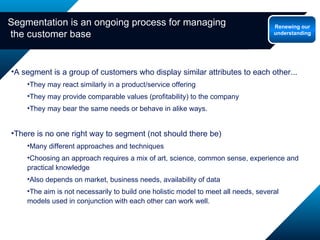
Segmentation is an ongoing process for managing  the customer base A segment is a group of customers who display similar attributes to each other... They may react similarly in a product/service offering  They may provide comparable values (profitability) to the company They may bear the same needs or behave in alike ways. There is no one right way to segment (not should there be) Many different approaches and techniques Choosing an approach requires a mix of art, science, common sense, experience and practical knowledge Also depends on market, business needs, availability of data The aim is not necessarily to build one holistic model to meet all needs, several models used in conjunction with each other can work well. Renewing our understanding
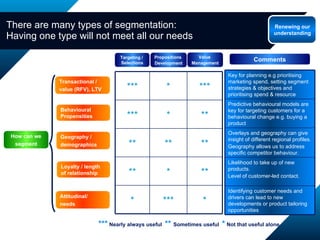
There are many types of segmentation: Having one type will not meet all our needs How can we segment Transactional /  value (RFV), LTV Attitudinal/  needs Loyalty / length of relationship Geography /  demographics Behavioural Propensities Targeting /  Selections Value  Management Propositions  Development Comments ***  Nearly always useful  **   Sometimes useful  *   Not that useful alone Renewing our understanding *** * *** *** * ** ** ** ** ** * ** * *** * Key for planning e.g prioritising marketing spend, setting segment strategies & objectives and prioritising spend & resource Predictive behavioural models are key for targeting customers for a behavioural change e.g. buying a product Overlays and geography can give insight of different regional profiles. Geography allows us to address specific competitor behaviour. Likelihood to take up of new products. Level of customer-led contact. Identifying customer needs and drivers can lead to new developments or product tailoring opportunities
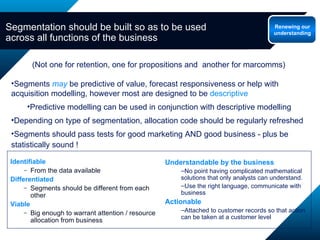
(Not one for retention, one for propositions and  another for marcomms) Segments  may   be predictive of value, forecast responsiveness or help with acquisition modelling, however most are designed to be  descriptive Predictive modelling can be used in conjunction with descriptive modelling Depending on type of segmentation, allocation code should be regularly refreshed Segments should pass tests for good marketing AND good business - plus be statistically sound ! Segmentation should be built so as to be used across all functions of the business Renewing our understanding Identifiable From the data available Differentiated Segments should be different from each other Viable Big enough to warrant attention / resource allocation from business Understandable by the business No point having complicated mathematical solutions that only analysts can understand. Use the right language, communicate with business Actionable Attached to customer records so that action can be taken at a customer level
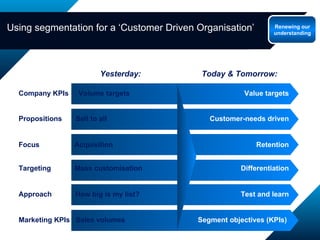
Yesterday: Today & Tomorrow: Targeting  Mass customisation Focus    Acquisition Approach  How big is my list? Differentiation Retention Test and learn Company KPIs  Volume targets Marketing KPIs  Sales volumes Value targets Segment objectives (KPIs)  Propositions  Sell to all Customer-needs driven Using segmentation for a  ‘Customer Driven Organisation’ Renewing our understanding
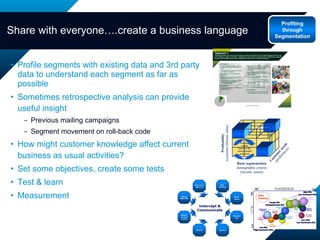
Profile segments with existing data and 3rd party data to understand each segment as far as possible Sometimes retrospective analysis can provide useful insight Previous mailing campaigns Segment movement on roll-back code How might customer knowledge affect current business as usual activities? Set some objectives, create some tests Test & learn Measurement Share with everyone….create a business language Profiting through Segmentation Basic segmentation demographic criteria (income, assets) Customer needs  (preferences) Profitability (customer lifetime value) Possible switch between the actual market segments
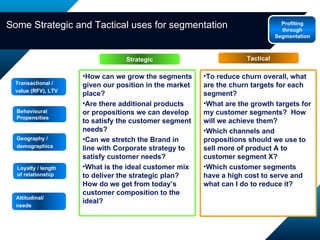
Some Strategic and Tactical uses for segmentation Transactional /  value (RFV), LTV Attitudinal/  needs Loyalty / length of relationship Geography /  demographics Behavioural Propensities Strategic Tactical Profiting through Segmentation How can we grow the segments given our position in the market place?  Are there additional products or propositions we can develop to satisfy the customer segment needs?  Can we stretch the Brand in line with Corporate strategy to satisfy customer needs? What is the ideal customer mix to deliver the strategic plan?  How do we get from today’s customer composition to the ideal? To reduce churn overall, what are the churn targets for each segment? What are the growth targets for my customer segments?  How will we achieve them? Which channels and propositions should we use to sell more of product A to customer segment X? Which customer segments have a high cost to serve and what can I do to reduce it?
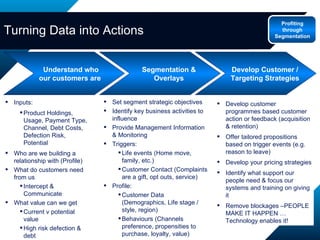
Turning Data into Actions Inputs:  Product Holdings, Usage, Payment Type, Channel, Debt Costs, Defection Risk, Potential Who are we building a relationship with (Profile) What do customers need from us Intercept & Communicate What value can we get Current v potential value High risk defection & debt Develop customer programmes based customer action or feedback (acquisition & retention) Offer tailored propositions based on trigger events (e.g. reason to leave) Develop your pricing strategies Identify what support our people need & focus our systems and training on giving it Remove blockages –PEOPLE MAKE IT HAPPEN … Technology enables it! Set segment strategic objectives Identify key business activities to influence Provide Management Information & Monitoring Triggers: Life events (Home move, family, etc.) Customer Contact (Complaints are a gift, opt outs, service) Profile: Customer Data (Demographics, Life stage / style, region) Behaviours (Channels preference, propensities to purchase, loyalty, value) Profiting through Segmentation Understand who our customers are  Segmentation & Overlays Develop Customer / Targeting Strategies
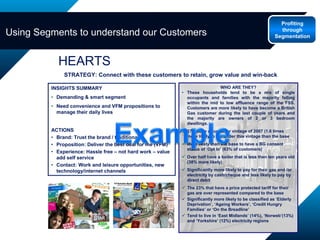
Using Segments to understand our Customers  Profiting through Segmentation
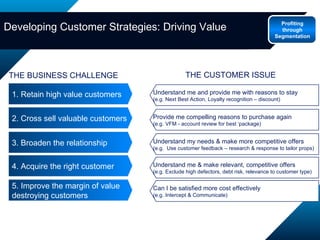
Developing Customer Strategies: Driving Value 1. Retain high value customers 2. Cross sell valuable customers 3. Broaden the relationship 5. Improve the margin of value  destroying customers 4. Acquire the right customer THE BUSINESS CHALLENGE Understand me and provide me with reasons to stay  (e.g. Next Best Action, Loyalty recognition – discount) THE CUSTOMER ISSUE Provide me compelling reasons to purchase again (e.g. VFM - account review for best ‘package) Understand me & make relevant, competitive offers (e.g. Exclude high defectors, debt risk, relevance to customer type) Understand my needs & make more competitive offers (e.g.  Use customer feedback – research & response to tailor props) Can I be satisfied more cost effectively (e.g. Intercept & Communicate) Profiting through Segmentation
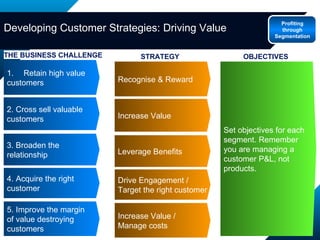
Retain high value  customers 2. Cross sell valuable  customers 3. Broaden the  relationship 5. Improve the margin  of value destroying  customers 4. Acquire the right  customer THE BUSINESS CHALLENGE Profiting through Segmentation Recognise & Reward Increase Value Leverage Benefits Increase Value / Manage costs Drive Engagement / Target the right customer STRATEGY Set objectives for each  segment. Remember  you are managing a customer P&L, not  products. OBJECTIVES Developing Customer Strategies: Driving Value
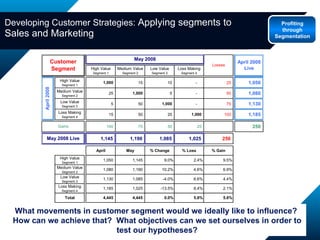
Developing Customer Strategies:  Applying segments to Sales and Marketing What movements in customer segment would we ideally like to influence?  How can we achieve that?  What objectives can we set ourselves in order to test our hypotheses? Profiting through Segmentation
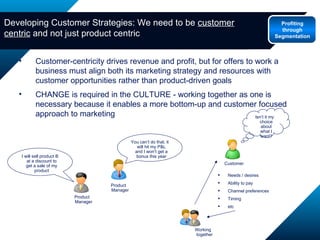
Isn’t it my choice about what I want? I will sell product B at a discount to get a sale of my product You can’t do that, it will hit my P&L and I won’t get a bonus this year Product Manager Product Manager Customer Needs / desires Ability to pay Channel preferences Timing etc Working together Developing Customer Strategies: We need to be  customer centric  and not just product centric Customer-centricity drives revenue and profit, but for offers to work a business must align both its marketing strategy and resources with customer opportunities rather than product-driven goals CHANGE is required in the CULTURE - working together as one is necessary because it enables a more bottom-up and customer focused approach to marketing  Profiting through Segmentation
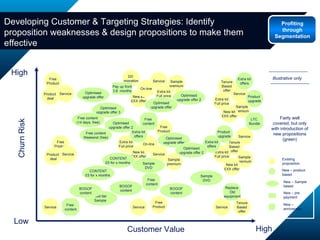
Customer Value Churn Risk High High New kit £XX offer Sample premium Free Product Free Product Product  deal Service DD  migration On-line Extra kit Full price Service Service Service Service Tenure  Based offer Service Service Tenure  Based offer Tenure  Based offer Service Service Sample premium Sample premium Product deal Extra kit Full price Extra kit Full price Extra kit Full price Sample premium New kit £XX offer New kit £XX offer New kit £XX offer On-line Product  upgrade Extra kit offers Pay up front 3,6  months Free content Replace Old equipment Optimised upgrade offer 2 Optimised upgrade offer Optimised upgrade offer 3 Free content  (14 days, free) Free content Weekend (free) BOGOF content Sample  DVD Mid tier Sample  CONTENT £5 for x months  CONTENT £5 for x months  Extra kit offers Extra kit offers Free Product Free  content Product  upgrade Existing proposition New – product based New – Sample based New – pre payment New – anniversary Low Sample  DVD BOGOF content BOGOF content Free  content Free Product Optimised upgrade offer 2 Optimised upgrade offer Optimised upgrade offer Optimised upgrade offer 2 LTC  Bundle Fairly well covered, but only with introduction of new propositions (green) Illustrative only Developing Customer & Targeting Strategies: Identify proposition weaknesses & design propositions to make them effective Profiting through Segmentation
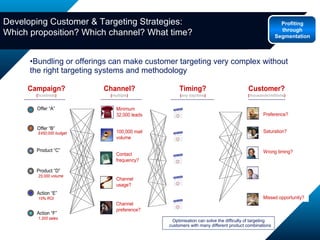
Bundling or offerings can make customer targeting very complex without the right targeting systems and methodology Event trigger Enquirer Life-stage Competitor Product Renewal Market  inflection Optimisation can solve the difficulty of targeting customers with many different product combinations Developing Customer & Targeting Strategies:  Which proposition? Which channel? What time? Profiting through Segmentation
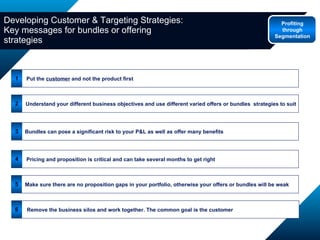
Developing Customer & Targeting Strategies: Key messages for bundles or offering strategies Put the  customer  and not the product first Pricing and proposition is critical and can take several months to get right Make sure there are no proposition gaps in your portfolio, otherwise your offers or bundles will be weak Remove the business silos and work together. The common goal is the customer Bundles can pose a significant risk to your P&L as well as offer many benefits  Understand your different business objectives and use different varied offers or bundles  strategies to suit 1 2 3 4 5 6 Profiting through Segmentation
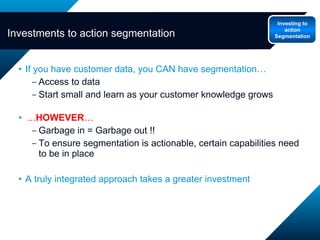
If you have customer data, you CAN have segmentation… Access to data Start small and learn as your customer knowledge grows ... HOWEVER … Garbage in = Garbage out !!  To ensure segmentation is actionable, certain capabilities need to be in place  A truly integrated approach takes a greater investment Investments to action segmentation Investing to action Segmentation
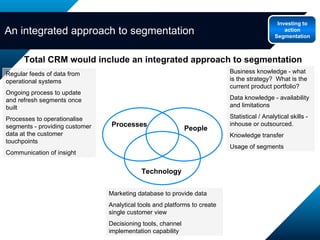
An integrated approach to segmentation Total CRM would include an integrated approach to segmentation Business knowledge - what is the strategy?  What is the current product portfolio? Data knowledge - availability and limitations Statistical / Analytical skills - inhouse or outsourced. Knowledge transfer  Usage of segments Marketing database to provide data Analytical tools and platforms to create single customer view Decisioning tools, channel implementation capability Regular feeds of data from operational systems Ongoing process to update and refresh segments once built Processes to operationalise segments - providing customer data at the customer touchpoints  Communication of insight Investing to action Segmentation
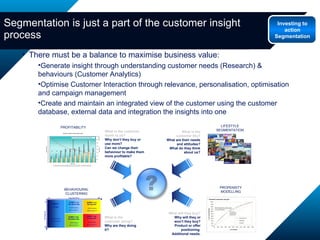
Segmentation is just a part of the customer insight process There must be a balance to maximise business value:  Generate insight through understanding customer needs (Research) & behaviours (Customer Analytics) Optimise Customer Interaction through relevance, personalisation, optimisation and campaign management Create and maintain an integrated view of the customer using the customer database, external data and integration the insights into one  Investing to action Segmentation
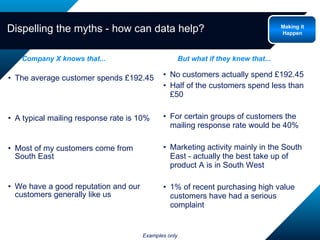
The average customer spends £192.45 A typical mailing response rate is 10% Most of my customers come from South East We have a good reputation and our customers generally like us No customers actually spend £192.45 Half of the customers spend less than £50 For certain groups of customers the mailing response rate would be 40% Marketing activity mainly in the South East - actually the best take up of product A is in South West 1% of recent purchasing high value customers have had a serious complaint Company X knows that... Dispelling the myths - how can data help? Examples only But what if they knew that... Making it Happen
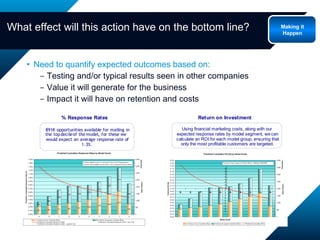
Need to quantify expected outcomes based on: Testing and/or typical results seen in other companies Value it will generate for the business  Impact it will have on retention and costs What effect will this action have on the bottom line? Making it Happen
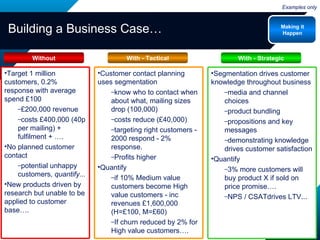
Building a Business Case… Without With - Tactical With - Strategic Examples only Making it Happen Target 1 million customers, 0.2% response with average spend £100 £200,000 revenue costs £400,000 (40p per mailing) + fulfilment + …. No planned customer contact potential unhappy customers , quantify... New products driven by research but unable to be applied to customer base…. Customer contact planning uses segmentation know who to contact when about what, mailing sizes drop (100,000) costs reduce (£40,000) targeting right customers - 2000 respond - 2% response.  Profits higher Quantify if 10% Medium value customers become High value customers - inc revenues £1,600,000  (H=£100, M=£60) If churn reduced by 2% for High value customers…. Segmentation drives customer knowledge throughout business media and channel choices product bundling propositions and key messages demonstrating knowledge drives customer satisfaction Quantify 3% more customers will buy product X if sold on price promise…. NPS / CSATdrives LTV...
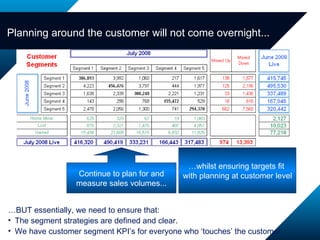
Planning around the customer will not come overnight... Continue to plan for and measure sales volumes... … whilst ensuring targets fit  with planning at customer level … BUT essentially, we need to ensure that: The segment strategies are defined and clear. We have customer segment KPI’s for everyone who ‘touches’ the customer
Customer segments are the starting point but we need to learn to manage the  customer  P&L Products, Propositions and Channels do not drive the value of the business. It is CUSTOMERS - acquisition, mix, loyalty development and retention. Buy-in at all levels and usage is fundamental. We have failed in the past because there was no buy-in to the Customer P&L.  Investment in technology is important but PEOPLE are critical.  Conclusion & Summary

Customer Segmentation

  • 1.
    Successful Segmentation for Creating Profitable Customers Carlos Soares Head of Customer Insight October 2008
  • 2.
    1. Introduction 2.Renewing our understanding 3. Profiting through segmentation 4. Investing to action segmentation 5. Making it happen Contents
  • 3.
    Introduction Renewing ourunderstanding What is segmentation really? And why do we use it? Communicate the learning and drive understanding throughout the business Profiting through segmentation Understanding who our customers are? What drives and motivates their behaviour? Understanding how to drive value for both parties. Determine risk and value. Developing customer and targeting strategies. Strategic and tactical. Investing to action segmentation What tools and skills are necessary What system implementations are there? Making it happen Demonstrating through action, testing and hypothesising. The myth of the average customer Internal Passion
  • 4.
    Segmentation is neededto drive higher profitability through understanding customer needs and delivering on those needs Meet Exceed Relationship Development Retain and develop Manage Customer Expectations Cherish and tailor Number of individuals Few Many Low High Value per individual Unprofitable Marginally profitable More profitable Very profitable Segmentation is an important tool in becoming customer-centric. It is a key enabler of CRM. “ Recognise me, remember me, value me.” Typically customers are not created equal ..and different “segments” need different customer strategies to exploit their value Renewing our understanding 20-30% 40-50% 20-30%
  • 5.
    So, why arecompanies embracing CRM so rapidly? As the world evolves, companies failing to evolve with it will be left behind - the world is ever-increasingly consumer-driven Acquisition/retention costs Positioning in a crowded market Competitive markets exert downward pressure on margins Generate growth Organisation Multi-channel activity Provide for a 24:7 society Multiple touch-points Channels Consumers more sophisticated Retain & develop profitable customers Cost to serve reduction & service improvement Multiple buying relationships Demographic changes Customers Proliferation of choice More complex products Maturing markets Internet reducing some products to commodities Products Renewing our understanding
  • 6.
    Segmentation is anongoing process for managing the customer base A segment is a group of customers who display similar attributes to each other... They may react similarly in a product/service offering They may provide comparable values (profitability) to the company They may bear the same needs or behave in alike ways. There is no one right way to segment (not should there be) Many different approaches and techniques Choosing an approach requires a mix of art, science, common sense, experience and practical knowledge Also depends on market, business needs, availability of data The aim is not necessarily to build one holistic model to meet all needs, several models used in conjunction with each other can work well. Renewing our understanding
  • 7.
    There are manytypes of segmentation: Having one type will not meet all our needs How can we segment Transactional / value (RFV), LTV Attitudinal/ needs Loyalty / length of relationship Geography / demographics Behavioural Propensities Targeting / Selections Value Management Propositions Development Comments *** Nearly always useful ** Sometimes useful * Not that useful alone Renewing our understanding *** * *** *** * ** ** ** ** ** * ** * *** * Key for planning e.g prioritising marketing spend, setting segment strategies & objectives and prioritising spend & resource Predictive behavioural models are key for targeting customers for a behavioural change e.g. buying a product Overlays and geography can give insight of different regional profiles. Geography allows us to address specific competitor behaviour. Likelihood to take up of new products. Level of customer-led contact. Identifying customer needs and drivers can lead to new developments or product tailoring opportunities
  • 8.
    (Not one forretention, one for propositions and another for marcomms) Segments may be predictive of value, forecast responsiveness or help with acquisition modelling, however most are designed to be descriptive Predictive modelling can be used in conjunction with descriptive modelling Depending on type of segmentation, allocation code should be regularly refreshed Segments should pass tests for good marketing AND good business - plus be statistically sound ! Segmentation should be built so as to be used across all functions of the business Renewing our understanding Identifiable From the data available Differentiated Segments should be different from each other Viable Big enough to warrant attention / resource allocation from business Understandable by the business No point having complicated mathematical solutions that only analysts can understand. Use the right language, communicate with business Actionable Attached to customer records so that action can be taken at a customer level
  • 9.
    Yesterday: Today &Tomorrow: Targeting Mass customisation Focus Acquisition Approach How big is my list? Differentiation Retention Test and learn Company KPIs Volume targets Marketing KPIs Sales volumes Value targets Segment objectives (KPIs) Propositions Sell to all Customer-needs driven Using segmentation for a ‘Customer Driven Organisation’ Renewing our understanding
  • 10.
    Profile segments withexisting data and 3rd party data to understand each segment as far as possible Sometimes retrospective analysis can provide useful insight Previous mailing campaigns Segment movement on roll-back code How might customer knowledge affect current business as usual activities? Set some objectives, create some tests Test & learn Measurement Share with everyone….create a business language Profiting through Segmentation Basic segmentation demographic criteria (income, assets) Customer needs (preferences) Profitability (customer lifetime value) Possible switch between the actual market segments
  • 11.
    Some Strategic andTactical uses for segmentation Transactional / value (RFV), LTV Attitudinal/ needs Loyalty / length of relationship Geography / demographics Behavioural Propensities Strategic Tactical Profiting through Segmentation How can we grow the segments given our position in the market place? Are there additional products or propositions we can develop to satisfy the customer segment needs? Can we stretch the Brand in line with Corporate strategy to satisfy customer needs? What is the ideal customer mix to deliver the strategic plan? How do we get from today’s customer composition to the ideal? To reduce churn overall, what are the churn targets for each segment? What are the growth targets for my customer segments? How will we achieve them? Which channels and propositions should we use to sell more of product A to customer segment X? Which customer segments have a high cost to serve and what can I do to reduce it?
  • 12.
    Turning Data intoActions Inputs: Product Holdings, Usage, Payment Type, Channel, Debt Costs, Defection Risk, Potential Who are we building a relationship with (Profile) What do customers need from us Intercept & Communicate What value can we get Current v potential value High risk defection & debt Develop customer programmes based customer action or feedback (acquisition & retention) Offer tailored propositions based on trigger events (e.g. reason to leave) Develop your pricing strategies Identify what support our people need & focus our systems and training on giving it Remove blockages –PEOPLE MAKE IT HAPPEN … Technology enables it! Set segment strategic objectives Identify key business activities to influence Provide Management Information & Monitoring Triggers: Life events (Home move, family, etc.) Customer Contact (Complaints are a gift, opt outs, service) Profile: Customer Data (Demographics, Life stage / style, region) Behaviours (Channels preference, propensities to purchase, loyalty, value) Profiting through Segmentation Understand who our customers are Segmentation & Overlays Develop Customer / Targeting Strategies
  • 13.
    Using Segments tounderstand our Customers Profiting through Segmentation
  • 14.
    Developing Customer Strategies:Driving Value 1. Retain high value customers 2. Cross sell valuable customers 3. Broaden the relationship 5. Improve the margin of value destroying customers 4. Acquire the right customer THE BUSINESS CHALLENGE Understand me and provide me with reasons to stay (e.g. Next Best Action, Loyalty recognition – discount) THE CUSTOMER ISSUE Provide me compelling reasons to purchase again (e.g. VFM - account review for best ‘package) Understand me & make relevant, competitive offers (e.g. Exclude high defectors, debt risk, relevance to customer type) Understand my needs & make more competitive offers (e.g. Use customer feedback – research & response to tailor props) Can I be satisfied more cost effectively (e.g. Intercept & Communicate) Profiting through Segmentation
  • 15.
    Retain high value customers 2. Cross sell valuable customers 3. Broaden the relationship 5. Improve the margin of value destroying customers 4. Acquire the right customer THE BUSINESS CHALLENGE Profiting through Segmentation Recognise & Reward Increase Value Leverage Benefits Increase Value / Manage costs Drive Engagement / Target the right customer STRATEGY Set objectives for each segment. Remember you are managing a customer P&L, not products. OBJECTIVES Developing Customer Strategies: Driving Value
  • 16.
    Developing Customer Strategies: Applying segments to Sales and Marketing What movements in customer segment would we ideally like to influence? How can we achieve that? What objectives can we set ourselves in order to test our hypotheses? Profiting through Segmentation
  • 17.
    Isn’t it mychoice about what I want? I will sell product B at a discount to get a sale of my product You can’t do that, it will hit my P&L and I won’t get a bonus this year Product Manager Product Manager Customer Needs / desires Ability to pay Channel preferences Timing etc Working together Developing Customer Strategies: We need to be customer centric and not just product centric Customer-centricity drives revenue and profit, but for offers to work a business must align both its marketing strategy and resources with customer opportunities rather than product-driven goals CHANGE is required in the CULTURE - working together as one is necessary because it enables a more bottom-up and customer focused approach to marketing Profiting through Segmentation
  • 18.
    Customer Value ChurnRisk High High New kit £XX offer Sample premium Free Product Free Product Product deal Service DD migration On-line Extra kit Full price Service Service Service Service Tenure Based offer Service Service Tenure Based offer Tenure Based offer Service Service Sample premium Sample premium Product deal Extra kit Full price Extra kit Full price Extra kit Full price Sample premium New kit £XX offer New kit £XX offer New kit £XX offer On-line Product upgrade Extra kit offers Pay up front 3,6 months Free content Replace Old equipment Optimised upgrade offer 2 Optimised upgrade offer Optimised upgrade offer 3 Free content (14 days, free) Free content Weekend (free) BOGOF content Sample DVD Mid tier Sample CONTENT £5 for x months CONTENT £5 for x months Extra kit offers Extra kit offers Free Product Free content Product upgrade Existing proposition New – product based New – Sample based New – pre payment New – anniversary Low Sample DVD BOGOF content BOGOF content Free content Free Product Optimised upgrade offer 2 Optimised upgrade offer Optimised upgrade offer Optimised upgrade offer 2 LTC Bundle Fairly well covered, but only with introduction of new propositions (green) Illustrative only Developing Customer & Targeting Strategies: Identify proposition weaknesses & design propositions to make them effective Profiting through Segmentation
  • 19.
    Bundling or offeringscan make customer targeting very complex without the right targeting systems and methodology Event trigger Enquirer Life-stage Competitor Product Renewal Market inflection Optimisation can solve the difficulty of targeting customers with many different product combinations Developing Customer & Targeting Strategies: Which proposition? Which channel? What time? Profiting through Segmentation
  • 20.
    Developing Customer &Targeting Strategies: Key messages for bundles or offering strategies Put the customer and not the product first Pricing and proposition is critical and can take several months to get right Make sure there are no proposition gaps in your portfolio, otherwise your offers or bundles will be weak Remove the business silos and work together. The common goal is the customer Bundles can pose a significant risk to your P&L as well as offer many benefits Understand your different business objectives and use different varied offers or bundles strategies to suit 1 2 3 4 5 6 Profiting through Segmentation
  • 21.
    If you havecustomer data, you CAN have segmentation… Access to data Start small and learn as your customer knowledge grows ... HOWEVER … Garbage in = Garbage out !! To ensure segmentation is actionable, certain capabilities need to be in place A truly integrated approach takes a greater investment Investments to action segmentation Investing to action Segmentation
  • 22.
    An integrated approachto segmentation Total CRM would include an integrated approach to segmentation Business knowledge - what is the strategy? What is the current product portfolio? Data knowledge - availability and limitations Statistical / Analytical skills - inhouse or outsourced. Knowledge transfer Usage of segments Marketing database to provide data Analytical tools and platforms to create single customer view Decisioning tools, channel implementation capability Regular feeds of data from operational systems Ongoing process to update and refresh segments once built Processes to operationalise segments - providing customer data at the customer touchpoints Communication of insight Investing to action Segmentation
  • 23.
    Segmentation is justa part of the customer insight process There must be a balance to maximise business value: Generate insight through understanding customer needs (Research) & behaviours (Customer Analytics) Optimise Customer Interaction through relevance, personalisation, optimisation and campaign management Create and maintain an integrated view of the customer using the customer database, external data and integration the insights into one Investing to action Segmentation
  • 24.
    The average customerspends £192.45 A typical mailing response rate is 10% Most of my customers come from South East We have a good reputation and our customers generally like us No customers actually spend £192.45 Half of the customers spend less than £50 For certain groups of customers the mailing response rate would be 40% Marketing activity mainly in the South East - actually the best take up of product A is in South West 1% of recent purchasing high value customers have had a serious complaint Company X knows that... Dispelling the myths - how can data help? Examples only But what if they knew that... Making it Happen
  • 25.
    Need to quantifyexpected outcomes based on: Testing and/or typical results seen in other companies Value it will generate for the business Impact it will have on retention and costs What effect will this action have on the bottom line? Making it Happen
  • 26.
    Building a BusinessCase… Without With - Tactical With - Strategic Examples only Making it Happen Target 1 million customers, 0.2% response with average spend £100 £200,000 revenue costs £400,000 (40p per mailing) + fulfilment + …. No planned customer contact potential unhappy customers , quantify... New products driven by research but unable to be applied to customer base…. Customer contact planning uses segmentation know who to contact when about what, mailing sizes drop (100,000) costs reduce (£40,000) targeting right customers - 2000 respond - 2% response. Profits higher Quantify if 10% Medium value customers become High value customers - inc revenues £1,600,000 (H=£100, M=£60) If churn reduced by 2% for High value customers…. Segmentation drives customer knowledge throughout business media and channel choices product bundling propositions and key messages demonstrating knowledge drives customer satisfaction Quantify 3% more customers will buy product X if sold on price promise…. NPS / CSATdrives LTV...
  • 27.
    Planning around thecustomer will not come overnight... Continue to plan for and measure sales volumes... … whilst ensuring targets fit with planning at customer level … BUT essentially, we need to ensure that: The segment strategies are defined and clear. We have customer segment KPI’s for everyone who ‘touches’ the customer
  • 28.
    Customer segments arethe starting point but we need to learn to manage the customer P&L Products, Propositions and Channels do not drive the value of the business. It is CUSTOMERS - acquisition, mix, loyalty development and retention. Buy-in at all levels and usage is fundamental. We have failed in the past because there was no buy-in to the Customer P&L. Investment in technology is important but PEOPLE are critical. Conclusion & Summary

Editor's Notes

  • #10 Value - market share Voume - share of customer
  • #24 1. Profitability: Customer profitability is the cornerstone of CRM, it identifies who is worth servicing and gives a performance measure. Who is adding value to our business? Where does the value get generated? How effective have our CRM efforts been? How much can we spend on CRM activity? 2. Segmentation: The Lifestyle segmentation tells you what your customers are like as people, we need this to develop marketing messages and to design appropriate products / propositions What do our customers look like as people, not data? What kind of products would they need based on their life-stage? What kind of messages would be appropriate for our customer / consumer set? 3. Behavioural Clustering: This shows what the customers are doing with us, often very similar customers from a lifestyle perspective have very different behaviours. What are our customers doing with us? What do our customers choose us for? What opportunities exist to migrate customers into more productive segments? Are there clear gaps in product take up by our customers? Data mining starts without an end in mind and helps get to hidden patterns. 4. Propensity Modelling: Shows how likely a customer /consumer is to purchase a product, defect, etc., this analysis can be done for each of the behavioural clusters Other questions it answer are: How similar is this customer to other customers with this product or behaviour? NOT JUST about SALES but BUYING AND CUSTOMER DIALOGUE