Shende, et al.:Postural behavior of large white yorkshire piglets
AEXTJ/Jan-Mar-2025/Vol 9/Issue 1 2
affect animal behavior and growth performance if
the flooring material causes stress to the animal.
Bedding substrates can help animals adapt to a
new environment by providing environmental
enrichment. Therefore, the ideal bed needs to be
hygienic, dry, resilient, and reasonably temperature
resistant.
Earlier, pigs were reared traditionally in small to
medium herds, in simple housing to provide comfort
and warmth. Over time, pigs are confined and reared
under an intensive system of housing.[16]
As a result
of confinement, pigs exhibit various behavioral
changes and many behavioral problems. One of
the most essential factors that decide the ability of
piglets to adapt to the post-weaning environment
is the piglet’s pre-weaning experience gained by
their various behavioral traits.[7]
Piglets are very
intelligent and most fascinating creatures which
show conspicuously various behaviors. Piglets
may exhibit numerous normal as well as several
abnormal behaviors and it is important to investigate
and understand such behaviors in the interest of
improving pig welfare and productivity. Piglet’s
behavior could vary with the advancement of age.
Number of behavioral problems are associated with
weaning piglets including belly nosing, ear and tail
biting, and low intake of solid food. These appear
to be less pronounced in piglets reared on outdoor
systems, which initially consume more solid food
and show less belly nosing and aggression than
indoor-reared piglets.[7]
Time spent resting occupies the majority of the time
budget in growing-finishing pigs,[18]
and therefore,
an adequate lying comfort seems important for their
welfare.[19]
The aforementioned housing factors
can compromise the ability of pigs to perform this
activity adequately. Data relative to the allometric
spacerequiredtosatisfypigs’differentlyingpostures
already exists,[10,17]
but the quantitative relationships
between housing factors and the percentage of time
spent lying remain largely unknown. The evaluation
of these relationships could provide valuable
information to determine the impact of alternative
management systems on the welfare of growing-
finishing pigs, and how it might be improved.
A pre-weaning housing system may also influence
the negative side of the social interactions among
piglets, namely their agonistic behavior. Agonistic
behavior is important for the establishment of a
dominance hierarchy among new group members.[13]
MATERIALS AND METHODS
After farrowing, 24-day-old large white Yorkshire
(LWY) piglets of either sex from 3 L were selected
from the pig unit and reared on normal conventional
concreteflooringalongwiththeirmothertillweaning
(56 days). All the piglets during the preweaning
period were housed under conventional housing with
concrete floor along with their mother provided with
a floor space of 9 m2
/sow in the covered shed with
an asbestos roof. The experimental piglets were ear
notched for proper recording of the data. The needle
teeth of the piglets were cut on the birthday. All the
piglets were injected with iron dextran Ferrextran
100 (Ferrextran 100 @100 mg/piglet) on the 4th
day
and 14th
day and vitaminA(Vetinol-Aat 3 Lakh I.U./
kg body weight) on the 14th
day of the experiment.
Experimental piglets during the preweaning period
were provided with the creep ration as per ICAR
(2013), and the composition of the creep ration is
presented in Table 1.[2]
Creep feed was provided to
piglets during the preweaning period once a day ad
libitum in the creep area from the 21st
day of age.
Behavior recording was done by scan sampling
(collecting data at specified time intervals, and
noting what each animal is currently doing) as per
Crews et al.[8]
The investigator himself recorded all
the behavioral parameters for the purpose.
The behavioral pattern of piglets was studied for a
continuous period of 56 days from birth to weaning
during the preweaning period by recording the
behavioral traits at different hours continuously
from morning 6 am to evening 6 pm at 60-min
interval daily. Data of various postural and social
behaviors recorded at hourly interval were tabulated
and daily and fortnightly average for each behavior
was calculated. The behavioral pattern of piglets
was recorded by visual recording from outside the
pen without interfering with the natural behavior of
the piglets during the study period.
Various postural and social-behavioral traits of
piglets were observed and recorded through scan
sampling procedure. The description of various
recorded behavior activities of piglets given by Cox
and Cooper[7]
is as follows.
3.
Shende, et al.:Postural behavior of large white yorkshire piglets
AEXTJ/Jan-Mar-2025/Vol 9/Issue 1 3
The average number of animals exhibiting each
behavior was computed fortnightwise to observe
the effect of age on each behavior during pre-
weaning period. The proportion of each behavior
was calculated from the obtained average and data
were again transformed to meet the assumptions of
normality and homogeneity, necessary for further
statistical analysis. Behavioral data were analyzed
by General Linear Model One-way Analysis of
Variance. Tukey’s Honest Significant Difference
test was used to test the differences among the
fortnights of each behavior. The trial version of
the Statistical Package for the Social Sciences
(version 25.0; SPSS, 2019) was used for statistical
analysis using SPSS statistical software.
RESULTS
Postural Behaviors
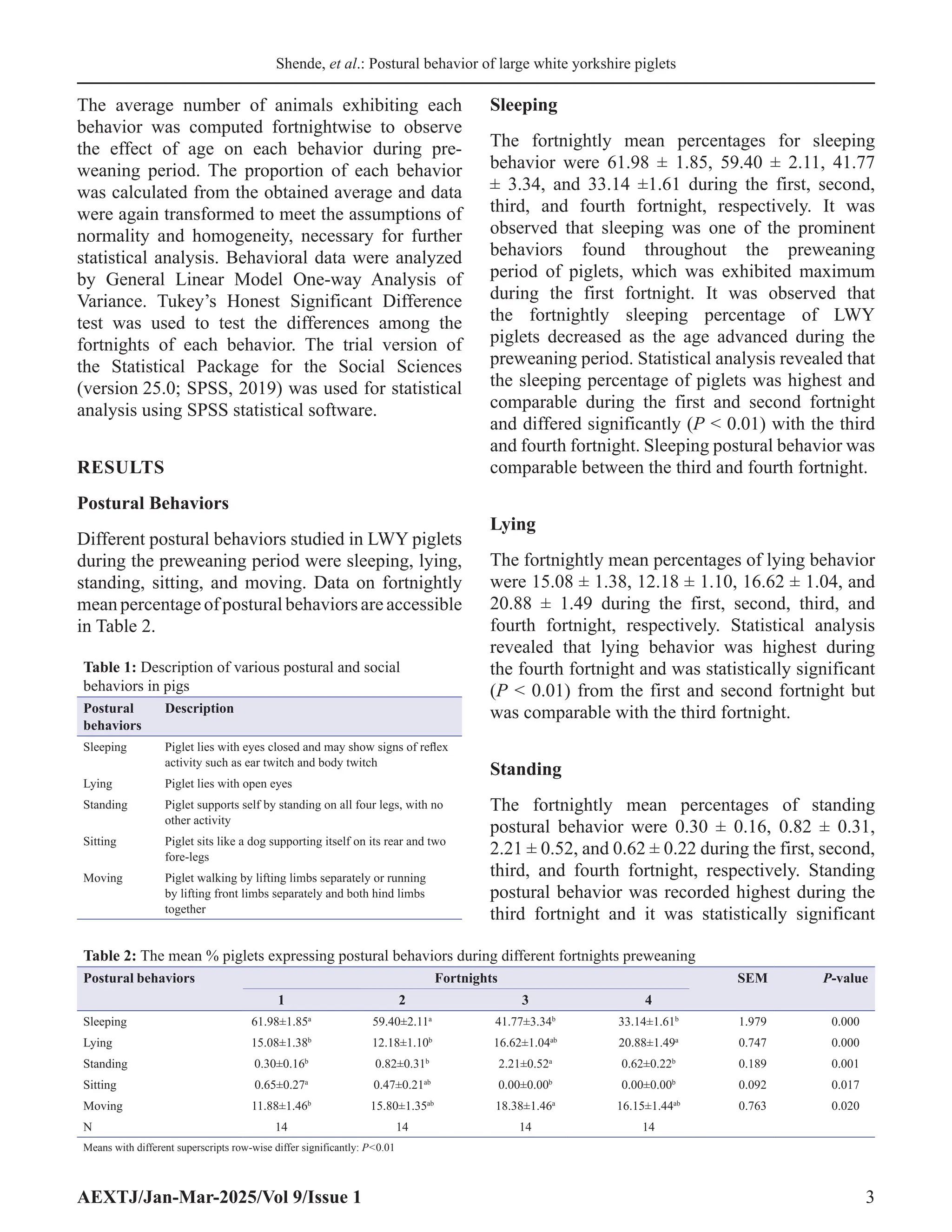
Different postural behaviors studied in LWY piglets
during the preweaning period were sleeping, lying,
standing, sitting, and moving. Data on fortnightly
mean percentage of postural behaviors are accessible
in Table 2.
Sleeping
The fortnightly mean percentages for sleeping
behavior were 61.98 ± 1.85, 59.40 ± 2.11, 41.77
± 3.34, and 33.14 ±1.61 during the first, second,
third, and fourth fortnight, respectively. It was
observed that sleeping was one of the prominent
behaviors found throughout the preweaning
period of piglets, which was exhibited maximum
during the first fortnight. It was observed that
the fortnightly sleeping percentage of LWY
piglets decreased as the age advanced during the
preweaning period. Statistical analysis revealed that
the sleeping percentage of piglets was highest and
comparable during the first and second fortnight
and differed significantly (P 0.01) with the third
and fourth fortnight. Sleeping postural behavior was
comparable between the third and fourth fortnight.
Lying
The fortnightly mean percentages of lying behavior
were 15.08 ± 1.38, 12.18 ± 1.10, 16.62 ± 1.04, and
20.88 ± 1.49 during the first, second, third, and
fourth fortnight, respectively. Statistical analysis
revealed that lying behavior was highest during
the fourth fortnight and was statistically significant
(P 0.01) from the first and second fortnight but
was comparable with the third fortnight.
Standing
The fortnightly mean percentages of standing
postural behavior were 0.30 ± 0.16, 0.82 ± 0.31,
2.21 ± 0.52, and 0.62 ± 0.22 during the first, second,
third, and fourth fortnight, respectively. Standing
postural behavior was recorded highest during the
third fortnight and it was statistically significant
Table 2: The mean % piglets expressing postural behaviors during different fortnights preweaning
Postural behaviors Fortnights SEM P‑value
1 2 3 4
Sleeping 61.98±1.85a
59.40±2.11a
41.77±3.34b
33.14±1.61b
1.979 0.000
Lying 15.08±1.38b
12.18±1.10b
16.62±1.04ab
20.88±1.49a
0.747 0.000
Standing 0.30±0.16b
0.82±0.31b
2.21±0.52a
0.62±0.22b
0.189 0.001
Sitting 0.65±0.27a
0.47±0.21ab
0.00±0.00b
0.00±0.00b
0.092 0.017
Moving 11.88±1.46b
15.80±1.35ab
18.38±1.46a
16.15±1.44ab
0.763 0.020
N 14 14 14 14
Means with different superscripts row‑wise differ significantly: P0.01
Table 1: Description of various postural and social
behaviors in pigs
Postural
behaviors
Description
Sleeping Piglet lies with eyes closed and may show signs of reflex
activity such as ear twitch and body twitch
Lying Piglet lies with open eyes
Standing Piglet supports self by standing on all four legs, with no
other activity
Sitting Piglet sits like a dog supporting itself on its rear and two
fore‑legs
Moving Piglet walking by lifting limbs separately or running
by lifting front limbs separately and both hind limbs
together
4.
Shende, et al.:Postural behavior of large white yorkshire piglets
AEXTJ/Jan-Mar-2025/Vol 9/Issue 1 4
(P0.01)fromthefirst,second,andfourthfortnight.
Standing postural behavior among the first, second,
and fourth fortnight was non-significant and it was
highest during the second fortnight followed by the
fourth and first.
Sitting
As per Table 2, it was seen that the fortnightly mean
percentage of sitting behavior were 0.65 ± 0.27, 0.47
± 0.21, 0.00 ± 0.00, and 0.00 ± 0.00, respectively,
during the first, second, third, and fourth fortnight.
Sitting behavior at the first fortnight was highest
and statistically significant (P 0.05) from the third
and fourth fortnight but non-significant with the
second fortnight. Sitting postural behavior was not
expressed during the third and fourth fortnight but
did not differ significantly with the second fortnight.
Moving
The fortnightly mean percentage of moving postural
behavior were 11.88 ± 1.46, 15.80 ± 1.35, 18.38
± 1.46, and 16.15 ± 1.44 during the first, second,
third, and fourth fortnight. Statistical analysis
revealed that the mean percentage of moving
postural behavior was highest at the third fortnight
and differed significantly (P 0.05) with the first
fortnight and non-significantly with the second
and fourth fortnights. Means in the second and
fourth fortnight were comparable to each other and
differed non-significantly from the means in the
first fortnight.
DISCUSSION
Sleeping
The fortnightly mean percentage for sleeping was
61.98 ± 1.85, 59.40 ± 2.11, 41.77 ± 3.34, and
33.14 ± 1.61 during the first, second, third and
fourth fortnight, respectively. It was observed
that sleeping was one of the prominent behaviors
found throughout the preweaning fortnights of
piglets, which was exhibited maximum during the
first fortnight. It was observed that the fortnightly
sleeping percentage of LWY piglets decreased as
the age advanced during the preweaning period.
The present findings are in agreement with Cox and
Cooper[7]
and Li,[12]
whereas, Cherryl et al.[5]
have
reported maximum proportion of piglets sleeping at
4th
week, hence dissimilar to the present findings.
Lying
The fortnightly mean percentage of lying were
15.08 ± 1.38, 12.18 ± 1.10, 16.62 ± 1.04, and
20.88 ± 1.49 during the first, second, third, and
fourth fortnight, respectively. Statistical analysis
revealed that lying postural behavior was highest
and statistically significant (P 0.01) from the
first and second fortnight but was comparable with
the third fortnight. The lying postural behavior
percentage was higher in the first fortnight than
the second fortnight but did not differ significantly.
The present findings are in agreement with Cox and
Cooper,[7]
Breuer et al.,[2]
and Cherryl et al.[5]
where
no effect of age on lying during preweaning period
was recorded.
Standing
The fortnightly mean percentage of standing were
0.30 ± 0.16, 0.82 ± 0.31, 2.21 ± 0.52, and 0.62 ±
0.22 during the first, second, third, and fourth
fortnight, respectively. Standing postural behavior
was recorded highest during the third fortnight and it
was statistically significant (P 0.01) from the first,
second, and fourth fortnight. There was no effect
of age on standing behavior and it is supported by
the findings of Cox and Cooper[7]
and these results
are contrary to Cherryl et al.[5]
who have reported
increase and stabilization in standing behavior as
the age advanced.
Sitting
The fortnightly mean percentage of sitting was
0.65 ± 0.27, 0.47 ± 0.21, 0.00 ± 0.00, and 0.00 ± 0.00,
respectively, during the first, second, third, and
fourth fortnight, respectively. Sitting postural
behavior in the first fortnight was highest and
statistically significant (P 0.05) from the third and
fourth fortnight but non-significant with the second
fortnight. Only very few piglets were observed in
sitting posture throughout the preweaning period
5.
Shende, et al.:Postural behavior of large white yorkshire piglets
AEXTJ/Jan-Mar-2025/Vol 9/Issue 1 5
which was supported by the findings of Cox and
Cooper,[7]
Li,[12]
and Cherryl et al.[5]
Moving
The fortnightly mean percentage of moving was
11.88 ± 1.46, 15.80 ± 1.35, 18.38 ± 1.46, and
16.15 ± 1.44 during the first, second, third, and
fourth fortnight. Statistical analysis revealed that
the mean percentage of moving postural behavior
was highest in the third fortnight and differed
significantly (P 0.05) with the first fortnight
and non-significantly with the second and fourth
fortnight. Movement of the piglets varied with
age and there was an increasing trend from birth
to third fortnight and slight decrease at fourth
fortnight. These findings are in concurrence with
Cherryl et al.[5]
CONCLUSION
Concrete floor did not cause any stress on piglets
during the preweaning period as reflected by normal
postural and social behavior expressed by LWY
piglets during the preweaning period.
REFERENCES
1. Barnett JL, Hemsworth PH, Cronin GM, Jongman EC,
Hutson GD. A review of the welfare issues for sows and
pigletsinrelationtohousing.AustJAgricRes2001;52:1-28.
2. Breuer K, Kay RM, Demmers TG, Day JE. The effect
of floor type on ammonia emission, welfare, health
and behaviour of growing pigs. BSAP Occas Publ
2004;31:157-63.
3. Broom DM. Animal welfare: Concepts and measurement.
J Anim Sci 1991;69:4167-75.
4. Candiani D, Salamano G, Mellia E, Doglione L,
Bruno R, Toussaint M, et al. A combination of behavioral
and physiological indicators for assessing pig welfare on
the farm. J Appl Anim Welf Sci 2008;11:1-13.
5. Cherryl DM, Prasad RM, Jayalaxmi P, Guruvishnu P.
A study on preweaning postural behaviour of Large
White Yorkshire Piglets. Int J Sci Environ Technol
2016a;5:1438-44.
6. Cherryl DM, Prasad RM, Guruvishnu P, Jayalaxmi P.
A study on cross bred (Large White Yorkshire) piglet
behaviour from birth to weaning in the hot and dry areas
of Kadapa district of Andhra Pradesh. Global J Bio Sci
Biotechnol 2016b;5:324-6.
7. Cox LN, Cooper JJ. Observations on the pre- and post-
weaning behaviour of piglets reared in commercial indoor
and outdoor environments. Anim Sci 2001;72:75-86.
8. Crews J, Braude S, Stephenson C, Clardy T. The Ethogram
and Animal Behavior Research. St. Louis: Washington
University; 2002.
9. Dupjan S, Schon P, Puppe B,TuchschererA, Manteuffel G.
Differential vocal response to physical and mental
stressors in domestic pigs (Sus scrofa). Appl Anim Behav
Sci 2008;114:105-15.
10. Ekkel ED, Spoolder HA, Hulsegge I, Hopster H. Lying
characteristics as determinants for space requirements in
pigs. Appl Anim Behav Sci 2003;80:19-30.
11. Kymalainen HR, Kuisma R, Maatta J, Sjoberg AM.
Assessment of cleanness of environmental surfaces in
cattle barns and piggeries.Agric Food Sci 2009;18:268-82.
12. Li Y. Normal and Abnormal Behaviours of Swine under
Production Conditions. Normal andAbnormal Behaviours
of Swine under Production Conditions, The Pig Site.
Available from: https://www.thepigsite.com/articles/2014
[Last accessed on 2025 Feb 02].
13. Meese GB and Ewbank R. The establishment and nature
of the dominance hierarchy in the domesticated pig. Anim
Behav 1973;21:326-34.
14. Mills DS, Marchant-Forde JN, Mcgreevy PD, Morton D,
Nicol CJ, Phillips CJ, et al. The Encyclopedia of
Applied Animal Behaviour and Welfare. Cambridge,
United Kingdom: CAB International, Cambridge
University Press; 2010. p. 269-270.
15. MiroSM,FernandoT,RamonM,EscribanoD,FuensantaH,
Madrid J, et al. Causes, consequences and biomarkers of
stress in swine: An update. BMC Vet Res 2016;12:171.
16. PavicicZ,OstovicM,MencikS,KabalinAE,VucemiloM,
Matkovic K, et al. Postural behaviour in gilts housed on
concrete and rubber slats during four seasons. Maced Vet
Rev 2014;37:157-64.
17. Petherick JC. A biological basis for the design of space
in livestock housing. In: Baxter, SH, Baxter MR,
MacCormack JA, editors. Farm Animal Housing and
Welfare. Germany: Springer; 1983. p. 103-20.
18. RuckebuschY.Therelevanceofdrowsinessinthecircadian
cycle of farm animals. Anim Behav 1972;20:637-43.
19. Tuyttens FAM. The importance of straw for pig and cattle
welfare: A review. Appl Anim Behav Sci 2005;92:261-82.
![© 2025, AEXTJ. All Rights Reserved 1
RESEARCH ARTICLE
Postural Behavior of Large White Yorkshire Piglets during Preweaning Period
Reared on Cement Concrete Floor
G. P. Shende1
, R. M. V. Prasad2
, Sarat Chandra3
, Gnana Prakash4
, D. Nagalakshmi5
, M. Srinivas Reddy6
1
Department of Livestock Production Management, College of Veterinary Science, Hyderabad, Telangana, India,
2
Department of Livestock Farm Complex, College of Veterinary Science, Hyderabad, Telangana, India, 3
Department
of Livestock Production Management, College of Dairy Technology, Kamareddy, Telangana, India, 4
Department of
Animal Genetics and Breeding, P.V. Narsimha Rao Telangana Veterinary University, Hyderabad, Telangana, India,
5
Department of Animal Nutrition, College of Fishery Science, Pebbair, Telangana, India, 6
Department of Veterinary
and A.H. Extension Education, College of Veterinary Science, Hyderabad, Telangana, India
Received: 02-02-2025; Revised: 02-02-2025; Accepted: 10-02-2025
ABSTRACT
After farrowing, 24-day-old large white Yorkshire piglets of either sex from 3 L were reared on normal
conventional concrete flooring along with their mother till weaning (56 days). The behavioral pattern of
piglets was studied at different hours continuously from morning 6 am to evening 6 pm at 60-min intervals
daily. The behavioral pattern of piglets was recorded by visual recording from outside the pen without
interfering with the natural behavior of the piglets during the study period. It was observed that sleeping was
one of the prominent behaviors found throughout the experimental period, which was exhibited maximum
during the first fortnight. Lying postural behavior was highest during the fourth fortnight. Standing postural
behavior was recorded highest during the third fortnight and it was statistically significant (P 0.01) from
the first, second, and fourth fortnight. Only very few piglets were observed in sitting posture throughout the
experimental period. The mean percentage of moving postural behavior was highest in the third fortnight.
There was an increasing trend in agonistic behavior as the age advanced. Nose contact and belly contact social
behaviors were expressed highest during the fourth fortnight. Tail-biting social behavior was expressed only
during the third and fourth fortnight. Ear-biting social behavior was expressed only at the fourth fortnight
during the experimental period.
Key words: Cement concrete floor, large white Yorkshire piglets, postural and social behaviors,
preweaning period
INTRODUCTION
Behavior is the reaction of an organism through
which it interacts with the environment. Behaviors
may indicate animal welfare, particularly in a
confinement environment.[6]
Behavioral assessment
has the advantage of being non-invasive,[9]
a quick,
and practical technique that measures the status of
an individual in relation to the environment.[3]
Address for correspondence:
G. P. Shende
drshende_1979@rediffmail.com
In recent years, there has been a growing
concern about animal welfare due to the
undesirable consequences on general productivity
performance.[15]
Increased demand for quality
animal products has led to the intensification of
production that compromises animal welfare.[1,4]
Animal welfare, among other things, depends on
the type of floor in their housing.[14]
The floor as the
main part of the house influences animal welfare by
its design and material, which is then manifested in
species-specific behavior, the occurrence of lesions
and diseases, and convenience.[11]
Flooring type may
Available Online at www.aextj.com
Agricultural Extension Journal 2025; 9(1):1-5
ISSN 2582- 564X](https://image.slidesharecdn.com/aextj4632520250225v1-250818064325-f6de3824/75/Postural-Behavior-of-Large-White-Yorkshire-Piglets-during-Preweaning-Period-Reared-on-Cement-Concrete-Floor-1-2048.jpg)
![Shende, et al.: Postural behavior of large white yorkshire piglets
AEXTJ/Jan-Mar-2025/Vol 9/Issue 1 2
affect animal behavior and growth performance if
the flooring material causes stress to the animal.
Bedding substrates can help animals adapt to a
new environment by providing environmental
enrichment. Therefore, the ideal bed needs to be
hygienic, dry, resilient, and reasonably temperature
resistant.
Earlier, pigs were reared traditionally in small to
medium herds, in simple housing to provide comfort
and warmth. Over time, pigs are confined and reared
under an intensive system of housing.[16]
As a result
of confinement, pigs exhibit various behavioral
changes and many behavioral problems. One of
the most essential factors that decide the ability of
piglets to adapt to the post-weaning environment
is the piglet’s pre-weaning experience gained by
their various behavioral traits.[7]
Piglets are very
intelligent and most fascinating creatures which
show conspicuously various behaviors. Piglets
may exhibit numerous normal as well as several
abnormal behaviors and it is important to investigate
and understand such behaviors in the interest of
improving pig welfare and productivity. Piglet’s
behavior could vary with the advancement of age.
Number of behavioral problems are associated with
weaning piglets including belly nosing, ear and tail
biting, and low intake of solid food. These appear
to be less pronounced in piglets reared on outdoor
systems, which initially consume more solid food
and show less belly nosing and aggression than
indoor-reared piglets.[7]
Time spent resting occupies the majority of the time
budget in growing-finishing pigs,[18]
and therefore,
an adequate lying comfort seems important for their
welfare.[19]
The aforementioned housing factors
can compromise the ability of pigs to perform this
activity adequately. Data relative to the allometric
spacerequiredtosatisfypigs’differentlyingpostures
already exists,[10,17]
but the quantitative relationships
between housing factors and the percentage of time
spent lying remain largely unknown. The evaluation
of these relationships could provide valuable
information to determine the impact of alternative
management systems on the welfare of growing-
finishing pigs, and how it might be improved.
A pre-weaning housing system may also influence
the negative side of the social interactions among
piglets, namely their agonistic behavior. Agonistic
behavior is important for the establishment of a
dominance hierarchy among new group members.[13]
MATERIALS AND METHODS
After farrowing, 24-day-old large white Yorkshire
(LWY) piglets of either sex from 3 L were selected
from the pig unit and reared on normal conventional
concreteflooringalongwiththeirmothertillweaning
(56 days). All the piglets during the preweaning
period were housed under conventional housing with
concrete floor along with their mother provided with
a floor space of 9 m2
/sow in the covered shed with
an asbestos roof. The experimental piglets were ear
notched for proper recording of the data. The needle
teeth of the piglets were cut on the birthday. All the
piglets were injected with iron dextran Ferrextran
100 (Ferrextran 100 @100 mg/piglet) on the 4th
day
and 14th
day and vitaminA(Vetinol-Aat 3 Lakh I.U./
kg body weight) on the 14th
day of the experiment.
Experimental piglets during the preweaning period
were provided with the creep ration as per ICAR
(2013), and the composition of the creep ration is
presented in Table 1.[2]
Creep feed was provided to
piglets during the preweaning period once a day ad
libitum in the creep area from the 21st
day of age.
Behavior recording was done by scan sampling
(collecting data at specified time intervals, and
noting what each animal is currently doing) as per
Crews et al.[8]
The investigator himself recorded all
the behavioral parameters for the purpose.
The behavioral pattern of piglets was studied for a
continuous period of 56 days from birth to weaning
during the preweaning period by recording the
behavioral traits at different hours continuously
from morning 6 am to evening 6 pm at 60-min
interval daily. Data of various postural and social
behaviors recorded at hourly interval were tabulated
and daily and fortnightly average for each behavior
was calculated. The behavioral pattern of piglets
was recorded by visual recording from outside the
pen without interfering with the natural behavior of
the piglets during the study period.
Various postural and social-behavioral traits of
piglets were observed and recorded through scan
sampling procedure. The description of various
recorded behavior activities of piglets given by Cox
and Cooper[7]
is as follows.](https://image.slidesharecdn.com/aextj4632520250225v1-250818064325-f6de3824/75/Postural-Behavior-of-Large-White-Yorkshire-Piglets-during-Preweaning-Period-Reared-on-Cement-Concrete-Floor-2-2048.jpg)
![Shende, et al.: Postural behavior of large white yorkshire piglets
AEXTJ/Jan-Mar-2025/Vol 9/Issue 1 4
(P0.01)fromthefirst,second,andfourthfortnight.
Standing postural behavior among the first, second,
and fourth fortnight was non-significant and it was
highest during the second fortnight followed by the
fourth and first.
Sitting
As per Table 2, it was seen that the fortnightly mean
percentage of sitting behavior were 0.65 ± 0.27, 0.47
± 0.21, 0.00 ± 0.00, and 0.00 ± 0.00, respectively,
during the first, second, third, and fourth fortnight.
Sitting behavior at the first fortnight was highest
and statistically significant (P 0.05) from the third
and fourth fortnight but non-significant with the
second fortnight. Sitting postural behavior was not
expressed during the third and fourth fortnight but
did not differ significantly with the second fortnight.
Moving
The fortnightly mean percentage of moving postural
behavior were 11.88 ± 1.46, 15.80 ± 1.35, 18.38
± 1.46, and 16.15 ± 1.44 during the first, second,
third, and fourth fortnight. Statistical analysis
revealed that the mean percentage of moving
postural behavior was highest at the third fortnight
and differed significantly (P 0.05) with the first
fortnight and non-significantly with the second
and fourth fortnights. Means in the second and
fourth fortnight were comparable to each other and
differed non-significantly from the means in the
first fortnight.
DISCUSSION
Sleeping
The fortnightly mean percentage for sleeping was
61.98 ± 1.85, 59.40 ± 2.11, 41.77 ± 3.34, and
33.14 ± 1.61 during the first, second, third and
fourth fortnight, respectively. It was observed
that sleeping was one of the prominent behaviors
found throughout the preweaning fortnights of
piglets, which was exhibited maximum during the
first fortnight. It was observed that the fortnightly
sleeping percentage of LWY piglets decreased as
the age advanced during the preweaning period.
The present findings are in agreement with Cox and
Cooper[7]
and Li,[12]
whereas, Cherryl et al.[5]
have
reported maximum proportion of piglets sleeping at
4th
week, hence dissimilar to the present findings.
Lying
The fortnightly mean percentage of lying were
15.08 ± 1.38, 12.18 ± 1.10, 16.62 ± 1.04, and
20.88 ± 1.49 during the first, second, third, and
fourth fortnight, respectively. Statistical analysis
revealed that lying postural behavior was highest
and statistically significant (P 0.01) from the
first and second fortnight but was comparable with
the third fortnight. The lying postural behavior
percentage was higher in the first fortnight than
the second fortnight but did not differ significantly.
The present findings are in agreement with Cox and
Cooper,[7]
Breuer et al.,[2]
and Cherryl et al.[5]
where
no effect of age on lying during preweaning period
was recorded.
Standing
The fortnightly mean percentage of standing were
0.30 ± 0.16, 0.82 ± 0.31, 2.21 ± 0.52, and 0.62 ±
0.22 during the first, second, third, and fourth
fortnight, respectively. Standing postural behavior
was recorded highest during the third fortnight and it
was statistically significant (P 0.01) from the first,
second, and fourth fortnight. There was no effect
of age on standing behavior and it is supported by
the findings of Cox and Cooper[7]
and these results
are contrary to Cherryl et al.[5]
who have reported
increase and stabilization in standing behavior as
the age advanced.
Sitting
The fortnightly mean percentage of sitting was
0.65 ± 0.27, 0.47 ± 0.21, 0.00 ± 0.00, and 0.00 ± 0.00,
respectively, during the first, second, third, and
fourth fortnight, respectively. Sitting postural
behavior in the first fortnight was highest and
statistically significant (P 0.05) from the third and
fourth fortnight but non-significant with the second
fortnight. Only very few piglets were observed in
sitting posture throughout the preweaning period](https://image.slidesharecdn.com/aextj4632520250225v1-250818064325-f6de3824/75/Postural-Behavior-of-Large-White-Yorkshire-Piglets-during-Preweaning-Period-Reared-on-Cement-Concrete-Floor-4-2048.jpg)
![Shende, et al.: Postural behavior of large white yorkshire piglets
AEXTJ/Jan-Mar-2025/Vol 9/Issue 1 5
which was supported by the findings of Cox and
Cooper,[7]
Li,[12]
and Cherryl et al.[5]
Moving
The fortnightly mean percentage of moving was
11.88 ± 1.46, 15.80 ± 1.35, 18.38 ± 1.46, and
16.15 ± 1.44 during the first, second, third, and
fourth fortnight. Statistical analysis revealed that
the mean percentage of moving postural behavior
was highest in the third fortnight and differed
significantly (P 0.05) with the first fortnight
and non-significantly with the second and fourth
fortnight. Movement of the piglets varied with
age and there was an increasing trend from birth
to third fortnight and slight decrease at fourth
fortnight. These findings are in concurrence with
Cherryl et al.[5]
CONCLUSION
Concrete floor did not cause any stress on piglets
during the preweaning period as reflected by normal
postural and social behavior expressed by LWY
piglets during the preweaning period.
REFERENCES
1. Barnett JL, Hemsworth PH, Cronin GM, Jongman EC,
Hutson GD. A review of the welfare issues for sows and
pigletsinrelationtohousing.AustJAgricRes2001;52:1-28.
2. Breuer K, Kay RM, Demmers TG, Day JE. The effect
of floor type on ammonia emission, welfare, health
and behaviour of growing pigs. BSAP Occas Publ
2004;31:157-63.
3. Broom DM. Animal welfare: Concepts and measurement.
J Anim Sci 1991;69:4167-75.
4. Candiani D, Salamano G, Mellia E, Doglione L,
Bruno R, Toussaint M, et al. A combination of behavioral
and physiological indicators for assessing pig welfare on
the farm. J Appl Anim Welf Sci 2008;11:1-13.
5. Cherryl DM, Prasad RM, Jayalaxmi P, Guruvishnu P.
A study on preweaning postural behaviour of Large
White Yorkshire Piglets. Int J Sci Environ Technol
2016a;5:1438-44.
6. Cherryl DM, Prasad RM, Guruvishnu P, Jayalaxmi P.
A study on cross bred (Large White Yorkshire) piglet
behaviour from birth to weaning in the hot and dry areas
of Kadapa district of Andhra Pradesh. Global J Bio Sci
Biotechnol 2016b;5:324-6.
7. Cox LN, Cooper JJ. Observations on the pre- and post-
weaning behaviour of piglets reared in commercial indoor
and outdoor environments. Anim Sci 2001;72:75-86.
8. Crews J, Braude S, Stephenson C, Clardy T. The Ethogram
and Animal Behavior Research. St. Louis: Washington
University; 2002.
9. Dupjan S, Schon P, Puppe B,TuchschererA, Manteuffel G.
Differential vocal response to physical and mental
stressors in domestic pigs (Sus scrofa). Appl Anim Behav
Sci 2008;114:105-15.
10. Ekkel ED, Spoolder HA, Hulsegge I, Hopster H. Lying
characteristics as determinants for space requirements in
pigs. Appl Anim Behav Sci 2003;80:19-30.
11. Kymalainen HR, Kuisma R, Maatta J, Sjoberg AM.
Assessment of cleanness of environmental surfaces in
cattle barns and piggeries.Agric Food Sci 2009;18:268-82.
12. Li Y. Normal and Abnormal Behaviours of Swine under
Production Conditions. Normal andAbnormal Behaviours
of Swine under Production Conditions, The Pig Site.
Available from: https://www.thepigsite.com/articles/2014
[Last accessed on 2025 Feb 02].
13. Meese GB and Ewbank R. The establishment and nature
of the dominance hierarchy in the domesticated pig. Anim
Behav 1973;21:326-34.
14. Mills DS, Marchant-Forde JN, Mcgreevy PD, Morton D,
Nicol CJ, Phillips CJ, et al. The Encyclopedia of
Applied Animal Behaviour and Welfare. Cambridge,
United Kingdom: CAB International, Cambridge
University Press; 2010. p. 269-270.
15. MiroSM,FernandoT,RamonM,EscribanoD,FuensantaH,
Madrid J, et al. Causes, consequences and biomarkers of
stress in swine: An update. BMC Vet Res 2016;12:171.
16. PavicicZ,OstovicM,MencikS,KabalinAE,VucemiloM,
Matkovic K, et al. Postural behaviour in gilts housed on
concrete and rubber slats during four seasons. Maced Vet
Rev 2014;37:157-64.
17. Petherick JC. A biological basis for the design of space
in livestock housing. In: Baxter, SH, Baxter MR,
MacCormack JA, editors. Farm Animal Housing and
Welfare. Germany: Springer; 1983. p. 103-20.
18. RuckebuschY.Therelevanceofdrowsinessinthecircadian
cycle of farm animals. Anim Behav 1972;20:637-43.
19. Tuyttens FAM. The importance of straw for pig and cattle
welfare: A review. Appl Anim Behav Sci 2005;92:261-82.](https://image.slidesharecdn.com/aextj4632520250225v1-250818064325-f6de3824/75/Postural-Behavior-of-Large-White-Yorkshire-Piglets-during-Preweaning-Period-Reared-on-Cement-Concrete-Floor-5-2048.jpg)


