Lauren Patty Daskivich, MD, MSHS
LAC DHS
Carol M. Mangione, MD, MSPH
UCLA
Implementation of a Primary Care-
Based Teleretinal Screening Protocol for
the Los Angeles County Safety Net
___________________________
Diabetic Retinopathy
  Diabetic retinopathy (DR) is a leading cause of
blindness in working-age adults in the United States
  Prevalence of diabetic retinopathy in a large study of Latinos
in LA has been shown to be close to 50%
  THE leading cause of blindness in Los Angeles County
  Early Treatment Diabetic Retinopathy Study (ETDRS)
showed that severe vision loss from diabetic
retinopathy can be reduced by up to 94% by
effective treatments.
  At least 40-45% of diabetics who may benefit from
earlier detection and treatment of retinopathy are
not receiving it
Teleretinal Screening for Diabetic
Retinopathy
  High sensitivity and specificity when compared
to gold standard (7 standard field fundus
photographs and indirect ophthalmoscopy by an
ophthalmic physician)
  Sensitivity: 71-82%
  Specificity: 92-96%
  Recognized by the American Academy of
Ophthalmology
  No studies evaluating teleretinal screening in a
safety net setting
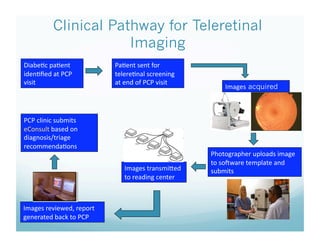
Clinical Pathway for Teleretinal
Imaging
Diabe&c pa&ent 
iden&fied at PCP 
visit 
Pa&ent sent for 
telere&nal screening 
at end of PCP visit 
Photographer uploads image 
to so:ware template and 
submits 
Images acquired
Images transmi=ed 
to reading center 
Images reviewed, report 
generated back to PCP 
PCP clinic submits 
eConsult based on 
diagnosis/triage 
recommenda&ons 
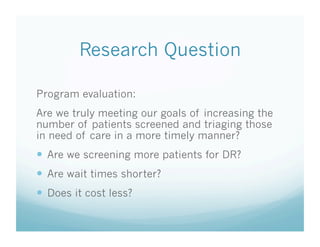
Research Question
Program evaluation:
Are we truly meeting our goals of increasing the
number of patients screened and triaging those
in need of care in a more timely manner?
  Are we screening more patients for DR?
  Are wait times shorter?
  Does it cost less?
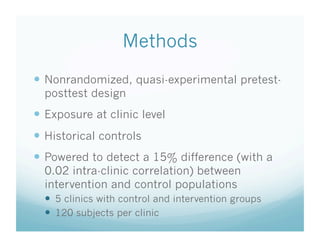
Methods
  Nonrandomized, quasi-experimental pretest-
posttest design
  Exposure at clinic level
  Historical controls
  Powered to detect a 15% difference (with a
0.02 intra-clinic correlation) between
intervention and control populations
  5 clinics with control and intervention groups
  120 subjects per clinic
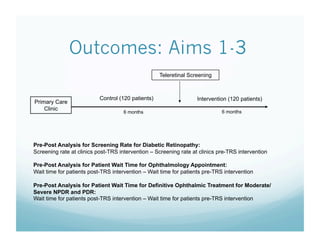
Outcomes: Aims 1-3
Control (120 patients) Intervention (120 patients)
Teleretinal Screening
6 months 6 months
Pre-Post Analysis for Screening Rate for Diabetic Retinopathy:
Screening rate at clinics post-TRS intervention – Screening rate at clinics pre-TRS intervention
Pre-Post Analysis for Patient Wait Time for Ophthalmology Appointment:
Wait time for patients post-TRS intervention – Wait time for patients pre-TRS intervention
Pre-Post Analysis for Patient Wait Time for Definitive Ophthalmic Treatment for Moderate/
Severe NPDR and PDR:
Wait time for patients post-TRS intervention – Wait time for patients pre-TRS intervention
Primary Care
Clinic
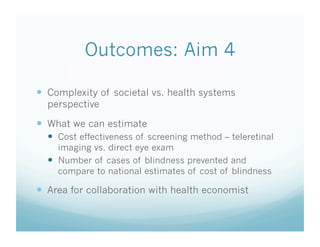
Outcomes: Aim 4
  Complexity of societal vs. health systems
perspective
  What we can estimate
  Cost effectiveness of screening method – teleretinal
imaging vs. direct eye exam
  Number of cases of blindness prevented and
compare to national estimates of cost of blindness
  Area for collaboration with health economist
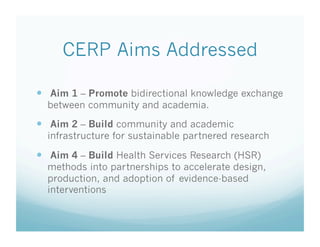
CERP Aims Addressed
  Aim 1 – Promote bidirectional knowledge exchange
between community and academia.
  Aim 2 – Build community and academic
infrastructure for sustainable partnered research
  Aim 4 – Build Health Services Research (HSR)
methods into partnerships to accelerate design,
production, and adoption of evidence-based
interventions
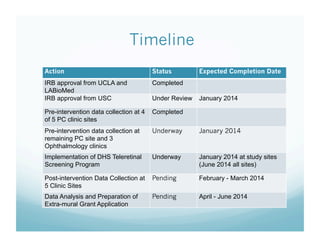
Action Status Expected Completion Date
IRB approval from UCLA and
LABioMed
Completed
IRB approval from USC Under Review January 2014
Pre-intervention data collection at 4
of 5 PC clinic sites
Completed
Pre-intervention data collection at
remaining PC site and 3
Ophthalmology clinics
Underway January 2014
Implementation of DHS Teleretinal
Screening Program
Underway January 2014 at study sites
(June 2014 all sites)
Post-intervention Data Collection at
5 Clinic Sites
Pending February - March 2014
Data Analysis and Preparation of
Extra-mural Grant Application
Pending April - June 2014
Timeline
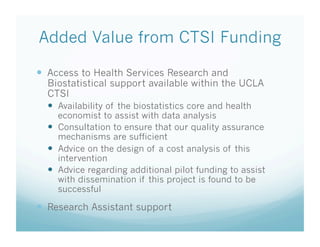
Added Value from CTSI Funding
  Access to Health Services Research and
Biostatistical support available within the UCLA
CTSI
  Availability of the biostatistics core and health
economist to assist with data analysis
  Consultation to ensure that our quality assurance
mechanisms are sufficient
  Advice on the design of a cost analysis of this
intervention
  Advice regarding additional pilot funding to assist
with dissemination if this project is found to be
successful
  Research Assistant support
Next Steps and Products
  IRB approval obtained from UCLA, LABioMed; USC under review
  Major strides in implementation, including:
  Ensuring clinic access to fundus cameras for 13 DHS primary care sites
  Identifying and training fundus photographers (LVN/Medical Assistant
level)
  Selecting and implementing the software platform for transmitting
teleretinal images
  Creating a quality assurance mechanism for image acquisition and
evaluation
  Establishing appropriate triage mechanisms for abnormal screening
photographs integrated with eConsult, the new web-based LAC specialty
referral system
  Teleretinal Screening has begun at 2 sites and will rollout to 11 more
over the next 6 months
  Currently developing a protocol for standardized referral timelines
across LA County that will further streamline patient care

Primary care-based, teleretinal-screening protocol (Los Angeles Safety Net)

  • 1.
    Lauren Patty Daskivich,MD, MSHS LAC DHS Carol M. Mangione, MD, MSPH UCLA Implementation of a Primary Care- Based Teleretinal Screening Protocol for the Los Angeles County Safety Net ___________________________
  • 2.
    Diabetic Retinopathy   Diabeticretinopathy (DR) is a leading cause of blindness in working-age adults in the United States   Prevalence of diabetic retinopathy in a large study of Latinos in LA has been shown to be close to 50%   THE leading cause of blindness in Los Angeles County   Early Treatment Diabetic Retinopathy Study (ETDRS) showed that severe vision loss from diabetic retinopathy can be reduced by up to 94% by effective treatments.   At least 40-45% of diabetics who may benefit from earlier detection and treatment of retinopathy are not receiving it
  • 3.
    Teleretinal Screening forDiabetic Retinopathy   High sensitivity and specificity when compared to gold standard (7 standard field fundus photographs and indirect ophthalmoscopy by an ophthalmic physician)   Sensitivity: 71-82%   Specificity: 92-96%   Recognized by the American Academy of Ophthalmology   No studies evaluating teleretinal screening in a safety net setting
  • 4.
    Clinical Pathway forTeleretinal Imaging Diabe&c pa&ent  iden&fied at PCP  visit  Pa&ent sent for  telere&nal screening  at end of PCP visit  Photographer uploads image  to so:ware template and  submits  Images acquired Images transmi=ed  to reading center  Images reviewed, report  generated back to PCP  PCP clinic submits  eConsult based on  diagnosis/triage  recommenda&ons 
  • 5.
    Research Question Program evaluation: Arewe truly meeting our goals of increasing the number of patients screened and triaging those in need of care in a more timely manner?   Are we screening more patients for DR?   Are wait times shorter?   Does it cost less?
  • 6.
    Methods   Nonrandomized, quasi-experimentalpretest- posttest design   Exposure at clinic level   Historical controls   Powered to detect a 15% difference (with a 0.02 intra-clinic correlation) between intervention and control populations   5 clinics with control and intervention groups   120 subjects per clinic
  • 7.
    Outcomes: Aims 1-3 Control(120 patients) Intervention (120 patients) Teleretinal Screening 6 months 6 months Pre-Post Analysis for Screening Rate for Diabetic Retinopathy: Screening rate at clinics post-TRS intervention – Screening rate at clinics pre-TRS intervention Pre-Post Analysis for Patient Wait Time for Ophthalmology Appointment: Wait time for patients post-TRS intervention – Wait time for patients pre-TRS intervention Pre-Post Analysis for Patient Wait Time for Definitive Ophthalmic Treatment for Moderate/ Severe NPDR and PDR: Wait time for patients post-TRS intervention – Wait time for patients pre-TRS intervention Primary Care Clinic
  • 8.
    Outcomes: Aim 4  Complexity of societal vs. health systems perspective   What we can estimate   Cost effectiveness of screening method – teleretinal imaging vs. direct eye exam   Number of cases of blindness prevented and compare to national estimates of cost of blindness   Area for collaboration with health economist
  • 9.
    CERP Aims Addressed  Aim 1 – Promote bidirectional knowledge exchange between community and academia.   Aim 2 – Build community and academic infrastructure for sustainable partnered research   Aim 4 – Build Health Services Research (HSR) methods into partnerships to accelerate design, production, and adoption of evidence-based interventions
  • 10.
    Action Status ExpectedCompletion Date IRB approval from UCLA and LABioMed Completed IRB approval from USC Under Review January 2014 Pre-intervention data collection at 4 of 5 PC clinic sites Completed Pre-intervention data collection at remaining PC site and 3 Ophthalmology clinics Underway January 2014 Implementation of DHS Teleretinal Screening Program Underway January 2014 at study sites (June 2014 all sites) Post-intervention Data Collection at 5 Clinic Sites Pending February - March 2014 Data Analysis and Preparation of Extra-mural Grant Application Pending April - June 2014 Timeline
  • 11.
    Added Value fromCTSI Funding   Access to Health Services Research and Biostatistical support available within the UCLA CTSI   Availability of the biostatistics core and health economist to assist with data analysis   Consultation to ensure that our quality assurance mechanisms are sufficient   Advice on the design of a cost analysis of this intervention   Advice regarding additional pilot funding to assist with dissemination if this project is found to be successful   Research Assistant support
  • 12.
    Next Steps andProducts   IRB approval obtained from UCLA, LABioMed; USC under review   Major strides in implementation, including:   Ensuring clinic access to fundus cameras for 13 DHS primary care sites   Identifying and training fundus photographers (LVN/Medical Assistant level)   Selecting and implementing the software platform for transmitting teleretinal images   Creating a quality assurance mechanism for image acquisition and evaluation   Establishing appropriate triage mechanisms for abnormal screening photographs integrated with eConsult, the new web-based LAC specialty referral system   Teleretinal Screening has begun at 2 sites and will rollout to 11 more over the next 6 months   Currently developing a protocol for standardized referral timelines across LA County that will further streamline patient care