BETTER CANCER CARE
FOR OUR COMMUNITY
BETTER CANCER CARE
FOR OUR COMMUNITY
A Real-Time Prostate Cancer
Radiation Oncology Research
Database
A/Prof Thomas Eade
A/Prof Andrew Kneebone
A/Prof George Hruby
Lesley Guo
Dr Thilo Schuler
Mary-Anne Brancato
BETTER CANCER CARE
FOR OUR COMMUNITY
BETTER CANCER CARE
FOR OUR COMMUNITY
Background
• Clinical audit and research requires high quality
information
• Electronic medical records can contribute to
effectiveness and efficiency collection of high
quality information...
• ... but current systems are often inadequate
Perfect world Common reality
Correct Retrospective audits/research by different people
Complete Doctors are notorious in skipping fields
Electronic Often (scanned) paper
Structured Often in freetext fields and letters
i.e. high quality
BETTER CANCER CARE
FOR OUR COMMUNITY
Methods
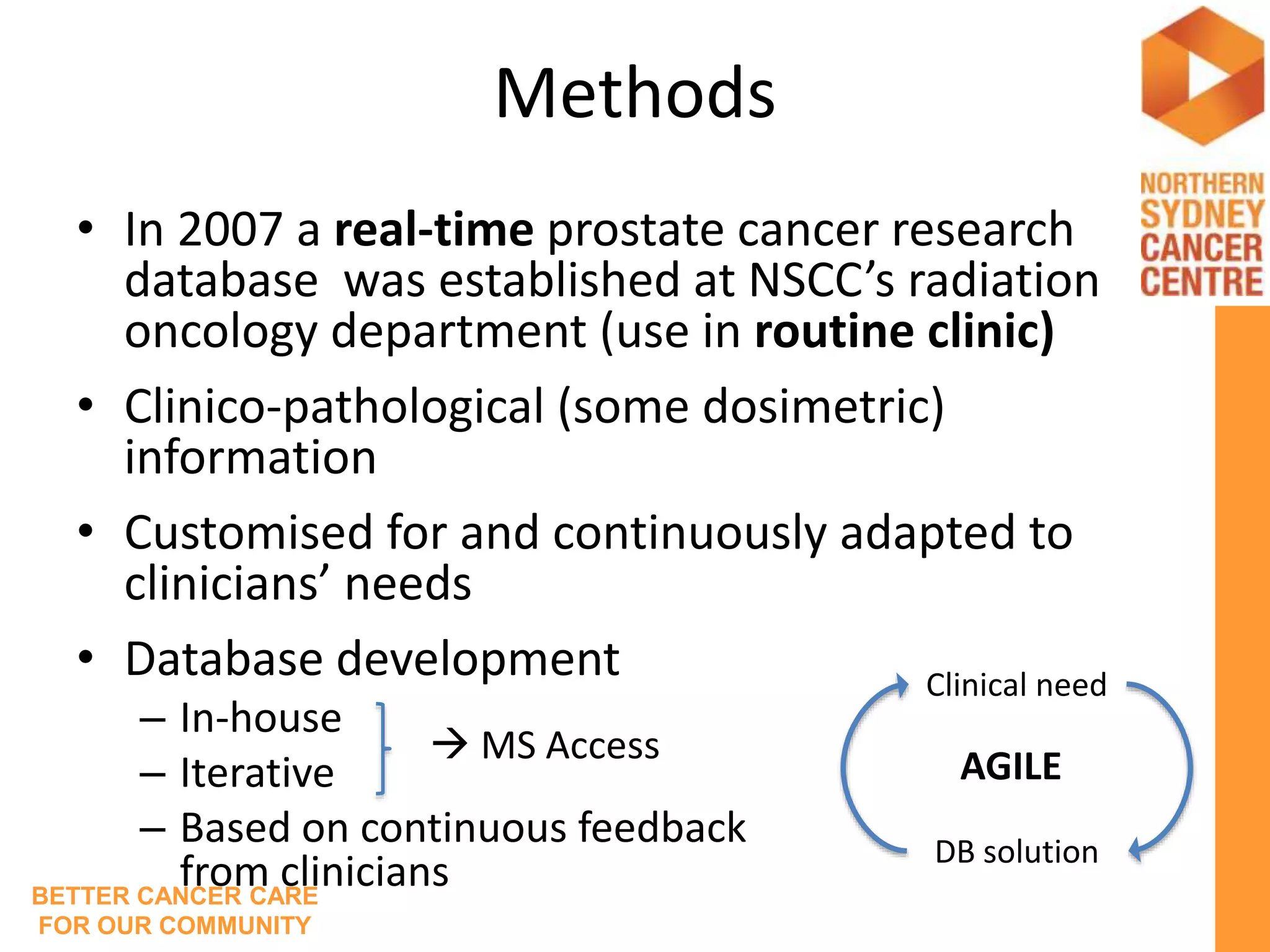
• In 2007 a real-time prostate cancer research
database was established at NSCC’s radiation
oncology department (use in routine clinic)
• Clinico-pathological (some dosimetric)
information
• Customised for and continuously adapted to
clinicians’ needs
• Database development
– In-house
– Iterative
– Based on continuous feedback
from clinicians
Clinical need
DB solution
AGILE MS Access
BETTER CANCER CARE
FOR OUR COMMUNITY
BETTER CANCER CARE
FOR OUR COMMUNITY
Results
Usage
• Total patients in DB: 1660
• Received RT at NSCC: 1292 (78%)
– At least x1 follow-up entry: 1169 (90%)
– More than 24mo follow up data: 469 (36%)
Audit/Research outcomes
• 5 formal clinical audits
• 26 peer-reviewed publications
BETTER CANCER CARE
FOR OUR COMMUNITY
Discussion
• A real-time prostate database is feasible
– also established for several other NSCC tumour
streams
• Success factors
– Clinician-driven design
– Agile, in-house development
– Senior clinician buy-in
BETTER CANCER CARE
FOR OUR COMMUNITY
Improved follow-up completeness
BETTER CANCER CARE
FOR OUR COMMUNITY
Limitations
• GUI
– “clunky” - prohibits innovative data viewing and entry
solutions
– annoying freezes/shutdowns
• Poor accessibility from outside the organisation
• Not truly multi user capable
– Concurrent write access issues
• No integration
• Table size issues
Next generation real-
time radiation
oncology database
project is underway at
NSCC...
BETTER CANCER CARE
FOR OUR COMMUNITY
Conclusion
• Real-time research databases are feasible if
driven by local clinicians
– participating in (partially in-house) agile development
– senior clinician buy-in
• Current system has limitations mainly related to
MS Access
• A next generation system is being developed at
NSCC
• Thanks. Questions?

A Real-Time Prostate Cancer Radiotherapy Research Database

  • 1.
  • 2.
    BETTER CANCER CARE FOROUR COMMUNITY A Real-Time Prostate Cancer Radiation Oncology Research Database A/Prof Thomas Eade A/Prof Andrew Kneebone A/Prof George Hruby Lesley Guo Dr Thilo Schuler Mary-Anne Brancato
  • 3.
  • 4.
    BETTER CANCER CARE FOROUR COMMUNITY Background • Clinical audit and research requires high quality information • Electronic medical records can contribute to effectiveness and efficiency collection of high quality information... • ... but current systems are often inadequate Perfect world Common reality Correct Retrospective audits/research by different people Complete Doctors are notorious in skipping fields Electronic Often (scanned) paper Structured Often in freetext fields and letters i.e. high quality
  • 5.
    BETTER CANCER CARE FOROUR COMMUNITY Methods • In 2007 a real-time prostate cancer research database was established at NSCC’s radiation oncology department (use in routine clinic) • Clinico-pathological (some dosimetric) information • Customised for and continuously adapted to clinicians’ needs • Database development – In-house – Iterative – Based on continuous feedback from clinicians Clinical need DB solution AGILE MS Access
  • 6.
  • 7.
    BETTER CANCER CARE FOROUR COMMUNITY Results Usage • Total patients in DB: 1660 • Received RT at NSCC: 1292 (78%) – At least x1 follow-up entry: 1169 (90%) – More than 24mo follow up data: 469 (36%) Audit/Research outcomes • 5 formal clinical audits • 26 peer-reviewed publications
  • 8.
    BETTER CANCER CARE FOROUR COMMUNITY Discussion • A real-time prostate database is feasible – also established for several other NSCC tumour streams • Success factors – Clinician-driven design – Agile, in-house development – Senior clinician buy-in
  • 9.
    BETTER CANCER CARE FOROUR COMMUNITY Improved follow-up completeness
  • 10.
    BETTER CANCER CARE FOROUR COMMUNITY Limitations • GUI – “clunky” - prohibits innovative data viewing and entry solutions – annoying freezes/shutdowns • Poor accessibility from outside the organisation • Not truly multi user capable – Concurrent write access issues • No integration • Table size issues Next generation real- time radiation oncology database project is underway at NSCC...
  • 11.
    BETTER CANCER CARE FOROUR COMMUNITY Conclusion • Real-time research databases are feasible if driven by local clinicians – participating in (partially in-house) agile development – senior clinician buy-in • Current system has limitations mainly related to MS Access • A next generation system is being developed at NSCC • Thanks. Questions?

Editor's Notes

  • #3 Thank you for inviting me to speak on “...” My name is Thilo Schuler I am a first year Radiation Oncology trainee with a Masters in Health IT and previous work experience in Health IT in Australia and Switzerland. I am speaking on behalf of this team lead by A/Prof Thomas Eade. While Graeme talked about ways to collate and display data as a dashboard our project looked into collecting data during routine care.
  • #4 Before we start on the dry topic of databases here is a cartoon that I liked, which demonstrates the value of having enough data.
  • #5 So we know that... We also know that... However,.... At our centre we use ARIA which clearly is not customisable enough. Ideally the data should be.... However, in practice data quality is impaired by issues such as doctors skipping fields or using a lot of free text
  • #6 In order to generate high quality information for research purposes we decided this information needs to be collected during routine care. So in 2007 a real-time... It contains clinical and pathological information To be practical in routine it is customised for... We achieved this by setting up a DB that we could develop in-house... This was implemented using MS Access.
  • #7 To get a sense what it looks like here are some screenshots follow-up screen Biopsy screen
  • #8 We analysed the usage and found that over 1600 patients were in the DB of which 78% ended up receiving RT through us. Of the patients that received RT 90% had at least one follow up entry and 36% had more than 24mo follow up data. Information from the data base contributed to 5 formal clinical audiat 24 peer-reviewed publications
  • #9 Based on this experience we have proofed that a real-time... This is also reflected in that fact that similar real-time DB have established for other tumour streams We identified the following success factors: ...
  • #10 This diagram shows the culture change with senior clinicians endorsing and enforcing the DB usage
  • #11 These are the key limitations mainly resulting from using MS Access