The Role of the Patient’s Voice in Improving the Quality of Health Care Research & Policy Forum • January 26, 2011 Michael J. Barry, MD Foundation President
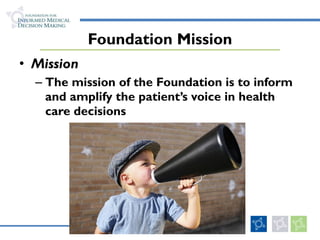
Foundation Mission Mission The mission of the Foundation is to inform and amplify the patient’s voice in health care decisions
Foundation Principles Guiding Principles We believe patients have the right to be: Supported and encouraged to participate in their health care decisions Fully informed with accurate, unbiased and understandable information Respected by having their goals and concerns honored
Foundation Principles We believe fully informed patients understand: There is seldom one right choice for everyone The full range of their options The risks and benefits of their options What may happen without any intervention When evidence is lacking Why their participation is important
The Foundation and Health Dialog The licensing agreement between the Foundation and Health Dialog, its production and distribution partner, provides royalties as well as contract funding to develop and maintain Shared Decision-Making Programs and other decision support materials. Staff of the Foundation and all Medical Editors must adhere to a stringent conflict-of-interest policy that prohibits financial support from the drug and device industries, and requires disclosure of any relationships with professional societies or health plans.
Is Informed Consent “Real”? In a survey of consecutive patients scheduled for an elective coronary revascularization procedure at Yale New Haven Hospital in 1997-1998 75% believed PCI would help prevent an MI 71% believed PCI would help them live longer Less than half could name even one possible complication of PCI 85% were “consented” just before the procedure (by a fellow or an NP) (Holmboe ES.  JGIM 2000;  15:632)
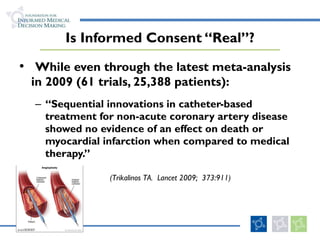
Is Informed Consent “Real”? While even through the latest meta-analysis in 2009 (61 trials, 25,388 patients): “ Sequential innovations in catheter-based treatment for non-acute coronary artery disease showed no evidence of an effect on death or myocardial infarction when compared to medical therapy.” (Trikalinos TA.  Lancet 2009;  373:911)
Is Informed Consent “Real”…10 years later? In a survey of consecutive patients consented for an elective coronary angiogram and possible percutaneous coronary intervention at Baystate Medical Center in 2007-2008 88% believed PCI would help prevent an MI 76% believed PCI would help them live longer (Rothberg MB.  Annals Intern Med 2010;  153:307)
DECISIONS Survey Conducted by University of Michigan Nationwide random-digit dial telephone survey Probability sample of 2575 English speaking Americans age 40 +   Reported a discussion of 1 of 9 medical decisions with a health care provider within the past 2 years Response rate 51% (The Decisions Study. Medical Decision Making 2010;  30 supplement 1)
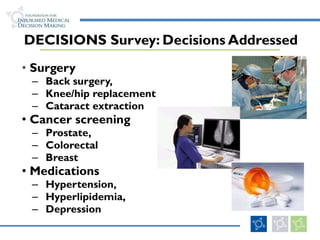
DECISIONS Survey: Decisions Addressed Surgery Back surgery,  Knee/hip replacement Cataract extraction Cancer screening Prostate,  Colorectal Breast Medications Hypertension,  Hyperlipidemia,  Depression
Epidemiology of Medical Decisions in US In the past 2 years: 56% discussed starting or stopping meds for hypertension, hyperlipidemia or depression 72% discussed a screening test for cancer 16% discussed one of the 4 operations
What did Clinicians Recommend? Surgery: About 65% of recommendations: “do it” Screening: About 95% of recommendations: “do it” Medications: Over 90% of recommendations: “do it”
Were Patients Asked for their Opinions? For surgery: About 1/2 the time for the orthopedic surgeries;  1/3 of the time for cataracts For screening: Less than 1/5 of the time for decisions about cancer screening For medications: About 1/3 of the time
How Much did Patients Know ? Clinical experts identified 4-5 facts a person should know, for example, common side effects of medications or surgery Respondents were asked the knowledge questions related to their decision For 8 out of 10 decisions, fewer than half of respondents could get more than one knowledge question right.
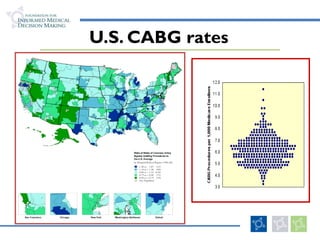
U.S. CABG rates
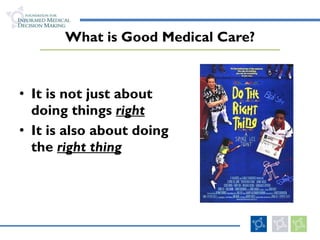
What is Good Medical Care? It is not just about doing things  right It is also about doing the  right thing
Practice Policies: Standards, Guidelines and Options Standard: “…at least 95%, perhaps even 99%, of people who are candidates should agree on the desirability of it outcomes Guideline: “…the outcomes must be prefered by an appreciable but not unanimous majority [60% to 95%] of people.” Option:  “Outcomes unknown…preferences unknown…preferences indifferent…or preferences split [40% to 60%]” (Eddy DM.  JAMA 1990;  263:3077)
Shared Decision-Making Model Key characteristics: At least two participants – [clinician] and patient – are involved Both parties share information Both parties take steps to build a consensus about the preferred treatment An agreement is reached on the treatment to implement (Charles C, Soc Sci Med 1997;  44:681)
 
Determining the Need for Hip and Knee Arthroplasty Survey of people >55 in a high and low rate community to identify symptoms suggesting severe hip/knee arthritis Potential need: High symptom score confirmed by exam and x-ray, no contraindications and not scheduled already 36/1000 in high rate area 28/1000 in low rate area Actual need: Standardized interview to present options, risks and benefits, asked if willing to undergo arthroplasty 15% of potential need in the high rate area 8.5% of potential need in the low rate area (Hawker GA, et al. Medical Care 2001;  39:206)
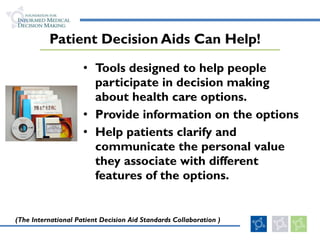
Tools designed to help people participate in decision making about health care options.  Provide information on the options  Help patients clarify and communicate the personal value they associate with different features of the options.  Patient Decision Aids Can Help! (The International Patient Decision Aid Standards Collaboration )
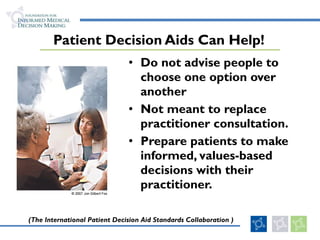
Do not advise people to choose one option over another Not meant to replace practitioner consultation.  Prepare patients to make informed, values-based decisions with their practitioner.  Patient Decision Aids Can Help! (The International Patient Decision Aid Standards Collaboration )
Cochrane Review of Decision Aids In 55 trials of 23 different decision aids, use has led to: Greater knowledge More accurate risk perceptions Greater comfort with decisions Greater participation in decision-making Fewer people remaining undecided Fewer patients choosing major surgery, PSA tests (O’Connor et al. Cochrane Database of Systematic Reviews  2009, Issue 3. Art. No.: CD001431 )
Patients interested in being informed and activated to participate in their health decisions Practical systems and protocols for routine use of decision support tools Validated measures of “decision quality” A health care environment with the appropriate incentives to reward good “decision quality” rather than simply “more is better” Clinicians and hospitals truly receptive to patient participation SDM: Implementation Needs

The Role of the Patient's Voice in Improving the Quality of Health Care

  • 1.
    The Role ofthe Patient’s Voice in Improving the Quality of Health Care Research & Policy Forum • January 26, 2011 Michael J. Barry, MD Foundation President
  • 2.
    Foundation Mission MissionThe mission of the Foundation is to inform and amplify the patient’s voice in health care decisions
  • 3.
    Foundation Principles GuidingPrinciples We believe patients have the right to be: Supported and encouraged to participate in their health care decisions Fully informed with accurate, unbiased and understandable information Respected by having their goals and concerns honored
  • 4.
    Foundation Principles Webelieve fully informed patients understand: There is seldom one right choice for everyone The full range of their options The risks and benefits of their options What may happen without any intervention When evidence is lacking Why their participation is important
  • 5.
    The Foundation andHealth Dialog The licensing agreement between the Foundation and Health Dialog, its production and distribution partner, provides royalties as well as contract funding to develop and maintain Shared Decision-Making Programs and other decision support materials. Staff of the Foundation and all Medical Editors must adhere to a stringent conflict-of-interest policy that prohibits financial support from the drug and device industries, and requires disclosure of any relationships with professional societies or health plans.
  • 6.
    Is Informed Consent“Real”? In a survey of consecutive patients scheduled for an elective coronary revascularization procedure at Yale New Haven Hospital in 1997-1998 75% believed PCI would help prevent an MI 71% believed PCI would help them live longer Less than half could name even one possible complication of PCI 85% were “consented” just before the procedure (by a fellow or an NP) (Holmboe ES. JGIM 2000; 15:632)
  • 7.
    Is Informed Consent“Real”? While even through the latest meta-analysis in 2009 (61 trials, 25,388 patients): “ Sequential innovations in catheter-based treatment for non-acute coronary artery disease showed no evidence of an effect on death or myocardial infarction when compared to medical therapy.” (Trikalinos TA. Lancet 2009; 373:911)
  • 8.
    Is Informed Consent“Real”…10 years later? In a survey of consecutive patients consented for an elective coronary angiogram and possible percutaneous coronary intervention at Baystate Medical Center in 2007-2008 88% believed PCI would help prevent an MI 76% believed PCI would help them live longer (Rothberg MB. Annals Intern Med 2010; 153:307)
  • 9.
    DECISIONS Survey Conductedby University of Michigan Nationwide random-digit dial telephone survey Probability sample of 2575 English speaking Americans age 40 + Reported a discussion of 1 of 9 medical decisions with a health care provider within the past 2 years Response rate 51% (The Decisions Study. Medical Decision Making 2010; 30 supplement 1)
  • 10.
    DECISIONS Survey: DecisionsAddressed Surgery Back surgery, Knee/hip replacement Cataract extraction Cancer screening Prostate, Colorectal Breast Medications Hypertension, Hyperlipidemia, Depression
  • 11.
    Epidemiology of MedicalDecisions in US In the past 2 years: 56% discussed starting or stopping meds for hypertension, hyperlipidemia or depression 72% discussed a screening test for cancer 16% discussed one of the 4 operations
  • 12.
    What did CliniciansRecommend? Surgery: About 65% of recommendations: “do it” Screening: About 95% of recommendations: “do it” Medications: Over 90% of recommendations: “do it”
  • 13.
    Were Patients Askedfor their Opinions? For surgery: About 1/2 the time for the orthopedic surgeries; 1/3 of the time for cataracts For screening: Less than 1/5 of the time for decisions about cancer screening For medications: About 1/3 of the time
  • 14.
    How Much didPatients Know ? Clinical experts identified 4-5 facts a person should know, for example, common side effects of medications or surgery Respondents were asked the knowledge questions related to their decision For 8 out of 10 decisions, fewer than half of respondents could get more than one knowledge question right.
  • 15.
  • 16.
    What is GoodMedical Care? It is not just about doing things right It is also about doing the right thing
  • 17.
    Practice Policies: Standards,Guidelines and Options Standard: “…at least 95%, perhaps even 99%, of people who are candidates should agree on the desirability of it outcomes Guideline: “…the outcomes must be prefered by an appreciable but not unanimous majority [60% to 95%] of people.” Option: “Outcomes unknown…preferences unknown…preferences indifferent…or preferences split [40% to 60%]” (Eddy DM. JAMA 1990; 263:3077)
  • 18.
    Shared Decision-Making ModelKey characteristics: At least two participants – [clinician] and patient – are involved Both parties share information Both parties take steps to build a consensus about the preferred treatment An agreement is reached on the treatment to implement (Charles C, Soc Sci Med 1997; 44:681)
  • 19.
  • 20.
    Determining the Needfor Hip and Knee Arthroplasty Survey of people >55 in a high and low rate community to identify symptoms suggesting severe hip/knee arthritis Potential need: High symptom score confirmed by exam and x-ray, no contraindications and not scheduled already 36/1000 in high rate area 28/1000 in low rate area Actual need: Standardized interview to present options, risks and benefits, asked if willing to undergo arthroplasty 15% of potential need in the high rate area 8.5% of potential need in the low rate area (Hawker GA, et al. Medical Care 2001; 39:206)
  • 21.
    Tools designed tohelp people participate in decision making about health care options. Provide information on the options Help patients clarify and communicate the personal value they associate with different features of the options. Patient Decision Aids Can Help! (The International Patient Decision Aid Standards Collaboration )
  • 22.
    Do not advisepeople to choose one option over another Not meant to replace practitioner consultation. Prepare patients to make informed, values-based decisions with their practitioner. Patient Decision Aids Can Help! (The International Patient Decision Aid Standards Collaboration )
  • 23.
    Cochrane Review ofDecision Aids In 55 trials of 23 different decision aids, use has led to: Greater knowledge More accurate risk perceptions Greater comfort with decisions Greater participation in decision-making Fewer people remaining undecided Fewer patients choosing major surgery, PSA tests (O’Connor et al. Cochrane Database of Systematic Reviews 2009, Issue 3. Art. No.: CD001431 )
  • 24.
    Patients interested inbeing informed and activated to participate in their health decisions Practical systems and protocols for routine use of decision support tools Validated measures of “decision quality” A health care environment with the appropriate incentives to reward good “decision quality” rather than simply “more is better” Clinicians and hospitals truly receptive to patient participation SDM: Implementation Needs