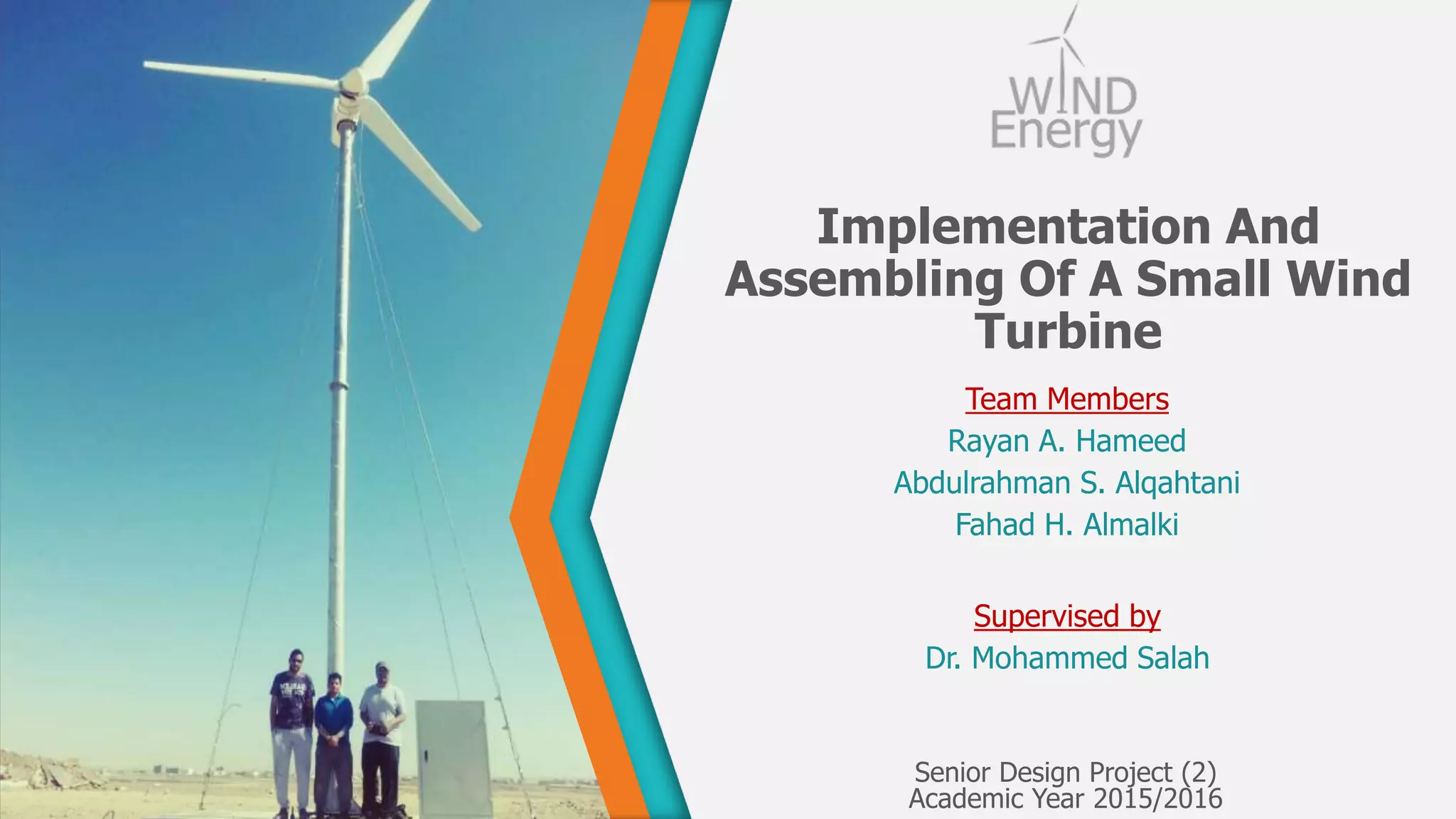




Implementation And
Assembling Of A Small Wind
Turbine
Senior Design Project (2)
Academic Year 2015/2016
Team Members
Rayan A. Hameed
Abdulrahman S. Alqahtani
Fahad H. Almalki
Supervised by
Dr. Mohammed Salah
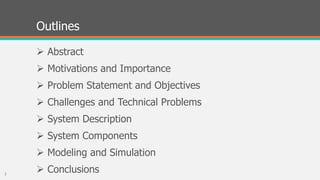
Outlines
 Abstract
 Motivations and Importance
 Problem Statement and Objectives
 Challenges and Technical Problems
 System Description
 System Components
 Modeling and Simulation
 Conclusions2
Abstract
3
Motivations and Importance
A great demand has been increased recently for renewable energy in Saudi
Arabia due to the environment damage caused by fossil fuels. Renewable
energy is certainly safer for the environment has a great positive impact on
economy.
Renewable Energy is (1) Sustainable, (2) Global, and (3) Essentially NON-polluting4
 Environmental Impact
 Economic Impact
 Society Impact
Project Impacts
Motivations and Importance
5
Problem Statement and Objects
Problem
Components of wind turbine system were bought from China and currently
available in the lab but their specifications are unknown (no manuals or any
documents)
Solution and Objectives
Perform scientific conclusion to:
1. Assemble and integrate the components in order to operate the system
components in harmony
2. Install appropriately the mechanical parts
3. Wiring appropriately the components with the control panel and other parts
4. Understand how the wind energy is converted to electricity6
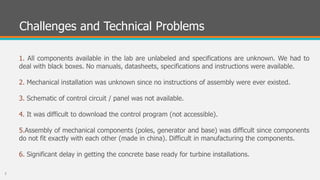
Challenges and Technical Problems
1. All components available in the lab are unlabeled and specifications are unknown. We had to
deal with black boxes. No manuals, datasheets, specifications and instructions were available.
2. Mechanical installation was unknown since no instructions of assembly were ever existed.
3. Schematic of control circuit / panel was not available.
4. It was difficult to download the control program (not accessible).
5.Assembly of mechanical components (poles, generator and base) was difficult since components
do not fit exactly with each other (made in china). Difficult in manufacturing the components.
6. Significant delay in getting the concrete base ready for turbine installations.
7
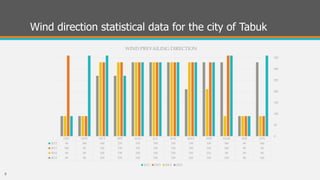
Wind direction statistical data for the city of Tabuk
8
JANFEBMARAPRMAYJUNJULAUGSEPOCTNOVDEC
2012 3609036033033033033033027036036090
2013 909036033033033033033033033090360
2014 9090902103303303303303303309090
2015 330903303302103303303302702709090
0
50
100
150
200
250
300
350
WIND PREVAILING DIRECTION
2012 2013 2014 2015
Wind direction statistical data for the city of Tabuk
9
0
1
2
3
4
5
6
7
8
9
JANFEBMARAPRMAYJUNJULAUGSEPOCTNOVDEC
KNOTS
MONTHS
Wind Mean Speed
2014 2015
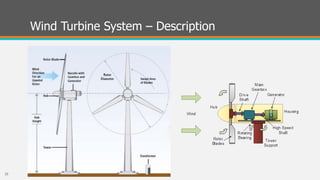
Wind Turbine System – Description
10
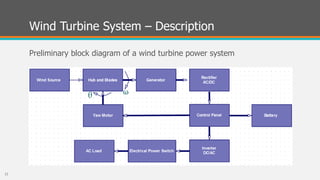
Wind Turbine System – Description
Preliminary block diagram of a wind turbine power system
11
θ ω
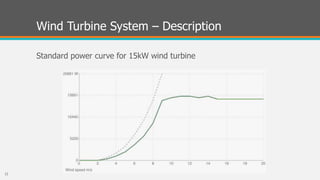
Wind Turbine System – Description
Standard power curve for 15kW wind turbine
12
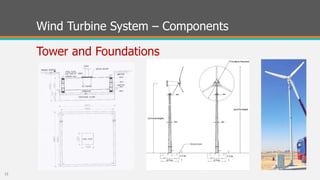
Wind Turbine System – Components
Tower and Foundations
13
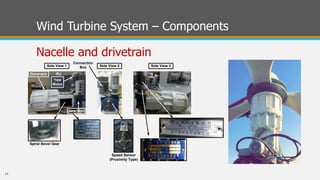
Nacelle and drivetrain
Wind Turbine System – Components
Spiral Bevel Gear
Side View 1 Side View 2 Side View 3
Generator
Yaw
Motor
Gear Box
Connection
Box
Speed Sensor
(Proximity Type)
14
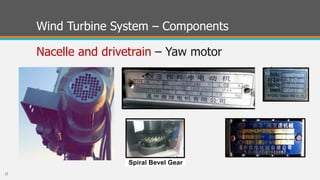
Nacelle and drivetrain – Yaw motor
Wind Turbine System – Components
15
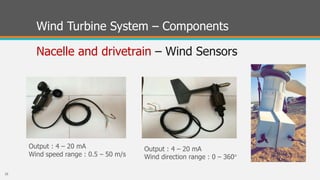
Nacelle and drivetrain – Wind Sensors
Wind Turbine System – Components
Output : 4 – 20 mA
Wind speed range : 0.5 – 50 m/s
Output : 4 – 20 mA
Wind direction range : 0 – 360°
16
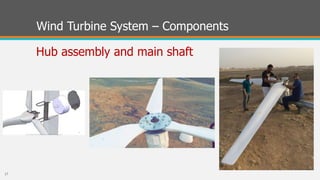
Hub assembly and main shaft
Wind Turbine System – Components
17
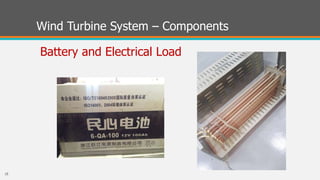
Battery and Electrical Load
Wind Turbine System – Components
18
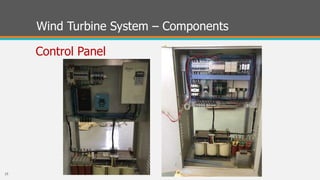
Control Panel
Wind Turbine System – Components
19
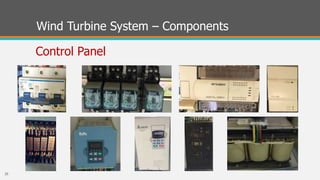
Wind Turbine System – Components
Control Panel
20
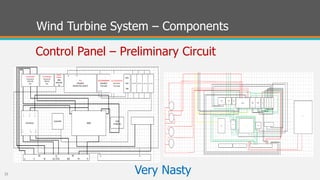
Control Panel – Preliminary Circuit
Wind Turbine System – Components
21 Very Nasty
Modeling and Simulation
Wind Turbine Dynamic Model
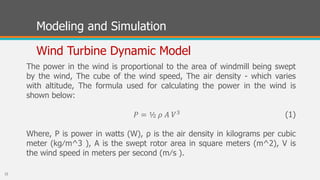
The power in the wind is proportional to the area of windmill being swept
by the wind, The cube of the wind speed, The air density - which varies
with altitude, The formula used for calculating the power in the wind is
shown below:
(1)
Where, P is power in watts (W), ρ is the air density in kilograms per cubic
meter (kg⁄m^3 ), A is the swept rotor area in square meters (m^2), V is
the wind speed in meters per second (m⁄s ).
𝑃 = ½ 𝜌 𝐴 𝑉3
22
Modeling and Simulation
Wind Turbine Dynamic Model
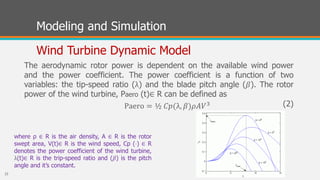
The aerodynamic rotor power is dependent on the available wind power
and the power coefficient. The power coefficient is a function of two
variables: the tip-speed ratio (λ) and the blade pitch angle (𝛽). The rotor
power of the wind turbine, Paero (t)∈ R can be defined as
(2)Paero = ½ 𝐶𝑝(λ, 𝛽)𝜌𝐴𝑉3
23
where ρ ∈ R is the air density, A ∈ R is the rotor
swept area, V(t)∈ R is the wind speed, Cp (⋅) ∈ R
denotes the power coefficient of the wind turbine,
λ(t)∈ R is the trip-speed ratio and (𝛽) is the pitch
angle and it’s constant.
Modeling and Simulation
Wind Turbine Dynamic Model [1]
The tip-speed ratio, λ(t), is defined as
(3)
The rotor power, Paero (t), can also be written as
(4)
Aerodynamic torque applied to the rotor by the wind. An expression for τ𝑎𝑒𝑟𝑜 can
be derived from (2)-(4) as
(5)
λ = 𝜔
𝑅
𝑉
Paero = τ𝑎𝑒𝑟𝑜 𝜔
τ𝑎𝑒𝑟𝑜 = ½𝜌𝐴𝑅
𝐶𝑝
λ
𝑉2
24
Modeling and Simulation
Mechanical Subsystem Dynamics
𝐽𝜔∙ + f = 𝜏𝑒𝑚
25
The mechanical subsystem that describes the rotor dynamics of the
variable speed wind turbine can be of the following form:
(6)
where J ∈ R+ is the rotor moment of inertia, ω˙(t) ∈ R is the rotor
acceleration, f (ω,va) ∈ R represents the system unknown nonlinearities
and is defined as f =−τaero, and τem ∈ R+ is the electromagnetic
torque and is considered as the torque control input for the generator.
[1] J Control Theory Appl 2012
Modeling and Simulation
Induction Yaw Motor Modeling [2]
𝜏𝑖𝑛𝑑 = 𝐾 𝐵𝑠 ₓ 𝐵𝑅 (1)
𝜏𝑚𝑎𝑥 =
3𝑉𝑡ℎ2
2𝜔𝑠 (𝑅𝑡ℎ + 𝑅𝑡ℎ2+ 𝑋𝑡ℎ+𝑋2 2
(2)
𝑃𝑖𝑛 = 3 𝑉𝑇 𝐼𝐿 𝑐𝑜𝑠 𝜃 (3)
𝑃𝑜𝑢𝑡 = 𝜏𝑙𝑜𝑎𝑑 ₓ 𝜔𝑚 (4)
26
[2] stephen j. chapman electric machinery fundamentals
Modeling and Simulation
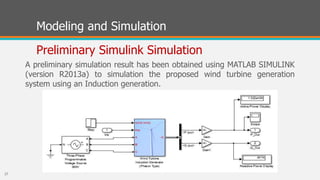
Preliminary Simulink Simulation
A preliminary simulation result has been obtained using MATLAB SIMULINK
(version R2013a) to simulation the proposed wind turbine generation
system using an Induction generation.
27
Modeling and Simulation
28
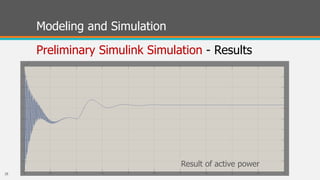
Preliminary Simulink Simulation - Results
Result of active power
Conclusions
A preliminary study has been conducted during the current semester
to understand how the wind turbine system operates and how the
system components are integrated. The system in hand is definitely
a tremendous asset to the University of Tabuk and a great
educational and training facility for students and professionals to
learn more about renewable and sustainable energy conversion.
Unfortunately and due to some unaccepted challenges and technical
problem, the project was not completely finical.
29
30
Thanks for
listening

Implementation and assemplingof a small wind turbine

  • 1.
    Implementation And Assembling OfA Small Wind Turbine Senior Design Project (2) Academic Year 2015/2016 Team Members Rayan A. Hameed Abdulrahman S. Alqahtani Fahad H. Almalki Supervised by Dr. Mohammed Salah
  • 2.
    Outlines  Abstract  Motivationsand Importance  Problem Statement and Objectives  Challenges and Technical Problems  System Description  System Components  Modeling and Simulation  Conclusions2
  • 3.
  • 4.
    Motivations and Importance Agreat demand has been increased recently for renewable energy in Saudi Arabia due to the environment damage caused by fossil fuels. Renewable energy is certainly safer for the environment has a great positive impact on economy. Renewable Energy is (1) Sustainable, (2) Global, and (3) Essentially NON-polluting4
  • 5.
     Environmental Impact Economic Impact  Society Impact Project Impacts Motivations and Importance 5
  • 6.
    Problem Statement andObjects Problem Components of wind turbine system were bought from China and currently available in the lab but their specifications are unknown (no manuals or any documents) Solution and Objectives Perform scientific conclusion to: 1. Assemble and integrate the components in order to operate the system components in harmony 2. Install appropriately the mechanical parts 3. Wiring appropriately the components with the control panel and other parts 4. Understand how the wind energy is converted to electricity6
  • 7.
    Challenges and TechnicalProblems 1. All components available in the lab are unlabeled and specifications are unknown. We had to deal with black boxes. No manuals, datasheets, specifications and instructions were available. 2. Mechanical installation was unknown since no instructions of assembly were ever existed. 3. Schematic of control circuit / panel was not available. 4. It was difficult to download the control program (not accessible). 5.Assembly of mechanical components (poles, generator and base) was difficult since components do not fit exactly with each other (made in china). Difficult in manufacturing the components. 6. Significant delay in getting the concrete base ready for turbine installations. 7
  • 8.
    Wind direction statisticaldata for the city of Tabuk 8 JANFEBMARAPRMAYJUNJULAUGSEPOCTNOVDEC 2012 3609036033033033033033027036036090 2013 909036033033033033033033033090360 2014 9090902103303303303303303309090 2015 330903303302103303303302702709090 0 50 100 150 200 250 300 350 WIND PREVAILING DIRECTION 2012 2013 2014 2015
  • 9.
    Wind direction statisticaldata for the city of Tabuk 9 0 1 2 3 4 5 6 7 8 9 JANFEBMARAPRMAYJUNJULAUGSEPOCTNOVDEC KNOTS MONTHS Wind Mean Speed 2014 2015
  • 10.
    Wind Turbine System– Description 10
  • 11.
    Wind Turbine System– Description Preliminary block diagram of a wind turbine power system 11 θ ω
  • 12.
    Wind Turbine System– Description Standard power curve for 15kW wind turbine 12
  • 13.
    Wind Turbine System– Components Tower and Foundations 13
  • 14.
    Nacelle and drivetrain WindTurbine System – Components Spiral Bevel Gear Side View 1 Side View 2 Side View 3 Generator Yaw Motor Gear Box Connection Box Speed Sensor (Proximity Type) 14
  • 15.
    Nacelle and drivetrain– Yaw motor Wind Turbine System – Components 15
  • 16.
    Nacelle and drivetrain– Wind Sensors Wind Turbine System – Components Output : 4 – 20 mA Wind speed range : 0.5 – 50 m/s Output : 4 – 20 mA Wind direction range : 0 – 360° 16
  • 17.
    Hub assembly andmain shaft Wind Turbine System – Components 17
  • 18.
    Battery and ElectricalLoad Wind Turbine System – Components 18
  • 19.
    Control Panel Wind TurbineSystem – Components 19
  • 20.
    Wind Turbine System– Components Control Panel 20
  • 21.
    Control Panel –Preliminary Circuit Wind Turbine System – Components 21 Very Nasty
  • 22.
    Modeling and Simulation WindTurbine Dynamic Model The power in the wind is proportional to the area of windmill being swept by the wind, The cube of the wind speed, The air density - which varies with altitude, The formula used for calculating the power in the wind is shown below: (1) Where, P is power in watts (W), ρ is the air density in kilograms per cubic meter (kg⁄m^3 ), A is the swept rotor area in square meters (m^2), V is the wind speed in meters per second (m⁄s ). 𝑃 = ½ 𝜌 𝐴 𝑉3 22
  • 23.
    Modeling and Simulation WindTurbine Dynamic Model The aerodynamic rotor power is dependent on the available wind power and the power coefficient. The power coefficient is a function of two variables: the tip-speed ratio (λ) and the blade pitch angle (𝛽). The rotor power of the wind turbine, Paero (t)∈ R can be defined as (2)Paero = ½ 𝐶𝑝(λ, 𝛽)𝜌𝐴𝑉3 23 where ρ ∈ R is the air density, A ∈ R is the rotor swept area, V(t)∈ R is the wind speed, Cp (⋅) ∈ R denotes the power coefficient of the wind turbine, λ(t)∈ R is the trip-speed ratio and (𝛽) is the pitch angle and it’s constant.
  • 24.
    Modeling and Simulation WindTurbine Dynamic Model [1] The tip-speed ratio, λ(t), is defined as (3) The rotor power, Paero (t), can also be written as (4) Aerodynamic torque applied to the rotor by the wind. An expression for τ𝑎𝑒𝑟𝑜 can be derived from (2)-(4) as (5) λ = 𝜔 𝑅 𝑉 Paero = τ𝑎𝑒𝑟𝑜 𝜔 τ𝑎𝑒𝑟𝑜 = ½𝜌𝐴𝑅 𝐶𝑝 λ 𝑉2 24
  • 25.
    Modeling and Simulation MechanicalSubsystem Dynamics 𝐽𝜔∙ + f = 𝜏𝑒𝑚 25 The mechanical subsystem that describes the rotor dynamics of the variable speed wind turbine can be of the following form: (6) where J ∈ R+ is the rotor moment of inertia, ω˙(t) ∈ R is the rotor acceleration, f (ω,va) ∈ R represents the system unknown nonlinearities and is defined as f =−τaero, and τem ∈ R+ is the electromagnetic torque and is considered as the torque control input for the generator. [1] J Control Theory Appl 2012
  • 26.
    Modeling and Simulation InductionYaw Motor Modeling [2] 𝜏𝑖𝑛𝑑 = 𝐾 𝐵𝑠 ₓ 𝐵𝑅 (1) 𝜏𝑚𝑎𝑥 = 3𝑉𝑡ℎ2 2𝜔𝑠 (𝑅𝑡ℎ + 𝑅𝑡ℎ2+ 𝑋𝑡ℎ+𝑋2 2 (2) 𝑃𝑖𝑛 = 3 𝑉𝑇 𝐼𝐿 𝑐𝑜𝑠 𝜃 (3) 𝑃𝑜𝑢𝑡 = 𝜏𝑙𝑜𝑎𝑑 ₓ 𝜔𝑚 (4) 26 [2] stephen j. chapman electric machinery fundamentals
  • 27.
    Modeling and Simulation PreliminarySimulink Simulation A preliminary simulation result has been obtained using MATLAB SIMULINK (version R2013a) to simulation the proposed wind turbine generation system using an Induction generation. 27
  • 28.
    Modeling and Simulation 28 PreliminarySimulink Simulation - Results Result of active power
  • 29.
    Conclusions A preliminary studyhas been conducted during the current semester to understand how the wind turbine system operates and how the system components are integrated. The system in hand is definitely a tremendous asset to the University of Tabuk and a great educational and training facility for students and professionals to learn more about renewable and sustainable energy conversion. Unfortunately and due to some unaccepted challenges and technical problem, the project was not completely finical. 29
  • 30.