DENTAL IMPLANT
Dr. Ibadat Jamil
Assistant professor
Dep. Of Prothodontics
TERMINOLOGY
DENTAL
IMPLANT
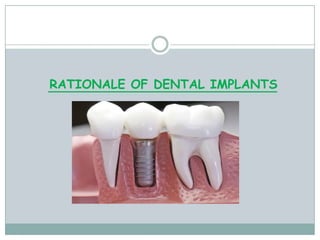
Can be defined as a substance that is placed into
the jaw to support a crown or fixed or removable
denture.
DENTAL
IMPLANT
A prosthetic device or alloplastic material
implanted into oral tissues beneath the mucosal
or periosteal tissues and/or within the bone to
provide retention and support for fixed or
removal prosthesis.
RATIONALE OF DENTAL IMPLANTS
RATIONALE
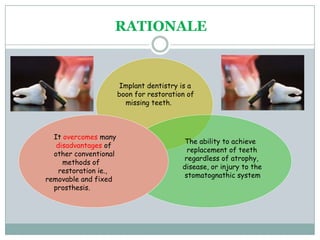
Implant dentistry is a
boon for restoration of
missing teeth.
It overcomes many
disadvantages of
other conventional
methods of
restoration ie.,
removable and fixed
prosthesis.
The ability to achieve
replacement of teeth
regardless of atrophy,
disease, or injury to the
stomatognathic system
Why are Implants preferred over Dentures and
Bridges ?
Stability
Grinding of adjacent healthy teeth
Chewing efficiency
Comfort /artificial feeling
Protection of the jawbone
Eating habits
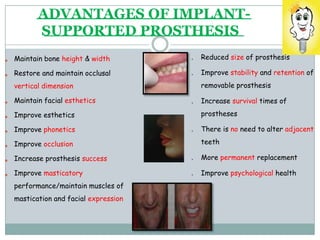
ADVANTAGES OF IMPLANT-
SUPPORTED PROSTHESIS


Maintain bone height & width •
•
Reduced size of prosthesis
Improve stability and retention of
Restore and maintain occlusal
vertical dimension
Maintain facial esthetics
Improve esthetics
removable prosthesis
•


Increase survival times of
prostheses




Improve phonetics
Improve occlusion
Increase prosthesis success
Improve masticatory
• There is no need to alter adjacent
teeth
•
•
More permanent replacement
Improve psychological health
performance/maintain muscles of
mastication and facial expression
DISADVANTAGES OF DENTAL IMPLANTS
 Very expensive.
 Cannot be used in medically compromised patients who cannot
undergo surgery.
 Longer duration of treatment and tedious fabrication
procedures.
 Requires a lot of patient co-operation because of repeated recall
visits for after care is essential
INDICATIONS
 Severe morphologic compromise of denture supporting areas that
significantly undermine denture retention.
 Poor oral muscular coordination.
 Para functional habits leading to recurrent soreness and instability of
prosthesis.
 Unrealistic prosthodontic expectations
 Active or hyperactive gag reflexes elicited by removable prosthesis.
 Psychological inability to wear a removable prosthesis, even if adequate
denture retention and stability is present.
 Unfavorable number and location of potential abutments in a residual
dentition.
 Single tooth loss to avoid involving neighboring tooth as abutments.
 Esthetic zone
 preserve interdental diastemas
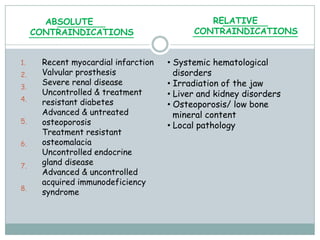
ABSOLUTE
CONTRAINDICATIONS
1.
RELATIVE
CONTRAINDICATIONS
• Systemic hematological
disorders
• Irradiation of the jaw
• Liver and kidney disorders
• Osteoporosis/ low bone
mineral content
• Local pathology
2.
3.
4.
5.
6.
7.
8.
Recent myocardial infarction
Valvular prosthesis
Severe renal disease
Uncontrolled & treatment
resistant diabetes
Advanced & untreated
osteoporosis
Treatment resistant
osteomalacia
Uncontrolled endocrine
gland disease
Advanced & uncontrolled
acquired immunodeficiency
syndrome
CLASSIFICATION
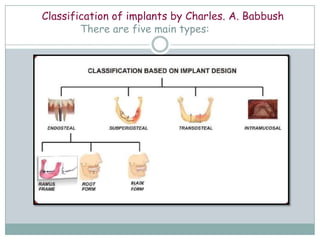
Classification of implants by Charles. A. Babbush
There are five main types:
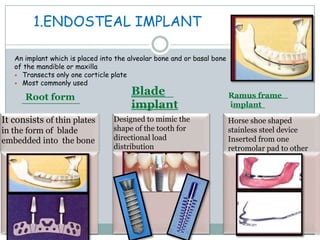
1.ENDOSTEAL IMPLANT
An implant which is placed into the alveolar bone and or basal bone
of the mandible or maxilla
 Transects only one corticle plate
 Most commonly used
Root form
Blade
implant
Ramus frame
implant
It consists of thin plates
in the form of blade
embedded into the bone
Designed to mimic the
shape of the tooth for
directional load
distribution
Horse shoe shaped
stainless steel device
Inserted from one
retromolar pad to other
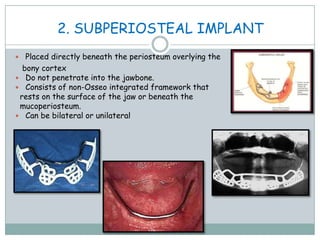
2. SUBPERIOSTEAL IMPLANT
 Placed directly beneath the periosteum overlying the
bony cortex
 Do not penetrate into the jawbone.
 Consists of non-Osseo integrated framework that
rests on the surface of the jaw or beneath the
mucoperiosteum.
 Can be bilateral or unilateral
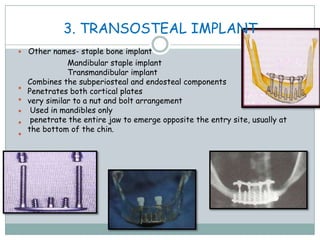
3. TRANSOSTEAL IMPLANT
 Other names- staple bone implant





Mandibular staple implant
Transmandibular implant
Combines the subperiosteal and endosteal components
Penetrates both cortical plates
very similar to a nut and bolt arrangement
Used in mandibles only
penetrate the entire jaw to emerge opposite the entry site, usually at
the bottom of the chin.
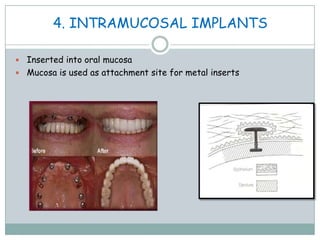
4. INTRAMUCOSAL IMPLANTS
 Inserted into oral mucosa
 Mucosa is used as attachment site for metal inserts
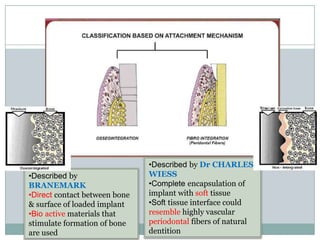
•Described by
BRANEMARK
•Direct contact between bone
& surface of loaded implant
•Bio active materials that
stimulate formation of bone
are used
•Described by Dr CHARLES
WIESS
•Complete encapsulation of
implant with soft tissue
•Soft tissue interface could
resemble highly vascular
periodontal fibers of natural
dentition
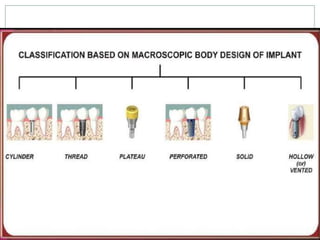
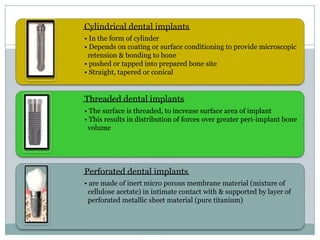
Cylindrical dental implants
• In the form of cylinder
• Depends on coating or surface conditioning to provide microscopic
retension & bonding to bone
• pushed or tapped into prepared bone site
• Straight, tapered or conical
Threaded dental implants
• The surface is threaded, to increase surface area of implant
• This results in distribution of forces over greater peri-implant bone
volume
Perforated dental implants
• are made of inert micro porous membrane material (mixture of
cellulose acetate) in intimate contact with & supported by layer of
perforated metallic sheet material (pure titanium)
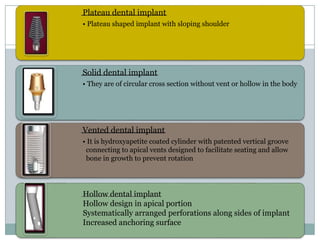
Plateau dental implant
• Plateau shaped implant with sloping shoulder
Solid dental implant
• They are of circular cross section without vent or hollow in the body
Vented dental implant
• It is hydroxyapetite coated cylinder with patented vertical groove
connecting to apical vents designed to facilitate seating and allow
bone in growth to prevent rotation
Hollow dental implant
Hollow design in apical portion
Systematically arranged perforations along sides of implant
Increased anchoring surface
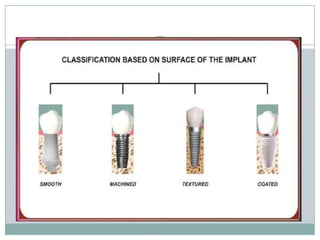
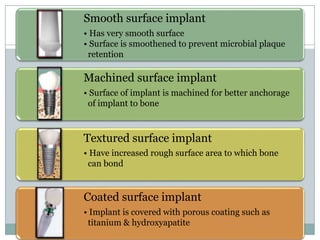
Smooth surface implant
• Has very smooth surface
• Surface is smoothened to prevent microbial plaque
retention
Machined surface implant
• Surface of implant is machined for better anchorage
of implant to bone
Textured surface implant
• Have increased rough surface area to which bone
can bond
Coated surface implant
• Implant is covered with porous coating such as
titanium & hydroxyapatite
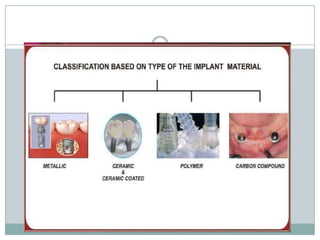
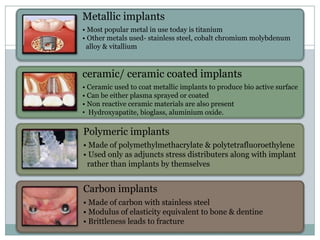
Metallic implants
• Most popular metal in use today is titanium
• Other metals used- stainless steel, cobalt chromium molybdenum
alloy & vitallium
ceramic/ ceramic coated implants
• Ceramic used to coat metallic implants to produce bio active surface
• Can be either plasma sprayed or coated
• Non reactive ceramic materials are also present
• Hydroxyapatite, bioglass, aluminium oxide.
Polymeric implants
• Made of polymethylmethacrylate & polytetrafluoroethylene
• Used only as adjuncts stress distributers along with implant
rather than implants by themselves
Carbon implants
• Made of carbon with stainless steel
• Modulus of elasticity equivalent to bone & dentine
• Brittleness leads to fracture
• Depending on the materials used:
Metallic implants
[titanium, titanium alloy, cobalt chromium molybdenum alloy]
Non- metallic implants
[ceramics, carbon]
• According to loading
• Immediate(<2weeks)
• Early(2weeks -2mts)
• Delayed (>3mts)
• According to method of placement
• Tapping system
• Threading system
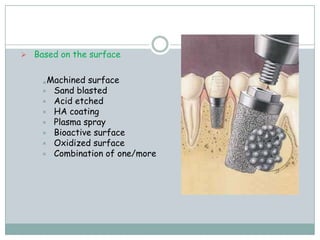
 Based on the surface
Machined surface
 Sand blasted
 Acid etched
 HA coating
 Plasma spray
 Bioactive surface
 Oxidized surface
 Combination of one/more

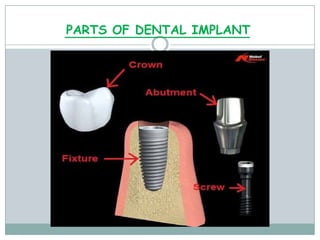
PARTS OF DENTAL IMPLANT
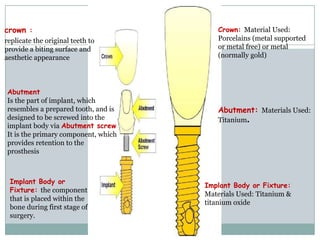
crown :
replicate the original teeth to
provide a biting surface and
aesthetic appearance
Crown: Material Used:
Porcelains (metal supported
or metal free) or metal
(normally gold)
Abutment
Is the part of implant, which
resembles a prepared tooth, and is
designed to be screwed into the
implant body via Abutment screw
It is the primary component, which
provides retention to the
prosthesis
Abutment: Materials Used:
Titanium.
Implant Body or
Fixture: the component
that is placed within the
bone during first stage of
surgery.
Implant Body or Fixture:
Materials Used: Titanium &
titanium oxide
OTHER IMPLANT
COMPONENTS
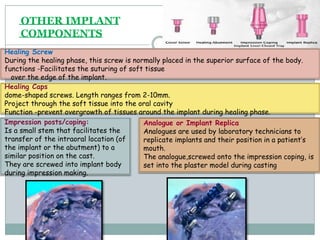
Healing Screw
During the healing phase, this screw is normally placed in the superior surface of the body.
functions -Facilitates the suturing of soft tissue
over the edge of the implant.
Healing Caps
dome-shaped screws. Length ranges from 2-10mm.
Project through the soft tissue into the oral cavity
Function -prevent overgrowth of tissues around the implant during healing phase.
Impression posts/coping:
Is a small stem that facilitates the
transfer of the intraoral location (of
the implant or the abutment) to a
similar position on the cast.
They are screwed into implant body
during impression making.
Analogue or Implant Replica
Analogues are used by laboratory technicians to
replicate implants and their position in a patient’s
mouth.
The analogue,screwed onto the impression coping, is
set into the plaster model during casting
Implants_013948.ppt
Implants_013948.ppt

Implants_013948.ppt

  • 1.
    DENTAL IMPLANT Dr. IbadatJamil Assistant professor Dep. Of Prothodontics
  • 2.
    TERMINOLOGY DENTAL IMPLANT Can be definedas a substance that is placed into the jaw to support a crown or fixed or removable denture. DENTAL IMPLANT A prosthetic device or alloplastic material implanted into oral tissues beneath the mucosal or periosteal tissues and/or within the bone to provide retention and support for fixed or removal prosthesis.
  • 3.
  • 4.
    RATIONALE Implant dentistry isa boon for restoration of missing teeth. It overcomes many disadvantages of other conventional methods of restoration ie., removable and fixed prosthesis. The ability to achieve replacement of teeth regardless of atrophy, disease, or injury to the stomatognathic system
  • 5.
    Why are Implantspreferred over Dentures and Bridges ? Stability Grinding of adjacent healthy teeth Chewing efficiency Comfort /artificial feeling Protection of the jawbone Eating habits
  • 6.
    ADVANTAGES OF IMPLANT- SUPPORTEDPROSTHESIS   Maintain bone height & width • • Reduced size of prosthesis Improve stability and retention of Restore and maintain occlusal vertical dimension Maintain facial esthetics Improve esthetics removable prosthesis •   Increase survival times of prostheses     Improve phonetics Improve occlusion Increase prosthesis success Improve masticatory • There is no need to alter adjacent teeth • • More permanent replacement Improve psychological health performance/maintain muscles of mastication and facial expression
  • 7.
    DISADVANTAGES OF DENTALIMPLANTS  Very expensive.  Cannot be used in medically compromised patients who cannot undergo surgery.  Longer duration of treatment and tedious fabrication procedures.  Requires a lot of patient co-operation because of repeated recall visits for after care is essential
  • 8.
    INDICATIONS  Severe morphologiccompromise of denture supporting areas that significantly undermine denture retention.  Poor oral muscular coordination.  Para functional habits leading to recurrent soreness and instability of prosthesis.  Unrealistic prosthodontic expectations  Active or hyperactive gag reflexes elicited by removable prosthesis.  Psychological inability to wear a removable prosthesis, even if adequate denture retention and stability is present.  Unfavorable number and location of potential abutments in a residual dentition.  Single tooth loss to avoid involving neighboring tooth as abutments.  Esthetic zone  preserve interdental diastemas
  • 9.
    ABSOLUTE CONTRAINDICATIONS 1. RELATIVE CONTRAINDICATIONS • Systemic hematological disorders •Irradiation of the jaw • Liver and kidney disorders • Osteoporosis/ low bone mineral content • Local pathology 2. 3. 4. 5. 6. 7. 8. Recent myocardial infarction Valvular prosthesis Severe renal disease Uncontrolled & treatment resistant diabetes Advanced & untreated osteoporosis Treatment resistant osteomalacia Uncontrolled endocrine gland disease Advanced & uncontrolled acquired immunodeficiency syndrome
  • 10.
  • 11.
    Classification of implantsby Charles. A. Babbush There are five main types:
  • 12.
    1.ENDOSTEAL IMPLANT An implantwhich is placed into the alveolar bone and or basal bone of the mandible or maxilla  Transects only one corticle plate  Most commonly used Root form Blade implant Ramus frame implant It consists of thin plates in the form of blade embedded into the bone Designed to mimic the shape of the tooth for directional load distribution Horse shoe shaped stainless steel device Inserted from one retromolar pad to other
  • 13.
    2. SUBPERIOSTEAL IMPLANT Placed directly beneath the periosteum overlying the bony cortex  Do not penetrate into the jawbone.  Consists of non-Osseo integrated framework that rests on the surface of the jaw or beneath the mucoperiosteum.  Can be bilateral or unilateral
  • 14.
    3. TRANSOSTEAL IMPLANT Other names- staple bone implant      Mandibular staple implant Transmandibular implant Combines the subperiosteal and endosteal components Penetrates both cortical plates very similar to a nut and bolt arrangement Used in mandibles only penetrate the entire jaw to emerge opposite the entry site, usually at the bottom of the chin.
  • 15.
    4. INTRAMUCOSAL IMPLANTS Inserted into oral mucosa  Mucosa is used as attachment site for metal inserts
  • 16.
    •Described by BRANEMARK •Direct contactbetween bone & surface of loaded implant •Bio active materials that stimulate formation of bone are used •Described by Dr CHARLES WIESS •Complete encapsulation of implant with soft tissue •Soft tissue interface could resemble highly vascular periodontal fibers of natural dentition
  • 18.
    Cylindrical dental implants •In the form of cylinder • Depends on coating or surface conditioning to provide microscopic retension & bonding to bone • pushed or tapped into prepared bone site • Straight, tapered or conical Threaded dental implants • The surface is threaded, to increase surface area of implant • This results in distribution of forces over greater peri-implant bone volume Perforated dental implants • are made of inert micro porous membrane material (mixture of cellulose acetate) in intimate contact with & supported by layer of perforated metallic sheet material (pure titanium)
  • 19.
    Plateau dental implant •Plateau shaped implant with sloping shoulder Solid dental implant • They are of circular cross section without vent or hollow in the body Vented dental implant • It is hydroxyapetite coated cylinder with patented vertical groove connecting to apical vents designed to facilitate seating and allow bone in growth to prevent rotation Hollow dental implant Hollow design in apical portion Systematically arranged perforations along sides of implant Increased anchoring surface
  • 21.
    Smooth surface implant •Has very smooth surface • Surface is smoothened to prevent microbial plaque retention Machined surface implant • Surface of implant is machined for better anchorage of implant to bone Textured surface implant • Have increased rough surface area to which bone can bond Coated surface implant • Implant is covered with porous coating such as titanium & hydroxyapatite
  • 23.
    Metallic implants • Mostpopular metal in use today is titanium • Other metals used- stainless steel, cobalt chromium molybdenum alloy & vitallium ceramic/ ceramic coated implants • Ceramic used to coat metallic implants to produce bio active surface • Can be either plasma sprayed or coated • Non reactive ceramic materials are also present • Hydroxyapatite, bioglass, aluminium oxide. Polymeric implants • Made of polymethylmethacrylate & polytetrafluoroethylene • Used only as adjuncts stress distributers along with implant rather than implants by themselves Carbon implants • Made of carbon with stainless steel • Modulus of elasticity equivalent to bone & dentine • Brittleness leads to fracture
  • 24.
    • Depending onthe materials used: Metallic implants [titanium, titanium alloy, cobalt chromium molybdenum alloy] Non- metallic implants [ceramics, carbon] • According to loading • Immediate(<2weeks) • Early(2weeks -2mts) • Delayed (>3mts) • According to method of placement • Tapping system • Threading system
  • 25.
     Based onthe surface Machined surface  Sand blasted  Acid etched  HA coating  Plasma spray  Bioactive surface  Oxidized surface  Combination of one/more 
  • 26.
  • 27.
    crown : replicate theoriginal teeth to provide a biting surface and aesthetic appearance Crown: Material Used: Porcelains (metal supported or metal free) or metal (normally gold) Abutment Is the part of implant, which resembles a prepared tooth, and is designed to be screwed into the implant body via Abutment screw It is the primary component, which provides retention to the prosthesis Abutment: Materials Used: Titanium. Implant Body or Fixture: the component that is placed within the bone during first stage of surgery. Implant Body or Fixture: Materials Used: Titanium & titanium oxide
  • 28.
    OTHER IMPLANT COMPONENTS Healing Screw Duringthe healing phase, this screw is normally placed in the superior surface of the body. functions -Facilitates the suturing of soft tissue over the edge of the implant. Healing Caps dome-shaped screws. Length ranges from 2-10mm. Project through the soft tissue into the oral cavity Function -prevent overgrowth of tissues around the implant during healing phase. Impression posts/coping: Is a small stem that facilitates the transfer of the intraoral location (of the implant or the abutment) to a similar position on the cast. They are screwed into implant body during impression making. Analogue or Implant Replica Analogues are used by laboratory technicians to replicate implants and their position in a patient’s mouth. The analogue,screwed onto the impression coping, is set into the plaster model during casting