“What is now proved was once only imagined.”
-William Blake
1
IMMUNOTHERAPY
The next magic bullet in medicine
2
Presented by:
Anupam Singh Thapa
Deekshya Devkota
Pooja Rokaya
Sakar Pant
Scheme of Presentation
-Definition
-Immunotherapy as an innovation
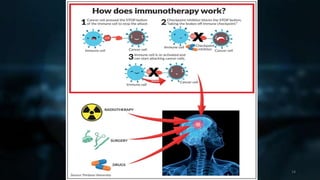
-Introduction to immunotherapy
-Components
-Mechanism of action
-Uses and need of immunotherapy
-Risks and benefits
-Current situation
-Advantages of immunotherapy
-Possibilities and challenges
-Immunotherapy in Nepal 3
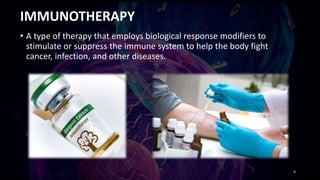
IMMUNOTHERAPY
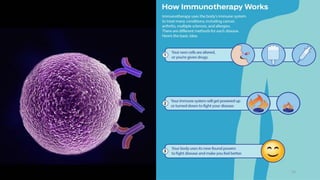
• A type of therapy that employs biological response modifiers to
stimulate or suppress the immune system to help the body fight
cancer, infection, and other diseases.
4
IMMUNOTHERAPY AS AN INNOVATION
• Every
disease or
infection is
directly or
indirectly
linked with
immunity.
• Solution to
diseases not
treated by
classical
therapies.
• Provides our
immune
system an
upper hand
against
cancer,
infection and
diseases.
5
INTRODUCTION
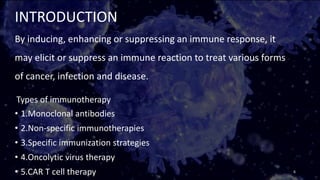
By inducing, enhancing or suppressing an immune response, it
may elicit or suppress an immune reaction to treat various forms
of cancer, infection and disease.
Types of immunotherapy
• 1.Monoclonal antibodies
• 2.Non-specific immunotherapies
• 3.Specific immunization strategies
• 4.Oncolytic virus therapy
• 5.CAR T cell therapy 6
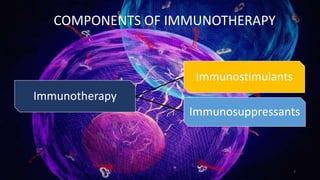
COMPONENTS OF IMMUNOTHERAPY
7
Immunotherapy
Immunostimulants
Immunosuppressants
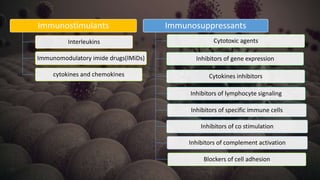
Immunostimulants
Interleukins
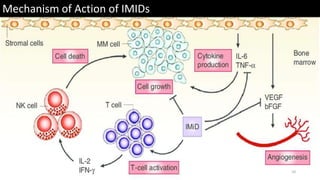
Immunomodulatory imide drugs(IMiDs)
cytokines and chemokines
Immunosuppressants
Blockers of cell adhesion
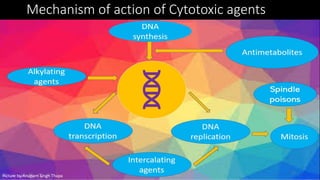
Cytotoxic agents
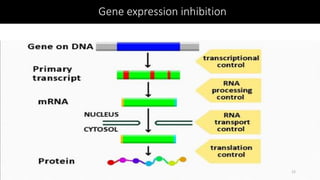
Inhibitors of gene expression
Cytokines inhibitors
Inhibitors of lymphocyte signaling
Inhibitors of specific immune cells
Inhibitors of co stimulation
Inhibitors of complement activation
9
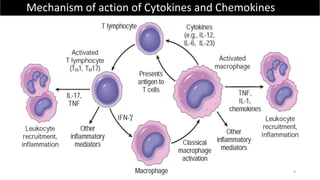
Mechanism of action of Cytokines and Chemokines
10
Mechanism of Action of IMIDs
Mechanism of action of Cytotoxic agents
11
Picture by:Anupam Singh Thapa
Gene expression inhibition
12
13
14
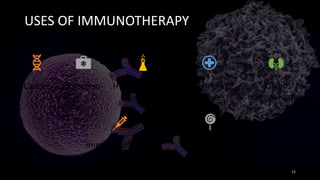
USES OF IMMUNOTHERAPY
Cancer Infection Hypersensitivity
reactions
Autoimmune
diseases
Organ
transplantation
Immunodeficiency
diseases
Type I
diabetes
15
NEED OF IMMUNOTHERAPY
•Less adverse effects that classical therapies like
chemotherapy, surgery and radiation
•Targeted therapy can be achieved in more efficiently
•A revolutionary treatment choice for many untreated
diseases
16
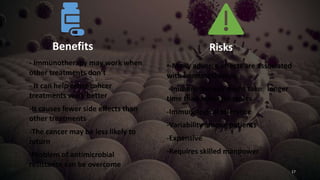
Benefits
- Immunotherapy may work when
other treatments don’t
- It can help other cancer
treatments work better
-It causes fewer side effects than
other treatments
-The cancer may be less likely to
return
-Problem of antimicrobial
resistance can be overcome
Risks
•-Many adverse effects are associated
with immunotherapy
-Immunotherapy might take longer
time than other therapies
-Immunological tolerance
-Variability among patients
-Expensive
-Requires skilled manpower
17
CURRENT SITUATION
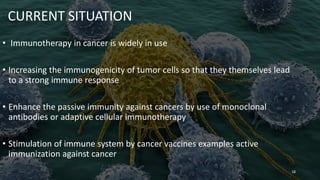
• Immunotherapy in cancer is widely in use
• Increasing the immunogenicity of tumor cells so that they themselves lead
to a strong immune response
• Enhance the passive immunity against cancers by use of monoclonal
antibodies or adaptive cellular immunotherapy
• Stimulation of immune system by cancer vaccines examples active
immunization against cancer
18
IMMUNOTHERAPY AND CANCER
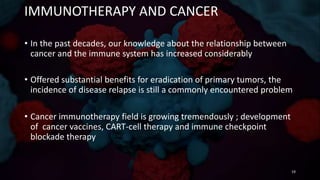
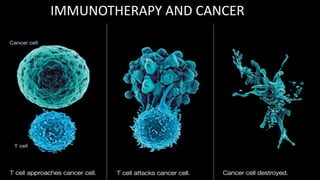
• In the past decades, our knowledge about the relationship between
cancer and the immune system has increased considerably
• Offered substantial benefits for eradication of primary tumors, the
incidence of disease relapse is still a commonly encountered problem
• Cancer immunotherapy field is growing tremendously ; development
of cancer vaccines, CART-cell therapy and immune checkpoint
blockade therapy
19
IMMUNOTHERAPY AND CANCER
20
ADVANTAGES OF IMMUNOTHERAPY IN
CANCER PATIENTS
• Boon to cancer patients
• Suppresses and even cure almost all types of cancers
• Proven to cure malignant disease where classical therapies fail or are
contraindicated
• Flexibility of therapy according to complications of malignancy provided
• Offers the possibilities for long term cancer remission
• Better prognosis of cancer and higher survival rates
21
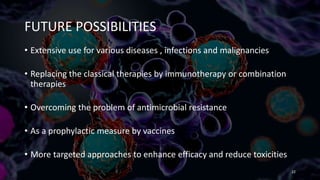
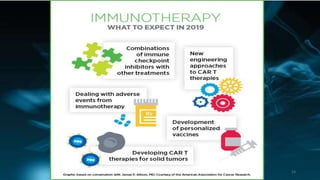
FUTURE POSSIBILITIES
• Extensive use for various diseases , infections and malignancies
• Replacing the classical therapies by immunotherapy or combination
therapies
• Overcoming the problem of antimicrobial resistance
• As a prophylactic measure by vaccines
• More targeted approaches to enhance efficacy and reduce toxicities
22
23
CHALLENGES
• Unpredictable efficacy
• Distinct clinical study designs needed to evaluate efficacy
• Expensive and requires highly skilled manpower and infrastructures
• Differential response rates due to diversity of individual immune
responses
24
IMMUNOTHERAPY IN NEPAL
25
• Mostly used for treatment of cancer
• IVIG in Guillain Barre syndrome
REFERENCES
 IMMUNOLOGY, Eight edition , David male , Jonathan Brostoff, David b Roth, Ivan M Roitt ,
immunotherapy for cancer (pg. 364-367) , immunotherapy for fungal infection(240-241),
immunotherapy for immediate hypersensitivity reactions ( 387-388), non-specific (pg. 300-
308)
 Basic and clinical pharmacology, 14th edition , Bertram G. Katzung, Immunomodulators,
therapeutic(pg. 996-998), immunotherapy (pg. 997-1001), immunosuppressive therapy(pg.
985-993)
 https://www.webmd.com
 https://connect.uclahealth.org
 https://www.the-scientist.com
 https://www.cancer.gov
 https://www.ncbi.nlm.nih.gov
Picture References
• https://www.npr.org
• https://www.quantamagazine.org
• https://www.uq.edu.au
• https://www.aceabio.com
• https://www.mskcc.org
• https://www.the-scientist.com
• https://www.webmd.com
• https://www.aaaai.org
• ROBBINS AND COTRAN PATHOLOGIC BASIS OF DISEASE 9th edition
27
28

Immunotherapy as an innovation

  • 1.
    “What is nowproved was once only imagined.” -William Blake 1
  • 2.
    IMMUNOTHERAPY The next magicbullet in medicine 2 Presented by: Anupam Singh Thapa Deekshya Devkota Pooja Rokaya Sakar Pant
  • 3.
    Scheme of Presentation -Definition -Immunotherapyas an innovation -Introduction to immunotherapy -Components -Mechanism of action -Uses and need of immunotherapy -Risks and benefits -Current situation -Advantages of immunotherapy -Possibilities and challenges -Immunotherapy in Nepal 3
  • 4.
    IMMUNOTHERAPY • A typeof therapy that employs biological response modifiers to stimulate or suppress the immune system to help the body fight cancer, infection, and other diseases. 4
  • 5.
    IMMUNOTHERAPY AS ANINNOVATION • Every disease or infection is directly or indirectly linked with immunity. • Solution to diseases not treated by classical therapies. • Provides our immune system an upper hand against cancer, infection and diseases. 5
  • 6.
    INTRODUCTION By inducing, enhancingor suppressing an immune response, it may elicit or suppress an immune reaction to treat various forms of cancer, infection and disease. Types of immunotherapy • 1.Monoclonal antibodies • 2.Non-specific immunotherapies • 3.Specific immunization strategies • 4.Oncolytic virus therapy • 5.CAR T cell therapy 6
  • 7.
  • 8.
    Immunostimulants Interleukins Immunomodulatory imide drugs(IMiDs) cytokinesand chemokines Immunosuppressants Blockers of cell adhesion Cytotoxic agents Inhibitors of gene expression Cytokines inhibitors Inhibitors of lymphocyte signaling Inhibitors of specific immune cells Inhibitors of co stimulation Inhibitors of complement activation
  • 9.
    9 Mechanism of actionof Cytokines and Chemokines
  • 10.
  • 11.
    Mechanism of actionof Cytotoxic agents 11 Picture by:Anupam Singh Thapa
  • 12.
  • 13.
  • 14.
  • 15.
    USES OF IMMUNOTHERAPY CancerInfection Hypersensitivity reactions Autoimmune diseases Organ transplantation Immunodeficiency diseases Type I diabetes 15
  • 16.
    NEED OF IMMUNOTHERAPY •Lessadverse effects that classical therapies like chemotherapy, surgery and radiation •Targeted therapy can be achieved in more efficiently •A revolutionary treatment choice for many untreated diseases 16
  • 17.
    Benefits - Immunotherapy maywork when other treatments don’t - It can help other cancer treatments work better -It causes fewer side effects than other treatments -The cancer may be less likely to return -Problem of antimicrobial resistance can be overcome Risks •-Many adverse effects are associated with immunotherapy -Immunotherapy might take longer time than other therapies -Immunological tolerance -Variability among patients -Expensive -Requires skilled manpower 17
  • 18.
    CURRENT SITUATION • Immunotherapyin cancer is widely in use • Increasing the immunogenicity of tumor cells so that they themselves lead to a strong immune response • Enhance the passive immunity against cancers by use of monoclonal antibodies or adaptive cellular immunotherapy • Stimulation of immune system by cancer vaccines examples active immunization against cancer 18
  • 19.
    IMMUNOTHERAPY AND CANCER •In the past decades, our knowledge about the relationship between cancer and the immune system has increased considerably • Offered substantial benefits for eradication of primary tumors, the incidence of disease relapse is still a commonly encountered problem • Cancer immunotherapy field is growing tremendously ; development of cancer vaccines, CART-cell therapy and immune checkpoint blockade therapy 19
  • 20.
  • 21.
    ADVANTAGES OF IMMUNOTHERAPYIN CANCER PATIENTS • Boon to cancer patients • Suppresses and even cure almost all types of cancers • Proven to cure malignant disease where classical therapies fail or are contraindicated • Flexibility of therapy according to complications of malignancy provided • Offers the possibilities for long term cancer remission • Better prognosis of cancer and higher survival rates 21
  • 22.
    FUTURE POSSIBILITIES • Extensiveuse for various diseases , infections and malignancies • Replacing the classical therapies by immunotherapy or combination therapies • Overcoming the problem of antimicrobial resistance • As a prophylactic measure by vaccines • More targeted approaches to enhance efficacy and reduce toxicities 22
  • 23.
  • 24.
    CHALLENGES • Unpredictable efficacy •Distinct clinical study designs needed to evaluate efficacy • Expensive and requires highly skilled manpower and infrastructures • Differential response rates due to diversity of individual immune responses 24
  • 25.
    IMMUNOTHERAPY IN NEPAL 25 •Mostly used for treatment of cancer • IVIG in Guillain Barre syndrome
  • 26.
    REFERENCES  IMMUNOLOGY, Eightedition , David male , Jonathan Brostoff, David b Roth, Ivan M Roitt , immunotherapy for cancer (pg. 364-367) , immunotherapy for fungal infection(240-241), immunotherapy for immediate hypersensitivity reactions ( 387-388), non-specific (pg. 300- 308)  Basic and clinical pharmacology, 14th edition , Bertram G. Katzung, Immunomodulators, therapeutic(pg. 996-998), immunotherapy (pg. 997-1001), immunosuppressive therapy(pg. 985-993)  https://www.webmd.com  https://connect.uclahealth.org  https://www.the-scientist.com  https://www.cancer.gov  https://www.ncbi.nlm.nih.gov
  • 27.
    Picture References • https://www.npr.org •https://www.quantamagazine.org • https://www.uq.edu.au • https://www.aceabio.com • https://www.mskcc.org • https://www.the-scientist.com • https://www.webmd.com • https://www.aaaai.org • ROBBINS AND COTRAN PATHOLOGIC BASIS OF DISEASE 9th edition 27
  • 28.