Immunology
Lymphocytes Development
• Express a diversity of antigen receptors
• Diversity generated during development of B and
T cells from precursor cells
• Lymphocyte development or lymphocyte
maturation
• Immune repertoire – antigen receptors on B and T
cells
• Central feature of lymphocyte development –
rearangement and expression of antigen receptor
genes
Commitment to the B and T cell lineages
• B and T cells (plus others) come from HSCs
• Early B and T cell development is
characterized by the proliferation of
progenitors, stimulated mainly by IL-7
resulting in marked increase in cell numbers
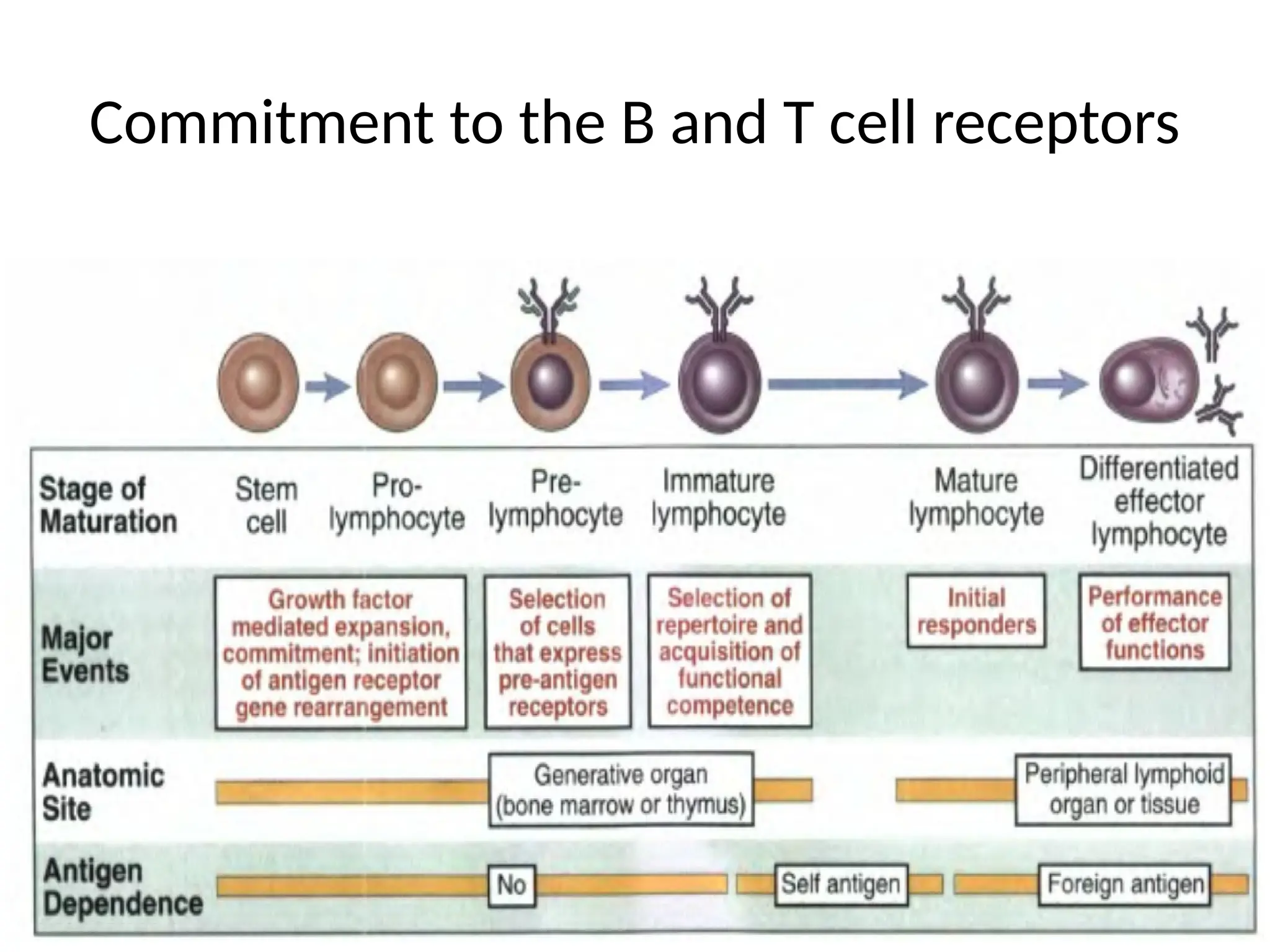
Commitment to the B and T cell receptors
Antigen receptor gene rearrangement and
expression
• Key event in lymphocyte develepment
• Drives generation of a diverse repertoire
• Upto 107
or more different B and T cell clones,
each with a unique receptor
• The rearrangement events are not dependent on
or influenced by presence of antigens
• Antigen receptors are expressed before
encounter with antigens (clonal selection
hypothesis)
Selection processes that shape the B and T
cell repertoire
• Signals delivered through pre-antigen and antigen
receptors for survival and proliferation plus continued
maturation
• Positive selection – receptors with low avidity
• Negative selection – elimination of high avid receptors
in generative organs by apoptosis (clonal deletion)
• Negative selection maintains tolerance (central
tolerance)
• Receptor editing – making further Ig gene
rearrangements to evade self-reactivity
Generation of lymphocyte subsets
• Double positive T cells differentiate into either
CD4+ class II MHC or CD8+ MHC I restricted T
cells
• B cells differentiate into either follicular B cells
and mediate T cell-dependent immune
responses in secondary organs or marginal
zone B cells that reside in marginal sinus in the
spleen and mediate largely T cell-independent
responses to blood-borne antigens
Rearrangement of antigen receptor genes in
B and T cells
• Genes that encode diverse antigen receptors
of B and T cells are generated by the
rearrangement in individual lymphocytes of
different variable (V) region gene segments
with diversity (D) and/or joining (J) gene
segments (VDJ recombination)
Germline organization of Ig and TCR Genes
• Ig and TCR germline organizations are
fundamentally similar
• Characterized by spatial segregation of
sequences that must be joined together to
produce functional genes coding for antigen
receptors
Organization of Ig gene loci
• Ig heavy chain, Ig κ chain, and Ig λ chain loci
from different chromosomes code for those
respective proteins
• Organized essentially the same way in all
mammals although may vary on chromosomal
locations, number, and sequence
• Non-coding sequences in the Ig loci play
important roles in recombination and gene
expression.
Organization of TCR gene loci
• TCR α chain, TCR β chain, TCR γ chain map to
three seperate loci, and the TCR δ chain locus
is contained within the TCR α locus.
V(D)J recombination
• Can be divided into 4 distinct sequential
events
Synapsis
Cleavage
Coding end processing
Joining
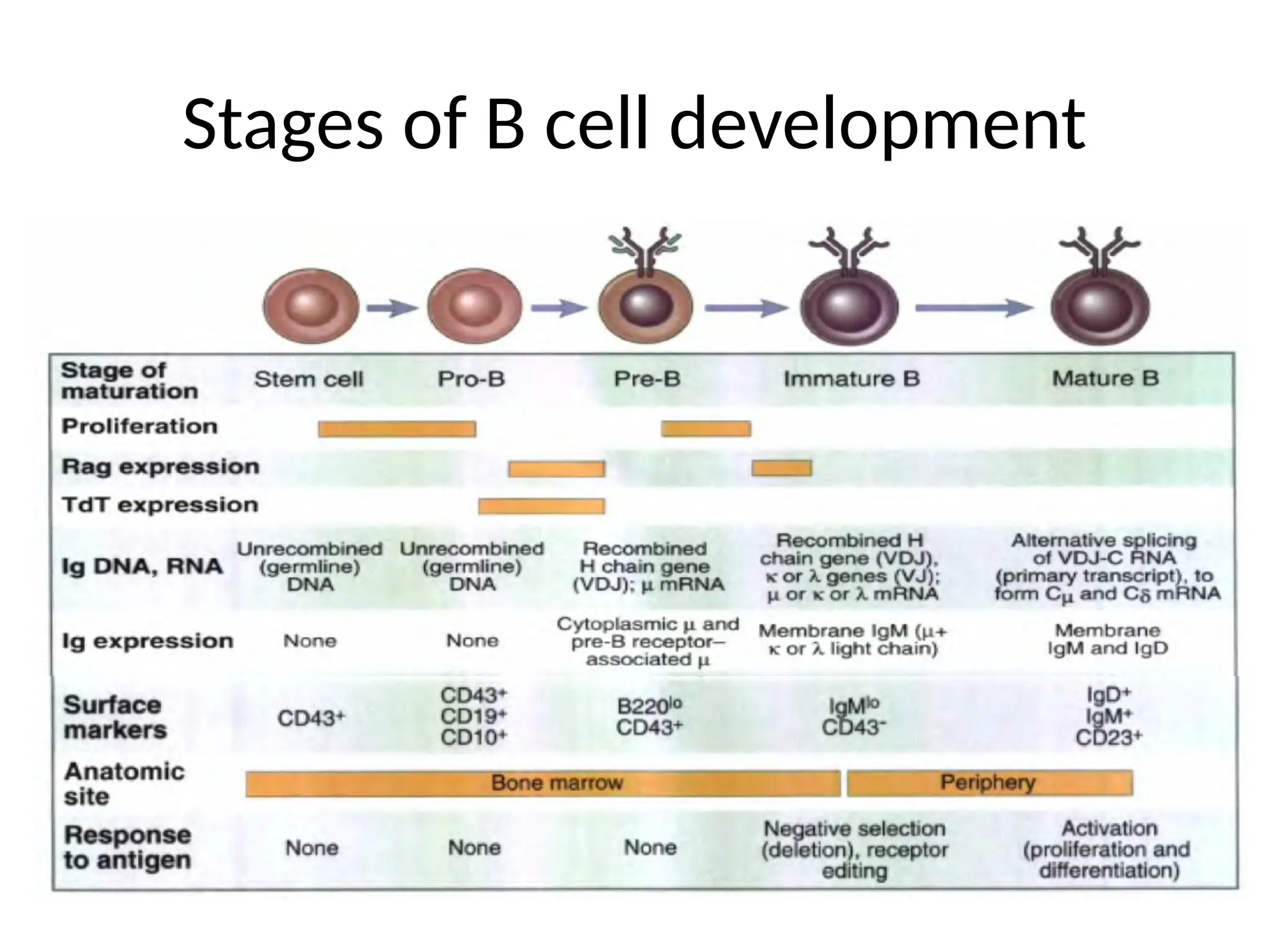
B lymphocyte development
• Main events are: rearrangement and
expression of Ig genes, selection, and
proliferation
Stages of B cell development
Maturation of T cells
• Involve sequential rearrangement and
expression of TCR genes, proliferation, antigen
induced selection, and the acquisition of
functional capabilities

immunology lecture 3.pptx powerpoint presentation

  • 1.
  • 2.
    Lymphocytes Development • Expressa diversity of antigen receptors • Diversity generated during development of B and T cells from precursor cells • Lymphocyte development or lymphocyte maturation • Immune repertoire – antigen receptors on B and T cells • Central feature of lymphocyte development – rearangement and expression of antigen receptor genes
  • 3.
    Commitment to theB and T cell lineages • B and T cells (plus others) come from HSCs • Early B and T cell development is characterized by the proliferation of progenitors, stimulated mainly by IL-7 resulting in marked increase in cell numbers
  • 4.
    Commitment to theB and T cell receptors
  • 5.
    Antigen receptor generearrangement and expression • Key event in lymphocyte develepment • Drives generation of a diverse repertoire • Upto 107 or more different B and T cell clones, each with a unique receptor • The rearrangement events are not dependent on or influenced by presence of antigens • Antigen receptors are expressed before encounter with antigens (clonal selection hypothesis)
  • 6.
    Selection processes thatshape the B and T cell repertoire • Signals delivered through pre-antigen and antigen receptors for survival and proliferation plus continued maturation • Positive selection – receptors with low avidity • Negative selection – elimination of high avid receptors in generative organs by apoptosis (clonal deletion) • Negative selection maintains tolerance (central tolerance) • Receptor editing – making further Ig gene rearrangements to evade self-reactivity
  • 7.
    Generation of lymphocytesubsets • Double positive T cells differentiate into either CD4+ class II MHC or CD8+ MHC I restricted T cells • B cells differentiate into either follicular B cells and mediate T cell-dependent immune responses in secondary organs or marginal zone B cells that reside in marginal sinus in the spleen and mediate largely T cell-independent responses to blood-borne antigens
  • 8.
    Rearrangement of antigenreceptor genes in B and T cells • Genes that encode diverse antigen receptors of B and T cells are generated by the rearrangement in individual lymphocytes of different variable (V) region gene segments with diversity (D) and/or joining (J) gene segments (VDJ recombination)
  • 9.
    Germline organization ofIg and TCR Genes • Ig and TCR germline organizations are fundamentally similar • Characterized by spatial segregation of sequences that must be joined together to produce functional genes coding for antigen receptors
  • 10.
    Organization of Iggene loci • Ig heavy chain, Ig κ chain, and Ig λ chain loci from different chromosomes code for those respective proteins • Organized essentially the same way in all mammals although may vary on chromosomal locations, number, and sequence • Non-coding sequences in the Ig loci play important roles in recombination and gene expression.
  • 11.
    Organization of TCRgene loci • TCR α chain, TCR β chain, TCR γ chain map to three seperate loci, and the TCR δ chain locus is contained within the TCR α locus.
  • 12.
    V(D)J recombination • Canbe divided into 4 distinct sequential events Synapsis Cleavage Coding end processing Joining
  • 13.
    B lymphocyte development •Main events are: rearrangement and expression of Ig genes, selection, and proliferation
  • 14.
    Stages of Bcell development
  • 15.
    Maturation of Tcells • Involve sequential rearrangement and expression of TCR genes, proliferation, antigen induced selection, and the acquisition of functional capabilities