Basic Immunology
Lectures 9-10
Lymphocyte Development and
Antigen Receptor Gene Rearrangement
Basic Immunology
Lectures 9-10
Lymphocyte Development and
Antigen Receptor Gene Rearrangement
OVERVIEW OF LYMPHOCYTE DEVELOPMENT
The maturation of B and T lymphocytes involves a series of
events that occur in the generative lymphoid organs. These
events include the following:
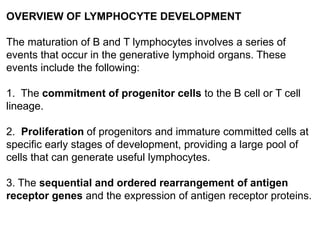
1. The commitment of progenitor cells to the B cell or T cell
lineage.
2. Proliferation of progenitors and immature committed cells at
specific early stages of development, providing a large pool of
cells that can generate useful lymphocytes.
3. The sequential and ordered rearrangement of antigen
receptor genes and the expression of antigen receptor proteins.
OVERVIEW OF LYMPHOCYTE DEVELOPMENT (cont.)
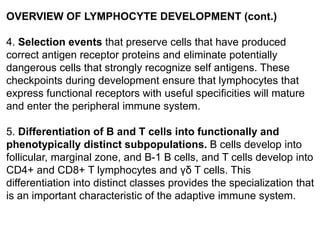
4. Selection events that preserve cells that have produced
correct antigen receptor proteins and eliminate potentially
dangerous cells that strongly recognize self antigens. These
checkpoints during development ensure that lymphocytes that
express functional receptors with useful specificities will mature
and enter the peripheral immune system.
5. Differentiation of B and T cells into functionally and
phenotypically distinct subpopulations. B cells develop into
follicular, marginal zone, and B-1 B cells, and T cells develop into
CD4+ and CD8+ T lymphocytes and γδ T cells. This
differentiation into distinct classes provides the specialization that
is an important characteristic of the adaptive immune system.
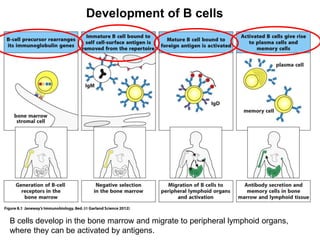
Development of B cells
B cells develop in the bone marrow and migrate to peripheral lymphoid organs,
where they can be activated by antigens.
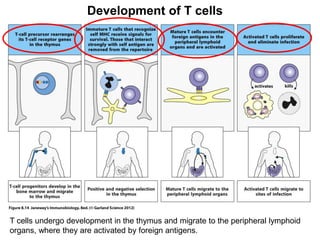
Development of T cells
T cells undergo development in the thymus and migrate to the peripheral lymphoid
organs, where they are activated by foreign antigens.
Copyright © 2011 by Saunders, an imprint of Elsevier Inc.Abbas, Lichtman, and Pillai. Cellular and Molecular Immunology, 7th edition. Copyright © 2012 by Saunders, an imprint of Elsevier Inc.
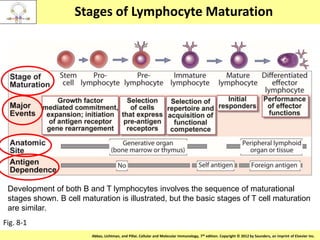
Stages of Lymphocyte Maturation
Fig. 8-1
Development of both B and T lymphocytes involves the sequence of maturational
stages shown. B cell maturation is illustrated, but the basic stages of T cell maturation
are similar.
Copyright © 2011 by Saunders, an imprint of Elsevier Inc.Abbas, Lichtman, and Pillai. Cellular and Molecular Immunology, 7th edition. Copyright © 2012 by Saunders, an imprint of Elsevier Inc.
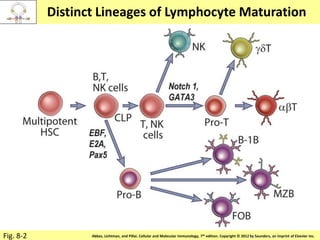
Distinct Lineages of Lymphocyte Maturation
Fig. 8-2
Copyright © 2011 by Saunders, an imprint of Elsevier Inc.Abbas, Lichtman, and Pillai. Cellular and Molecular Immunology, 7th edition. Copyright © 2012 by Saunders, an imprint of Elsevier Inc.
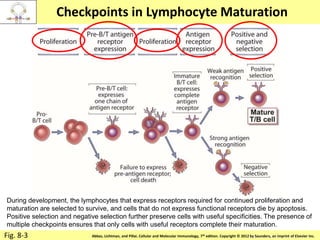
Checkpoints in Lymphocyte Maturation
Fig. 8-3
During development, the lymphocytes that express receptors required for continued proliferation and
maturation are selected to survive, and cells that do not express functional receptors die by apoptosis.
Positive selection and negative selection further preserve cells with useful specificities. The presence of
multiple checkpoints ensures that only cells with useful receptors complete their maturation.
Copyright © 2011 by Saunders, an imprint of Elsevier Inc.Abbas, Lichtman, and Pillai. Cellular and Molecular Immunology, 7th edition. Copyright © 2012 by Saunders, an imprint of Elsevier Inc.
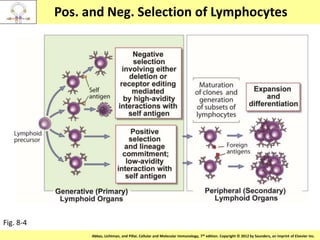
Pos. and Neg. Selection of Lymphocytes
Fig. 8-4
Copyright © 2011 by Saunders, an imprint of Elsevier Inc.Abbas, Lichtman, and Pillai. Cellular and Molecular Immunology, 7th edition. Copyright © 2012 by Saunders, an imprint of Elsevier Inc.
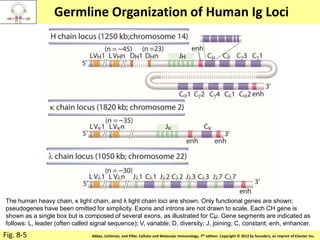
Germline Organization of Human Ig Loci
Fig. 8-5
The human heavy chain, κ light chain, and λ light chain loci are shown. Only functional genes are shown;
pseudogenes have been omitted for simplicity. Exons and introns are not drawn to scale. Each CH gene is
shown as a single box but is composed of several exons, as illustrated for Cμ. Gene segments are indicated as
follows: L, leader (often called signal sequence); V, variable; D, diversity; J, joining; C, constant; enh, enhancer.
Copyright © 2011 by Saunders, an imprint of Elsevier Inc.Abbas, Lichtman, and Pillai. Cellular and Molecular Immunology, 7th edition. Copyright © 2012 by Saunders, an imprint of Elsevier Inc.
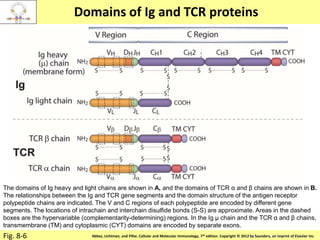
Domains of Ig and TCR proteins
Fig. 8-6
The domains of Ig heavy and light chains are shown in A, and the domains of TCR α and β chains are shown in B.
The relationships between the Ig and TCR gene segments and the domain structure of the antigen receptor
polypeptide chains are indicated. The V and C regions of each polypeptide are encoded by different gene
segments. The locations of intrachain and interchain disulfide bonds (S-S) are approximate. Areas in the dashed
boxes are the hypervariable (complementarity-determining) regions. In the Ig μ chain and the TCR α and β chains,
transmembrane (TM) and cytoplasmic (CYT) domains are encoded by separate exons.
Copyright © 2011 by Saunders, an imprint of Elsevier Inc.Abbas, Lichtman, and Pillai. Cellular and Molecular Immunology, 7th edition. Copyright © 2012 by Saunders, an imprint of Elsevier Inc.
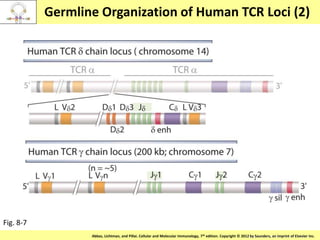
Germline Organization of Human TCR Loci (1)
Fig. 8-7
The human TCR β, α, γ, and δ chain loci are shown, as indicated. Exons and introns are not
drawn to scale, and nonfunctional pseudogenes are not shown. Each C gene is shown as a single
box but is composed of several exons, as illustrated for Cβ1. Gene segments are indicated as
follows: L, leader (usually called signal sequence); V, variable; D, diversity; J, joining; C, constant;
enh, enhancer; sil, silencer (sequences that regulate TCR gene transcription).
Copyright © 2011 by Saunders, an imprint of Elsevier Inc.Abbas, Lichtman, and Pillai. Cellular and Molecular Immunology, 7th edition. Copyright © 2012 by Saunders, an imprint of Elsevier Inc.
Germline Organization of Human TCR Loci (2)
Fig. 8-7
Copyright © 2011 by Saunders, an imprint of Elsevier Inc.Abbas, Lichtman, and Pillai. Cellular and Molecular Immunology, 7th edition. Copyright © 2012 by Saunders, an imprint of Elsevier Inc.
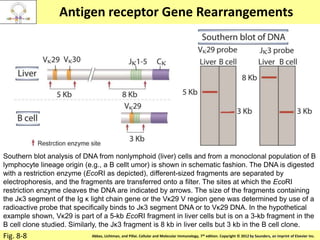
Antigen receptor Gene Rearrangements
Fig. 8-8
Southern blot analysis of DNA from nonlymphoid (liver) cells and from a monoclonal population of B
lymphocyte lineage origin (e.g., a B cellt umor) is shown in schematic fashion. The DNA is digested
with a restriction enzyme (EcoRI as depicted), different-sized fragments are separated by
electrophoresis, and the fragments are transferred onto a filter. The sites at which the EcoRI
restriction enzyme cleaves the DNA are indicated by arrows. The size of the fragments containing
the Jκ3 segment of the Ig κ light chain gene or the Vκ29 V region gene was determined by use of a
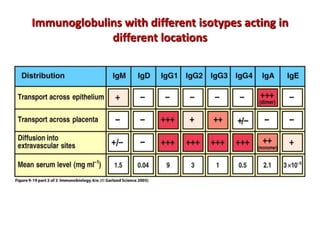
radioactive probe that specifically binds to Jκ3 segment DNA or to Vκ29 DNA. In the hypothetical
example shown, Vκ29 is part of a 5-kb EcoRI fragment in liver cells but is on a 3-kb fragment in the
B cell clone studied. Similarly, the Jκ3 fragment is 8 kb in liver cells but 3 kb in the B cell clone.
www.nobelprize.org
Copyright © 2011 by Saunders, an imprint of Elsevier Inc.Abbas, Lichtman, and Pillai. Cellular and Molecular Immunology, 7th edition. Copyright © 2012 by Saunders, an imprint of Elsevier Inc.
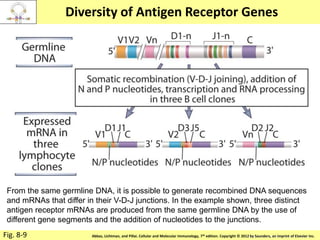
Diversity of Antigen Receptor Genes
Fig. 8-9
From the same germline DNA, it is possible to generate recombined DNA sequences
and mRNAs that differ in their V-D-J junctions. In the example shown, three distinct
antigen receptor mRNAs are produced from the same germline DNA by the use of
different gene segments and the addition of nucleotides to the junctions.
Copyright © 2011 by Saunders, an imprint of Elsevier Inc.Abbas, Lichtman, and Pillai. Cellular and Molecular Immunology, 7th edition. Copyright © 2012 by Saunders, an imprint of Elsevier Inc.
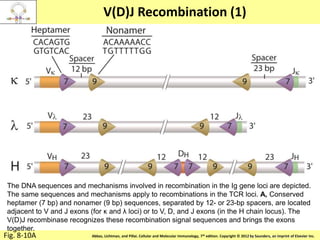
V(D)J Recombination (1)
Fig. 8-10A
The DNA sequences and mechanisms involved in recombination in the Ig gene loci are depicted.
The same sequences and mechanisms apply to recombinations in the TCR loci. A, Conserved
heptamer (7 bp) and nonamer (9 bp) sequences, separated by 12- or 23-bp spacers, are located
adjacent to V and J exons (for κ and λ loci) or to V, D, and J exons (in the H chain locus). The
V(D)J recombinase recognizes these recombination signal sequences and brings the exons
together.
Copyright © 2011 by Saunders, an imprint of Elsevier Inc.Abbas, Lichtman, and Pillai. Cellular and Molecular Immunology, 7th edition. Copyright © 2012 by Saunders, an imprint of Elsevier Inc.
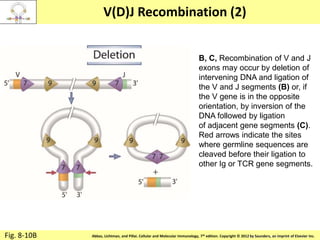
V(D)J Recombination (2)
Fig. 8-10B
B, C, Recombination of V and J
exons may occur by deletion of
intervening DNA and ligation of
the V and J segments (B) or, if
the V gene is in the opposite
orientation, by inversion of the
DNA followed by ligation
of adjacent gene segments (C).
Red arrows indicate the sites
where germline sequences are
cleaved before their ligation to
other Ig or TCR gene segments.
Copyright © 2011 by Saunders, an imprint of Elsevier Inc.Abbas, Lichtman, and Pillai. Cellular and Molecular Immunology, 7th edition. Copyright © 2012 by Saunders, an imprint of Elsevier Inc.
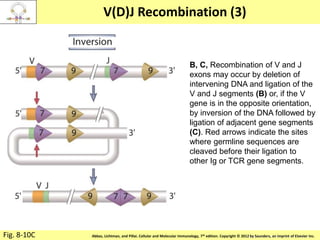
V(D)J Recombination (3)
Fig. 8-10C
B, C, Recombination of V and J
exons may occur by deletion of
intervening DNA and ligation of the
V and J segments (B) or, if the V
gene is in the opposite orientation,
by inversion of the DNA followed by
ligation of adjacent gene segments
(C). Red arrows indicate the sites
where germline sequences are
cleaved before their ligation to
other Ig or TCR gene segments.
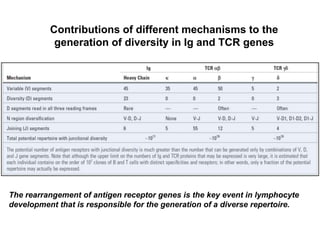
Contributions of different mechanisms to the
generation of diversity in Ig and TCR genes
The rearrangement of antigen receptor genes is the key event in lymphocyte
development that is responsible for the generation of a diverse repertoire.
Copyright © 2011 by Saunders, an imprint of Elsevier Inc.Abbas, Lichtman, and Pillai. Cellular and Molecular Immunology, 7th edition. Copyright © 2012 by Saunders, an imprint of Elsevier Inc.
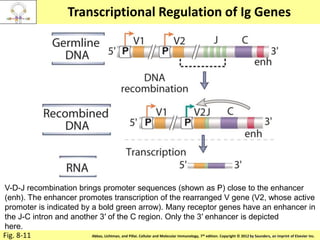
Transcriptional Regulation of Ig Genes
Fig. 8-11
V-D-J recombination brings promoter sequences (shown as P) close to the enhancer
(enh). The enhancer promotes transcription of the rearranged V gene (V2, whose active
promoter is indicated by a bold green arrow). Many receptor genes have an enhancer in
the J-C intron and another 3′ of the C region. Only the 3′ enhancer is depicted
here.
Copyright © 2011 by Saunders, an imprint of Elsevier Inc.Abbas, Lichtman, and Pillai. Cellular and Molecular Immunology, 7th edition. Copyright © 2012 by Saunders, an imprint of Elsevier Inc.
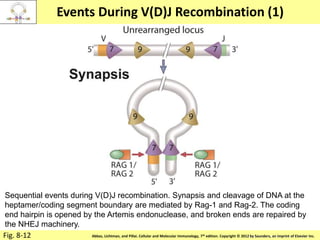
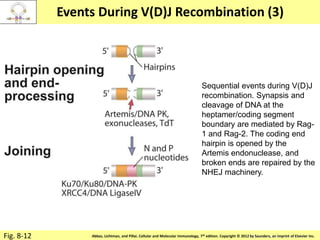
Events During V(D)J Recombination (1)
Fig. 8-12
Sequential events during V(D)J recombination. Synapsis and cleavage of DNA at the
heptamer/coding segment boundary are mediated by Rag-1 and Rag-2. The coding
end hairpin is opened by the Artemis endonuclease, and broken ends are repaired by
the NHEJ machinery.
Copyright © 2011 by Saunders, an imprint of Elsevier Inc.Abbas, Lichtman, and Pillai. Cellular and Molecular Immunology, 7th edition. Copyright © 2012 by Saunders, an imprint of Elsevier Inc.
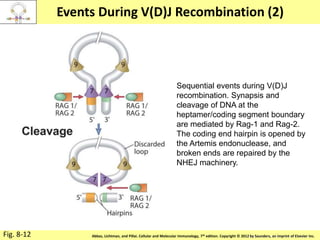
Events During V(D)J Recombination (2)
Fig. 8-12
Sequential events during V(D)J
recombination. Synapsis and
cleavage of DNA at the
heptamer/coding segment boundary
are mediated by Rag-1 and Rag-2.
The coding end hairpin is opened by
the Artemis endonuclease, and
broken ends are repaired by the
NHEJ machinery.
Copyright © 2011 by Saunders, an imprint of Elsevier Inc.Abbas, Lichtman, and Pillai. Cellular and Molecular Immunology, 7th edition. Copyright © 2012 by Saunders, an imprint of Elsevier Inc.
Events During V(D)J Recombination (3)
Fig. 8-12
Sequential events during V(D)J
recombination. Synapsis and
cleavage of DNA at the
heptamer/coding segment
boundary are mediated by Rag-
1 and Rag-2. The coding end
hairpin is opened by the
Artemis endonuclease, and
broken ends are repaired by the
NHEJ machinery.
Copyright © 2011 by Saunders, an imprint of Elsevier Inc.Abbas, Lichtman, and Pillai. Cellular and Molecular Immunology, 7th edition. Copyright © 2012 by Saunders, an imprint of Elsevier Inc.
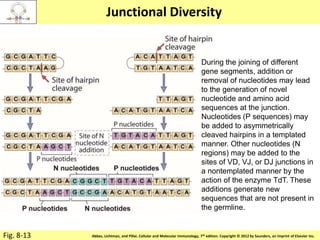
Junctional Diversity
Fig. 8-13
During the joining of different
gene segments, addition or
removal of nucleotides may lead
to the generation of novel
nucleotide and amino acid
sequences at the junction.
Nucleotides (P sequences) may
be added to asymmetrically
cleaved hairpins in a templated
manner. Other nucleotides (N
regions) may be added to the
sites of VD, VJ, or DJ junctions in
a nontemplated manner by the
action of the enzyme TdT. These
additions generate new
sequences that are not present in
the germline.
Copyright © 2011 by Saunders, an imprint of Elsevier Inc.Abbas, Lichtman, and Pillai. Cellular and Molecular Immunology, 7th edition. Copyright © 2012 by Saunders, an imprint of Elsevier Inc.
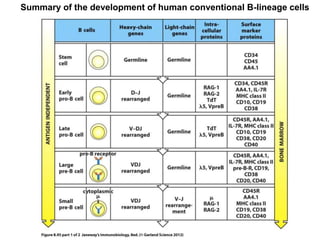
Stages of B Cell Maturation
Fig. 8-14
Events corresponding to each stage of B cell maturation from a bone marrow stem cell to a mature
B lymphocyte are illustrated. Several surface markers in addition to those shown have been used to
define distinct stages of B cell maturation.
Copyright © 2011 by Saunders, an imprint of Elsevier Inc.Abbas, Lichtman, and Pillai. Cellular and Molecular Immunology, 7th edition. Copyright © 2012 by Saunders, an imprint of Elsevier Inc.
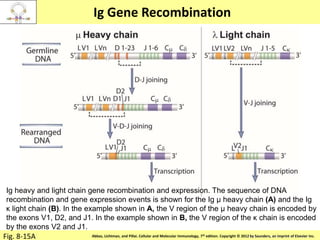
Ig Gene Recombination
Fig. 8-15A
Ig heavy and light chain gene recombination and expression. The sequence of DNA
recombination and gene expression events is shown for the Ig μ heavy chain (A) and the Ig
κ light chain (B). In the example shown in A, the V region of the μ heavy chain is encoded by
the exons V1, D2, and J1. In the example shown in B, the V region of the κ chain is encoded
by the exons V2 and J1.
Copyright © 2011 by Saunders, an imprint of Elsevier Inc.Abbas, Lichtman, and Pillai. Cellular and Molecular Immunology, 7th edition. Copyright © 2012 by Saunders, an imprint of Elsevier Inc.
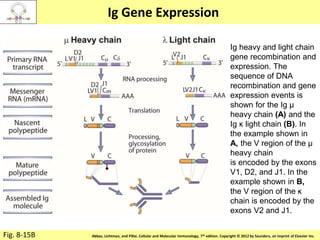
Ig Gene Expression
Fig. 8-15B
Ig heavy and light chain
gene recombination and
expression. The
sequence of DNA
recombination and gene
expression events is
shown for the Ig μ
heavy chain (A) and the
Ig κ light chain (B). In
the example shown in
A, the V region of the μ
heavy chain
is encoded by the exons
V1, D2, and J1. In the
example shown in B,
the V region of the κ
chain is encoded by the
exons V2 and J1.
Copyright © 2011 by Saunders, an imprint of Elsevier Inc.Abbas, Lichtman, and Pillai. Cellular and Molecular Immunology, 7th edition. Copyright © 2012 by Saunders, an imprint of Elsevier Inc.
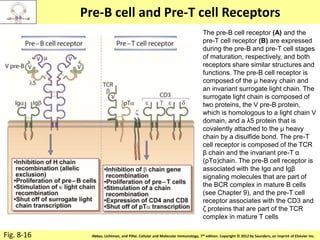
Pre-B cell and Pre-T cell Receptors
Fig. 8-16
The pre-B cell receptor (A) and the
pre-T cell receptor (B) are expressed
during the pre-B and pre-T cell stages
of maturation, respectively, and both
receptors share similar structures and
functions. The pre-B cell receptor is
composed of the μ heavy chain and
an invariant surrogate light chain. The
surrogate light chain is composed of
two proteins, the V pre-B protein,
which is homologous to a light chain V
domain, and a λ5 protein that is
covalently attached to the μ heavy
chain by a disulfide bond. The pre-T
cell receptor is composed of the TCR
β chain and the invariant pre-T α
(pTα)chain. The pre-B cell receptor is
associated with the Igα and Igβ
signaling molecules that are part of
the BCR complex in mature B cells
(see Chapter 9), and the pre-T cell
receptor associates with the CD3 and
ζ proteins that are part of the TCR
complex in mature T cells
Copyright © 2011 by Saunders, an imprint of Elsevier Inc.Abbas, Lichtman, and Pillai. Cellular and Molecular Immunology, 7th edition. Copyright © 2012 by Saunders, an imprint of Elsevier Inc.
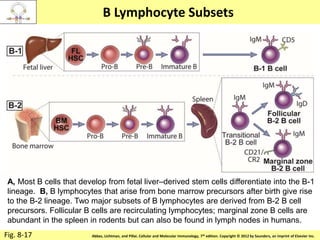
B Lymphocyte Subsets
Fig. 8-17
A, Most B cells that develop from fetal liver–derived stem cells differentiate into the B-1
lineage. B, B lymphocytes that arise from bone marrow precursors after birth give rise
to the B-2 lineage. Two major subsets of B lymphocytes are derived from B-2 B cell
precursors. Follicular B cells are recirculating lymphocytes; marginal zone B cells are
abundant in the spleen in rodents but can also be found in lymph nodes in humans.
Copyright © 2011 by Saunders, an imprint of Elsevier Inc.Abbas, Lichtman, and Pillai. Cellular and Molecular Immunology, 7th edition. Copyright © 2012 by Saunders, an imprint of Elsevier Inc.
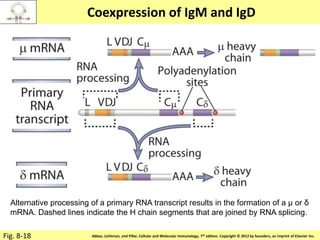
Coexpression of IgM and IgD
Fig. 8-18
Alternative processing of a primary RNA transcript results in the formation of a μ or δ
mRNA. Dashed lines indicate the H chain segments that are joined by RNA splicing.
Copyright © 2011 by Saunders, an imprint of Elsevier Inc.Abbas, Lichtman, and Pillai. Cellular and Molecular Immunology, 7th edition. Copyright © 2012 by Saunders, an imprint of Elsevier Inc.
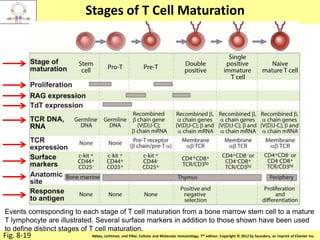
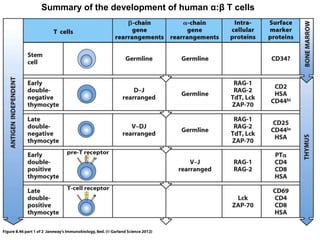
Stages of T Cell Maturation
Fig. 8-19
Events corresponding to each stage of T cell maturation from a bone marrow stem cell to a mature
T lymphocyte are illustrated. Several surface markers in addition to those shown have been used
to define distinct stages of T cell maturation.
Copyright © 2011 by Saunders, an imprint of Elsevier Inc.Abbas, Lichtman, and Pillai. Cellular and Molecular Immunology, 7th edition. Copyright © 2012 by Saunders, an imprint of Elsevier Inc.
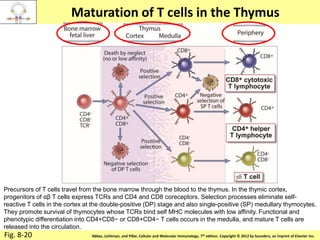
Maturation of T cells in the Thymus
Fig. 8-20
Precursors of T cells travel from the bone marrow through the blood to the thymus. In the thymic cortex,
progenitors of αβ T cells express TCRs and CD4 and CD8 coreceptors. Selection processes eliminate self-
reactive T cells in the cortex at the double-positive (DP) stage and also single-positive (SP) medullary thymocytes.
They promote survival of thymocytes whose TCRs bind self MHC molecules with low affinity. Functional and
phenotypic differentiation into CD4+CD8− or CD8+CD4− T cells occurs in the medulla, and mature T cells are
released into the circulation.
Copyright © 2011 by Saunders, an imprint of Elsevier Inc.Abbas, Lichtman, and Pillai. Cellular and Molecular Immunology, 7th edition. Copyright © 2012 by Saunders, an imprint of Elsevier Inc.
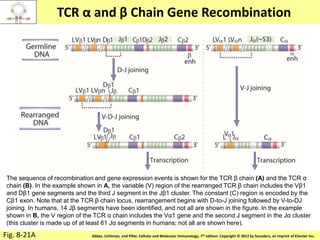
TCR α and β Chain Gene Recombination
Fig. 8-21A
The sequence of recombination and gene expression events is shown for the TCR β chain (A) and the TCR α
chain (B). In the example shown in A, the variable (V) region of the rearranged TCR β chain includes the Vβ1
and Dβ1 gene segments and the third J segment in the Jβ1 cluster. The constant (C) region is encoded by the
Cβ1 exon. Note that at the TCR β chain locus, rearrangement begins with D-to-J joining followed by V-to-DJ
joining. In humans, 14 Jβ segments have been identified, and not all are shown in the figure. In the example
shown in B, the V region of the TCR α chain includes the Vα1 gene and the second J segment in the Jα cluster
(this cluster is made up of at least 61 Jα segments in humans; not all are shown here).
Copyright © 2011 by Saunders, an imprint of Elsevier Inc.Abbas, Lichtman, and Pillai. Cellular and Molecular Immunology, 7th edition. Copyright © 2012 by Saunders, an imprint of Elsevier Inc.
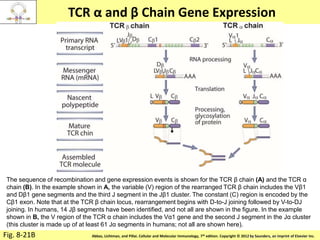
TCR α and β Chain Gene Expression
Fig. 8-21B
The sequence of recombination and gene expression events is shown for the TCR β chain (A) and the TCR α
chain (B). In the example shown in A, the variable (V) region of the rearranged TCR β chain includes the Vβ1
and Dβ1 gene segments and the third J segment in the Jβ1 cluster. The constant (C) region is encoded by the
Cβ1 exon. Note that at the TCR β chain locus, rearrangement begins with D-to-J joining followed by V-to-DJ
joining. In humans, 14 Jβ segments have been identified, and not all are shown in the figure. In the example
shown in B, the V region of the TCR α chain includes the Vα1 gene and the second J segment in the Jα cluster
(this cluster is made up of at least 61 Jα segments in humans; not all are shown here).
Copyright © 2011 by Saunders, an imprint of Elsevier Inc.Abbas, Lichtman, and Pillai. Cellular and Molecular Immunology, 7th edition. Copyright © 2012 by Saunders, an imprint of Elsevier Inc.
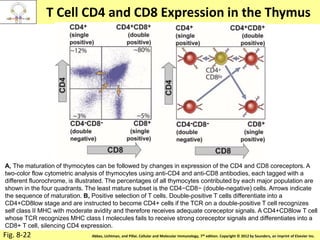
T Cell CD4 and CD8 Expression in the Thymus
Fig. 8-22
A, The maturation of thymocytes can be followed by changes in expression of the CD4 and CD8 coreceptors. A
two-color flow cytometric analysis of thymocytes using anti-CD4 and anti-CD8 antibodies, each tagged with a
different fluorochrome, is illustrated. The percentages of all thymocytes contributed by each major population are
shown in the four quadrants. The least mature subset is the CD4−CD8− (double-negative) cells. Arrows indicate
the sequence of maturation. B, Positive selection of T cells. Double-positive T cells differentiate into a
CD4+CD8low stage and are instructed to become CD4+ cells if the TCR on a double-positive T cell recognizes
self class II MHC with moderate avidity and therefore receives adequate coreceptor signals. A CD4+CD8low T cell
whose TCR recognizes MHC class I molecules fails to receive strong coreceptor signals and differentiates into a
CD8+ T cell, silencing CD4 expression.
Summary of the development of human conventional B-lineage cells
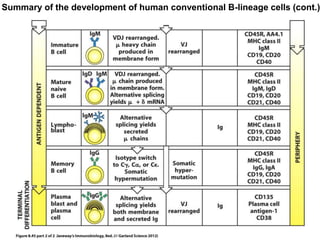
Summary of the development of human conventional B-lineage cells (cont.)
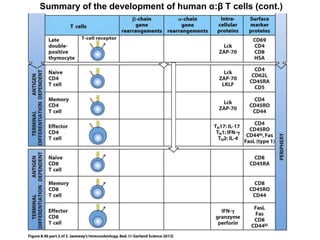
Summary of the development of human α:β T cells
Summary of the development of human α:β T cells (cont.)
Lecture 15 - 16th
Production and application of
monoclonal antibodies
Systemic and local immunity
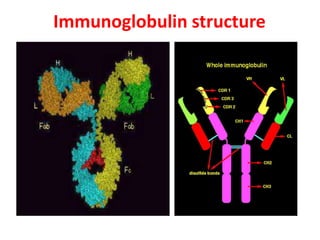
Immunoglobulin structure
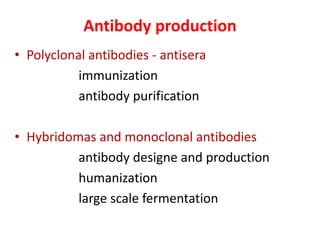
Antibody production
• Polyclonal antibodies - antisera
immunization
antibody purification
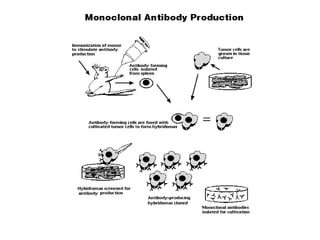
• Hybridomas and monoclonal antibodies
antibody designe and production
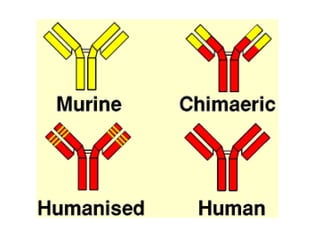
humanization
large scale fermentation
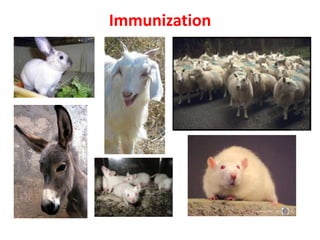
Immunization
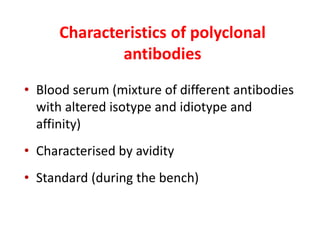
Characteristics of polyclonal
antibodies
• Blood serum (mixture of different antibodies
with altered isotype and idiotype and
affinity)
• Characterised by avidity
• Standard (during the bench)
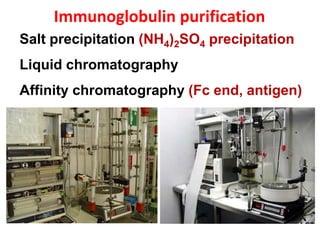
Immunoglobulin purification
Salt precipitation (NH4)2SO4 precipitation
Liquid chromatography
Affinity chromatography (Fc end, antigen)
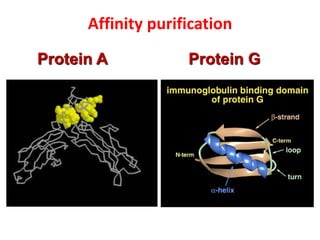
Affinity purification
Protein A Protein G
Characteristics of monoclonal
antibodies
• Produced by genetic engineering
• Specific for single epitope exclusively
• Uniform antibodies with the same isotype and
idiotype
• Characterized by chemical affinity
• Standard by the continuous cell line
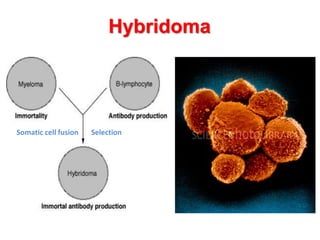
Hybridoma
Somatic cell fusion Selection
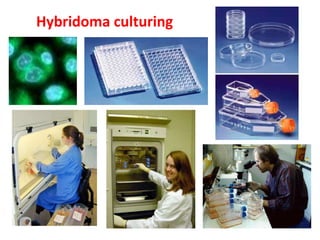
Hybridoma culturing
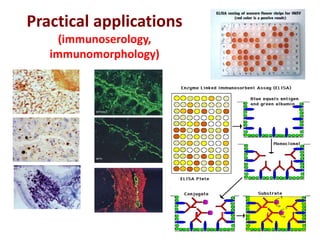
Practical applications
(immunoserology,
immunomorphology)
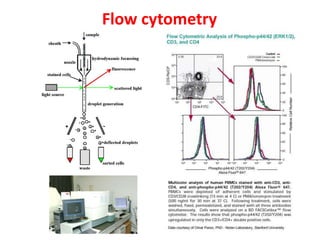
Flow cytometry
Antibodies for medical application
• Antibodies developed for therapeutic use
– Polyclonal antisera
– Monoclonal antibodies
• Antibodies for in vitro laboratory diagnostics
• Antibodies for in vivo diagnostic imaging
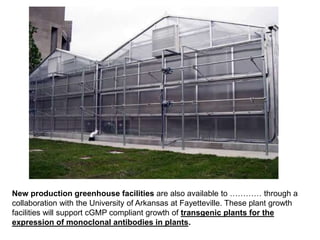
New production greenhouse facilities are also available to ………… through a
collaboration with the University of Arkansas at Fayetteville. These plant growth
facilities will support cGMP compliant growth of transgenic plants for the
expression of monoclonal antibodies in plants.
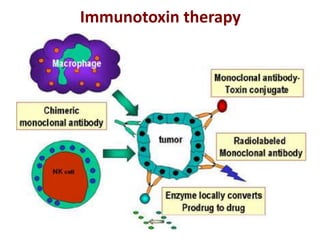
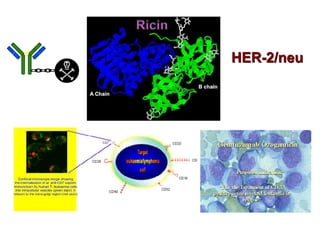
Immunotoxin therapy
HER-2/neu
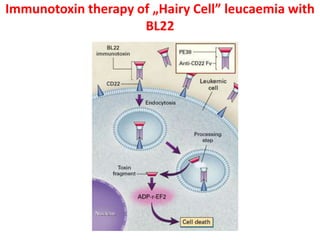
Immunotoxin therapy of „Hairy Cell” leucaemia with
BL22
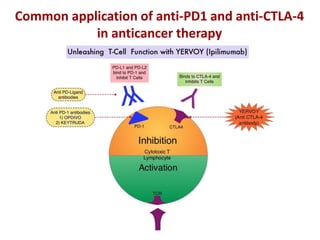
Common application of anti-PD1 and anti-CTLA-4
in anticancer therapy
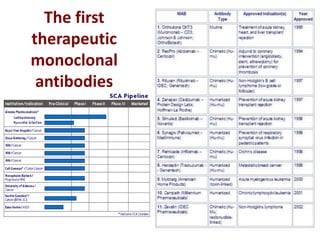
The first
therapeutic
monoclonal
antibodies
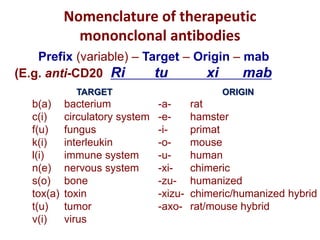
Nomenclature of therapeutic
mononclonal antibodies
TARGET
b(a) bacterium
c(i) circulatory system
f(u) fungus
k(i) interleukin
l(i) immune system
n(e) nervous system
s(o) bone
tox(a) toxin
t(u) tumor
v(i) virus
ORIGIN
-a- rat
-e- hamster
-i- primat
-o- mouse
-u- human
-xi- chimeric
-zu- humanized
-xizu- chimeric/humanized hybrid
-axo- rat/mouse hybrid
Prefix (variable) – Target – Origin – mab
(E.g. anti-CD20 Ri tu xi mab)
More thousands therapeutic
monoclonal antibodies are under
clinical trial in 2018 worldwide
Systemic and local immunity
Mucosa and skin associated immune system
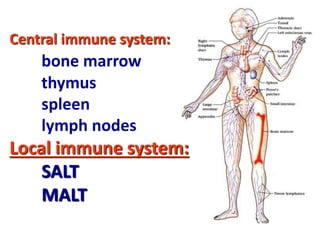
Central immune system:
bone marrow
thymus
spleen
lymph nodes
Local immune system:
SALT
MALT
In the cases of local immune responses the
immune reaction develops in the place of the
antigen administration (in the external and/or
internal body surface) and remains locally.
Different connections are existing between the
systemic and local immunity.
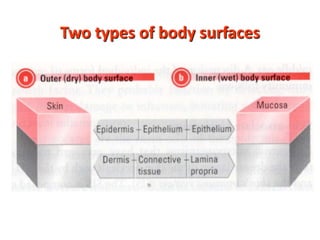
External skin surface (“dry body
surface” is apr. 1.7 - 1.8 m2) and the
internal mucosal surface, (“wet body
surface” is apr. 400 m2).
Local immunity
• Skin Associated Lymphatic Tissue (SALT)
• Mucosa Associated Lymphatic Tissue
(MALT, BALT, GALT)
Two types of body surfaces
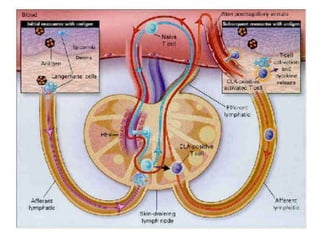
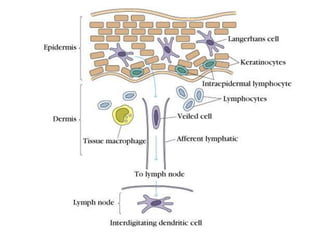
Skin associated immune system (SIS or
SALT)
Special structural elements:
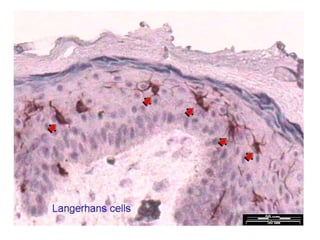
• Antigen presenting cells (Langerhans cells, veiled
cells, monocytes, tissue macrophages)
• Effector cells (gamma-delta T cells, alpha-beta T
cells, B cells, NK cells, granulocytes, mast cells),
• Keratinocytes (cytokine production).
The co-operation between keratinocytes and T cells
is similar to the thymus epithelia and thymocyte co-
operations.
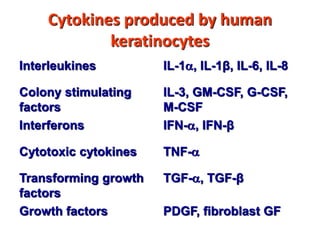
Cytokines produced by human
keratinocytes
Interleukines IL-1, IL-1β, IL-6, IL-8
Colony stimulating
factors
IL-3, GM-CSF, G-CSF,
M-CSF
Interferons IFN-, IFN-β
Cytotoxic cytokines TNF-
Transforming growth
factors
TGF-, TGF-β
Growth factors PDGF, fibroblast GF
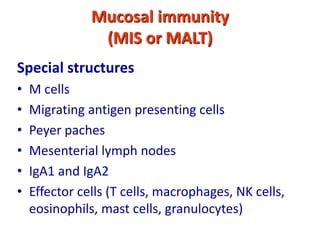
Mucosal immunity
(MIS or MALT)
Special structures
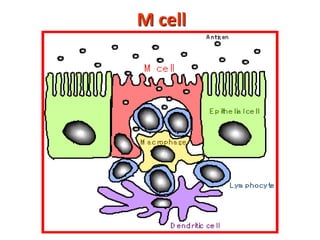
• M cells
• Migrating antigen presenting cells
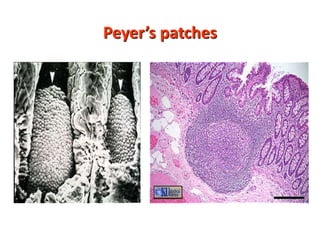
• Peyer paches
• Mesenterial lymph nodes
• IgA1 and IgA2
• Effector cells (T cells, macrophages, NK cells,
eosinophils, mast cells, granulocytes)
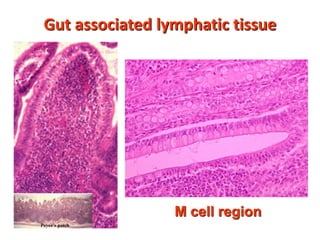
Gut associated lymphatic tissue
M cell region
Peyer’s patches
M cell
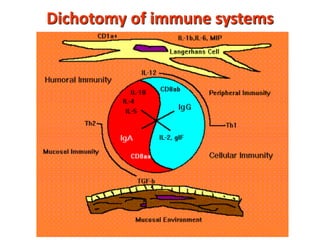
Dichotomy of immune systems
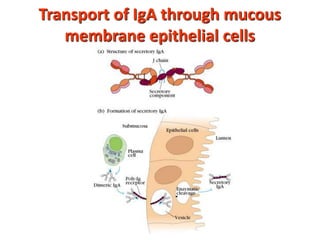
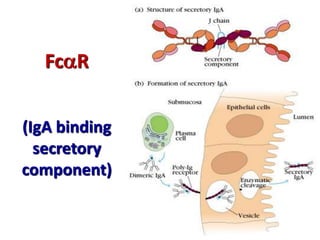
Transport of IgA through mucous
membrane epithelial cells
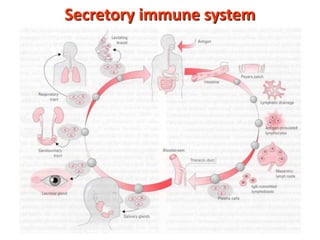
Secretory immune system
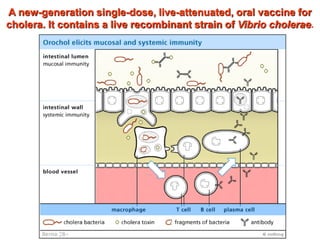
A new-generation single-dose, live-attenuated, oral vaccine for
cholera. It contains a live recombinant strain of Vibrio cholerae.
Basic Immunology
Lecture17 - 18th
Regulation of effector functions
Antibody mediated effector functions.
Effector mechanisms of cell mediated immune
response
Functions of immunoglobulins
Monofunctional character (specific antigen
recognition and binding) before the antigen
administration.
Polyfunctional character after the antigen
administration during the effector functions
(agglutination, precipitation, complement fixation,
opsonization, immunocomplex formation,
neutralisation, FcR binding, signal transduction).
Elimination of pathogens before an infection.
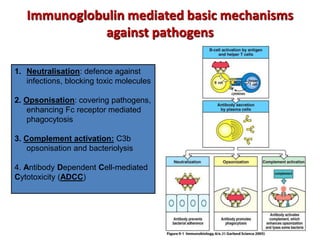
Immunoglobulin mediated basic mechanisms
against pathogens
1. Neutralisation: defence against
infections, blocking toxic molecules
2. Opsonisation: covering pathogens,
enhancing Fc receptor mediated
phagocytosis
3. Complement activation: C3b
opsonisation and bacteriolysis
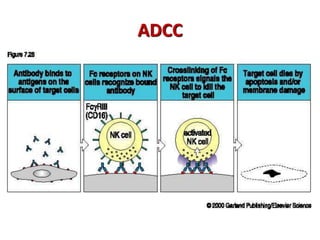
4. Antibody Dependent Cell-mediated
Cytotoxicity (ADCC)
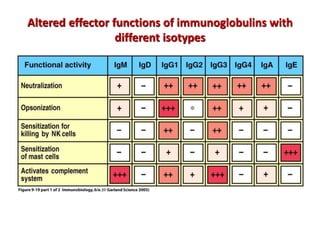
Altered effector functions of immunoglobulins with
different isotypes
Immunoglobulins with different isotypes acting in
different locations
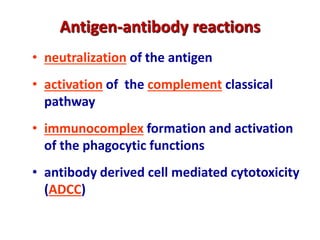
Antigen-antibody reactions
• neutralization of the antigen
• activation of the complement classical
pathway
• immunocomplex formation and activation
of the phagocytic functions
• antibody derived cell mediated cytotoxicity
(ADCC)
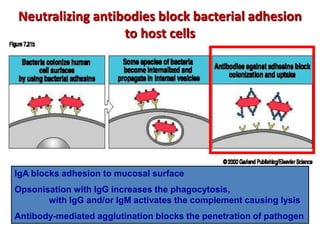
Neutralizing antibodies block bacterial adhesion
to host cells
IgA blocks adhesion to mucosal surface
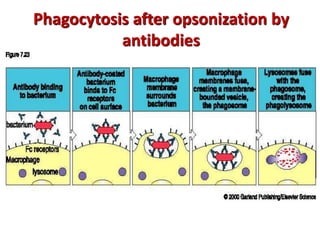
Opsonisation with IgG increases the phagocytosis,
with IgG and/or IgM activates the complement causing lysis
Antibody-mediated agglutination blocks the penetration of pathogen
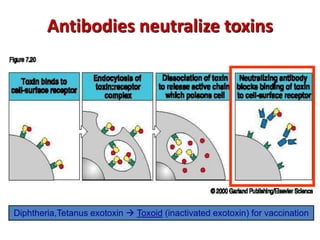
Antibodies neutralize toxins
Diphtheria,Tetanus exotoxin  Toxoid (inactivated exotoxin) for vaccination
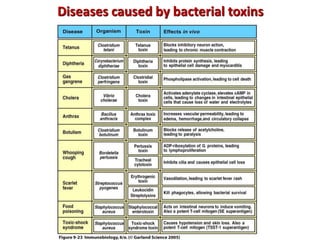
Diseases caused by bacterial toxins
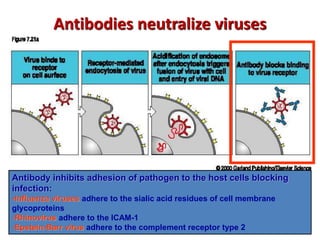
Antibodies neutralize viruses
Antibody inhibits adhesion of pathogen to the host cells blocking
infection:
-Influenza viruses adhere to the sialic acid residues of cell membrane
glycoproteins
-Rhinovirus adhere to the ICAM-1
-Epstein-Barr virus adhere to the complement receptor type 2
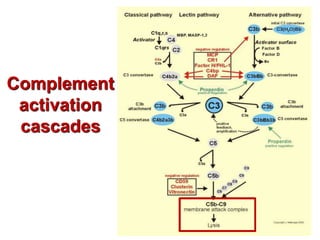
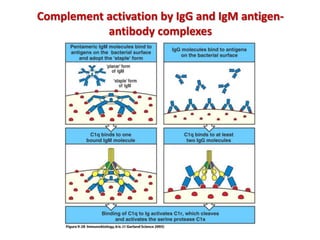
Complement activation by IgG and IgM antigen-
antibody complexes
Complement
activation
cascades
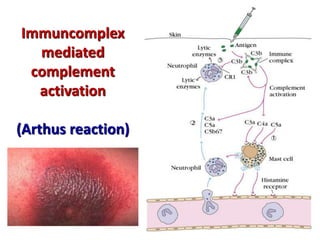
Immuncomplex
mediated
complement
activation
(Arthus reaction)
Phagocytosis after opsonization by
antibodies
ADCC
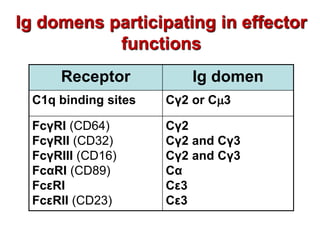
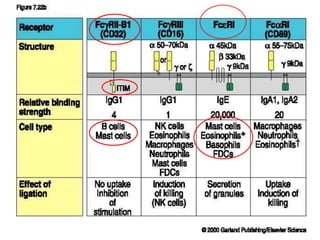
Receptor Ig domen
C1q binding sites Cγ2 or C3
FcγRI (CD64)
FcγRII (CD32)
FcγRIII (CD16)
FcαRI (CD89)
FcεRI
FcεRII (CD23)
Cγ2
Cγ2 and Cγ3
Cγ2 and Cγ3
Cα
Cε3
Cε3
Ig domens participating in effector
functions
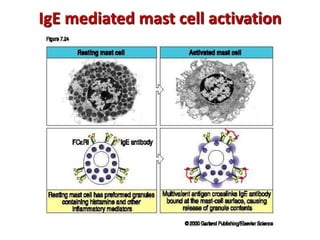
IgE mediated mast cell activation
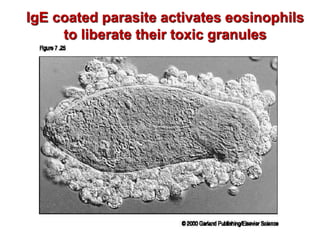
IgE coated parasite activates eosinophils
to liberate their toxic granules
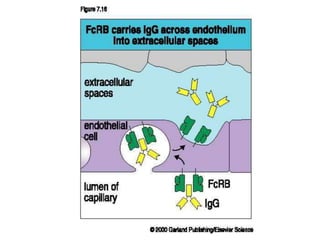
FcR
(IgA binding
secretory
component)
Effektor functions II.
Cell mediated immune response
Cytotoxicity, TH–cell mediated macrophage
activation, delayed type hypersensitivity
(DTH)
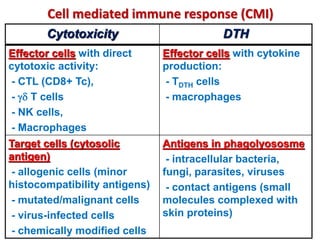
Cell mediated immune response (CMI)
Cytotoxicity DTH
Effector cells with direct
cytotoxic activity:
- CTL (CD8+ Tc),
-  T cells
- NK cells,
- Macrophages
Effector cells with cytokine
production:
- TDTH cells
- macrophages
Target cells (cytosolic
antigen)
- allogenic cells (minor
histocompatibility antigens)
- mutated/malignant cells
- virus-infected cells
- chemically modified cells
Antigens in phagolyososme
- intracellular bacteria,
fungi, parasites, viruses
- contact antigens (small
molecules complexed with
skin proteins)
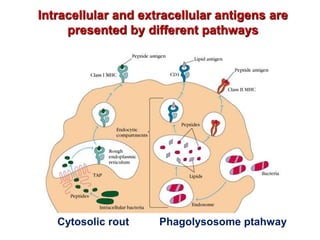
Intracellular and extracellular antigens are
presented by different pathways
Cytosolic rout Phagolysosome ptahway
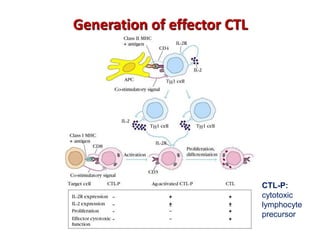
Generation of effector CTL
CTL-P:
cytotoxic
lymphocyte
precursor
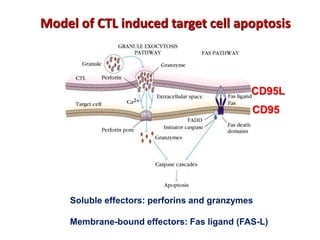
Model of CTL induced target cell apoptosis
Soluble effectors: perforins and granzymes
Membrane-bound effectors: Fas ligand (FAS-L)
CD95L
CD95
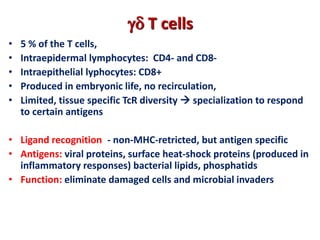
 T cells
• 5 % of the T cells,
• Intraepidermal lymphocytes: CD4- and CD8-
• Intraepithelial lyphocytes: CD8+
• Produced in embryonic life, no recirculation,
• Limited, tissue specific TcR diversity  specialization to respond
to certain antigens
• Ligand recognition: - non-MHC-retricted, but antigen specific
• Antigens: viral proteins, surface heat-shock proteins (produced in
inflammatory responses) bacterial lipids, phosphatids
• Function: eliminate damaged cells and microbial invaders
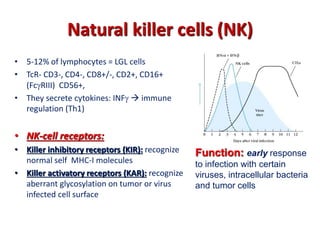
Natural killer cells (NK)
• 5-12% of lymphocytes = LGL cells
• TcR- CD3-, CD4-, CD8+/-, CD2+, CD16+
(FcRIII) CD56+,
• They secrete cytokines: INF  immune
regulation (Th1)
• NK-cell receptors:
• Killer inhibitory receptors (KIR): recognize
normal self MHC-I molecules
• Killer activatory receptors (KAR): recognize
aberrant glycosylation on tumor or virus
infected cell surface
Function: early response
to infection with certain
viruses, intracellular bacteria
and tumor cells
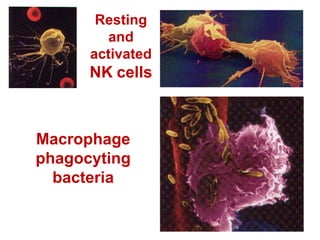
Resting
and
activated
NK cells
Macrophage
phagocyting
bacteria
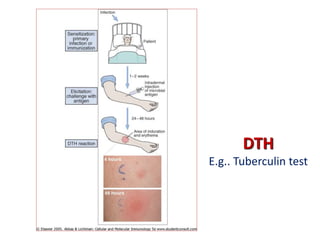
DTH
E.g.. Tuberculin test
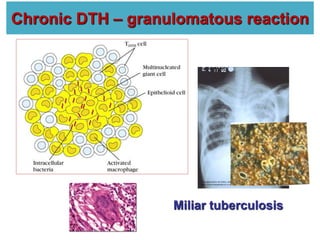
Chronic DTH – granulomatous reaction
Miliar tuberculosis
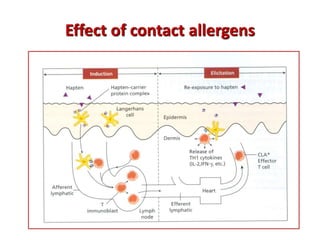
Effect of contact allergens
Basic Immunology
Lecture 19th - 20th
Suppression of the immune response
Cellular and molecular mechanisms participate in
suppression of the immune response
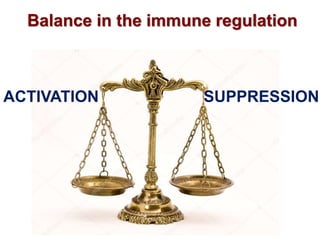
Balance in the immune regulation
ACTIVATION SUPPRESSION
What is the suppression?
• Suppression is a general biological function.
• Immunosuppression is a reduction of the
activation or efficacy of the immune system.
• Some portions of the immune system itself
have immunosuppressive effects on other
parts of the immune system.
Regulators involved in the
suppression
• Antigen is the main regulator: withdraw the antigen
stop the Ig production and proliferation of T and B
lymphocytes
• Cytokine mediated T-cell regulation: Th1/Th2 balance
• APCs: T-cell co-stimulation – CD28/CTLA-4
• Regulatory T cells (natural and induced Treg)
• Antigen/immune complex: BcR+co-receptors
• Anti-idiotype antibody-mediated regulation
Basic regulation of the immune
response by cytokines
• General effects of cytokines: enhancing and
blocking of cell proliferation, migration, Ig
secretion, etc.
• Regulation of the CD4 T cell differentiation
(Th0, Th1, Th2, Th17) by the pattern of cytokines
The antigen-MHC-lymphokine regulations not
cover the total feedback mechanisms, other
pathways are necessary (network hypothesis).
Suppression in cellular level
• APC/macrophage suppression
• T cell suppression
• B cell suppression
APC/macrophage suppression
Activated macrophages produce different
inhibitory agents:
• large amount of incorporated thymidine from
the cells phagocyted and digested previously,
complement factors, polyamine oxidase
enzyme (PAO), interferon, cyclic AMP,
prostaglandins inhibit the proliferation.
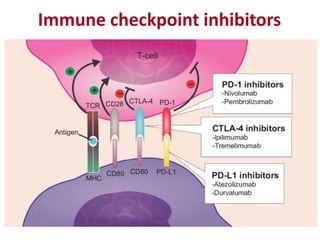
• PD-1 (CD279) blocks the T cells (check point
inhibition)
T cell suppression
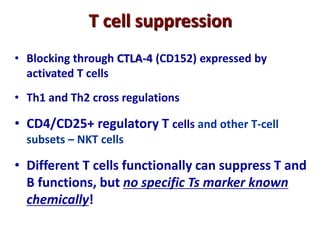
• Blocking through CTLA-4 (CD152) expressed by
activated T cells
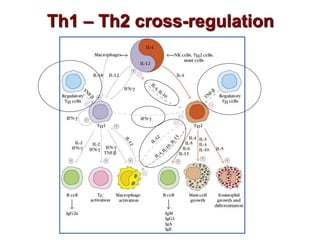
• Th1 and Th2 cross regulations
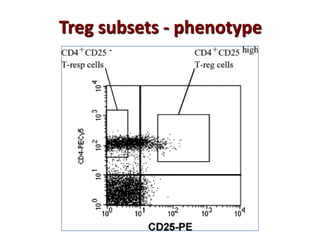
• CD4/CD25+ regulatory T cells and other T-cell
subsets – NKT cells
• Different T cells functionally can suppress T and
B functions, but no specific Ts marker known
chemically!
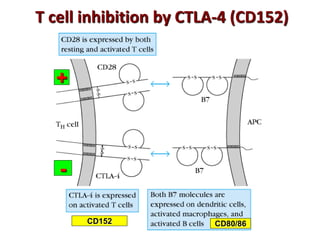
T cell inhibition by CTLA-4 (CD152)
CD152 CD80/86
+
-
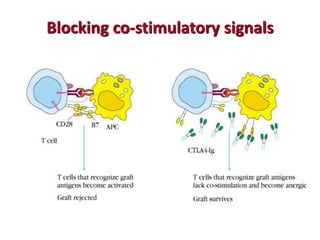
Blocking co-stimulatory signals
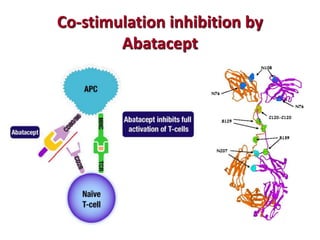
Co-stimulation inhibition by
Abatacept
Immune checkpoint inhibitors
Th1 – Th2 cross-regulation
Treg subsets - phenotype
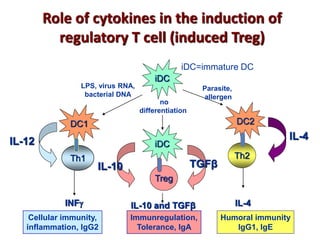
Role of cytokines in the induction of
regulatory T cell (induced Treg)
iDC
iDC
DC1 DC2
Th1 Th2
Treg
Parasite,
allergen
LPS, virus RNA,
bacterial DNA
IL-12
IL-10 TGFβ
IL-4
INF
no
differentiation
IL-4IL-10 and TGFβ
Cellular immunity,
inflammation, IgG2
Humoral immunity
IgG1, IgE
Immunregulation,
Tolerance, IgA
iDC=immature DC
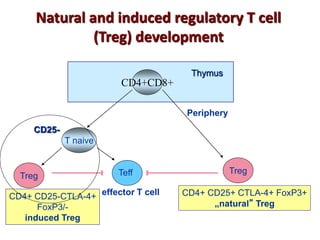
Thymus
CD4+CD8+
Periphery
Treg
CD4+ CD25+ CTLA-4+ FoxP3+
„natural” Treg
T naive
CD25-
Treg Teff
CD4+ CD25-CTLA-4+
FoxP3/-
induced Treg
effector T cell
Natural and induced regulatory T cell
(Treg) development
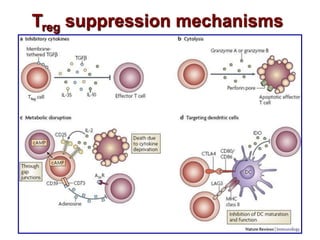
Treg suppression mechanisms
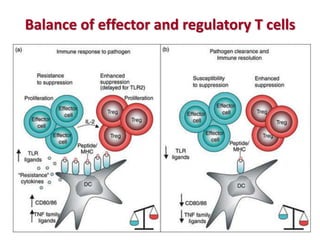
Balance of effector and regulatory T cells
B cell suppression
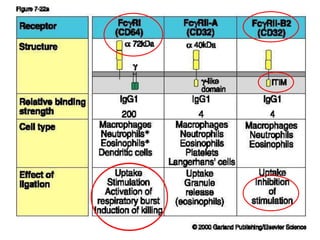
• Antibody excess blocks the further activation
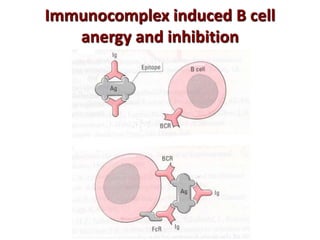
• Ig coated antigen inhibits the following B cell
activation through the low affinity FcγR II
(CD32) transmitted blocking signals (ITIM)
Immunocomplex induced B cell
anergy and inhibition
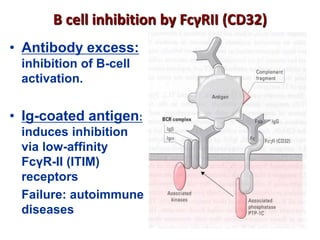
B cell inhibition by FcγRII (CD32)
• Antibody excess:
inhibition of B-cell
activation.
• Ig-coated antigen:
induces inhibition
via low-affinity
FcγR-II (ITIM)
receptors
Failure: autoimmune
diseases
Suppression by immunoglobulins
• The affinity maturation results in the formation of large amounts
of mutated immunoglobulins representing new structures
capable of inducing humoral immune response. The unique
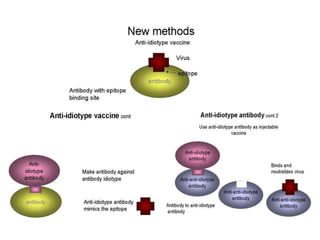
antigenic determinants (idiotops) will elicit the generation of
antibodies against these structures within the V-regions of ag-
specific antibodies named “anti-idiotype antibodies”.
• Anti-isotype antibodies: the appearance of non-IgM (especially
IgG) isotype antibodies (so called „Rheuma factors”) will induce a
transient increase of antibodies against their constant regions
(IgM anti-IgG) contribute to the regulation of possible effector
mechanisms of humoral immune response.
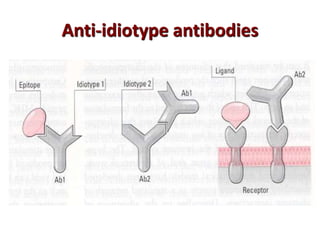
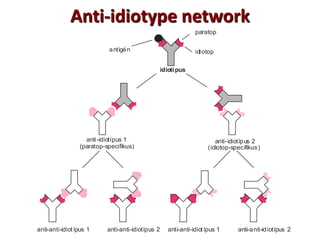
Anti-idiotype antibodies
Anti-idiotype network
idiotípus
paratop
anti-idiotípus 2
(idiotop-specifikus)
anti-idiotípus 1
(paratop-specifikus)
anti-anti-idiotípus 1 anti-anti-idiotípus 2 anti-anti-idiotípus 1 anti-anti-idiotípus 2
idiotopantigén
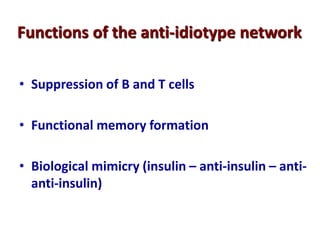
Functions of the anti-idiotype network
• Suppression of B and T cells
• Functional memory formation
• Biological mimicry (insulin – anti-insulin – anti-
anti-insulin)
• Suppression is a basic biological function.
• The whole immune machinery participate in the
suppressor functions, not a unique cell subset is
responsible for it.
• Several regulatory mechanisms are controlling
the immune response forming a regulatory
network which includes the suppression as a
basic immune function as well.
What is the suppression?

Basic Immunology 11-20

  • 1.
    Basic Immunology Lectures 9-10 LymphocyteDevelopment and Antigen Receptor Gene Rearrangement
  • 2.
    Basic Immunology Lectures 9-10 LymphocyteDevelopment and Antigen Receptor Gene Rearrangement
  • 3.
    OVERVIEW OF LYMPHOCYTEDEVELOPMENT The maturation of B and T lymphocytes involves a series of events that occur in the generative lymphoid organs. These events include the following: 1. The commitment of progenitor cells to the B cell or T cell lineage. 2. Proliferation of progenitors and immature committed cells at specific early stages of development, providing a large pool of cells that can generate useful lymphocytes. 3. The sequential and ordered rearrangement of antigen receptor genes and the expression of antigen receptor proteins.
  • 4.
    OVERVIEW OF LYMPHOCYTEDEVELOPMENT (cont.) 4. Selection events that preserve cells that have produced correct antigen receptor proteins and eliminate potentially dangerous cells that strongly recognize self antigens. These checkpoints during development ensure that lymphocytes that express functional receptors with useful specificities will mature and enter the peripheral immune system. 5. Differentiation of B and T cells into functionally and phenotypically distinct subpopulations. B cells develop into follicular, marginal zone, and B-1 B cells, and T cells develop into CD4+ and CD8+ T lymphocytes and γδ T cells. This differentiation into distinct classes provides the specialization that is an important characteristic of the adaptive immune system.
  • 5.
    Development of Bcells B cells develop in the bone marrow and migrate to peripheral lymphoid organs, where they can be activated by antigens.
  • 6.
    Development of Tcells T cells undergo development in the thymus and migrate to the peripheral lymphoid organs, where they are activated by foreign antigens.
  • 7.
    Copyright © 2011by Saunders, an imprint of Elsevier Inc.Abbas, Lichtman, and Pillai. Cellular and Molecular Immunology, 7th edition. Copyright © 2012 by Saunders, an imprint of Elsevier Inc. Stages of Lymphocyte Maturation Fig. 8-1 Development of both B and T lymphocytes involves the sequence of maturational stages shown. B cell maturation is illustrated, but the basic stages of T cell maturation are similar.
  • 8.
    Copyright © 2011by Saunders, an imprint of Elsevier Inc.Abbas, Lichtman, and Pillai. Cellular and Molecular Immunology, 7th edition. Copyright © 2012 by Saunders, an imprint of Elsevier Inc. Distinct Lineages of Lymphocyte Maturation Fig. 8-2
  • 9.
    Copyright © 2011by Saunders, an imprint of Elsevier Inc.Abbas, Lichtman, and Pillai. Cellular and Molecular Immunology, 7th edition. Copyright © 2012 by Saunders, an imprint of Elsevier Inc. Checkpoints in Lymphocyte Maturation Fig. 8-3 During development, the lymphocytes that express receptors required for continued proliferation and maturation are selected to survive, and cells that do not express functional receptors die by apoptosis. Positive selection and negative selection further preserve cells with useful specificities. The presence of multiple checkpoints ensures that only cells with useful receptors complete their maturation.
  • 10.
    Copyright © 2011by Saunders, an imprint of Elsevier Inc.Abbas, Lichtman, and Pillai. Cellular and Molecular Immunology, 7th edition. Copyright © 2012 by Saunders, an imprint of Elsevier Inc. Pos. and Neg. Selection of Lymphocytes Fig. 8-4
  • 11.
    Copyright © 2011by Saunders, an imprint of Elsevier Inc.Abbas, Lichtman, and Pillai. Cellular and Molecular Immunology, 7th edition. Copyright © 2012 by Saunders, an imprint of Elsevier Inc. Germline Organization of Human Ig Loci Fig. 8-5 The human heavy chain, κ light chain, and λ light chain loci are shown. Only functional genes are shown; pseudogenes have been omitted for simplicity. Exons and introns are not drawn to scale. Each CH gene is shown as a single box but is composed of several exons, as illustrated for Cμ. Gene segments are indicated as follows: L, leader (often called signal sequence); V, variable; D, diversity; J, joining; C, constant; enh, enhancer.
  • 12.
    Copyright © 2011by Saunders, an imprint of Elsevier Inc.Abbas, Lichtman, and Pillai. Cellular and Molecular Immunology, 7th edition. Copyright © 2012 by Saunders, an imprint of Elsevier Inc. Domains of Ig and TCR proteins Fig. 8-6 The domains of Ig heavy and light chains are shown in A, and the domains of TCR α and β chains are shown in B. The relationships between the Ig and TCR gene segments and the domain structure of the antigen receptor polypeptide chains are indicated. The V and C regions of each polypeptide are encoded by different gene segments. The locations of intrachain and interchain disulfide bonds (S-S) are approximate. Areas in the dashed boxes are the hypervariable (complementarity-determining) regions. In the Ig μ chain and the TCR α and β chains, transmembrane (TM) and cytoplasmic (CYT) domains are encoded by separate exons.
  • 13.
    Copyright © 2011by Saunders, an imprint of Elsevier Inc.Abbas, Lichtman, and Pillai. Cellular and Molecular Immunology, 7th edition. Copyright © 2012 by Saunders, an imprint of Elsevier Inc. Germline Organization of Human TCR Loci (1) Fig. 8-7 The human TCR β, α, γ, and δ chain loci are shown, as indicated. Exons and introns are not drawn to scale, and nonfunctional pseudogenes are not shown. Each C gene is shown as a single box but is composed of several exons, as illustrated for Cβ1. Gene segments are indicated as follows: L, leader (usually called signal sequence); V, variable; D, diversity; J, joining; C, constant; enh, enhancer; sil, silencer (sequences that regulate TCR gene transcription).
  • 14.
    Copyright © 2011by Saunders, an imprint of Elsevier Inc.Abbas, Lichtman, and Pillai. Cellular and Molecular Immunology, 7th edition. Copyright © 2012 by Saunders, an imprint of Elsevier Inc. Germline Organization of Human TCR Loci (2) Fig. 8-7
  • 15.
    Copyright © 2011by Saunders, an imprint of Elsevier Inc.Abbas, Lichtman, and Pillai. Cellular and Molecular Immunology, 7th edition. Copyright © 2012 by Saunders, an imprint of Elsevier Inc. Antigen receptor Gene Rearrangements Fig. 8-8 Southern blot analysis of DNA from nonlymphoid (liver) cells and from a monoclonal population of B lymphocyte lineage origin (e.g., a B cellt umor) is shown in schematic fashion. The DNA is digested with a restriction enzyme (EcoRI as depicted), different-sized fragments are separated by electrophoresis, and the fragments are transferred onto a filter. The sites at which the EcoRI restriction enzyme cleaves the DNA are indicated by arrows. The size of the fragments containing the Jκ3 segment of the Ig κ light chain gene or the Vκ29 V region gene was determined by use of a radioactive probe that specifically binds to Jκ3 segment DNA or to Vκ29 DNA. In the hypothetical example shown, Vκ29 is part of a 5-kb EcoRI fragment in liver cells but is on a 3-kb fragment in the B cell clone studied. Similarly, the Jκ3 fragment is 8 kb in liver cells but 3 kb in the B cell clone.
  • 16.
  • 17.
    Copyright © 2011by Saunders, an imprint of Elsevier Inc.Abbas, Lichtman, and Pillai. Cellular and Molecular Immunology, 7th edition. Copyright © 2012 by Saunders, an imprint of Elsevier Inc. Diversity of Antigen Receptor Genes Fig. 8-9 From the same germline DNA, it is possible to generate recombined DNA sequences and mRNAs that differ in their V-D-J junctions. In the example shown, three distinct antigen receptor mRNAs are produced from the same germline DNA by the use of different gene segments and the addition of nucleotides to the junctions.
  • 18.
    Copyright © 2011by Saunders, an imprint of Elsevier Inc.Abbas, Lichtman, and Pillai. Cellular and Molecular Immunology, 7th edition. Copyright © 2012 by Saunders, an imprint of Elsevier Inc. V(D)J Recombination (1) Fig. 8-10A The DNA sequences and mechanisms involved in recombination in the Ig gene loci are depicted. The same sequences and mechanisms apply to recombinations in the TCR loci. A, Conserved heptamer (7 bp) and nonamer (9 bp) sequences, separated by 12- or 23-bp spacers, are located adjacent to V and J exons (for κ and λ loci) or to V, D, and J exons (in the H chain locus). The V(D)J recombinase recognizes these recombination signal sequences and brings the exons together.
  • 19.
    Copyright © 2011by Saunders, an imprint of Elsevier Inc.Abbas, Lichtman, and Pillai. Cellular and Molecular Immunology, 7th edition. Copyright © 2012 by Saunders, an imprint of Elsevier Inc. V(D)J Recombination (2) Fig. 8-10B B, C, Recombination of V and J exons may occur by deletion of intervening DNA and ligation of the V and J segments (B) or, if the V gene is in the opposite orientation, by inversion of the DNA followed by ligation of adjacent gene segments (C). Red arrows indicate the sites where germline sequences are cleaved before their ligation to other Ig or TCR gene segments.
  • 20.
    Copyright © 2011by Saunders, an imprint of Elsevier Inc.Abbas, Lichtman, and Pillai. Cellular and Molecular Immunology, 7th edition. Copyright © 2012 by Saunders, an imprint of Elsevier Inc. V(D)J Recombination (3) Fig. 8-10C B, C, Recombination of V and J exons may occur by deletion of intervening DNA and ligation of the V and J segments (B) or, if the V gene is in the opposite orientation, by inversion of the DNA followed by ligation of adjacent gene segments (C). Red arrows indicate the sites where germline sequences are cleaved before their ligation to other Ig or TCR gene segments.
  • 21.
    Contributions of differentmechanisms to the generation of diversity in Ig and TCR genes The rearrangement of antigen receptor genes is the key event in lymphocyte development that is responsible for the generation of a diverse repertoire.
  • 22.
    Copyright © 2011by Saunders, an imprint of Elsevier Inc.Abbas, Lichtman, and Pillai. Cellular and Molecular Immunology, 7th edition. Copyright © 2012 by Saunders, an imprint of Elsevier Inc. Transcriptional Regulation of Ig Genes Fig. 8-11 V-D-J recombination brings promoter sequences (shown as P) close to the enhancer (enh). The enhancer promotes transcription of the rearranged V gene (V2, whose active promoter is indicated by a bold green arrow). Many receptor genes have an enhancer in the J-C intron and another 3′ of the C region. Only the 3′ enhancer is depicted here.
  • 23.
    Copyright © 2011by Saunders, an imprint of Elsevier Inc.Abbas, Lichtman, and Pillai. Cellular and Molecular Immunology, 7th edition. Copyright © 2012 by Saunders, an imprint of Elsevier Inc. Events During V(D)J Recombination (1) Fig. 8-12 Sequential events during V(D)J recombination. Synapsis and cleavage of DNA at the heptamer/coding segment boundary are mediated by Rag-1 and Rag-2. The coding end hairpin is opened by the Artemis endonuclease, and broken ends are repaired by the NHEJ machinery.
  • 24.
    Copyright © 2011by Saunders, an imprint of Elsevier Inc.Abbas, Lichtman, and Pillai. Cellular and Molecular Immunology, 7th edition. Copyright © 2012 by Saunders, an imprint of Elsevier Inc. Events During V(D)J Recombination (2) Fig. 8-12 Sequential events during V(D)J recombination. Synapsis and cleavage of DNA at the heptamer/coding segment boundary are mediated by Rag-1 and Rag-2. The coding end hairpin is opened by the Artemis endonuclease, and broken ends are repaired by the NHEJ machinery.
  • 25.
    Copyright © 2011by Saunders, an imprint of Elsevier Inc.Abbas, Lichtman, and Pillai. Cellular and Molecular Immunology, 7th edition. Copyright © 2012 by Saunders, an imprint of Elsevier Inc. Events During V(D)J Recombination (3) Fig. 8-12 Sequential events during V(D)J recombination. Synapsis and cleavage of DNA at the heptamer/coding segment boundary are mediated by Rag- 1 and Rag-2. The coding end hairpin is opened by the Artemis endonuclease, and broken ends are repaired by the NHEJ machinery.
  • 26.
    Copyright © 2011by Saunders, an imprint of Elsevier Inc.Abbas, Lichtman, and Pillai. Cellular and Molecular Immunology, 7th edition. Copyright © 2012 by Saunders, an imprint of Elsevier Inc. Junctional Diversity Fig. 8-13 During the joining of different gene segments, addition or removal of nucleotides may lead to the generation of novel nucleotide and amino acid sequences at the junction. Nucleotides (P sequences) may be added to asymmetrically cleaved hairpins in a templated manner. Other nucleotides (N regions) may be added to the sites of VD, VJ, or DJ junctions in a nontemplated manner by the action of the enzyme TdT. These additions generate new sequences that are not present in the germline.
  • 27.
    Copyright © 2011by Saunders, an imprint of Elsevier Inc.Abbas, Lichtman, and Pillai. Cellular and Molecular Immunology, 7th edition. Copyright © 2012 by Saunders, an imprint of Elsevier Inc. Stages of B Cell Maturation Fig. 8-14 Events corresponding to each stage of B cell maturation from a bone marrow stem cell to a mature B lymphocyte are illustrated. Several surface markers in addition to those shown have been used to define distinct stages of B cell maturation.
  • 28.
    Copyright © 2011by Saunders, an imprint of Elsevier Inc.Abbas, Lichtman, and Pillai. Cellular and Molecular Immunology, 7th edition. Copyright © 2012 by Saunders, an imprint of Elsevier Inc. Ig Gene Recombination Fig. 8-15A Ig heavy and light chain gene recombination and expression. The sequence of DNA recombination and gene expression events is shown for the Ig μ heavy chain (A) and the Ig κ light chain (B). In the example shown in A, the V region of the μ heavy chain is encoded by the exons V1, D2, and J1. In the example shown in B, the V region of the κ chain is encoded by the exons V2 and J1.
  • 29.
    Copyright © 2011by Saunders, an imprint of Elsevier Inc.Abbas, Lichtman, and Pillai. Cellular and Molecular Immunology, 7th edition. Copyright © 2012 by Saunders, an imprint of Elsevier Inc. Ig Gene Expression Fig. 8-15B Ig heavy and light chain gene recombination and expression. The sequence of DNA recombination and gene expression events is shown for the Ig μ heavy chain (A) and the Ig κ light chain (B). In the example shown in A, the V region of the μ heavy chain is encoded by the exons V1, D2, and J1. In the example shown in B, the V region of the κ chain is encoded by the exons V2 and J1.
  • 30.
    Copyright © 2011by Saunders, an imprint of Elsevier Inc.Abbas, Lichtman, and Pillai. Cellular and Molecular Immunology, 7th edition. Copyright © 2012 by Saunders, an imprint of Elsevier Inc. Pre-B cell and Pre-T cell Receptors Fig. 8-16 The pre-B cell receptor (A) and the pre-T cell receptor (B) are expressed during the pre-B and pre-T cell stages of maturation, respectively, and both receptors share similar structures and functions. The pre-B cell receptor is composed of the μ heavy chain and an invariant surrogate light chain. The surrogate light chain is composed of two proteins, the V pre-B protein, which is homologous to a light chain V domain, and a λ5 protein that is covalently attached to the μ heavy chain by a disulfide bond. The pre-T cell receptor is composed of the TCR β chain and the invariant pre-T α (pTα)chain. The pre-B cell receptor is associated with the Igα and Igβ signaling molecules that are part of the BCR complex in mature B cells (see Chapter 9), and the pre-T cell receptor associates with the CD3 and ζ proteins that are part of the TCR complex in mature T cells
  • 31.
    Copyright © 2011by Saunders, an imprint of Elsevier Inc.Abbas, Lichtman, and Pillai. Cellular and Molecular Immunology, 7th edition. Copyright © 2012 by Saunders, an imprint of Elsevier Inc. B Lymphocyte Subsets Fig. 8-17 A, Most B cells that develop from fetal liver–derived stem cells differentiate into the B-1 lineage. B, B lymphocytes that arise from bone marrow precursors after birth give rise to the B-2 lineage. Two major subsets of B lymphocytes are derived from B-2 B cell precursors. Follicular B cells are recirculating lymphocytes; marginal zone B cells are abundant in the spleen in rodents but can also be found in lymph nodes in humans.
  • 32.
    Copyright © 2011by Saunders, an imprint of Elsevier Inc.Abbas, Lichtman, and Pillai. Cellular and Molecular Immunology, 7th edition. Copyright © 2012 by Saunders, an imprint of Elsevier Inc. Coexpression of IgM and IgD Fig. 8-18 Alternative processing of a primary RNA transcript results in the formation of a μ or δ mRNA. Dashed lines indicate the H chain segments that are joined by RNA splicing.
  • 33.
    Copyright © 2011by Saunders, an imprint of Elsevier Inc.Abbas, Lichtman, and Pillai. Cellular and Molecular Immunology, 7th edition. Copyright © 2012 by Saunders, an imprint of Elsevier Inc. Stages of T Cell Maturation Fig. 8-19 Events corresponding to each stage of T cell maturation from a bone marrow stem cell to a mature T lymphocyte are illustrated. Several surface markers in addition to those shown have been used to define distinct stages of T cell maturation.
  • 34.
    Copyright © 2011by Saunders, an imprint of Elsevier Inc.Abbas, Lichtman, and Pillai. Cellular and Molecular Immunology, 7th edition. Copyright © 2012 by Saunders, an imprint of Elsevier Inc. Maturation of T cells in the Thymus Fig. 8-20 Precursors of T cells travel from the bone marrow through the blood to the thymus. In the thymic cortex, progenitors of αβ T cells express TCRs and CD4 and CD8 coreceptors. Selection processes eliminate self- reactive T cells in the cortex at the double-positive (DP) stage and also single-positive (SP) medullary thymocytes. They promote survival of thymocytes whose TCRs bind self MHC molecules with low affinity. Functional and phenotypic differentiation into CD4+CD8− or CD8+CD4− T cells occurs in the medulla, and mature T cells are released into the circulation.
  • 35.
    Copyright © 2011by Saunders, an imprint of Elsevier Inc.Abbas, Lichtman, and Pillai. Cellular and Molecular Immunology, 7th edition. Copyright © 2012 by Saunders, an imprint of Elsevier Inc. TCR α and β Chain Gene Recombination Fig. 8-21A The sequence of recombination and gene expression events is shown for the TCR β chain (A) and the TCR α chain (B). In the example shown in A, the variable (V) region of the rearranged TCR β chain includes the Vβ1 and Dβ1 gene segments and the third J segment in the Jβ1 cluster. The constant (C) region is encoded by the Cβ1 exon. Note that at the TCR β chain locus, rearrangement begins with D-to-J joining followed by V-to-DJ joining. In humans, 14 Jβ segments have been identified, and not all are shown in the figure. In the example shown in B, the V region of the TCR α chain includes the Vα1 gene and the second J segment in the Jα cluster (this cluster is made up of at least 61 Jα segments in humans; not all are shown here).
  • 36.
    Copyright © 2011by Saunders, an imprint of Elsevier Inc.Abbas, Lichtman, and Pillai. Cellular and Molecular Immunology, 7th edition. Copyright © 2012 by Saunders, an imprint of Elsevier Inc. TCR α and β Chain Gene Expression Fig. 8-21B The sequence of recombination and gene expression events is shown for the TCR β chain (A) and the TCR α chain (B). In the example shown in A, the variable (V) region of the rearranged TCR β chain includes the Vβ1 and Dβ1 gene segments and the third J segment in the Jβ1 cluster. The constant (C) region is encoded by the Cβ1 exon. Note that at the TCR β chain locus, rearrangement begins with D-to-J joining followed by V-to-DJ joining. In humans, 14 Jβ segments have been identified, and not all are shown in the figure. In the example shown in B, the V region of the TCR α chain includes the Vα1 gene and the second J segment in the Jα cluster (this cluster is made up of at least 61 Jα segments in humans; not all are shown here).
  • 37.
    Copyright © 2011by Saunders, an imprint of Elsevier Inc.Abbas, Lichtman, and Pillai. Cellular and Molecular Immunology, 7th edition. Copyright © 2012 by Saunders, an imprint of Elsevier Inc. T Cell CD4 and CD8 Expression in the Thymus Fig. 8-22 A, The maturation of thymocytes can be followed by changes in expression of the CD4 and CD8 coreceptors. A two-color flow cytometric analysis of thymocytes using anti-CD4 and anti-CD8 antibodies, each tagged with a different fluorochrome, is illustrated. The percentages of all thymocytes contributed by each major population are shown in the four quadrants. The least mature subset is the CD4−CD8− (double-negative) cells. Arrows indicate the sequence of maturation. B, Positive selection of T cells. Double-positive T cells differentiate into a CD4+CD8low stage and are instructed to become CD4+ cells if the TCR on a double-positive T cell recognizes self class II MHC with moderate avidity and therefore receives adequate coreceptor signals. A CD4+CD8low T cell whose TCR recognizes MHC class I molecules fails to receive strong coreceptor signals and differentiates into a CD8+ T cell, silencing CD4 expression.
  • 38.
    Summary of thedevelopment of human conventional B-lineage cells
  • 39.
    Summary of thedevelopment of human conventional B-lineage cells (cont.)
  • 40.
    Summary of thedevelopment of human α:β T cells
  • 41.
    Summary of thedevelopment of human α:β T cells (cont.)
  • 42.
    Lecture 15 -16th Production and application of monoclonal antibodies Systemic and local immunity
  • 43.
  • 45.
    Antibody production • Polyclonalantibodies - antisera immunization antibody purification • Hybridomas and monoclonal antibodies antibody designe and production humanization large scale fermentation
  • 46.
  • 47.
    Characteristics of polyclonal antibodies •Blood serum (mixture of different antibodies with altered isotype and idiotype and affinity) • Characterised by avidity • Standard (during the bench)
  • 48.
    Immunoglobulin purification Salt precipitation(NH4)2SO4 precipitation Liquid chromatography Affinity chromatography (Fc end, antigen)
  • 49.
  • 50.
    Characteristics of monoclonal antibodies •Produced by genetic engineering • Specific for single epitope exclusively • Uniform antibodies with the same isotype and idiotype • Characterized by chemical affinity • Standard by the continuous cell line
  • 51.
  • 53.
  • 54.
  • 55.
  • 56.
    Antibodies for medicalapplication • Antibodies developed for therapeutic use – Polyclonal antisera – Monoclonal antibodies • Antibodies for in vitro laboratory diagnostics • Antibodies for in vivo diagnostic imaging
  • 61.
    New production greenhousefacilities are also available to ………… through a collaboration with the University of Arkansas at Fayetteville. These plant growth facilities will support cGMP compliant growth of transgenic plants for the expression of monoclonal antibodies in plants.
  • 62.
  • 63.
  • 64.
    Immunotoxin therapy of„Hairy Cell” leucaemia with BL22
  • 65.
    Common application ofanti-PD1 and anti-CTLA-4 in anticancer therapy
  • 67.
  • 68.
    Nomenclature of therapeutic mononclonalantibodies TARGET b(a) bacterium c(i) circulatory system f(u) fungus k(i) interleukin l(i) immune system n(e) nervous system s(o) bone tox(a) toxin t(u) tumor v(i) virus ORIGIN -a- rat -e- hamster -i- primat -o- mouse -u- human -xi- chimeric -zu- humanized -xizu- chimeric/humanized hybrid -axo- rat/mouse hybrid Prefix (variable) – Target – Origin – mab (E.g. anti-CD20 Ri tu xi mab)
  • 69.
    More thousands therapeutic monoclonalantibodies are under clinical trial in 2018 worldwide
  • 70.
    Systemic and localimmunity Mucosa and skin associated immune system
  • 71.
    Central immune system: bonemarrow thymus spleen lymph nodes Local immune system: SALT MALT
  • 72.
    In the casesof local immune responses the immune reaction develops in the place of the antigen administration (in the external and/or internal body surface) and remains locally. Different connections are existing between the systemic and local immunity. External skin surface (“dry body surface” is apr. 1.7 - 1.8 m2) and the internal mucosal surface, (“wet body surface” is apr. 400 m2).
  • 73.
    Local immunity • SkinAssociated Lymphatic Tissue (SALT) • Mucosa Associated Lymphatic Tissue (MALT, BALT, GALT)
  • 74.
    Two types ofbody surfaces
  • 75.
    Skin associated immunesystem (SIS or SALT) Special structural elements: • Antigen presenting cells (Langerhans cells, veiled cells, monocytes, tissue macrophages) • Effector cells (gamma-delta T cells, alpha-beta T cells, B cells, NK cells, granulocytes, mast cells), • Keratinocytes (cytokine production). The co-operation between keratinocytes and T cells is similar to the thymus epithelia and thymocyte co- operations.
  • 76.
    Cytokines produced byhuman keratinocytes Interleukines IL-1, IL-1β, IL-6, IL-8 Colony stimulating factors IL-3, GM-CSF, G-CSF, M-CSF Interferons IFN-, IFN-β Cytotoxic cytokines TNF- Transforming growth factors TGF-, TGF-β Growth factors PDGF, fibroblast GF
  • 80.
    Mucosal immunity (MIS orMALT) Special structures • M cells • Migrating antigen presenting cells • Peyer paches • Mesenterial lymph nodes • IgA1 and IgA2 • Effector cells (T cells, macrophages, NK cells, eosinophils, mast cells, granulocytes)
  • 81.
    Gut associated lymphatictissue M cell region
  • 82.
  • 83.
  • 85.
  • 86.
    Transport of IgAthrough mucous membrane epithelial cells
  • 87.
  • 88.
    A new-generation single-dose,live-attenuated, oral vaccine for cholera. It contains a live recombinant strain of Vibrio cholerae.
  • 89.
    Basic Immunology Lecture17 -18th Regulation of effector functions Antibody mediated effector functions. Effector mechanisms of cell mediated immune response
  • 90.
    Functions of immunoglobulins Monofunctionalcharacter (specific antigen recognition and binding) before the antigen administration. Polyfunctional character after the antigen administration during the effector functions (agglutination, precipitation, complement fixation, opsonization, immunocomplex formation, neutralisation, FcR binding, signal transduction). Elimination of pathogens before an infection.
  • 91.
    Immunoglobulin mediated basicmechanisms against pathogens 1. Neutralisation: defence against infections, blocking toxic molecules 2. Opsonisation: covering pathogens, enhancing Fc receptor mediated phagocytosis 3. Complement activation: C3b opsonisation and bacteriolysis 4. Antibody Dependent Cell-mediated Cytotoxicity (ADCC)
  • 92.
    Altered effector functionsof immunoglobulins with different isotypes
  • 93.
    Immunoglobulins with differentisotypes acting in different locations
  • 94.
    Antigen-antibody reactions • neutralizationof the antigen • activation of the complement classical pathway • immunocomplex formation and activation of the phagocytic functions • antibody derived cell mediated cytotoxicity (ADCC)
  • 95.
    Neutralizing antibodies blockbacterial adhesion to host cells IgA blocks adhesion to mucosal surface Opsonisation with IgG increases the phagocytosis, with IgG and/or IgM activates the complement causing lysis Antibody-mediated agglutination blocks the penetration of pathogen
  • 96.
    Antibodies neutralize toxins Diphtheria,Tetanusexotoxin  Toxoid (inactivated exotoxin) for vaccination
  • 97.
    Diseases caused bybacterial toxins
  • 98.
    Antibodies neutralize viruses Antibodyinhibits adhesion of pathogen to the host cells blocking infection: -Influenza viruses adhere to the sialic acid residues of cell membrane glycoproteins -Rhinovirus adhere to the ICAM-1 -Epstein-Barr virus adhere to the complement receptor type 2
  • 99.
    Complement activation byIgG and IgM antigen- antibody complexes
  • 100.
  • 101.
  • 102.
  • 103.
  • 104.
    Receptor Ig domen C1qbinding sites Cγ2 or C3 FcγRI (CD64) FcγRII (CD32) FcγRIII (CD16) FcαRI (CD89) FcεRI FcεRII (CD23) Cγ2 Cγ2 and Cγ3 Cγ2 and Cγ3 Cα Cε3 Cε3 Ig domens participating in effector functions
  • 107.
    IgE mediated mastcell activation
  • 108.
    IgE coated parasiteactivates eosinophils to liberate their toxic granules
  • 110.
  • 111.
    Effektor functions II. Cellmediated immune response Cytotoxicity, TH–cell mediated macrophage activation, delayed type hypersensitivity (DTH)
  • 112.
    Cell mediated immuneresponse (CMI) Cytotoxicity DTH Effector cells with direct cytotoxic activity: - CTL (CD8+ Tc), -  T cells - NK cells, - Macrophages Effector cells with cytokine production: - TDTH cells - macrophages Target cells (cytosolic antigen) - allogenic cells (minor histocompatibility antigens) - mutated/malignant cells - virus-infected cells - chemically modified cells Antigens in phagolyososme - intracellular bacteria, fungi, parasites, viruses - contact antigens (small molecules complexed with skin proteins)
  • 113.
    Intracellular and extracellularantigens are presented by different pathways Cytosolic rout Phagolysosome ptahway
  • 114.
    Generation of effectorCTL CTL-P: cytotoxic lymphocyte precursor
  • 115.
    Model of CTLinduced target cell apoptosis Soluble effectors: perforins and granzymes Membrane-bound effectors: Fas ligand (FAS-L) CD95L CD95
  • 116.
     T cells •5 % of the T cells, • Intraepidermal lymphocytes: CD4- and CD8- • Intraepithelial lyphocytes: CD8+ • Produced in embryonic life, no recirculation, • Limited, tissue specific TcR diversity  specialization to respond to certain antigens • Ligand recognition: - non-MHC-retricted, but antigen specific • Antigens: viral proteins, surface heat-shock proteins (produced in inflammatory responses) bacterial lipids, phosphatids • Function: eliminate damaged cells and microbial invaders
  • 117.
    Natural killer cells(NK) • 5-12% of lymphocytes = LGL cells • TcR- CD3-, CD4-, CD8+/-, CD2+, CD16+ (FcRIII) CD56+, • They secrete cytokines: INF  immune regulation (Th1) • NK-cell receptors: • Killer inhibitory receptors (KIR): recognize normal self MHC-I molecules • Killer activatory receptors (KAR): recognize aberrant glycosylation on tumor or virus infected cell surface Function: early response to infection with certain viruses, intracellular bacteria and tumor cells
  • 118.
  • 119.
  • 120.
    Chronic DTH –granulomatous reaction Miliar tuberculosis
  • 122.
  • 123.
    Basic Immunology Lecture 19th- 20th Suppression of the immune response Cellular and molecular mechanisms participate in suppression of the immune response
  • 124.
    Balance in theimmune regulation ACTIVATION SUPPRESSION
  • 125.
    What is thesuppression? • Suppression is a general biological function. • Immunosuppression is a reduction of the activation or efficacy of the immune system. • Some portions of the immune system itself have immunosuppressive effects on other parts of the immune system.
  • 126.
    Regulators involved inthe suppression • Antigen is the main regulator: withdraw the antigen stop the Ig production and proliferation of T and B lymphocytes • Cytokine mediated T-cell regulation: Th1/Th2 balance • APCs: T-cell co-stimulation – CD28/CTLA-4 • Regulatory T cells (natural and induced Treg) • Antigen/immune complex: BcR+co-receptors • Anti-idiotype antibody-mediated regulation
  • 127.
    Basic regulation ofthe immune response by cytokines • General effects of cytokines: enhancing and blocking of cell proliferation, migration, Ig secretion, etc. • Regulation of the CD4 T cell differentiation (Th0, Th1, Th2, Th17) by the pattern of cytokines The antigen-MHC-lymphokine regulations not cover the total feedback mechanisms, other pathways are necessary (network hypothesis).
  • 128.
    Suppression in cellularlevel • APC/macrophage suppression • T cell suppression • B cell suppression
  • 129.
    APC/macrophage suppression Activated macrophagesproduce different inhibitory agents: • large amount of incorporated thymidine from the cells phagocyted and digested previously, complement factors, polyamine oxidase enzyme (PAO), interferon, cyclic AMP, prostaglandins inhibit the proliferation. • PD-1 (CD279) blocks the T cells (check point inhibition)
  • 130.
    T cell suppression •Blocking through CTLA-4 (CD152) expressed by activated T cells • Th1 and Th2 cross regulations • CD4/CD25+ regulatory T cells and other T-cell subsets – NKT cells • Different T cells functionally can suppress T and B functions, but no specific Ts marker known chemically!
  • 131.
    T cell inhibitionby CTLA-4 (CD152) CD152 CD80/86 + -
  • 132.
  • 133.
  • 134.
  • 135.
    Th1 – Th2cross-regulation
  • 136.
    Treg subsets -phenotype
  • 137.
    Role of cytokinesin the induction of regulatory T cell (induced Treg) iDC iDC DC1 DC2 Th1 Th2 Treg Parasite, allergen LPS, virus RNA, bacterial DNA IL-12 IL-10 TGFβ IL-4 INF no differentiation IL-4IL-10 and TGFβ Cellular immunity, inflammation, IgG2 Humoral immunity IgG1, IgE Immunregulation, Tolerance, IgA iDC=immature DC
  • 138.
    Thymus CD4+CD8+ Periphery Treg CD4+ CD25+ CTLA-4+FoxP3+ „natural” Treg T naive CD25- Treg Teff CD4+ CD25-CTLA-4+ FoxP3/- induced Treg effector T cell Natural and induced regulatory T cell (Treg) development
  • 139.
  • 140.
    Balance of effectorand regulatory T cells
  • 141.
    B cell suppression •Antibody excess blocks the further activation • Ig coated antigen inhibits the following B cell activation through the low affinity FcγR II (CD32) transmitted blocking signals (ITIM)
  • 142.
    Immunocomplex induced Bcell anergy and inhibition
  • 143.
    B cell inhibitionby FcγRII (CD32) • Antibody excess: inhibition of B-cell activation. • Ig-coated antigen: induces inhibition via low-affinity FcγR-II (ITIM) receptors Failure: autoimmune diseases
  • 144.
    Suppression by immunoglobulins •The affinity maturation results in the formation of large amounts of mutated immunoglobulins representing new structures capable of inducing humoral immune response. The unique antigenic determinants (idiotops) will elicit the generation of antibodies against these structures within the V-regions of ag- specific antibodies named “anti-idiotype antibodies”. • Anti-isotype antibodies: the appearance of non-IgM (especially IgG) isotype antibodies (so called „Rheuma factors”) will induce a transient increase of antibodies against their constant regions (IgM anti-IgG) contribute to the regulation of possible effector mechanisms of humoral immune response.
  • 145.
  • 146.
    Anti-idiotype network idiotípus paratop anti-idiotípus 2 (idiotop-specifikus) anti-idiotípus1 (paratop-specifikus) anti-anti-idiotípus 1 anti-anti-idiotípus 2 anti-anti-idiotípus 1 anti-anti-idiotípus 2 idiotopantigén
  • 147.
    Functions of theanti-idiotype network • Suppression of B and T cells • Functional memory formation • Biological mimicry (insulin – anti-insulin – anti- anti-insulin)
  • 149.
    • Suppression isa basic biological function. • The whole immune machinery participate in the suppressor functions, not a unique cell subset is responsible for it. • Several regulatory mechanisms are controlling the immune response forming a regulatory network which includes the suppression as a basic immune function as well. What is the suppression?