Innate Immunity
Jason Ryan, MD, MPH
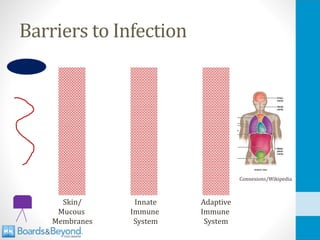
Barriers to Infection
Skin/
Mucous
Membranes
Innate
Immune
System
Adaptive
Immune
System
Connexions/Wikipedia
Immune Systems
Innate
• Fast-acting system
• Non-specific reaction
• Same cells, same reaction
to many invaders
• No memory
• 2nd infection same
response as 1st infection
Adaptive
• Slow-acting (days)
• Highly specific
• Unique cells activated to
respond to a single
invader
• Memory
• 2nd infection: faster
response
Antigen Presentation
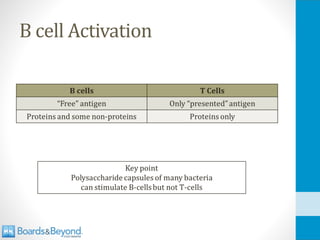
• Innate system can be activated by “free” antigen
• Pathogenic molecules detected freely in blood, tissue
• Adaptive system requires “antigen presentation”
• Pathogens must be engulfed by cells, broken down
• Pieces of protein transported to surface
• Antigen “presented” to T-cells for activation
Cytokines
• Cell signaling proteins
• Often released by immune cells
• Stimulate inflammatory response
• Various subsets
• Chemokine: Attracts immune cells (chemotaxis)
• Interleukins: IL-1, IL,2, etc
• Tumor necrosis factor (TNF): Can cause tumor death
• Transforming growth factor (TGF)
• Interferons: Named for interfering with viral replication
Cluster of Differentiation (CD)
• Cellular surface molecules
• CD3, CD4, CD8
• Found on many immune cells (T-cells, B-cells)
• Used to identify cell types
• Some used as receptor/cell binding
Innate Immune System
• Phagocytes
• Macrophages (hallmark cell)
• Neutrophils
• Complement
• Natural Killer Cells
• Eosinophils
• Mast cells and Basophils
Innate Immunity
GeneralPrinciples
• Recognize molecules that are “foreign”
• “Pathogen-associated molecular patterns” (PAMPs)
• Present on many microbes
• Not present on human cells
• Pattern recognition receptors
• Key receptor class: “Toll-like receptors” (TLRs)
• Macrophages, dendritic cells, mast cells
• Recognize PAMPs → secrete cytokines
Innate Immunity
PatternRecognition
• Endotoxin (LPS)
• LPS binds LPS-binding protein (found in plasma)
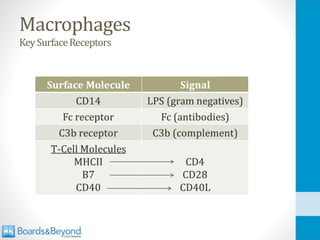
• Binds CD14 on Macrophages
• Triggers TLR4
• Cytokine production: IL-1, IL-6, IL-8, TNF
• Peptidoglycan cell wall
• NOD receptors (intracellular)
• Nucleotide-binding oligomerization domain
• Cytokine expression
Innate Immunity
PatternRecognition
• Mannose (polysaccharide on bacteria/yeast)
• Mannose-binding lectin (MBL) from liver
• Activates lectin pathway of complement activation
• Lipoteichoic acid on Gram-positive bacteria
• Double stranded RNA
• Unmethylated DNA
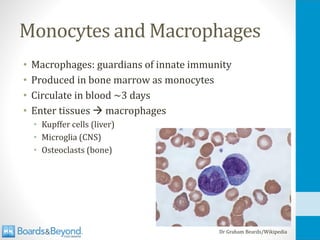
Monocytes and Macrophages
• Macrophages: guardians of innate immunity
• Produced in bone marrow as monocytes
• Circulate in blood ~3 days
• Enter tissues → macrophages
• Kupffer cells (liver)
• Microglia (CNS)
• Osteoclasts (bone)
Dr Graham Beards/Wikipedia
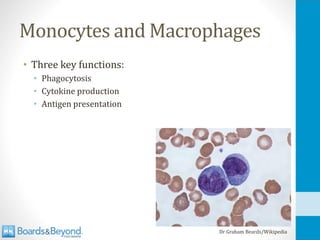
Monocytes and Macrophages
• Three key functions:
• Phagocytosis
• Cytokine production
• Antigen presentation
Dr Graham Beards/Wikipedia
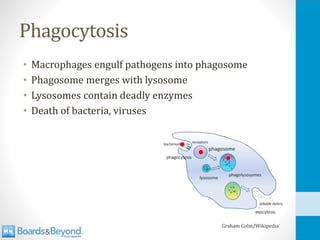
Phagocytosis
• Macrophages engulf pathogens into phagosome
• Phagosome merges with lysosome
• Lysosomes contain deadly enzymes
• Death of bacteria, viruses
Graham Colm/Wikipedia
Phagocytosis
• Reactive oxygen species (superoxides)
• Produced by NADPH Oxidase (respiratory burst)
• Generate hydrogen peroxide H2O2 and O2
-
• Reactive nitrogen intermediates
• NO (nitric oxide) + O2
− (superoxide) → ONOO− (peroxynitrite)
• Enzymes:
• Proteases
• Nucleases
• Lysozymes (hydrolyze peptidoglycans)
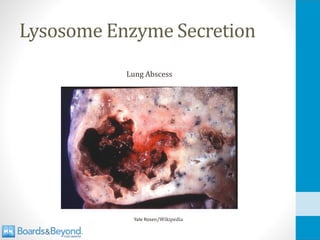
Lysosome Enzyme Secretion
Yale Rosen/Wikipedia
Lung Abscess
Phagocytosis
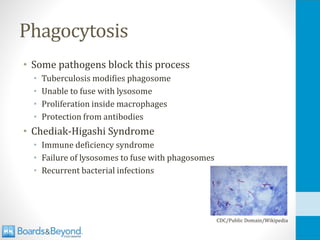
• Some pathogens block this process
• Tuberculosis modifies phagosome
• Unable to fuse with lysosome
• Proliferation inside macrophages
• Protection from antibodies
• Chediak-Higashi Syndrome
• Immune deficiency syndrome
• Failure of lysosomes to fuse with phagosomes
• Recurrent bacterial infections
CDC/Public Domain/Wikipedia
Macrophages
• Macrophages can exist in several “states”
• Resting: Debris removal
• Activated (“primed”): more effective
• Major activators (via surface TLRs):
• LPS from bacteria
• Peptidoglycan
• Bacterial DNA (no methylation)
• Also, IFN-γ from T-cells, NKC
• Attracted by C5a (complement)
Macrophages
KeySurfaceReceptors
Macrophages
Cytokines
• Key cytokines are IL-1 and TNF-α
• Others: IL-6, IL-8, IL-12
IL-1 and TNF-α
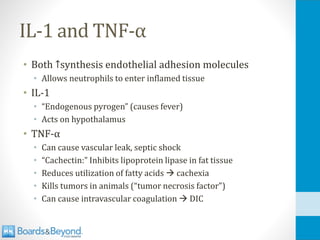
• Both ↑synthesis endothelial adhesion molecules
• Allows neutrophils to enter inflamed tissue
• IL-1
• “Endogenous pyrogen” (causes fever)
• Acts on hypothalamus
• TNF-α
• Can cause vascular leak, septic shock
• “Cachectin:” Inhibits lipoprotein lipase in fat tissue
• Reduces utilization of fatty acids → cachexia
• Kills tumors in animals (“tumor necrosis factor”)
• Can cause intravascular coagulation → DIC
IL-6, IL-8, IL-12
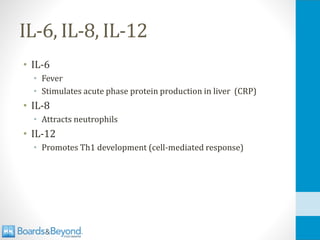
• IL-6
• Fever
• Stimulates acute phase protein production in liver (CRP)
• IL-8
• Attracts neutrophils
• IL-12
• Promotes Th1 development (cell-mediated response)
Neutrophil
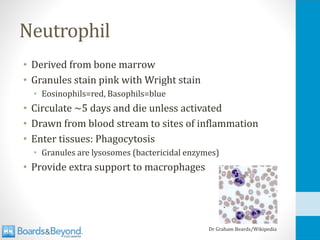
• Derived from bone marrow
• Granules stain pink with Wright stain
• Eosinophils=red, Basophils=blue
• Circulate ~5 days and die unless activated
• Drawn from blood stream to sites of inflammation
• Enter tissues: Phagocytosis
• Granules are lysosomes (bactericidal enzymes)
• Provide extra support to macrophages
Dr Graham Beards/Wikipedia
Neutrophil
Bloodstreamexit
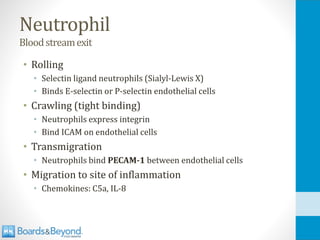
• Rolling
• Selectin ligand neutrophils (Sialyl-Lewis X)
• Binds E-selectin or P-selectin endothelial cells
• Crawling (tight binding)
• Neutrophils express integrin
• Bind ICAM on endothelial cells
• Transmigration
• Neutrophils bind PECAM-1 between endothelial cells
• Migration to site of inflammation
• Chemokines: C5a, IL-8
Neutrophil
Bloodstreamexit
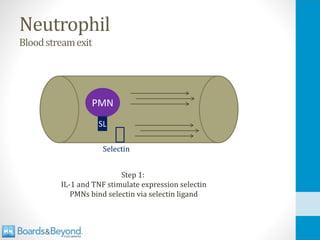
PMN
Step 1:
IL-1 and TNF stimulate expression selectin
PMNs bind selectin via selectin ligand
SL
Selectin
Neutrophil
Bloodstreamexit
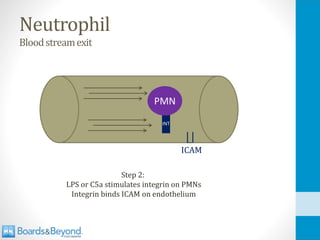
Step 2:
LPS or C5a stimulates integrin on PMNs
Integrin binds ICAM on endothelium
INT
ICAM
PMN
Neutrophils
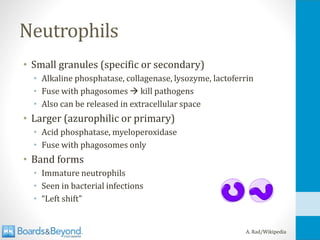
• Small granules (specific or secondary)
• Alkaline phosphatase, collagenase, lysozyme, lactoferrin
• Fuse with phagosomes → kill pathogens
• Also can be released in extracellular space
• Larger (azurophilic or primary)
• Acid phosphatase, myeloperoxidase
• Fuse with phagosomes only
• Band forms
• Immature neutrophils
• Seen in bacterial infections
• “Left shift”
A. Rad/Wikipedia
Neutrophil
• Do not present antigen
• Phagocytosis only
• Contrast with macrophages: APCs and phagocytes
• Chemotaxins (attracters of neutrophils)
• IL-8 (from macrophages)
• C5a
• Opsonin: IgG (only antibody that binds neutrophils)
Complement
• Complement proteins produced by liver
• Most abundant is C3
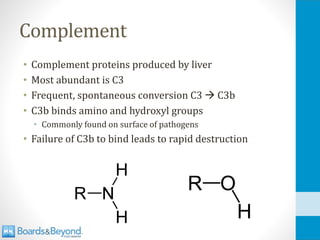
• Frequent, spontaneous conversion C3 → C3b
• C3b binds amino and hydroxyl groups
• Commonly found on surface of pathogens
• Failure of C3b to bind leads to rapid destruction
Complement
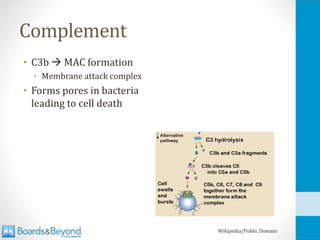
• C3b → MAC formation
• Membrane attack complex
• Forms pores in bacteria
leading to cell death
Wikipedia/Public Domain
Natural Killer Cells
• Two key roles:
• Kill human cells infected by viruses
• Produce IFN-γ to activates macrophages
Natural Killer Cells
• MHC Class I
• Surface molecule of most human cells
• Presents antigen to CD8 T-cells
• Activates adaptive immunity against intracellular pathogens
• Some viruses block MHC class I
• NKC destroy human cells with reduced MHC I
Natural Killer Cells
• CD16 on surface
• Binds Fc of IgG → enhanced activity
• Antibody-dependent cell-mediated cytotoxicity
• CD56
• Also called NCAM (Neural Cell Adhesion Molecule)
• Expressed on surface of NK cells (useful marker)
• Also found in brain and neuromuscular junctions
• Aids in binding to other cells
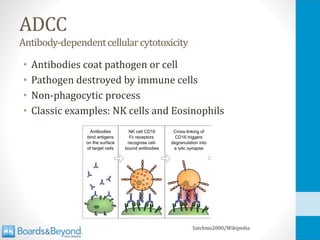
ADCC
Antibody-dependentcellularcytotoxicity
• Antibodies coat pathogen or cell
• Pathogen destroyed by immune cells
• Non-phagocytic process
• Classic examples: NK cells and Eosinophils
Satchmo2000/Wikipedia
ADCC
Antibody-dependentcellularcytotoxicity
• Natural Killer Cells
• IgG binds to pathogen-infected cells
• CD16 on NK binds Fc of IgG
• NKC kills cell
• Eosinophils
• IgE binds to pathogens, especially large parasites
• Eosinophils bind Fc of IgE
• Release of toxic enzymes onto parasite
Natural Killer Cells
• Lymphocytes (same lineage as T-cells and B-cells)
• Do not mature in thymus
• No memory
• Do not require antigen presentation by MHC
Eosinophils, Mast Cells, Basophils
• All contain granules with destructive enzymes
• All can be activated/triggered by IgE antibodies
• Important for defense against parasites (helminths)
• Too large for phagocytosis
• Release of toxic substances kills parasite
• Main medical relevance is in allergic disease
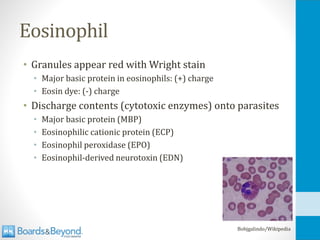
Eosinophil
• Granules appear red with Wright stain
• Major basic protein in eosinophils: (+) charge
• Eosin dye: (-) charge
• Discharge contents (cytotoxic enzymes) onto parasites
• Major basic protein (MBP)
• Eosinophilic cationic protein (ECP)
• Eosinophil peroxidase (EPO)
• Eosinophil-derived neurotoxin (EDN)
Bobjgalindo/Wikipedia
Eosinophil
• Activated by IgE
• Antibody-dependent cellular cytotoxicity
• Stimulated by IL-5 from Th2 cells
• ↑eosinophil count characteristic of helminth infection
• Normal % eosinophils <5% or <500 eosinophils/microL
• Also seen in many allergic diseases
Bobjgalindo/Wikipedia
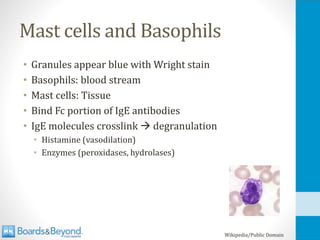
Mast cells and Basophils
• Granules appear blue with Wright stain
• Basophils: blood stream
• Mast cells: Tissue
• Bind Fc portion of IgE antibodies
• IgE molecules crosslink → degranulation
• Histamine (vasodilation)
• Enzymes (peroxidases, hydrolases)
Wikipedia/Public Domain
Innate Immune System
• Phagocytes
• Macrophages (hallmark cell)
• Neutrophils
• Complement
• Natural Killer Cells
• Eosinophils
• Mast cells and Basophils
Adaptive Immune System
• T-cells
• CD4: Cytokine production
• CD8: Destruction infected human cells
• B-cells
• Antibody production
• Inter-related with innate immunity
• Cytokines
• Antigen presentation
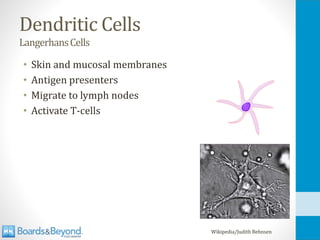
Dendritic Cells
LangerhansCells
• Skin and mucosal membranes
• Antigen presenters
• Migrate to lymph nodes
• Activate T-cells
Wikipedia/Judith Behnsen
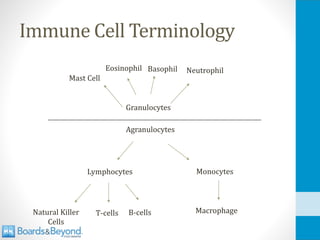
Immune Cell Terminology
Agranulocytes
Lymphocytes Monocytes
Natural Killer
Cells
T-cells B-cells Macrophage
Granulocytes
Neutrophil
Basophil
Eosinophil
Mast Cell
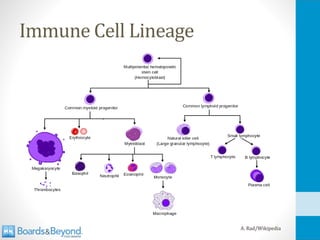
Immune Cell Lineage
A. Rad/Wikipedia
T-cells
Jason Ryan, MD, MPH
T-cells
• Part of the adaptive immune system
• Millions of T-cells in the human body
• Each recognizes a unique antigen via T-cell receptor
• Emerge from thymus as “naïve” T-cells
• Once they encounter antigen: “mature” T-cells
• Key fact: T-cells only recognize peptides
Antigen Presentation
• T-cells only recognize antigen when “presented”
• Antigen presenting cells
• Produce peptide fragments on their surfaces
• Major histocompatibility complexes (MHC)
• Fragments placed on MHC molecules (I or II)
• T-cell react only to antigen when placed on “self” MHC
• “MHC restriction”
T-cell Receptor
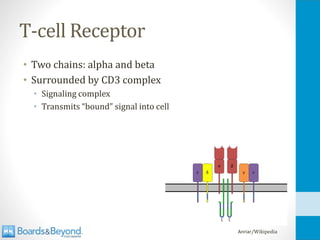
• Two chains: alpha and beta
• Surrounded by CD3 complex
• Signaling complex
• Transmits “bound” signal into cell
Anriar/Wikipedia
T-cell Receptor
• Formed by similar process to antibody heavy chains
• Encoded by genes that rearrange for diversity
• V (variable)
• D (diversity)
• J (joining)
• C (constant)
• Hypervariable domains
T-cells
• Two key subsets: CD4 and CD8
• CD4 T-cells (helper T-cells)
• Produce cytokines
• Activate other cells
• Direct immune response
• CD8 T-cells (cytotoxic T-cells)
• Kill virus-infected cells (also tumor cells)
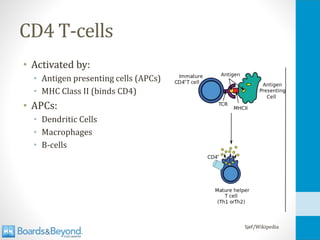
CD4 T-cells
• Activated by:
• Antigen presenting cells (APCs)
• MHC Class II (binds CD4)
• APCs:
• Dendritic Cells
• Macrophages
• B-cells
Sjef/Wikipedia
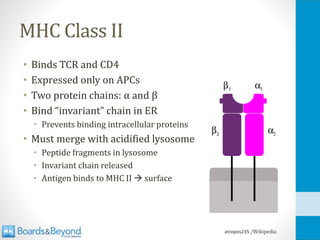
MHC Class II
• Binds TCR and CD4
• Expressed only on APCs
• Two protein chains: α and β
• Bind “invariant” chain in ER
• Prevents binding intracellular proteins
• Must merge with acidified lysosome
• Peptide fragments in lysosome
• Invariant chain released
• Antigen binds to MHC II → surface
atropos235 /Wikipedia
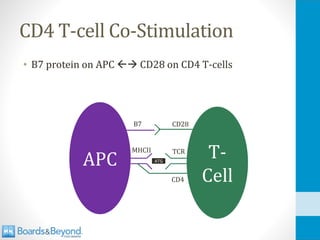
CD4 T-cell Co-Stimulation
• B7 protein on APC → CD28 on CD4 T-cells
APC T-
Cell
ATG
TCR
MHCII
B7 CD28
CD4
CD4 T-cell Activation
• Stimulate B-cells
• More effective antibody production
• Class switching
• Stimulate CD8 T-cells
• Activate macrophages
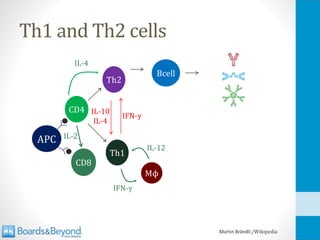
Th1 and Th2 cells
• Two subpopulations CD4 T-cells
• Th1 cells
• “Cell-mediated” immune response
• Activate CD8 T-cells, macrophages
• IL-12 (macrophages) drives Th1 production
• Promotes specific IgG subclasses (opsonizing/complement)
• Th2 cells
• “Humoral” immunity
• Activate B-cells to produce antibodies (IgE, IgA)
Th1 Cytokines
• IL-2
• Mostly from Th1 cells (some from Th2)
• T-cell growth factor
• Stimulates growth CD4, CD8 T-cells
• Also activates B-cells and NK cells
• Aldesleukin (IL-2) for renal cell carcinoma and melanoma
• IFN-γ
• Activates Th1 cells/suppresses Th2 production
• Activates macrophages (phagocytosis/killing)
• More MHC Class I and II expression
Th2 Cytokines
• IL-4 (major Th2 cytokine)
• Activates Th2 cells/suppresses Th1 production
• Promotes IgE production (parasites)
• IL-5
• Activates eosinophils (helminth infections)
• Promotes IgA production (GI bacteria)
• IL-10
• Inhibits Th1 production
• “Anti-inflammatory” cytokine only
• No pro-inflammatory effect
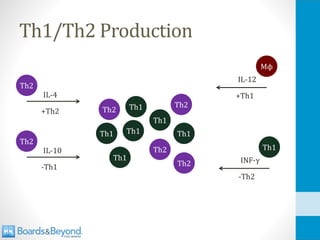
Th1/Th2 Production
Th1
Th1
Th1
Th1
Th1
Th1
Th2
Th2
Th2
IL-4
+Th2
Th2
IL-12
+Th1
Mϕ
IL-10
-Th1
Th2
INF-γ
-Th2
Th1
Th2
Th1 and Th2 cells
APC
CD4
CD8
Th2
Th1
Mϕ
Bcell
Martin Brändli /Wikipedia
IL-10
IL-4
IFN-γ
IFN-γ
IL-12
IL-4
IL-2
Th1 and Th2 cells
• Th1 versus Th2 varies by infection
• Th1 important for many intracellular infections
• M. Tuberculosis
• Intracellular infection macrophages
• Antibodies not effective
• Need strong Th1 response
• Listeria
• Facultative intracellular organism
• Weaker (relatively) Th1 response certain populations
• Newborns/elderly: Risk for listeria meningitis
• Pregnancy: Granulomatosis Infantiseptica
Granulomatous Diseases
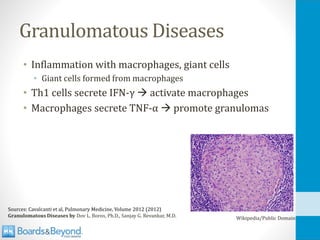
• Inflammation with macrophages, giant cells
• Giant cells formed from macrophages
• Th1 cells secrete IFN-γ → activate macrophages
• Macrophages secrete TNF-α → promote granulomas
Sources: Cavalcanti et al, Pulmonary Medicine, Volume 2012 (2012)
Granulomatous Diseases by Dov L. Boros, Ph.D., Sanjay G. Revankar, M.D. Wikipedia/Public Domain
Leprosy
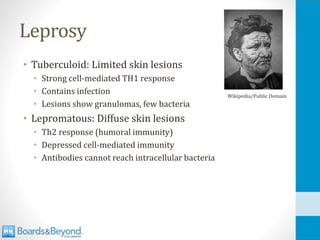
• Tuberculoid: Limited skin lesions
• Strong cell-mediated TH1 response
• Contains infection
• Lesions show granulomas, few bacteria
• Lepromatous: Diffuse skin lesions
• Th2 response (humoral immunity)
• Depressed cell-mediated immunity
• Antibodies cannot reach intracellular bacteria
Wikipedia/Public Domain
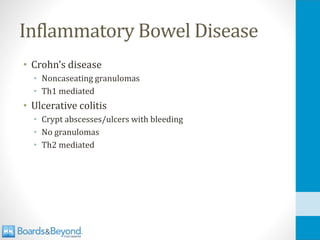
Inflammatory Bowel Disease
• Crohn’s disease
• Noncaseating granulomas
• Th1 mediated
• Ulcerative colitis
• Crypt abscesses/ulcers with bleeding
• No granulomas
• Th2 mediated
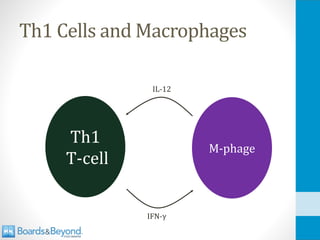
Th1 Cells and Macrophages
Th1
T-cell
M-phage
IL-12
IFN-γ
IL-12 Receptor Deficiency
• IL-12 cannot trigger differentiation T-cells to Th1 cells
• Loss of activated Th1 cells to produce IFN-γ
• Weak Th1 response and low levels IFN-γ
• Increased susceptibility:
• Disseminated mycobacterial infections
• Disseminated Salmonella
• Disseminated Bacillus Calmette-Guerin (BCG) after vaccine
• Treatment: IFN-γ
IFN-γ Receptor Deficiency
• Severe disseminated mycobacterial disease
• Also salmonella infections (and others)
• Infancy or early childhood
• IFN-γ not effective
• Treatment:
• Continuous anti-mycobacterial therapy
• Stem cell transplant (restore receptors)
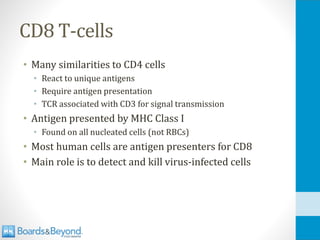
CD8 T-cells
• Many similarities to CD4 cells
• React to unique antigens
• Require antigen presentation
• TCR associated with CD3 for signal transmission
• Antigen presented by MHC Class I
• Found on all nucleated cells (not RBCs)
• Most human cells are antigen presenters for CD8
• Main role is to detect and kill virus-infected cells
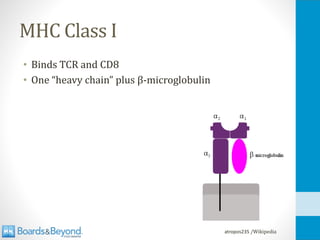
MHC Class I
• Binds TCR and CD8
• One “heavy chain” plus β-microglobulin
atropos235 /Wikipedia
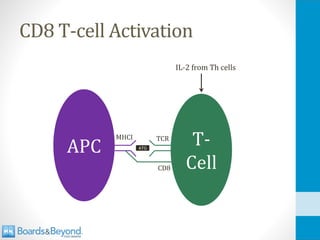
CD8 T-cell Activation
APC T-
Cell
ATG
TCR
MHCI
CD8
IL-2 from Th cells
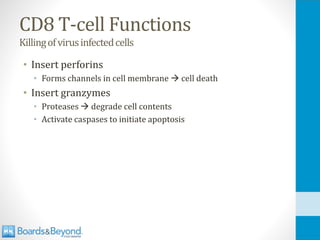
CD8 T-cell Functions
Killingofvirusinfectedcells
• Insert perforins
• Forms channels in cell membrane → cell death
• Insert granzymes
• Proteases → degrade cell contents
• Activate caspases to initiate apoptosis
CD8 T-cell Functions
Killingofvirusinfectedcells
• Insert granulysin
• Lyses bacteria
• Induces apoptosis
• Produce Fas ligand
• Binds to Fas (CD95) on surface of cells
• Activation caspases in cytosol
• Cellular breakdown
• Apoptosis (cell death with no significant inflammation)
• “Extrinsic pathway” of apoptosis
Regulatory T-cells
• Suppress CD4 and CD8 functions
• All express CD25 (classical marker)
• Composed of alpha subunit of IL-2 receptor
• Also have CD4 and CD3
• Produce anti-inflammatory cytokines
• IL-10
• TGF-β
Th17 Cells
• Subset of CD4 T cells (distinct from Th1 and Th2)
• Important for mucosal immunity (GI tract)
• Produce IL-17
• Recruit neutrophils and macrophages
• Loss of these cells: GI bacteria in bloodstream
• E. coli, other enteric gram negatives
• Emerging evidence of role in autoimmune disease
Memory T-cells
• Most T-cells involved in immune reaction die
• Antigen withdrawal
• Loss of stimulation (IL-2)
• Apoptosis
• Some remain as memory T-cells
• Live for many years
• Secondary response requires less antigen
• Secondary exposure produces more cytokines
• Results: Faster, more vigorous response
PPD Test
Purifiedproteinderivative
• Injection tuberculin protein under skin
• Memory Th1 cells activated
• Secrete IFN-γ
• Activate skin macrophages
• Local skin swelling/redness if prior TB exposure
• No prior exposure, no memory T cells: No reaction
• Delayed-type hypersensitivity reaction
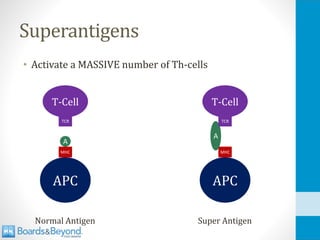
Superantigens
• Activate a MASSIVE number of Th-cells
APC
MHC
A
T-Cell
TCR
Normal Antigen
APC
MHC
A
T-Cell
TCR
Super Antigen
Superantigens
• Typical antigen response: <1% T-cells
• Superantigen: 2-20% T-cells
• HUGE release of cytokines
• Especially IFN-γ and IL-2 from Th1 cells
• Massive vasodilation and shock
Superantigens
• Superantigens cause toxic shock syndrome
• Staph aureus
• Toxic shock syndrome toxin (TSST-1)
• Strep pyogenes (group A strep)
• Pyrogenic exotoxin A or C
Thymus
• Anterior mediastinal structure
• Site of T-cell “maturation”
• Immature T-cells migrate bone marrow to thymus
• In thymus, express TCR
• Only those with ideal TCR survive
• Bind to self MHC Class I and II
• Does not bind in presence of self antigens
• Many undergo apoptosis
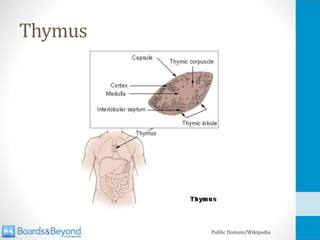
Thymus
Public Domain/Wikipedia
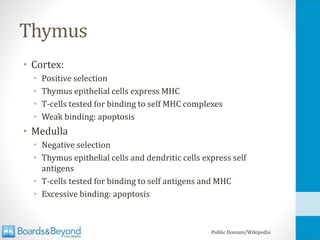
Thymus
• Cortex:
• Positive selection
• Thymus epithelial cells express MHC
• T-cells tested for binding to self MHC complexes
• Weak binding: apoptosis
• Medulla
• Negative selection
• Thymus epithelial cells and dendritic cells express self
antigens
• T-cells tested for binding to self antigens and MHC
• Excessive binding: apoptosis
Public Domain/Wikipedia
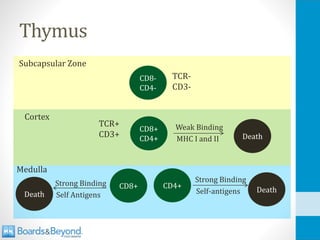
Thymus
Subcapsular Zone
Cortex
Medulla
CD8-
CD4-
CD8+
CD4+
CD8+ CD4+
Weak Binding
MHC I and II Death
Strong Binding
Self-antigens Death
Strong Binding
Self Antigens
Death
TCR-
CD3-
TCR+
CD3+
AIRE Genes
• Autoimmune regulator (AIRE)
• Genes responsible for expression self antigens
• Mutations → autoimmune disease
• Clinical consequences:
• Recurrent candida infections
• Chronic mucocutaneous candidiasis
• Hypoparathyroidism
• Adrenal insufficiency
B-cells
Jason Ryan, MD, MPH
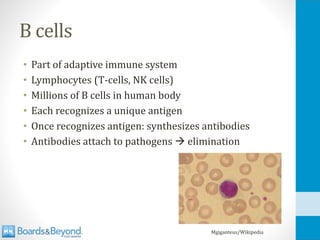
B cells
• Part of adaptive immune system
• Lymphocytes (T-cells, NK cells)
• Millions of B cells in human body
• Each recognizes a unique antigen
• Once recognizes antigen: synthesizes antibodies
• Antibodies attach to pathogens → elimination
Mgiganteus/Wikipedia
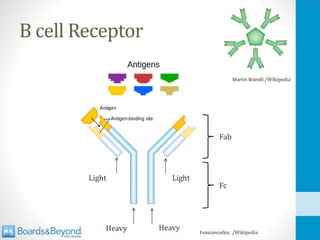
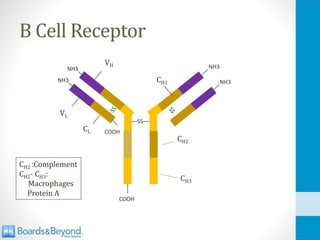
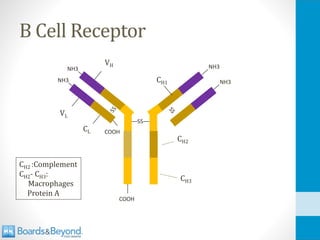
B cell Receptor
Fvasconcellos /Wikipedia
Heavy
Heavy
Light Light
Fab
Fc
Martin Brändli /Wikipedia
B Cell Receptor
NH3
NH3
NH3
NH3
COOH
SS
VH
VL
CL
CH1
CH2
CH3
CH2 :Complement
CH2- CH3:
Macrophages
Protein A
COOH
B cell Diversity
• Millions of B cells with unique antigen receptors
• More unique receptors than genes
• If one gene = one receptor, how can this be?
• Answer: Rearrangements of genetic building blocks
B Cell Receptor
NH3
NH3
NH3
NH3
COOH
SS
VH
VL
CL
CH1
CH2
CH3
CH2 :Complement
CH2- CH3:
Macrophages
Protein A
COOH
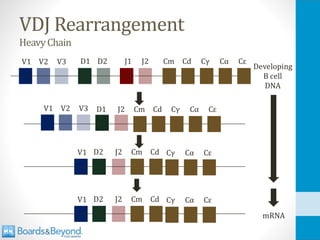
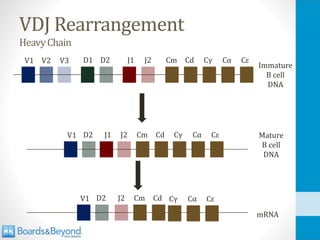
VDJ Rearrangement
HeavyChain
VDJ Rearrangement
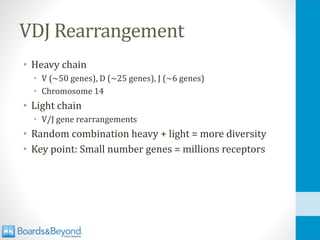
• Heavy chain
• V (~50 genes), D (~25 genes), J (~6 genes)
• Chromosome 14
• Light chain
• V/J gene rearrangements
• Random combination heavy + light = more diversity
• Key point: Small number genes = millions receptors
B cell Activation
B cell Activation
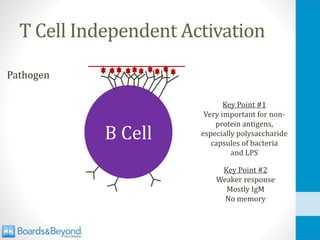
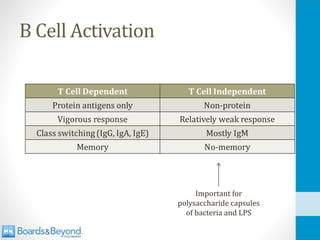
• Two types of activation
• T-cell dependent (proteins)
• T-cell independent (non-proteins)
• For T-cell dependent, two signals required:
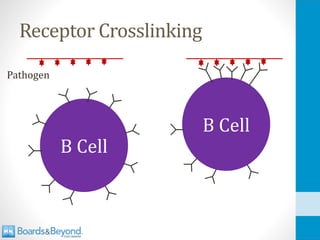
• #1: Crosslinking of receptors bound to antigen
• #2: T cell binding (T-cell dependent activation)
Receptor Crosslinking
B Cell
Pathogen
B Cell
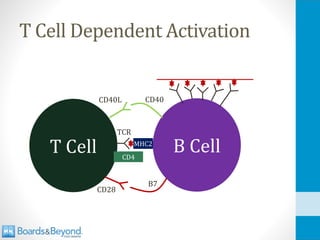
T Cell Dependent Activation
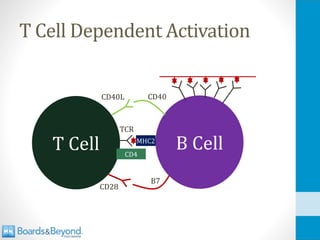
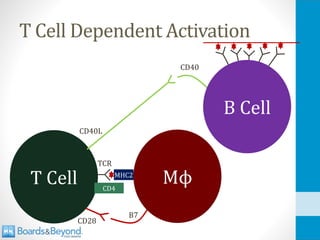
• B cell can present antigen to T-cells via MHC Class II
• Binds MHC Class II to T cell receptor
• Other T-cell to B-cell interactions also occur
• CD40 (B cells) to CD40 ligand (T cell)
• Required for class switching
• B7 (B cells) to CD28 (T cell)
• Required for stimulation of T-cell cytokine production
T Cell Dependent Activation
B Cell
T Cell MHC2
TCR
CD4
CD40L CD40
CD28
B7
T Cell Dependent Activation
Mϕ
T Cell MHC2
TCR
CD4
CD40L
CD28
B7
B Cell
CD40
T Cell Independent Activation
Pathogen
B Cell
Key Point #1
Very important for non-
protein antigens,
especially polysaccharide
capsules of bacteria
and LPS
Key Point #2
Weaker response
Mostly IgM
No memory
B Cell Activation
Important for
polysaccharide capsules
of bacteria and LPS
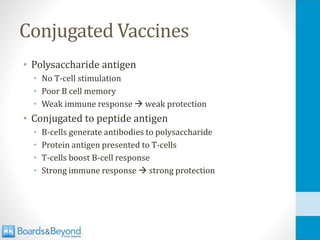
Conjugated Vaccines
• Polysaccharide antigen
• No T-cell stimulation
• Poor B cell memory
• Weak immune response → weak protection
• Conjugated to peptide antigen
• B-cells generate antibodies to polysaccharide
• Protein antigen presented to T-cells
• T-cells boost B-cell response
• Strong immune response → strong protection
Conjugated Vaccines
• H. Influenza type B (Hib)
• Neisseria meningitidis
• Streptococcus pneumoniae
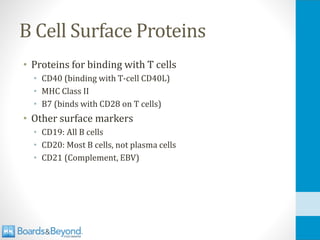
B Cell Surface Proteins
• Proteins for binding with T cells
• CD40 (binding with T-cell CD40L)
• MHC Class II
• B7 (binds with CD28 on T cells)
• Other surface markers
• CD19: All B cells
• CD20: Most B cells, not plasma cells
• CD21 (Complement, EBV)
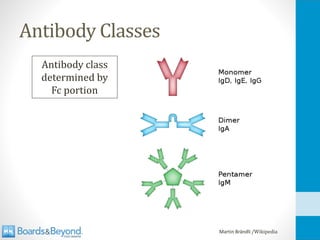
Antibody Classes
Martin Brändli /Wikipedia
Antibody class
determined by
Fc portion
Antibody Functions
• #1: Opsonization
• Mark pathogens for phagocytosis
• #2: Neutralization
• Block adherence to structures
• #3: Activate complement
• “Classical” pathway activated by antibodies
Protein A
• Key virulence factor of Staph Aureus
• Part of peptidoglycan cell wall
• Binds Fc portion of IgG antibodies
• Prevents Mϕ opsonization phagocytosis
• Prevents complement activation
Class Switching
• Activated B cells initially produce IgM
• Can also produce small amount IgD
• Significance of IgD not clear
• As B cell matures/proliferates, it can switch class
• Gene rearrangements produces IgG, IgA, IgE
• NOTE: No change in antibody specificity
• Triggers for class switching:
• Cytokines (IL-4, IL-5 in Th2 response)
• T-cell binding (CD40-CD40L)
VDJ Rearrangement
HeavyChain
V1 V2 V3 D1 D2 J1 J2 Cm Cd
V1 D2 J2 Cm Cd
Immature
B cell
DNA
Mature
B cell
DNA
J1
V1 D2 J2 Cm Cd
mRNA
Cγ Cα Cε
Cγ Cα Cε
Cγ Cα Cε
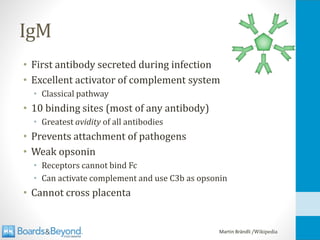
IgM
• First antibody secreted during infection
• Excellent activator of complement system
• Classical pathway
• 10 binding sites (most of any antibody)
• Greatest avidity of all antibodies
• Prevents attachment of pathogens
• Weak opsonin
• Receptors cannot bind Fc
• Can activate complement and use C3b as opsonin
• Cannot cross placenta
Martin Brändli /Wikipedia
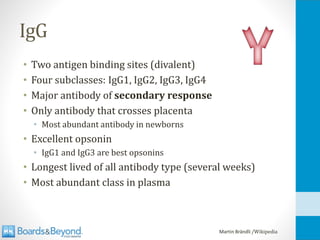
IgG
• Two antigen binding sites (divalent)
• Four subclasses: IgG1, IgG2, IgG3, IgG4
• Major antibody of secondary response
• Only antibody that crosses placenta
• Most abundant antibody in newborns
• Excellent opsonin
• IgG1 and IgG3 are best opsonins
• Longest lived of all antibody type (several weeks)
• Most abundant class in plasma
Martin Brändli /Wikipedia
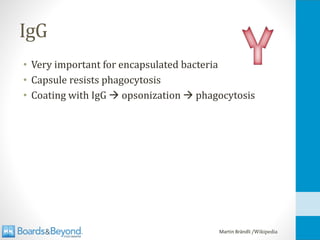
IgG
• Very important for encapsulated bacteria
• Capsule resists phagocytosis
• Coating with IgG → opsonization → phagocytosis
Martin Brändli /Wikipedia
IgA
• Found on mucosal surfaces, mucosal secretions
• GI tract, respiratory tract, saliva, tears
• Monomer in plasma
• Crosses epithelial cells by transcytosis
• Transported through cell
• Linked by secretory component from epithelial cells
• Becomes dimer in secretions
Martin Brändli /Wikipedia
IgA
• Does not fix complement
• Excellent at coating mucosal pathogens
• Ideal for mucosal surfaces
• Coat pathogens so they cannot invade
• Pathogens swept away with mucosal secretions
• No complement = no inflammation
• Secreted into milk to protect baby’s GI tract
Martin Brändli /Wikipedia
IgA
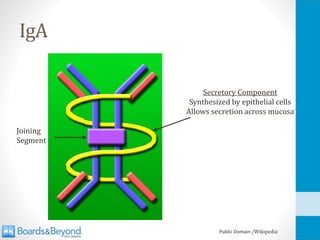
Public Domain /Wikipedia
Joining
Segment
Secretory Component
Synthesized by epithelial cells
Allows secretion across mucosa
IgA Protease
• Enzymes that cleave IgA secretory component
• Allows colonization of mucosal surfaces
• S. pneumonia
• H. influenza
• Neisseria (gonorrheae and meningitidis)
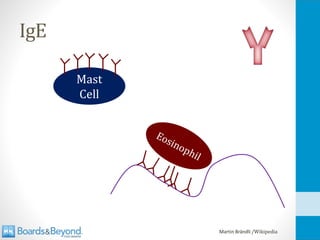
IgE
• Bind to mast cells and eosinophils
• Designed for defense against parasites
• Too large for phagocytosis
• IgE binds → mast cell or eosinophil degranulation
• Low concentration in plasma
• Does not activate complement
• Mediates allergic reactions
• Seasonal allergies
• Anaphylactic shock
Martin Brändli /Wikipedia
IgE
Martin Brändli /Wikipedia
Mast
Cell
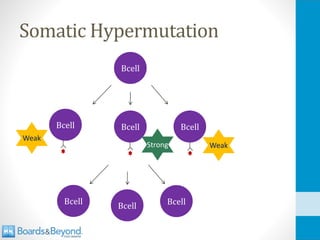
Somatic Hypermutation
• Late event during inflammation/infection
• Often after class switching
• High mutation rate in portions of V, D, J genes
• Re-stimulation required for ongoing proliferation
• Strongest binding BCR proliferate the most
• “Affinity maturation”
• Receptors mutate: Stronger antigen binding over time
Somatic Hypermutation
Bcell
Bcell Bcell Bcell
Weak
Weak
Strong
Bcell Bcell Bcell
B Cell Fate
• After activation B cells become:
• Plasma cells (make antibodies)
• Memory B cells
• Plasma cells
• Usually travel to spleen or bone marrow
• Secrete thousands of antibodies per second
• Die after a few days
• More created if infection/antigen persist
• Memory B cells
• Only produced in T-cell dependent activation
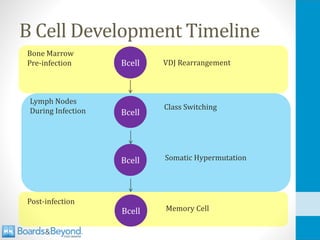
B Cell Development Timeline
Bcell
Bcell
Bcell
Bcell
VDJ Rearrangement
Class Switching
Somatic Hypermutation
Memory Cell
Bone Marrow
Pre-infection
Lymph Nodes
During Infection
Post-infection
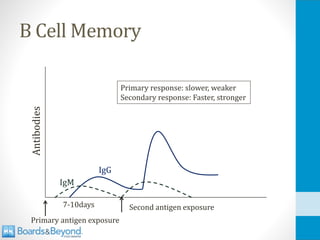
B Cell Memory
Antibodies
Primary antigen exposure
Second antigen exposure
Primary response: slower, weaker
Secondary response: Faster, stronger
7-10days
IgM
IgG
Vaccines
• B cell and T cell response without overt infection
• Protection via immune memory
• Various types:
• Live attenuated
• Killed
• Oral/intramuscular
Vaccines
• Live attenuated
• Pathogens modified to be less virulent
• Can induce a strong, cell-mediated response
• Some risk of infection (especially immunocompromised)
• If given <1yo, maternal antibodies may kill pathogen
• MMR
• Killed
• Pathogen killed but antigens remain intact
• Strong humoral response (antibodies)
• Weaker immune response than live, attenuated
• No risk of infection
Vaccines
• Oral
• Stimulate GI mucosal immunity
• Largely IgA response
• Oral polio, rotavirus
• Intramuscular
• Stimulate tissue response
• Large IgG
Vaccines
• Passive Immunization
• Administration of antibodies
• Short term protection (weeks)
• No memory or long term protection
• Used for dangerous, imminent infections
• Rabies, Tetanus
• Also maternal antibodies → fetus
• Sometimes passive and active done simultaneously
• Rabies immune globulin plus rabies vaccine
The Complement
System
Jason Ryan, MD, MPH
Complement System
• Proteins circulating in blood stream
• Can bind to pathogens, especially bacteria
• Binding results in bacterial cell death
• Various names of proteins
• C3, C5, C6
• C3a, C3b
C3
• Most abundant complement protein
• Synthesized by liver
• Can be converted to C3b
• C3b binds to bacteria → bacterial death
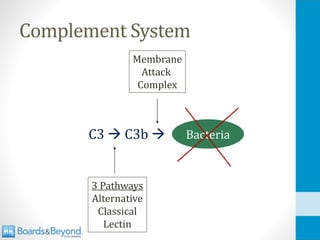
• All complement activation involves C3→C3b
Complement System
C3 → C3b → Bacteria
3 Pathways
Alternative
Classical
Lectin
Membrane
Attack
Complex
Alternative Pathway
• C3 spontaneously converts to C3b
• C3b rapidly destroyed unless stabilized by binding
• C3b binds amino and hydroxyl groups
• Commonly found on surface of pathogens
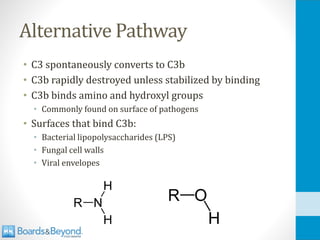
• Surfaces that bind C3b:
• Bacterial lipopolysaccharides (LPS)
• Fungal cell walls
• Viral envelopes
C3b
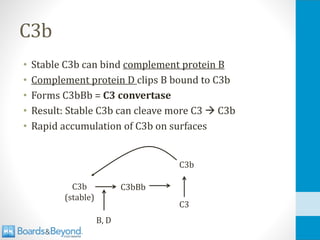
• Stable C3b can bind complement protein B
• Complement protein D clips B bound to C3b
• Forms C3bBb = C3 convertase
• Result: Stable C3b can cleave more C3 → C3b
• Rapid accumulation of C3b on surfaces
C3b
(stable)
C3bBb
C3
C3b
B, D
Factor H
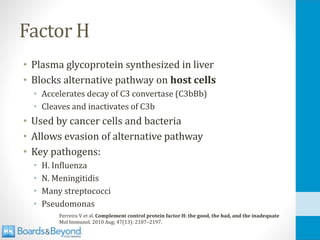
• Plasma glycoprotein synthesized in liver
• Blocks alternative pathway on host cells
• Accelerates decay of C3 convertase (C3bBb)
• Cleaves and inactivates of C3b
• Used by cancer cells and bacteria
• Allows evasion of alternative pathway
• Key pathogens:
• H. Influenza
• N. Meningitidis
• Many streptococci
• Pseudomonas
Ferreira V et al. Complement control protein factor H: the good, the bad, and the inadequate
Mol Immunol. 2010 Aug; 47(13): 2187–2197.
Lectin Pathway
• Mannose-binding lectin (MBL)
• Produced by liver → blood and tissues
• Circulates with MASPs
• Mannose associated serine proteases
• Binds surfaces with mannose (many microbes)
• Cleaves C2 → C2b
• Cleaves C4 → C4b
• C2b4b is a “C3 convertase”
• Converts C3 → C3b
Classical Pathway
• Antibody-antigen complexes
• Bind C1
• Cleaves C2 → C2b
• Cleaves C4 → C4b
• C2b4b is a “C3 convertase”
• Converts C3 → C3b
C1
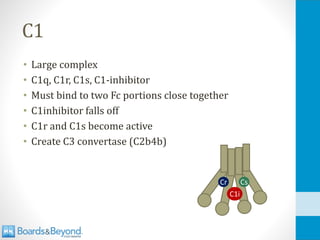
• Large complex
• C1q, C1r, C1s, C1-inhibitor
• Must bind to two Fc portions close together
• C1inhibitor falls off
• C1r and C1s become active
• Create C3 convertase (C2b4b)
Cr Cs
C1i
C Reactive Protein (CRP)
• “Acute phase reactant”
• Liver synthesis in response to IL-6 (Macrophages)
• Can bind to bacterial polysaccharides
• Activates early classical pathway via C1 binding
• Consumes C3, C4
• Generates C3b
• Does not active late pathway
• Little consumption of C5-C9
Biro et al. Studies on the interactions between C-reactive protein and complement proteins.
Immunology. 2007 May; 121(1): 40–50.
C3a and C3b
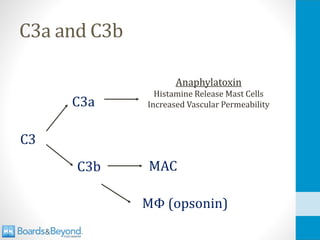
C3
C3a
C3b MAC
Anaphylatoxin
Histamine Release Mast Cells
Increased Vascular Permeability
MΦ (opsonin)
Complement System
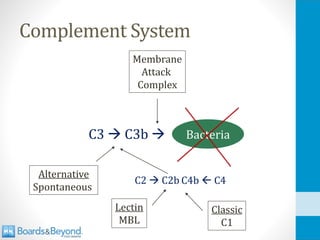
C3 → C3b → Bacteria
Alternative
Spontaneous
Membrane
Attack
Complex
C2 → C2b C4b  C4
Lectin
MBL
Classic
C1
Membrane Attack Complex
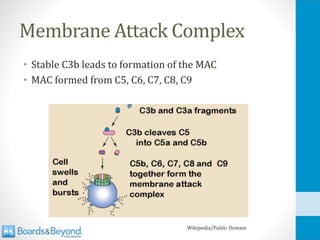
• Stable C3b leads to formation of the MAC
• MAC formed from C5, C6, C7, C8, C9
Wikipedia/Public Domain
C5a
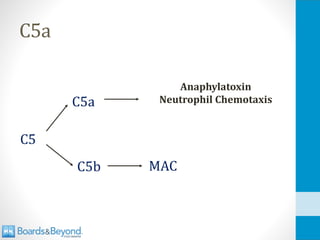
C5
C5a
C5b MAC
Anaphylatoxin
Neutrophil Chemotaxis
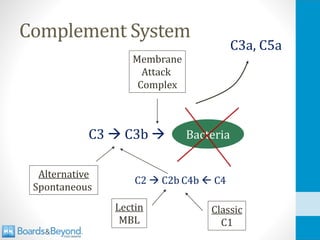
Complement System
C3 → C3b → Bacteria
Alternative
Spontaneous
Membrane
Attack
Complex
C2 → C2b C4b  C4
Lectin
MBL
Classic
C1
C3a, C5a
Inhibition of Complement
• Membrane proteins protect human cells
• Decay Accelerating Factor (DAF/CD55)
• MAC inhibitory protein (CD59)
• DAF disrupts C3b attachment
• CD59 disrupts MAC
• Especially important for protecting RBCs
• Deficiency of DAF or CD59 leads to hemolysis
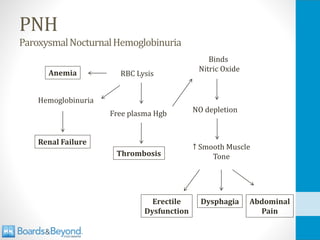
PNH
ParoxysmalNocturnalHemoglobinuria
RBC Lysis
Anemia
Hemoglobinuria
Free plasma Hgb
Thrombosis
Binds
Nitric Oxide
NO depletion
↑ Smooth Muscle
Tone
Erectile
Dysfunction
Dysphagia Abdominal
Pain
Renal Failure
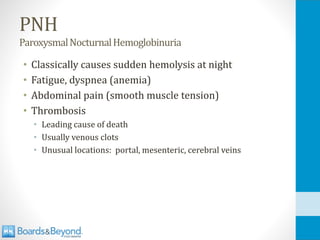
PNH
ParoxysmalNocturnalHemoglobinuria
• Classically causes sudden hemolysis at night
• Fatigue, dyspnea (anemia)
• Abdominal pain (smooth muscle tension)
• Thrombosis
• Leading cause of death
• Usually venous clots
• Unusual locations: portal, mesenteric, cerebral veins
Inherited C3 Deficiency
• Recurrent infections encapsulated bacteria
• Pneumococcal and H. flu pneumonia
• Begins in infancy
• Immune complex (IC) deposition
• IC cleared when they bind complement
• Macrophages have complement receptors
• C3 deficiency: glomerulonephritis from IC deposition
• Other type III hypersensitivity syndromes can occur
C5-C9 Deficiency
Terminalcomplementpathwaydeficiency
• Like C3, impaired defense against encapsulated bugs
• Still have C3a (anaphylatoxin)
• Also have C3b (opsonin for macrophages)
• Recurrent Neisseria infections
• Most often meningitis
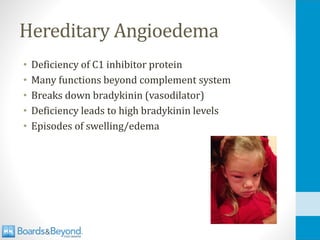
Hereditary Angioedema
• Deficiency of C1 inhibitor protein
• Many functions beyond complement system
• Breaks down bradykinin (vasodilator)
• Deficiency leads to high bradykinin levels
• Episodes of swelling/edema
Hereditary Angioedema
• Recurrent episodes swelling without urticaria
• Begins in childhood
• Swelling of skin, GI tract, upper airway
• Airway swelling can be fatal
• Diagnosis: Low C4 level
• Lack of C1 inhibitor
• Consumption of C4
• Can treat with C1 inhibitor concentrate
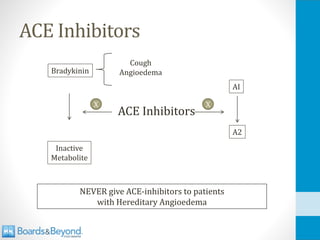
ACE Inhibitors
NEVER give ACE-inhibitors to patients
with Hereditary Angioedema
ACE Inhibitors
X
X
A2
AI
Inactive
Metabolite
Bradykinin
Cough
Angioedema
C3 Nephritic Factor
• Autoantibody
• Stabilizes C3 convertase
• Overactivity of classical pathway
• Found in >80% patients with MPGN II
• Leads to inflammation, hypocomplementemia
Hypocomplementemia
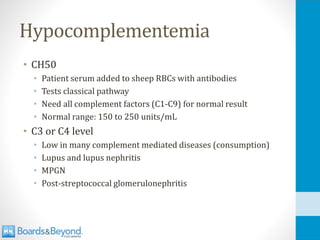
• CH50
• Patient serum added to sheep RBCs with antibodies
• Tests classical pathway
• Need all complement factors (C1-C9) for normal result
• Normal range: 150 to 250 units/mL
• C3 or C4 level
• Low in many complement mediated diseases (consumption)
• Lupus and lupus nephritis
• MPGN
• Post-streptococcal glomerulonephritis
Lymph Nodes and
Spleen
Jason Ryan, MD, MPH
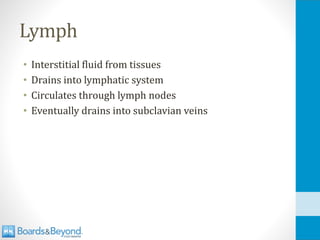
Lymph
• Interstitial fluid from tissues
• Drains into lymphatic system
• Circulates through lymph nodes
• Eventually drains into subclavian veins
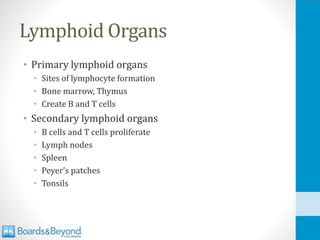
Lymphoid Organs
• Primary lymphoid organs
• Sites of lymphocyte formation
• Bone marrow, Thymus
• Create B and T cells
• Secondary lymphoid organs
• B cells and T cells proliferate
• Lymph nodes
• Spleen
• Peyer’s patches
• Tonsils
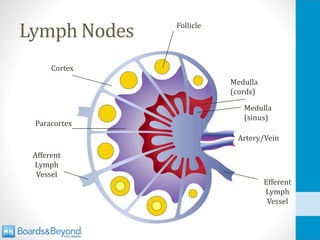
Lymph Nodes
Cortex
Paracortex
Medulla
(cords)
Medulla
(sinus)
Follicle
Efferent
Lymph
Vessel
Afferent
Lymph
Vessel
Artery/Vein
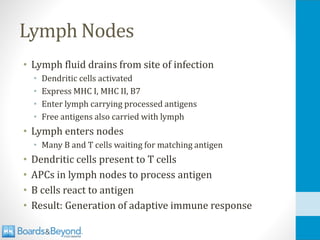
Lymph Nodes
• Lymph fluid drains from site of infection
• Dendritic cells activated
• Express MHC I, MHC II, B7
• Enter lymph carrying processed antigens
• Free antigens also carried with lymph
• Lymph enters nodes
• Many B and T cells waiting for matching antigen
• Dendritic cells present to T cells
• APCs in lymph nodes to process antigen
• B cells react to antigen
• Result: Generation of adaptive immune response
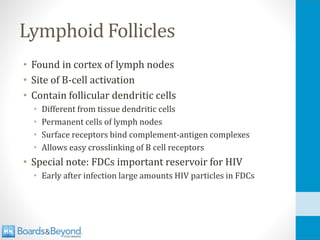
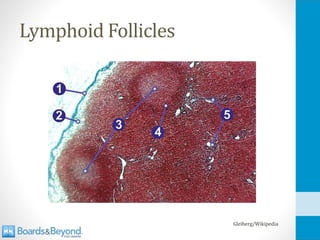
Lymphoid Follicles
• Found in cortex of lymph nodes
• Site of B-cell activation
• Contain follicular dendritic cells
• Different from tissue dendritic cells
• Permanent cells of lymph nodes
• Surface receptors bind complement-antigen complexes
• Allows easy crosslinking of B cell receptors
• Special note: FDCs important reservoir for HIV
• Early after infection large amounts HIV particles in FDCs
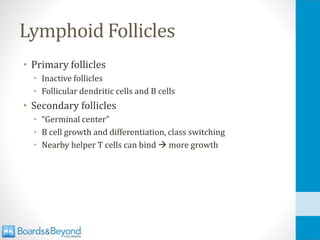
Lymphoid Follicles
• Primary follicles
• Inactive follicles
• Follicular dendritic cells and B cells
• Secondary follicles
• “Germinal center”
• B cell growth and differentiation, class switching
• Nearby helper T cells can bind → more growth
Lymphoid Follicles
Gleiberg/Wikipedia
Paracortex
• Two key features:
• #1: Contain T cells activated by dendritic cells and antigen
• #2: Contain high endothelial venules
• Vessels that allow B/T cell entry into node
• Engorged in immune response (swollen nodes)
• Underdeveloped in rare T-cell deficiency disorders
• DiGeorge syndrome
Medulla
• Medullary sinuses (cavities)
• Contain macrophages
• Filters lymph → phagocytosis
• Medullary chords (tissue between cavities)
• Contain plasma cells secreting antibodies
Spleen
• Filters blood (no lymph)
• All blood elements can enter
• No high endothelial venules
• No selective entry T and B cells
Wikipedia/Public Domain
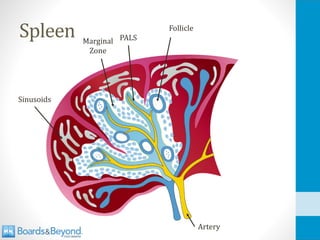
Spleen
Artery
Follicle
PALS
Marginal
Zone
Sinusoids
Spleen
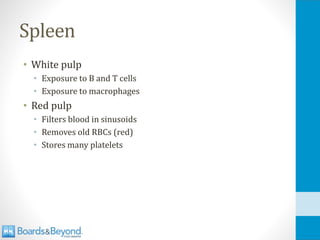
• White pulp
• Exposure to B and T cells
• Exposure to macrophages
• Red pulp
• Filters blood in sinusoids
• Removes old RBCs (red)
• Stores many platelets
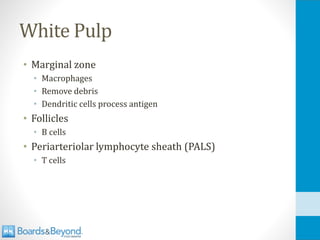
White Pulp
• Marginal zone
• Macrophages
• Remove debris
• Dendritic cells process antigen
• Follicles
• B cells
• Periarteriolar lymphocyte sheath (PALS)
• T cells
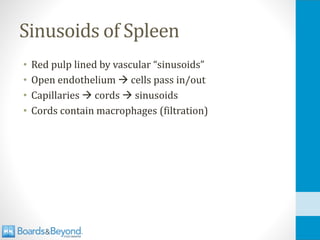
Sinusoids of Spleen
• Red pulp lined by vascular “sinusoids”
• Open endothelium → cells pass in/out
• Capillaries → cords → sinusoids
• Cords contain macrophages (filtration)
Splenic Dysfunction
• Increased risk from encapsulated organisms
• Loss of marginal zone macrophages → ↓ phagocytosis
• Also loss of opsonization:
• ↓ IgM and IgG against capsules (splenic B cells)
• Loss of IgG opsonization
• ↓ complement against encapsulated bacteria
• ↓ C3b opsonization
Splenic Dysfunction
• Strep pneumo is predominant pathogen for sepsis
• Death in > 50% of patients
• Others: H. flu (Hib), Neisseria meningitidis
• Less common: Strep pyogenes, E coli, Salmonella
• Also malaria and babesia (RBC infections)
Ram e al; Infections of People with Complement Deficiencies and Patients Who Have Undergone Splenectomy
Clin Microbiol Rev. 2010 Oct; 23(4): 740–780.
Splenic Dysfunction
• Splenectomy
• Trauma
• ITP (spleen site of phagocytosis of platelets)
• Hereditary spherocytosis (minimizes anemia)
• Functional asplenia
• Sickle cell anemia
Splenic Dysfunction
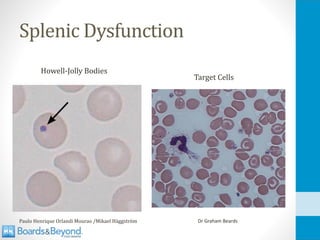
• Howell Jolly Bodies
• Some RBCs leave marrow with nuclear remnants
• Normally cleared by spleen
• Presence in peripheral blood indicates splenic dysfunction
• Target cells
• Also seen in liver disease, hemoglobin disorders
• From too much surface area (membrane) or too little volume
• Too much surface area: liver disease
• Too little volume: hemoglobin disorders
• Thrombocytosis
• Failure of spleen to remove platelets
Splenic Dysfunction
Paulo Henrique Orlandi Mourao /Mikael Häggström Dr Graham Beards
Howell-Jolly Bodies
Target Cells
Hypersensitivity
Jason Ryan, MD, MPH
Hypersensitivity
• Immune response that causes disease
• Exaggerated or inappropriate
• Allergic reactions = subtype of hypersensitivity
Hypersensitivity
• First contact with antigen “sensitizes”
• Generation of immune response
• Antibodies, Memory cells
• Second contact → hypersensitivity
• Symptoms from overreaction of immune system
• Four patterns of underlying immune response
• Type I, II, III, IV
Type I
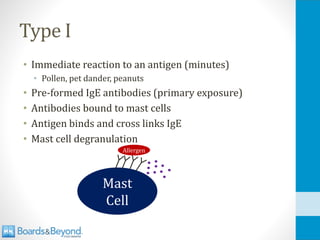
• Immediate reaction to an antigen (minutes)
• Pollen, pet dander, peanuts
• Pre-formed IgE antibodies (primary exposure)
• Antibodies bound to mast cells
• Antigen binds and cross links IgE
• Mast cell degranulation
Mast
Cell
Allergen
Type I Immunology
• Susceptible individuals make IgE to antigens
• Majority of people make IgG
• IgG does not trigger hypersensitivity response
• IgE results from:
• B cell class switching
• Driven by Th2 cells (humoral response)
• IL-4 is key cytokine for IgE production
• No complement
• IgE does not activate complement
Type I Symptoms
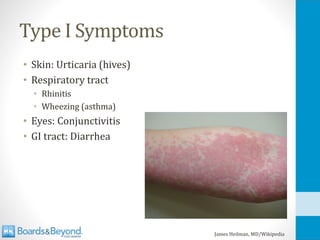
• Skin: Urticaria (hives)
• Respiratory tract
• Rhinitis
• Wheezing (asthma)
• Eyes: Conjunctivitis
• GI tract: Diarrhea
James Heilman, MD/Wikipedia
Anaphylaxis
• Systemic type I hypersensitivity reaction
• Itching, diffuse hives/erythema
• Respiratory distress from bronchoconstriction
• Hoarseness (laryngeal swelling/edema)
• Vomiting, cramps, diarrhea
• Shock and death
• Treatment: Epinephrine
Atopy
• Genetic predisposition to localized hypersensitivity
• Urticaria, rhinitis, asthma
• Usually positive family history of similar reaction
Type I Examples
• Asthma
• Penicillin drug allergy
• Seasonal allergies (allergic rhinitis)
• Allergic conjunctivitis
• Peanut allergy (children)
• Shellfish (food allergy)
Type I
• Early symptoms
• Occur within minutes
• Degranulation → release of pre-formed mediators (histamine)
• Synthesis/release of leukotrienes, prostaglandins
• Edema, redness, itching
• Late symptoms
• ~6 hours later
• Synthesis/release of cytokines
• Influx of inflammatory cells (neutrophils, eosinophils)
• Induration
Type I Mediators
• Histamine
• Vasodilation (warmth)
• Increased permeability venules (swelling)
• Smooth muscle contraction (bronchospasm)
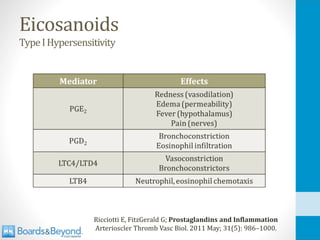
• Leukotrienes, prostaglandins and thromboxanes
• Derived from arachidonic acid
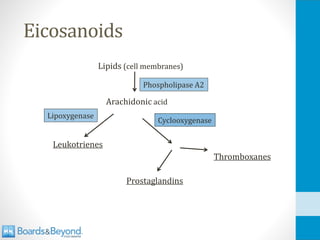
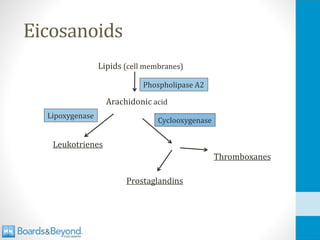
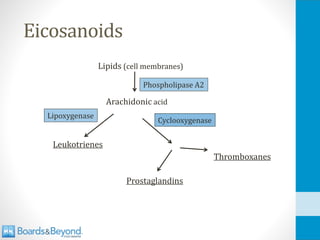
Eicosanoids
Lipids (cell membranes)
Arachidonic acid
Leukotrienes
Lipoxygenase
Thromboxanes
Prostaglandins
Cyclooxygenase
Phospholipase A2
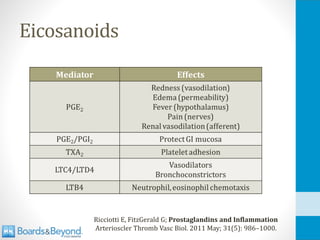
Eicosanoids
TypeIHypersensitivity
Ricciotti E, FitzGerald G; Prostaglandins and Inflammation
Arterioscler Thromb Vasc Biol. 2011 May; 31(5): 986–1000.
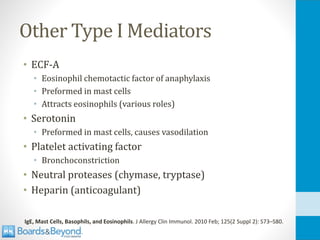
Other Type I Mediators
• ECF-A
• Eosinophil chemotactic factor of anaphylaxis
• Preformed in mast cells
• Attracts eosinophils (various roles)
• Serotonin
• Preformed in mast cells, causes vasodilation
• Platelet activating factor
• Bronchoconstriction
• Neutral proteases (chymase, tryptase)
• Heparin (anticoagulant)
IgE, Mast Cells, Basophils, and Eosinophils. J Allergy Clin Immunol. 2010 Feb; 125(2 Suppl 2): S73–S80.
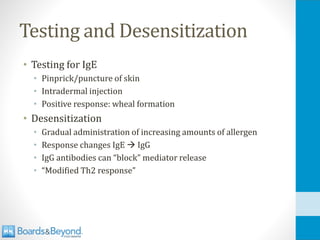
Testing and Desensitization
• Testing for IgE
• Pinprick/puncture of skin
• Intradermal injection
• Positive response: wheal formation
• Desensitization
• Gradual administration of increasing amounts of allergen
• Response changes IgE → IgG
• IgG antibodies can “block” mediator release
• “Modified Th2 response”
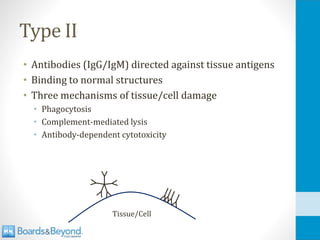
Type II
• Antibodies (IgG/IgM) directed against tissue antigens
• Binding to normal structures
• Three mechanisms of tissue/cell damage
• Phagocytosis
• Complement-mediated lysis
• Antibody-dependent cytotoxicity
Tissue/Cell
Type II
• Phagocytosis
• Fc receptors or C3b receptors on phagocytes
• Complement
• IgM or IgG → classical complement cascade
• Formation of MAC → cell death
• ADCC
• Antibody-dependent cell-mediated cytotoxicity
• Natural killer cells bind Fc portion IgG
Type II Examples
• Rheumatic fever
• Strep antibodies cross-react with cardiac myocytes
• Exposure to wrong blood type
• RBC lysis by circulating IgG
• Erythroblastosis fetalis
• Autoimmune hemolytic anemia
• Methyldopa and penicillin: drugs bind to surface of RBCs
• Mycoplasma pneumonia: Induces RBC antibodies
Type II Examples
• Pemphigus vulgaris
• Antibodies against desmosomes in epidermis
• Goodpasture syndrome
• Nephritic syndrome and pulmonary hemorrhage
• Type IV collagen antibodies
• Myasthenia gravis
• Antibodies against Ach receptors
Type III
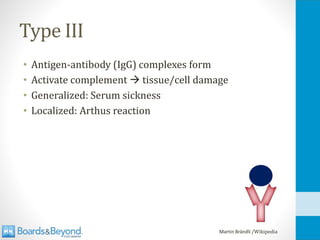
• Antigen-antibody (IgG) complexes form
• Activate complement → tissue/cell damage
• Generalized: Serum sickness
• Localized: Arthus reaction
Martin Brändli /Wikipedia
Generalized Type III
Serumsickness
• IC in plasma → systemic disease
• Usually IgG or IgM (complement activators)
• Deposit in various tissues
• Skin
• Kidneys
• Joints
• Trigger immune response
• Complement activation
• Activation of macrophages and neutrophils (Fc receptors)
Generalized Type III
Serumsickness
• Historical description:
• Horse plasma used for passive immunization
• ~5-10 days later triad: Fever, rash, arthralgias
• Antibodies to horse serum antigens
• IC deposits in skin, joints
Generalized Type III
Serumsickness
• Urticaria or palpable purpura
• Low serum complement levels
• Elevated sedimentation rate
• Diffuse lymphadenopathy
• Acute glomerulonephritis
Generalized Type III
Serumsickness
• Classic serum sickness
• Rabies or tetanus anti-toxin
• Rarely penicillin: drug acts as a “hapten”
• Monoclonal antibodies (rituximab, infliximab)
• Other Type III diseases
• Post-strep glomerulonephritis
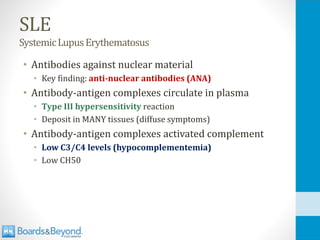
• Systemic lupus erythematosus (Anti-DNA antibodies)
• Polyarteritis nodosa (Hep B antigens)
Localized Type III
ArthusReaction
• Local tissue reaction, usually in the skin
• Injection of antigen
• Preformed antibodies in plasma/tissue
• Formation of immune complexes
Localized Type III
ArthusReaction
• Local immune complexes form
• 4-10 hours after injection
• Contrast with Type I reaction in minutes
• Complement activation, edema, necrosis
• Immunofluorescent staining
• Antibodies, complement in vessel walls
Localized Type III
ArthusReaction
• Reported with skin injections:
• Tetanus, diphtheria, hep B vaccines
• Insulin
• Swelling, redness at site hours after injection
• Hypersensitivity pneumonitis
• Farmer’s lung
• Hypersensitivity reaction to environmental antigen
Type IV
Delayed-typehypersensitivity
• Cell-mediated reaction
• No antibodies (different from I, II, III)
• Memory T-cells initiate immune response
Type IV
Delayed-typehypersensitivity
• Classic example: PPD test (tuberculosis)
• Tuberculin protein injected into skin
• Previously exposed person has memory T-cells
• CD4 T-cells recognize protein on APCs (MHC II)
• Th1 response
• IFN-γ activates macrophages
• IL-12 from macrophages stimulates Th1 cells
• Result: Redness, induration 24 to 72 hours later
Type IV Examples
• Immune response to many pathogens:
• Mycobacteria
• Fungi
• Contact dermatitis (i.e. poison ivy)
• Chemicals (oils) attach to skin cells
• Involves CD8 T-cells that attack skin cells
• Erythema, itching
• 12 to 48hrs after exposure (contrast with type I)
• Multiple sclerosis
• Myelin basic protein
Transplants
Jason Ryan, MD, MPH
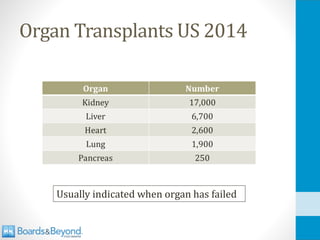
Organ Transplants US 2014
Usually indicated when organ has failed
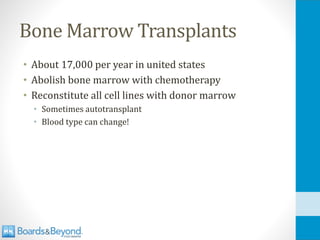
Bone Marrow Transplants
• About 17,000 per year in united states
• Abolish bone marrow with chemotherapy
• Reconstitute all cell lines with donor marrow
• Sometimes autotransplant
• Blood type can change!
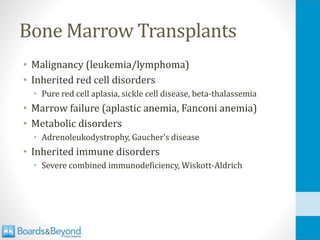
Bone Marrow Transplants
• Malignancy (leukemia/lymphoma)
• Inherited red cell disorders
• Pure red cell aplasia, sickle cell disease, beta-thalassemia
• Marrow failure (aplastic anemia, Fanconi anemia)
• Metabolic disorders
• Adrenoleukodystrophy, Gaucher’s disease
• Inherited immune disorders
• Severe combined immunodeficiency, Wiskott-Aldrich
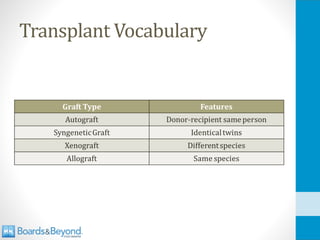
Transplant Vocabulary
Matching
• Goal is to “match” transplanted tissue
• Recipient and donor tissue same/similar
• Failure to match leads to rejection of transplant
• Immune system attacks transplant as foreign
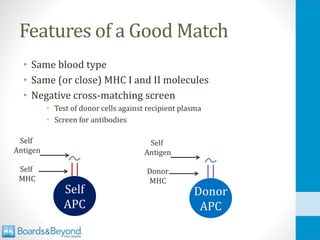
Features of a Good Match
• Same blood type
• Same (or close) MHC I and II molecules
• Negative cross-matching screen
• Test of donor cells against recipient plasma
• Screen for antibodies
Self
APC
Donor
APC
Self
MHC
Self
Antigen
Donor
MHC
Self
Antigen
MHC Matching
• Donor cells express MHC I
• If different from recipient, CD8 cells will react
• MHC Class II also expressed
• Donor APCs may be carried along
• Vascular endothelial cells may express MHC II
Human Leukocyte Antigens
HLAs
• Antigens that make up MHC class I and II molecules
• If different between donor-recipient, immune system
will classify donor tissue as foreign
HLA Matching
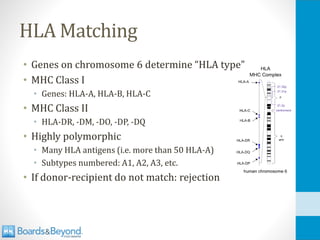
• Genes on chromosome 6 determine “HLA type”
• MHC Class I
• Genes: HLA-A, HLA-B, HLA-C
• MHC Class II
• HLA-DR, -DM, -DO, -DP, -DQ
• Highly polymorphic
• Many HLA antigens (i.e. more than 50 HLA-A)
• Subtypes numbered: A1, A2, A3, etc.
• If donor-recipient do not match: rejection
HLA Subtypes
• Some associated with autoimmune diseases
• Example: B27
• Higher risk of ankylosing spondylitis
• Also psoriasis, inflammatory bowel disease, Reiter’s syndrome
• Example: A3
• Higher risk of hemochromatosis
HLA Matching
• Two sets of HLA genes per patient
• All HLAs transferred en bloc from each parent
• 1 set from mother (i.e. A2, B3, etc.)
• 1 set from father
• Sibling has 25% chance of perfect match
MHC Matching
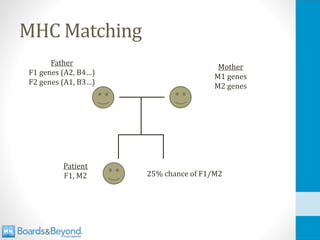
Mother
M1 genes
M2 genes
Father
F1 genes (A2, B4…)
F2 genes (A1, B3…)
Patient
F1, M2 25% chance of F1/M2
The “Perfect” Match
• Two-haplotype match
• Still some degree of incompatibility
• Minor histocompatibility antigens
• Identical twins
• Only time when true “perfect” match exists
MHC Matching
• Most important HLA genes for solid organ transplants:
• HLA-A, HLA-B, HLA-DR
• Sometimes called a “6 out of 6 match”
• More genes sometimes tested
• If HLA-C and HLA-DQ tests, “10 out of 10 match”
Source: American Society for Histocompatibility and Immunogenetics (ASHI)
Bone Marrow Transplants
• Chemotherapy to abolish recipient bone marrow
• Grafted cells must replenish all cell lines
• Matched for HLA-A, -B, -DR, also HLA-C
• Sometimes also -DQ, -DP
• Two problems with mismatch:
• Rejection of new cells
• Graft versus host disease
Graft Versus Host Disease
• Mostly a complication of bone marrow transplant
• Donated (grafted) T-cells (CD8) react to recipient cells
• See recipient cells as foreign
• Opposite of rejection
• Symptoms GVHD
• Skin: Rash
• GI Tract: Diarrhea, abdominal pain
• Liver: ↑LFTs, ↑bilirubin
Graft Versus Host Disease
• Small degree GVHD may be good
• New WBCs kill residual cancer cells
• Graft-vs-leukemia (GVL) effect
• Associated with increased overall survival (less relapse)
Rejection
• Hyperacute (minutes)
• Acute (weeks-months)
• Chronic (years)
Hyperacute Rejection
• Within minutes of transplantation
• Caused by preformed antibodies in recipient
• Against ABO or HLA antigens
• Antibodies formed from previous exposure foreign antigens
• Pregnancy, blood transfusion, previous transplantation
• Prevented by cross-matching screen
MULLEY W, KANELLIS J. Understanding crossmatch testing in organ transplantation:
A case-based guide for the general nephrologist. Nephrology 16 (2011) 125–133
Hyperacute Rejection
• Blood vessels spasm
• Intravascular coagulation
• Ischemia (“white rejection”)
• Rare, usually not treatable
Acute Rejection
• Weeks/months after transplant
• Recipients T cells react to graft (via HLA)
• Cell-mediated immune response
• CD8 T-cells very important
• Biopsy: Infiltrates of lymphocytes/mononuclear cells
• Treatable with immunosuppression
Chronic Rejection
• Months or years after transplant
• Inflammation and fibrosis, especially vessels
• Kidneys: fibrosis of capillaries, glomeruli
• Heart: Narrowing coronary arteries
• Lungs: bronchiolitis obliterans
• Complex, incompletely understood process
• Involves cell-mediated and humoral systems
Immune Deficiency
Syndromes
Jason Ryan, MD, MPH
Immune Deficiency
GeneralPrinciples
• Loss of T-cells, B-cells, Granulocytes, Complement
• Acquired: HIV, Chemotherapy
• Genetic/Congenital:
• Usually presents in infancy with recurrent infections
X-linked Agammaglobulinemia
Bruton’sAgammaglobulinemia
• X-linked
• Failure of B cell precursors to become B cells
• Light chains not produced
• Defect in Bruton tyrosine kinase (BTK) gene
• Symptoms begin ~6 months of age
• Loss of maternal antibodies
X-linked Agammaglobulinemia
Bruton’sAgammaglobulinemia
• Recurrent respiratory bacterial infections
• Loss of opsonization by antibodies
• H. Flu, Strep pneumo are common
• Classic presentation: Recurrent otitis media +/- sinusitis/PNA
• GI pathogen infections (loss of IgA)
• Enteroviruses (echo, polio, coxsackie)
• Giardia (GI parasite)
X-linked Agammaglobulinemia
Bruton’sAgammaglobulinemia
• Key findings:
• Mature B cells (CD19, CD20, BCR) absent in peripheral blood
• Underdeveloped germinal centers of lymph nodes
• Absence of antibodies (all classes)
• Treatment: IVIG
Selective IgA Deficiency
• Very common syndrome in US (~1 in 600)
• Defective IgA B-cells (exact mechanism unknown)
• Most patients asymptomatic
• Symptomatic patients:
• Recurrent sinus, pulmonary infections
• Otitis media, sinusitis, pneumonia
• Recurrent diarrheal illnesses from Giardiasis
• Blood transfusions → anaphylaxis
• IgA in blood products
• Antibodies against IgA in IgA deficient patients
• SLE and RA are common (20-30%)
Selective IgA Deficiency
• Diagnosis:
• Serum IgA < 7mg/dl
• Normal IgG, IgM
• Treatment:
• Prophylactic antibiotics
• IVIG
• Special features: False positive β-HCG test
• Heterophile antibodies produced in IgA deficiency
• Lead to false positive β-HCG
• Up to 30% IgA deficient patients test positive for β-HCG
CVID
CommonVariableImmunodeficiency
• Defective B cell maturation
• Loss of plasma cells and antibodies
• Many underlying genetic causes
• Most cases due to unknown cause
• 10+ genes mutations associated with CVID
• Often sporadic – no family history
• Normal B cell count, absence of antibodies
• Usually IgG
• Sometimes IgA and IgM (variable)
CVID
CommonVariableImmunodeficiency
• Similar to X-linked Agammaglobulinemia
• Recurrent respiratory bacterial infections
• Enteroviruses, Giardiasis
• Key differences:
• Not X-linked (affects females)
• Later onset (majority 20-45 years old)
• ↑ frequency other diseases:
• RA, pernicious anemia, lymphoma
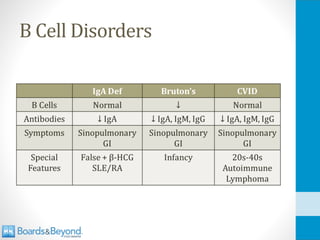
B Cell Disorders
Thymic Aplasia
DiGeorgeSyndrome
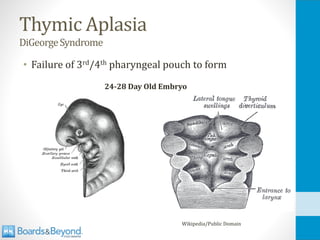
• Failure of 3rd/4th pharyngeal pouch to form
Wikipedia/Public Domain
24-28 Day Old Embryo
Thymic Aplasia
DiGeorgeSyndrome
• Most cases: 22q11 chromosomal deletion
• Key point: Not familial
• Classic triad:
• Loss of thymus (Loss of T-cells, recurrent infections)
• Loss of parathyroid glands (hypocalcemia, tetany)
• Congenital heart defects (“conotruncal”)
• Heart Defects:
• Abnormal aortic arch
• Truncus arteriosus
• Tetralogy of Fallot
• ASDs/VSDs
Thymic Aplasia
DiGeorgeSyndrome
• Immune symptoms
• Recurrent infections
• Viral, fungal, protozoal, intracellular bacteria
• Immune symptoms sometimes improve
• Cleft palate, mandible problems also common
Thymic Aplasia
KeyFindings
• No thymus shadow on CXR
• Thymus large in newborns
• Faint white shadow on chest x-ray
• Also seen in SCID (without ↓Ca, facial/heart abnormalities)
• Low T-cell count
• Underdeveloped T-cell structures
• Paracortex in lymph nodes
• Peri-arteriolar sheaths in spleen
• Treatment:
• Thymic transplantation
• Hematopoietic cell transplantation
Hyper-IgE Syndrome
Job’sSyndrome
• Rare syndrome, poorly understood
• Immune symptoms with skin/bone findings
• Defective CD4+ Th17 cells
• Failure to produce IL-17
• Loss of attraction of neutrophils
• Defects of STAT3 signaling pathway
• Signal transducer and activator of transcription
• Activated by cytokines
• Overproduction IgE, loss of IFN-γ
• Characteristic labs: ↑IgE, ↓IFN-γ
Hyper-IgE Syndrome
Job’sSyndrome
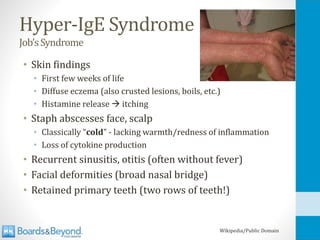
• Skin findings
• First few weeks of life
• Diffuse eczema (also crusted lesions, boils, etc.)
• Histamine release → itching
• Staph abscesses face, scalp
• Classically “cold” - lacking warmth/redness of inflammation
• Loss of cytokine production
• Recurrent sinusitis, otitis (often without fever)
• Facial deformities (broad nasal bridge)
• Retained primary teeth (two rows of teeth!)
Wikipedia/Public Domain
Hyper-IgE Syndrome
Job’sSyndrome
• Classic case:
• Newborn baby
• Deformed face/teeth
• Diffuse rash
• Skin abscesses that are “cold”
• Recurrent infections without fever
• Labs: Elevated IgE
Chronic mucocutaneous
candidiasis
• Defect in autoimmune regulator (AIRE) genes
• AIRE Function #1:
• Associates with Dectin-1 receptor
• Dectin-1 responds to Candida antigens
• Result of defect: Recurrent candida infections
• AIRE Function #2:
• Promotes self antigens production in thymus
• Self antigens presented to T-cells (negative selection)
• Result of defect: Autoimmune T-cells
• Endocrine dysfunction (parathyroid/adrenal)
Chronic mucocutaneous
candidiasis
• T-cell dysfunction (cell-mediated defect)
• Th1 cytokines: ↓IL-2, ↓IFN-γ
• ↑IL-10 (anti-inflammatory cytokine)
• NOT due to antibody or B-cell deficiencies
• T cells fail to react to candida antigens
D Lilic. New perspectives on the immunology of chronic mucocutaneous candidiasis.
Curr Opin Infect Dis. 2002; 15(2):143-7
Chronic mucocutaneous
candidiasis
• Chronic skin, mucous membrane candida infections
• Thrush
• Skin
• Esophagus
• Associated with endocrine dysfunction:
• Hypoparathyroidism
• Adrenal failure
• Classic case:
• Child with recurrent thrush, diaper rash
Candida Infections
• T-cells important for mucosal defense
• Example: HIV patients often get thrush (↓CD4)
• Neutrophils important for systemic defense
• HIV patients rarely get candidemia
• No candidemia in CMC
• Chemo patients at risk for candidemia (neutropenia)
SCID
SevereCombinedImmunodeficiency
• Loss of cell-mediated and humoral immunity
• Usually primary T cell problem
• Loss of B-cells, antibodies usually secondary
SCID
SevereCombinedImmunodeficiency
• T-cell/B cell areas absent/diminished:
• Loss of thymic shadow
• Loss of germinal centers in nodes
• Susceptible to many infections
• Thrush, bacterial, viral, fungal
• Babies: Thrush, diaper rash, failure to thrive
• Death unless bone marrow transplant
SCID
SevereCombinedImmunodeficiency
• Most common forms are X-linked (boys)
• Mutation of γ subunit of cytokine receptors
• Gene: IL2RG (interleukin-2 receptor gamma gene)
• Also caused by adenosine deaminase gene deficiency
• Newborn screening:
• Maternal T-cells may falsely indicate normal counts
• TRECs (T-cell receptor excision circles)
• Circular DNA formed in normal T-cells in the thymus
• Mandated in many states
SCID
SevereCombinedImmunodeficiency
• Classic case:
• Infant with recurrent infections
• Multiple systems: otitis, GI, candida (skin)
• Absent thymic shadow
• Normal calcium/heart (contrast with DiGeorge)
ADA
AdenosineDeaminaseDeficiency
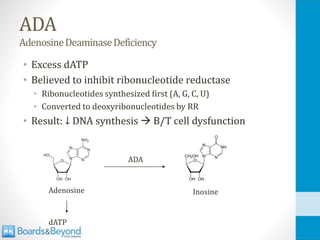
• Excess dATP
• Believed to inhibit ribonucleotide reductase
• Ribonucleotides synthesized first (A, G, C, U)
• Converted to deoxyribonucleotides by RR
• Result: ↓ DNA synthesis → B/T cell dysfunction
Adenosine Inosine
ADA
dATP
Ataxia Telangiectasia
• Autosomal recessive genetic disorder
• Defective ATM gene on chromosome 11
• Ataxia Telangiectasia Mutated gene
• Repairs double stranded DNA breaks
• Nonhomologous end-joining (NHEJ)
• Result: Failure to repair DNA mutations
• Hypersensitivity of DNA to ionizing radiation
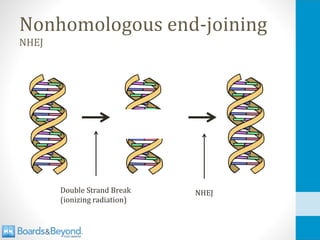
Nonhomologous end-joining
NHEJ
Double Strand Break
(ionizing radiation)
NHEJ
Ataxia Telangiectasia
• Mix of systems involved with varying findings
• CNS (ataxia)
• Skin (telangiectasias)
• Immune system (infections, malignancies)
• Presents in childhood with progressive symptoms
• Usually begins with gait and balance problems
Ataxia Telangiectasia
• Cerebellar atrophy
• Ataxia in 1st year of life
• Telangiectasias
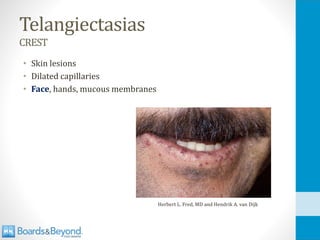
• Dilation of capillary vessels on skin
• Repeated sinus/respiratory infections
• Low levels immunoglobulins, especially IgA and IgG
• High risk of cancer (lymphomas)
• Commonly identified lab abnormalities:
• Most consistent lab finding: ↑AFP
• Low IgA level
Hyper-IgM Syndrome
• Class switching disorder
• Failure of B cells (CD40) to T cell (CD40L) binding
• 70% cases: Defective CD40L gene (T-cell problem)
• B cells make IgM only
• Labs show ↑IgM, all other antibodies absent
• Most common form X-linked (boys)
T Cell Dependent Activation
B Cell
T Cell MHC2
TCR
CD4
CD40L CD40
CD28
B7
Hyper-IgM Syndrome
• Recurrent bacterial infections in infancy
• Sinus and pulmonary infections
• Pneumonia, sinusitis, otitis media
• Mostly caused by encapsulated bacteria (S. pneumo, H. flu)
• Also opportunistic infections
• Pneumocystis, Cryptosporidium, Histoplasmosis
• Loss of IgG opsonization
Wiskott-Aldrich Syndrome
• X linked disorder of WAS gene (WAS protein)
• WASp absence/dysfunction
• Necessary for T-cell cytoskeleton maintenance
• This forms “immunologic synapse”
• T-cells cannot properly react to APCs
• Can worsen with age
• Immune dysfunction, ↓platelets, eczema
• Elevated IgE and IgA common (eczema)
• Treatment: Bone marrow transplant
Wiskott-Aldrich Syndrome
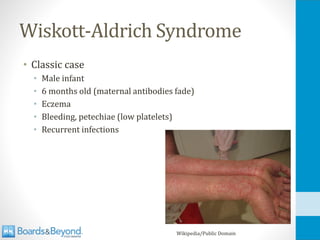
• Classic case
• Male infant
• 6 months old (maternal antibodies fade)
• Eczema
• Bleeding, petechiae (low platelets)
• Recurrent infections
Wikipedia/Public Domain
Leukocyte Adhesion Deficiency
• Defective neutrophil/lymphocyte migration
• Most common type: Type 1
• Autosomal recessive defect in CD18
• Also called Lymphocyte function associated antigen-1 (LFA1)
• Forms beta subunit of several integrins (adhesion molecules)
• WBCs (especially PMNs) cannot roll, migrate
Leukocyte Adhesion Deficiency
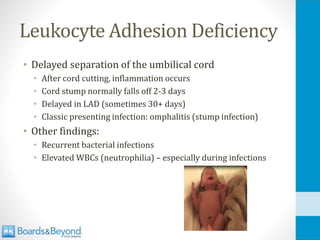
• Delayed separation of the umbilical cord
• After cord cutting, inflammation occurs
• Cord stump normally falls off 2-3 days
• Delayed in LAD (sometimes 30+ days)
• Classic presenting infection: omphalitis (stump infection)
• Other findings:
• Recurrent bacterial infections
• Elevated WBCs (neutrophilia) – especially during infections
Chediak-Higashi Syndrome
• Failure of lysosomes to fuse with phagosomes
• Mutation: lysosomal trafficking regulator (LYST) gene
• Causes microtubule dysfunction
• Recurrent bacterial infections
• Especially Staph and Strep
• Oculocutaneous albinism
• Fair skin, blond hair, light blue eyes
• Children who survive → severe neuro impairment
• Peripheral neuropathy: weakness and sensory deficits
• Often wheelchair bound
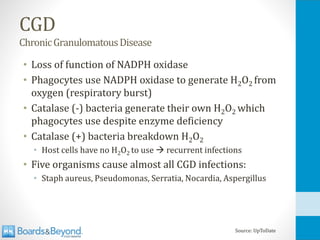
CGD
ChronicGranulomatousDisease
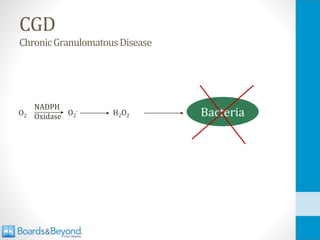
• Loss of function of NADPH oxidase
• Phagocytes use NADPH oxidase to generate H2O2 from
oxygen (respiratory burst)
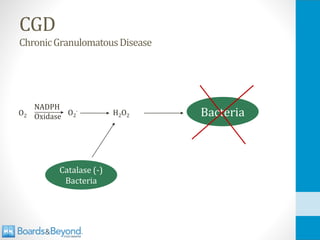
• Catalase (-) bacteria generate their own H2O2 which
phagocytes use despite enzyme deficiency
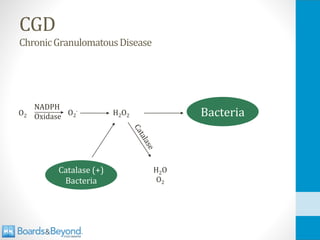
• Catalase (+) bacteria breakdown H2O2
• Host cells have no H2O2 to use → recurrent infections
• Five organisms cause almost all CGD infections:
• Staph aureus, Pseudomonas, Serratia, Nocardia, Aspergillus
Source: UpToDate
CGD
ChronicGranulomatousDisease
H2O2 Bacteria
O2
·
NADPH
Oxidase
O2
CGD
ChronicGranulomatousDisease
H2O2 Bacteria
Catalase (-)
Bacteria
O2
·
NADPH
Oxidase
O2
CGD
ChronicGranulomatousDisease
H2O2
O2
·
Bacteria
Catalase (+)
Bacteria
H2O
O2
NADPH
Oxidase
O2
CGD
ChronicGranulomatousDisease
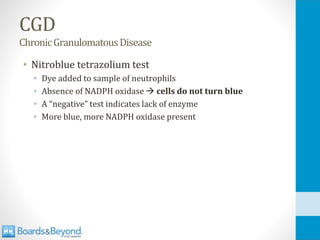
• Nitroblue tetrazolium test
• Dye added to sample of neutrophils
• Absence of NADPH oxidase → cells do not turn blue
• A “negative” test indicates lack of enzyme
• More blue, more NADPH oxidase present
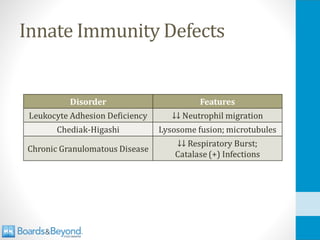
Innate Immunity Defects
Glucocorticoids and
NSAIDs
Jason Ryan, MD, MPH
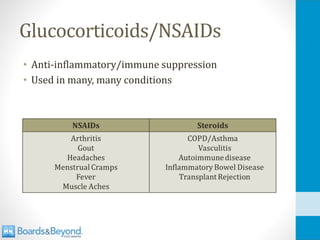
Glucocorticoids/NSAIDs
• Anti-inflammatory/immune suppression
• Used in many, many conditions
Eicosanoids
Lipids (cell membranes)
Arachidonic acid
Leukotrienes
Lipoxygenase
Thromboxanes
Prostaglandins
Cyclooxygenase
Phospholipase A2
Eicosanoids
Ricciotti E, FitzGerald G; Prostaglandins and Inflammation
Arterioscler Thromb Vasc Biol. 2011 May; 31(5): 986–1000.
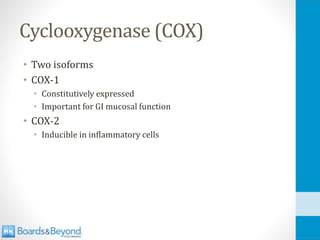
Cyclooxygenase (COX)
• Two isoforms
• COX-1
• Constitutively expressed
• Important for GI mucosal function
• COX-2
• Inducible in inflammatory cells
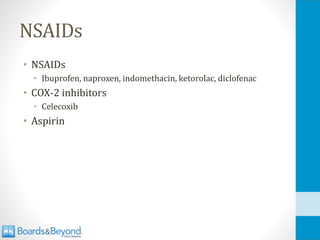
NSAIDs
• NSAIDs
• Ibuprofen, naproxen, indomethacin, ketorolac, diclofenac
• COX-2 inhibitors
• Celecoxib
• Aspirin
NSAIDs
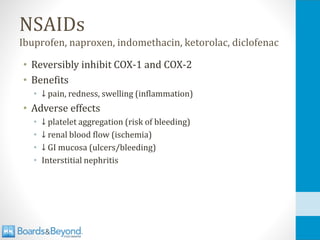
Ibuprofen, naproxen, indomethacin, ketorolac, diclofenac
• Reversibly inhibit COX-1 and COX-2
• Benefits
• ↓ pain, redness, swelling (inflammation)
• Adverse effects
• ↓ platelet aggregation (risk of bleeding)
• ↓ renal blood flow (ischemia)
• ↓ GI mucosa (ulcers/bleeding)
• Interstitial nephritis
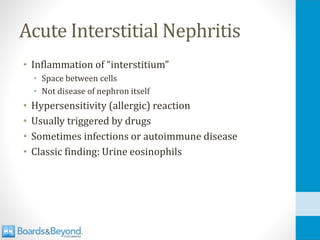
Acute Interstitial Nephritis
• Inflammation of “interstitium”
• Space between cells
• Not disease of nephron itself
• Hypersensitivity (allergic) reaction
• Usually triggered by drugs
• Sometimes infections or autoimmune disease
• Classic finding: Urine eosinophils
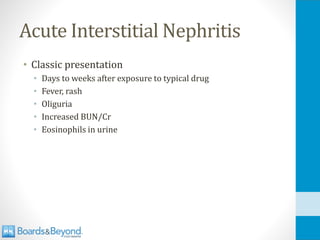
Acute Interstitial Nephritis
• Classic presentation
• Days to weeks after exposure to typical drug
• Fever, rash
• Oliguria
• Increased BUN/Cr
• Eosinophils in urine
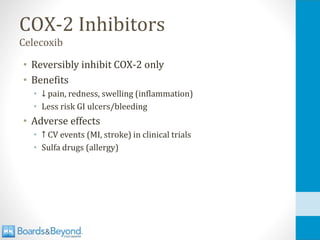
COX-2 Inhibitors
Celecoxib
• Reversibly inhibit COX-2 only
• Benefits
• ↓ pain, redness, swelling (inflammation)
• Less risk GI ulcers/bleeding
• Adverse effects
• ↑ CV events (MI, stroke) in clinical trials
• Sulfa drugs (allergy)
Glucocorticoids
Prednisone,methylprednisolone,hydrocortisone,triamcinolone,
dexamethasone,beclomethasone
• Diffuse across cell membranes
• Bind to glucocorticoid receptor (GR)
• GR-steroid complex translocates to nucleus
• Effects via altering gene expression
Glucocorticoids
Mechanismsofaction
• Inactivation NF-KB
• Key inflammatory transcription factor
• Mediates response to TNF-α
• Controls synthesis inflammatory mediators
• COX-2, PLA2, Lipoxygenase
Eicosanoids
Lipids (cell membranes)
Arachidonic acid
Leukotrienes
Lipoxygenase
Thromboxanes
Prostaglandins
Cyclooxygenase
Phospholipase A2
Glucocorticoids
• Many, many immunosuppressive effects
• Neutrophilic leukocytosis (↑WBCs)
• Impaired neutrophil migration
• ↓ circulating eosinophils, monocytes, lymphocytes
• ↓ expression many cytokines
• Interleukins, IFN-γ, TNF-α, GM-CSF
Glucocorticoids
SelectedsideEffects
• Skin: skin thinning and easy bruising
• Cushingoid appearance/weight gain
• Truncal obesity, buffalo hump, moon face
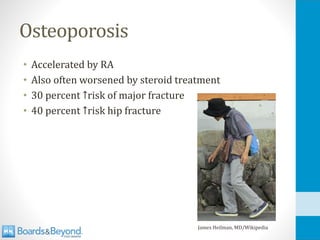
• Osteoporosis
• Hyperglycemia
• ↑ liver gluconeogenesis
• ↓ glucose uptake fat tissue
Glucocorticoids
SelectedsideEffects
• Cataracts
• Myopathy (muscle weakness)
• skeletal muscle catabolism (amino acids) for gluconeogenesis
• Gastritis/peptic ulcers
• Gastric hyperplasia
• ↑ acid secretion
• ↓ mucus synthesis
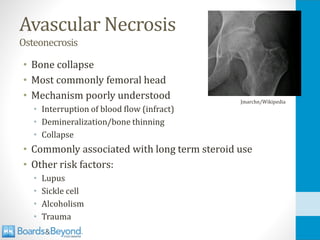
Avascular Necrosis
Osteonecrosis
• Bone collapse
• Most commonly femoral head
• Mechanism poorly understood
• Interruption of blood flow (infract)
• Demineralization/bone thinning
• Collapse
• Commonly associated with long term steroid use
• Other risk factors:
• Lupus
• Sickle cell
• Alcoholism
• Trauma
Jmarchn/Wikipedia
Adrenal Insufficiency
• Long term steroid use suppresses HPA axis
• Hypothalamus-Pituitary-Adrenal axis
• Abrupt discontinuation → adrenal insufficiency
• Symptoms (adrenal crisis):
• Dominant feature: Hypotension/shock
• Anorexia, nausea, vomiting, abdominal pain
• Weakness, fatigue, lethargy
• Fever
• Confusion or coma
Immunosuppressants
Jason Ryan, MD, MPH
Immune Suppression
• Commonly used drugs:
• NSAIDs, Steroids
• Less commonly used drugs:
• Cyclosporine/Tacrolimus
• Sirolimus
• Methotrexate
• Mycophenolate
• Cyclophosphamide
• Azathioprine
• TNF-α inhibitors
• Hydroxychloroquine
Cyclosporine & Tacrolimus
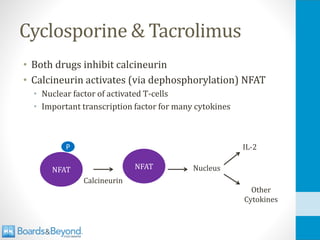
• Both drugs inhibit calcineurin
• Calcineurin activates (via dephosphorylation) NFAT
• Nuclear factor of activated T-cells
• Important transcription factor for many cytokines
NFAT
P
NFAT
Calcineurin
Nucleus
IL-2
Other
Cytokines
Cyclosporine & Tacrolimus
• Cyclosporine: binds to cyclophilins
• Complex inactivates calcineurin
• Tacrolimus: binds to FK-506 binding protein
• Complex inactivates calcineurin
Cyclosporine & Tacrolimus
• Autoimmune diseases, organ transplants
• Similar side effects
• Both drugs metabolized P450 system
• Many drug-drug interactions
• Can raise/lower levels/effects
Cyclosporine & Tacrolimus
• Nephrotoxicity
• Most important and limiting side effect
• Vasoconstriction of the afferent/efferent arterioles
• Hypertension
• Via renal vasoconstriction (salt/water retention)
• Diltiazem drug of choice
• Impairs cyclosporine metabolism (↑ drug levels)
• Treats HTN and allows lower dose cyclosporine to be used
Cyclosporine & Tacrolimus
• Hyperuricemia and gout
• Hyperglycemia (may impair insulin secretion)
• Neurotoxicity (usually tremor)
Cyclosporine
• Two unique side effects
• Not reported with tacrolimus
• Gingival hyperplasia
• Hirsutism
Lesion/Wikipedia
Wikipedia/Public Domain
Sirolimus
Rapamycin
• Kidney transplant, drug-eluting stents
• Inhibits mTOR (mechanistic target of rapamycin)
• Binds FK binding protein
• Same target as Tacrolimus
• Does NOT inhibit calcineurin
• Inhibits mTOR
• Blocks response to IL-2 in B/T cells
• Blocks signaling pathways
• Cell cycle arrest in the G1-S phase
• No growth/proliferation
Sirolimus
Rapamycin
• Anemia, thrombocytopenia, leukopenia
• Hyperlipidemia
• inhibition of lipoprotein lipase
• Hyperglycemia
• Insulin resistance
Coronary Stents
• “Drug-eluting stents” (DES)
• Coated with anti-proliferative drug
• Blunts scar tissue growth (restenosis)
• Sirolimus
• Everolimus
• Paclitaxel
Wikipedia/Public Domain
Methotrexate
• Chemotherapy, autoimmune diseases
• Mimics folic acid - inhibits dihydrofolate reductase
dUMP dTMP
Thymidylate
Synthase
DHF
N, N Methylene-THF
THF
Dihydrofolate
Reductase
Methotrexate
SideEffects
• Myelosuppression
• Reversible with leucovorin (folinic acid )
• Converted to THF
• Does not require dihydrofolate reductase
• “Leucovorin rescue”
• Stomatitis/Mucositis (mouth soreness)
• Occurs with many chemo agents
• DNA damage → cytokine release
• Cytokines damage epithelium
• Loss of mucosal integrity → pain, bacterial growth
• Abnormal LFTs, GI upset
The pathobiology of mucositis. Sonis ST. Nat Rev Cancer. 2004;4(4):277
Mycophenolic acid
CellCept
• Inhibits IMP dehydrogenase
• Rate-limiting step in purine synthesis in lymphocytes only
• Also, preferentially binds type II isoform IMP dehydrogenase
• Type II Expressed by activated lymphocytes
• ↓ nucleotides → ↓ DNA synthesis in T/B cells
• Bone Marrow Suppression
• GI: Nausea, cramping, abdominal pain
Inosine-MP Guanosine-MP
IMP
Dehydrogenase
Cyclophosphamide
• Powerful immunosuppressant (also anti-tumor)
• Used in vasculitis, glomerulonephritis (oral)
• Prodrug: Requires bioactivation by liver
• Converted to phosphoramide mustard
• Metabolized by P450 system
• “Alkylating agent”
• Adds an alkyl group to the N7 position
• DNA strands will cross link
• Inhibits DNA replication → cell death
Cyclophosphamide
SideEffects
• Myelosuppression
• ↓WBC, ↓Hct, ↓Plt
• Hemorrhagic cystitis
• Acrolein metabolite toxic to bladder
• Hematuria +/- dysuria
• Lower risk with hydration and mesna
• Mesna: sodium 2-mercaptoethane sulfonate
• Mesna binds and inactivates acrolein in the urine
Cyclophosphamide
SideEffects
• SIADH
• Usually IV dosing for chemotherapy
• Hyponatremia; possible seizures
• Compounded by IVF
• Complex mechanism: More ADH release, less renal response
Azathioprine
• Transplants, autoimmune diseases
• Prodrug converted to 6-Mercaptopurine (6-MP)
• Analog to hypoxanthine (purine like adenine, guanine)
• 6-MP competes for binding to HGPRT
• Hypoxanthine guanine phosphoribosyltransferase
• Converts hypoxanthine to inosine monophosphate
• Also guanine to guanosine monophosphate
Hypoxanthine 6-MP
Guanine
Azathioprine
IMP
Hypoxanthine Guanine
GMP
HGPRT
GMP
AMP
Guanine
Azathioprine
6-MP
HGPRT
Thioinosinic acid
monophosphate
↓Purines
(A, G)
Azathioprine
Adverse Effects
• Bone marrow suppression
• GI: Anorexia, nausea, and vomiting
• Caution with allopurinol
• Xanthine oxidase inhibitor
• Metabolizes purines → uric acid
• Blunts metabolism of 6-MP/azathioprine
• ↑ risk of adverse effects
6-MP
Xanthine
Oxidase
6-thiouric acid
(inactive)
Muromonab-CD3
OKT3
• Monoclonal antibody
• Used in organ transplantation
• Binds to epsilon chain of CD3 (T cells)
• Blocks T-cell activation
• Leads to T-cell depletion from circulation
Muromonab-CD3
OKT3
• Key side effect: Cytokine release syndrome
• Occurs after first or second dose
• Fevers, rigors, nausea, vomiting, diarrhea, hypotension
• Sometimes chest pain, dyspnea or wheezing
• Arthralgias and myalgias
• Caused by initial activation of T cells → release of cytokines
• Minimized by pre-medication with steroids, antihistamines
Infliximab
• Antibody against TNF-α
• Used in rheumatoid arthritis, Crohn’s
• “Chimeric”
• Both mouse (murine) and human components
• Antigen-binding portion of molecule: murine
• Constant Fc domain: human
• Risk of reactivation TB
• PPD screening done prior to treatment
• Risk of other infections: bacterial, hepatitis, zoster
Other TNF-α Inhibitors
• Adalimumab (monoclonal antibody TNF-α)
• Golimumab (monoclonal antibody TNF-α)
• Etanercept
• Made by recombinant DNA
• Recombinant protein of TNF receptor
• “Decoy receptor”
• Binds TNF instead of TNF receptor
Malaria Drugs
• Chloroquine and hydroxychloroquine
• Malaria drugs with immunosuppressive actions
• Block TLRs in B-cells (↓activation)
• Weak bases: ↑pH in immune cells → ↓ activity
• Other actions
• Used in rheumatoid arthritis, SLE
Systemic Lupus
Erythematosus
Jason Ryan, MD, MPH
SLE
SystemicLupusErythematosus
• Autoimmune disease
• Most patients (90%) are women
• Usually develops age 15 to 45
Picpedia.org
SLE
SystemicLupusErythematosus
• Antibodies against nuclear material
• Key finding: anti-nuclear antibodies (ANA)
• Antibody-antigen complexes circulate in plasma
• Type III hypersensitivity reaction
• Deposit in MANY tissues (diffuse symptoms)
• Antibody-antigen complexes activated complement
• Low C3/C4 levels (hypocomplementemia)
• Low CH50
SLE
Cause
• Etiology unknown
• Likely genetic, immune, environmental factors
• Viruses and UV light may play a role
Lupus Antibodies
• Anti-nuclear antibodies (ANA)
• Present in serum of lupus patients
• Also present in 5% normal patients
• Also present in many other autoimmune disorders
• Sensitive but not specific
• Negative test = disease very unlikely
• Reported as titre: 1:20 or 1:200
• Often 1:160 considered positive
Lupus Antibodies
• Anti-double stranded DNA (anti-dsDNA)
• Specific for SLE
• Associated with disease activity (↑ in flares)
• Associated with renal involvement (glomerulonephritis)
• Anti-smith (anti-Sm)
• Specific for SLE
• Directed against small nuclear ribonucleoprotein (snRNPs)
snRNPs
Smallnuclearribonucleoprotein
• Combine with RNA transcripts
• Form a “spliceosome”
• Removes a portion of the RNA transcript
• Antibodies against RNP (anti-Sm) in lupus
Extractable Nuclear Antigens
ENAPanel
• Panel of blood tests against nuclear antigens
SLE
Symptoms
• Flares and remissions common
• Fever, weight loss, fatigue, lymphadenopathy
Malar Rash
• Classic lupus skin finding
• “Butterfly” rash
• Common on sunlight exposure
• Can also see “discoid” lesion
• Circular skin lesion
• Classically on forearm
Wikipedia/Public Domain
Raynaud Phenomenon
• White/blue fingertips
• Painful on exposure to cold
• Vasospasm of the artery → ischemia
• Can lead to fingertip ulcers
• Seen in other conditions
• Isolated
• Other autoimmune disorders
Jamclaassen~commonswiki /Wikipedia
SLE
Symptoms
• Oral or nasal ulcers
• Arthritis (tender, swollen joints)
• Serositis
• Inflammation of pleura (pain with inspiration)
• Inflammation of pericardium (pericarditis)
• “Penias”
• Anemia, thrombocytopenia, leukopenia
• Antibody attack of cells (Type II hypersensitivity)
de:Benutzer:Padawan/Wikipedia
Databese Center for Life Science (DBCLS)
Lupus Cerebritis
CNSInvolvement
• Cognitive dysfunction
• Confusion
• Memory loss
• Stroke
• Seizures
Wikipedia/Public Domain
Lupus Nephropathy
• Nephritic or nephrotic syndrome (or both)
• Common cause of death in lupus
• Diffuse proliferative glomerular nephritis
• Most common SLE renal syndrome
• Nephritic syndrome
• Membranous glomerular nephritis
• Nephrotic syndrome
Pixabay/Public Domain
Cardiac Manifestations
• Libman-Sacks (marantic) endocarditis
• Nonbacterial inflammation of valves
• Classically affects both sides of mitral valve
Anti-Phospholipid Antibodies
• Occur in association with lupus
• Can also occur as a primary problem
• Antibodies against proteins in phospholipids
• Three important clinical consequences
• “Antiphospholipid syndrome”
• Increased risk of venous and arterial thrombosis
• DVT, stroke, fetal loss
• Increased PTT
• False positive syphilis (RPR/VDRL)
Anti-Phospholipid Antibodies
• Anti-cardiolipin
• False positive RPR/VDRL
• Syphilis also produces these antibodies
• “Lupus anticoagulant”
• Interferes with PTT test
• False elevation
• Anti-β2 glycoprotein
SLE
Diagnosis
• Need four of 11 criteria
Drug-Induced Lupus
• Lupus-like syndrome after taking a drug
• Classic drugs: INH, hydralazine, procainamide
• Often rash, arthritis, penias, ANA+
• Kidney or CNS involvement rare
• Key features: anti-histone antibodies
• Resolves on stopping the drug
Pixabay/Public Domain
SLE
Treatment
• Steroids
• Other immunosuppressants
• Avoid sunlight
• Many patients photosensitive
• Can trigger flares
• Causes of death
• Renal failure
• Infection (immunosuppression drugs)
• Coronary disease (SLE → increased risk)
Pixabay/Public Domain
Neonatal Lupus
• Maternal antibodies → fetus
• 1 to 2% babies born if maternal autoimmune disease
• Systemic lupus erythematosus
• Sjogren's syndrome
• +SSA/Ro or + SSB/La – either disease
Ernest F/Wikipedia
Neonatal Lupus
• At birth or first few weeks of life
• Rash
• Multiple red, circular lesions on face, scalp
• Congenital complete heart block
• Slow heart rate (50s)
• Often does not respond to steroids
Rheumatoid
Arthritis
Jason Ryan, MD, MPH
Rheumatoid Arthritis
• Autoimmune disorder
• Inflammation of joints especially hands, wrists
• More common in women
• Usual age of onset 40 - 60
Pixabay/Public Domain
Rheumatoid Arthritis
• Synovium
• Thin layer of tissue (few cells thick)
• Lines joints and tendon sheaths
• Secretes hyaluronic acid to lubricate joint space
• Inflammation
• Unknown trigger
• Overproduction of TNF and IL-6
Rheumatoid Arthritis
• Synovial hypertrophy
• Thickens into pannus
• Infiltrated with inflammatory cells, granulation tissue
• Increase in synovial fluid
• Erodes into cartilage, bone
• Antibody-mediated
• Type III hypersensitivity
Synovial Joint
Open Stax College/Wikipedia
Rheumatoid Arthritis
• Symmetric joint inflammation
• Gradual onset
• Pain, stiffness, swelling
• Classically “morning stiffness”
• Joint stiffness >1 hour after rising
• Improves with use
• May have systemic symptoms (fever)
Rheumatoid Arthritis
• Classically affects MCP and PIP joints of hands
• Often tender to touch
• DIP joints spared
James Heilman, MD/Wikipedia
davida__jones/Flikr
Rheumatoid Arthritis
• Bones can erode/deviate
• Ulnar deviation
• Swelling of MCP joints → deviated wrist
• Swan neck deformity
• Hyperextended PIP joint
• Flexed DIP
Phoenix119/Wikipedia
Rheumatoid Arthritis
• Other joints:
• Wrists
• Elbows
• Knees
• Hips
• Toes
Wikipedia/Public Domain
Rheumatoid Arthritis
• Baker's cyst (popliteal cyst)
• Synovium-lined sac at back of knee
• Continuous with the joint space
• If ruptures → symptoms similar to DVT
Wikipedia/Public Domain
Rheumatoid Arthritis
• Serositis
• Pleuritis, pleural effusion
• Pericarditis, pericardial effusion
Subcutaneous nodules
• Palpable nodules common (20 to 35% patients)
• Almost always occur in patients with RF+
• Common on elbow (can occur anywhere)
• Central necrosis surrounded by
macrophages/lymphocytes
• Usually no specific treatment
Nephron/Wikipedia
Rheumatoid Arthritis
• Episcleritis
• Red, painful without discharge
• Scleritis
• Often bilateral
• Dark, red eyes
• Deep ocular pain on eye movement
• Uveitis
• Anterior/posterior
• Floaters if posterior
Image courtesy of Kribz
Sjogren’s Syndrome
• Salivary and lacrimal glands
• Dry eyes, dry mouth (sicca symptoms)
• Commonly associated with rheumatoid arthritis
Lusb/Wikipedia Joyhill09
Osteoporosis
• Accelerated by RA
• Also often worsened by steroid treatment
• 30 percent ↑risk of major fracture
• 40 percent ↑risk hip fracture
James Heilman, MD/Wikipedia
Rheumatoid Arthritis
• ~80% positive rheumatoid factor
• Antibodies against Fc portion of IgG antibody
• “Seropositive” rheumatoid arthritis
• Poor specificity
• Positive in endocarditis, Hep B, Hep C
• Positive in Sjogren’s, Lupus
• Antibodies to citrullinated peptides (ACPA)
• Specific marker of RA
Urea Cycle
Citrulline
Argininosuccinate
Arginine
Ornithine
ATP
Aspartate
Fumarate
Urea
Carbamoyl
Phosphate
Citrulline
• Non-standard amino acid - not encoded by genome
• Incorporated into proteins via post-translational
modification
• More incorporation in inflammation
• Anti-citrulline peptide antibodies used in RA
• Up to 80% of patients with RA
Rheumatoid Arthritis
• Elevated CRP and ESR
• Strong association with HLA-DR4
Treatment
• NSAIDs
• Steroids
• Disease-modifying antirheumatic drugs (DMARDs)
• Protect joints from destruction
• Methotrexate
• Azathioprine
• Cyclosporine
• Hydroxychloroquine
• Sulfasalazine
• Leflunomide
• TNF-a inhibitors (antibodies against TNF-α)
Sulfasalazine
Sulfasalazine
Sulfapyridine 5-aminosalicylic acid
(5-ASA)
Colonic
Bacteria
Acetylsalicylic acid
(aspirin)
• Inhibits dihydroorotate dehydrogenase
• Inhibits pyrimidine synthesis
• Side effects: diarrhea, abnormal LFTs, ↓WBCs
• Also used in psoriatic arthritis
Dihydroorotate
Dehydrogenase
Leflunomide
UMP
CMP
TMP
Orotic Acid
Dihydroorotic acid
Infliximab
• Antibody against TNF-α
• Used in rheumatoid arthritis, Crohn’s
• Risk of reactivation TB
• PPD screening done prior to treatment
• Risk of other infections: bacterial, zoster
Other TNF-α Inhibitors
• Adalimumab (monoclonal antibody TNF-α)
• Golimumab (monoclonal antibody TNF-α)
• Etanercept
• Recombinant protein of TNF receptor
• “Decoy receptor”
• Binds TNF instead of TNF receptor
Long Term Complications
• Increased risk of coronary disease
• Leading cause of mortality
• Amyloidosis
• Secondary (AA) amyloidosis
Ed Uthman, MD/Wikipedia
Felty Syndrome
• Syndrome of splenomegaly, neutropenia in RA
• Classically occurs many years after onset RA
• Usually in patient with severe RA
• Joint deformity
• Extra-articular disease
• Improves with RA therapy
Wikipedia/Public Domain
Bob Blaylock/Wikipedia
Scleroderma
Jason Ryan, MD, MPH
Scleroderma
SystemicSclerosis
• Autoimmune disorder
• Stiff, hardened tissue (sclerosis)
• Skin, other organ systems involved
Scleroderma
SystemicSclerosis
• Endothelial cell damage
• Trigger unclear
• Antibodies, cytokines → damage
• Result is fibroblast activation
• Excess collagen deposition
Scleroderma
SystemicSclerosis
• Most common demographic is women
• Peak onset 30-50 years old
• Presents in two clinical syndromes
• Diffuse
• Limited (CREST)
Diffuse Scleroderma
• Diffuse skin thickening
• Raynaud’s phenomenon
• Often initial sign
• Followed ~ 1 year with other signs/symptoms
• Early involvement of visceral organs
• Renal disease – renal failure
• GI tract – dysmotility, heartburn
• Heart: pericarditis, myocarditis, conduction disease
• Joints/muscles: Arthralgia, myalgias
Pulmonary Disease
• Pulmonary hypertension
• Can progress to right heart failure
• RV heave
• Elevated jugular veins
• Pitting edema
• Routine monitoring: echocardiography
• Interstitial lung disease
Scleroderma Renal Crisis
• Life-threatening complication of diffuse scleroderma
• Acute worsening of renal function
• Marked hypertension
• Responds to ACE inhibitors
Limited Scleroderma
CREST
• “Limited” skin involvement
• Skin sclerosis restricted to hands
• Sometimes distal forearm, face or neck
• CREST
• Calcinosis
• Raynaud’s phenomenon
• Esophageal dysmotility
• Sclerodactyly
• Telangiectasias
Calcinosis
CREST
• Calcium deposits in subcutaneous tissue
• Bumps on elbows, knees and fingers
• Can break skin, leak white liquid
• X-rays of hands may show soft tissue calcifications
Raynaud’s Phenomenon
CREST
• White/blue fingertips
• Painful on exposure to cold
• Vasospasm of the artery → ischemia
• Can lead to fingertip ulcers
• Often 1st sign for years/decades
• Seen in other conditions
• Isolated
• Other autoimmune disorders
Jamclaassen~commonswiki /Wikipedia
Esophageal Dysmotility
CREST
• Difficulty swallowing
• Dysmotility
• Reflux/heartburn
• LES hypotonia
• “Incompetent LES”
Olek Remesz/Wikipedia
Sclerodactyly
CREST
• Fibrosis of skin of hands
• Can begin as fingers puffy, hard to bend
• Later, skin often be becomes shiny skin
• Thickened skin (can’t pinch the skin)
• Loss of wrinkles
• Severe form: hands like claws
• Also seen in diffuse type
James Heilman /Wikipedia
Telangiectasias
CREST
• Skin lesions
• Dilated capillaries
• Face, hands, mucous membranes
Herbert L. Fred, MD and Hendrik A. van Dijk
Limited Scleroderma
CREST
• Generally more benign course than diffuse
• Rarely involves heart, kidneys
• Main risk is pulmonary disease
• Leading cause of death
• Pulmonary hypertension
• Interstitial lung disease
• Similar features to diffuse scleroderma
Scleroderma
SystemicSclerosis
• Antinuclear antibody (ANA) – Not specific
• Anti-topoisomerase I (anti-Scl-70) antibody
• Diffuse disease
• Anti-centromere antibody (ACA)
• Limited disease
• CREST = centromere
• Anti-RNA polymerase III antibody
• Diffuse disease
• Associated with rapidly progressive skin involvement
• Also increased risk for renal crisis
Scleroderma
SystemicSclerosis
• Treatment usually aimed at organ system
• GI tract: proton pump inhibitors
• Raynaud’s: Calcium channel blockers
• Pulmonary: Pulmonary hypertension drugs
• Immunosuppressants have limited role
• Little proven benefit
• Used in rare, special cases
Primary Biliary Cirrhosis
• T-cell destruction small bile ducts
• Often presents jaundice, fatigue, itching
• Can lead to cirrhosis and liver failure
• Elevated conjugated bilirubin, alkaline phosphatase
• Associated with scleroderma
• 5 to 15% PBC patients have limited scleroderma
• Also associated with Sjogren’s, Lupus, RA
• Also Hashimoto’s thyroiditis
Sjogren’s Syndrome
Jason Ryan, MD, MPH
Sjogren’s Syndrome
• Autoimmune disorder
• Destruction of salivary and lacrimal glands
Lusb/Wikipedia Joyhill09
Sjogren’s Syndrome
• Dry eyes (keratoconjunctivitis sicca)
• May present as feeling of dirt/debris in eyes
• Dry mouth (xerostomia)
• Difficulty chewing dry foods (i.e. crackers)
• Cavities
• Bad breath
Jamesbrdfl/Deviant Art
Sjogren’s Syndrome
“Extraglandular”diseasesymptoms
• Xerosis
• Dry, scaly skin
• Often lower extremities and axilla
• Joints: arthralgias or arthritis
• Raynaud’s phenomena
• Many, many other potential symptoms
Sjogren’s Syndrome
• More common among women
• Age of onset usually in 40s
• Many elderly patients have “sicca symptoms”
• Dry mouth, dry eyes
• Not due to Sjogren’s
• Antibody tests and/or biopsy = normal
Sjogren’s Syndrome
• Lymphocyte mediated
• Type IV hypersensitivity disorder
• Biopsy of salivary gland: Lymphocytic sialadenitis
KGH/Wikipedia
Sjogren’s Syndrome
• Primary or secondary
• Often associated with rheumatoid arthritis and lupus
• 40-65% of primary biliary cirrhosis patients have Sjögren's
Antibodies
• Four relevant antibody tests
Schirmer Test
• Tests reflex tear production
• Filter paper placed near lower eyelid
• Patient closes eyes
• Amount of wetting (mm) measured over 5 minutes
Jmarchn/Wikipedia
Salivary Testing
• Salivary gland scintigraphy
• Nuclear test
• Low uptake of radionuclide in patients with SS
• Whole sialometry
• Measurement of saliva production
• Patient collects all saliva over 15 minutes
• Sample weighed
Diagnosis
• Any 4 of 6 criteria
• Must include either histopathology or autoantibodies
Treatment
• Good oral hygiene
• Artificial saliva
• Muscarinic agonists: pilocarpine
• Sometimes steroids for extraglandular disease
Bill Branson/Public Domain
B cell Lymphoma
• Increased risk among Sjogren’s patients
• 5-10% of patients
• May present as persistent unilateral swollen gland
• May mimic past swelling
KGH/Wikipedia
Neonatal Lupus
• Maternal antibodies → fetus
• 1 to 2% babies born if maternal autoimmune disease
• Systemic lupus erythematosus
• Sjögren's syndrome
• +SSA/Ro or + SSB/La – either disease
Ernest F/Wikipedia
Neonatal Lupus
• At birth or first few weeks of life
• Rash
• Multiple red, circular lesions on face, scalp
• Congenital complete heart block
• Slow heart rate (50s)
• Often does not respond to steroids
Vasculitis
Jason Ryan, MD, MPH
Vasculitis
• Inflammation of blood vessels
• Leukocytes in blood vessel walls
• Typical inflammation symptoms
• Fever
• Myalgias
• Arthralgias
• Fatigue
• Organ/disease specific symptoms
• Vessel lumen narrows or occludes from inflammation
Classification
Palpable Purpura
• Purpura: red-purple skin lesions
• Extravagation of blood into the skin
• Does not blanch when pressed
* Images courtesy Dr. James Heilman and Wikipedia; used with permission
Palpable Purpura
• Non-palpable purpura
• Usually non-inflammatory
• Petechiae (small), Ecchymosis (large)
• Palpable purpura
• Occurs in vasculitis
• Raised
• Small vessel inflammation
• Leukocytoclastic vasculitis
* Images courtesy Dr. James Heilman and Wikipedia; used with permission
Vasculitis Treatment
• Most treated with steroids or cyclophosphamide
Classification
Large Vessel Vasculitis
• Temporal arteritis
• Takayasu’s arteritis
• Granulomatous inflammation
• Narrowing of large arteries
Temporal Arteritis
GiantCellArteritis
• Narrowing of temporal artery system
• Headache, jaw claudication (pain on chewing)
• If not treated → blindness
• Ophthalmic artery occlusion
Wikipedia/Public Domain
Temporal Arteritis
GiantCellArteritis
• High ESR
• Diagnosis: Biopsy temporal artery (granulomas)
• Treat with high dose steroids (don’t wait for biopsy)
• Classic case:
• Elderly female with headache
• Pain on chewing
• High ESR
Dr. Ryan’s Grandmother
Takayasu’s Arteritis
• Granulomatous thickening of aortic arch and branches
• Up to 90% of cases occur in women
• Greatest prevalence in Asia
Public Domain
Takayasu’s Arteritis
• Classic symptoms: Weak pulses one arm
• "Pulseless disease"
• Proximal great vessels
• BP difference between arms/legs
• Bruits over arteries
• ↑ESR
• Treat with steroids
Wikipedia/Public Domain
Kawasaki Disease
• Autoimmune attack of medium vessels
• Most cases occur in children
• Classic involvement: skin, lips, tongue
• Diffuse, red rash
• Palms, soles → later desquamates
• Changes in lips/oral mucosa: "strawberry tongue”
• Feared complication: coronary aneurysms
• Rupture → myocardial infarction
• Treatment: IV immunoglobulin and aspirin
AHA Scientific Statement: Diagnosis, Treatment, and Long-Term Management of Kawasaki Disease.
Circulation 2004:110:2747-2771
Kawasaki Disease
Wikipedia/Dong Soo Kim Wikipedia/mprice18
Kawasaki Disease
Wikipedia/ Maen K Househ
Scarlet Fever
• Fever, sore throat, diffuse red rash
• Many small papules ("sandpaper" skin)
• Classic finding: Strawberry tongue
• Eventually skin desquamates
Image courtesy of Wikipedia/Public Domain
Image courtesy of Afag Azizova/Wikipedia
Reye’s Syndrome
• Encephalopathy, liver failure, fatty infiltration
• Symptoms: vomiting, confusion, seizures, coma
• Often follows viral illness
• Influenza, varicella
• Caused by diffuse mitochondrial insult
• Associated with aspirin use in children
• Generally, aspirin not used for kids
• Only exception is Kawasaki
Buerger’s Disease
thromboangiitisobliterans
• Male smokers
• Poor blood flow to hands/feet
• Gangrene
• Autoamputation of digits
• Superficial nodular phlebitis
• Tender nodules over course of a vein
• Raynaud's phenomenon
• Segmental thrombosing vasculitis
• Treatment: Smoking cessation
Dr. James Heilman/Wikipedia
Polyarteritis Nodosa
• Immune complex mediated disease: medium vessels
• Type III hypersensitivity reactions
• Classic demographic: Hep B+
• Nerves: Motor/sensory deficits
• Skin: Nodules, purpura
• Kidneys: Renal failure
James Heilman, MD/Wikipedia
Polyarteritis Nodosa
• Many aneurysms and constrictions on arteriogram
• Kidney, liver, and mesenteric arteries
• Rosary sign
• Transmural inflammation of medium vessel wall
• Fibrinoid necrosis
Polyarteritis Nodosa
• Classic case:
• Hep B+, nerve defects, skin nodules, purpura, renal failure
• Diagnosis:
• Angiogram (aneurysms)
• Tissue biopsy of affected system
• Treatment: Corticosteroids, cyclophosphamide
Wikipedia/mprice18
Henoch-Schonlein purpura
• Most common childhood systemic vasculitis
• Often follows URI
• Associated with IgA
• Vasculitis from IgA complex deposition
• IgA nephropathy
• Also C3 deposition
Martin Brändli /Wikipedia
IgA Antibody
Henoch-Schonlein purpura
• Skin: palpable purpura on buttocks/legs
• GI: abdominal pain, melena
• Kidney: Nephritis
Public Domain/Wikipedia
Henoch-Schonlein purpura
• Classic case:
• Child with recent URI
• Palpable purpura
• Melena
• Tissue biopsy is best test
• Usually self-limited
• Feared result: renal failure
• More common adults
• Severe cases: steroids/cyclophosphamide (rarely
done)
Emmanuelm/Wikipedia
ANCA Diseases
Anti-neutrophilcytoplasmicantibodies
• Churg-Strauss syndrome
• Wegener's Granulomatosis
• Microscopic Polyangiitis
• All have pulmonary involvement
• All have renal involvement
• Crescentic RPGN
• “Pauci-immune”
• Paucity of Ig (negative IF)
• Nephritic syndrome
• Proteinuria, hematuria
Images courtesy of bilalbanday
Daisuke Koya, Kazuyuki Shibuya,
Ryuichi Kikkawa and Masakazu Haneda.
ANCA Diseases
Anti-neutrophilcytoplasmicantibodies
• ANCA
• Autoantibodies
• Attack neutrophil proteins
• Two patterns distinguish diseases
• c-ANCA (cytoplasmic)
• Usually proteinase 3 (PR3) antibodies
• Wegener’s only
• p-ANCA (perinuclear)
• Usually myeloperoxidase (MPO) antibodies
• Churg-Strauss and Microscopic Polyangiitis
Dr Graham Beards/Wikipedia
Churg-Strauss syndrome
• Asthma, sinusitis, neuropathy
• Eosinophilia
• p-ANCA, elevated IgE level
• Palpable purpura
• Granulomatous, necrotizing vasculitis
• Can also involve heart, GI, kidneys
• Treatment: steroids, cyclophosphamide
Bobjgalindo/Wikipedia
Wegener's Granulomatosis
(granulomatosiswithpolyangiitis)
• Sinusitis, otitis media, hemoptysis
• Upper and lower airway disease
• Renal: hematuria, red cell casts
• Purpura
• Granulomas on biopsy
• c-ANCA
• Treatment: steroids, cyclophosphamide
BruceBlaus/Wikipedia
Microscopic Polyangiitis
• Hemoptysis, kidney failure, purpura
• Just like Wegner’s except
• No upper airway disease (sinusitis)
• p-ANCA not c-ANCA
• No granulomas on biopsy
• Treatment: steroids and cyclophosphamide
Goodpasture’s Syndrome
• Antibody to collagen (type II hypersensitivity)
• Antibodies to alpha-3 chain of type IV collagen
• Anti-GBM
• Anti-alveoli
• Hemoptysis and nephritic syndrome
• Linear IF (IgG, C3)
• Classic case
• Young adult
• Male
• Hemoptysis
• Hematuria
Images courtesy of bilalbanday
Treatment Summary
Diseases Treatment
Temporal Arteritis
Takayasu’s Arteritis
Steroids
Steroids
Polyarteritis Nodosa
Kawasaki Disease
Buerger's disease
Steroids/CycP
IVIG/Aspirin
Smoking Cessation
Churg-Strauss
Wegener’s granulomatosis
Microscopic polyangiitis
Henoch-Schönlein purpura
Steroids/CycP
Steroids/CycP
Steroids/CycP
Steroids/CycP
Blood Test Summary

Immunology .lecture notes.pdf easy note.

  • 1.
  • 2.
  • 3.
    Immune Systems Innate • Fast-actingsystem • Non-specific reaction • Same cells, same reaction to many invaders • No memory • 2nd infection same response as 1st infection Adaptive • Slow-acting (days) • Highly specific • Unique cells activated to respond to a single invader • Memory • 2nd infection: faster response
  • 4.
    Antigen Presentation • Innatesystem can be activated by “free” antigen • Pathogenic molecules detected freely in blood, tissue • Adaptive system requires “antigen presentation” • Pathogens must be engulfed by cells, broken down • Pieces of protein transported to surface • Antigen “presented” to T-cells for activation
  • 5.
    Cytokines • Cell signalingproteins • Often released by immune cells • Stimulate inflammatory response • Various subsets • Chemokine: Attracts immune cells (chemotaxis) • Interleukins: IL-1, IL,2, etc • Tumor necrosis factor (TNF): Can cause tumor death • Transforming growth factor (TGF) • Interferons: Named for interfering with viral replication
  • 6.
    Cluster of Differentiation(CD) • Cellular surface molecules • CD3, CD4, CD8 • Found on many immune cells (T-cells, B-cells) • Used to identify cell types • Some used as receptor/cell binding
  • 7.
    Innate Immune System •Phagocytes • Macrophages (hallmark cell) • Neutrophils • Complement • Natural Killer Cells • Eosinophils • Mast cells and Basophils
  • 8.
    Innate Immunity GeneralPrinciples • Recognizemolecules that are “foreign” • “Pathogen-associated molecular patterns” (PAMPs) • Present on many microbes • Not present on human cells • Pattern recognition receptors • Key receptor class: “Toll-like receptors” (TLRs) • Macrophages, dendritic cells, mast cells • Recognize PAMPs → secrete cytokines
  • 9.
    Innate Immunity PatternRecognition • Endotoxin(LPS) • LPS binds LPS-binding protein (found in plasma) • Binds CD14 on Macrophages • Triggers TLR4 • Cytokine production: IL-1, IL-6, IL-8, TNF • Peptidoglycan cell wall • NOD receptors (intracellular) • Nucleotide-binding oligomerization domain • Cytokine expression
  • 10.
    Innate Immunity PatternRecognition • Mannose(polysaccharide on bacteria/yeast) • Mannose-binding lectin (MBL) from liver • Activates lectin pathway of complement activation • Lipoteichoic acid on Gram-positive bacteria • Double stranded RNA • Unmethylated DNA
  • 11.
    Monocytes and Macrophages •Macrophages: guardians of innate immunity • Produced in bone marrow as monocytes • Circulate in blood ~3 days • Enter tissues → macrophages • Kupffer cells (liver) • Microglia (CNS) • Osteoclasts (bone) Dr Graham Beards/Wikipedia
  • 12.
    Monocytes and Macrophages •Three key functions: • Phagocytosis • Cytokine production • Antigen presentation Dr Graham Beards/Wikipedia
  • 13.
    Phagocytosis • Macrophages engulfpathogens into phagosome • Phagosome merges with lysosome • Lysosomes contain deadly enzymes • Death of bacteria, viruses Graham Colm/Wikipedia
  • 14.
    Phagocytosis • Reactive oxygenspecies (superoxides) • Produced by NADPH Oxidase (respiratory burst) • Generate hydrogen peroxide H2O2 and O2 - • Reactive nitrogen intermediates • NO (nitric oxide) + O2 − (superoxide) → ONOO− (peroxynitrite) • Enzymes: • Proteases • Nucleases • Lysozymes (hydrolyze peptidoglycans)
  • 15.
    Lysosome Enzyme Secretion YaleRosen/Wikipedia Lung Abscess
  • 16.
    Phagocytosis • Some pathogensblock this process • Tuberculosis modifies phagosome • Unable to fuse with lysosome • Proliferation inside macrophages • Protection from antibodies • Chediak-Higashi Syndrome • Immune deficiency syndrome • Failure of lysosomes to fuse with phagosomes • Recurrent bacterial infections CDC/Public Domain/Wikipedia
  • 17.
    Macrophages • Macrophages canexist in several “states” • Resting: Debris removal • Activated (“primed”): more effective • Major activators (via surface TLRs): • LPS from bacteria • Peptidoglycan • Bacterial DNA (no methylation) • Also, IFN-γ from T-cells, NKC • Attracted by C5a (complement)
  • 18.
  • 19.
    Macrophages Cytokines • Key cytokinesare IL-1 and TNF-α • Others: IL-6, IL-8, IL-12
  • 20.
    IL-1 and TNF-α •Both ↑synthesis endothelial adhesion molecules • Allows neutrophils to enter inflamed tissue • IL-1 • “Endogenous pyrogen” (causes fever) • Acts on hypothalamus • TNF-α • Can cause vascular leak, septic shock • “Cachectin:” Inhibits lipoprotein lipase in fat tissue • Reduces utilization of fatty acids → cachexia • Kills tumors in animals (“tumor necrosis factor”) • Can cause intravascular coagulation → DIC
  • 21.
    IL-6, IL-8, IL-12 •IL-6 • Fever • Stimulates acute phase protein production in liver (CRP) • IL-8 • Attracts neutrophils • IL-12 • Promotes Th1 development (cell-mediated response)
  • 22.
    Neutrophil • Derived frombone marrow • Granules stain pink with Wright stain • Eosinophils=red, Basophils=blue • Circulate ~5 days and die unless activated • Drawn from blood stream to sites of inflammation • Enter tissues: Phagocytosis • Granules are lysosomes (bactericidal enzymes) • Provide extra support to macrophages Dr Graham Beards/Wikipedia
  • 23.
    Neutrophil Bloodstreamexit • Rolling • Selectinligand neutrophils (Sialyl-Lewis X) • Binds E-selectin or P-selectin endothelial cells • Crawling (tight binding) • Neutrophils express integrin • Bind ICAM on endothelial cells • Transmigration • Neutrophils bind PECAM-1 between endothelial cells • Migration to site of inflammation • Chemokines: C5a, IL-8
  • 24.
    Neutrophil Bloodstreamexit PMN Step 1: IL-1 andTNF stimulate expression selectin PMNs bind selectin via selectin ligand SL Selectin
  • 25.
    Neutrophil Bloodstreamexit Step 2: LPS orC5a stimulates integrin on PMNs Integrin binds ICAM on endothelium INT ICAM PMN
  • 26.
    Neutrophils • Small granules(specific or secondary) • Alkaline phosphatase, collagenase, lysozyme, lactoferrin • Fuse with phagosomes → kill pathogens • Also can be released in extracellular space • Larger (azurophilic or primary) • Acid phosphatase, myeloperoxidase • Fuse with phagosomes only • Band forms • Immature neutrophils • Seen in bacterial infections • “Left shift” A. Rad/Wikipedia
  • 27.
    Neutrophil • Do notpresent antigen • Phagocytosis only • Contrast with macrophages: APCs and phagocytes • Chemotaxins (attracters of neutrophils) • IL-8 (from macrophages) • C5a • Opsonin: IgG (only antibody that binds neutrophils)
  • 28.
    Complement • Complement proteinsproduced by liver • Most abundant is C3 • Frequent, spontaneous conversion C3 → C3b • C3b binds amino and hydroxyl groups • Commonly found on surface of pathogens • Failure of C3b to bind leads to rapid destruction
  • 29.
    Complement • C3b →MAC formation • Membrane attack complex • Forms pores in bacteria leading to cell death Wikipedia/Public Domain
  • 30.
    Natural Killer Cells •Two key roles: • Kill human cells infected by viruses • Produce IFN-γ to activates macrophages
  • 31.
    Natural Killer Cells •MHC Class I • Surface molecule of most human cells • Presents antigen to CD8 T-cells • Activates adaptive immunity against intracellular pathogens • Some viruses block MHC class I • NKC destroy human cells with reduced MHC I
  • 32.
    Natural Killer Cells •CD16 on surface • Binds Fc of IgG → enhanced activity • Antibody-dependent cell-mediated cytotoxicity • CD56 • Also called NCAM (Neural Cell Adhesion Molecule) • Expressed on surface of NK cells (useful marker) • Also found in brain and neuromuscular junctions • Aids in binding to other cells
  • 33.
    ADCC Antibody-dependentcellularcytotoxicity • Antibodies coatpathogen or cell • Pathogen destroyed by immune cells • Non-phagocytic process • Classic examples: NK cells and Eosinophils Satchmo2000/Wikipedia
  • 34.
    ADCC Antibody-dependentcellularcytotoxicity • Natural KillerCells • IgG binds to pathogen-infected cells • CD16 on NK binds Fc of IgG • NKC kills cell • Eosinophils • IgE binds to pathogens, especially large parasites • Eosinophils bind Fc of IgE • Release of toxic enzymes onto parasite
  • 35.
    Natural Killer Cells •Lymphocytes (same lineage as T-cells and B-cells) • Do not mature in thymus • No memory • Do not require antigen presentation by MHC
  • 36.
    Eosinophils, Mast Cells,Basophils • All contain granules with destructive enzymes • All can be activated/triggered by IgE antibodies • Important for defense against parasites (helminths) • Too large for phagocytosis • Release of toxic substances kills parasite • Main medical relevance is in allergic disease
  • 37.
    Eosinophil • Granules appearred with Wright stain • Major basic protein in eosinophils: (+) charge • Eosin dye: (-) charge • Discharge contents (cytotoxic enzymes) onto parasites • Major basic protein (MBP) • Eosinophilic cationic protein (ECP) • Eosinophil peroxidase (EPO) • Eosinophil-derived neurotoxin (EDN) Bobjgalindo/Wikipedia
  • 38.
    Eosinophil • Activated byIgE • Antibody-dependent cellular cytotoxicity • Stimulated by IL-5 from Th2 cells • ↑eosinophil count characteristic of helminth infection • Normal % eosinophils <5% or <500 eosinophils/microL • Also seen in many allergic diseases Bobjgalindo/Wikipedia
  • 39.
    Mast cells andBasophils • Granules appear blue with Wright stain • Basophils: blood stream • Mast cells: Tissue • Bind Fc portion of IgE antibodies • IgE molecules crosslink → degranulation • Histamine (vasodilation) • Enzymes (peroxidases, hydrolases) Wikipedia/Public Domain
  • 40.
    Innate Immune System •Phagocytes • Macrophages (hallmark cell) • Neutrophils • Complement • Natural Killer Cells • Eosinophils • Mast cells and Basophils
  • 41.
    Adaptive Immune System •T-cells • CD4: Cytokine production • CD8: Destruction infected human cells • B-cells • Antibody production • Inter-related with innate immunity • Cytokines • Antigen presentation
  • 42.
    Dendritic Cells LangerhansCells • Skinand mucosal membranes • Antigen presenters • Migrate to lymph nodes • Activate T-cells Wikipedia/Judith Behnsen
  • 43.
    Immune Cell Terminology Agranulocytes LymphocytesMonocytes Natural Killer Cells T-cells B-cells Macrophage Granulocytes Neutrophil Basophil Eosinophil Mast Cell
  • 44.
  • 45.
  • 46.
    T-cells • Part ofthe adaptive immune system • Millions of T-cells in the human body • Each recognizes a unique antigen via T-cell receptor • Emerge from thymus as “naïve” T-cells • Once they encounter antigen: “mature” T-cells • Key fact: T-cells only recognize peptides
  • 47.
    Antigen Presentation • T-cellsonly recognize antigen when “presented” • Antigen presenting cells • Produce peptide fragments on their surfaces • Major histocompatibility complexes (MHC) • Fragments placed on MHC molecules (I or II) • T-cell react only to antigen when placed on “self” MHC • “MHC restriction”
  • 48.
    T-cell Receptor • Twochains: alpha and beta • Surrounded by CD3 complex • Signaling complex • Transmits “bound” signal into cell Anriar/Wikipedia
  • 49.
    T-cell Receptor • Formedby similar process to antibody heavy chains • Encoded by genes that rearrange for diversity • V (variable) • D (diversity) • J (joining) • C (constant) • Hypervariable domains
  • 50.
    T-cells • Two keysubsets: CD4 and CD8 • CD4 T-cells (helper T-cells) • Produce cytokines • Activate other cells • Direct immune response • CD8 T-cells (cytotoxic T-cells) • Kill virus-infected cells (also tumor cells)
  • 51.
    CD4 T-cells • Activatedby: • Antigen presenting cells (APCs) • MHC Class II (binds CD4) • APCs: • Dendritic Cells • Macrophages • B-cells Sjef/Wikipedia
  • 52.
    MHC Class II •Binds TCR and CD4 • Expressed only on APCs • Two protein chains: α and β • Bind “invariant” chain in ER • Prevents binding intracellular proteins • Must merge with acidified lysosome • Peptide fragments in lysosome • Invariant chain released • Antigen binds to MHC II → surface atropos235 /Wikipedia
  • 53.
    CD4 T-cell Co-Stimulation •B7 protein on APC → CD28 on CD4 T-cells APC T- Cell ATG TCR MHCII B7 CD28 CD4
  • 54.
    CD4 T-cell Activation •Stimulate B-cells • More effective antibody production • Class switching • Stimulate CD8 T-cells • Activate macrophages
  • 55.
    Th1 and Th2cells • Two subpopulations CD4 T-cells • Th1 cells • “Cell-mediated” immune response • Activate CD8 T-cells, macrophages • IL-12 (macrophages) drives Th1 production • Promotes specific IgG subclasses (opsonizing/complement) • Th2 cells • “Humoral” immunity • Activate B-cells to produce antibodies (IgE, IgA)
  • 56.
    Th1 Cytokines • IL-2 •Mostly from Th1 cells (some from Th2) • T-cell growth factor • Stimulates growth CD4, CD8 T-cells • Also activates B-cells and NK cells • Aldesleukin (IL-2) for renal cell carcinoma and melanoma • IFN-γ • Activates Th1 cells/suppresses Th2 production • Activates macrophages (phagocytosis/killing) • More MHC Class I and II expression
  • 57.
    Th2 Cytokines • IL-4(major Th2 cytokine) • Activates Th2 cells/suppresses Th1 production • Promotes IgE production (parasites) • IL-5 • Activates eosinophils (helminth infections) • Promotes IgA production (GI bacteria) • IL-10 • Inhibits Th1 production • “Anti-inflammatory” cytokine only • No pro-inflammatory effect
  • 58.
  • 59.
    Th1 and Th2cells APC CD4 CD8 Th2 Th1 Mϕ Bcell Martin Brändli /Wikipedia IL-10 IL-4 IFN-γ IFN-γ IL-12 IL-4 IL-2
  • 60.
    Th1 and Th2cells • Th1 versus Th2 varies by infection • Th1 important for many intracellular infections • M. Tuberculosis • Intracellular infection macrophages • Antibodies not effective • Need strong Th1 response • Listeria • Facultative intracellular organism • Weaker (relatively) Th1 response certain populations • Newborns/elderly: Risk for listeria meningitis • Pregnancy: Granulomatosis Infantiseptica
  • 61.
    Granulomatous Diseases • Inflammationwith macrophages, giant cells • Giant cells formed from macrophages • Th1 cells secrete IFN-γ → activate macrophages • Macrophages secrete TNF-α → promote granulomas Sources: Cavalcanti et al, Pulmonary Medicine, Volume 2012 (2012) Granulomatous Diseases by Dov L. Boros, Ph.D., Sanjay G. Revankar, M.D. Wikipedia/Public Domain
  • 62.
    Leprosy • Tuberculoid: Limitedskin lesions • Strong cell-mediated TH1 response • Contains infection • Lesions show granulomas, few bacteria • Lepromatous: Diffuse skin lesions • Th2 response (humoral immunity) • Depressed cell-mediated immunity • Antibodies cannot reach intracellular bacteria Wikipedia/Public Domain
  • 63.
    Inflammatory Bowel Disease •Crohn’s disease • Noncaseating granulomas • Th1 mediated • Ulcerative colitis • Crypt abscesses/ulcers with bleeding • No granulomas • Th2 mediated
  • 64.
    Th1 Cells andMacrophages Th1 T-cell M-phage IL-12 IFN-γ
  • 65.
    IL-12 Receptor Deficiency •IL-12 cannot trigger differentiation T-cells to Th1 cells • Loss of activated Th1 cells to produce IFN-γ • Weak Th1 response and low levels IFN-γ • Increased susceptibility: • Disseminated mycobacterial infections • Disseminated Salmonella • Disseminated Bacillus Calmette-Guerin (BCG) after vaccine • Treatment: IFN-γ
  • 66.
    IFN-γ Receptor Deficiency •Severe disseminated mycobacterial disease • Also salmonella infections (and others) • Infancy or early childhood • IFN-γ not effective • Treatment: • Continuous anti-mycobacterial therapy • Stem cell transplant (restore receptors)
  • 67.
    CD8 T-cells • Manysimilarities to CD4 cells • React to unique antigens • Require antigen presentation • TCR associated with CD3 for signal transmission • Antigen presented by MHC Class I • Found on all nucleated cells (not RBCs) • Most human cells are antigen presenters for CD8 • Main role is to detect and kill virus-infected cells
  • 68.
    MHC Class I •Binds TCR and CD8 • One “heavy chain” plus β-microglobulin atropos235 /Wikipedia
  • 69.
    CD8 T-cell Activation APCT- Cell ATG TCR MHCI CD8 IL-2 from Th cells
  • 70.
    CD8 T-cell Functions Killingofvirusinfectedcells •Insert perforins • Forms channels in cell membrane → cell death • Insert granzymes • Proteases → degrade cell contents • Activate caspases to initiate apoptosis
  • 71.
    CD8 T-cell Functions Killingofvirusinfectedcells •Insert granulysin • Lyses bacteria • Induces apoptosis • Produce Fas ligand • Binds to Fas (CD95) on surface of cells • Activation caspases in cytosol • Cellular breakdown • Apoptosis (cell death with no significant inflammation) • “Extrinsic pathway” of apoptosis
  • 72.
    Regulatory T-cells • SuppressCD4 and CD8 functions • All express CD25 (classical marker) • Composed of alpha subunit of IL-2 receptor • Also have CD4 and CD3 • Produce anti-inflammatory cytokines • IL-10 • TGF-β
  • 73.
    Th17 Cells • Subsetof CD4 T cells (distinct from Th1 and Th2) • Important for mucosal immunity (GI tract) • Produce IL-17 • Recruit neutrophils and macrophages • Loss of these cells: GI bacteria in bloodstream • E. coli, other enteric gram negatives • Emerging evidence of role in autoimmune disease
  • 74.
    Memory T-cells • MostT-cells involved in immune reaction die • Antigen withdrawal • Loss of stimulation (IL-2) • Apoptosis • Some remain as memory T-cells • Live for many years • Secondary response requires less antigen • Secondary exposure produces more cytokines • Results: Faster, more vigorous response
  • 75.
    PPD Test Purifiedproteinderivative • Injectiontuberculin protein under skin • Memory Th1 cells activated • Secrete IFN-γ • Activate skin macrophages • Local skin swelling/redness if prior TB exposure • No prior exposure, no memory T cells: No reaction • Delayed-type hypersensitivity reaction
  • 76.
    Superantigens • Activate aMASSIVE number of Th-cells APC MHC A T-Cell TCR Normal Antigen APC MHC A T-Cell TCR Super Antigen
  • 77.
    Superantigens • Typical antigenresponse: <1% T-cells • Superantigen: 2-20% T-cells • HUGE release of cytokines • Especially IFN-γ and IL-2 from Th1 cells • Massive vasodilation and shock
  • 78.
    Superantigens • Superantigens causetoxic shock syndrome • Staph aureus • Toxic shock syndrome toxin (TSST-1) • Strep pyogenes (group A strep) • Pyrogenic exotoxin A or C
  • 79.
    Thymus • Anterior mediastinalstructure • Site of T-cell “maturation” • Immature T-cells migrate bone marrow to thymus • In thymus, express TCR • Only those with ideal TCR survive • Bind to self MHC Class I and II • Does not bind in presence of self antigens • Many undergo apoptosis
  • 80.
  • 81.
    Thymus • Cortex: • Positiveselection • Thymus epithelial cells express MHC • T-cells tested for binding to self MHC complexes • Weak binding: apoptosis • Medulla • Negative selection • Thymus epithelial cells and dendritic cells express self antigens • T-cells tested for binding to self antigens and MHC • Excessive binding: apoptosis Public Domain/Wikipedia
  • 82.
    Thymus Subcapsular Zone Cortex Medulla CD8- CD4- CD8+ CD4+ CD8+ CD4+ WeakBinding MHC I and II Death Strong Binding Self-antigens Death Strong Binding Self Antigens Death TCR- CD3- TCR+ CD3+
  • 83.
    AIRE Genes • Autoimmuneregulator (AIRE) • Genes responsible for expression self antigens • Mutations → autoimmune disease • Clinical consequences: • Recurrent candida infections • Chronic mucocutaneous candidiasis • Hypoparathyroidism • Adrenal insufficiency
  • 84.
  • 85.
    B cells • Partof adaptive immune system • Lymphocytes (T-cells, NK cells) • Millions of B cells in human body • Each recognizes a unique antigen • Once recognizes antigen: synthesizes antibodies • Antibodies attach to pathogens → elimination Mgiganteus/Wikipedia
  • 86.
    B cell Receptor Fvasconcellos/Wikipedia Heavy Heavy Light Light Fab Fc Martin Brändli /Wikipedia
  • 87.
    B Cell Receptor NH3 NH3 NH3 NH3 COOH SS VH VL CL CH1 CH2 CH3 CH2:Complement CH2- CH3: Macrophages Protein A COOH
  • 88.
    B cell Diversity •Millions of B cells with unique antigen receptors • More unique receptors than genes • If one gene = one receptor, how can this be? • Answer: Rearrangements of genetic building blocks
  • 89.
    B Cell Receptor NH3 NH3 NH3 NH3 COOH SS VH VL CL CH1 CH2 CH3 CH2:Complement CH2- CH3: Macrophages Protein A COOH
  • 90.
  • 91.
    VDJ Rearrangement • Heavychain • V (~50 genes), D (~25 genes), J (~6 genes) • Chromosome 14 • Light chain • V/J gene rearrangements • Random combination heavy + light = more diversity • Key point: Small number genes = millions receptors
  • 92.
  • 93.
    B cell Activation •Two types of activation • T-cell dependent (proteins) • T-cell independent (non-proteins) • For T-cell dependent, two signals required: • #1: Crosslinking of receptors bound to antigen • #2: T cell binding (T-cell dependent activation)
  • 94.
  • 95.
    T Cell DependentActivation • B cell can present antigen to T-cells via MHC Class II • Binds MHC Class II to T cell receptor • Other T-cell to B-cell interactions also occur • CD40 (B cells) to CD40 ligand (T cell) • Required for class switching • B7 (B cells) to CD28 (T cell) • Required for stimulation of T-cell cytokine production
  • 96.
    T Cell DependentActivation B Cell T Cell MHC2 TCR CD4 CD40L CD40 CD28 B7
  • 97.
    T Cell DependentActivation Mϕ T Cell MHC2 TCR CD4 CD40L CD28 B7 B Cell CD40
  • 98.
    T Cell IndependentActivation Pathogen B Cell Key Point #1 Very important for non- protein antigens, especially polysaccharide capsules of bacteria and LPS Key Point #2 Weaker response Mostly IgM No memory
  • 99.
    B Cell Activation Importantfor polysaccharide capsules of bacteria and LPS
  • 100.
    Conjugated Vaccines • Polysaccharideantigen • No T-cell stimulation • Poor B cell memory • Weak immune response → weak protection • Conjugated to peptide antigen • B-cells generate antibodies to polysaccharide • Protein antigen presented to T-cells • T-cells boost B-cell response • Strong immune response → strong protection
  • 101.
    Conjugated Vaccines • H.Influenza type B (Hib) • Neisseria meningitidis • Streptococcus pneumoniae
  • 102.
    B Cell SurfaceProteins • Proteins for binding with T cells • CD40 (binding with T-cell CD40L) • MHC Class II • B7 (binds with CD28 on T cells) • Other surface markers • CD19: All B cells • CD20: Most B cells, not plasma cells • CD21 (Complement, EBV)
  • 103.
    Antibody Classes Martin Brändli/Wikipedia Antibody class determined by Fc portion
  • 104.
    Antibody Functions • #1:Opsonization • Mark pathogens for phagocytosis • #2: Neutralization • Block adherence to structures • #3: Activate complement • “Classical” pathway activated by antibodies
  • 105.
    Protein A • Keyvirulence factor of Staph Aureus • Part of peptidoglycan cell wall • Binds Fc portion of IgG antibodies • Prevents Mϕ opsonization phagocytosis • Prevents complement activation
  • 106.
    Class Switching • ActivatedB cells initially produce IgM • Can also produce small amount IgD • Significance of IgD not clear • As B cell matures/proliferates, it can switch class • Gene rearrangements produces IgG, IgA, IgE • NOTE: No change in antibody specificity • Triggers for class switching: • Cytokines (IL-4, IL-5 in Th2 response) • T-cell binding (CD40-CD40L)
  • 107.
    VDJ Rearrangement HeavyChain V1 V2V3 D1 D2 J1 J2 Cm Cd V1 D2 J2 Cm Cd Immature B cell DNA Mature B cell DNA J1 V1 D2 J2 Cm Cd mRNA Cγ Cα Cε Cγ Cα Cε Cγ Cα Cε
  • 108.
    IgM • First antibodysecreted during infection • Excellent activator of complement system • Classical pathway • 10 binding sites (most of any antibody) • Greatest avidity of all antibodies • Prevents attachment of pathogens • Weak opsonin • Receptors cannot bind Fc • Can activate complement and use C3b as opsonin • Cannot cross placenta Martin Brändli /Wikipedia
  • 109.
    IgG • Two antigenbinding sites (divalent) • Four subclasses: IgG1, IgG2, IgG3, IgG4 • Major antibody of secondary response • Only antibody that crosses placenta • Most abundant antibody in newborns • Excellent opsonin • IgG1 and IgG3 are best opsonins • Longest lived of all antibody type (several weeks) • Most abundant class in plasma Martin Brändli /Wikipedia
  • 110.
    IgG • Very importantfor encapsulated bacteria • Capsule resists phagocytosis • Coating with IgG → opsonization → phagocytosis Martin Brändli /Wikipedia
  • 111.
    IgA • Found onmucosal surfaces, mucosal secretions • GI tract, respiratory tract, saliva, tears • Monomer in plasma • Crosses epithelial cells by transcytosis • Transported through cell • Linked by secretory component from epithelial cells • Becomes dimer in secretions Martin Brändli /Wikipedia
  • 112.
    IgA • Does notfix complement • Excellent at coating mucosal pathogens • Ideal for mucosal surfaces • Coat pathogens so they cannot invade • Pathogens swept away with mucosal secretions • No complement = no inflammation • Secreted into milk to protect baby’s GI tract Martin Brändli /Wikipedia
  • 113.
    IgA Public Domain /Wikipedia Joining Segment SecretoryComponent Synthesized by epithelial cells Allows secretion across mucosa
  • 114.
    IgA Protease • Enzymesthat cleave IgA secretory component • Allows colonization of mucosal surfaces • S. pneumonia • H. influenza • Neisseria (gonorrheae and meningitidis)
  • 115.
    IgE • Bind tomast cells and eosinophils • Designed for defense against parasites • Too large for phagocytosis • IgE binds → mast cell or eosinophil degranulation • Low concentration in plasma • Does not activate complement • Mediates allergic reactions • Seasonal allergies • Anaphylactic shock Martin Brändli /Wikipedia
  • 116.
  • 117.
    Somatic Hypermutation • Lateevent during inflammation/infection • Often after class switching • High mutation rate in portions of V, D, J genes • Re-stimulation required for ongoing proliferation • Strongest binding BCR proliferate the most • “Affinity maturation” • Receptors mutate: Stronger antigen binding over time
  • 118.
    Somatic Hypermutation Bcell Bcell BcellBcell Weak Weak Strong Bcell Bcell Bcell
  • 119.
    B Cell Fate •After activation B cells become: • Plasma cells (make antibodies) • Memory B cells • Plasma cells • Usually travel to spleen or bone marrow • Secrete thousands of antibodies per second • Die after a few days • More created if infection/antigen persist • Memory B cells • Only produced in T-cell dependent activation
  • 120.
    B Cell DevelopmentTimeline Bcell Bcell Bcell Bcell VDJ Rearrangement Class Switching Somatic Hypermutation Memory Cell Bone Marrow Pre-infection Lymph Nodes During Infection Post-infection
  • 121.
    B Cell Memory Antibodies Primaryantigen exposure Second antigen exposure Primary response: slower, weaker Secondary response: Faster, stronger 7-10days IgM IgG
  • 122.
    Vaccines • B celland T cell response without overt infection • Protection via immune memory • Various types: • Live attenuated • Killed • Oral/intramuscular
  • 123.
    Vaccines • Live attenuated •Pathogens modified to be less virulent • Can induce a strong, cell-mediated response • Some risk of infection (especially immunocompromised) • If given <1yo, maternal antibodies may kill pathogen • MMR • Killed • Pathogen killed but antigens remain intact • Strong humoral response (antibodies) • Weaker immune response than live, attenuated • No risk of infection
  • 124.
    Vaccines • Oral • StimulateGI mucosal immunity • Largely IgA response • Oral polio, rotavirus • Intramuscular • Stimulate tissue response • Large IgG
  • 125.
    Vaccines • Passive Immunization •Administration of antibodies • Short term protection (weeks) • No memory or long term protection • Used for dangerous, imminent infections • Rabies, Tetanus • Also maternal antibodies → fetus • Sometimes passive and active done simultaneously • Rabies immune globulin plus rabies vaccine
  • 126.
  • 127.
    Complement System • Proteinscirculating in blood stream • Can bind to pathogens, especially bacteria • Binding results in bacterial cell death • Various names of proteins • C3, C5, C6 • C3a, C3b
  • 128.
    C3 • Most abundantcomplement protein • Synthesized by liver • Can be converted to C3b • C3b binds to bacteria → bacterial death • All complement activation involves C3→C3b
  • 129.
    Complement System C3 →C3b → Bacteria 3 Pathways Alternative Classical Lectin Membrane Attack Complex
  • 130.
    Alternative Pathway • C3spontaneously converts to C3b • C3b rapidly destroyed unless stabilized by binding • C3b binds amino and hydroxyl groups • Commonly found on surface of pathogens • Surfaces that bind C3b: • Bacterial lipopolysaccharides (LPS) • Fungal cell walls • Viral envelopes
  • 131.
    C3b • Stable C3bcan bind complement protein B • Complement protein D clips B bound to C3b • Forms C3bBb = C3 convertase • Result: Stable C3b can cleave more C3 → C3b • Rapid accumulation of C3b on surfaces C3b (stable) C3bBb C3 C3b B, D
  • 132.
    Factor H • Plasmaglycoprotein synthesized in liver • Blocks alternative pathway on host cells • Accelerates decay of C3 convertase (C3bBb) • Cleaves and inactivates of C3b • Used by cancer cells and bacteria • Allows evasion of alternative pathway • Key pathogens: • H. Influenza • N. Meningitidis • Many streptococci • Pseudomonas Ferreira V et al. Complement control protein factor H: the good, the bad, and the inadequate Mol Immunol. 2010 Aug; 47(13): 2187–2197.
  • 133.
    Lectin Pathway • Mannose-bindinglectin (MBL) • Produced by liver → blood and tissues • Circulates with MASPs • Mannose associated serine proteases • Binds surfaces with mannose (many microbes) • Cleaves C2 → C2b • Cleaves C4 → C4b • C2b4b is a “C3 convertase” • Converts C3 → C3b
  • 134.
    Classical Pathway • Antibody-antigencomplexes • Bind C1 • Cleaves C2 → C2b • Cleaves C4 → C4b • C2b4b is a “C3 convertase” • Converts C3 → C3b
  • 135.
    C1 • Large complex •C1q, C1r, C1s, C1-inhibitor • Must bind to two Fc portions close together • C1inhibitor falls off • C1r and C1s become active • Create C3 convertase (C2b4b) Cr Cs C1i
  • 136.
    C Reactive Protein(CRP) • “Acute phase reactant” • Liver synthesis in response to IL-6 (Macrophages) • Can bind to bacterial polysaccharides • Activates early classical pathway via C1 binding • Consumes C3, C4 • Generates C3b • Does not active late pathway • Little consumption of C5-C9 Biro et al. Studies on the interactions between C-reactive protein and complement proteins. Immunology. 2007 May; 121(1): 40–50.
  • 137.
    C3a and C3b C3 C3a C3bMAC Anaphylatoxin Histamine Release Mast Cells Increased Vascular Permeability MΦ (opsonin)
  • 138.
    Complement System C3 →C3b → Bacteria Alternative Spontaneous Membrane Attack Complex C2 → C2b C4b  C4 Lectin MBL Classic C1
  • 139.
    Membrane Attack Complex •Stable C3b leads to formation of the MAC • MAC formed from C5, C6, C7, C8, C9 Wikipedia/Public Domain
  • 140.
  • 141.
    Complement System C3 →C3b → Bacteria Alternative Spontaneous Membrane Attack Complex C2 → C2b C4b  C4 Lectin MBL Classic C1 C3a, C5a
  • 142.
    Inhibition of Complement •Membrane proteins protect human cells • Decay Accelerating Factor (DAF/CD55) • MAC inhibitory protein (CD59) • DAF disrupts C3b attachment • CD59 disrupts MAC • Especially important for protecting RBCs • Deficiency of DAF or CD59 leads to hemolysis
  • 143.
    PNH ParoxysmalNocturnalHemoglobinuria RBC Lysis Anemia Hemoglobinuria Free plasmaHgb Thrombosis Binds Nitric Oxide NO depletion ↑ Smooth Muscle Tone Erectile Dysfunction Dysphagia Abdominal Pain Renal Failure
  • 144.
    PNH ParoxysmalNocturnalHemoglobinuria • Classically causessudden hemolysis at night • Fatigue, dyspnea (anemia) • Abdominal pain (smooth muscle tension) • Thrombosis • Leading cause of death • Usually venous clots • Unusual locations: portal, mesenteric, cerebral veins
  • 145.
    Inherited C3 Deficiency •Recurrent infections encapsulated bacteria • Pneumococcal and H. flu pneumonia • Begins in infancy • Immune complex (IC) deposition • IC cleared when they bind complement • Macrophages have complement receptors • C3 deficiency: glomerulonephritis from IC deposition • Other type III hypersensitivity syndromes can occur
  • 146.
    C5-C9 Deficiency Terminalcomplementpathwaydeficiency • LikeC3, impaired defense against encapsulated bugs • Still have C3a (anaphylatoxin) • Also have C3b (opsonin for macrophages) • Recurrent Neisseria infections • Most often meningitis
  • 147.
    Hereditary Angioedema • Deficiencyof C1 inhibitor protein • Many functions beyond complement system • Breaks down bradykinin (vasodilator) • Deficiency leads to high bradykinin levels • Episodes of swelling/edema
  • 148.
    Hereditary Angioedema • Recurrentepisodes swelling without urticaria • Begins in childhood • Swelling of skin, GI tract, upper airway • Airway swelling can be fatal • Diagnosis: Low C4 level • Lack of C1 inhibitor • Consumption of C4 • Can treat with C1 inhibitor concentrate
  • 149.
    ACE Inhibitors NEVER giveACE-inhibitors to patients with Hereditary Angioedema ACE Inhibitors X X A2 AI Inactive Metabolite Bradykinin Cough Angioedema
  • 150.
    C3 Nephritic Factor •Autoantibody • Stabilizes C3 convertase • Overactivity of classical pathway • Found in >80% patients with MPGN II • Leads to inflammation, hypocomplementemia
  • 151.
    Hypocomplementemia • CH50 • Patientserum added to sheep RBCs with antibodies • Tests classical pathway • Need all complement factors (C1-C9) for normal result • Normal range: 150 to 250 units/mL • C3 or C4 level • Low in many complement mediated diseases (consumption) • Lupus and lupus nephritis • MPGN • Post-streptococcal glomerulonephritis
  • 152.
  • 153.
    Lymph • Interstitial fluidfrom tissues • Drains into lymphatic system • Circulates through lymph nodes • Eventually drains into subclavian veins
  • 154.
    Lymphoid Organs • Primarylymphoid organs • Sites of lymphocyte formation • Bone marrow, Thymus • Create B and T cells • Secondary lymphoid organs • B cells and T cells proliferate • Lymph nodes • Spleen • Peyer’s patches • Tonsils
  • 155.
  • 156.
    Lymph Nodes • Lymphfluid drains from site of infection • Dendritic cells activated • Express MHC I, MHC II, B7 • Enter lymph carrying processed antigens • Free antigens also carried with lymph • Lymph enters nodes • Many B and T cells waiting for matching antigen • Dendritic cells present to T cells • APCs in lymph nodes to process antigen • B cells react to antigen • Result: Generation of adaptive immune response
  • 157.
    Lymphoid Follicles • Foundin cortex of lymph nodes • Site of B-cell activation • Contain follicular dendritic cells • Different from tissue dendritic cells • Permanent cells of lymph nodes • Surface receptors bind complement-antigen complexes • Allows easy crosslinking of B cell receptors • Special note: FDCs important reservoir for HIV • Early after infection large amounts HIV particles in FDCs
  • 158.
    Lymphoid Follicles • Primaryfollicles • Inactive follicles • Follicular dendritic cells and B cells • Secondary follicles • “Germinal center” • B cell growth and differentiation, class switching • Nearby helper T cells can bind → more growth
  • 159.
  • 160.
    Paracortex • Two keyfeatures: • #1: Contain T cells activated by dendritic cells and antigen • #2: Contain high endothelial venules • Vessels that allow B/T cell entry into node • Engorged in immune response (swollen nodes) • Underdeveloped in rare T-cell deficiency disorders • DiGeorge syndrome
  • 161.
    Medulla • Medullary sinuses(cavities) • Contain macrophages • Filters lymph → phagocytosis • Medullary chords (tissue between cavities) • Contain plasma cells secreting antibodies
  • 162.
    Spleen • Filters blood(no lymph) • All blood elements can enter • No high endothelial venules • No selective entry T and B cells Wikipedia/Public Domain
  • 163.
  • 164.
    Spleen • White pulp •Exposure to B and T cells • Exposure to macrophages • Red pulp • Filters blood in sinusoids • Removes old RBCs (red) • Stores many platelets
  • 165.
    White Pulp • Marginalzone • Macrophages • Remove debris • Dendritic cells process antigen • Follicles • B cells • Periarteriolar lymphocyte sheath (PALS) • T cells
  • 166.
    Sinusoids of Spleen •Red pulp lined by vascular “sinusoids” • Open endothelium → cells pass in/out • Capillaries → cords → sinusoids • Cords contain macrophages (filtration)
  • 167.
    Splenic Dysfunction • Increasedrisk from encapsulated organisms • Loss of marginal zone macrophages → ↓ phagocytosis • Also loss of opsonization: • ↓ IgM and IgG against capsules (splenic B cells) • Loss of IgG opsonization • ↓ complement against encapsulated bacteria • ↓ C3b opsonization
  • 168.
    Splenic Dysfunction • Streppneumo is predominant pathogen for sepsis • Death in > 50% of patients • Others: H. flu (Hib), Neisseria meningitidis • Less common: Strep pyogenes, E coli, Salmonella • Also malaria and babesia (RBC infections) Ram e al; Infections of People with Complement Deficiencies and Patients Who Have Undergone Splenectomy Clin Microbiol Rev. 2010 Oct; 23(4): 740–780.
  • 169.
    Splenic Dysfunction • Splenectomy •Trauma • ITP (spleen site of phagocytosis of platelets) • Hereditary spherocytosis (minimizes anemia) • Functional asplenia • Sickle cell anemia
  • 170.
    Splenic Dysfunction • HowellJolly Bodies • Some RBCs leave marrow with nuclear remnants • Normally cleared by spleen • Presence in peripheral blood indicates splenic dysfunction • Target cells • Also seen in liver disease, hemoglobin disorders • From too much surface area (membrane) or too little volume • Too much surface area: liver disease • Too little volume: hemoglobin disorders • Thrombocytosis • Failure of spleen to remove platelets
  • 171.
    Splenic Dysfunction Paulo HenriqueOrlandi Mourao /Mikael Häggström Dr Graham Beards Howell-Jolly Bodies Target Cells
  • 172.
  • 173.
    Hypersensitivity • Immune responsethat causes disease • Exaggerated or inappropriate • Allergic reactions = subtype of hypersensitivity
  • 174.
    Hypersensitivity • First contactwith antigen “sensitizes” • Generation of immune response • Antibodies, Memory cells • Second contact → hypersensitivity • Symptoms from overreaction of immune system • Four patterns of underlying immune response • Type I, II, III, IV
  • 175.
    Type I • Immediatereaction to an antigen (minutes) • Pollen, pet dander, peanuts • Pre-formed IgE antibodies (primary exposure) • Antibodies bound to mast cells • Antigen binds and cross links IgE • Mast cell degranulation Mast Cell Allergen
  • 176.
    Type I Immunology •Susceptible individuals make IgE to antigens • Majority of people make IgG • IgG does not trigger hypersensitivity response • IgE results from: • B cell class switching • Driven by Th2 cells (humoral response) • IL-4 is key cytokine for IgE production • No complement • IgE does not activate complement
  • 177.
    Type I Symptoms •Skin: Urticaria (hives) • Respiratory tract • Rhinitis • Wheezing (asthma) • Eyes: Conjunctivitis • GI tract: Diarrhea James Heilman, MD/Wikipedia
  • 178.
    Anaphylaxis • Systemic typeI hypersensitivity reaction • Itching, diffuse hives/erythema • Respiratory distress from bronchoconstriction • Hoarseness (laryngeal swelling/edema) • Vomiting, cramps, diarrhea • Shock and death • Treatment: Epinephrine
  • 179.
    Atopy • Genetic predispositionto localized hypersensitivity • Urticaria, rhinitis, asthma • Usually positive family history of similar reaction
  • 180.
    Type I Examples •Asthma • Penicillin drug allergy • Seasonal allergies (allergic rhinitis) • Allergic conjunctivitis • Peanut allergy (children) • Shellfish (food allergy)
  • 181.
    Type I • Earlysymptoms • Occur within minutes • Degranulation → release of pre-formed mediators (histamine) • Synthesis/release of leukotrienes, prostaglandins • Edema, redness, itching • Late symptoms • ~6 hours later • Synthesis/release of cytokines • Influx of inflammatory cells (neutrophils, eosinophils) • Induration
  • 182.
    Type I Mediators •Histamine • Vasodilation (warmth) • Increased permeability venules (swelling) • Smooth muscle contraction (bronchospasm) • Leukotrienes, prostaglandins and thromboxanes • Derived from arachidonic acid
  • 183.
    Eicosanoids Lipids (cell membranes) Arachidonicacid Leukotrienes Lipoxygenase Thromboxanes Prostaglandins Cyclooxygenase Phospholipase A2
  • 184.
    Eicosanoids TypeIHypersensitivity Ricciotti E, FitzGeraldG; Prostaglandins and Inflammation Arterioscler Thromb Vasc Biol. 2011 May; 31(5): 986–1000.
  • 185.
    Other Type IMediators • ECF-A • Eosinophil chemotactic factor of anaphylaxis • Preformed in mast cells • Attracts eosinophils (various roles) • Serotonin • Preformed in mast cells, causes vasodilation • Platelet activating factor • Bronchoconstriction • Neutral proteases (chymase, tryptase) • Heparin (anticoagulant) IgE, Mast Cells, Basophils, and Eosinophils. J Allergy Clin Immunol. 2010 Feb; 125(2 Suppl 2): S73–S80.
  • 186.
    Testing and Desensitization •Testing for IgE • Pinprick/puncture of skin • Intradermal injection • Positive response: wheal formation • Desensitization • Gradual administration of increasing amounts of allergen • Response changes IgE → IgG • IgG antibodies can “block” mediator release • “Modified Th2 response”
  • 187.
    Type II • Antibodies(IgG/IgM) directed against tissue antigens • Binding to normal structures • Three mechanisms of tissue/cell damage • Phagocytosis • Complement-mediated lysis • Antibody-dependent cytotoxicity Tissue/Cell
  • 188.
    Type II • Phagocytosis •Fc receptors or C3b receptors on phagocytes • Complement • IgM or IgG → classical complement cascade • Formation of MAC → cell death • ADCC • Antibody-dependent cell-mediated cytotoxicity • Natural killer cells bind Fc portion IgG
  • 189.
    Type II Examples •Rheumatic fever • Strep antibodies cross-react with cardiac myocytes • Exposure to wrong blood type • RBC lysis by circulating IgG • Erythroblastosis fetalis • Autoimmune hemolytic anemia • Methyldopa and penicillin: drugs bind to surface of RBCs • Mycoplasma pneumonia: Induces RBC antibodies
  • 190.
    Type II Examples •Pemphigus vulgaris • Antibodies against desmosomes in epidermis • Goodpasture syndrome • Nephritic syndrome and pulmonary hemorrhage • Type IV collagen antibodies • Myasthenia gravis • Antibodies against Ach receptors
  • 191.
    Type III • Antigen-antibody(IgG) complexes form • Activate complement → tissue/cell damage • Generalized: Serum sickness • Localized: Arthus reaction Martin Brändli /Wikipedia
  • 192.
    Generalized Type III Serumsickness •IC in plasma → systemic disease • Usually IgG or IgM (complement activators) • Deposit in various tissues • Skin • Kidneys • Joints • Trigger immune response • Complement activation • Activation of macrophages and neutrophils (Fc receptors)
  • 193.
    Generalized Type III Serumsickness •Historical description: • Horse plasma used for passive immunization • ~5-10 days later triad: Fever, rash, arthralgias • Antibodies to horse serum antigens • IC deposits in skin, joints
  • 194.
    Generalized Type III Serumsickness •Urticaria or palpable purpura • Low serum complement levels • Elevated sedimentation rate • Diffuse lymphadenopathy • Acute glomerulonephritis
  • 195.
    Generalized Type III Serumsickness •Classic serum sickness • Rabies or tetanus anti-toxin • Rarely penicillin: drug acts as a “hapten” • Monoclonal antibodies (rituximab, infliximab) • Other Type III diseases • Post-strep glomerulonephritis • Systemic lupus erythematosus (Anti-DNA antibodies) • Polyarteritis nodosa (Hep B antigens)
  • 196.
    Localized Type III ArthusReaction •Local tissue reaction, usually in the skin • Injection of antigen • Preformed antibodies in plasma/tissue • Formation of immune complexes
  • 197.
    Localized Type III ArthusReaction •Local immune complexes form • 4-10 hours after injection • Contrast with Type I reaction in minutes • Complement activation, edema, necrosis • Immunofluorescent staining • Antibodies, complement in vessel walls
  • 198.
    Localized Type III ArthusReaction •Reported with skin injections: • Tetanus, diphtheria, hep B vaccines • Insulin • Swelling, redness at site hours after injection • Hypersensitivity pneumonitis • Farmer’s lung • Hypersensitivity reaction to environmental antigen
  • 199.
    Type IV Delayed-typehypersensitivity • Cell-mediatedreaction • No antibodies (different from I, II, III) • Memory T-cells initiate immune response
  • 200.
    Type IV Delayed-typehypersensitivity • Classicexample: PPD test (tuberculosis) • Tuberculin protein injected into skin • Previously exposed person has memory T-cells • CD4 T-cells recognize protein on APCs (MHC II) • Th1 response • IFN-γ activates macrophages • IL-12 from macrophages stimulates Th1 cells • Result: Redness, induration 24 to 72 hours later
  • 201.
    Type IV Examples •Immune response to many pathogens: • Mycobacteria • Fungi • Contact dermatitis (i.e. poison ivy) • Chemicals (oils) attach to skin cells • Involves CD8 T-cells that attack skin cells • Erythema, itching • 12 to 48hrs after exposure (contrast with type I) • Multiple sclerosis • Myelin basic protein
  • 202.
  • 203.
    Organ Transplants US2014 Usually indicated when organ has failed
  • 204.
    Bone Marrow Transplants •About 17,000 per year in united states • Abolish bone marrow with chemotherapy • Reconstitute all cell lines with donor marrow • Sometimes autotransplant • Blood type can change!
  • 205.
    Bone Marrow Transplants •Malignancy (leukemia/lymphoma) • Inherited red cell disorders • Pure red cell aplasia, sickle cell disease, beta-thalassemia • Marrow failure (aplastic anemia, Fanconi anemia) • Metabolic disorders • Adrenoleukodystrophy, Gaucher’s disease • Inherited immune disorders • Severe combined immunodeficiency, Wiskott-Aldrich
  • 206.
  • 207.
    Matching • Goal isto “match” transplanted tissue • Recipient and donor tissue same/similar • Failure to match leads to rejection of transplant • Immune system attacks transplant as foreign
  • 208.
    Features of aGood Match • Same blood type • Same (or close) MHC I and II molecules • Negative cross-matching screen • Test of donor cells against recipient plasma • Screen for antibodies Self APC Donor APC Self MHC Self Antigen Donor MHC Self Antigen
  • 209.
    MHC Matching • Donorcells express MHC I • If different from recipient, CD8 cells will react • MHC Class II also expressed • Donor APCs may be carried along • Vascular endothelial cells may express MHC II
  • 210.
    Human Leukocyte Antigens HLAs •Antigens that make up MHC class I and II molecules • If different between donor-recipient, immune system will classify donor tissue as foreign
  • 211.
    HLA Matching • Geneson chromosome 6 determine “HLA type” • MHC Class I • Genes: HLA-A, HLA-B, HLA-C • MHC Class II • HLA-DR, -DM, -DO, -DP, -DQ • Highly polymorphic • Many HLA antigens (i.e. more than 50 HLA-A) • Subtypes numbered: A1, A2, A3, etc. • If donor-recipient do not match: rejection
  • 212.
    HLA Subtypes • Someassociated with autoimmune diseases • Example: B27 • Higher risk of ankylosing spondylitis • Also psoriasis, inflammatory bowel disease, Reiter’s syndrome • Example: A3 • Higher risk of hemochromatosis
  • 213.
    HLA Matching • Twosets of HLA genes per patient • All HLAs transferred en bloc from each parent • 1 set from mother (i.e. A2, B3, etc.) • 1 set from father • Sibling has 25% chance of perfect match
  • 214.
    MHC Matching Mother M1 genes M2genes Father F1 genes (A2, B4…) F2 genes (A1, B3…) Patient F1, M2 25% chance of F1/M2
  • 215.
    The “Perfect” Match •Two-haplotype match • Still some degree of incompatibility • Minor histocompatibility antigens • Identical twins • Only time when true “perfect” match exists
  • 216.
    MHC Matching • Mostimportant HLA genes for solid organ transplants: • HLA-A, HLA-B, HLA-DR • Sometimes called a “6 out of 6 match” • More genes sometimes tested • If HLA-C and HLA-DQ tests, “10 out of 10 match” Source: American Society for Histocompatibility and Immunogenetics (ASHI)
  • 217.
    Bone Marrow Transplants •Chemotherapy to abolish recipient bone marrow • Grafted cells must replenish all cell lines • Matched for HLA-A, -B, -DR, also HLA-C • Sometimes also -DQ, -DP • Two problems with mismatch: • Rejection of new cells • Graft versus host disease
  • 218.
    Graft Versus HostDisease • Mostly a complication of bone marrow transplant • Donated (grafted) T-cells (CD8) react to recipient cells • See recipient cells as foreign • Opposite of rejection • Symptoms GVHD • Skin: Rash • GI Tract: Diarrhea, abdominal pain • Liver: ↑LFTs, ↑bilirubin
  • 219.
    Graft Versus HostDisease • Small degree GVHD may be good • New WBCs kill residual cancer cells • Graft-vs-leukemia (GVL) effect • Associated with increased overall survival (less relapse)
  • 220.
    Rejection • Hyperacute (minutes) •Acute (weeks-months) • Chronic (years)
  • 221.
    Hyperacute Rejection • Withinminutes of transplantation • Caused by preformed antibodies in recipient • Against ABO or HLA antigens • Antibodies formed from previous exposure foreign antigens • Pregnancy, blood transfusion, previous transplantation • Prevented by cross-matching screen MULLEY W, KANELLIS J. Understanding crossmatch testing in organ transplantation: A case-based guide for the general nephrologist. Nephrology 16 (2011) 125–133
  • 222.
    Hyperacute Rejection • Bloodvessels spasm • Intravascular coagulation • Ischemia (“white rejection”) • Rare, usually not treatable
  • 223.
    Acute Rejection • Weeks/monthsafter transplant • Recipients T cells react to graft (via HLA) • Cell-mediated immune response • CD8 T-cells very important • Biopsy: Infiltrates of lymphocytes/mononuclear cells • Treatable with immunosuppression
  • 224.
    Chronic Rejection • Monthsor years after transplant • Inflammation and fibrosis, especially vessels • Kidneys: fibrosis of capillaries, glomeruli • Heart: Narrowing coronary arteries • Lungs: bronchiolitis obliterans • Complex, incompletely understood process • Involves cell-mediated and humoral systems
  • 225.
  • 226.
    Immune Deficiency GeneralPrinciples • Lossof T-cells, B-cells, Granulocytes, Complement • Acquired: HIV, Chemotherapy • Genetic/Congenital: • Usually presents in infancy with recurrent infections
  • 227.
    X-linked Agammaglobulinemia Bruton’sAgammaglobulinemia • X-linked •Failure of B cell precursors to become B cells • Light chains not produced • Defect in Bruton tyrosine kinase (BTK) gene • Symptoms begin ~6 months of age • Loss of maternal antibodies
  • 228.
    X-linked Agammaglobulinemia Bruton’sAgammaglobulinemia • Recurrentrespiratory bacterial infections • Loss of opsonization by antibodies • H. Flu, Strep pneumo are common • Classic presentation: Recurrent otitis media +/- sinusitis/PNA • GI pathogen infections (loss of IgA) • Enteroviruses (echo, polio, coxsackie) • Giardia (GI parasite)
  • 229.
    X-linked Agammaglobulinemia Bruton’sAgammaglobulinemia • Keyfindings: • Mature B cells (CD19, CD20, BCR) absent in peripheral blood • Underdeveloped germinal centers of lymph nodes • Absence of antibodies (all classes) • Treatment: IVIG
  • 230.
    Selective IgA Deficiency •Very common syndrome in US (~1 in 600) • Defective IgA B-cells (exact mechanism unknown) • Most patients asymptomatic • Symptomatic patients: • Recurrent sinus, pulmonary infections • Otitis media, sinusitis, pneumonia • Recurrent diarrheal illnesses from Giardiasis • Blood transfusions → anaphylaxis • IgA in blood products • Antibodies against IgA in IgA deficient patients • SLE and RA are common (20-30%)
  • 231.
    Selective IgA Deficiency •Diagnosis: • Serum IgA < 7mg/dl • Normal IgG, IgM • Treatment: • Prophylactic antibiotics • IVIG • Special features: False positive β-HCG test • Heterophile antibodies produced in IgA deficiency • Lead to false positive β-HCG • Up to 30% IgA deficient patients test positive for β-HCG
  • 232.
    CVID CommonVariableImmunodeficiency • Defective Bcell maturation • Loss of plasma cells and antibodies • Many underlying genetic causes • Most cases due to unknown cause • 10+ genes mutations associated with CVID • Often sporadic – no family history • Normal B cell count, absence of antibodies • Usually IgG • Sometimes IgA and IgM (variable)
  • 233.
    CVID CommonVariableImmunodeficiency • Similar toX-linked Agammaglobulinemia • Recurrent respiratory bacterial infections • Enteroviruses, Giardiasis • Key differences: • Not X-linked (affects females) • Later onset (majority 20-45 years old) • ↑ frequency other diseases: • RA, pernicious anemia, lymphoma
  • 234.
  • 235.
    Thymic Aplasia DiGeorgeSyndrome • Failureof 3rd/4th pharyngeal pouch to form Wikipedia/Public Domain 24-28 Day Old Embryo
  • 236.
    Thymic Aplasia DiGeorgeSyndrome • Mostcases: 22q11 chromosomal deletion • Key point: Not familial • Classic triad: • Loss of thymus (Loss of T-cells, recurrent infections) • Loss of parathyroid glands (hypocalcemia, tetany) • Congenital heart defects (“conotruncal”) • Heart Defects: • Abnormal aortic arch • Truncus arteriosus • Tetralogy of Fallot • ASDs/VSDs
  • 237.
    Thymic Aplasia DiGeorgeSyndrome • Immunesymptoms • Recurrent infections • Viral, fungal, protozoal, intracellular bacteria • Immune symptoms sometimes improve • Cleft palate, mandible problems also common
  • 238.
    Thymic Aplasia KeyFindings • Nothymus shadow on CXR • Thymus large in newborns • Faint white shadow on chest x-ray • Also seen in SCID (without ↓Ca, facial/heart abnormalities) • Low T-cell count • Underdeveloped T-cell structures • Paracortex in lymph nodes • Peri-arteriolar sheaths in spleen • Treatment: • Thymic transplantation • Hematopoietic cell transplantation
  • 239.
    Hyper-IgE Syndrome Job’sSyndrome • Raresyndrome, poorly understood • Immune symptoms with skin/bone findings • Defective CD4+ Th17 cells • Failure to produce IL-17 • Loss of attraction of neutrophils • Defects of STAT3 signaling pathway • Signal transducer and activator of transcription • Activated by cytokines • Overproduction IgE, loss of IFN-γ • Characteristic labs: ↑IgE, ↓IFN-γ
  • 240.
    Hyper-IgE Syndrome Job’sSyndrome • Skinfindings • First few weeks of life • Diffuse eczema (also crusted lesions, boils, etc.) • Histamine release → itching • Staph abscesses face, scalp • Classically “cold” - lacking warmth/redness of inflammation • Loss of cytokine production • Recurrent sinusitis, otitis (often without fever) • Facial deformities (broad nasal bridge) • Retained primary teeth (two rows of teeth!) Wikipedia/Public Domain
  • 241.
    Hyper-IgE Syndrome Job’sSyndrome • Classiccase: • Newborn baby • Deformed face/teeth • Diffuse rash • Skin abscesses that are “cold” • Recurrent infections without fever • Labs: Elevated IgE
  • 242.
    Chronic mucocutaneous candidiasis • Defectin autoimmune regulator (AIRE) genes • AIRE Function #1: • Associates with Dectin-1 receptor • Dectin-1 responds to Candida antigens • Result of defect: Recurrent candida infections • AIRE Function #2: • Promotes self antigens production in thymus • Self antigens presented to T-cells (negative selection) • Result of defect: Autoimmune T-cells • Endocrine dysfunction (parathyroid/adrenal)
  • 243.
    Chronic mucocutaneous candidiasis • T-celldysfunction (cell-mediated defect) • Th1 cytokines: ↓IL-2, ↓IFN-γ • ↑IL-10 (anti-inflammatory cytokine) • NOT due to antibody or B-cell deficiencies • T cells fail to react to candida antigens D Lilic. New perspectives on the immunology of chronic mucocutaneous candidiasis. Curr Opin Infect Dis. 2002; 15(2):143-7
  • 244.
    Chronic mucocutaneous candidiasis • Chronicskin, mucous membrane candida infections • Thrush • Skin • Esophagus • Associated with endocrine dysfunction: • Hypoparathyroidism • Adrenal failure • Classic case: • Child with recurrent thrush, diaper rash
  • 245.
    Candida Infections • T-cellsimportant for mucosal defense • Example: HIV patients often get thrush (↓CD4) • Neutrophils important for systemic defense • HIV patients rarely get candidemia • No candidemia in CMC • Chemo patients at risk for candidemia (neutropenia)
  • 246.
    SCID SevereCombinedImmunodeficiency • Loss ofcell-mediated and humoral immunity • Usually primary T cell problem • Loss of B-cells, antibodies usually secondary
  • 247.
    SCID SevereCombinedImmunodeficiency • T-cell/B cellareas absent/diminished: • Loss of thymic shadow • Loss of germinal centers in nodes • Susceptible to many infections • Thrush, bacterial, viral, fungal • Babies: Thrush, diaper rash, failure to thrive • Death unless bone marrow transplant
  • 248.
    SCID SevereCombinedImmunodeficiency • Most commonforms are X-linked (boys) • Mutation of γ subunit of cytokine receptors • Gene: IL2RG (interleukin-2 receptor gamma gene) • Also caused by adenosine deaminase gene deficiency • Newborn screening: • Maternal T-cells may falsely indicate normal counts • TRECs (T-cell receptor excision circles) • Circular DNA formed in normal T-cells in the thymus • Mandated in many states
  • 249.
    SCID SevereCombinedImmunodeficiency • Classic case: •Infant with recurrent infections • Multiple systems: otitis, GI, candida (skin) • Absent thymic shadow • Normal calcium/heart (contrast with DiGeorge)
  • 250.
    ADA AdenosineDeaminaseDeficiency • Excess dATP •Believed to inhibit ribonucleotide reductase • Ribonucleotides synthesized first (A, G, C, U) • Converted to deoxyribonucleotides by RR • Result: ↓ DNA synthesis → B/T cell dysfunction Adenosine Inosine ADA dATP
  • 251.
    Ataxia Telangiectasia • Autosomalrecessive genetic disorder • Defective ATM gene on chromosome 11 • Ataxia Telangiectasia Mutated gene • Repairs double stranded DNA breaks • Nonhomologous end-joining (NHEJ) • Result: Failure to repair DNA mutations • Hypersensitivity of DNA to ionizing radiation
  • 252.
    Nonhomologous end-joining NHEJ Double StrandBreak (ionizing radiation) NHEJ
  • 253.
    Ataxia Telangiectasia • Mixof systems involved with varying findings • CNS (ataxia) • Skin (telangiectasias) • Immune system (infections, malignancies) • Presents in childhood with progressive symptoms • Usually begins with gait and balance problems
  • 254.
    Ataxia Telangiectasia • Cerebellaratrophy • Ataxia in 1st year of life • Telangiectasias • Dilation of capillary vessels on skin • Repeated sinus/respiratory infections • Low levels immunoglobulins, especially IgA and IgG • High risk of cancer (lymphomas) • Commonly identified lab abnormalities: • Most consistent lab finding: ↑AFP • Low IgA level
  • 255.
    Hyper-IgM Syndrome • Classswitching disorder • Failure of B cells (CD40) to T cell (CD40L) binding • 70% cases: Defective CD40L gene (T-cell problem) • B cells make IgM only • Labs show ↑IgM, all other antibodies absent • Most common form X-linked (boys)
  • 256.
    T Cell DependentActivation B Cell T Cell MHC2 TCR CD4 CD40L CD40 CD28 B7
  • 257.
    Hyper-IgM Syndrome • Recurrentbacterial infections in infancy • Sinus and pulmonary infections • Pneumonia, sinusitis, otitis media • Mostly caused by encapsulated bacteria (S. pneumo, H. flu) • Also opportunistic infections • Pneumocystis, Cryptosporidium, Histoplasmosis • Loss of IgG opsonization
  • 258.
    Wiskott-Aldrich Syndrome • Xlinked disorder of WAS gene (WAS protein) • WASp absence/dysfunction • Necessary for T-cell cytoskeleton maintenance • This forms “immunologic synapse” • T-cells cannot properly react to APCs • Can worsen with age • Immune dysfunction, ↓platelets, eczema • Elevated IgE and IgA common (eczema) • Treatment: Bone marrow transplant
  • 259.
    Wiskott-Aldrich Syndrome • Classiccase • Male infant • 6 months old (maternal antibodies fade) • Eczema • Bleeding, petechiae (low platelets) • Recurrent infections Wikipedia/Public Domain
  • 260.
    Leukocyte Adhesion Deficiency •Defective neutrophil/lymphocyte migration • Most common type: Type 1 • Autosomal recessive defect in CD18 • Also called Lymphocyte function associated antigen-1 (LFA1) • Forms beta subunit of several integrins (adhesion molecules) • WBCs (especially PMNs) cannot roll, migrate
  • 261.
    Leukocyte Adhesion Deficiency •Delayed separation of the umbilical cord • After cord cutting, inflammation occurs • Cord stump normally falls off 2-3 days • Delayed in LAD (sometimes 30+ days) • Classic presenting infection: omphalitis (stump infection) • Other findings: • Recurrent bacterial infections • Elevated WBCs (neutrophilia) – especially during infections
  • 262.
    Chediak-Higashi Syndrome • Failureof lysosomes to fuse with phagosomes • Mutation: lysosomal trafficking regulator (LYST) gene • Causes microtubule dysfunction • Recurrent bacterial infections • Especially Staph and Strep • Oculocutaneous albinism • Fair skin, blond hair, light blue eyes • Children who survive → severe neuro impairment • Peripheral neuropathy: weakness and sensory deficits • Often wheelchair bound
  • 263.
    CGD ChronicGranulomatousDisease • Loss offunction of NADPH oxidase • Phagocytes use NADPH oxidase to generate H2O2 from oxygen (respiratory burst) • Catalase (-) bacteria generate their own H2O2 which phagocytes use despite enzyme deficiency • Catalase (+) bacteria breakdown H2O2 • Host cells have no H2O2 to use → recurrent infections • Five organisms cause almost all CGD infections: • Staph aureus, Pseudomonas, Serratia, Nocardia, Aspergillus Source: UpToDate
  • 264.
  • 265.
  • 266.
  • 267.
    CGD ChronicGranulomatousDisease • Nitroblue tetrazoliumtest • Dye added to sample of neutrophils • Absence of NADPH oxidase → cells do not turn blue • A “negative” test indicates lack of enzyme • More blue, more NADPH oxidase present
  • 268.
  • 269.
  • 270.
  • 271.
    Eicosanoids Lipids (cell membranes) Arachidonicacid Leukotrienes Lipoxygenase Thromboxanes Prostaglandins Cyclooxygenase Phospholipase A2
  • 272.
    Eicosanoids Ricciotti E, FitzGeraldG; Prostaglandins and Inflammation Arterioscler Thromb Vasc Biol. 2011 May; 31(5): 986–1000.
  • 273.
    Cyclooxygenase (COX) • Twoisoforms • COX-1 • Constitutively expressed • Important for GI mucosal function • COX-2 • Inducible in inflammatory cells
  • 274.
    NSAIDs • NSAIDs • Ibuprofen,naproxen, indomethacin, ketorolac, diclofenac • COX-2 inhibitors • Celecoxib • Aspirin
  • 275.
    NSAIDs Ibuprofen, naproxen, indomethacin,ketorolac, diclofenac • Reversibly inhibit COX-1 and COX-2 • Benefits • ↓ pain, redness, swelling (inflammation) • Adverse effects • ↓ platelet aggregation (risk of bleeding) • ↓ renal blood flow (ischemia) • ↓ GI mucosa (ulcers/bleeding) • Interstitial nephritis
  • 276.
    Acute Interstitial Nephritis •Inflammation of “interstitium” • Space between cells • Not disease of nephron itself • Hypersensitivity (allergic) reaction • Usually triggered by drugs • Sometimes infections or autoimmune disease • Classic finding: Urine eosinophils
  • 277.
    Acute Interstitial Nephritis •Classic presentation • Days to weeks after exposure to typical drug • Fever, rash • Oliguria • Increased BUN/Cr • Eosinophils in urine
  • 278.
    COX-2 Inhibitors Celecoxib • Reversiblyinhibit COX-2 only • Benefits • ↓ pain, redness, swelling (inflammation) • Less risk GI ulcers/bleeding • Adverse effects • ↑ CV events (MI, stroke) in clinical trials • Sulfa drugs (allergy)
  • 279.
    Glucocorticoids Prednisone,methylprednisolone,hydrocortisone,triamcinolone, dexamethasone,beclomethasone • Diffuse acrosscell membranes • Bind to glucocorticoid receptor (GR) • GR-steroid complex translocates to nucleus • Effects via altering gene expression
  • 280.
    Glucocorticoids Mechanismsofaction • Inactivation NF-KB •Key inflammatory transcription factor • Mediates response to TNF-α • Controls synthesis inflammatory mediators • COX-2, PLA2, Lipoxygenase
  • 281.
    Eicosanoids Lipids (cell membranes) Arachidonicacid Leukotrienes Lipoxygenase Thromboxanes Prostaglandins Cyclooxygenase Phospholipase A2
  • 282.
    Glucocorticoids • Many, manyimmunosuppressive effects • Neutrophilic leukocytosis (↑WBCs) • Impaired neutrophil migration • ↓ circulating eosinophils, monocytes, lymphocytes • ↓ expression many cytokines • Interleukins, IFN-γ, TNF-α, GM-CSF
  • 283.
    Glucocorticoids SelectedsideEffects • Skin: skinthinning and easy bruising • Cushingoid appearance/weight gain • Truncal obesity, buffalo hump, moon face • Osteoporosis • Hyperglycemia • ↑ liver gluconeogenesis • ↓ glucose uptake fat tissue
  • 284.
    Glucocorticoids SelectedsideEffects • Cataracts • Myopathy(muscle weakness) • skeletal muscle catabolism (amino acids) for gluconeogenesis • Gastritis/peptic ulcers • Gastric hyperplasia • ↑ acid secretion • ↓ mucus synthesis
  • 285.
    Avascular Necrosis Osteonecrosis • Bonecollapse • Most commonly femoral head • Mechanism poorly understood • Interruption of blood flow (infract) • Demineralization/bone thinning • Collapse • Commonly associated with long term steroid use • Other risk factors: • Lupus • Sickle cell • Alcoholism • Trauma Jmarchn/Wikipedia
  • 286.
    Adrenal Insufficiency • Longterm steroid use suppresses HPA axis • Hypothalamus-Pituitary-Adrenal axis • Abrupt discontinuation → adrenal insufficiency • Symptoms (adrenal crisis): • Dominant feature: Hypotension/shock • Anorexia, nausea, vomiting, abdominal pain • Weakness, fatigue, lethargy • Fever • Confusion or coma
  • 287.
  • 288.
    Immune Suppression • Commonlyused drugs: • NSAIDs, Steroids • Less commonly used drugs: • Cyclosporine/Tacrolimus • Sirolimus • Methotrexate • Mycophenolate • Cyclophosphamide • Azathioprine • TNF-α inhibitors • Hydroxychloroquine
  • 289.
    Cyclosporine & Tacrolimus •Both drugs inhibit calcineurin • Calcineurin activates (via dephosphorylation) NFAT • Nuclear factor of activated T-cells • Important transcription factor for many cytokines NFAT P NFAT Calcineurin Nucleus IL-2 Other Cytokines
  • 290.
    Cyclosporine & Tacrolimus •Cyclosporine: binds to cyclophilins • Complex inactivates calcineurin • Tacrolimus: binds to FK-506 binding protein • Complex inactivates calcineurin
  • 291.
    Cyclosporine & Tacrolimus •Autoimmune diseases, organ transplants • Similar side effects • Both drugs metabolized P450 system • Many drug-drug interactions • Can raise/lower levels/effects
  • 292.
    Cyclosporine & Tacrolimus •Nephrotoxicity • Most important and limiting side effect • Vasoconstriction of the afferent/efferent arterioles • Hypertension • Via renal vasoconstriction (salt/water retention) • Diltiazem drug of choice • Impairs cyclosporine metabolism (↑ drug levels) • Treats HTN and allows lower dose cyclosporine to be used
  • 293.
    Cyclosporine & Tacrolimus •Hyperuricemia and gout • Hyperglycemia (may impair insulin secretion) • Neurotoxicity (usually tremor)
  • 294.
    Cyclosporine • Two uniqueside effects • Not reported with tacrolimus • Gingival hyperplasia • Hirsutism Lesion/Wikipedia Wikipedia/Public Domain
  • 295.
    Sirolimus Rapamycin • Kidney transplant,drug-eluting stents • Inhibits mTOR (mechanistic target of rapamycin) • Binds FK binding protein • Same target as Tacrolimus • Does NOT inhibit calcineurin • Inhibits mTOR • Blocks response to IL-2 in B/T cells • Blocks signaling pathways • Cell cycle arrest in the G1-S phase • No growth/proliferation
  • 296.
    Sirolimus Rapamycin • Anemia, thrombocytopenia,leukopenia • Hyperlipidemia • inhibition of lipoprotein lipase • Hyperglycemia • Insulin resistance
  • 297.
    Coronary Stents • “Drug-elutingstents” (DES) • Coated with anti-proliferative drug • Blunts scar tissue growth (restenosis) • Sirolimus • Everolimus • Paclitaxel Wikipedia/Public Domain
  • 298.
    Methotrexate • Chemotherapy, autoimmunediseases • Mimics folic acid - inhibits dihydrofolate reductase dUMP dTMP Thymidylate Synthase DHF N, N Methylene-THF THF Dihydrofolate Reductase
  • 299.
    Methotrexate SideEffects • Myelosuppression • Reversiblewith leucovorin (folinic acid ) • Converted to THF • Does not require dihydrofolate reductase • “Leucovorin rescue” • Stomatitis/Mucositis (mouth soreness) • Occurs with many chemo agents • DNA damage → cytokine release • Cytokines damage epithelium • Loss of mucosal integrity → pain, bacterial growth • Abnormal LFTs, GI upset The pathobiology of mucositis. Sonis ST. Nat Rev Cancer. 2004;4(4):277
  • 300.
    Mycophenolic acid CellCept • InhibitsIMP dehydrogenase • Rate-limiting step in purine synthesis in lymphocytes only • Also, preferentially binds type II isoform IMP dehydrogenase • Type II Expressed by activated lymphocytes • ↓ nucleotides → ↓ DNA synthesis in T/B cells • Bone Marrow Suppression • GI: Nausea, cramping, abdominal pain Inosine-MP Guanosine-MP IMP Dehydrogenase
  • 301.
    Cyclophosphamide • Powerful immunosuppressant(also anti-tumor) • Used in vasculitis, glomerulonephritis (oral) • Prodrug: Requires bioactivation by liver • Converted to phosphoramide mustard • Metabolized by P450 system • “Alkylating agent” • Adds an alkyl group to the N7 position • DNA strands will cross link • Inhibits DNA replication → cell death
  • 302.
    Cyclophosphamide SideEffects • Myelosuppression • ↓WBC,↓Hct, ↓Plt • Hemorrhagic cystitis • Acrolein metabolite toxic to bladder • Hematuria +/- dysuria • Lower risk with hydration and mesna • Mesna: sodium 2-mercaptoethane sulfonate • Mesna binds and inactivates acrolein in the urine
  • 303.
    Cyclophosphamide SideEffects • SIADH • UsuallyIV dosing for chemotherapy • Hyponatremia; possible seizures • Compounded by IVF • Complex mechanism: More ADH release, less renal response
  • 304.
    Azathioprine • Transplants, autoimmunediseases • Prodrug converted to 6-Mercaptopurine (6-MP) • Analog to hypoxanthine (purine like adenine, guanine) • 6-MP competes for binding to HGPRT • Hypoxanthine guanine phosphoribosyltransferase • Converts hypoxanthine to inosine monophosphate • Also guanine to guanosine monophosphate Hypoxanthine 6-MP Guanine
  • 305.
  • 306.
  • 307.
    Azathioprine Adverse Effects • Bonemarrow suppression • GI: Anorexia, nausea, and vomiting • Caution with allopurinol • Xanthine oxidase inhibitor • Metabolizes purines → uric acid • Blunts metabolism of 6-MP/azathioprine • ↑ risk of adverse effects 6-MP Xanthine Oxidase 6-thiouric acid (inactive)
  • 308.
    Muromonab-CD3 OKT3 • Monoclonal antibody •Used in organ transplantation • Binds to epsilon chain of CD3 (T cells) • Blocks T-cell activation • Leads to T-cell depletion from circulation
  • 309.
    Muromonab-CD3 OKT3 • Key sideeffect: Cytokine release syndrome • Occurs after first or second dose • Fevers, rigors, nausea, vomiting, diarrhea, hypotension • Sometimes chest pain, dyspnea or wheezing • Arthralgias and myalgias • Caused by initial activation of T cells → release of cytokines • Minimized by pre-medication with steroids, antihistamines
  • 310.
    Infliximab • Antibody againstTNF-α • Used in rheumatoid arthritis, Crohn’s • “Chimeric” • Both mouse (murine) and human components • Antigen-binding portion of molecule: murine • Constant Fc domain: human • Risk of reactivation TB • PPD screening done prior to treatment • Risk of other infections: bacterial, hepatitis, zoster
  • 311.
    Other TNF-α Inhibitors •Adalimumab (monoclonal antibody TNF-α) • Golimumab (monoclonal antibody TNF-α) • Etanercept • Made by recombinant DNA • Recombinant protein of TNF receptor • “Decoy receptor” • Binds TNF instead of TNF receptor
  • 312.
    Malaria Drugs • Chloroquineand hydroxychloroquine • Malaria drugs with immunosuppressive actions • Block TLRs in B-cells (↓activation) • Weak bases: ↑pH in immune cells → ↓ activity • Other actions • Used in rheumatoid arthritis, SLE
  • 313.
  • 314.
    SLE SystemicLupusErythematosus • Autoimmune disease •Most patients (90%) are women • Usually develops age 15 to 45 Picpedia.org
  • 315.
    SLE SystemicLupusErythematosus • Antibodies againstnuclear material • Key finding: anti-nuclear antibodies (ANA) • Antibody-antigen complexes circulate in plasma • Type III hypersensitivity reaction • Deposit in MANY tissues (diffuse symptoms) • Antibody-antigen complexes activated complement • Low C3/C4 levels (hypocomplementemia) • Low CH50
  • 316.
    SLE Cause • Etiology unknown •Likely genetic, immune, environmental factors • Viruses and UV light may play a role
  • 317.
    Lupus Antibodies • Anti-nuclearantibodies (ANA) • Present in serum of lupus patients • Also present in 5% normal patients • Also present in many other autoimmune disorders • Sensitive but not specific • Negative test = disease very unlikely • Reported as titre: 1:20 or 1:200 • Often 1:160 considered positive
  • 318.
    Lupus Antibodies • Anti-doublestranded DNA (anti-dsDNA) • Specific for SLE • Associated with disease activity (↑ in flares) • Associated with renal involvement (glomerulonephritis) • Anti-smith (anti-Sm) • Specific for SLE • Directed against small nuclear ribonucleoprotein (snRNPs)
  • 319.
    snRNPs Smallnuclearribonucleoprotein • Combine withRNA transcripts • Form a “spliceosome” • Removes a portion of the RNA transcript • Antibodies against RNP (anti-Sm) in lupus
  • 320.
    Extractable Nuclear Antigens ENAPanel •Panel of blood tests against nuclear antigens
  • 321.
    SLE Symptoms • Flares andremissions common • Fever, weight loss, fatigue, lymphadenopathy
  • 322.
    Malar Rash • Classiclupus skin finding • “Butterfly” rash • Common on sunlight exposure • Can also see “discoid” lesion • Circular skin lesion • Classically on forearm Wikipedia/Public Domain
  • 323.
    Raynaud Phenomenon • White/bluefingertips • Painful on exposure to cold • Vasospasm of the artery → ischemia • Can lead to fingertip ulcers • Seen in other conditions • Isolated • Other autoimmune disorders Jamclaassen~commonswiki /Wikipedia
  • 324.
    SLE Symptoms • Oral ornasal ulcers • Arthritis (tender, swollen joints) • Serositis • Inflammation of pleura (pain with inspiration) • Inflammation of pericardium (pericarditis) • “Penias” • Anemia, thrombocytopenia, leukopenia • Antibody attack of cells (Type II hypersensitivity) de:Benutzer:Padawan/Wikipedia Databese Center for Life Science (DBCLS)
  • 325.
    Lupus Cerebritis CNSInvolvement • Cognitivedysfunction • Confusion • Memory loss • Stroke • Seizures Wikipedia/Public Domain
  • 326.
    Lupus Nephropathy • Nephriticor nephrotic syndrome (or both) • Common cause of death in lupus • Diffuse proliferative glomerular nephritis • Most common SLE renal syndrome • Nephritic syndrome • Membranous glomerular nephritis • Nephrotic syndrome Pixabay/Public Domain
  • 327.
    Cardiac Manifestations • Libman-Sacks(marantic) endocarditis • Nonbacterial inflammation of valves • Classically affects both sides of mitral valve
  • 328.
    Anti-Phospholipid Antibodies • Occurin association with lupus • Can also occur as a primary problem • Antibodies against proteins in phospholipids • Three important clinical consequences • “Antiphospholipid syndrome” • Increased risk of venous and arterial thrombosis • DVT, stroke, fetal loss • Increased PTT • False positive syphilis (RPR/VDRL)
  • 329.
    Anti-Phospholipid Antibodies • Anti-cardiolipin •False positive RPR/VDRL • Syphilis also produces these antibodies • “Lupus anticoagulant” • Interferes with PTT test • False elevation • Anti-β2 glycoprotein
  • 330.
  • 331.
    Drug-Induced Lupus • Lupus-likesyndrome after taking a drug • Classic drugs: INH, hydralazine, procainamide • Often rash, arthritis, penias, ANA+ • Kidney or CNS involvement rare • Key features: anti-histone antibodies • Resolves on stopping the drug Pixabay/Public Domain
  • 332.
    SLE Treatment • Steroids • Otherimmunosuppressants • Avoid sunlight • Many patients photosensitive • Can trigger flares • Causes of death • Renal failure • Infection (immunosuppression drugs) • Coronary disease (SLE → increased risk) Pixabay/Public Domain
  • 333.
    Neonatal Lupus • Maternalantibodies → fetus • 1 to 2% babies born if maternal autoimmune disease • Systemic lupus erythematosus • Sjogren's syndrome • +SSA/Ro or + SSB/La – either disease Ernest F/Wikipedia
  • 334.
    Neonatal Lupus • Atbirth or first few weeks of life • Rash • Multiple red, circular lesions on face, scalp • Congenital complete heart block • Slow heart rate (50s) • Often does not respond to steroids
  • 335.
  • 336.
    Rheumatoid Arthritis • Autoimmunedisorder • Inflammation of joints especially hands, wrists • More common in women • Usual age of onset 40 - 60 Pixabay/Public Domain
  • 337.
    Rheumatoid Arthritis • Synovium •Thin layer of tissue (few cells thick) • Lines joints and tendon sheaths • Secretes hyaluronic acid to lubricate joint space • Inflammation • Unknown trigger • Overproduction of TNF and IL-6
  • 338.
    Rheumatoid Arthritis • Synovialhypertrophy • Thickens into pannus • Infiltrated with inflammatory cells, granulation tissue • Increase in synovial fluid • Erodes into cartilage, bone • Antibody-mediated • Type III hypersensitivity
  • 339.
    Synovial Joint Open StaxCollege/Wikipedia
  • 340.
    Rheumatoid Arthritis • Symmetricjoint inflammation • Gradual onset • Pain, stiffness, swelling • Classically “morning stiffness” • Joint stiffness >1 hour after rising • Improves with use • May have systemic symptoms (fever)
  • 341.
    Rheumatoid Arthritis • Classicallyaffects MCP and PIP joints of hands • Often tender to touch • DIP joints spared James Heilman, MD/Wikipedia davida__jones/Flikr
  • 342.
    Rheumatoid Arthritis • Bonescan erode/deviate • Ulnar deviation • Swelling of MCP joints → deviated wrist • Swan neck deformity • Hyperextended PIP joint • Flexed DIP Phoenix119/Wikipedia
  • 343.
    Rheumatoid Arthritis • Otherjoints: • Wrists • Elbows • Knees • Hips • Toes Wikipedia/Public Domain
  • 344.
    Rheumatoid Arthritis • Baker'scyst (popliteal cyst) • Synovium-lined sac at back of knee • Continuous with the joint space • If ruptures → symptoms similar to DVT Wikipedia/Public Domain
  • 345.
    Rheumatoid Arthritis • Serositis •Pleuritis, pleural effusion • Pericarditis, pericardial effusion
  • 346.
    Subcutaneous nodules • Palpablenodules common (20 to 35% patients) • Almost always occur in patients with RF+ • Common on elbow (can occur anywhere) • Central necrosis surrounded by macrophages/lymphocytes • Usually no specific treatment Nephron/Wikipedia
  • 347.
    Rheumatoid Arthritis • Episcleritis •Red, painful without discharge • Scleritis • Often bilateral • Dark, red eyes • Deep ocular pain on eye movement • Uveitis • Anterior/posterior • Floaters if posterior Image courtesy of Kribz
  • 348.
    Sjogren’s Syndrome • Salivaryand lacrimal glands • Dry eyes, dry mouth (sicca symptoms) • Commonly associated with rheumatoid arthritis Lusb/Wikipedia Joyhill09
  • 349.
    Osteoporosis • Accelerated byRA • Also often worsened by steroid treatment • 30 percent ↑risk of major fracture • 40 percent ↑risk hip fracture James Heilman, MD/Wikipedia
  • 350.
    Rheumatoid Arthritis • ~80%positive rheumatoid factor • Antibodies against Fc portion of IgG antibody • “Seropositive” rheumatoid arthritis • Poor specificity • Positive in endocarditis, Hep B, Hep C • Positive in Sjogren’s, Lupus • Antibodies to citrullinated peptides (ACPA) • Specific marker of RA
  • 351.
  • 352.
    Citrulline • Non-standard aminoacid - not encoded by genome • Incorporated into proteins via post-translational modification • More incorporation in inflammation • Anti-citrulline peptide antibodies used in RA • Up to 80% of patients with RA
  • 353.
    Rheumatoid Arthritis • ElevatedCRP and ESR • Strong association with HLA-DR4
  • 354.
    Treatment • NSAIDs • Steroids •Disease-modifying antirheumatic drugs (DMARDs) • Protect joints from destruction • Methotrexate • Azathioprine • Cyclosporine • Hydroxychloroquine • Sulfasalazine • Leflunomide • TNF-a inhibitors (antibodies against TNF-α)
  • 355.
  • 356.
    • Inhibits dihydroorotatedehydrogenase • Inhibits pyrimidine synthesis • Side effects: diarrhea, abnormal LFTs, ↓WBCs • Also used in psoriatic arthritis Dihydroorotate Dehydrogenase Leflunomide UMP CMP TMP Orotic Acid Dihydroorotic acid
  • 357.
    Infliximab • Antibody againstTNF-α • Used in rheumatoid arthritis, Crohn’s • Risk of reactivation TB • PPD screening done prior to treatment • Risk of other infections: bacterial, zoster
  • 358.
    Other TNF-α Inhibitors •Adalimumab (monoclonal antibody TNF-α) • Golimumab (monoclonal antibody TNF-α) • Etanercept • Recombinant protein of TNF receptor • “Decoy receptor” • Binds TNF instead of TNF receptor
  • 359.
    Long Term Complications •Increased risk of coronary disease • Leading cause of mortality • Amyloidosis • Secondary (AA) amyloidosis Ed Uthman, MD/Wikipedia
  • 360.
    Felty Syndrome • Syndromeof splenomegaly, neutropenia in RA • Classically occurs many years after onset RA • Usually in patient with severe RA • Joint deformity • Extra-articular disease • Improves with RA therapy Wikipedia/Public Domain Bob Blaylock/Wikipedia
  • 361.
  • 362.
    Scleroderma SystemicSclerosis • Autoimmune disorder •Stiff, hardened tissue (sclerosis) • Skin, other organ systems involved
  • 363.
    Scleroderma SystemicSclerosis • Endothelial celldamage • Trigger unclear • Antibodies, cytokines → damage • Result is fibroblast activation • Excess collagen deposition
  • 364.
    Scleroderma SystemicSclerosis • Most commondemographic is women • Peak onset 30-50 years old • Presents in two clinical syndromes • Diffuse • Limited (CREST)
  • 365.
    Diffuse Scleroderma • Diffuseskin thickening • Raynaud’s phenomenon • Often initial sign • Followed ~ 1 year with other signs/symptoms • Early involvement of visceral organs • Renal disease – renal failure • GI tract – dysmotility, heartburn • Heart: pericarditis, myocarditis, conduction disease • Joints/muscles: Arthralgia, myalgias
  • 366.
    Pulmonary Disease • Pulmonaryhypertension • Can progress to right heart failure • RV heave • Elevated jugular veins • Pitting edema • Routine monitoring: echocardiography • Interstitial lung disease
  • 367.
    Scleroderma Renal Crisis •Life-threatening complication of diffuse scleroderma • Acute worsening of renal function • Marked hypertension • Responds to ACE inhibitors
  • 368.
    Limited Scleroderma CREST • “Limited”skin involvement • Skin sclerosis restricted to hands • Sometimes distal forearm, face or neck • CREST • Calcinosis • Raynaud’s phenomenon • Esophageal dysmotility • Sclerodactyly • Telangiectasias
  • 369.
    Calcinosis CREST • Calcium depositsin subcutaneous tissue • Bumps on elbows, knees and fingers • Can break skin, leak white liquid • X-rays of hands may show soft tissue calcifications
  • 370.
    Raynaud’s Phenomenon CREST • White/bluefingertips • Painful on exposure to cold • Vasospasm of the artery → ischemia • Can lead to fingertip ulcers • Often 1st sign for years/decades • Seen in other conditions • Isolated • Other autoimmune disorders Jamclaassen~commonswiki /Wikipedia
  • 371.
    Esophageal Dysmotility CREST • Difficultyswallowing • Dysmotility • Reflux/heartburn • LES hypotonia • “Incompetent LES” Olek Remesz/Wikipedia
  • 372.
    Sclerodactyly CREST • Fibrosis ofskin of hands • Can begin as fingers puffy, hard to bend • Later, skin often be becomes shiny skin • Thickened skin (can’t pinch the skin) • Loss of wrinkles • Severe form: hands like claws • Also seen in diffuse type James Heilman /Wikipedia
  • 373.
    Telangiectasias CREST • Skin lesions •Dilated capillaries • Face, hands, mucous membranes Herbert L. Fred, MD and Hendrik A. van Dijk
  • 374.
    Limited Scleroderma CREST • Generallymore benign course than diffuse • Rarely involves heart, kidneys • Main risk is pulmonary disease • Leading cause of death • Pulmonary hypertension • Interstitial lung disease • Similar features to diffuse scleroderma
  • 375.
    Scleroderma SystemicSclerosis • Antinuclear antibody(ANA) – Not specific • Anti-topoisomerase I (anti-Scl-70) antibody • Diffuse disease • Anti-centromere antibody (ACA) • Limited disease • CREST = centromere • Anti-RNA polymerase III antibody • Diffuse disease • Associated with rapidly progressive skin involvement • Also increased risk for renal crisis
  • 376.
    Scleroderma SystemicSclerosis • Treatment usuallyaimed at organ system • GI tract: proton pump inhibitors • Raynaud’s: Calcium channel blockers • Pulmonary: Pulmonary hypertension drugs • Immunosuppressants have limited role • Little proven benefit • Used in rare, special cases
  • 377.
    Primary Biliary Cirrhosis •T-cell destruction small bile ducts • Often presents jaundice, fatigue, itching • Can lead to cirrhosis and liver failure • Elevated conjugated bilirubin, alkaline phosphatase • Associated with scleroderma • 5 to 15% PBC patients have limited scleroderma • Also associated with Sjogren’s, Lupus, RA • Also Hashimoto’s thyroiditis
  • 378.
  • 379.
    Sjogren’s Syndrome • Autoimmunedisorder • Destruction of salivary and lacrimal glands Lusb/Wikipedia Joyhill09
  • 380.
    Sjogren’s Syndrome • Dryeyes (keratoconjunctivitis sicca) • May present as feeling of dirt/debris in eyes • Dry mouth (xerostomia) • Difficulty chewing dry foods (i.e. crackers) • Cavities • Bad breath Jamesbrdfl/Deviant Art
  • 381.
    Sjogren’s Syndrome “Extraglandular”diseasesymptoms • Xerosis •Dry, scaly skin • Often lower extremities and axilla • Joints: arthralgias or arthritis • Raynaud’s phenomena • Many, many other potential symptoms
  • 382.
    Sjogren’s Syndrome • Morecommon among women • Age of onset usually in 40s • Many elderly patients have “sicca symptoms” • Dry mouth, dry eyes • Not due to Sjogren’s • Antibody tests and/or biopsy = normal
  • 383.
    Sjogren’s Syndrome • Lymphocytemediated • Type IV hypersensitivity disorder • Biopsy of salivary gland: Lymphocytic sialadenitis KGH/Wikipedia
  • 384.
    Sjogren’s Syndrome • Primaryor secondary • Often associated with rheumatoid arthritis and lupus • 40-65% of primary biliary cirrhosis patients have Sjögren's
  • 385.
  • 386.
    Schirmer Test • Testsreflex tear production • Filter paper placed near lower eyelid • Patient closes eyes • Amount of wetting (mm) measured over 5 minutes Jmarchn/Wikipedia
  • 387.
    Salivary Testing • Salivarygland scintigraphy • Nuclear test • Low uptake of radionuclide in patients with SS • Whole sialometry • Measurement of saliva production • Patient collects all saliva over 15 minutes • Sample weighed
  • 388.
    Diagnosis • Any 4of 6 criteria • Must include either histopathology or autoantibodies
  • 389.
    Treatment • Good oralhygiene • Artificial saliva • Muscarinic agonists: pilocarpine • Sometimes steroids for extraglandular disease Bill Branson/Public Domain
  • 390.
    B cell Lymphoma •Increased risk among Sjogren’s patients • 5-10% of patients • May present as persistent unilateral swollen gland • May mimic past swelling KGH/Wikipedia
  • 391.
    Neonatal Lupus • Maternalantibodies → fetus • 1 to 2% babies born if maternal autoimmune disease • Systemic lupus erythematosus • Sjögren's syndrome • +SSA/Ro or + SSB/La – either disease Ernest F/Wikipedia
  • 392.
    Neonatal Lupus • Atbirth or first few weeks of life • Rash • Multiple red, circular lesions on face, scalp • Congenital complete heart block • Slow heart rate (50s) • Often does not respond to steroids
  • 393.
  • 394.
    Vasculitis • Inflammation ofblood vessels • Leukocytes in blood vessel walls • Typical inflammation symptoms • Fever • Myalgias • Arthralgias • Fatigue • Organ/disease specific symptoms • Vessel lumen narrows or occludes from inflammation
  • 395.
  • 396.
    Palpable Purpura • Purpura:red-purple skin lesions • Extravagation of blood into the skin • Does not blanch when pressed * Images courtesy Dr. James Heilman and Wikipedia; used with permission
  • 397.
    Palpable Purpura • Non-palpablepurpura • Usually non-inflammatory • Petechiae (small), Ecchymosis (large) • Palpable purpura • Occurs in vasculitis • Raised • Small vessel inflammation • Leukocytoclastic vasculitis * Images courtesy Dr. James Heilman and Wikipedia; used with permission
  • 398.
    Vasculitis Treatment • Mosttreated with steroids or cyclophosphamide
  • 399.
  • 400.
    Large Vessel Vasculitis •Temporal arteritis • Takayasu’s arteritis • Granulomatous inflammation • Narrowing of large arteries
  • 401.
    Temporal Arteritis GiantCellArteritis • Narrowingof temporal artery system • Headache, jaw claudication (pain on chewing) • If not treated → blindness • Ophthalmic artery occlusion Wikipedia/Public Domain
  • 402.
    Temporal Arteritis GiantCellArteritis • HighESR • Diagnosis: Biopsy temporal artery (granulomas) • Treat with high dose steroids (don’t wait for biopsy) • Classic case: • Elderly female with headache • Pain on chewing • High ESR Dr. Ryan’s Grandmother
  • 403.
    Takayasu’s Arteritis • Granulomatousthickening of aortic arch and branches • Up to 90% of cases occur in women • Greatest prevalence in Asia Public Domain
  • 404.
    Takayasu’s Arteritis • Classicsymptoms: Weak pulses one arm • "Pulseless disease" • Proximal great vessels • BP difference between arms/legs • Bruits over arteries • ↑ESR • Treat with steroids Wikipedia/Public Domain
  • 405.
    Kawasaki Disease • Autoimmuneattack of medium vessels • Most cases occur in children • Classic involvement: skin, lips, tongue • Diffuse, red rash • Palms, soles → later desquamates • Changes in lips/oral mucosa: "strawberry tongue” • Feared complication: coronary aneurysms • Rupture → myocardial infarction • Treatment: IV immunoglobulin and aspirin AHA Scientific Statement: Diagnosis, Treatment, and Long-Term Management of Kawasaki Disease. Circulation 2004:110:2747-2771
  • 406.
  • 407.
  • 408.
    Scarlet Fever • Fever,sore throat, diffuse red rash • Many small papules ("sandpaper" skin) • Classic finding: Strawberry tongue • Eventually skin desquamates Image courtesy of Wikipedia/Public Domain Image courtesy of Afag Azizova/Wikipedia
  • 409.
    Reye’s Syndrome • Encephalopathy,liver failure, fatty infiltration • Symptoms: vomiting, confusion, seizures, coma • Often follows viral illness • Influenza, varicella • Caused by diffuse mitochondrial insult • Associated with aspirin use in children • Generally, aspirin not used for kids • Only exception is Kawasaki
  • 410.
    Buerger’s Disease thromboangiitisobliterans • Malesmokers • Poor blood flow to hands/feet • Gangrene • Autoamputation of digits • Superficial nodular phlebitis • Tender nodules over course of a vein • Raynaud's phenomenon • Segmental thrombosing vasculitis • Treatment: Smoking cessation Dr. James Heilman/Wikipedia
  • 411.
    Polyarteritis Nodosa • Immunecomplex mediated disease: medium vessels • Type III hypersensitivity reactions • Classic demographic: Hep B+ • Nerves: Motor/sensory deficits • Skin: Nodules, purpura • Kidneys: Renal failure James Heilman, MD/Wikipedia James Heilman, MD/Wikipedia
  • 412.
    Polyarteritis Nodosa • Manyaneurysms and constrictions on arteriogram • Kidney, liver, and mesenteric arteries • Rosary sign • Transmural inflammation of medium vessel wall • Fibrinoid necrosis
  • 413.
    Polyarteritis Nodosa • Classiccase: • Hep B+, nerve defects, skin nodules, purpura, renal failure • Diagnosis: • Angiogram (aneurysms) • Tissue biopsy of affected system • Treatment: Corticosteroids, cyclophosphamide Wikipedia/mprice18
  • 414.
    Henoch-Schonlein purpura • Mostcommon childhood systemic vasculitis • Often follows URI • Associated with IgA • Vasculitis from IgA complex deposition • IgA nephropathy • Also C3 deposition Martin Brändli /Wikipedia IgA Antibody
  • 415.
    Henoch-Schonlein purpura • Skin:palpable purpura on buttocks/legs • GI: abdominal pain, melena • Kidney: Nephritis Public Domain/Wikipedia
  • 416.
    Henoch-Schonlein purpura • Classiccase: • Child with recent URI • Palpable purpura • Melena • Tissue biopsy is best test • Usually self-limited • Feared result: renal failure • More common adults • Severe cases: steroids/cyclophosphamide (rarely done) Emmanuelm/Wikipedia
  • 417.
    ANCA Diseases Anti-neutrophilcytoplasmicantibodies • Churg-Strausssyndrome • Wegener's Granulomatosis • Microscopic Polyangiitis • All have pulmonary involvement • All have renal involvement • Crescentic RPGN • “Pauci-immune” • Paucity of Ig (negative IF) • Nephritic syndrome • Proteinuria, hematuria Images courtesy of bilalbanday Daisuke Koya, Kazuyuki Shibuya, Ryuichi Kikkawa and Masakazu Haneda.
  • 418.
    ANCA Diseases Anti-neutrophilcytoplasmicantibodies • ANCA •Autoantibodies • Attack neutrophil proteins • Two patterns distinguish diseases • c-ANCA (cytoplasmic) • Usually proteinase 3 (PR3) antibodies • Wegener’s only • p-ANCA (perinuclear) • Usually myeloperoxidase (MPO) antibodies • Churg-Strauss and Microscopic Polyangiitis Dr Graham Beards/Wikipedia
  • 419.
    Churg-Strauss syndrome • Asthma,sinusitis, neuropathy • Eosinophilia • p-ANCA, elevated IgE level • Palpable purpura • Granulomatous, necrotizing vasculitis • Can also involve heart, GI, kidneys • Treatment: steroids, cyclophosphamide Bobjgalindo/Wikipedia
  • 420.
    Wegener's Granulomatosis (granulomatosiswithpolyangiitis) • Sinusitis,otitis media, hemoptysis • Upper and lower airway disease • Renal: hematuria, red cell casts • Purpura • Granulomas on biopsy • c-ANCA • Treatment: steroids, cyclophosphamide BruceBlaus/Wikipedia
  • 421.
    Microscopic Polyangiitis • Hemoptysis,kidney failure, purpura • Just like Wegner’s except • No upper airway disease (sinusitis) • p-ANCA not c-ANCA • No granulomas on biopsy • Treatment: steroids and cyclophosphamide
  • 422.
    Goodpasture’s Syndrome • Antibodyto collagen (type II hypersensitivity) • Antibodies to alpha-3 chain of type IV collagen • Anti-GBM • Anti-alveoli • Hemoptysis and nephritic syndrome • Linear IF (IgG, C3) • Classic case • Young adult • Male • Hemoptysis • Hematuria Images courtesy of bilalbanday
  • 423.
    Treatment Summary Diseases Treatment TemporalArteritis Takayasu’s Arteritis Steroids Steroids Polyarteritis Nodosa Kawasaki Disease Buerger's disease Steroids/CycP IVIG/Aspirin Smoking Cessation Churg-Strauss Wegener’s granulomatosis Microscopic polyangiitis Henoch-Schönlein purpura Steroids/CycP Steroids/CycP Steroids/CycP Steroids/CycP
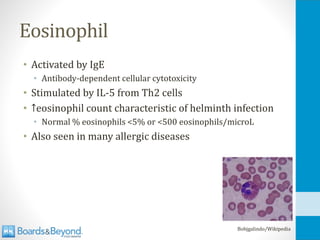
  • 424.