
IMMUNITY
Dr Akshay Shetty
Associate Professor
SSRAMC & H Inchal
Contents
• Objectives
• Definition of Immunity
• Classification of Immunity
• Mechanisms in Immunity
• Summary
• References
13/01/2024 IMMUNITY (Dr Akshay Shetty) 2
Objectives
By the end of the presentation
the students must be able to—
1. Define Immunity
2. Classify Immunity
3. Explain mechanism of
Immunity
13/01/2024 IMMUNITY (Dr Akshay Shetty) 3
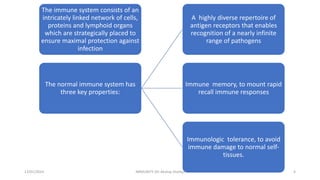
The immune system consists of an
intricately linked network of cells,
proteins and lymphoid organs
which are strategically placed to
ensure maximal protection against
infection
The normal immune system has
three key properties:
A highly diverse repertoire of
antigen receptors that enables
recognition of a nearly infinite
range of pathogens
Immune memory, to mount rapid
recall immune responses
Immunologic tolerance, to avoid
immune damage to normal self-
tissues.
13/01/2024 IMMUNITY (Dr Akshay Shetty) 4
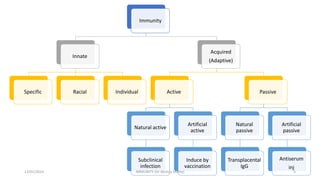
Immunity
Innate
Specific Racial Individual
Acquired
(Adaptive)
Active
Natural active
Subclinical
infection
Artificial
active
Induce by
vaccination
Passive
Natural
passive
Transplacental
IgG
Artificial
passive
Antiserum
inj
13/01/2024 IMMUNITY (Dr Akshay Shetty) 5
From invertebrates, humans have inherited the
innate immune system, an ancient defence system
that uses germ line–encoded proteins to recognize
pathogens.
Cells of the innate immune system, such as
macrophages, dendritic cells, and natural killer (NK)
lymphocytes, recognize pathogen-associated
molecular patterns (PAMPs) that are highly
conserved among many microbes and use a diverse
set of pattern recognition receptor molecules (PRRs)
13/01/2024 IMMUNITY (Dr Akshay Shetty) 6
Important components of the
recognition of microbes by the
innate immune system include
• Recognition by germ line–encoded
host molecules
• Recognition of key microbe virulence
factors but not recognition of self-
molecules,
• Nonrecognition of benign foreign
molecules or microbes.
13/01/2024 IMMUNITY (Dr Akshay Shetty) 7
Adaptive immunity is found only in vertebrates and
is based on the generation of antigen receptors on T
and B lymphocytes by gene rearrangements, such
that individual T or B cells express unique antigen
receptors on their surface capable of specifically
recognizing diverse antigens of the myriad infectious
agents in the environment.
Coupled with finely tuned specific recognition
mechanisms that maintain tolerance (nonreactivity)
to self-antigens, T and B lymphocytes bring both
specificity and immune memory to vertebrate host
defences
13/01/2024 IMMUNITY (Dr Akshay Shetty) 8
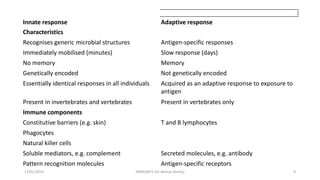
Innate response Adaptive response
Characteristics
Recognises generic microbial structures Antigen-specific responses
Immediately mobilised (minutes) Slow response (days)
No memory Memory
Genetically encoded Not genetically encoded
Essentially identical responses in all individuals Acquired as an adaptive response to exposure to
antigen
Present in invertebrates and vertebrates Present in vertebrates only
Immune components
Constitutive barriers (e.g. skin) T and B lymphocytes
Phagocytes
Natural killer cells
Soluble mediators, e.g. complement Secreted molecules, e.g. antibody
Pattern recognition molecules Antigen-specific receptors
13/01/2024 IMMUNITY (Dr Akshay Shetty) 9
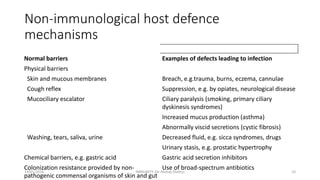
Non-immunological host defence
mechanisms
Normal barriers Examples of defects leading to infection
Physical barriers
Skin and mucous membranes Breach, e.g.trauma, burns, eczema, cannulae
Cough reflex Suppression, e.g. by opiates, neurological disease
Mucociliary escalator Ciliary paralysis (smoking, primary ciliary
dyskinesis syndromes)
Increased mucus production (asthma)
Abnormally viscid secretions (cystic fibrosis)
Washing, tears, saliva, urine Decreased fluid, e.g. sicca syndromes, drugs
Urinary stasis, e.g. prostatic hypertrophy
Chemical barriers, e.g. gastric acid Gastric acid secretion inhibitors
Colonization resistance provided by non-
pathogenic commensal organisms of skin and gut
Use of broad-spectrum antibiotics
13/01/2024 IMMUNITY (Dr Akshay Shetty) 10
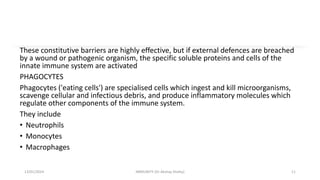
These constitutive barriers are highly effective, but if external defences are breached
by a wound or pathogenic organism, the specific soluble proteins and cells of the
innate immune system are activated
PHAGOCYTES
Phagocytes ('eating cells') are specialised cells which ingest and kill microorganisms,
scavenge cellular and infectious debris, and produce inflammatory molecules which
regulate other components of the immune system.
They include
• Neutrophils
• Monocytes
• Macrophages
13/01/2024 IMMUNITY (Dr Akshay Shetty) 11
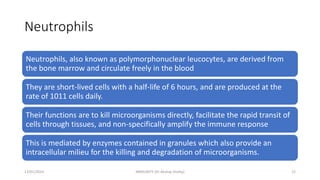
Neutrophils
Neutrophils, also known as polymorphonuclear leucocytes, are derived from
the bone marrow and circulate freely in the blood
They are short-lived cells with a half-life of 6 hours, and are produced at the
rate of 1011 cells daily.
Their functions are to kill microorganisms directly, facilitate the rapid transit of
cells through tissues, and non-specifically amplify the immune response
This is mediated by enzymes contained in granules which also provide an
intracellular milieu for the killing and degradation of microorganisms.
13/01/2024 IMMUNITY (Dr Akshay Shetty) 12
Monocytes and Macrophages
Monocytes are the precursors of tissue macrophages. They are produced in
the bone marrow and exported to the circulation, where they constitute about
5% of leucocytes.
After 7-10 hours in the blood stream, they migrate to peripheral tissues where
they differentiate into tissue macrophages and reside for long periods.
Specialised populations of tissue macrophages include Küpffer cells in the liver,
alveolar macrophages in the lung, mesangial cells in the kidney, and microglial
cells in the brain.
13/01/2024 IMMUNITY (Dr Akshay Shetty) 13
Cont..
Macrophages, like neutrophils, are capable of phagocytosis and
killing of microorganisms but also play an important role in the
amplification and regulation of the inflammatory response .
Unlike neutrophils, macrophages do not die after killing
pathogens
13/01/2024 IMMUNITY (Dr Akshay Shetty) 14
MAST CELLS AND BASOPHILS
Mast cells and basophils are bone marrow-derived cells which play a central role in
allergic disorders.
Mast cells reside predominantly in tissues exposed to the external environment, such as
the skin and gut, while basophils are located in the circulation and are recruited into
tissues in response to inflammation.
Both contain large cytoplasmic granules which enclose preformed vasoactive
substances such as histamine .
Additional mediators are synthesised de novo after activation, including leukotrienes,
prostaglandins and cytokines.
Local release of these mediators initiates an inflammatory cascade which increases local
blood flow and vascular permeability, stimulates smooth muscle contraction, and
increases secretion at mucosal surfaces.
13/01/2024 IMMUNITY (Dr Akshay Shetty) 15
NATURAL KILLER CELLS
Natural killer (NK) cells are large granular lymphocytes which play a major role in
defence against tumours and virally infected cells.
They express features of both the adaptive and innate immune systems: they are
morphologically similar to lymphocytes and recognise similar ligands, but they are
not antigen-specific and cannot generate immunological memory
Activated NK cells can kill their targets in various ways: pore-forming proteins such
as perforin induce direct cell lysis, while proteolytic enzymes known as granzymes
stimulate apoptosis.
In addition, NK cells produce a variety of cytokines such as TNF-α, IL-1, IFN-α and
IFN-γ which have direct antiviral and antitumour effects.
13/01/2024 IMMUNITY (Dr Akshay Shetty) 16
THE ADAPTIVE IMMUNE SYSTEM
If the innate immune system fails to provide effective protection against an invading
pathogen, the adaptive immune system is mobilised.
This possesses three key characteristics:
It has exquisite specificity and is able to discriminate between very small
differences in molecular structure
It is highly adaptive and can respond to an unlimited number of molecules
It possesses immunological memory, being able to recall previous encounter with
an antigen and respond more effectively than on the first occasion.
13/01/2024 IMMUNITY (Dr Akshay Shetty) 17
HUMORAL IMMUNITY
B lymphocytes
• These specialised cells arise from haemopoietic bone marrow
stem cells, and their major function is to produce antibody.
• Mature B lymphocytes can be found in the bone marrow,
lymphoid tissue, spleen, and to a lesser extent the blood
stream.
• They express a unique immunoglobulin receptor on their cell
surface (the B-cell receptor), which binds to soluble antigen
13/01/2024 IMMUNITY (Dr Akshay Shetty) 18
Cont..
Immunoglobulins
•Immunoglobulins (Ig) molecules are soluble proteins
made up of two heavy and two light chains .
•The heavy chain determines the antibody class or
isotype, i.e. IgG, IgA, IgM, IgE, IgD. Subclasses of IgG
and IgA also occur.
13/01/2024 IMMUNITY (Dr Akshay Shetty) 19
CELLULAR IMMUNITY
T lymphocytes mediate cellular immunity, and are particularly
important for defence against viruses, fungi and intracellular bacteria.
They also play an important immunoregulatory role, orchestrating and
regulating the responses of other cells of the immune system.
T lymphocyte precursors arise in bone marrow and are exported as
immature cells to the thymus.
13/01/2024 IMMUNITY (Dr Akshay Shetty) 20
Cont..
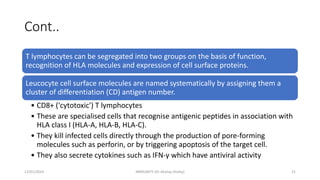
T lymphocytes can be segregated into two groups on the basis of function,
recognition of HLA molecules and expression of cell surface proteins.
Leucocyte cell surface molecules are named systematically by assigning them a
cluster of differentiation (CD) antigen number.
• CD8+ ('cytotoxic') T lymphocytes
• These are specialised cells that recognise antigenic peptides in association with
HLA class I (HLA-A, HLA-B, HLA-C).
• They kill infected cells directly through the production of pore-forming
molecules such as perforin, or by triggering apoptosis of the target cell.
• They also secrete cytokines such as IFN-γ which have antiviral activity
13/01/2024 IMMUNITY (Dr Akshay Shetty) 21
Cont..
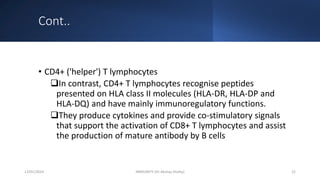
• CD4+ ('helper') T lymphocytes
In contrast, CD4+ T lymphocytes recognise peptides
presented on HLA class II molecules (HLA-DR, HLA-DP and
HLA-DQ) and have mainly immunoregulatory functions.
They produce cytokines and provide co-stimulatory signals
that support the activation of CD8+ T lymphocytes and assist
the production of mature antibody by B cells
13/01/2024 IMMUNITY (Dr Akshay Shetty) 22
Summary
1.Define
Immunity
01
Classify
Immunity
02
1.Explain
mechanism of
Immunity
03
13/01/2024 IMMUNITY (Dr Akshay Shetty) 23
References
Harrison's Internal Medicine ,Chapter
308, Introduction to the Immune
System
Davidson’s Principle & Practice of
medicine ,20th edition
Kumar & Clark: Clinical Medicine
13/01/2024 IMMUNITY (Dr Akshay Shetty) 24
THANK YOU
13/01/2024 IMMUNITY (Dr Akshay Shetty) 25

Immunity it's Classification .pptx by Dr Akshay Shetty

  • 1.
    IMMUNITY Dr Akshay Shetty AssociateProfessor SSRAMC & H Inchal
  • 2.
    Contents • Objectives • Definitionof Immunity • Classification of Immunity • Mechanisms in Immunity • Summary • References 13/01/2024 IMMUNITY (Dr Akshay Shetty) 2
  • 3.
    Objectives By the endof the presentation the students must be able to— 1. Define Immunity 2. Classify Immunity 3. Explain mechanism of Immunity 13/01/2024 IMMUNITY (Dr Akshay Shetty) 3
  • 4.
    The immune systemconsists of an intricately linked network of cells, proteins and lymphoid organs which are strategically placed to ensure maximal protection against infection The normal immune system has three key properties: A highly diverse repertoire of antigen receptors that enables recognition of a nearly infinite range of pathogens Immune memory, to mount rapid recall immune responses Immunologic tolerance, to avoid immune damage to normal self- tissues. 13/01/2024 IMMUNITY (Dr Akshay Shetty) 4
  • 5.
    Immunity Innate Specific Racial Individual Acquired (Adaptive) Active Naturalactive Subclinical infection Artificial active Induce by vaccination Passive Natural passive Transplacental IgG Artificial passive Antiserum inj 13/01/2024 IMMUNITY (Dr Akshay Shetty) 5
  • 6.
    From invertebrates, humanshave inherited the innate immune system, an ancient defence system that uses germ line–encoded proteins to recognize pathogens. Cells of the innate immune system, such as macrophages, dendritic cells, and natural killer (NK) lymphocytes, recognize pathogen-associated molecular patterns (PAMPs) that are highly conserved among many microbes and use a diverse set of pattern recognition receptor molecules (PRRs) 13/01/2024 IMMUNITY (Dr Akshay Shetty) 6
  • 7.
    Important components ofthe recognition of microbes by the innate immune system include • Recognition by germ line–encoded host molecules • Recognition of key microbe virulence factors but not recognition of self- molecules, • Nonrecognition of benign foreign molecules or microbes. 13/01/2024 IMMUNITY (Dr Akshay Shetty) 7
  • 8.
    Adaptive immunity isfound only in vertebrates and is based on the generation of antigen receptors on T and B lymphocytes by gene rearrangements, such that individual T or B cells express unique antigen receptors on their surface capable of specifically recognizing diverse antigens of the myriad infectious agents in the environment. Coupled with finely tuned specific recognition mechanisms that maintain tolerance (nonreactivity) to self-antigens, T and B lymphocytes bring both specificity and immune memory to vertebrate host defences 13/01/2024 IMMUNITY (Dr Akshay Shetty) 8
  • 9.
    Innate response Adaptiveresponse Characteristics Recognises generic microbial structures Antigen-specific responses Immediately mobilised (minutes) Slow response (days) No memory Memory Genetically encoded Not genetically encoded Essentially identical responses in all individuals Acquired as an adaptive response to exposure to antigen Present in invertebrates and vertebrates Present in vertebrates only Immune components Constitutive barriers (e.g. skin) T and B lymphocytes Phagocytes Natural killer cells Soluble mediators, e.g. complement Secreted molecules, e.g. antibody Pattern recognition molecules Antigen-specific receptors 13/01/2024 IMMUNITY (Dr Akshay Shetty) 9
  • 10.
    Non-immunological host defence mechanisms Normalbarriers Examples of defects leading to infection Physical barriers Skin and mucous membranes Breach, e.g.trauma, burns, eczema, cannulae Cough reflex Suppression, e.g. by opiates, neurological disease Mucociliary escalator Ciliary paralysis (smoking, primary ciliary dyskinesis syndromes) Increased mucus production (asthma) Abnormally viscid secretions (cystic fibrosis) Washing, tears, saliva, urine Decreased fluid, e.g. sicca syndromes, drugs Urinary stasis, e.g. prostatic hypertrophy Chemical barriers, e.g. gastric acid Gastric acid secretion inhibitors Colonization resistance provided by non- pathogenic commensal organisms of skin and gut Use of broad-spectrum antibiotics 13/01/2024 IMMUNITY (Dr Akshay Shetty) 10
  • 11.
    These constitutive barriersare highly effective, but if external defences are breached by a wound or pathogenic organism, the specific soluble proteins and cells of the innate immune system are activated PHAGOCYTES Phagocytes ('eating cells') are specialised cells which ingest and kill microorganisms, scavenge cellular and infectious debris, and produce inflammatory molecules which regulate other components of the immune system. They include • Neutrophils • Monocytes • Macrophages 13/01/2024 IMMUNITY (Dr Akshay Shetty) 11
  • 12.
    Neutrophils Neutrophils, also knownas polymorphonuclear leucocytes, are derived from the bone marrow and circulate freely in the blood They are short-lived cells with a half-life of 6 hours, and are produced at the rate of 1011 cells daily. Their functions are to kill microorganisms directly, facilitate the rapid transit of cells through tissues, and non-specifically amplify the immune response This is mediated by enzymes contained in granules which also provide an intracellular milieu for the killing and degradation of microorganisms. 13/01/2024 IMMUNITY (Dr Akshay Shetty) 12
  • 13.
    Monocytes and Macrophages Monocytesare the precursors of tissue macrophages. They are produced in the bone marrow and exported to the circulation, where they constitute about 5% of leucocytes. After 7-10 hours in the blood stream, they migrate to peripheral tissues where they differentiate into tissue macrophages and reside for long periods. Specialised populations of tissue macrophages include Küpffer cells in the liver, alveolar macrophages in the lung, mesangial cells in the kidney, and microglial cells in the brain. 13/01/2024 IMMUNITY (Dr Akshay Shetty) 13
  • 14.
    Cont.. Macrophages, like neutrophils,are capable of phagocytosis and killing of microorganisms but also play an important role in the amplification and regulation of the inflammatory response . Unlike neutrophils, macrophages do not die after killing pathogens 13/01/2024 IMMUNITY (Dr Akshay Shetty) 14
  • 15.
    MAST CELLS ANDBASOPHILS Mast cells and basophils are bone marrow-derived cells which play a central role in allergic disorders. Mast cells reside predominantly in tissues exposed to the external environment, such as the skin and gut, while basophils are located in the circulation and are recruited into tissues in response to inflammation. Both contain large cytoplasmic granules which enclose preformed vasoactive substances such as histamine . Additional mediators are synthesised de novo after activation, including leukotrienes, prostaglandins and cytokines. Local release of these mediators initiates an inflammatory cascade which increases local blood flow and vascular permeability, stimulates smooth muscle contraction, and increases secretion at mucosal surfaces. 13/01/2024 IMMUNITY (Dr Akshay Shetty) 15
  • 16.
    NATURAL KILLER CELLS Naturalkiller (NK) cells are large granular lymphocytes which play a major role in defence against tumours and virally infected cells. They express features of both the adaptive and innate immune systems: they are morphologically similar to lymphocytes and recognise similar ligands, but they are not antigen-specific and cannot generate immunological memory Activated NK cells can kill their targets in various ways: pore-forming proteins such as perforin induce direct cell lysis, while proteolytic enzymes known as granzymes stimulate apoptosis. In addition, NK cells produce a variety of cytokines such as TNF-α, IL-1, IFN-α and IFN-γ which have direct antiviral and antitumour effects. 13/01/2024 IMMUNITY (Dr Akshay Shetty) 16
  • 17.
    THE ADAPTIVE IMMUNESYSTEM If the innate immune system fails to provide effective protection against an invading pathogen, the adaptive immune system is mobilised. This possesses three key characteristics: It has exquisite specificity and is able to discriminate between very small differences in molecular structure It is highly adaptive and can respond to an unlimited number of molecules It possesses immunological memory, being able to recall previous encounter with an antigen and respond more effectively than on the first occasion. 13/01/2024 IMMUNITY (Dr Akshay Shetty) 17
  • 18.
    HUMORAL IMMUNITY B lymphocytes •These specialised cells arise from haemopoietic bone marrow stem cells, and their major function is to produce antibody. • Mature B lymphocytes can be found in the bone marrow, lymphoid tissue, spleen, and to a lesser extent the blood stream. • They express a unique immunoglobulin receptor on their cell surface (the B-cell receptor), which binds to soluble antigen 13/01/2024 IMMUNITY (Dr Akshay Shetty) 18
  • 19.
    Cont.. Immunoglobulins •Immunoglobulins (Ig) moleculesare soluble proteins made up of two heavy and two light chains . •The heavy chain determines the antibody class or isotype, i.e. IgG, IgA, IgM, IgE, IgD. Subclasses of IgG and IgA also occur. 13/01/2024 IMMUNITY (Dr Akshay Shetty) 19
  • 20.
    CELLULAR IMMUNITY T lymphocytesmediate cellular immunity, and are particularly important for defence against viruses, fungi and intracellular bacteria. They also play an important immunoregulatory role, orchestrating and regulating the responses of other cells of the immune system. T lymphocyte precursors arise in bone marrow and are exported as immature cells to the thymus. 13/01/2024 IMMUNITY (Dr Akshay Shetty) 20
  • 21.
    Cont.. T lymphocytes canbe segregated into two groups on the basis of function, recognition of HLA molecules and expression of cell surface proteins. Leucocyte cell surface molecules are named systematically by assigning them a cluster of differentiation (CD) antigen number. • CD8+ ('cytotoxic') T lymphocytes • These are specialised cells that recognise antigenic peptides in association with HLA class I (HLA-A, HLA-B, HLA-C). • They kill infected cells directly through the production of pore-forming molecules such as perforin, or by triggering apoptosis of the target cell. • They also secrete cytokines such as IFN-γ which have antiviral activity 13/01/2024 IMMUNITY (Dr Akshay Shetty) 21
  • 22.
    Cont.. • CD4+ ('helper')T lymphocytes In contrast, CD4+ T lymphocytes recognise peptides presented on HLA class II molecules (HLA-DR, HLA-DP and HLA-DQ) and have mainly immunoregulatory functions. They produce cytokines and provide co-stimulatory signals that support the activation of CD8+ T lymphocytes and assist the production of mature antibody by B cells 13/01/2024 IMMUNITY (Dr Akshay Shetty) 22
  • 23.
  • 24.
    References Harrison's Internal Medicine,Chapter 308, Introduction to the Immune System Davidson’s Principle & Practice of medicine ,20th edition Kumar & Clark: Clinical Medicine 13/01/2024 IMMUNITY (Dr Akshay Shetty) 24
  • 25.
    THANK YOU 13/01/2024 IMMUNITY(Dr Akshay Shetty) 25